(June–July 1855)
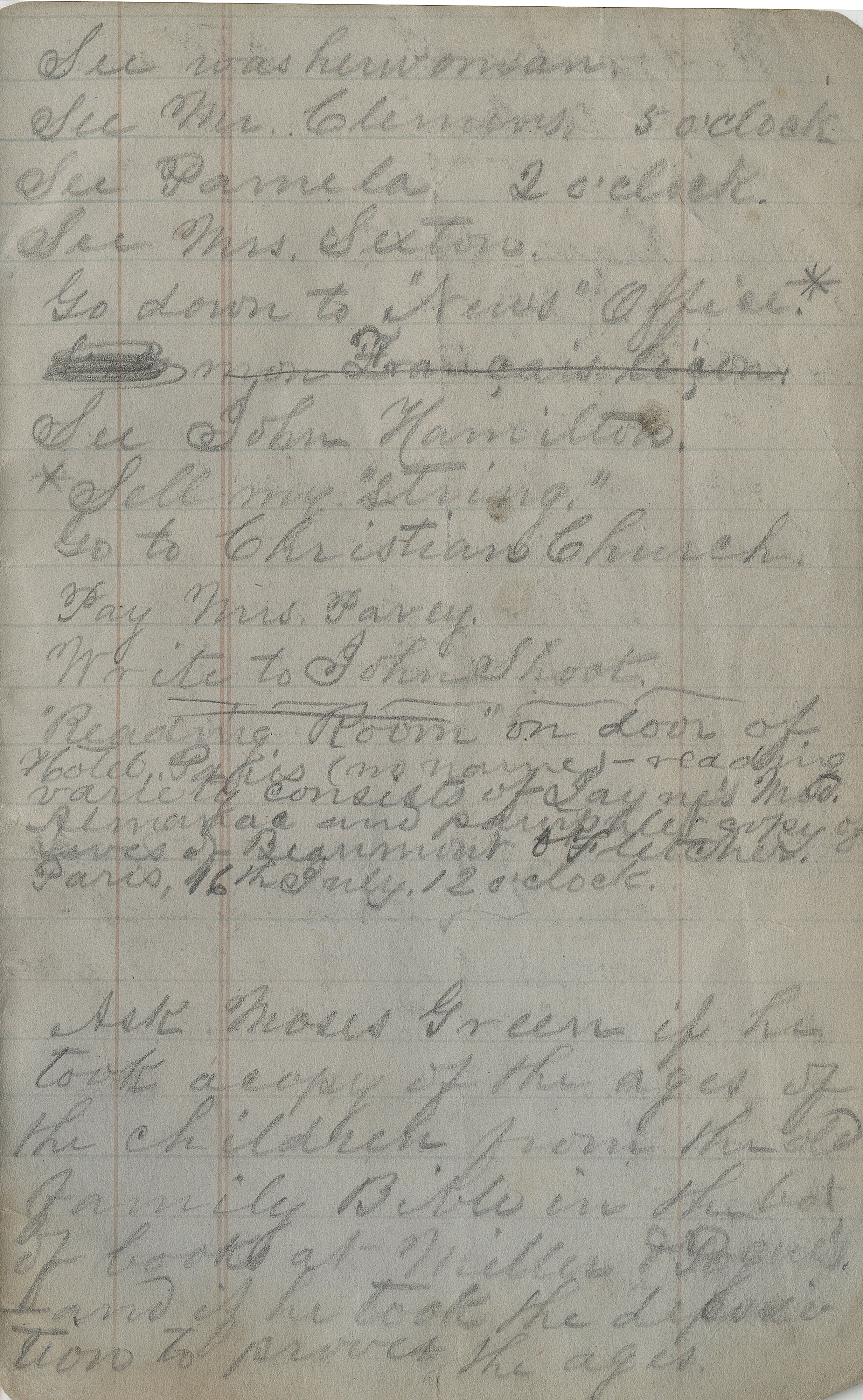
Samuel Clemens' forty-nine surviving notebooks had their genesis in a small account ledger which originally was intended to serve as a French lesson copybook. This first notebook presents evidence that the nineteen-year-old printer was learning chess as well as French, reading a book on phrenology, examining a theological controversy, and assisting in his family's business affairs. Although intrigued by feminine traits, he was surprisingly reticent about romantic emotions, observing and describing a young lady's personal characteristics with the same detachment with which he made out a laundry list. The impartial manner in which Clemens juxtaposed the ephemeral and trivial with matters of larger significance provides an index to his multiple interests, influences, and experiences in the summer of 1855. Entries in this notebook appear to have been made first in Saint Louis, then in Keokuk, Iowa, and afterwards during an excursion to three villages in Marion and Monroe counties, Missouri—Hannibal, Florida, and Paris.
Saint Louis in 1855 provided ample excitement and diversions even for a young man who had just returned from a Wanderjahr in New York City, Philadelphia, and Washington, D.C. Its population was nearly 125,000, and it was growing rapidly, although it still had characteristics of a frontier trading post. At midcentury Saint Louis was the thriving commercial center for all trade in the Upper Mississippi region, a point of exchange for raw material from the West and finished products from the East, for lumber and furs from the northern territories, and for hordes of emigrants coming up the river from New Orleans.
The site of major activity and the source of the city's prosperity and importance was the Mississippi levee. Nearly 3,500 steamboat arrivals were recorded at the Saint Louis wharves during the navigable season in 1855. There is evidence in this notebook and in a surviving letter of the period that even as early as 1855 Sam Clemens was trying without success to enter the respected profession of the riverboat pilot. In the spring of that year he appealed to a distant relative in Saint Louis, James Clemens, Jr., for an introduction to one of the veteran pilots with whom the businessman was acquainted, but the elder Clemens discouraged him from pursuing this ambition.
Another, more sympathetic relative residing in Saint Louis was William A. Moffett, who had married Pamela Clemens in 1851. Mark Twain would recall him many years later in an Autobiographical Dictation (29 March 1906) as “a fine man in every way.” Moffett was prospering as a commission merchant and in 1853 had served on the Committee of Arbitration for the Saint Louis Chamber of Commerce. It was he who would advance Sam Clemens the down payment of $100 to begin his training as a pilot in 1857.
For the time being, however, Clemens was compelled to support himself by working as a printer, as he had during his recent travels. Opportunities in that trade were numerous in Saint Louis: 858 printers were employed by twenty-one newspapers and twelve magazines in the city, and additional jobs were available in eight book and job printing offices. There is an indication in this notebook that Sam Clemens hoped to find employment on the Daily Evening News, a Whig paper founded in 1852.
Some idea of the way Clemens felt about the city itself may be gathered from a letter which he would send to the San Francisco Alta California when he revisited Saint Louis in 1867. “I found it ... the same happy, cheerful, contented old town—a town where the people are kind and polite, even to strangers—where you can go into a business house you never saw before and speak to a man you never heard of before, and get a perfectly civil answer” ( MTTB , pp. 133, 141).
But his feelings toward Saint Louis were ambivalent. In 1868 he commented somewhat cryptically to Mrs. Fairbanks that “there is something in my deep hatred of St. Louis that will hardly let me appear cheery even at my mother's own fireside. Nobody knows what a ghastly infliction it is on me to visit St. Louis. I am afraid I do not always disguise it, either” ( MTMF , p. 38). His earlier enthusiasm had ignored the civil disorders which resulted from antagonism between adherents of the Know-Nothing party and the German and Irish populations. Clemens may have witnessed the worst episode, the “election riots” of August 1854, when belligerent mobs invaded the Irish section of town, looting homes and exchanging occasional gunfire with residents who tried to block their way. Mark Twain mentions these riots in chapter 51 of Life on the Mississippi, where he recalls his decision to desert from a hastily formed militia of young men mustered to control the rampaging mobs.
Which of the Saint Louis disorders in the mid-fifties Clemens witnessed cannot be determined now because the meager evidence blurs his dates of residence in that city. It is known that he lived there in the summer of 1853, when he first left Hannibal on his way to see the Crystal Palace Exhibition in New York City. But statements regarding his return from this eastern excursion are speculative. Albert Bigelow Paine believed that Clemens returned “late in the summer of 1854” and then visited his family in Muscatine, Iowa, before returning to work on the Saint Louis Evening News ( MTB , pp. 102, 103). A later historian, Fred W. Lorch (“Mark Twain in Iowa,” Iowa Journal of History and Politics 27 July 1929: 414–417), was unable to find anything conclusive about Clemens' movements except a few indications that Clemens stayed in Muscatine longer than Paine suggests, perhaps for several months, before leaving that town for Saint Louis.
In any event, it is clear that he was again a resident of Saint Louis by 16 February 1855, when he wrote the first of two letters from there that were published in his brother Orion's Muscatine Journal. His second letter, written on 5 March 1855, reveals Clemens' acute interest in affairs along the river levee, and both letters document his regular attendance at lectures and theatrical productions. Moreover, the 24 February 1855 issue of the Saint Louis Missouri Republican includes Clemens in a list of persons having letters held for them at the Saint Louis Post Office.
Entries in the notebook show that during the month of July 1855 Clemens visited at least three towns in Missouri on business for his family. He began his errands with a visit to Erasmus Moffett, William Moffett's brother, and Erasmus' wife, Sarah, in Hannibal. From Hannibal Clemens went to Florida and Paris, probably traveling part of the way on the plank road whose construction his uncle John A. Quarles had championed. Clemens may have worked for awhile in Saint Louis after he returned from this trip, but it is more likely that he went directly to Keokuk, 214 miles up the river, to join his younger brother Henry as a typesetter in Orion's never prosperous Ben Franklin Book and Job Office.
The town of Keokuk was in the midst of a boom during 1855 and 1856. Contemporary handbooks for the encouragement of Iowa immigration emphasized the geographic advantages of Keokuk: it merited its title, “The Gate City,” because it was situated at the foot of the eleven-mile-long “Lower Rapids” on the Mississippi, which made it a transfer point for steamboat traffic during a great part of the year; it lay near the mouth of the Des Moines River, which carried trade into the fertile Des Moines Valley; moreover, at least three railroads were constructing lines toward the town. Clemens would mention the arrival of the first railroad locomotive in Keokuk in a letter to Henry Clemens on 5 August 1856. Ironically, it was these railroads that later nullified the advantages of Keokuk's location on the river. A canal that circumvented the river rapids, described by Mark Twain in chapter 57 of Life on the Mississippi as “a mighty work which was in progress there in my day,” also led to its subsequent decline. But in 1855 and 1856 Keokuk could fairly claim advantages over most other cities along the Mississippi.
Because of its flourishing commerce, Keokuk's civic improvements were greater than might be expected in a western city incorporated as recently as 1847. Its Main Street was macadamized, the city had been connected to trunk telegraph wires for several years, and on 4 January 1856 it would be illuminated by gas street lamps. In 1857 Orion Clemens reported in his Directory and Business Mirror that there were three daily papers and three weeklies. Orion owned the only book and job printing shop in the town, but at least three of the newspapers also competed for this trade.
As in Saint Louis, the Know-Nothings swept into public office in the years of Clemens' residence in Keokuk, demonstrating the growing “Native American” sentiments among inhabitants of a town that had expanded from 620 persons in 1847 to more than 6,000 in 1855. By 1856 the population had soared to 11,000, and a year later, in 1857, it had reached 15,000. There was also another, even more heated national controversy which was engaging Keokuk citizens: the border location of Lee County, Iowa, insured vigorous, continuing debate on slavery and the actions of abolitionists in the years preceding the Civil War.
The scantiness of surviving data makes it difficult to determine how deeply “Native American” and slavery issues affected Clemens at the time. It is a matter of record, however, that he later expressed adult disdain for the views he held as a youth. On 1 November 1876 he wrote a slashing self-criticism to J. H. Burrough, with whom he had roomed in a Saint Louis boarding house:
I can picture myself as I was, 22 years ago.... You think I have grown some; upon my word there was room for it. You have described a callow fool, a self-sufficient ass, a mere human tumble-bug, stern in air, heaving at his bit of dung & imagining he is re-modeling the world & is entirely capable of doing it right. Ignorance, intolerance, egotism, self-assertion, opaque perception, dense & pitiful chuckle-headedness—& an almost pathetic unconsciousness of it all. That is what I was at 19–20. (Kent Library, Southeast Missouri State College, Cape Girardeau)
The present location of Notebook 1 is not now known; consequently, the text has been taken from photostats of the original supplied to the Mark Twain Papers in 1954 by Mrs. Samuel Charles Webster, when the notebook was in her possession. Her husband published extracts from the notebook in chapter 3 of Mark Twain, Business Man in 1946.
The photocopy shows 36 pages, 4 of them blank. Pairs of facing blank pages were evidently not photographed. The photostats of the pages measure 5 15/16 by 3 11/16 inches (15.1 by 9.4 centimeters). The pages are ruled with twenty-one horizontal lines and have a wide top margin that appears, except in a sequence of four pages, at the bottom of Clemens' page. The pages are divided by vertical lines into four unequal columns in account ledger fashion. The photographed cover appears to be paper and to be only loosely attached to the pages.
Variations in Clemens' writing materials cannot be determined from the photocopy. His handwriting in this notebook, while beginning to show the characteristics of his mature hand, is small, neat, and in accord with the conventional penmanship of the period.
Since the pages were not numbered when the photocopy was made, their sequence has been established from content and such physical evidence as tears along the spine and bent corners. The interruption of the phrenology passages and their erratic sequence, the inversion of the notebook to inscribe four pages, and the cramped appearance of some entries may indicate that Clemens wrote part of the notebook in an order other than that which appears here. However, in the absence of firm evidence, the physical sequence established from the photocopy has been followed throughout, except that Clemens' running titles for his French lessons (such as “Leçon 11”) have been removed where he did not use the pages on which they appear for his language studies. Omitted headings are recorded as emendations.
In addition to the local newspapers of the period and the city and business directories for Saint Louis and Keokuk from 1853 until 1859, the following sources provided historical and genealogical descriptions relevant to Notebook 1:
History of Lee County, Iowa. Chicago: Western Historical Co., 1879.
Hyde, William and Conard, Howard L., eds. Encyclopedia of the History of St. Louis. 6 vols. New York: Southern History Co., 1917–1918.
Lorch, Fred W. “Mark Twain in Iowa,” Iowa Journal of History and Politics 27 (July 1929): 408–456.
Saint Louis: The Missouri Historical Society. Mary C. Clemens Collection. Contains biographical information about James Clemens, Jr., of Saint Louis.
Scharf, John Thomas. History of Saint Louis City and County. 2 vols. Philadelphia: Louis H. Everts & Co., 1883.
Varble, Rachel M. Jane Clemens: The Story of Mark Twain's Mother. Garden City, New York: Doubleday & Co., 1964.
Webster, Samuel C., ed. Mark Twain, Business Man. Boston: Little, Brown, and Company, 1946.
Three individuals were especially helpful in assisting with research on Notebook 1. Ralph Gregory, curator of the Mark Twain Birthplace Memorial Shrine at Florida, Missouri, supplied valuable facts about Clemens' 1855 visit to that region; Mrs. Goldena Howard of the Reference Library and Mrs. Alma Vaughan of the Newspaper Library in the State Historical Society of Missouri, Columbia, rendered repeated services in locating important information.
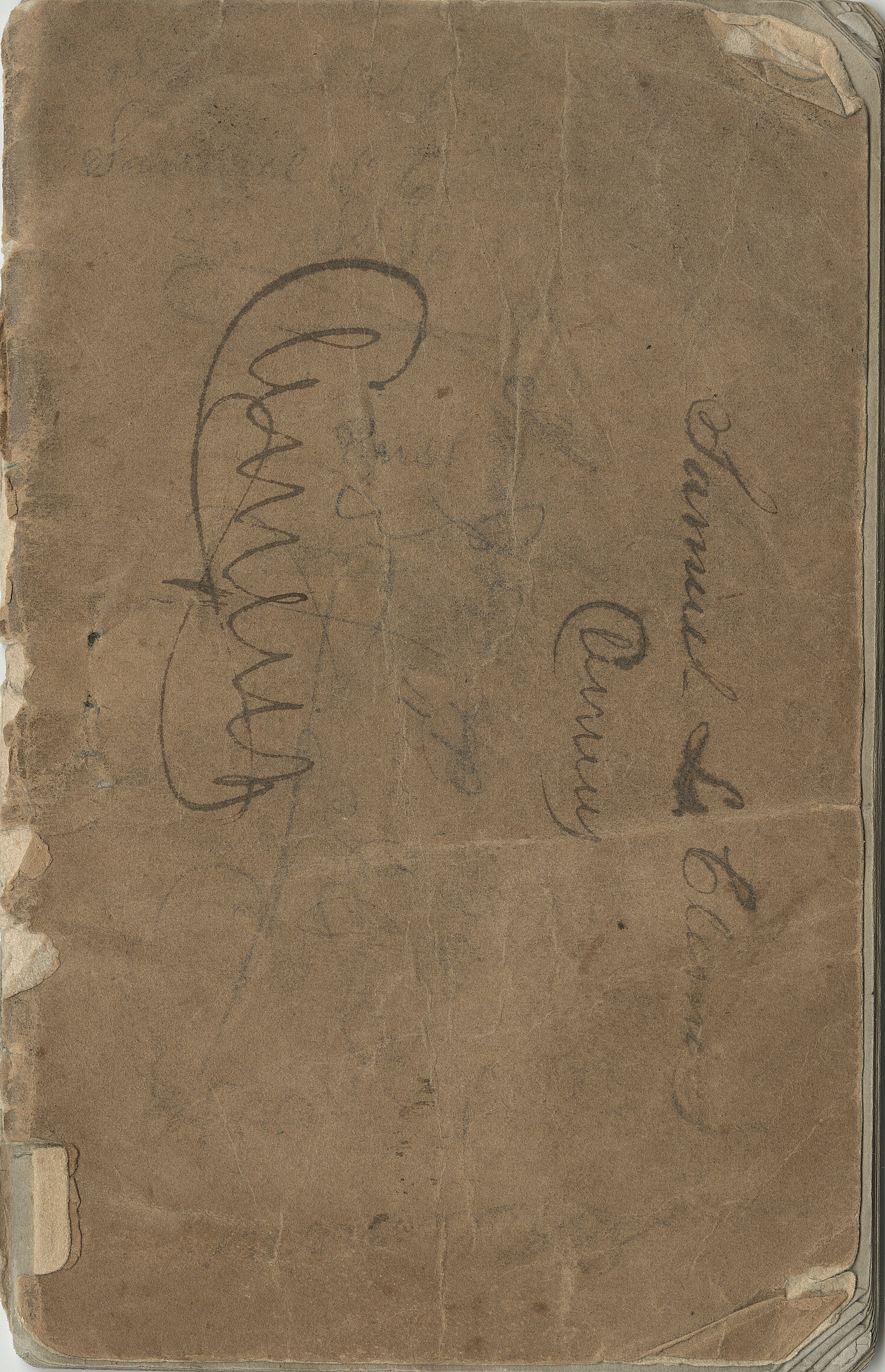
[MS: N01_front cover]
[MTP: N&J1_17]
Samuel L. Clemens1
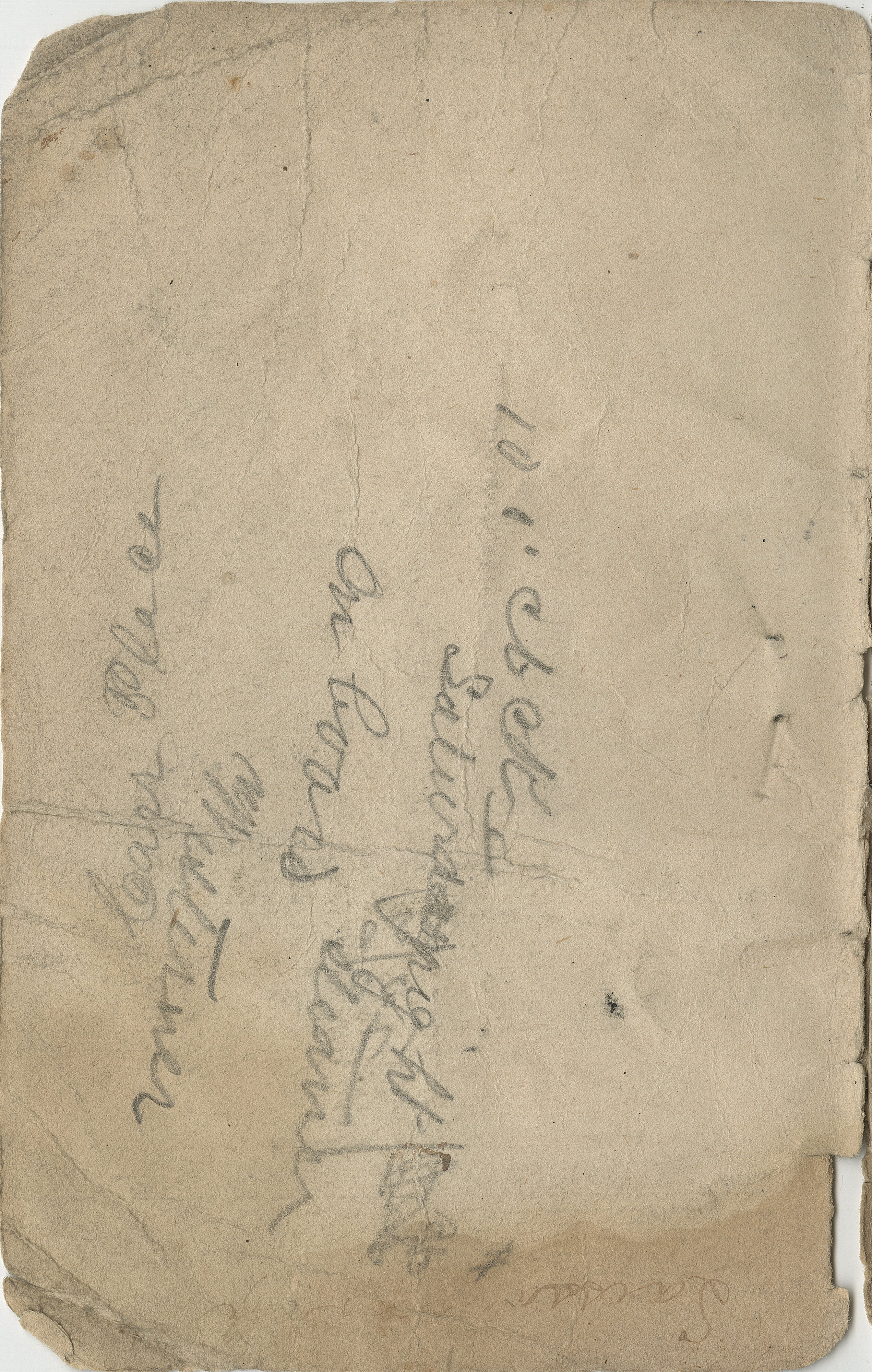
[MS: N01_front endpaper]
10 o'clock
Saturday nightⓉtextual note
on board steamer
Westerner2
written upside down: Carr Place3
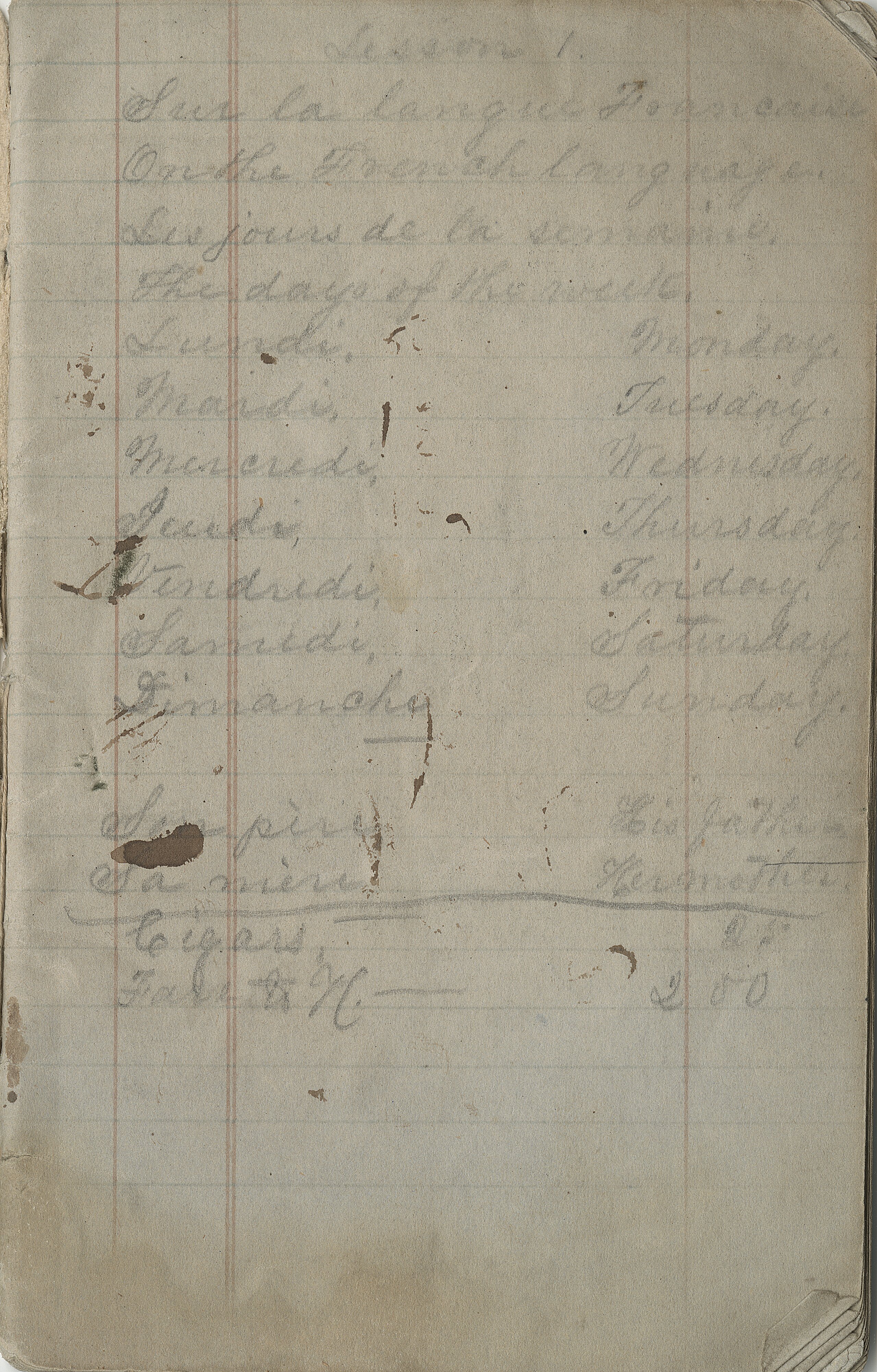
[MS: N01_leaf_001r]
Sur la langue Francaise
On the French language.
Les jours de la semaine.
[MTP: N&J1_18]
| The days of the week. | ||
| Lundi, | Monday. | |
| Mardi, | Tuesday. | |
| Mercredi, | Wednesday. | |
| Jeudi, | Thursday. | |
| Vendredi, | Friday. | |
| Samedi, | Saturday. | |
| Dimanche | Sunday. |
| Son père | His father. | |
| Sa mère | Her mother. |
| Cigars | . . . . . . . . . . . . . . . . . . . . . . . . . . . . | .25 |
| Fare to H. | . . . . . . . . . . . . . . . . . . . . . . . . | 2.00Ⓣtextual note 4 |
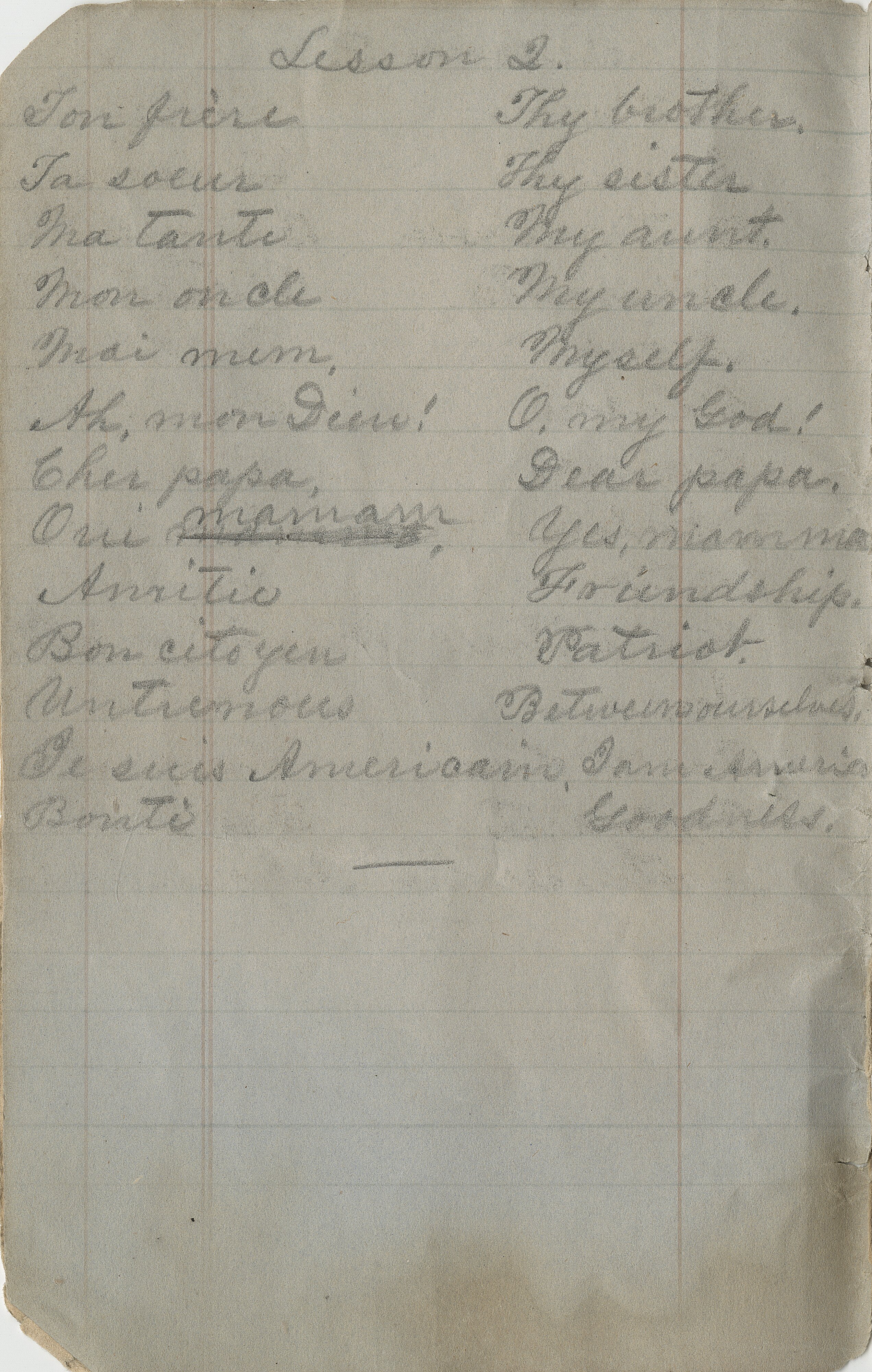
[MS: N01_leaf_001v]
| Ton frère | Thy brother. | |
| Ta soeur | Thy sister | |
| Ma tante | My aunt. | |
| Mon oncle | My uncle. | |
| Moi mem, | Myself. | |
| Ah, mon Dieu! | O, my God! | |
| Cher papa, | Dear papa. | |
| Oui mamma mamam , | Yes, mamma | |
| Amitie | Friendship | |
| Bon citoyen | Patriot. | |
| Untre nous | Between ourselves. | |
| Je suis Americain, | I am American Ⓜemendation | |
| Bontè | Goodness. |
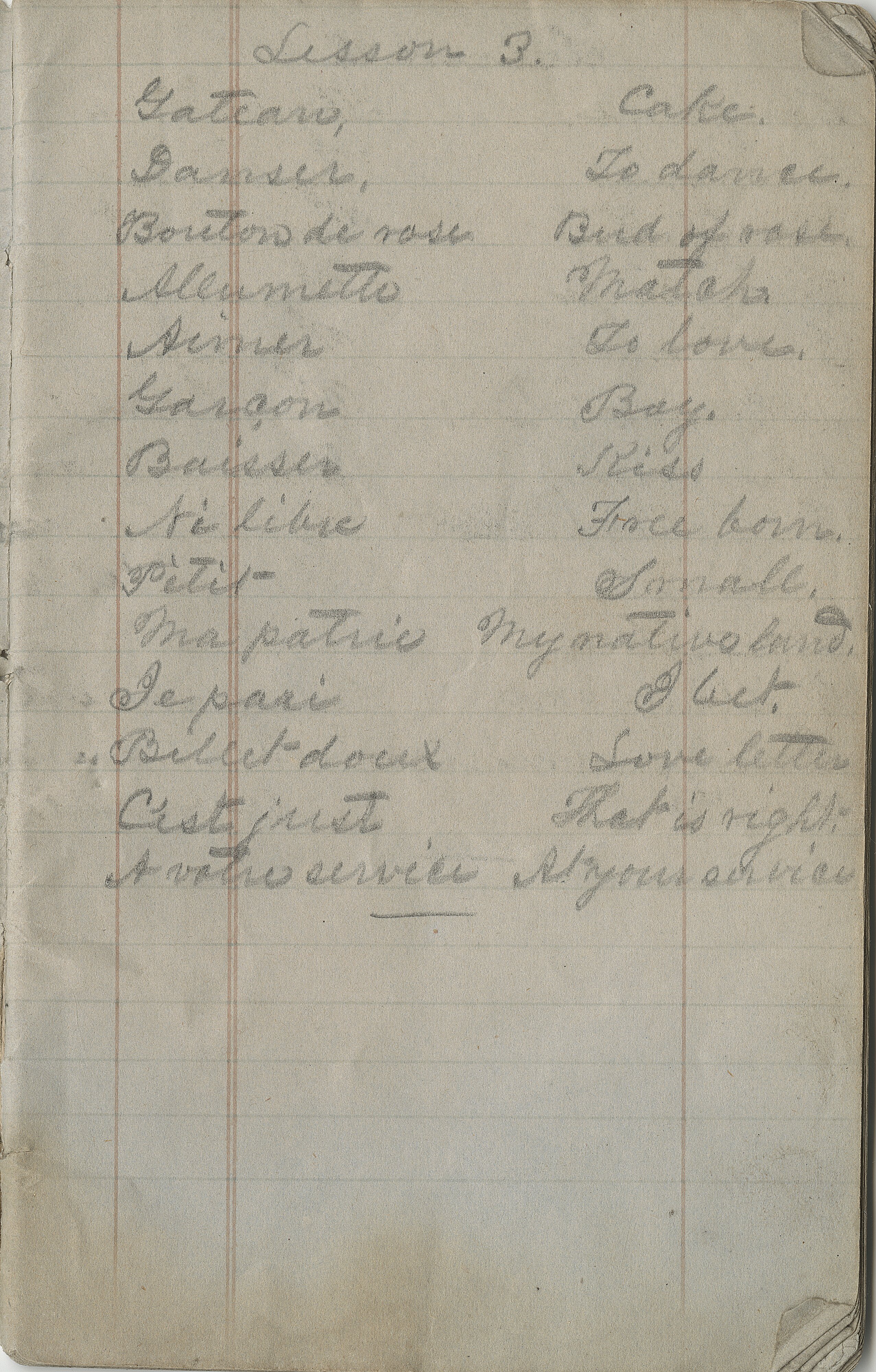
[MS: N01_leaf_002r]
| Gateau, | Cake. | |
| Danser, | To dance. | |
| Bouton de rose | Bud of rose. | |
| Allumette | Match. | |
| Aimer | To love. | |
| Garçon | Boy. | |
| Baisser | Kiss | |
| Nè libre | Free born. | |
| Pètit | Small. | |
| Ma patrie | My native land. | |
| Je pari | I bet. | |
| Billet doux | Love letter | |
| C'est just | That is right. | |
| A votre service | At your service |
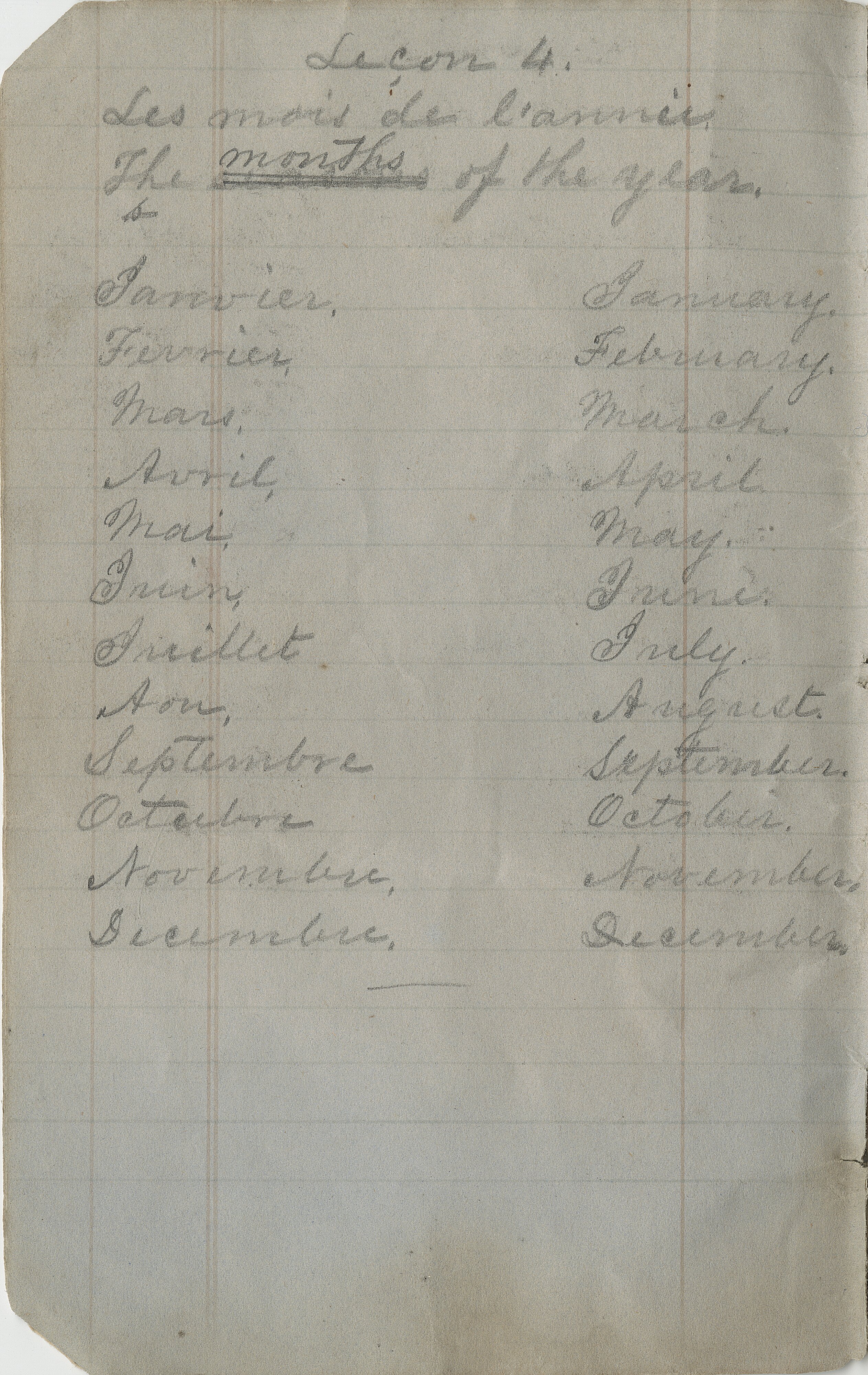
[MS: N01_leaf_002v]
| Les mois de l'annèe. | ||
| The seasons months of the year. | ||
| Janvier, | January. | |
| Fevrier, | February. | |
| Mars, | March. | |
| Avril, | April. | |
| Mai, | May. | |
| Juin, | June. | |
| Juillet | July. | |
| Aou, | August. | |
| Septembre | September. | |
| Octubre | October. | |
| Novembre, | November. | |
| Decembre, | December. |
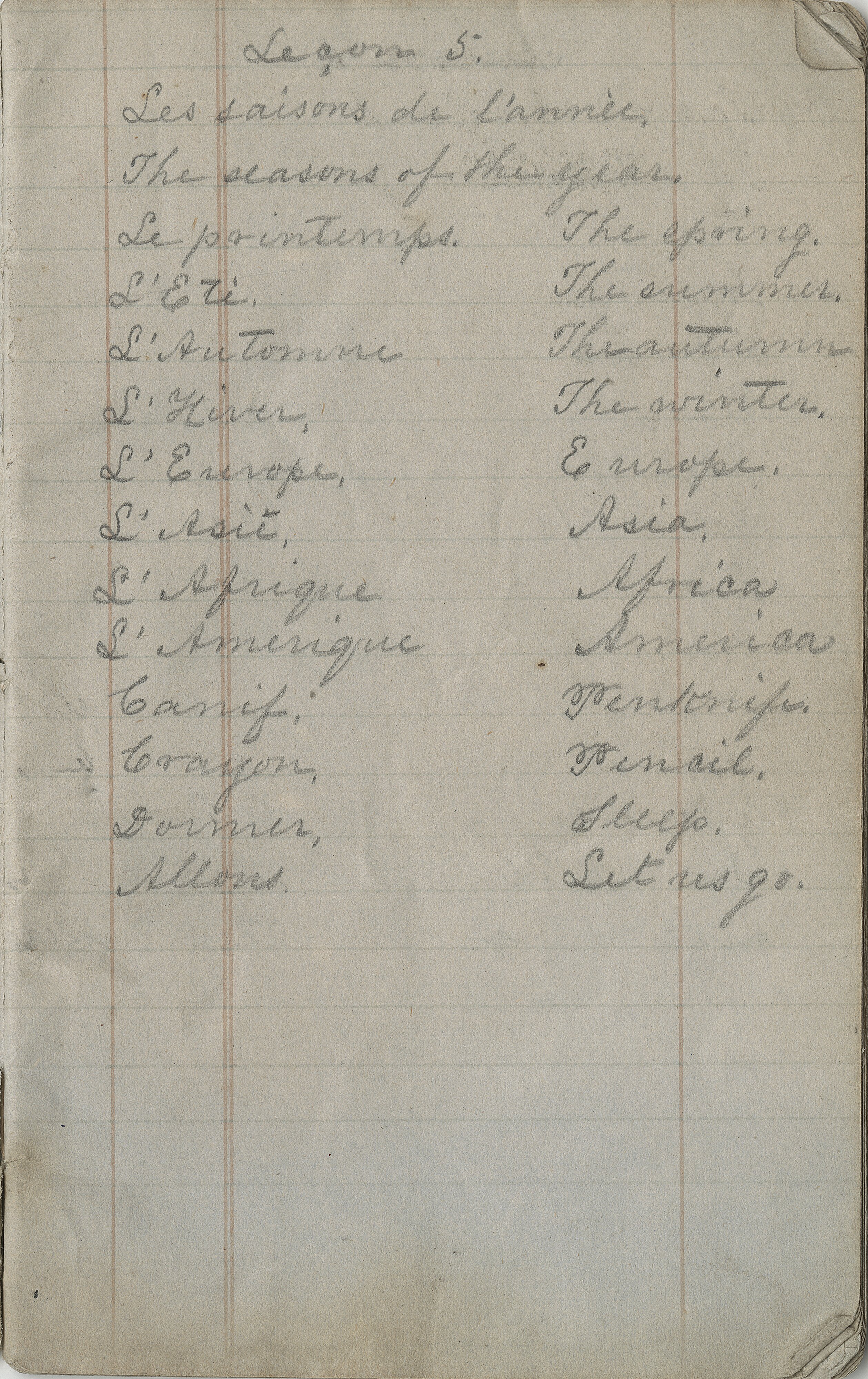
[MS: N01_leaf_003r]
| Les saisons de l'annèe. | ||
| The seasons of the year. | ||
| Le printemps. | The spring. | |
| L'Etè, | The summer. | |
| L'Automne | The autumn | |
| L'Hiver, | The winter. | |
| L'Europe, | Europe. | |
| L' Asièé,Ⓣtextual note | Asia. | |
| L'Afrique | Africa | |
| L'Amerique | America | |
| Canif, | Penknife. | |
| Crayon, | Pencil. | |
| Dormer, | Sleep. | |
| Allons. | Let us go. |
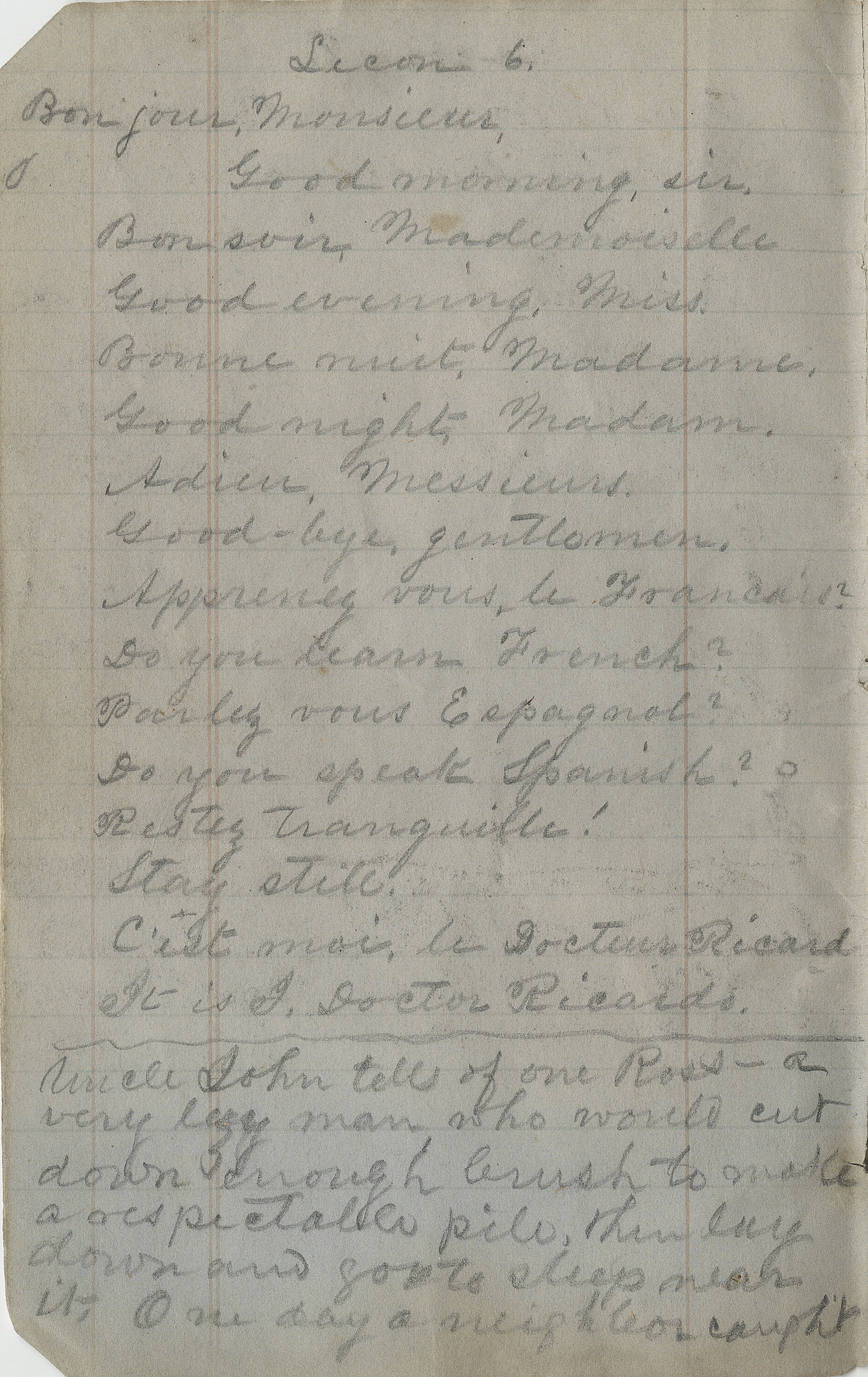
[MS: N01_leaf_003v]
| Bonjour, Monsieur, Good morning, sir. |
| Bonsoir, Mademoiselle |
| Good evening, Miss. |
| Bonne nuit, Madame. |
| Good night, Madam. |
| Adieu, Messieurs. |
| Good-bye, Gentlemen. |
| Apprenez vous, le Francais? |
| Do you learn French? |
| Parlez vous Espagnol? |
| Do you speak Spanish? |
| Restez tranquille! |
| Stay still. |
| C'est moi, le Docteur Ricard |
| It is I, Doctor Ricards. |
Uncle John6 tells of one
Ross—a
very lazy man, who would cut
down enough brush to make
a respectable pile, then lay
down and go to sleep near
it. One day a
neighbor caught
The above passage continues at the bottom of the following page.
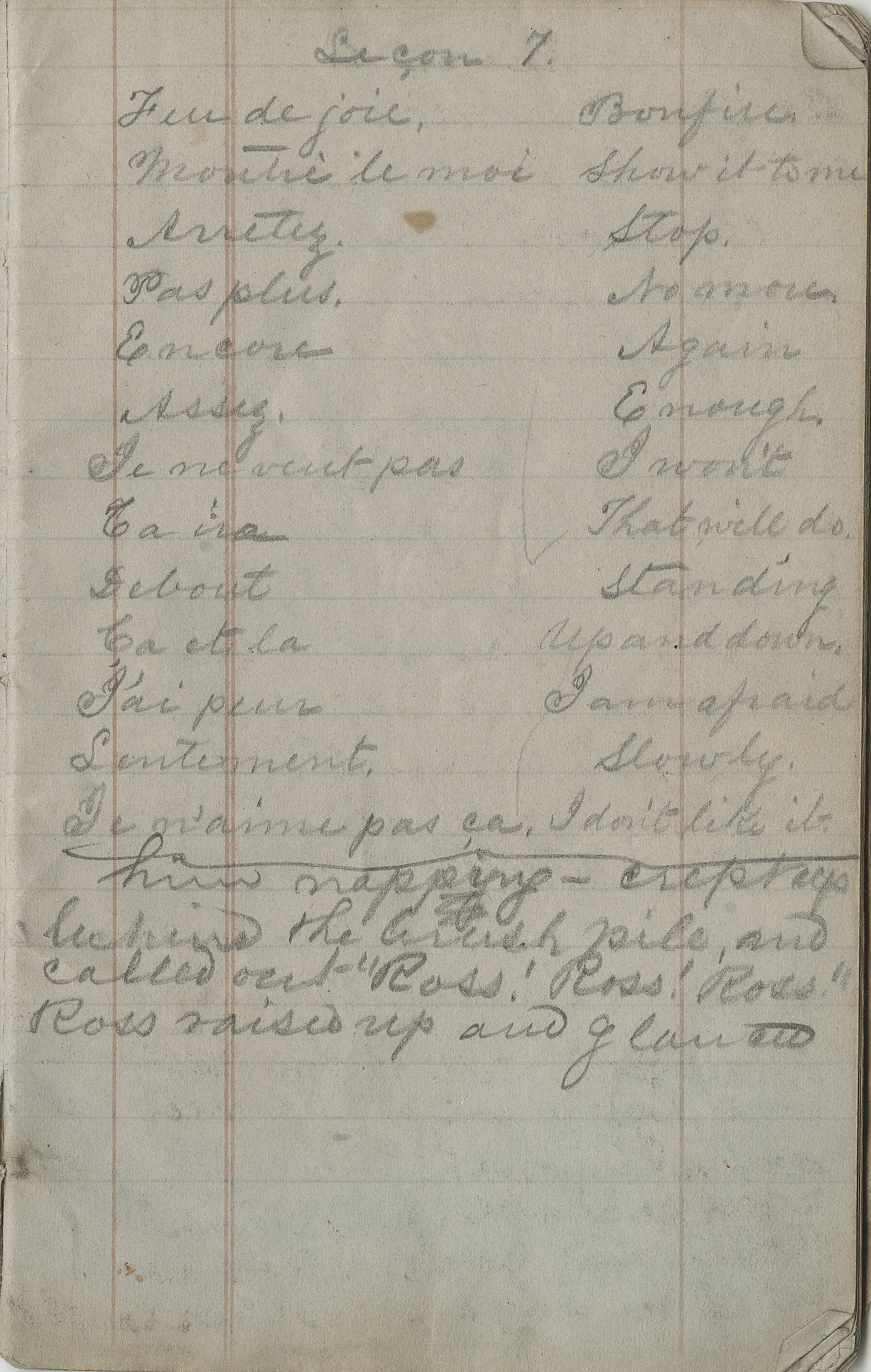
[MS: N01_leaf_004r]
| Feu de joie, | Bonfire. | |
| Montrè le moi | Show it to me | |
| Arretez. | Stop. | |
| Pas plus. | No more. | |
| Encore | Again | |
| Assez. | Enough. | |
| Je ne veut pas | I won't | |
| Ca ira | That will do. | |
| Debout | Standing | |
| Ça et la | Up and down. | |
| J'ai peur | I am afraid | |
| Lentement, | Slowly. | |
| Je n'aimie pas ça. | I don't like it.5 |
The following passage continues from the bottom of the previous page.
him napping—crept up
behind the brush pile,
and
called out “Ross! Ross! Ross!'
Ross raised up
and glancedⓉtextual note
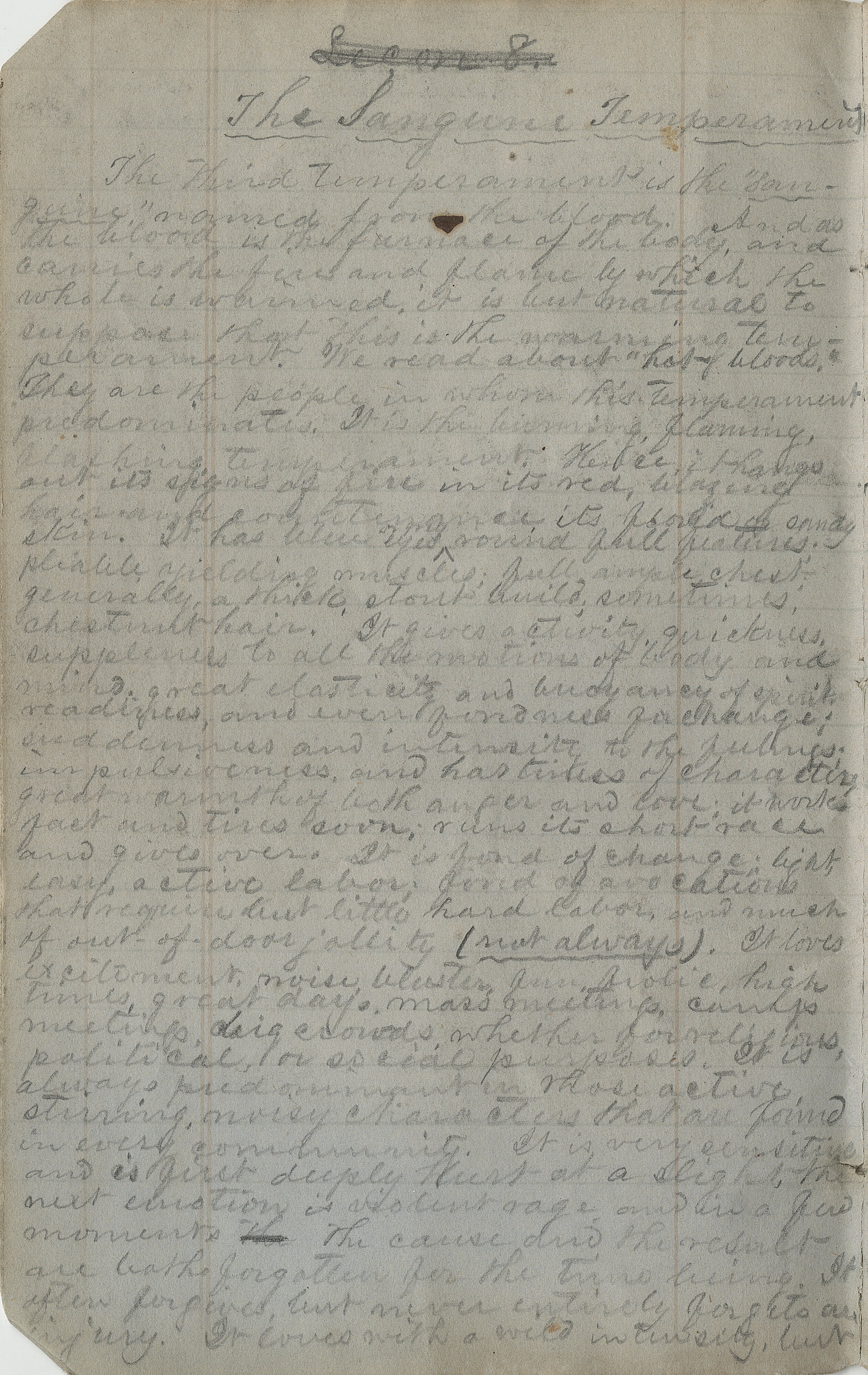
[MS: N01_leaf_004v]
The third temperament is the
“San-
guine,”
“Sanguine,”
named from the blood. And as
the blood is the furnace of the body, and
carries the fire and flame by
which the
whole is warmed, it is but natural to
suppose that this is the
warming
tem-
perament
temperament
. We read about “hot bloods.”
They are the people in whom this temperament
predominates. It is the
burning, flaming,
flashing temperament.
[MTP: N&J1_22]
Hence, it hangs
out its signs of
fire in its red, blazing
hair and countenance, its florid or sandy
skin.
It has blue eyes or gray
round full features;
pliable, yielding
muscles; full ample chest;
generally, a thick, stout build; sometimes,
chestnut hair. It gives activity, quickness,
suppleness to all the
motions of body and
mind; great elasticity and buoyancy of spirit;
readiness, and even fondness for change;
suddenness and intensity to the
feelings;
impulsiveness, and hastiness of character;
great warmth of
both anger and love; it works
fast and tires soon; runs its short race
and gives over. It is fond of change; light,
easy, active labor; fond of
avocations
that require but little hard labor, and much
of out-of-door
jollity (not always). It loves
excitement, noise,
bluster, fun, frolic, high
times, great days, mass meetings, camp
meetings, c big crowds, whether for religious,
political, or
social purposes. It is
always predominant in those active,
stirring,
noisy characters that are found
in every community. It is very sensitive
and a is first deeply hurt at a slight, the
next emotion is violent rage,
and in a few
moments theⓂemendation cause and the result
are both forgotten for the
time being. It
often forgives, but never entirely forgets an
injury. It
loves with a wild intensity, but
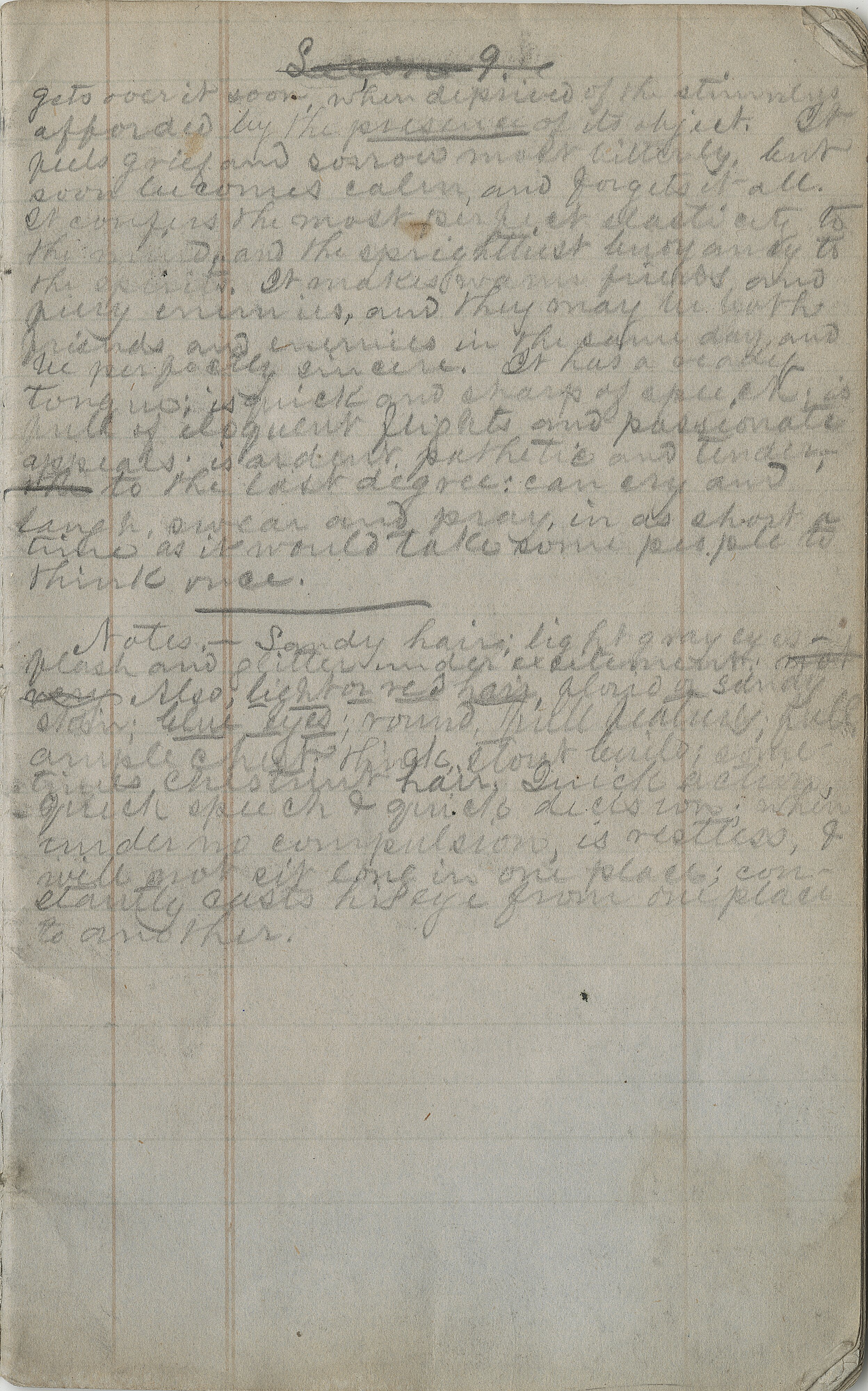
[MS: N01_leaf_005r]
Leçon 9.
gets over it soon, when deprived of the stimulus
afforded by the
presence of its object. It
feels grief and
sorrow most bitterly, but
soon becomes calm, and forgets it all.
It
confers
[MTP: N&J1_23]
the most perfect elasticity to
the mind, and the sprightliest
buoyancy to
the spirit. It makes warm friends and
fiery enemies, and
they may be both
friends and enemies in the same day, and
be perfectly
sincere. It has a ready
tongue; is quick and sharp of speech; is
full of
eloquent flights and passionate
appeals; is ardent, pathetic and tender,
the to the last degree: can cry and
laugh, swear and
pray, in as short a
time as it would take some people to
think once.
Notes.—Sandy hair; light gray eyes—
flash and
glitter under excitement ; not
very. Also, light or red hair, florid or sandy
skin; blue eyes; round, full features; full,
ample chest; thick,
stout build;
some-
times
sometimes
chestnut hair. Quick action,
quick speech
& quick decision; when
under no compulsion, is restless,
&
will not sit long in one place;
con-
stantly
constantly
casts his eye
from one place
to another.
[MS: N01_leaf_005v]
blank
[MS: N01_leaf_006r]
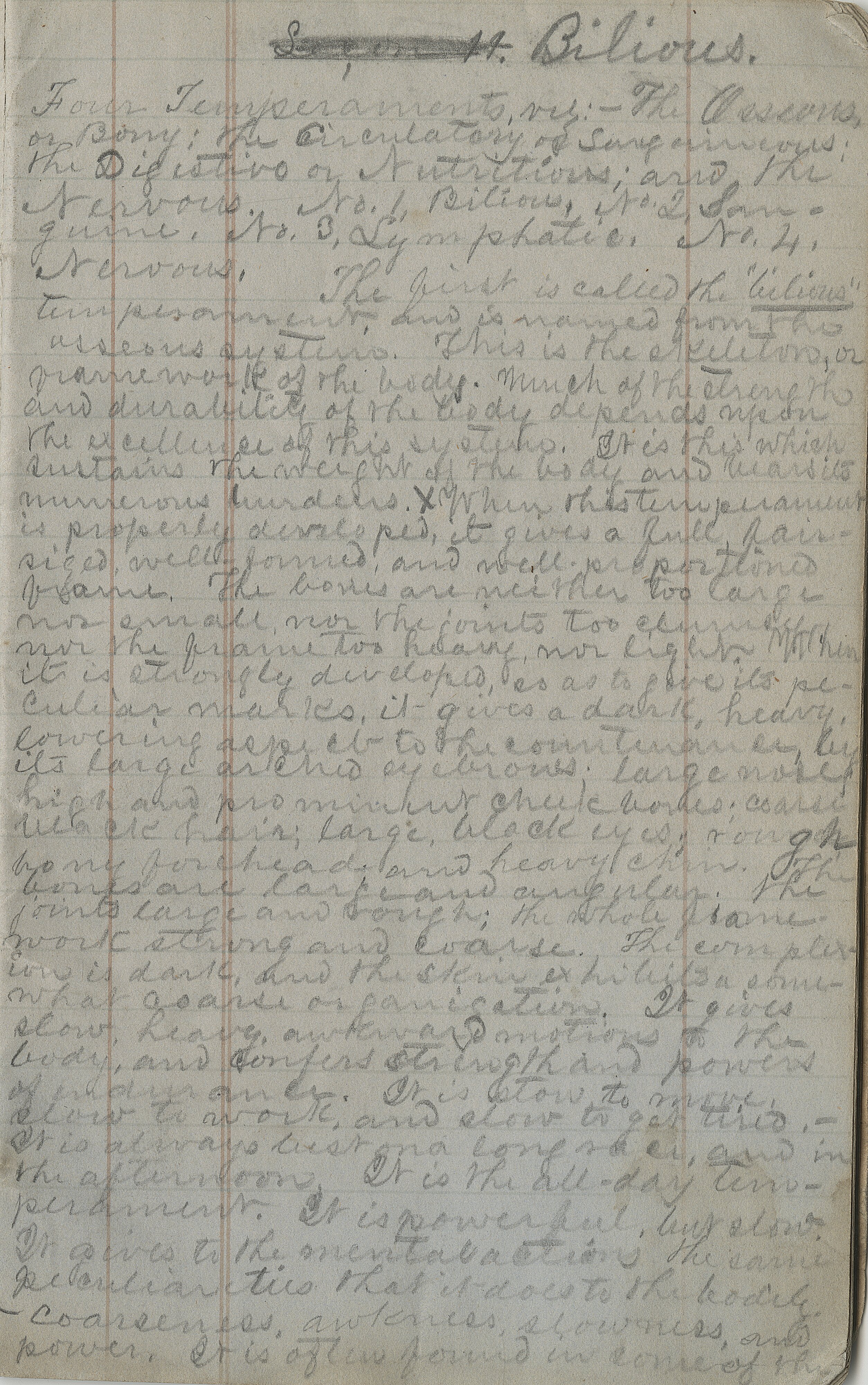
Four temperaments, viz:—The Osseous,
or Bony; the c
Circulatory or Sanguineous;
the Digestive or Nutritious; and the
Nervous. No. 1, Bilious. No. 2,
San-
guine
Sanguine
. No. 3, Lymphatic. No. 4,
Nervous.
The first is called the “bilious”
temperament, and is named from the
osseous system. This is the skeleton, or
framework of the body. Much of
the strength
and durability of the body depends upon
the excellence of
this system. It is this which
sustains the weight of the body and bears
its
numerous burdens. ✗8
When this temperament
is properly developed, it gives a full,
fair-
sized, well-formed, and well-proportioned
frame. The bones are
neither too large
nor small, nor the joints too clumsy,
nor the frame
too heavy, nor light. When
it is strongly developed, so as to give its
pe-
culiar
peculiar
marks, it gives a dark, heavy,
lowering aspect to the
countenance, by
its large arched eyebrows; large nose;
high and
prominent cheekbones; coarse
black hair; large, black eyes; rough,
bony
forehead; and heavy chin. The
[MTP: N&J1_24]
bones are large and angular; the
joints
large and rough; the whole
frame-
work
framework
strong and coarse. The
complex-
ion
complexion
is dark, and the skin exhibits a
some-
what
somewhat
coarse organization. It gives
slow, heavy, awkward motions to the
body, and confers strength and
powers
of endurance. It is slow to move,
slow to work, and slow to get
tired.—
It is always best on a long race, and in
the
afternoon. It is the all-day
tem-
perament
temperament
. It is powerful, but slow.
It
gives to the mental actions the same
peculiarities that it does to the
bodily.
—coarseness, awkness, slowness, and
power. It is often
found in some of the
[MS: N01_leaf_006v]
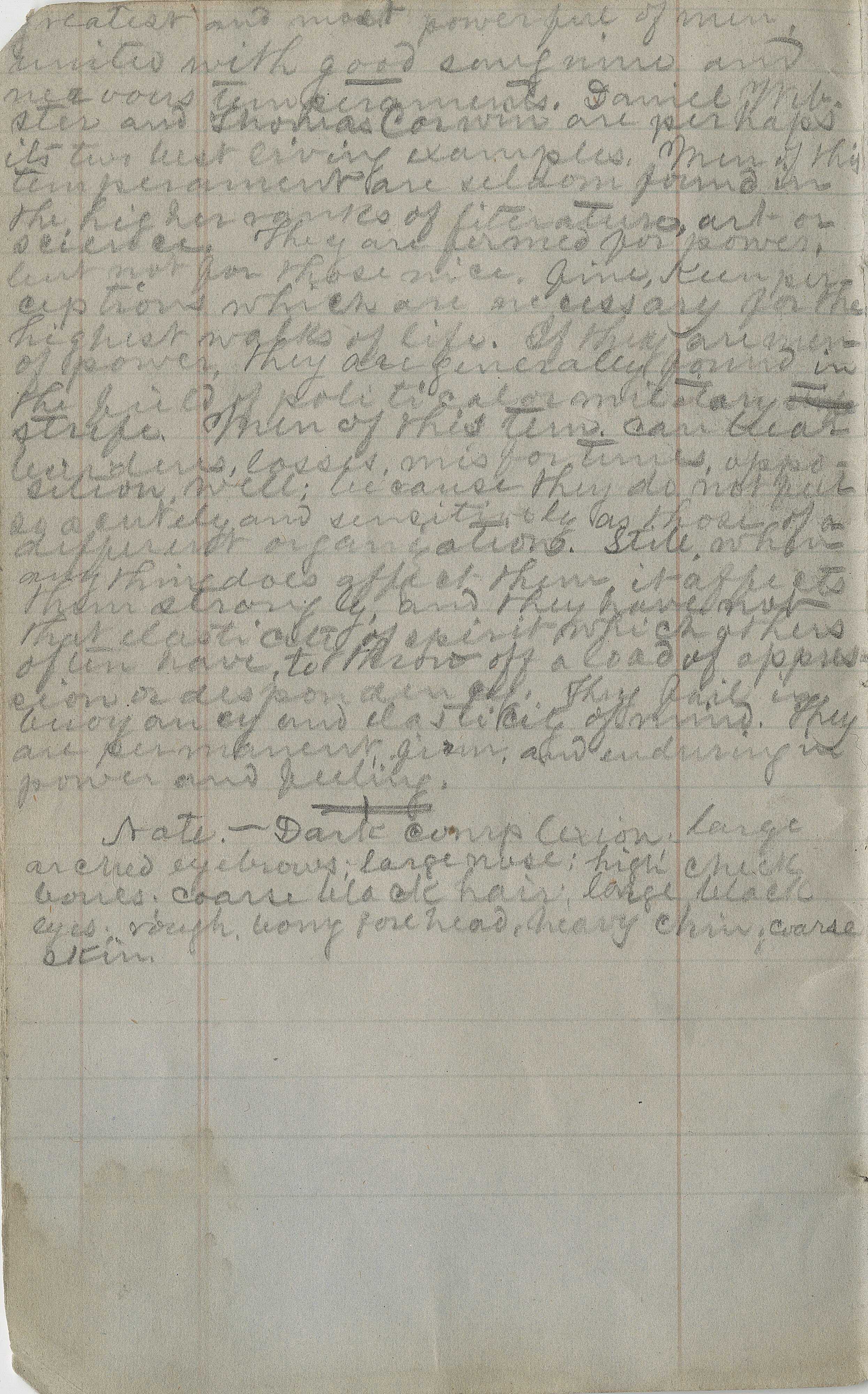
greatest and most powerful of men,
united with good sanguine and
nervous temperaments. Daniel
Web-
ster
Webster
and Thomas Corwin9 are perhaps
its two
best living examples. Men of this
temperament are seldom found in
the
higher ranks of literature, art or
science. They are formed for power,
but not for those nice, fine, keen
per-
ceptions
perceptions
which are necessary for
the
highest walks of life. If they are men
of power, they are generally
found in
the field of political or military
strife. Men of this tem. can
bear
burdens, losses, misfortunes,
oppo-
sition
opposition
, well; because they do not
feel
so acutely and sensitively as those of a
different organization.
Still, when
anything does affect them, it affects
them strongly, and
they have not
that elasticity of spirit which others
often have, to
throw off a load of
oppres-
sion
oppression
or despondency. They fail in
buoyancy and
elasticity of mind. They
are permanent, firm, and enduring in
power and
feeling.
Note.—Dark complexion; large
arched eyebrows; large nose; high
cheek
bones; coarse black hair; large black
eyes; rough, bony forehead,
heavy chin; coarse
skin.10
[MS: N01_leaf_007r]
blank recto
[MS: N01_leaf_008r]
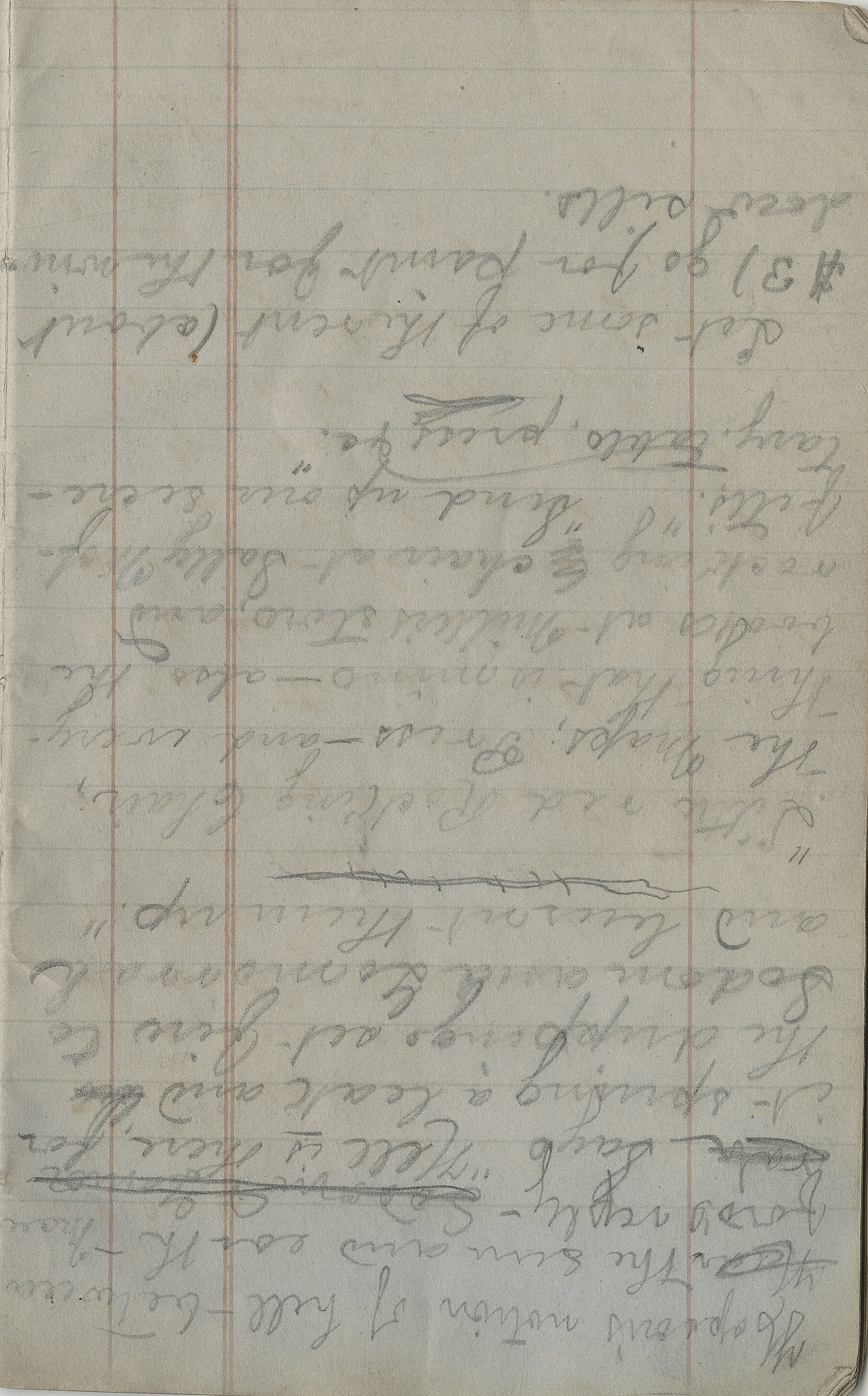
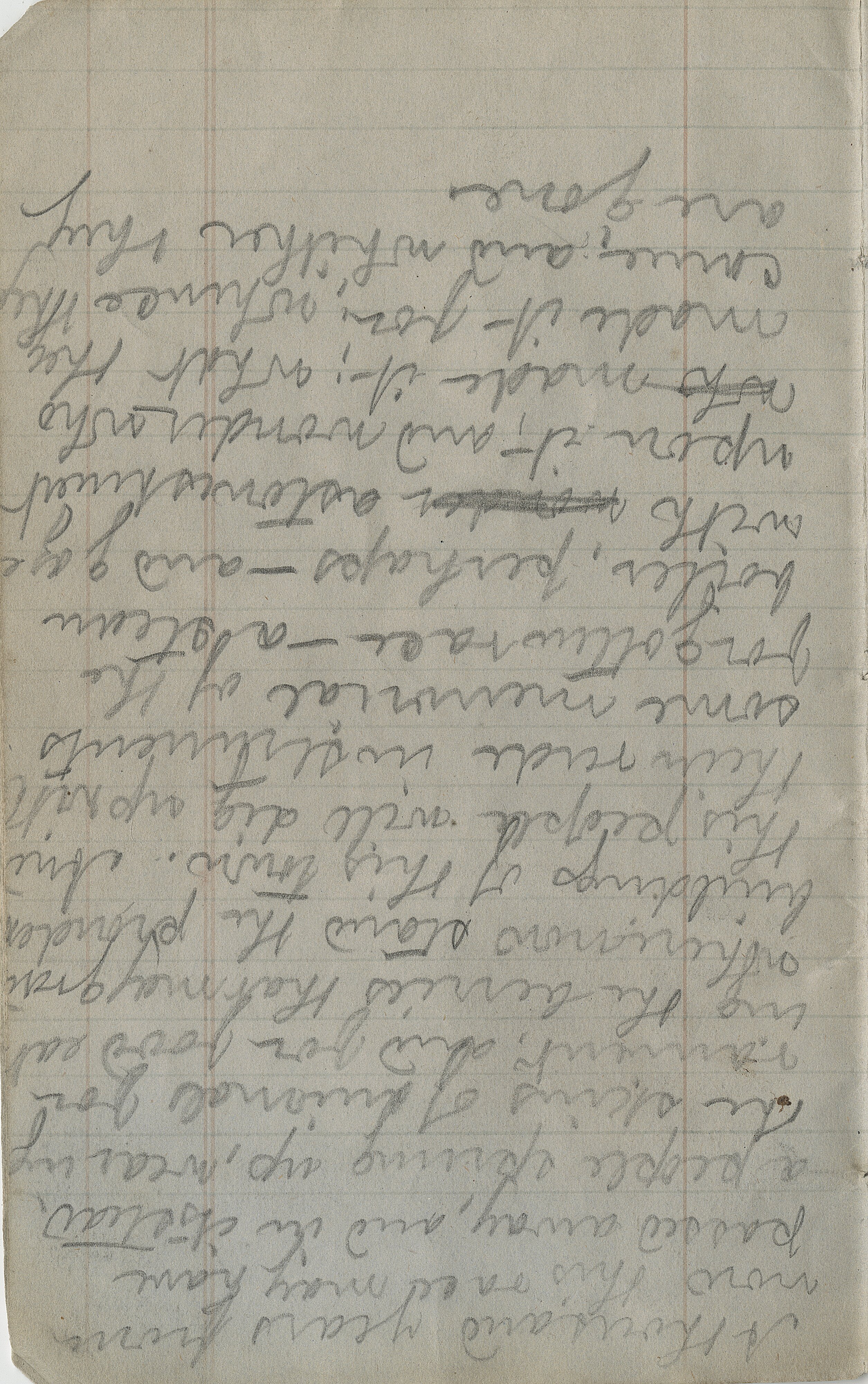
[MTP: N&J1_25] Clemens wrote the next two pages from the back to the front of the notebook. Thus, the page images proceed backward from lead_008r to leaf_007v, and the transcription of the two pages is presented below in the presumed order of their inscription.
Hopson's11 notion of hell—between
Heav the
sun and earth—
Man
ford’s
Manford's
12 reply—Sodom
&
Gomor
rah
Gomorrah
Says “Hell is there, for
it sprung a leak and
bu
the drippings set fire to
Sodom and Gomorrah
and burnt them
up.”
“Little red Rocking Chair;
the Maps; Press—and
every-
thing
everything
that is mine—also, the
books at
Miller's13 store, and
rocking
-
chair at Sally
Mof-
fett’s
Moffett's
.”14
“Send up our
secre-
tary
secretary
, table, press,
&c.”15
Let some of the rent (about
$3) go for paint for the
win-
dow
window
sills.16
[MS: N01_leaf_007v]
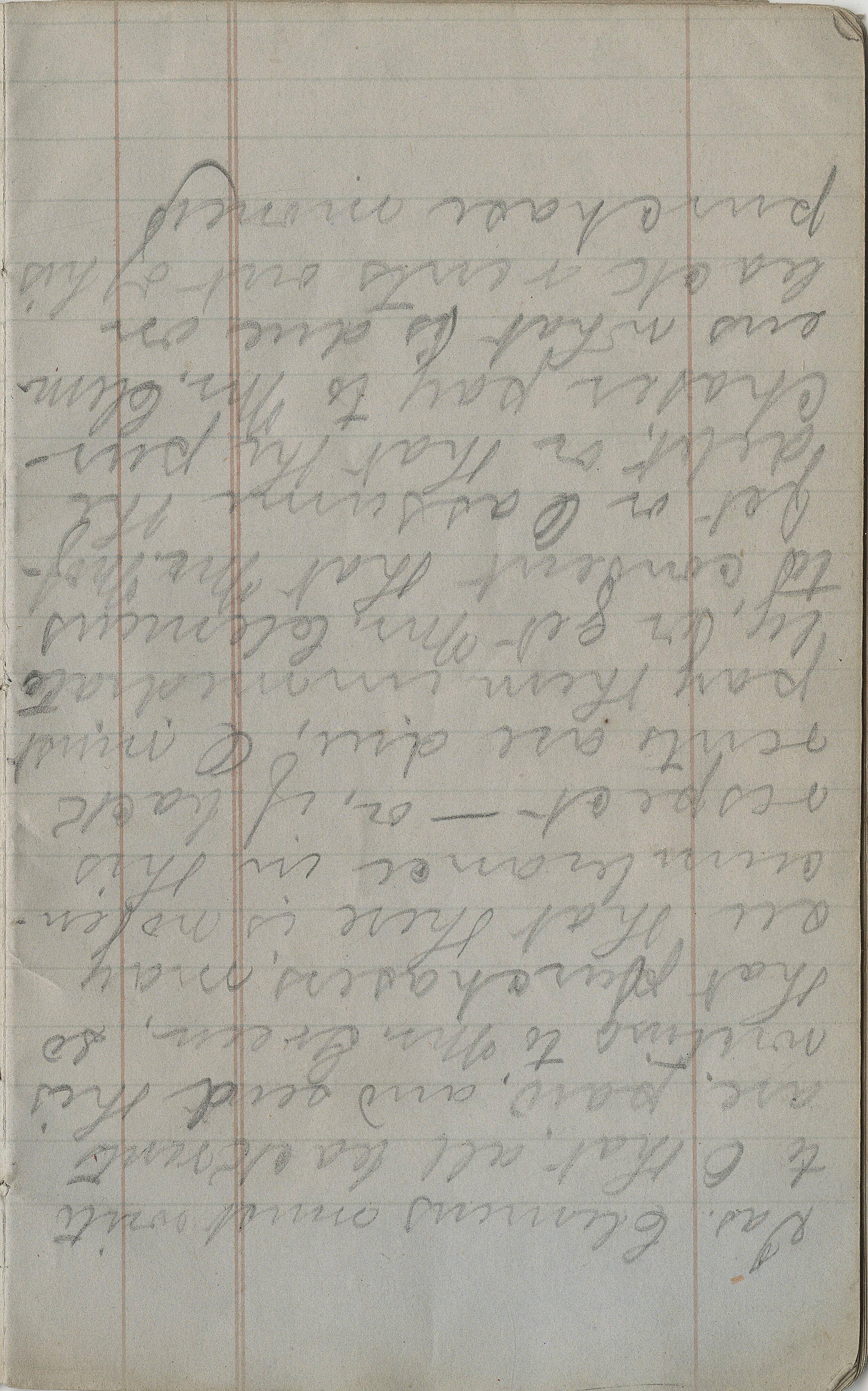
A thousand years from
now this race may have
passed away, and in its
stead,
a people sprung up, wearing
the skins of animals for
[MTP: N&J1_26] raiment, and
for food
eat-
ing
eating
the berries that may grow
where now stand the prouder
buildings of this town. And
this people will dig up with
their rude
instruments
some memorial of the
forgotten race—a steam
boiler, perhaps—and gaze
with wonder astonishment
upon it, and wonder who
wh made it; what they
made it for;
whence they
came, and whither they
are gone.17
[MS: N01_leaf_009r] Clemens wrote the next page from the back to the front of the notebook; the facing page following it was written in the same orientation by Moses P. Green. The transcription of the pages is presented below in the presumed order of their inscription.
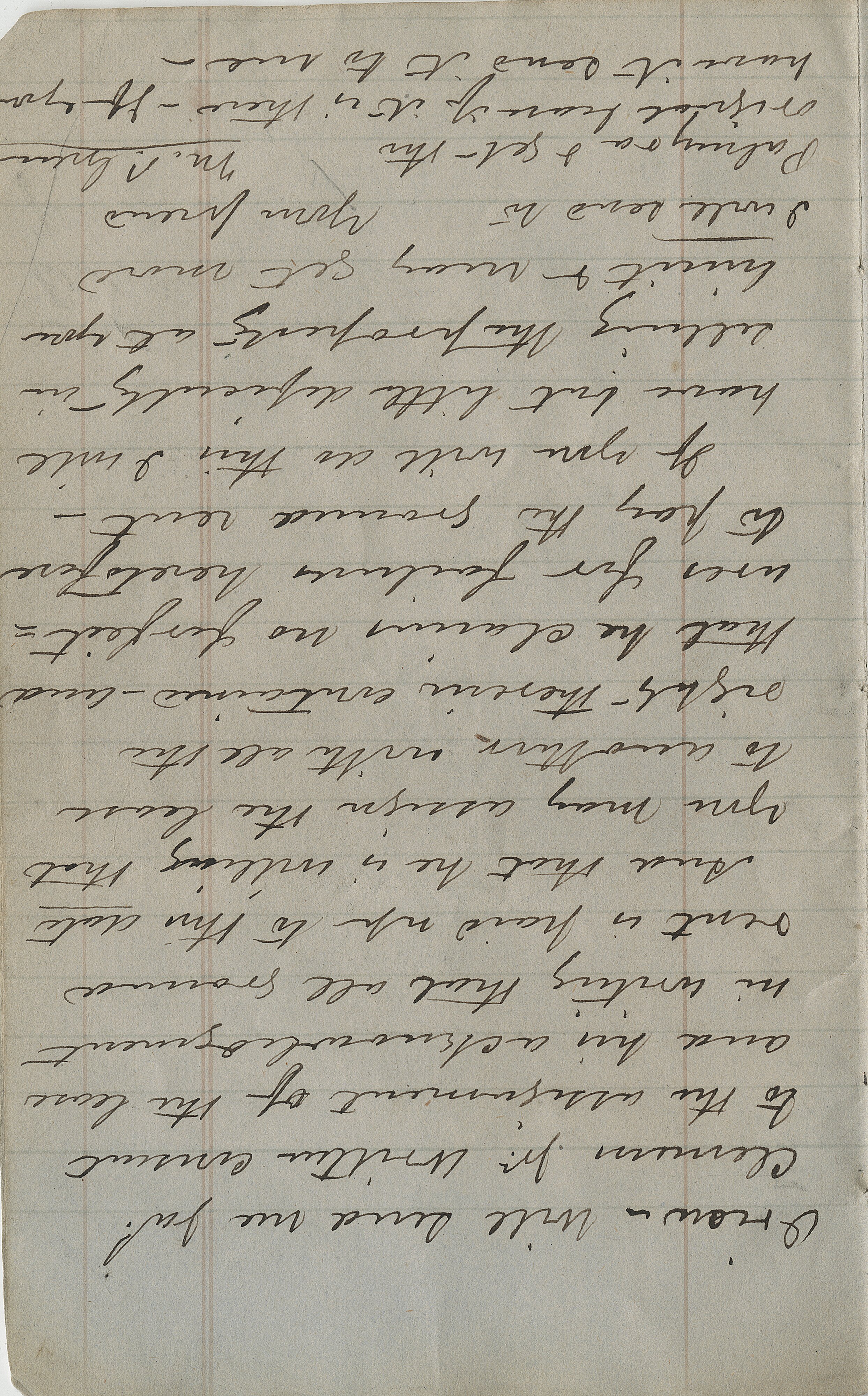
Jas. Clemens must write
to O that all back rents
are paid,18 and send this
writing to Mr. Green, so
that purchasers may
see
that there is no
en-
cumbrance
encumbrance
in this
respect—or, if back
rents are due, O must
pay them
immediate
ly
immediately
, or get Mr. Clemens
to
consent that Mr.
Mof-
fet
Moffet
or O assume the
debt, or that the
pur-
chaser
purchaser
pay
to Mr.
Clem-
ens
Clemens
what is due on
back rents out of his
purchase money
[MS: N01_leaf_008v] in pen:
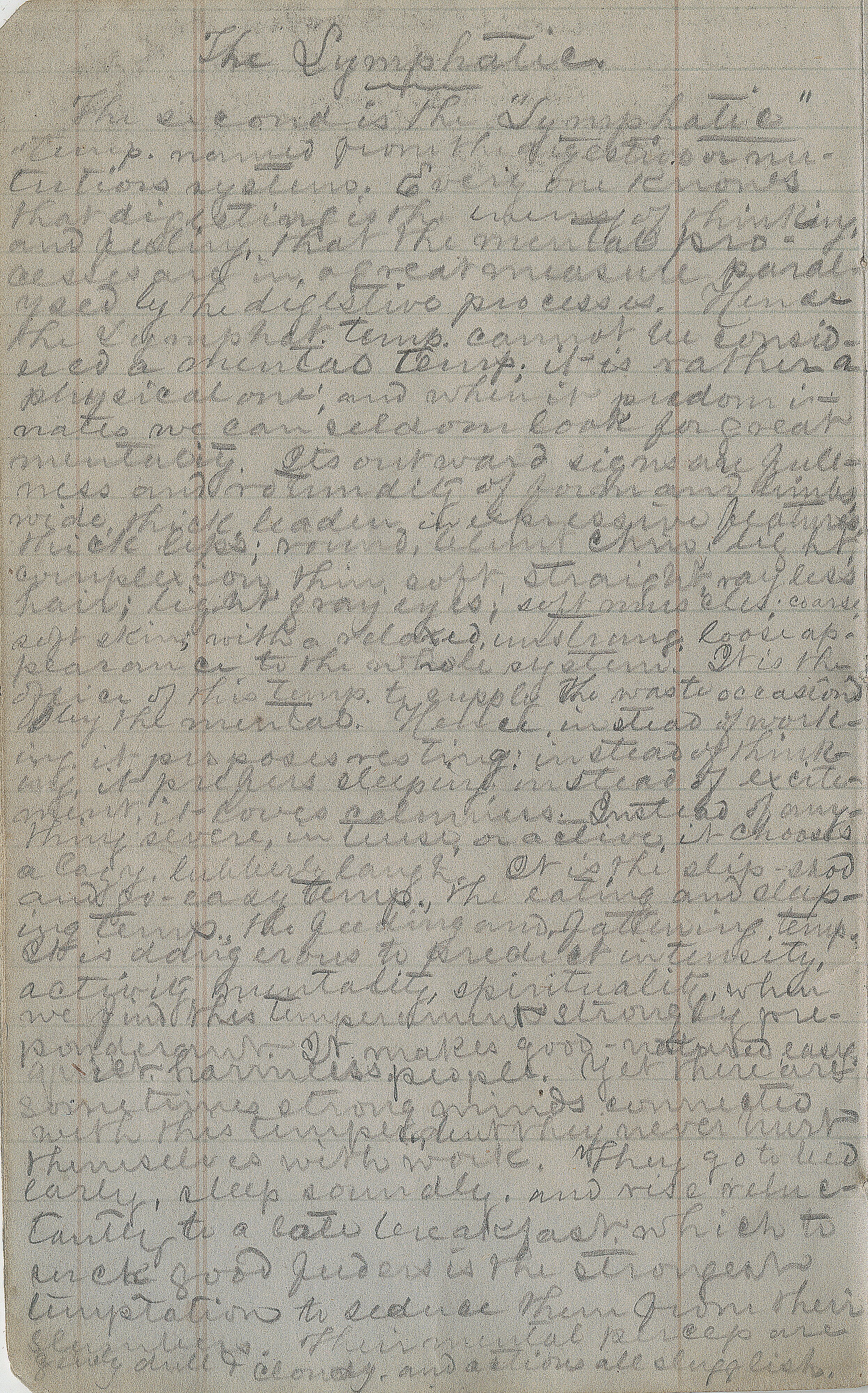
Orion—will send me Jas
Clemens Jr. written consent
to the
assignment of the lease
and his acknowledgment
in writing that all
ground
rent is paid up to this date
And that he is willing that
you may assign the lease
to another with all
the
rights therein contained—and
that he claims no
forfeit=
ures
forfeitures
for failures heretofore
to pay the ground rent—
[MTP: N&J1_27]
If you will do this I will
have but little dificulty in
selling the
property19 at your
limit & may get more
Your friend
M. P. Green20
I will send to
Palmyra21 & get the
original lease if it is there—If you
have it send it to
me—
[MS: N01_leaf_009v]
The second is the “Lymphatic”
temp. named from the digestive
or
nu-
tritious
nutritious
system. Every one knows
that digesting is the enemy of
thinking,
and feeling, that the mental
pro-
cesses
processes
are in a great measure
paral-
ysed
paralysed
by the digestive processes. Hence
the Lymphat. temp. cannot be
consid-
ered
considered
a mental temp; it is rather a
physical one; and when it
predomi-
nates
predominates
we can seldom look for great
mentality. Its outward signs
are
full-
ness
fullness
and rotundity of form and limbs,
wide, thick, leaden,
inexpressive features,
thick lips; round, blunt chin; light,
complexion,
thin, soft, straight, rayless
hair; light gray eyes; soft muscles;
coarse,
soft skin; with a relaxed, unstrung, loose
ap-
pearance
appearance
to the
whole system. It is the
office of this temp. to supply the waste
occasiond
by the mental. Hence, instead of
work-
ing
working
, it proposes resting;
instead of
think-
ing
thinking
, it prefers sleeping; instead of
excite-
ment
excitement
, it
loves calmness. Instead of
any-
thing
anything
severe, intense, or active, it
chooses
a lazy, lubberly laugh. It is the slip-shod
and go-easy temp.,
the eating and
sleep-
ing
sleeping
temp., the feeding and fattening temp.
It is
dangerous to predict intensity,
activity, mentality, spirituality, when
we find this temperament strongly
pre-
ponderant
preponderant
. It makes good-natured,
easy,
quiet, harmless, people. Yet there are
sometimes strong minds
connected
with this temper., but they never hurt
themselves with work.
They go to bed
early, sleep
[MTP: N&J1_28]
soundly, and rise
reluc-
tantly
reluctantly
to a late
breakfast, which to
such good feeders is the strongest
temptation to
seduce them from their
slumbers. Their mental percep are
gen'ly dull & cloudy, and actions all sluggish.
[MS: N01_leaf_010r]
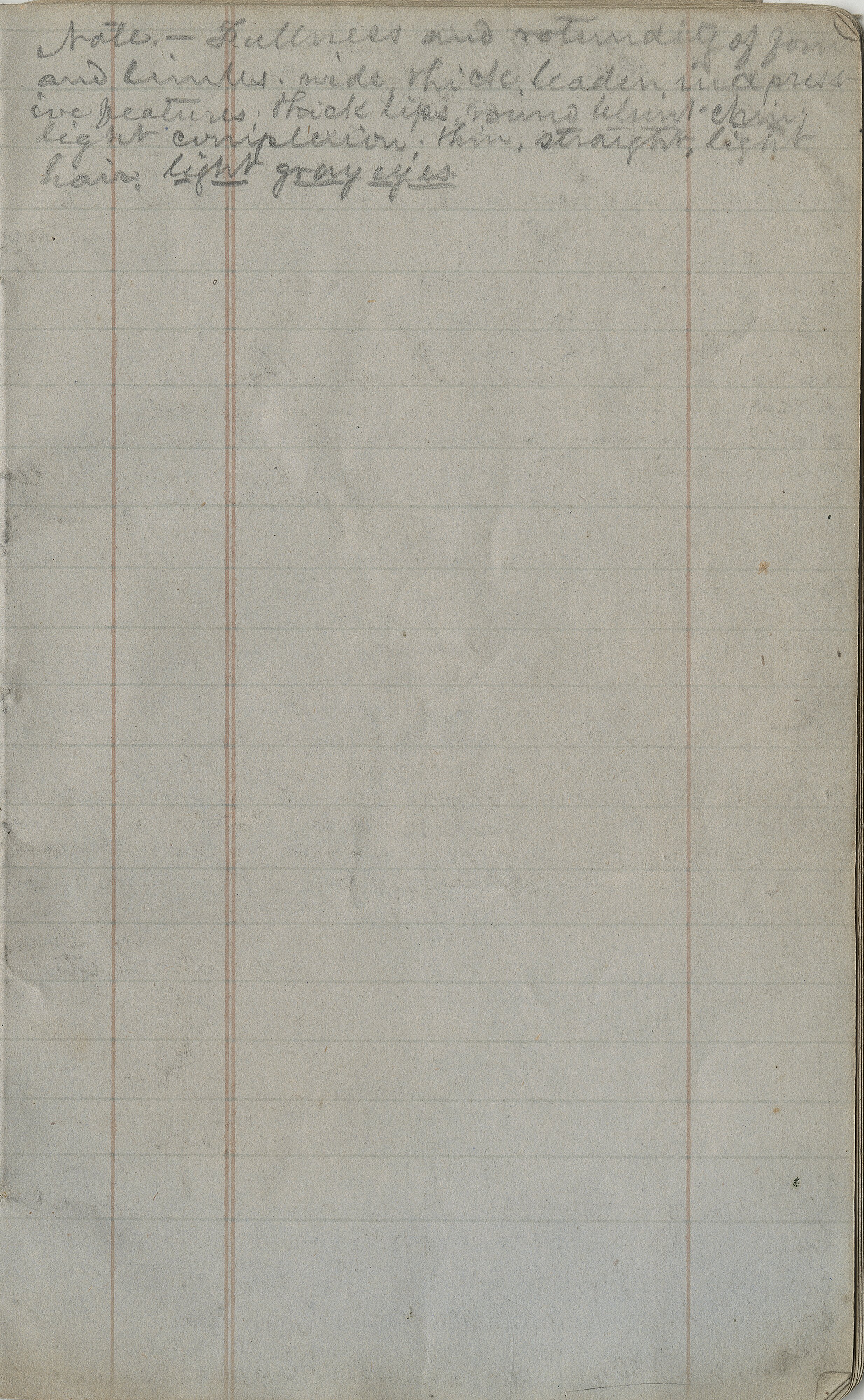
Note.—Fullness and rotundity of form
and limbs; wide, thick,
leaden,
inexpress-
ive
inexpressive
features; thick lips, round blunt chin;
light complexion; thin, straight, light
hair; light gray eyes.
[MS: N01_leaf_010v]
blank verso
[MS: N01_leaf_011r]
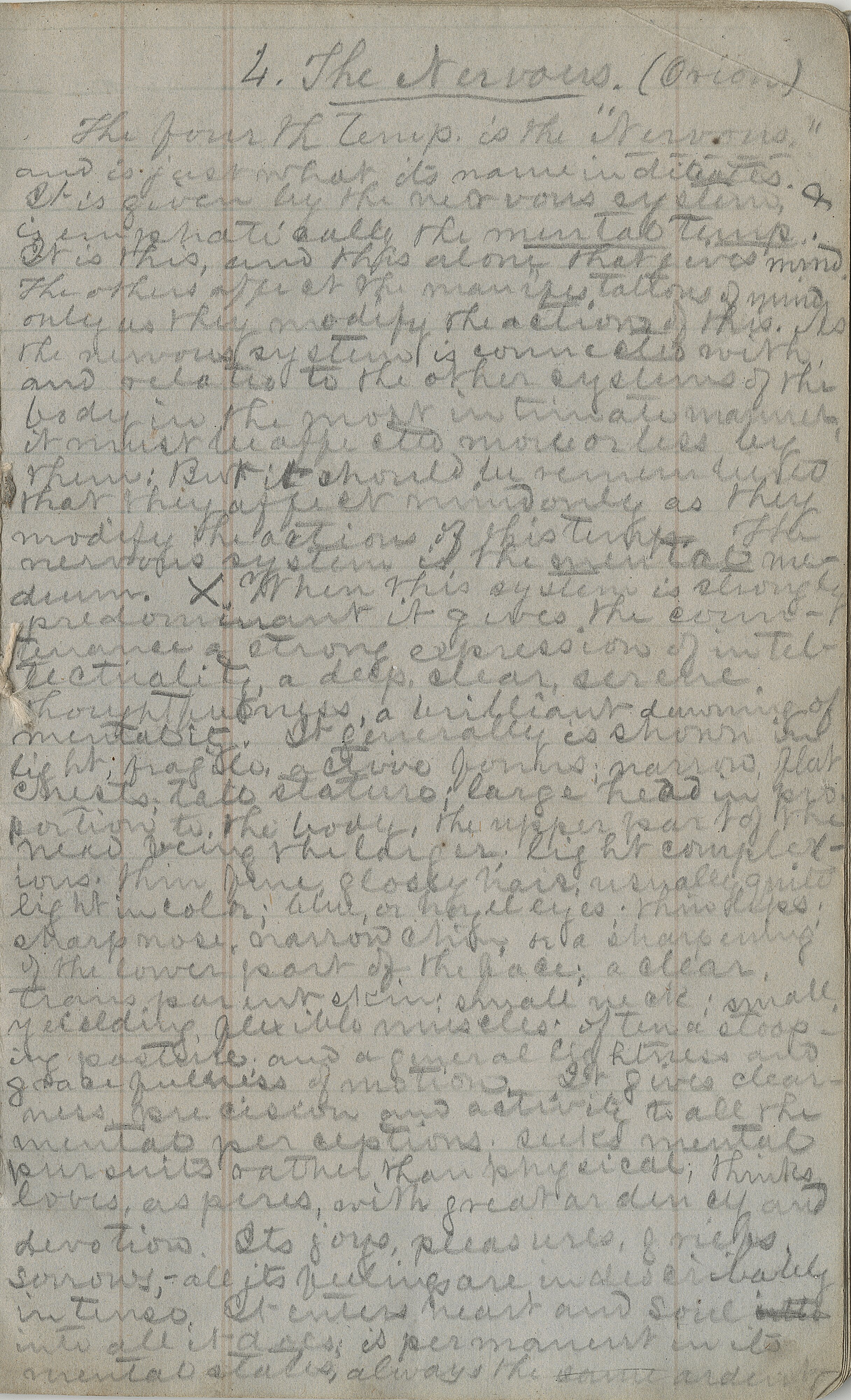
The fourth temp. is the “Nervous,”
and is just what its name
indicates.
It is given by the nervous system, &
is
emphatically the mental temp.
It is this, and
this alone, that gives mind.
The others affect the manifestations of
mind
only as they modify the actions of this. As
the nervous system is
connected with,
and related to the other systems of the
body in the most
intimate manner,
it must be affected more or less by
them: But it should
be remembered
that they affect mind only as they
modify the actions of
this temp. The
nervous system is the mental
me-
dium
medium
. ✗22 When this
system is strongly
predominant it gives the
coun-
tenance
countenance
a strong
expression of
intel-
lectuality
intellectuality
, a deep, clear, serene
thoughtfulness, a
brilliant dawning of
mentality. It generally is shown in
light, fragile,
active forms; narrow, flat
chests; tall stature; large head in
pro-
portion
proportion
to the body, the upper part of the
head being the larger;
light
complex-
ions
complexions
; thin, fine, glossy hair, usually quite
light in
color; blue, or hazel eyes; thin lips;
sharp nose, narrow chin, or a
sharpening
of the lower part of the face; a clear,
transparent skin;
small neck; small,
yeielding, flexible muscles; often a
stoop-
ing
stooping
posture; and a general lightness and
gracefulness of motion. It gives
clear-
ness
clearness
, precision and activity to all the
mental perceptions; seeks
mental
pursuits rather than physical; thinks,
loves, aspires, with great
ardency and
devotion. Its joys, pleasures, griefs,
sorrows,—all its feelings are indescribably
intense. It
enters heart and soul intto
into all it does; is permanent in its
mental
states, always the same ardent,
[MS: N01_leaf_011v]
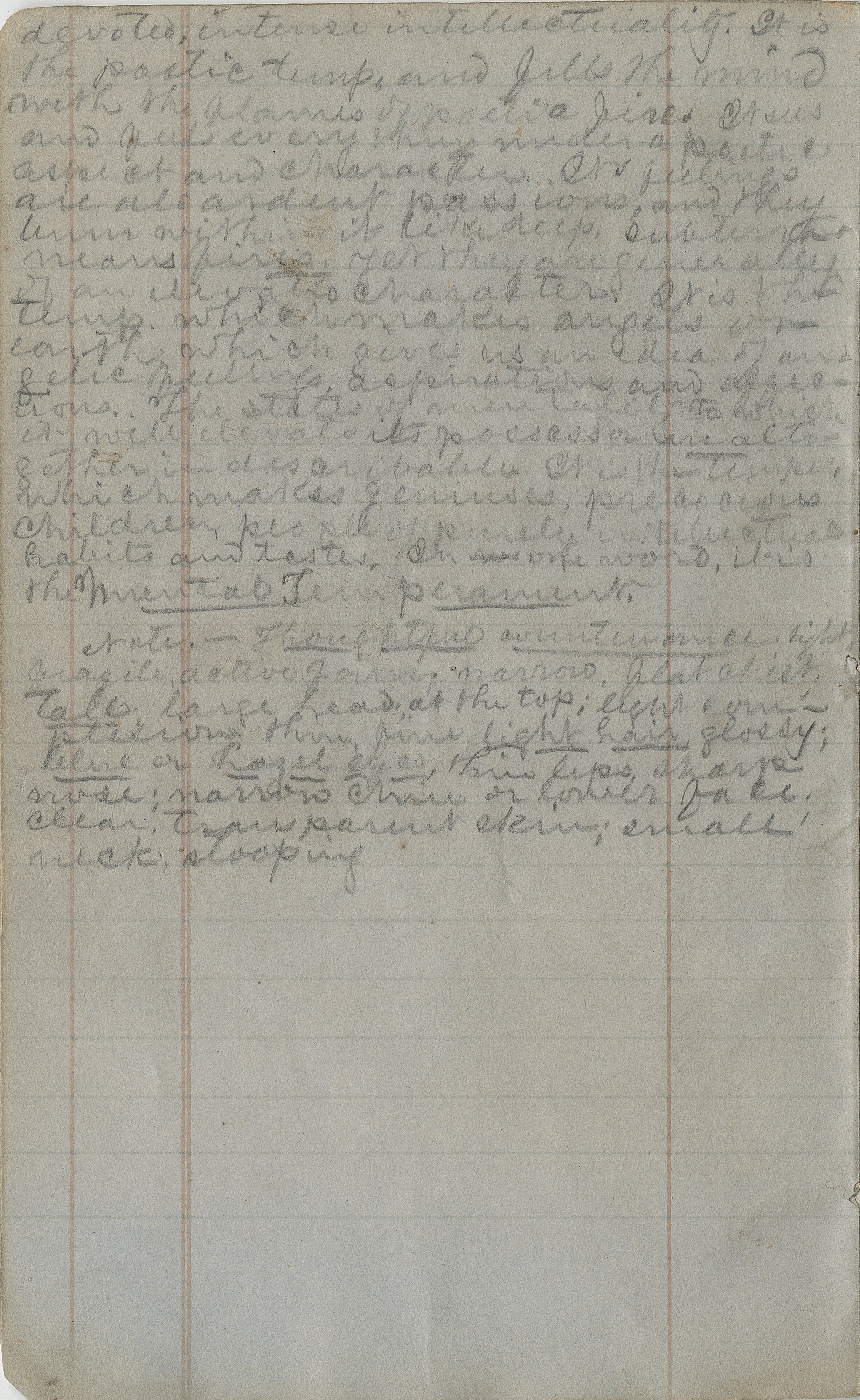
devoted, intense
intellectuality. It is
the poetic temp., and fills the
[MTP: N&J1_29]
mind
with the
flames of poetic fire. It sees
and feels every thing under a poetic
aspect and character. Its feelings
are all ardent passions, and they
burn within it like deep,
subterra-
neans
subterraneans
fires; yet they are generally
of
an elevated character. It is the
temp. which makes angels on
earth,
which gives us an idea of
an-
gelic
angelic
feelings, aspirations and
affec-
tions
affections
.
The states of mentality to which
it will elevate its possessor are
alto-
gether
altogether
indescribable. It is the temper.
which makes geniuses,
precocious
children, people of purely intellectual
habits and tastes. In
on one word, it is
the Mental Temperament.
Note.—Thoughtful countenance: light,
fragile, active form; narrow, flat chest;
tall;
large head; at the top; light
com-
plexion
complexion
; thin, fine, light hair, glossy;
blue or hazel eyes, thin lips, sharp
nose; narrow chin or
lower face;
clear, transparent skin; small
neck; stooping
[MS: N01_leaf_012r]
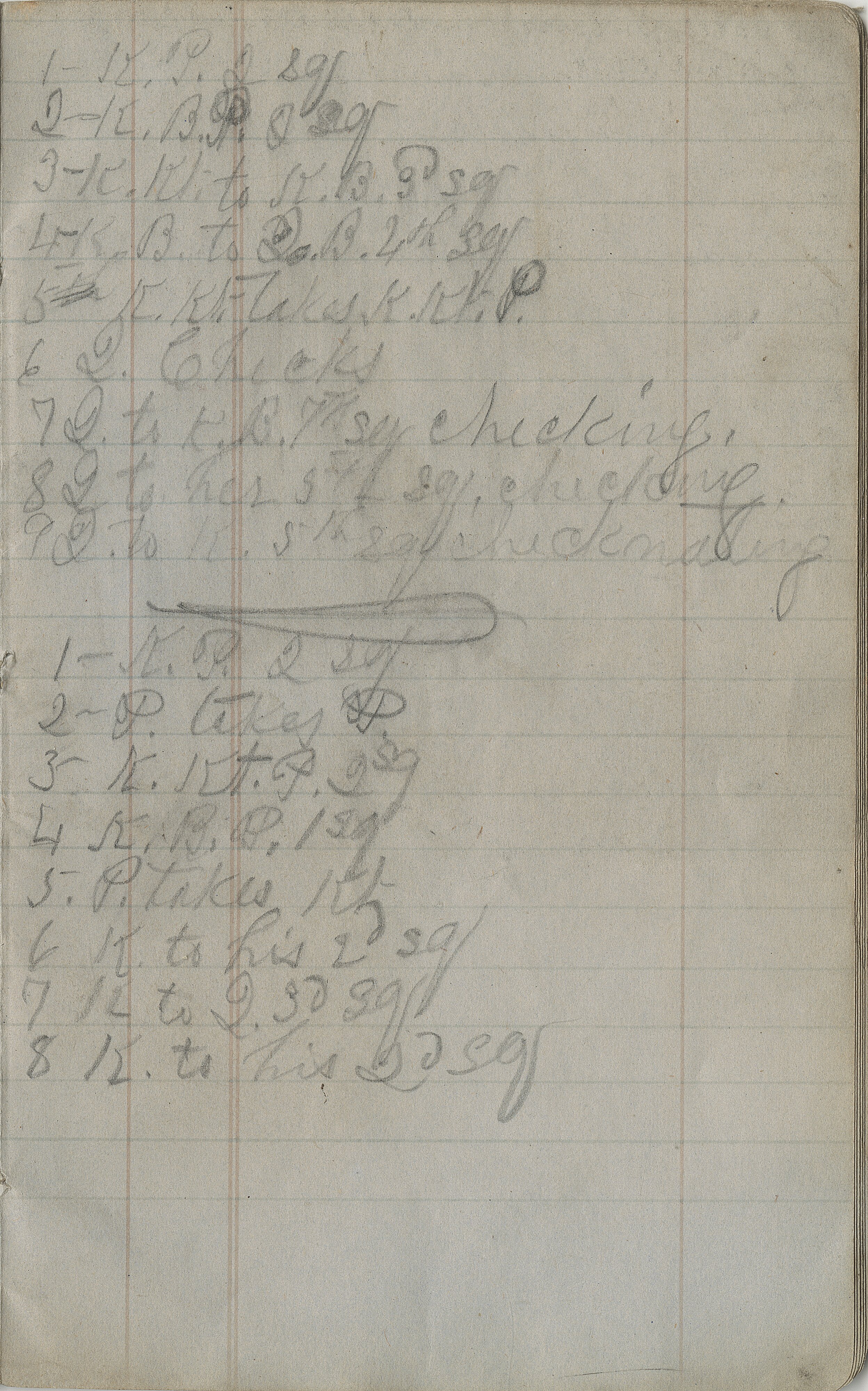
1—K.P. 2 sq
2—K.B.P. 2 sq
3—K.Kt. to K.B. 3d sq
4—K.B. to Q.B. 4th sq
5 th K.Kt. takes K.Kt.P.
6 Q. Checks
7 Q. to K.B. 7th sq checking.
8 Q to her 5th sq, checking.
9 Q. to K. 5th sq checkmating

1—K.P. 2 sq
2—P. takes P.
3—K.Kt. P. 2 sq
4 K.B.P. 1 sq
5. P. takes Kt
6 K. to his 2d sq
7 K to Q. 3d sq
8 K. to his 2d sq23
[MS: N01_leaf_012v]
[MTP: N&J1_30]
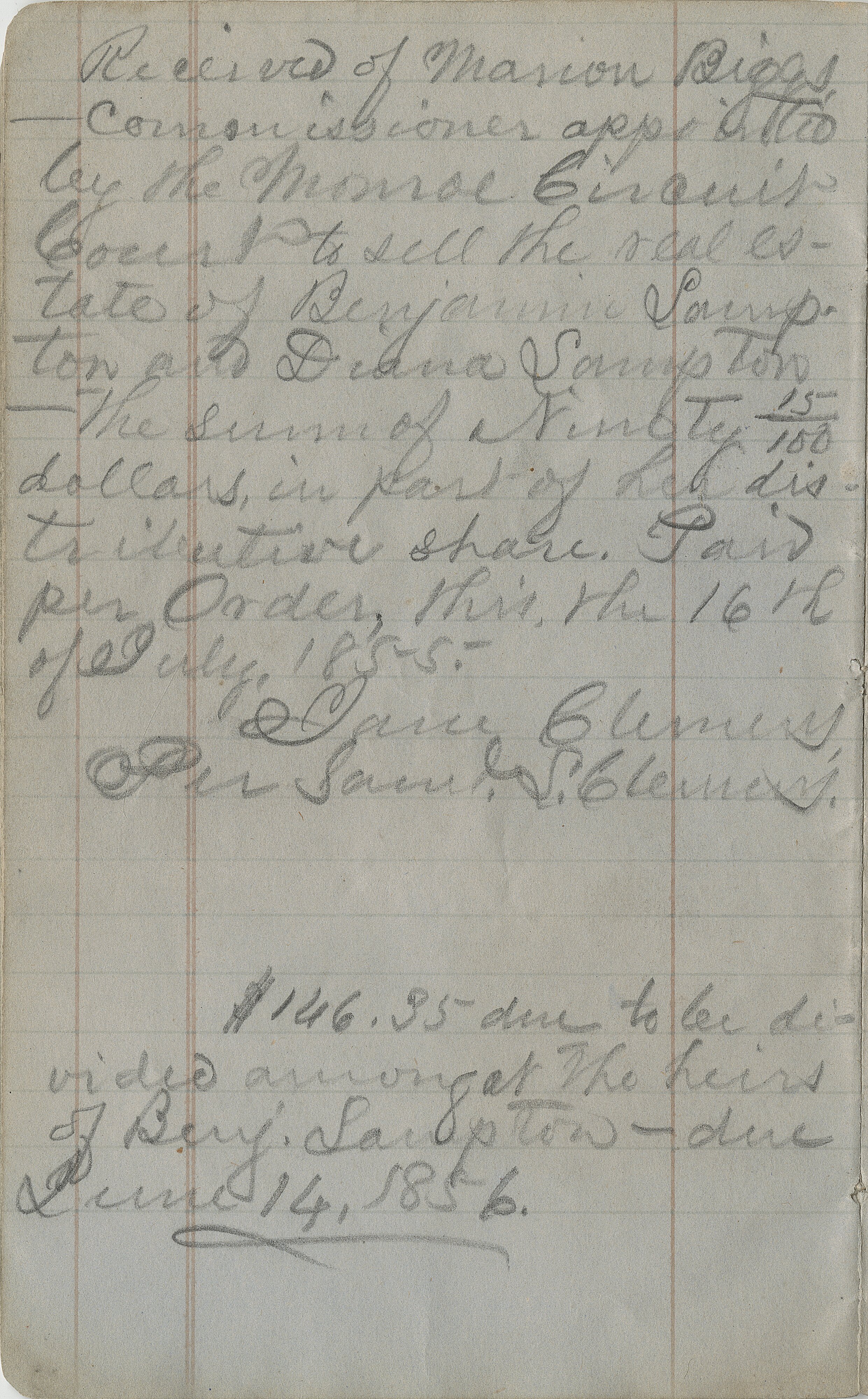
Received of Marion Biggs,
—commissioner appointed
by the Monroe
Circuit
Court to sell the real
es-
tate
estate
of Benjamin
Lamp-
ton
Lampton
and Diana
Lampton
—the sum of Ninety 15/100
dollars, in part of her
dis-
tributive
distributive
share. Paid
per Order, this, the 16th
of July, 1855.
Jane Clemens,
Per Samℓ L. Clemens.24
$146.35 due to be
di-
vided
divided
amongst the heirs
of Benj.
Lampton—due
June 14, 1856.Ⓣtextual note

[MS: N01_leaf_013r]
blank recto

[MS: N01_leaf_013v]
blank verso

[MS: N01_leaf_014r]
blank recto
[MS: N01_leaf_014v]
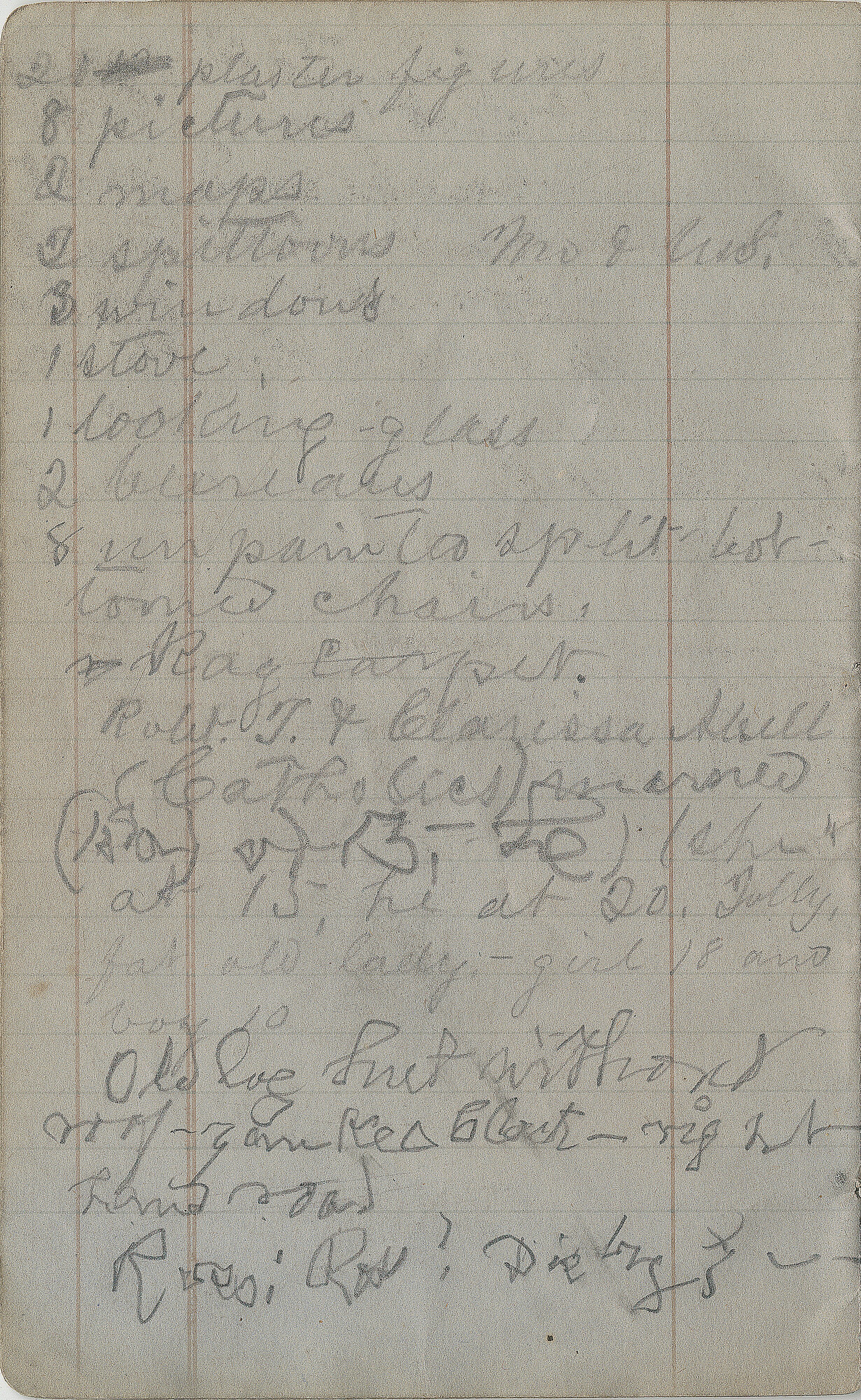
21 pd 2 plaster figures
8 pictures
2 maps
2 spittoons Mo & U.S. Ⓣtextual note
3 windows
1 stove
1 looking-glass
2 bureaus
8 unpainted split-
bot-
tomed
bottomed
chairs.
r Rag carpet.25
[MTP: N&J1_31]
Robt. T. & Clarissa Abell
(Catholics) married
(
Boy
Ⓜemendation of 15,Ⓜemendation he)26 (she marriedⓂemendation
at 15, he at 20. Jolly,
fat old lady.—girl 18 and boy
10
Old log hut without
roof—yankee Clock—right
hand
road
Ross: Ross! three? words Ⓜemendation 27
[MS: N01_leaf_015r]
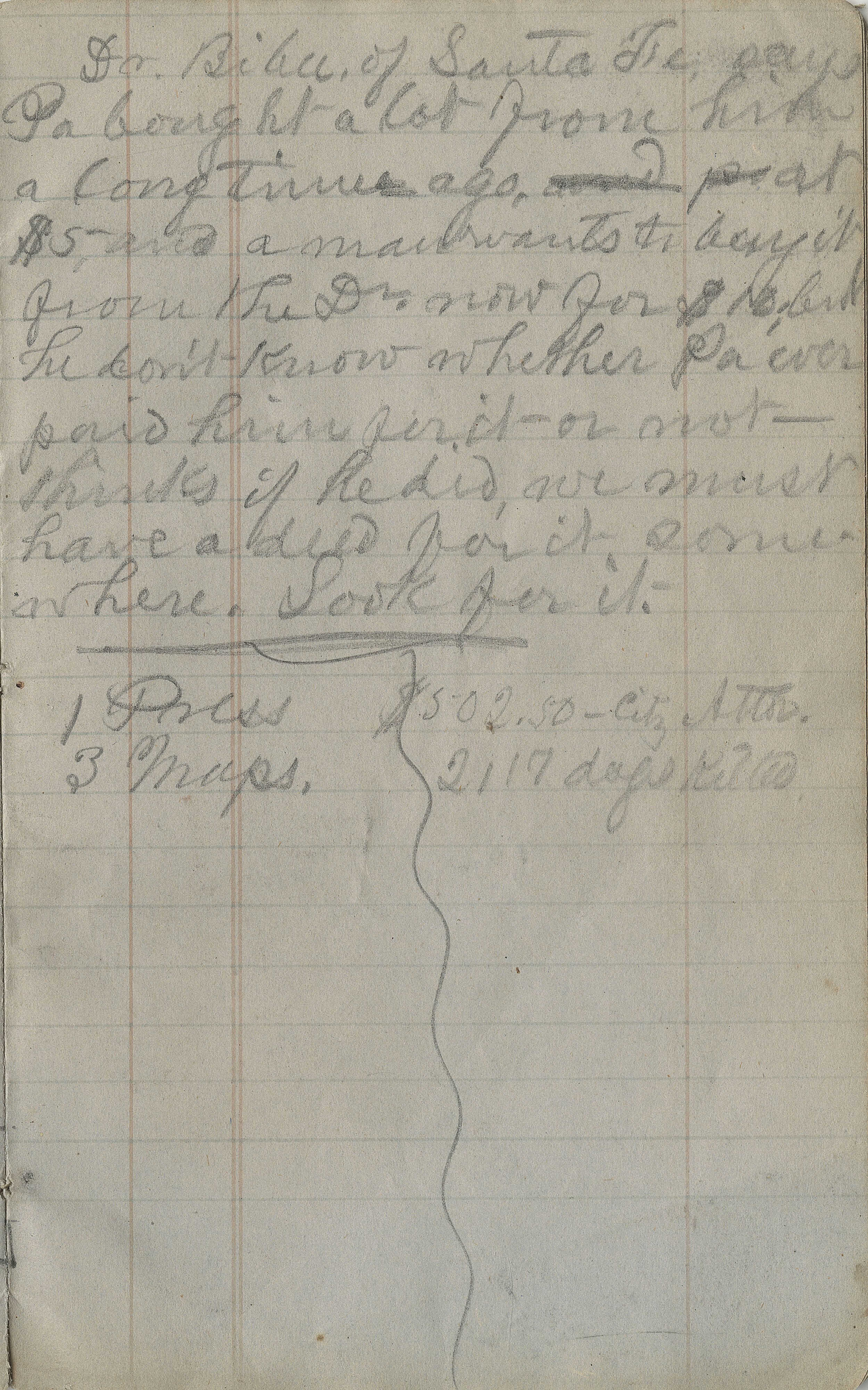
Dr. Bibee, of Santa Fe,28 says
Pa bought a lot from him
a long time ago, and
p at
$5, and a man wants to buy it
from the Dr now for $10; but
he
don't know whether Pa ever
paid him for it or
not—
thinks if he did, we must
have a deed for it
some-
where
somewhere
.
Look for it.
[MTP: N&J1_32]
| 1 Press | $502.50—City Attor.29 | |
| 3 Maps. | 2117 dogs killed.Ⓣtextual note 30 |

[MS: N01_leaf_015v]
blank verso

[MS: N01_leaf_016r]
blank recto
[MS: N01_leaf_016v]
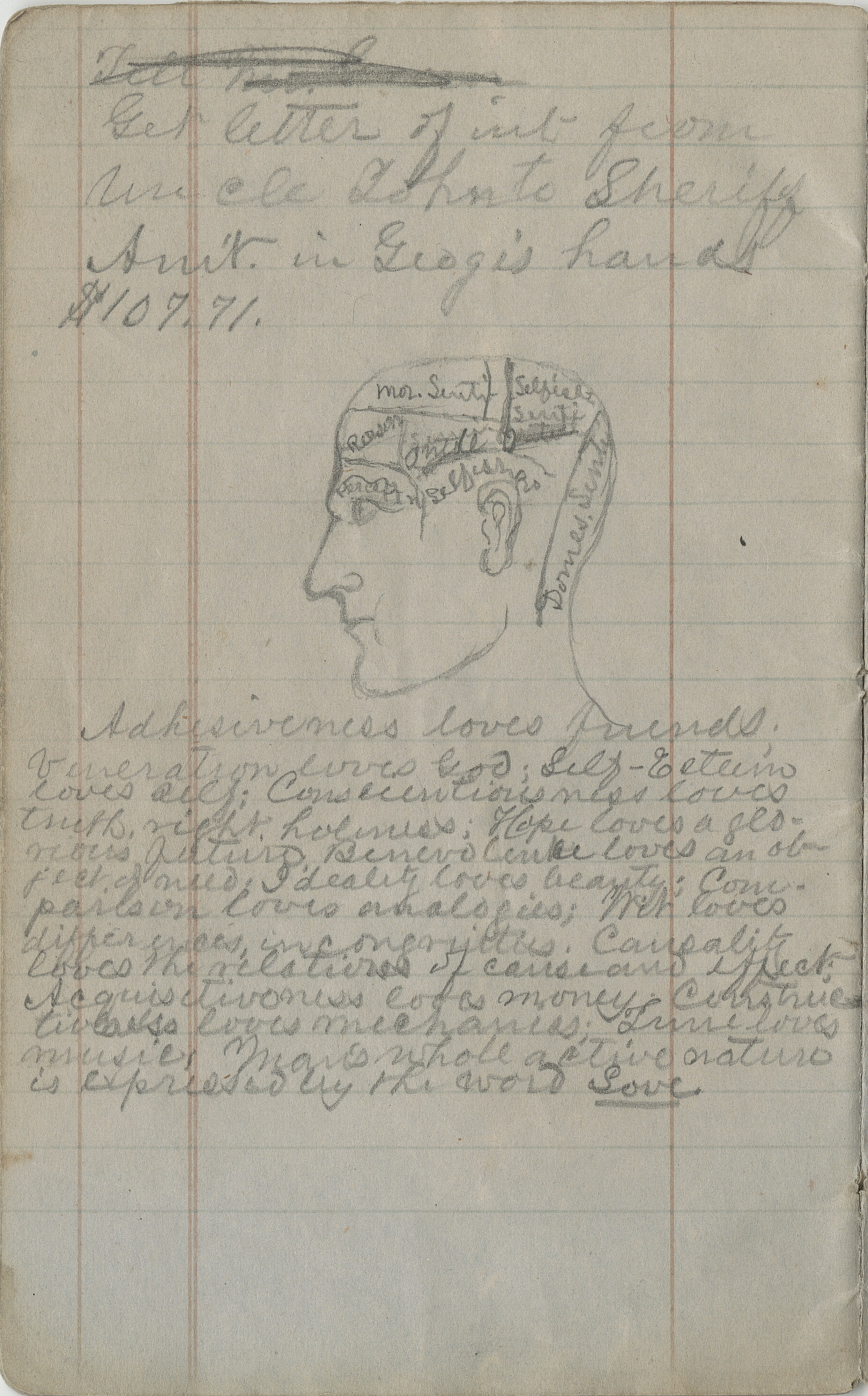
Tell Mr. Green
Get letter of int from
Uncle John31
to Sheriff
Am't. in Geoge's hands
$107.71.32
illustration33
Adhesiveness loves friends;
Veneration loves God; Self-Esteem
loves self;
Conscientiousness loves
truth, right, holiness; Hope loves a
glo-
rious
glorious
future;
Benevolent
BenevolenceⓉtextual note loves an
ob-
ject
object
of
[MTP: N&J1_33] need; Ideality loves beauty;
Com-
parison
Comparison
loves analogies; Wit
loves
differences, incongruities. Causality
loves the relations of cause
and effect;
Acquisitiveness loves money;
Construc-
tiveness
Constructiveness
loves
mechanics; Tune loves
music; Man's whole active nature
is
expressed by the word
Love.
Ⓣtextual note
[MS: N01_leaf_017r]
blank recto
[MS: N01_leaf_018v]
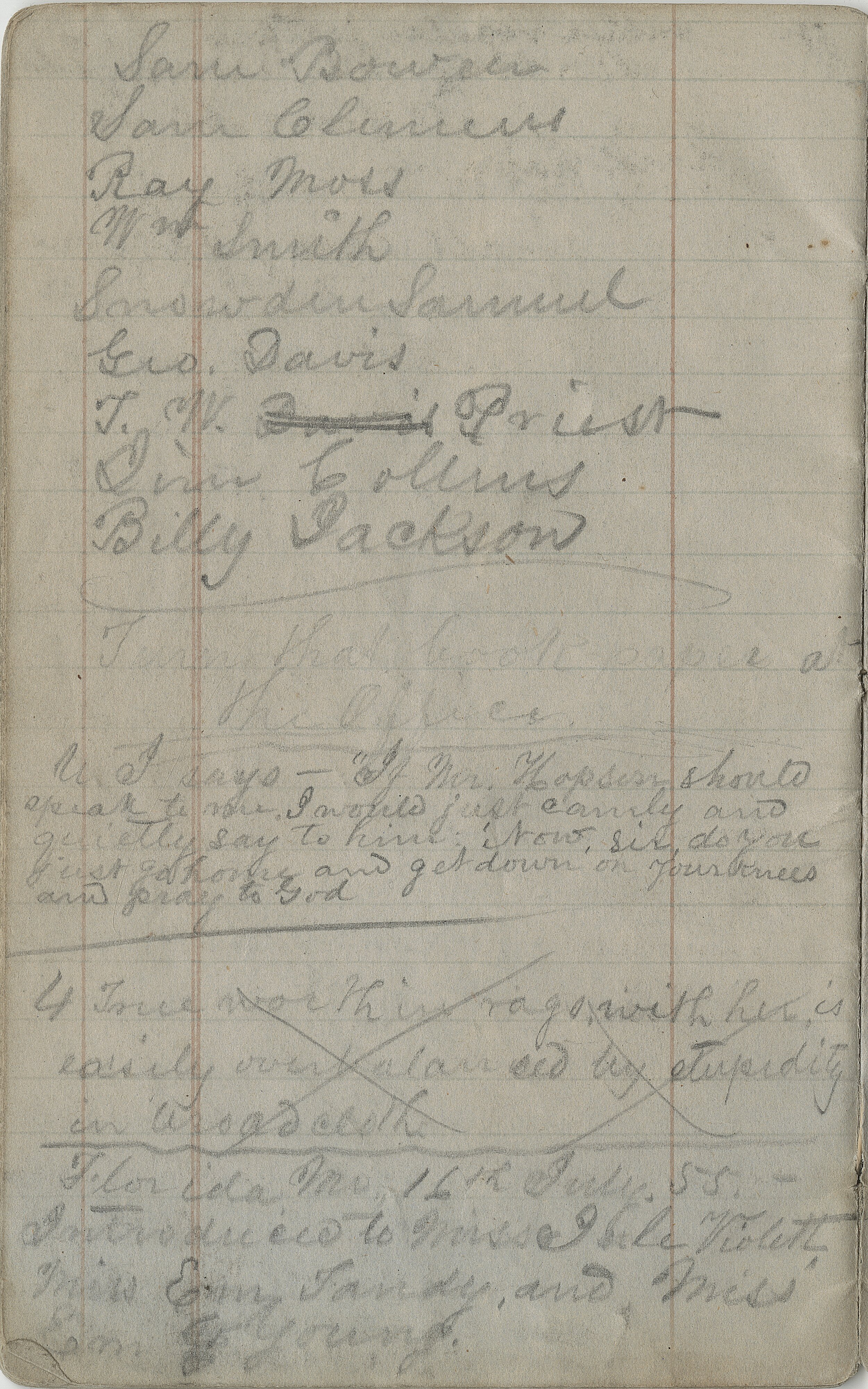
Sam Bowen
Sam Clemens
Ray Moss
Wm Smith
Snowden Samuel
Geo. Davis
T. W. Davis Priest
Jim Collins
Billy Jackson34
Turn that book paper at
the Office.35
U. J. says—“If Mr. Hopson should
speak to me, I
would just camly and
quietly say to him: ‘Now, sir, do you
just go home and get down on your knees
and pray to God36
[MTP: N&J1_34]
The fragment that appears in this place and that is numbered “4” in the manuscript has been moved to the end of the sequence it was intended for below.
Florida, Mo., 16th July,
55.—
Introduced to Miss Jule Violett,
Miss Em Tandy, and Miss
Em Young.37
The next three leaves were inscribed in reverse order in the manuscript notebook. Leaf_018v, transcribed above, comes between the pages numbered “1” and “2.” Thus, the page images below are numbered leaf_019r, leaf_18r, and leaf_17v, This sequence of pages has been placed after leaf_018v because Clemens presumably began writing on 018v before composing the sequence.
[MS: N01_leaf_019r] page numbered “1” in the upper left corner
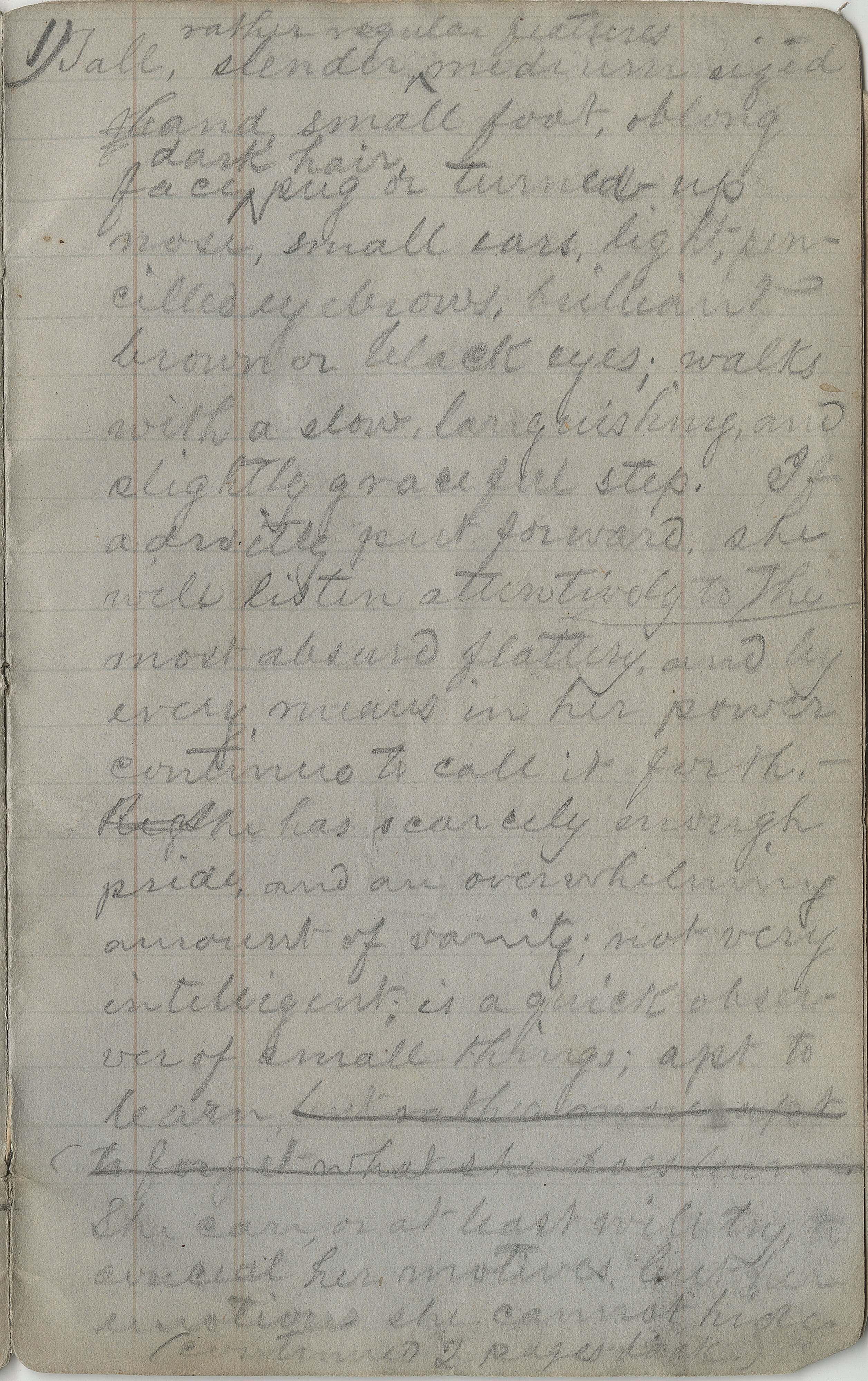
Tall, slender,
rather regular features
Ⓣtextual note medium sized
fo hand, small foot,
oblong
face,
dark hair,
Ⓣtextual note pug or turned-up
nose, small ears,
light,
pen-
cilled
pencilled
eyebrows, brilliant
brown or black eyes; walks
with a
slow, languishing, and
slightly graceful step. If
adroitly put forward,
she
will listen attentively to the
most absurd flattery, and by
every
means in her power
continue to call it forth. Rig
Ⓜemendation
She has scarcely enough
pride, and an overwhelming
amount of vanity; not
very
intelligent; is a quick
obser-
ver
observer
of small things; apt to
learn,
but rather more apt
to forget what she does learn.
She
can, or at least will try, to
conceal her motives, but her
emotions she
cannot hide.Ⓜemendation
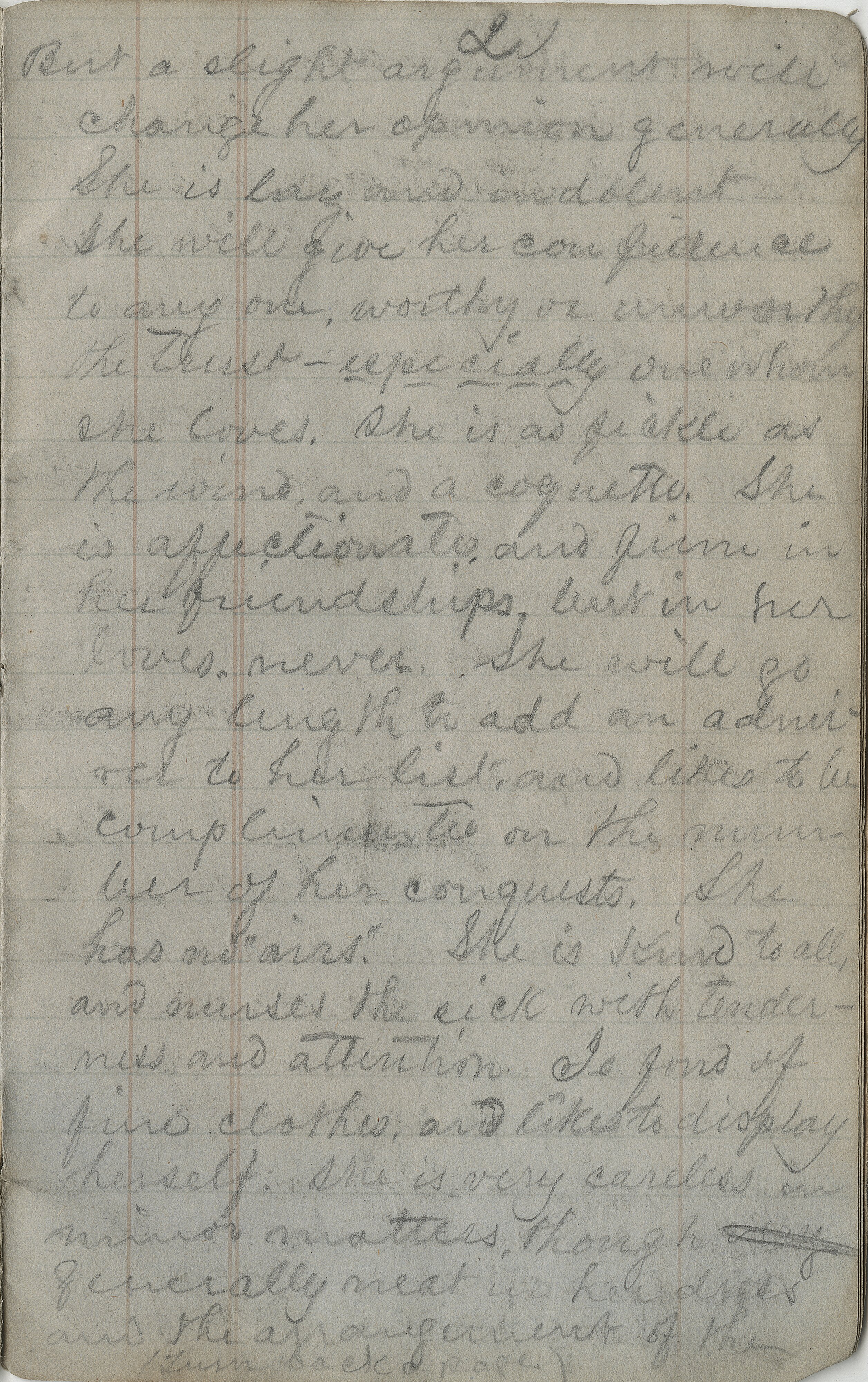
[MS: N01_leaf_018r]
page numbered “2” in the upper margin
But a slight argument will
change her opinion generally.
She is lazy and indolent
She will give her confidence
to any one, worthy
or unworthy
the trust—especially one
whom
she loves. She is as fickle as
the wind, and a coquette. She
is
affectionate, and firm in
her friendships, but in her
loves, never. She
will go
any length to add an
admi-
rer
admirer
to her list, and likes to be
complimented on the
num-
ber
number
of her conquests. She
has no
“airs.” She is kind to all,
and nurses the sick
with
tender-
ness
tenderness
and attention. Is fond of
fine clothes, and likes to
display
herself. She is very careless in
minor matters, though
very
generally neat in her dress
and the arrangement
[MTP: N&J1_35] of theⓂemendation
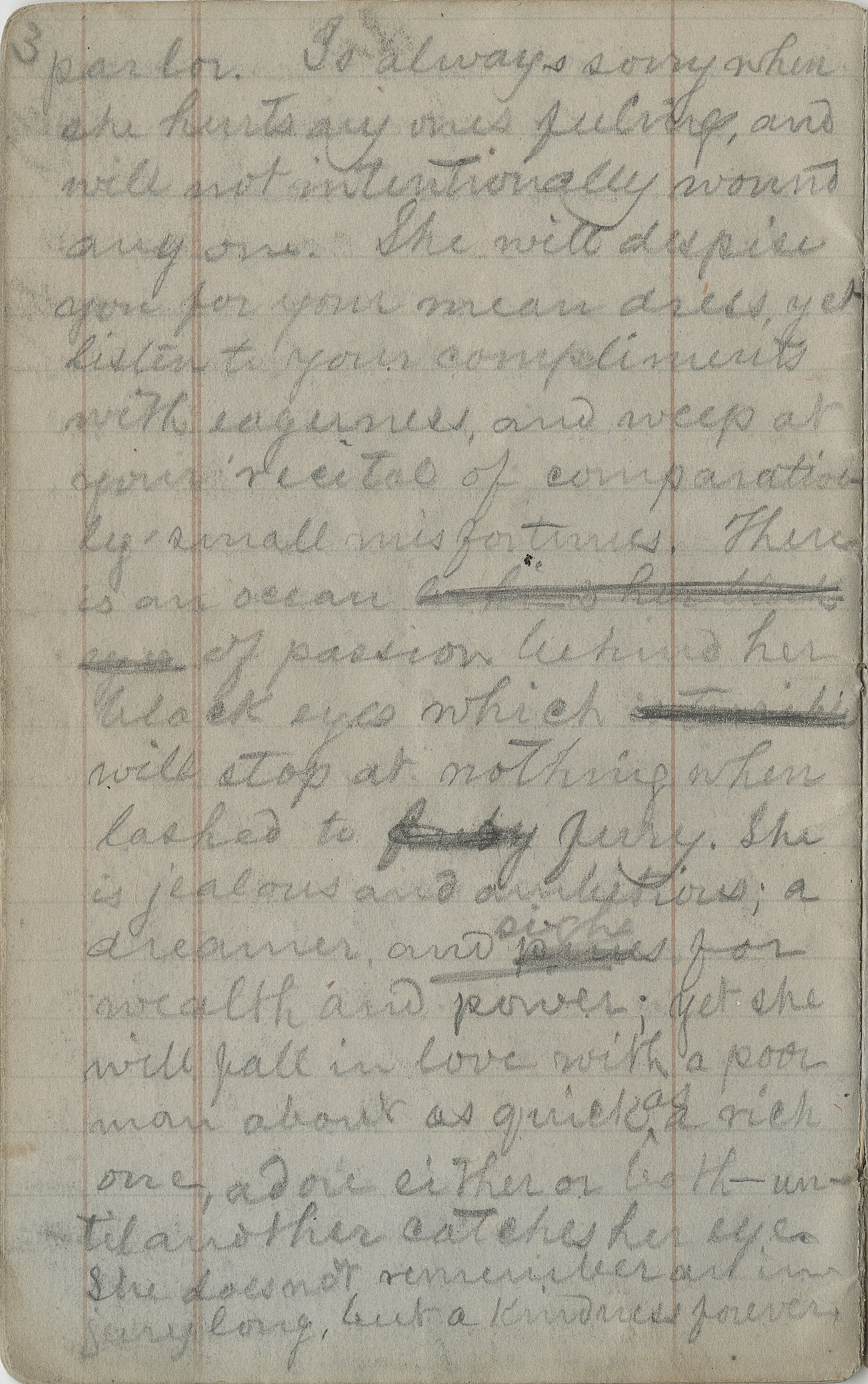
[MS: N01_leaf_017v]
page numbered “3” in the upper left corner
parlor. Is always sorry when
she hurts any ones feelings, and
will not
intentionally wound
any one. She will despise
you for your mean dress,
yet
listen to your compliments
with eagerness, and weep at
your recital
of
comparative-
ly
comparatively
small misfortunes. There
is an ocean behind her
black
eyes of passion behind her
black eyes which is
terrible
will stop at nothing when
lashed to fury
fury. She
is jealous and ambitious; a
dreamer, and
pines
sighs
Ⓣtextual note for
wealth and power; yet she
will fall in love
with a poor
man about as quick as
Ⓣtextual note a rich
one, adore either or
both—
un-
til
until
another catches her eye.
She does not remember an
in-
jury
injury
long, but a kindness forever.
The following sentence was originally inscribed on leaf_018v and numbered “4”:
True worth in rags,
in with her, is
easily overbalanced by stupidity
in
broadcloth.
Ⓣtextual note
38
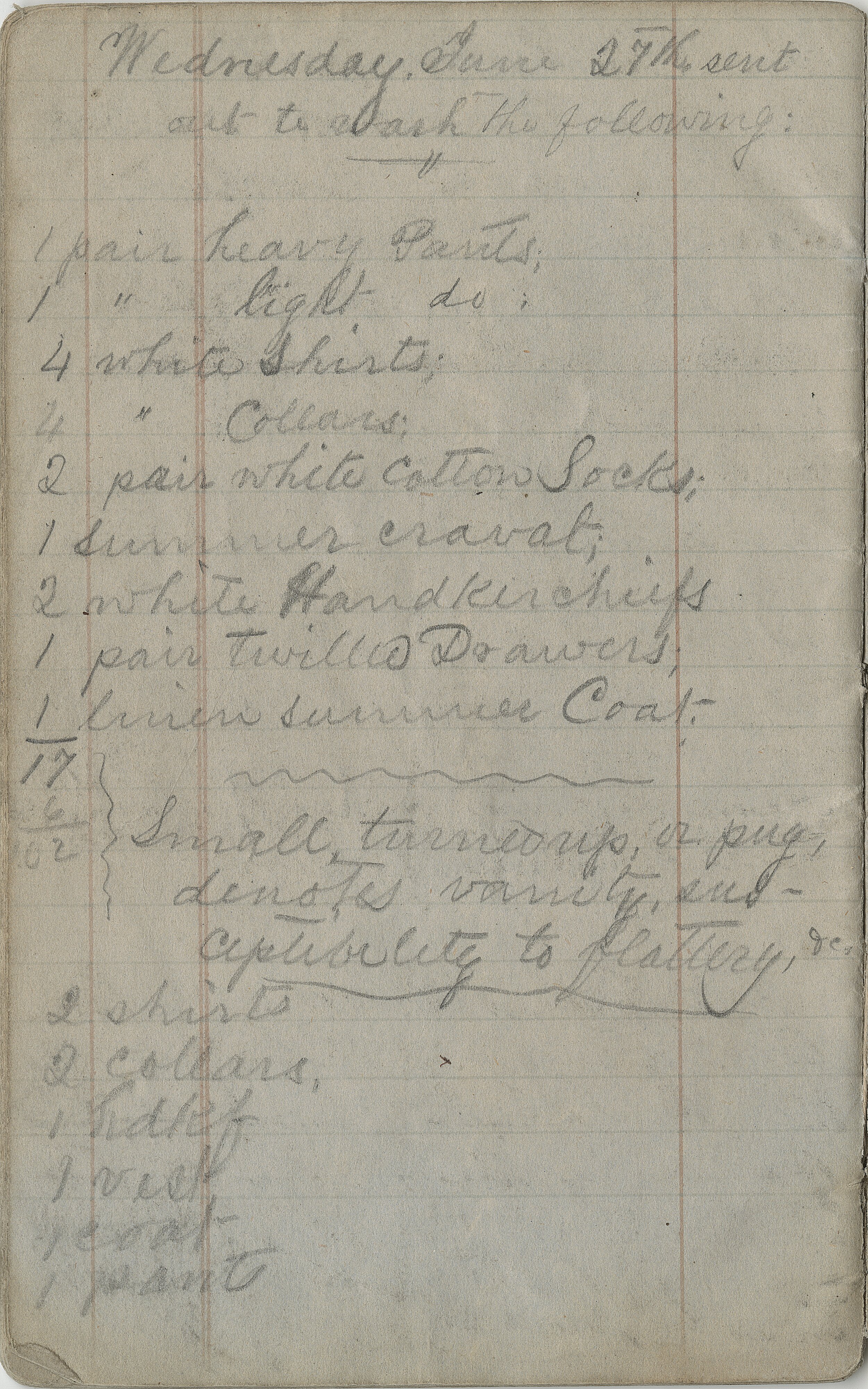
[MS: N01_leaf_019v]
Wednesday, June 27th sent
out to wash the
following:39
1 pair heavy Pants;
1 ” ” light do;
4 white Shirts;
4 ” Collars;
2 pair white cotton Socks;
1 summer cravat;
2 white Handkerchiefs
1 pair twilled Drawers;
1 linen summer Coat;
17
6
102
the fragment below is bordered by wavy lines:
Small, turned up, or pug,
denotes vanity,
sus-
ceptibility
susceptibility
to flattery,
&c.
[MTP: N&J1_36]
2 shirts
2 collars,
1 hdkf
1 vest
1 coat
1 pants
[MS: N01_leaf_020r]
See washerwoman.
See Mr. Clemens, 5 o'clock.40
See Pamela, 2 o'clock.41
See Mrs. Sexton.42
Go down to “News”43 Office.*
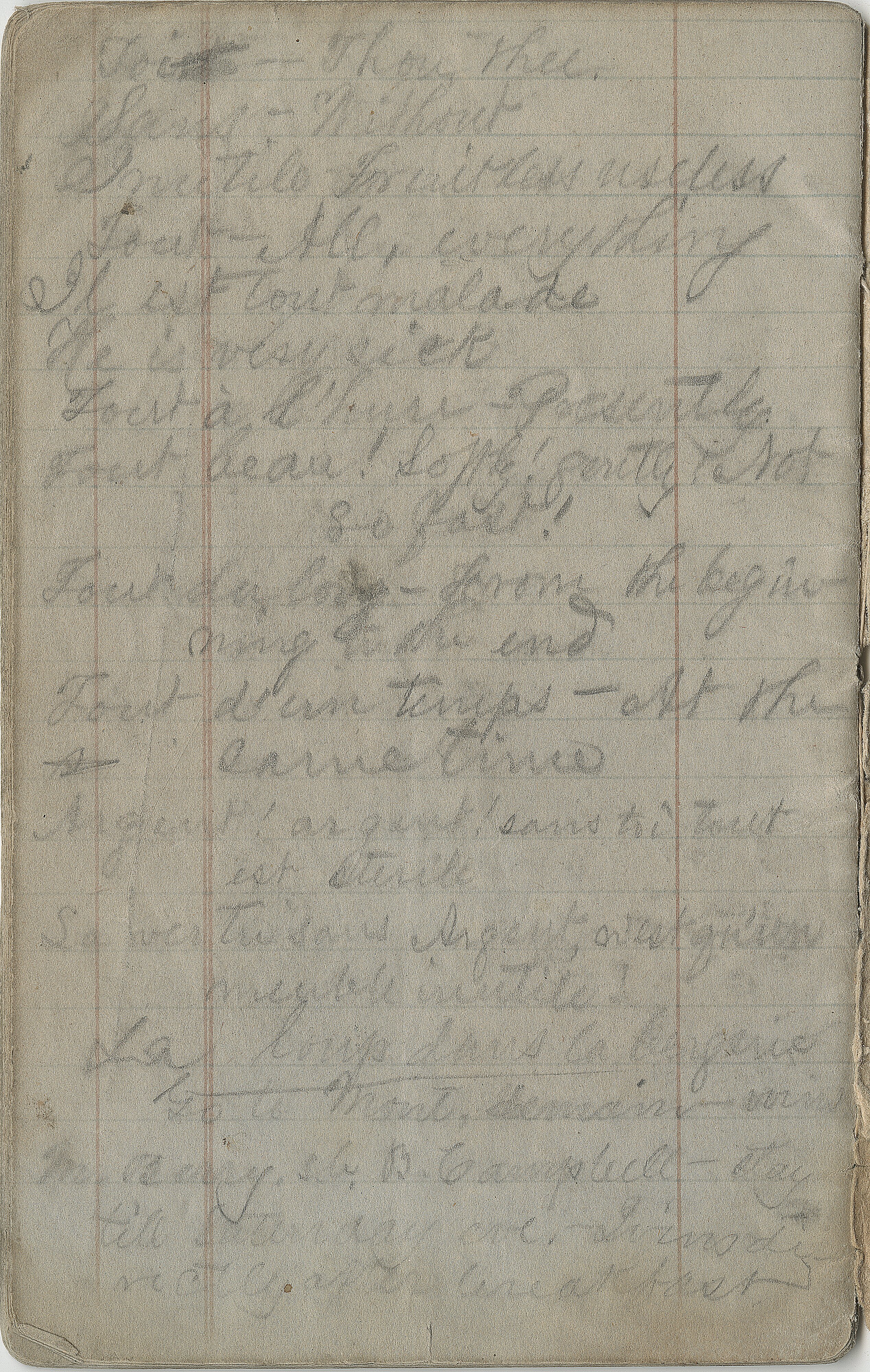
G- t mon L Français leçon.
[MTP: N&J1_37]
See John Hamilton.44
*Sell my “string.”
Go to Christian Church.
Pay Mrs. Pavey.45
Write to John Shoot.46
“Reading Room” on door of
Hotel, Paris (no
name)—reading
variety consists of Jayne's Med.
Almanac and pamphlet copy of
Lives of Beaumont &
Fletcher.47
Paris, 16th
July, 12 o'clock.
[MTP: N&J1_38]
Ask Moses Green if he
took a copy of the ages of
the children from the
old
family Bible in the box
of books at Miller &
Pogue's,
—and if he took the
deposi-
tion
deposition
to prove
the ages.
[MS: N01_leaf_020v]
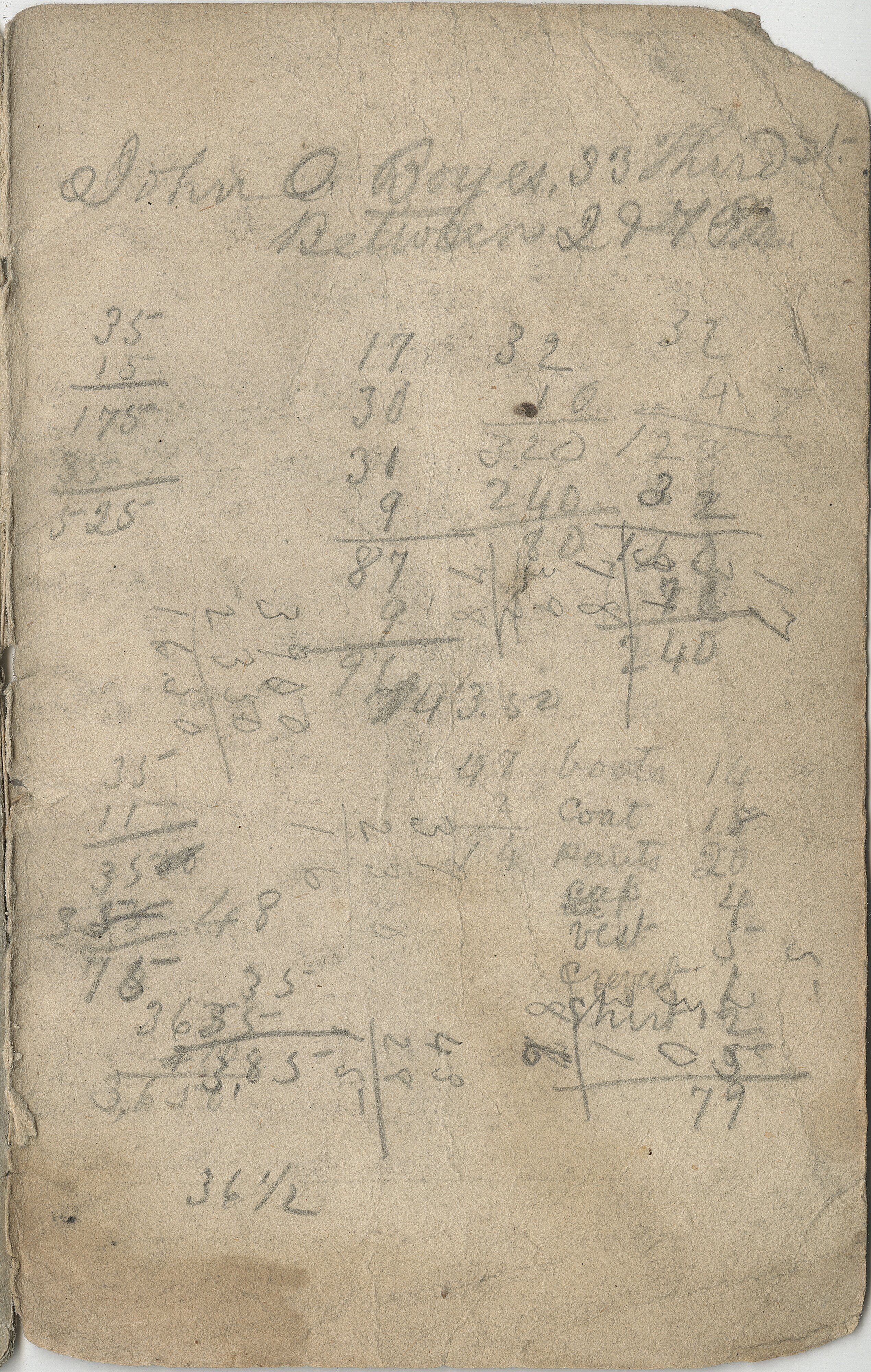
Toi - —Thou, thee.
Sans—Without
Inutile—Fruitless useless
Tout—All, everything
Il est tout malade
He is very sick
Tout à l'hure—Presently
Tout beau! Softly! gently! Not
so fast!
Tout du long—From the
begin-
ning
beginning
to the end
Tout d'un temps—At the
same time
Argent! argent! sans toi tout
est sterile
La vertu sans Argent, n'est
qu'un
meuble inutile!48
La loup dans la bergerie
Go to Mont,49
demain—voici
M. Bury, s.b. B. Campbell50—stay
[MTP: N&J1_39] till Saturday eve.—Ivins51
di-
rectly
directly
after breakfast.
[MS: N01_back endpaper]
calculations on this page have not been transcribed
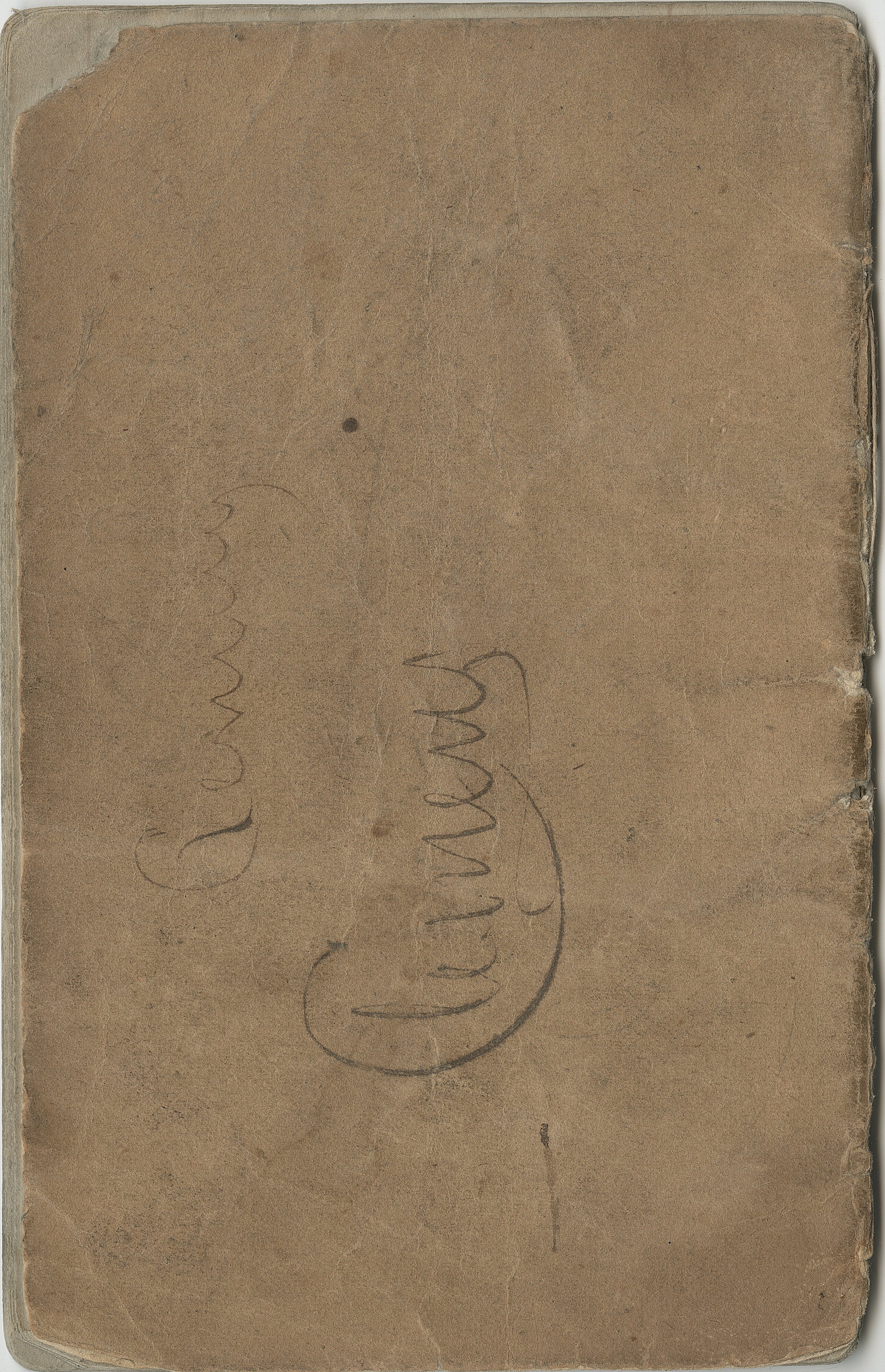
John O. Boyes, 33 Third st.
Between 2 & 7 PM.
boots
coat
pants
cap
vest
cravat
shirtⓉtextual note 52
[MS: N01_back cover]
When John Marshall Clemens' Hannibal property was auctioned for debt in 1843, his distant cousin James Clemens, Jr., a prosperous Saint Louis merchant and real estate investor, bought one of the lots on Hill Street for $330. Samuel Clemens' parents subsequently leased the lot from their relative and built a two-story frame house on it (Hannibal Courier-Post, 19 April 1947; SCH , pp. 102–103, 121, 290 note 2). After John Marshall Clemens died in 1847, Orion was appointed administrator of his father's estate, and he entered into a new ground lease, written for twenty-five years. In 1855 the yearly rental was thirty-five dollars, in addition to payment of all taxes (Marion County Deed Records).
On 6 August 1855 James Clemens, Jr., would write Orion verifying that no back rents were due. He also approved the sale of the house: “By this same mail I write to your mother and without the least doubt as to her consent to the sale prefer that my consent should pass through her hands and therefore enclose it to her to give or withhold as she may please.... I have charged rent and interest up to the 16th October next which ends a year—when you sell you can add rent from that time to 16 Octo. next.”
 conceivably from an attempt to
write while on a moving vehicle. They may be read as anything from
“Die by g—” to “Dirty
xg— —.” Ross is the subject of an
uncompleted anecdote recorded previously in this notebook.
conceivably from an attempt to
write while on a moving vehicle. They may be read as anything from
“Die by g—” to “Dirty
xg— —.” Ross is the subject of an
uncompleted anecdote recorded previously in this notebook.The steamboat Ben Campbell, a sidewheel packet built in 1852, was operating above the Des Moines Rapids during the summer of 1855 (George Byron Merrick, Old Times on the Upper Mississippi Cleveland, Ohio: Arthur H. Clark Co., 1909, p. 260; Saint Louis Missouri Republican, 11 August 1855). The boat left Montrose at 12 o'clock nightly, carrying Chicago-bound passengers to points along the Illinois shore (Keokuk Gate City, 10, 11 May 1855).
Clemens may have been seeking an experienced river pilot to teach him the craft. The name “Bury” does not appear in contemporary records, but William T. and David Berry were listed as pilots in the 1854/1855 Saint Louis city directory. According to Lloyd's Steamboat Directory (Cincinnati: James T. Lloyd & Co., 1856), p. 300, David Berry was piloting only on the Upper Mississippi during 1855.