(December 1866–January 1867)
On 15 december 1866, Mark Twain sailed from San Francisco on the North American Steamship Company's “opposition” steamer America, bound for New York via Nicaragua, “leaving more friends behind me than any newspaper man that ever sailed out of the Golden Gate” (SLC to “Dear Folks,” MTBus , p. 89). Notebook 7 is his record of this journey. It is perhaps the most circumscribed of the early notebooks, covering less than a month in time and limited to the incidents of an itinerary that allowed little room for independent activity. Nevertheless, Notebook 7 has an obscure and difficult chronology which is complicated throughout by Clemens' habit of inserting retrospective notes. Mark Twain's Travels with Mr. Brown (New York: Alfred A. Knopf, 1940), edited by Franklin Walker and G. Ezra Dane, gathers Mark Twain's letters to the Alta California to provide an orderly chronological account of the journey, which helps illuminate Clemens' chaotic notebook.
To a great degree the difficulties presented by Notebook 7 reflect the complex voyage from San Francisco to New York. The Nicaragua passage, controlled by the North American Steamship Company, was accomplished by a combination of ocean, land, river, and lake conveyances. The America, under the command of Edgar Wakeman, completed only the first leg of the voyage, bringing Clemens to the port of San Juan del Sur on the Pacific coast of Nicaragua on 28 December 1866. Here there was a delay occasioned by a report of cholera on the Isthmus, an ominous forecast of the dangers that lay ahead. The disease had broken out among a party of six hundred passengers from New York, half of them soldiers, who had been stranded at San Juan del Sur for two weeks awaiting the America. They had arrived there too late to make their scheduled connection for California partly because their ship from New York, the North American Steamship Company's San Francisco, became disabled near Virginia and had to put into port to transfer them to another vessel. Clemens recorded their distress in his notebook (see pp. 258 and 296–297) and was no doubt apprehensive that the San Francisco, with so recent a record of poor performance was to convey the America's four hundred passengers to New York. In fact, the routine discomforts of travel in such numbers—registered in Notebook 7 in Mark Twain's many complaints of second-cabin passengers' impositions—were to be exacerbated aboard the San Francisco by three mechanical failures while cholera spread among the passengers.
On 29 December, leaving the stranded travelers to board the America, Clemens and the other disembarked passengers, distributed among carriages or mounted on horses and mules, began the “twelve-mile journey of three hours and a half, over a hard, level, beautiful road” ( MTTB , p. 40) to Virgin Bay and the shores of Lake Nicaragua, where they boarded a steamer. After an afternoon and a night on the lake steamer they arrived at Fort San Carlos on the San Juan River. There at about 4 a.m. on 30 December they boarded “a long, double-decked shell of a stern-wheel boat, without a berth or a bulkhead in her—wide open, nothing to obstruct your view except the slender stanchions that supported the roof” and “started down the broad and beautiful river in the gray dawn of the balmy summer morning” ( MTTB , p. 47). At Castillo, where they had to go ashore to bypass dangerous rapids on foot and change to another stern-wheel steamer, the Cora, Clemens and his companions stopped for a lunch of fruit, eggs, bread, and coffee. Here and throughout the river segment of the trip Mark Twain's notes reflect his attention to the topography of Nicaragua. Recalling perhaps the fine response to his romantic word-portraits of Hawaii on his recent California-Nevada lecture tour, he composed lengthy descriptions of the physical features of Nicaragua, which he later incorporated into his Alta California letters.
After a night “tied up at the bank within 30 miles of Greytown” ( MTTB , p. 53), the Cora arrived at the coast on 31 December. Clemens spent the night ashore in Greytown and began the new year “in the midst of a heavy sea and a drenching rain,” as the passengers bound for New York were shuttled by small boat to the San Francisco. The San Francisco had been at sea only about a day when, on 2 January 1867, Clemens noted, “Two cases of cholera reported in the steerage to-day.” At this point Notebook 7 becomes the log of a desperate race against a spreading epidemic, first to Key West, where the San Francisco stopped for provisions and fuel on 6 January 1867, and then to New York, where it finally made port on 12 January after a harrowing ten days.
In addition to the complexities of the trip, it is because Notebook 7 is a record made by Clemens while afflicted by an undetermined illness and captive to fearful surroundings that this journal makes unusual demands on the patience of a reader. The effect of the developing epidemic on board the San Francisco is evident in the increasing morbidity of Clemens' notes after the departure from Greytown. “All levity has ceased,” he wrote at one point, and indeed there was no renewal of the foolish deck games that had been popular aboard the America. By 5 January, when six people were ill and the ship seemed a “floating hospital,” Clemens' preoccupation with his own chances of surviving and his pity and compassion for the dead and dying dominate the notebook. He sought distraction in Victor Hugo's Toilers of the Sea and in an attempted burlesque of that book, but he soon gave up both the reading and the satire. Other entries are less sustained than in the portion of the notebook used during the thirteen days aboard the America. There Clemens had transcribed entire anecdotes told by Ned Wakeman. He may originally have intended to write his Alta letters as he went, but during the whole trip he finished only one letter, which he sent back to San Francisco on the America. The six letters which complete his account of the journey did not begin to be published until more than a month after his arrival in New York, two appearing in late February, three in mid-March, and one at the end of that month. Upon arriving in New York on 12 January, Clemens telegraphed the bare details of the cholera-shadowed voyage to the Alta, but San Francisco readers had to wait until March for the full version. Clemens was determined to get full value from all of the events of the passage from San Francisco, the happy ones as well as the tragic. In few other instances is there so prolonged and direct a correspondence between the raw material of a notebook and its final literary expression.
Notebook 7 provides other evidence of Clemens' developing conception of himself as a professional writer. He was careful to preserve the moments of retrospection that were his characteristic response to the boredom inevitable on any voyage. Sometimes such notes are related to past incidents of the journey, but often they recall events from earlier periods, including a significant number that would be incorporated in Roughing It. Characters in Notebook 7 were to reappear regularly in Mark Twain's writings. He continued to employ Brown, the vernacular figure frequently present in Notebooks 5 and 6, and he introduced the Bore, a fellow passenger of persistent foolishness, who would figure in various guises in later travel accounts. More than anything else, however, it is Mark Twain's record of Captain Edgar Wakeman's manner and flamboyant anecdotal style that gives this notebook artistic substance.
Wakeman's place in Mark Twain's imagination is evident not only in the recurrent notes about him in this and succeeding notebooks, but also in his numerous appearances in Mark Twain's fiction. The first is the Captain Waxman of the Alta California letters, but Mark Twain also accurately portrayed Wakeman in 1872 as Captain Ned Blakely in chapter 50 of Roughing It and in 1877 as Captain Hurricane Jones in “Some Rambling Notes of an Idle Excursion.” Other treatments of Wakeman were less successful. In 1868 Mark Twain began “Captain Stormfield's Visit to Heaven,” based on a dream Wakeman recounted to him when the two met again during Mark Twain's return voyage to California that year. Mark Twain continued to work on this piece in the seventies, in 1881, and was still engaged by it in the early 1900s, finally publishing it as an “Extract from Captain Stormfield's Visit to Heaven” in Harper's Magazine in December 1907 and January 1908 and in book form in October 1909. In 1905 he worked on a manuscript he called “The Refuge of the Derelicts” about an aged Admiral Stormfield, who runs a haven for “Life's failures. Shipwrecks. Derelicts, old and battered and broken, that wander the ocean of life lonely and forlorn” ( FM , p. 186). Mark Twain claimed that this manuscript concerned “an ancient admiral, who is Captain Ned Wakefield under a borrowed name” (AD, 30 August 1906). The composite name Wakefield was a significant slip, for although distance in time led Clemens to believe he was again portraying Wakeman, in none of the Stormfield pieces could he recapture Wakeman's idiom and idiosyncrasies. He revived Wakeman's character only in small measure, and even that by assertion rather than art.
Except for the brief meeting in 1868, Clemens never saw Wakeman again, although he heard about him on several occasions. In 1872 Mark Twain was solicited to write an appeal for assistance to relieve the Wakeman family, which was in financial trouble and in danger of losing its home. On 3 December of that year he responded with a letter calling upon Wakeman's “old friends on the Pacific Coast” to “take the old mariner's case in hand . . . and do by him as he would surely do by them were their cases reversed,” which was published in the Alta California on 14 December 1872. Although Mark Twain was not listed among the contributors to the Wakeman fund, on 19 January 1873, Mrs. Wakeman wrote to thank him “for the kindness which prompted you in sending your timely letter to the Alta. Our home is once more our own, and we feel the kind and prompt assistance extended by the Capt's. California friends, is to be attributed to that letter.” Clemens later recalled that the need for his aid had been occasioned by Wakeman's death and that the sum proposed for the relief of the family was raised “in an hour” (AD, 29 August 1906). In fact, this was not the case. The $4,750 necessary to pay the mortgage on the Wakeman home had been raised only after several weeks and a second appeal, this time not directly involving Mark Twain, although alluding to his Alta letter. Nor had Wakeman died. He had, however, suffered a paralyzing stroke that made it impossible for him to work. Mark Twain's mistaken recollection that Wakeman died in 1872 was coupled with a curious failure to recall a last pathetic appeal. On 12 February 1874 he received a request from the captain, then only a little more than a year from death, for “about ten days with you” to discuss collaboration on a biography “full of the most remarkable incidents thrilling adventures both on the Sea and Land” which “When Clothed by your able and incomparable Pen. in Such Brilliant Robes that the readers will be unable to Judge the difference between facts and fiction . . . will have a Big Sale.” Don't “take Hold of any other Book until you have done With Mine . . . I want you and your memory to write my Life so I Shall Die Contented,” Wakeman entreated, but Clemens was already occupied with lecture commitments and a number of literary projects. Consequently, on 18 March 1874 he informed his brother Orion:
I have written him that you will edit his book & help him share the profits, & I will write the introduction & find a publisher.
There is no indication that either Orion Clemens or Wakeman seriously considered this offer. Several months later, while traveling to Panama, the Reverend Joseph Twichell discovered Wakeman among his fellow passengers. On 22 August 1874 Twichell wrote Mark Twain that Wakeman “had a good deal to say about your books which he admires enthusiastically”:
By and by he told me of his having written to ask you to write up his career, and expressed himself as much disappointed that you declined the job. And, really, I was sorry myself that you had to refuse him. 'Twould have done him so much good to have you for his chronicler.
Twichell thought Wakeman “a titanic commentator on the old Testament” and Mark Twain later used his report of Wakeman's “adventure of Isaac with the prophets of Baal” in “Some Rambling Notes of an Idle Excursion.” Wakeman's own adventures, finally edited by his daughter, appeared in 1878 as The Log of an Ancient Mariner (San Francisco: A. L. Bancroft & Co.). But Mark Twain's refusal to work with Wakeman cannot be attributed to a lack of belief in the literary value of Wakeman's character and anecdotes. For Notebook 7, a writer's notebook in the fullest, most immediate sense, provides primary evidence of Mark Twain's intention to use Wakeman and Wakeman's “most remarkable incidents thrilling adventures” as literary subjects long before he was invited to do so by the captain himself.
Notebook 7, used between 15 December 1866 and 12 January 1867, now contains 214 pages, 38 of them blank. The pages measure 6 9/16 by 4 inches (16.7 by 10.2 centimeters), and their edges are tinted blue; otherwise the book is identical in design and format to Notebook 5. All the gatherings have come loose from the binding, and many single leaves have come loose from the gatherings. Entries are in pencil with occasional revisions in various inks. Use marks in blue ink and in pencil, probably Paine's, appear throughout the notebook; Clemens drew wavy lines in brown ink through some entries toward the end of the notebook to indicate use. There are several pencil entries on the flyleaves and endpapers and a single entry in ink on the front cover. Paine, or possibly Clemens, wrote the date “1866” on the front cover in ink.
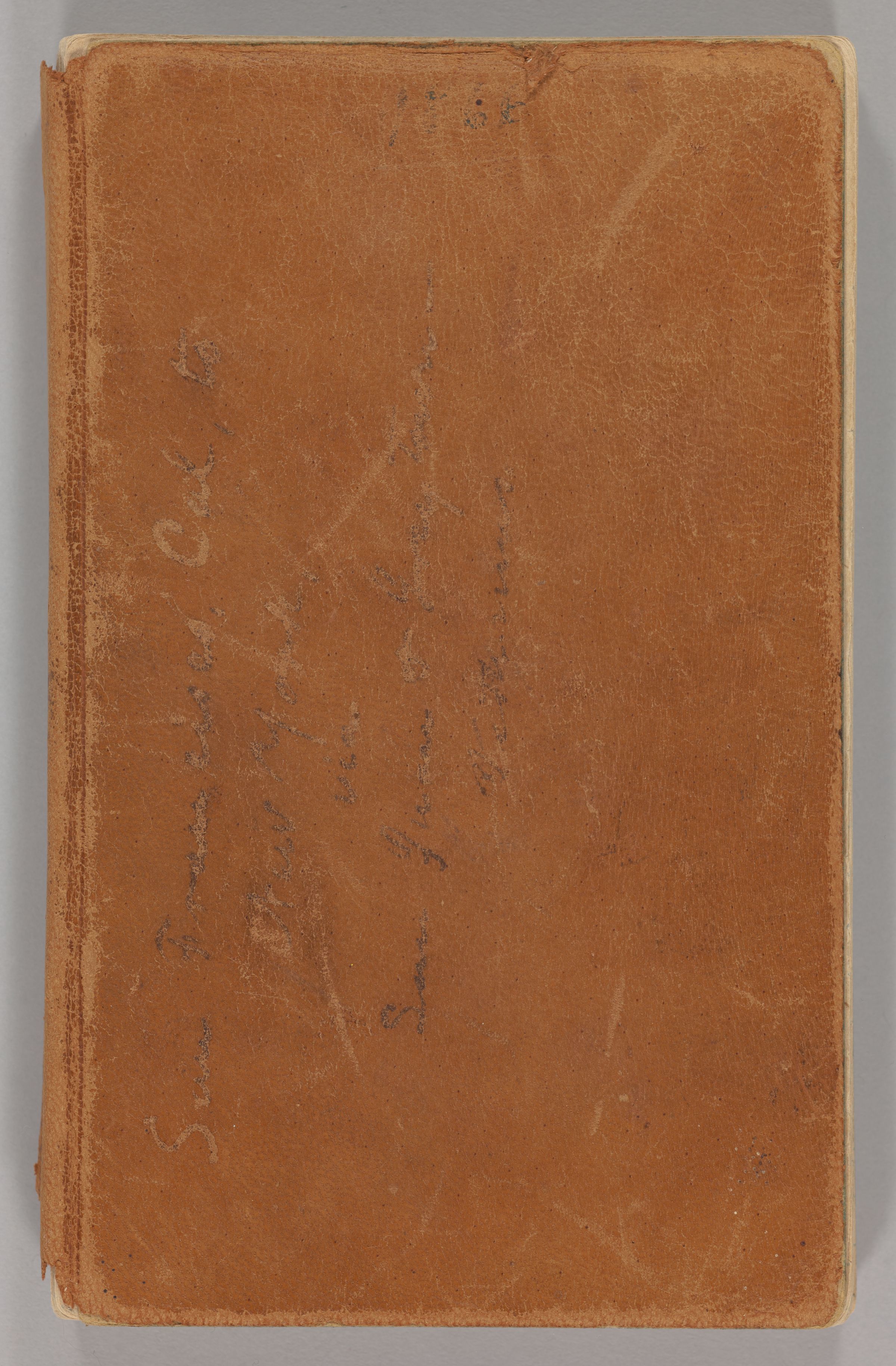
[MS: N7_front cover]
[MTP: N&J1_244]
San Francisco, Cal, to
New York,
via
San Juan & Greytown—
Isthmus.
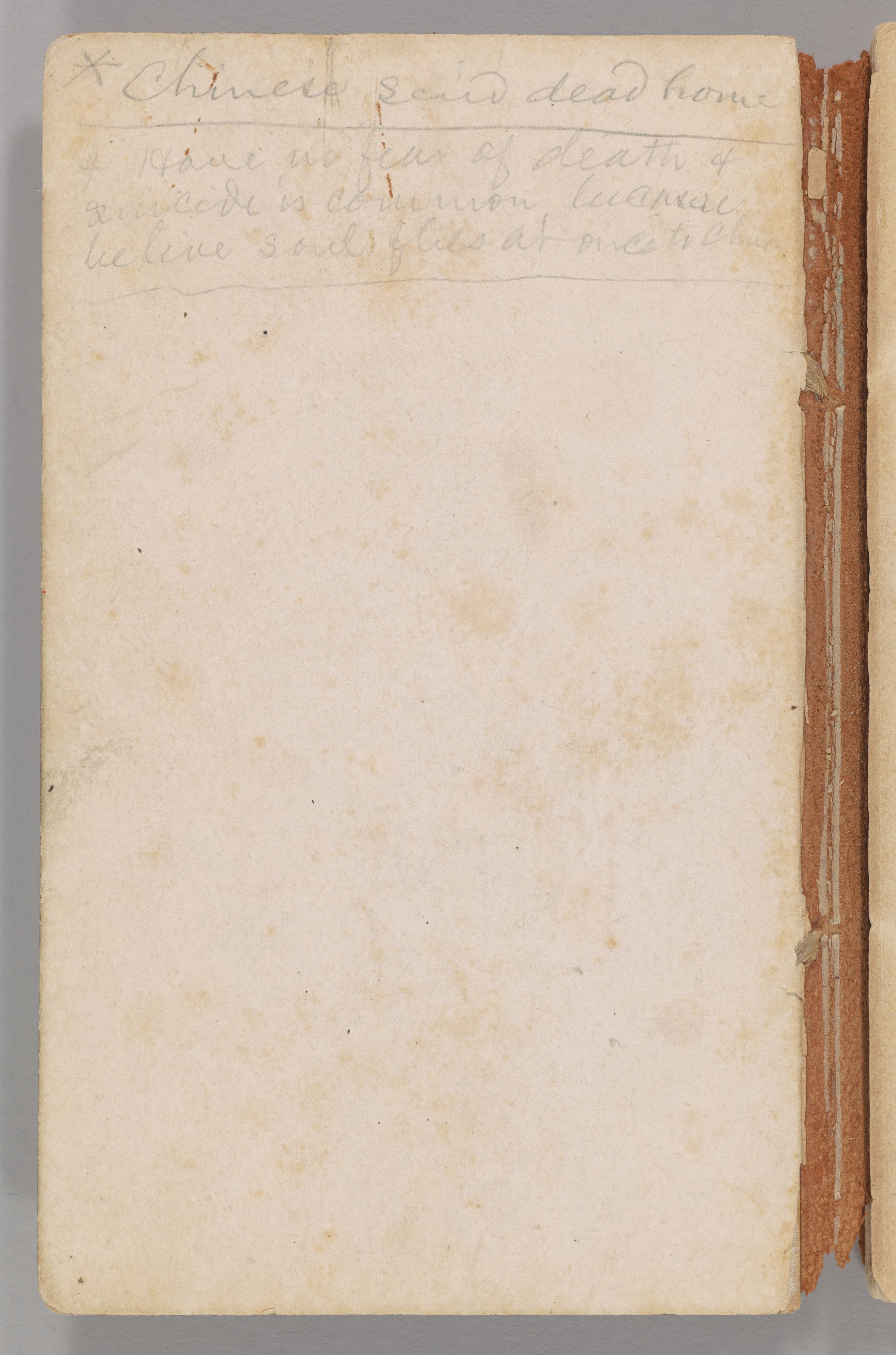
[MS: N7_front endpaper]
* Have no fear of death &
suicide is common, because
belive soul flies at once to China
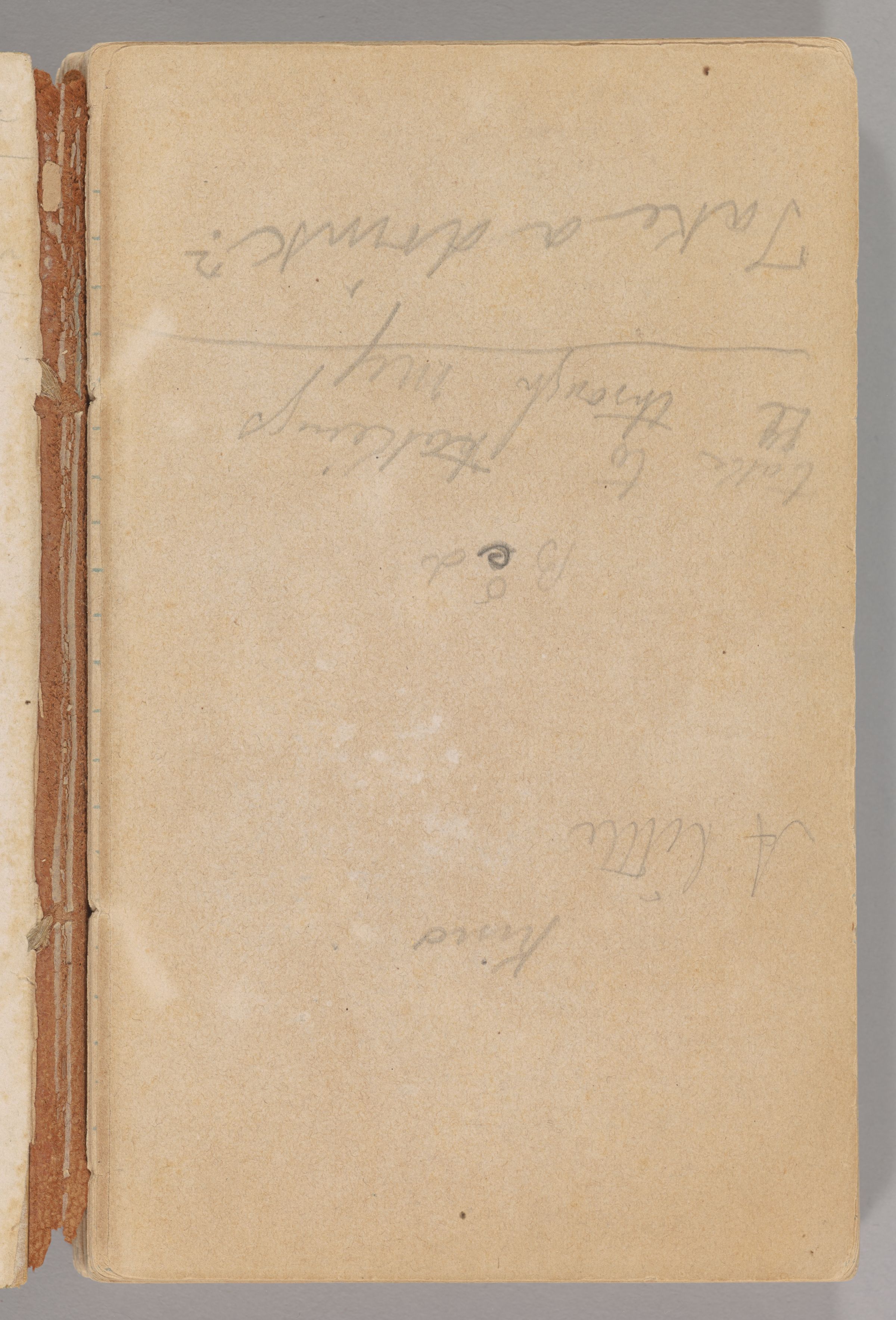
[MS: N7_front flyleaf recto]
written upside down from the bottom of the page
A little
Be̊d
taketo m takings
u U throughmy
Take a drink?

[MS: N7_front flyleaf verso]
blank verso
[MS: N7_leaf_001r]
blank recto, followed by blank verso and three blank leaves
[MS: N7_leaf_005r]
[MTP: N&J1_245]
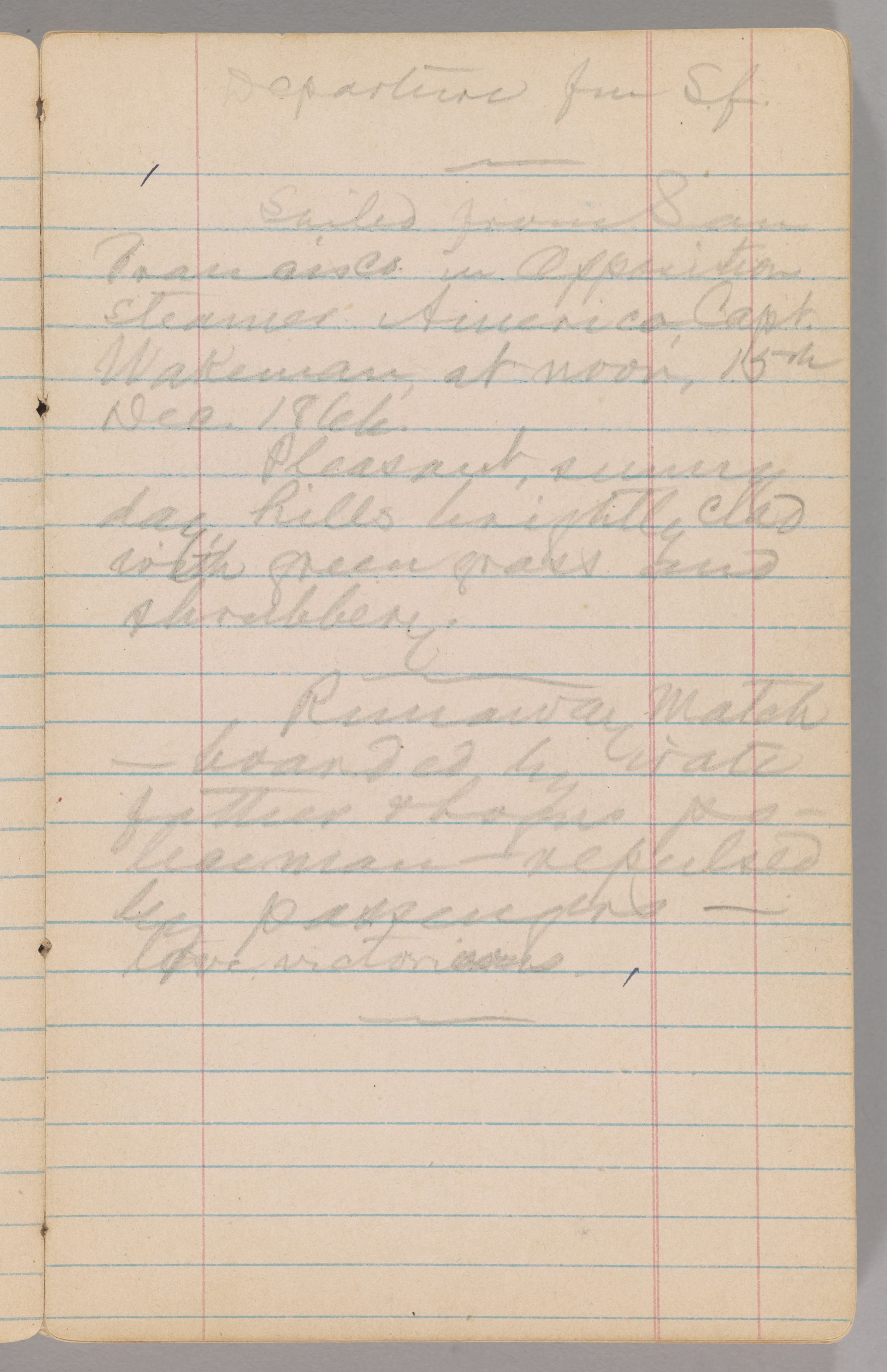
Departure fm S.f.
Sailed from San
Francisco in Opposition
steamer America, Capt.
Wakeman, at noon, 15th
Dec. 1866.
Pleasant, sunny
day, hills brightly clad
with green grass and
shrubbery.

Runaway Match
—boarded by irate
father & bogus
po-
liceman
policeman
—repulsed
by passengers—
love victorious.
[MS: N7_leaf_005v]
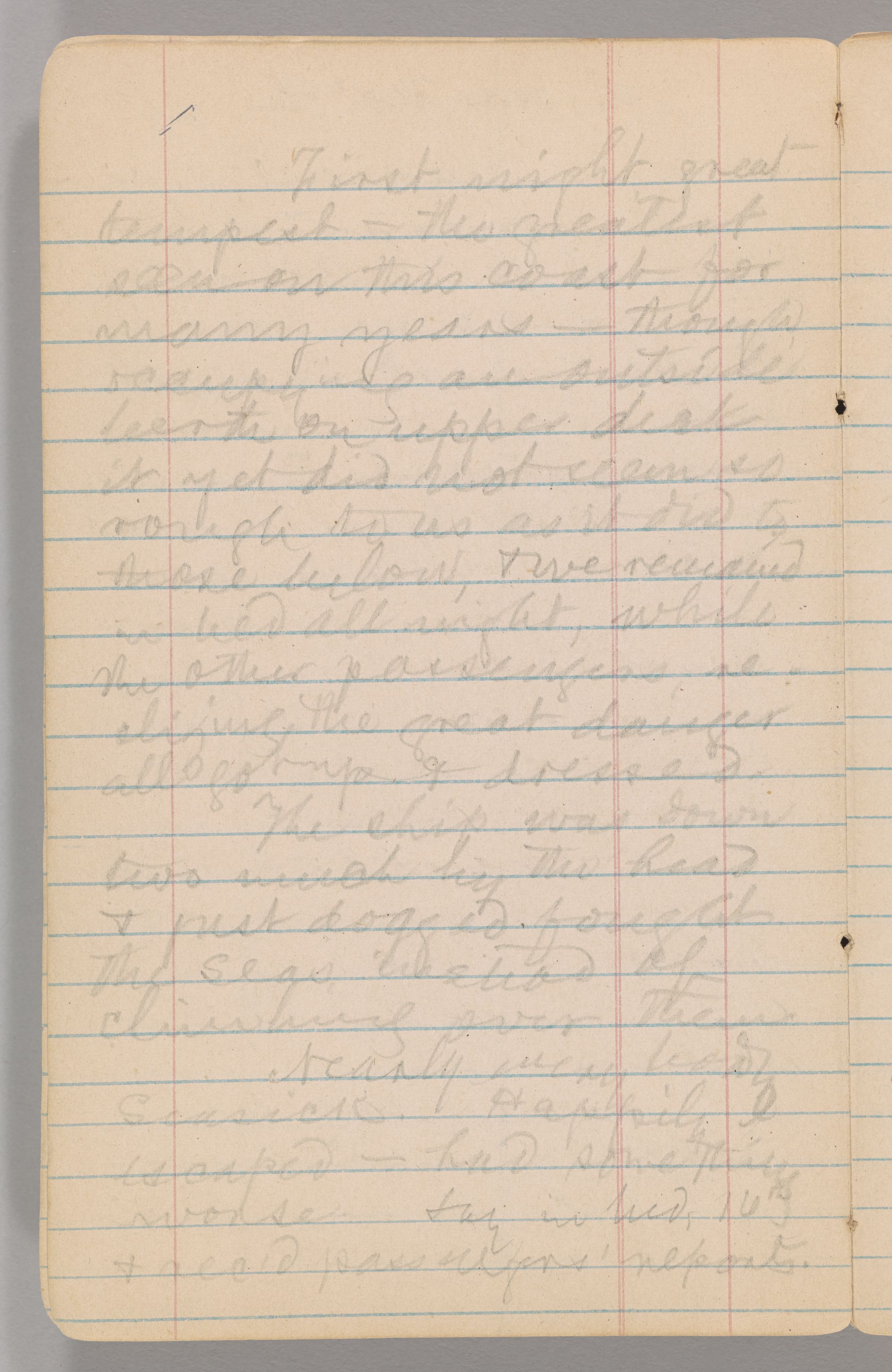
First night great
tempest—the greatest
seen on this coast for
many years—though,
occupying an outside
berth on upper deck
it yet did not seem so
rough to us as it did to
those below, & we remaind
in bed all night, while
the other passengers,
re-
alizing
realizing
the great danger
all got up & dressed.
The ship was down
two much by the head
& just dogged fought
the seas, instead of
climbing over them.
Nearly everybody
seasick. Happily I
escaped—had something
worse. Lay in bed, 16th
& rec'd passengers' reports.
[MS: N7_leaf_006r]
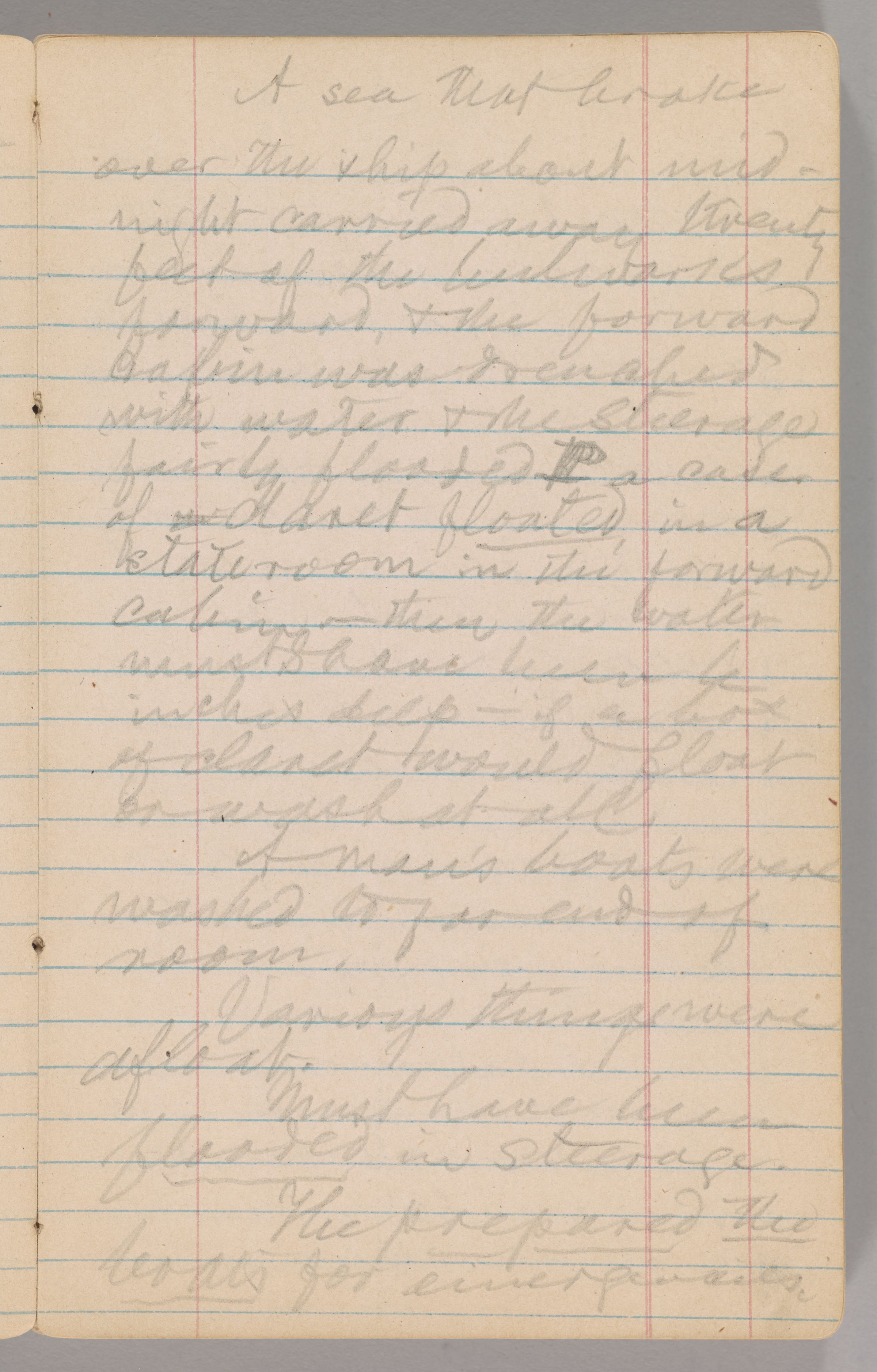
A sea that broke
over the ship about
mid-
night
midnight
carried away twenty
feet of the bulwarks
forward, & the forward
cabin was drenched
with water & the steerage
fairly flooded
&
¶ a case
of w claret floated, in a
state room in the forward
cabin—then the water
must have been 6
inches deep—if a box
of claret would float
or wash at all.
A man's boots were
washed to far end of
room.
Various things were
afloat.
[MTP: N&J1_246]
Must have been
flooded in steerage.
They
prepared the
boats for emergencies.
[MS: N7_leaf_006v]
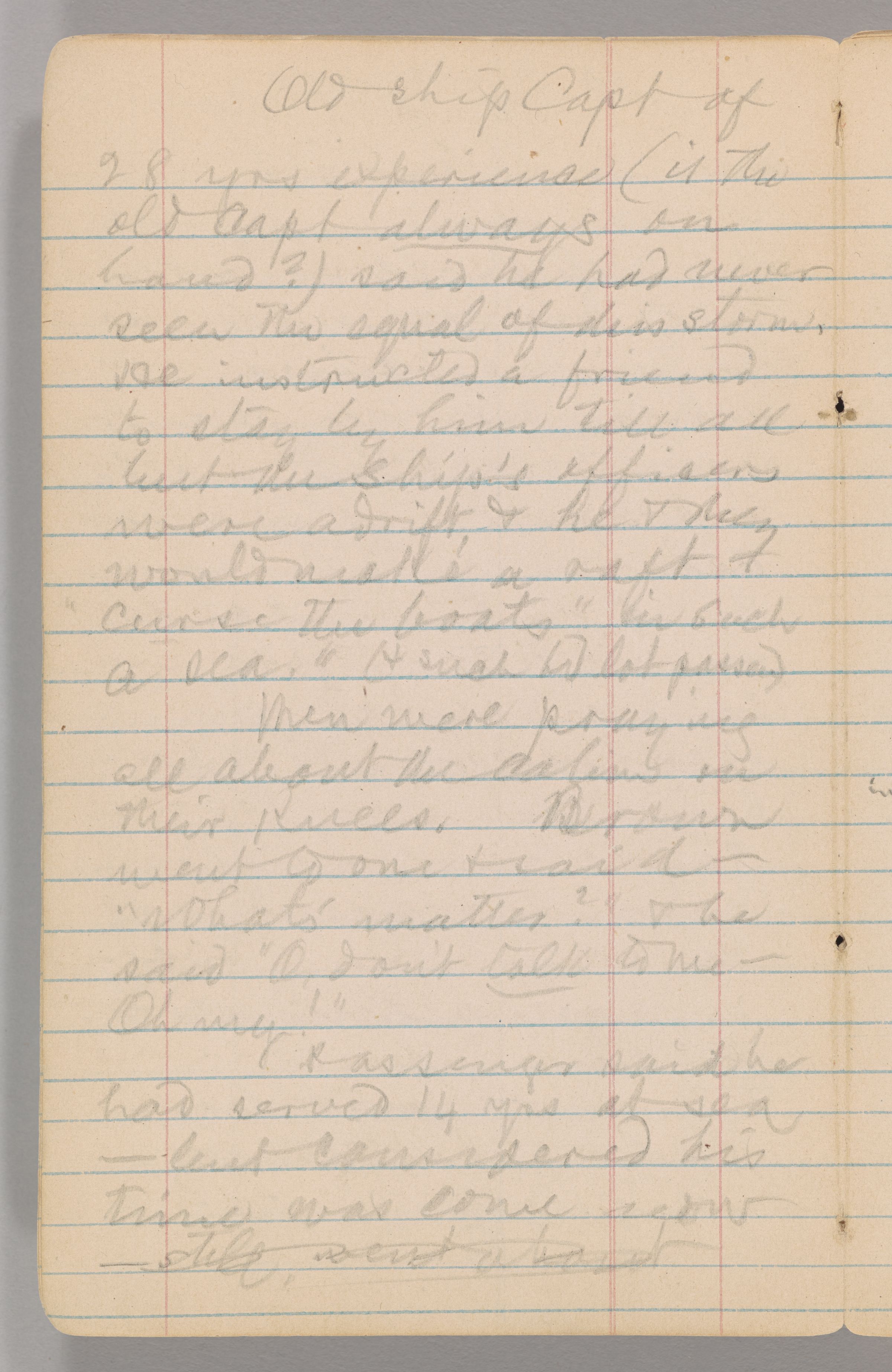
Old ship Capt of
28 yrs experience (is the
old Capt always on
hand?) said he had never
seen the equal of this storm.
He instructed a friend
to stay by him till all
but the ship's officers
were adrift, & he & they
would make a raft—
“curse the boats” in such
a sea.” (& such bd lot passen)
Men were praying
all about the cabin on
their knees.
W Brown
went to one & said—
“What's matter?” & he
said “O, don't talk to me—
Oh my!”
Passenger said he
had served 14 yrs at sea
—but considered his
time was come now
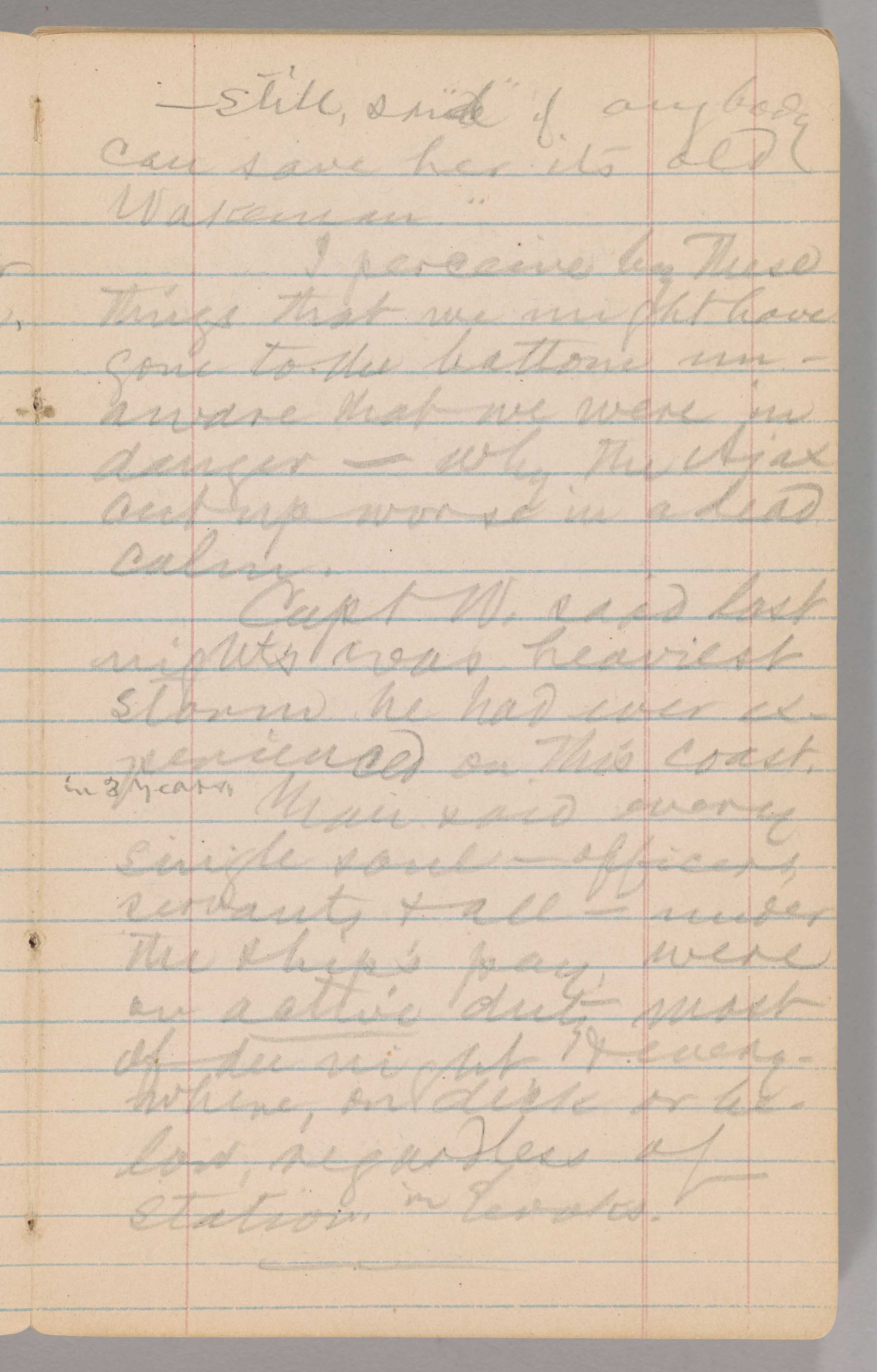
—still, went about
[MS: N7_leaf_007r]
—still, smileaid “if anybody
can save her its old
Wakeman.”
I perceive by these
things that we might have
gone to the bottom
un-
aware
unaware
that we were in
danger—why the Ajax
cut up worse in a dead
calm.
Capt W. said last
night's was heaviest
storm he had ever
ex-
perienced
experienced
on this coast.
in 3 years
.
Man said every
single soul—officers,
servants & all—under
the ship's pay, were
on active duty most
of the night &
every-
where
everywhere
, on deck or
be-
low
below
, regardless of
station, in books.
[MS: N7_leaf_007v]
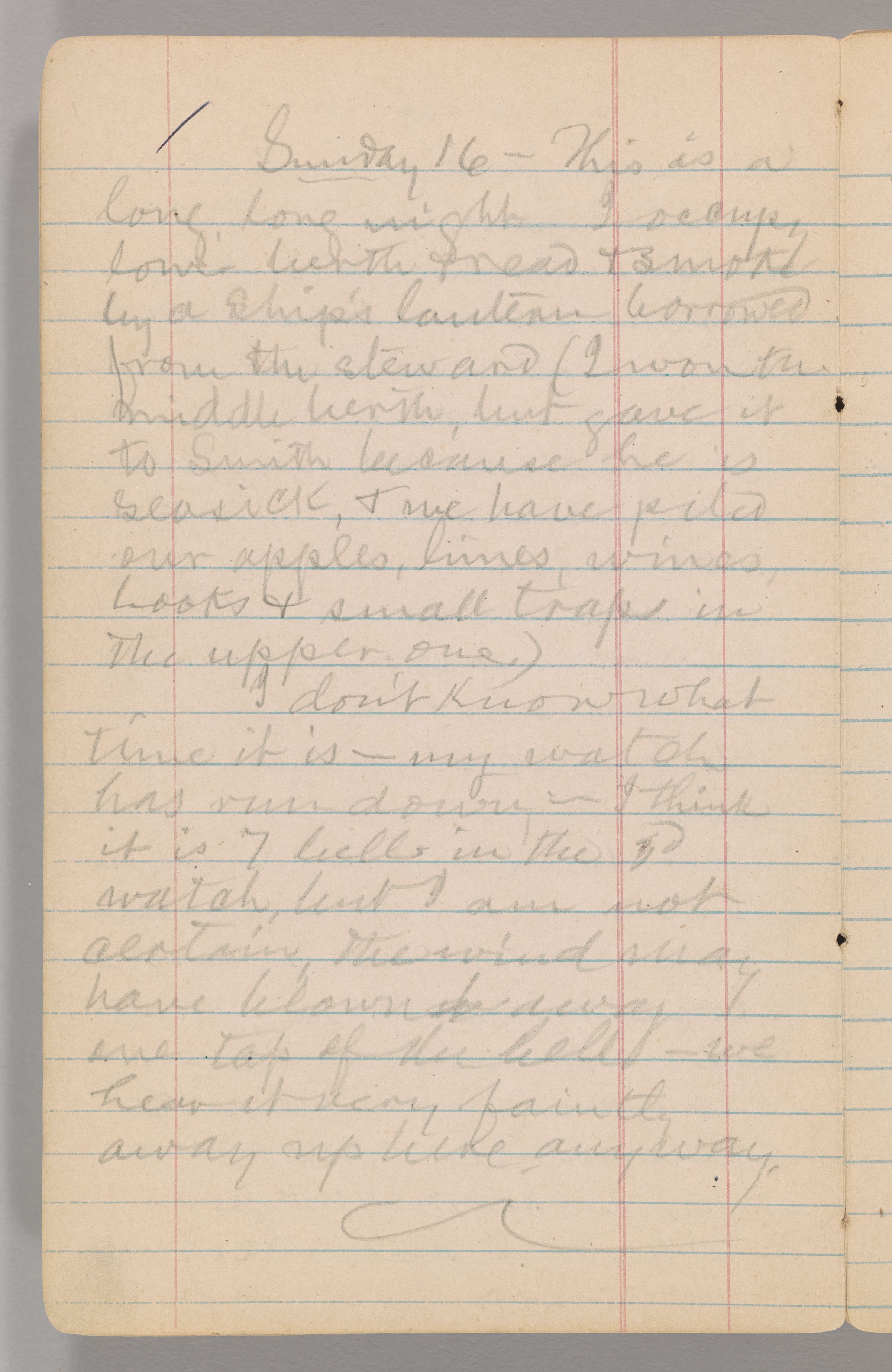
Sunday 16—This is a
long, long night. I occupy
lower berth & read & smoke
by a ship's lantern borrowed
from s the steward (I won the
middle berth, but gave it
to Smith because he is
seasick, & we have piled
our apples, limes, wines,
books & small traps in
the upper one.)
[MTP: N&J1_247]
I don't know what
time it is—my watch
has run down,—I think
it is 7 bells in the 3d
watch, but I am not
certain, the wind may
have blown it away
one tap of the bell—we
hear it very faintly
away up here, anyway.
[MS: N7_leaf_008r]
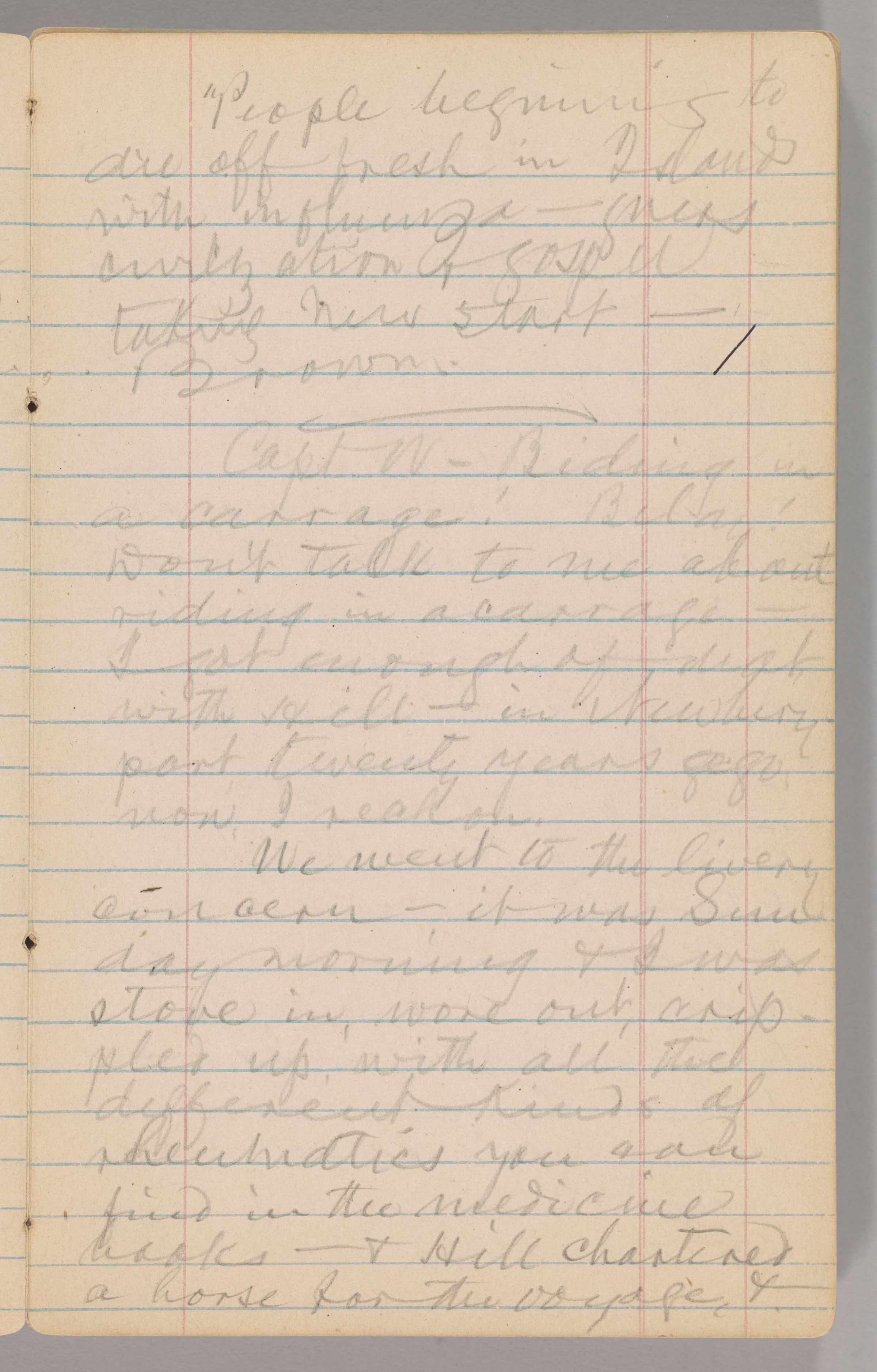
“People beginning to
die off fresh in Islands
with influenza—guess
civilization & gospel
taking new start—
Brown.
Capt W—Riding
in a carrage! Belay!
Don't talk to me about
riding in a carrage—
I got enough of that,
with Hill—in
Newbury-
port
Newburyport
, twenty years g ago,
now, I reckon.
We went to the livery
concern—it was
Sun
day
Sunday
morning & I was
stove in, wore out,
crip-
pled
crippled
up, with all the
different kinds of
rheumatics you can
find in the medicine
books—& Hill chartered
a horse for the voyage, &
[MS: N7_leaf_008v]
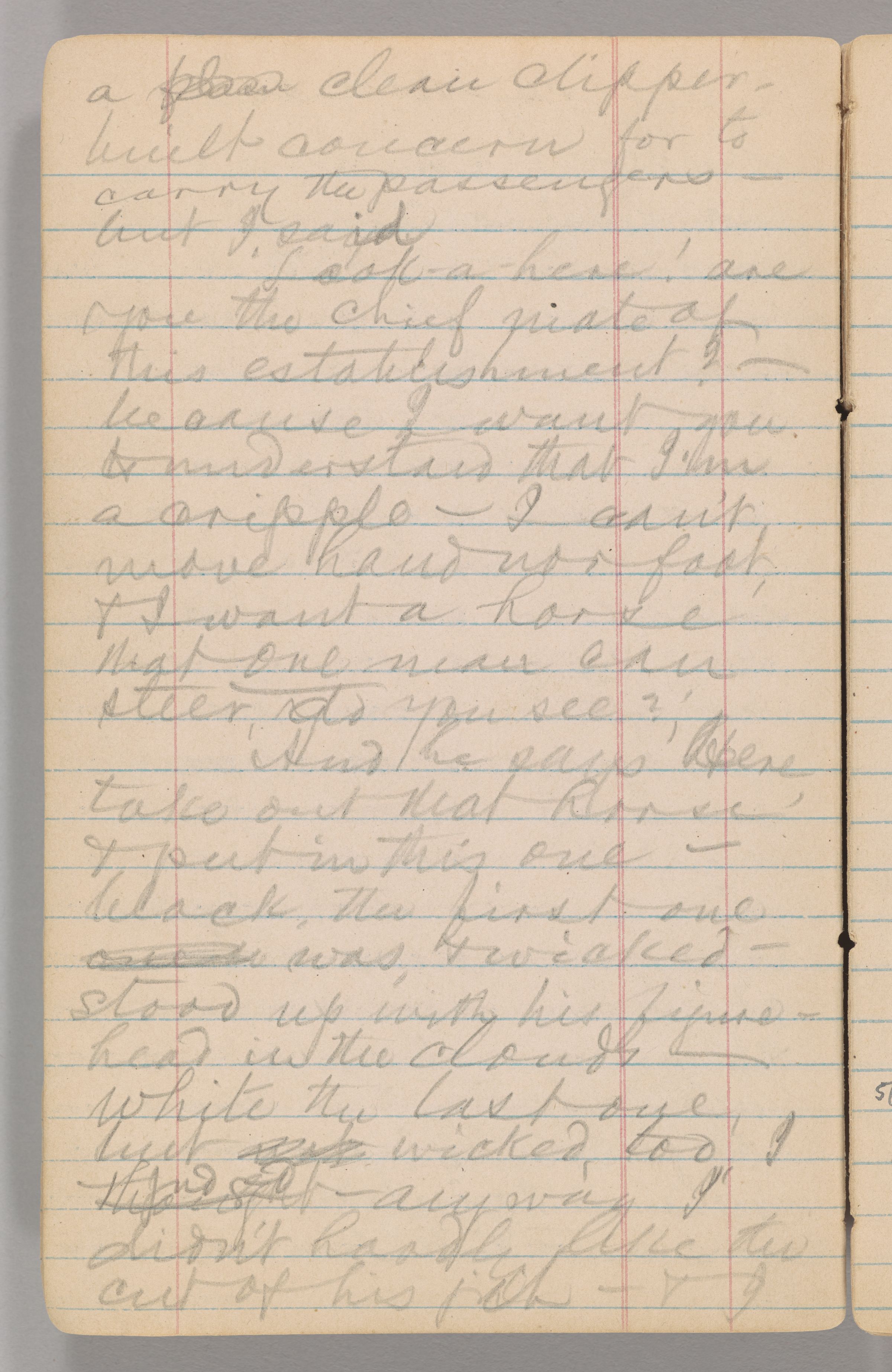
a fluen clean
clipper-
built
clipper-built
concern for to
carry the passengers—
but I saysid,
‘Look-a-here! are
you the chief mate of
this establishment?—
because I want you
to understand that I'm
a cripple—I can't
move hand nor foot,
& I want a horse
that one man can
steer, y do you see?’
And he says ‘h Here,
take out that horse
& put in this one—
black, the first one
was, & wicked—
stood up with his
figure-
head
figure-head
in the clouds—
white the last one,
but not wicked, too, I
thought
judged
—anyway I
didn't hardly like the
cut of his jib—& I
[MS: N7_leaf_009r]
said as much to
Hill—I said, “Here,
now, take some of
that rattlin’ stuff &
reeve it through his
fair-leaders there
forrard, & sieze it
onto his fore-ancle,
so as if we got in a
tight place & he missed
stays or run away
we could fetch him
up on
with
a round turn
—couldn't do much
on
◊
3 legs I don't
suppose?”
But no,—I didn't
know anything about
it, Hill knowed it all.
So we cast loose
off
& got
under way, stood out to wind’ard
& it
[MTP: N&J1_248] was
all fair sailing till we
sighted a fleet of sheep
or something or other
[MS: N7_leaf_009v]
of that kind, & then
bloody murder how
he did shake out his
reefs & howl before
the wind! Go?—go
ain't no name for it!
—over gardens & orchards
& dogs & cats, curb-stones
& children—round this
corner & then around
that—everybody
yelp-
ing
yelping
, everybody
skurry-
ing
skurrying
out of the way,
no-
body
nobody
trying to stop him
—I says “Luff, in the
name o' God! & let
him go about!—
be-
cause
because
I see right
a-
head
ahead
of us a little
cove with a bulkhead
across the other end
of it—& Hill he put
her down hard-a-port
—but it was too late—
it warn't no use—
[MS: N7_leaf_010r]
she missed stays &
down she went like
a rocket into that cove
& fetched up like the
staving of a ship-of-the
line agin that d—d
bulk-
head
bulkhead
!—& out we went
& Hill & me—I was on
the port side & the
min-
ute
minute
she struck she swung,
broadside on, & I went
over that bulkhead like
a shot & Hill cleared
the starboard bulwarks
& struck on his
shoul-
der
shoulder
& scoured the harness
off of him & peeled the
hide, too, & there horse
—hell! there warn't enough
of him left to hold an
in-
quest
inquest
on! ”
shaking like a sick monkey on a lee back-stay.
Eight bells, did
you say?—very well, let
her go just as she heads
an hour & a half & then
put her half a point more
[MS: N7_leaf_010v]
southerly. I've got to
J go forrard a minute, boys,
take it easy & amuse
your-
selves
yourselves
.”
“Well?” said Brown.
“Well?” said I.
“Well, how was it?”
“Didn't you hear the story?”
“Yes,—but I don't
un-
derstand
understand
them sailor terms.
What was the trouble
any-
way
anyway
?”
I disdained to
an-
swer
answer
, & left Brown to
figure it out himself.
[MS: N7_leaf_011r]
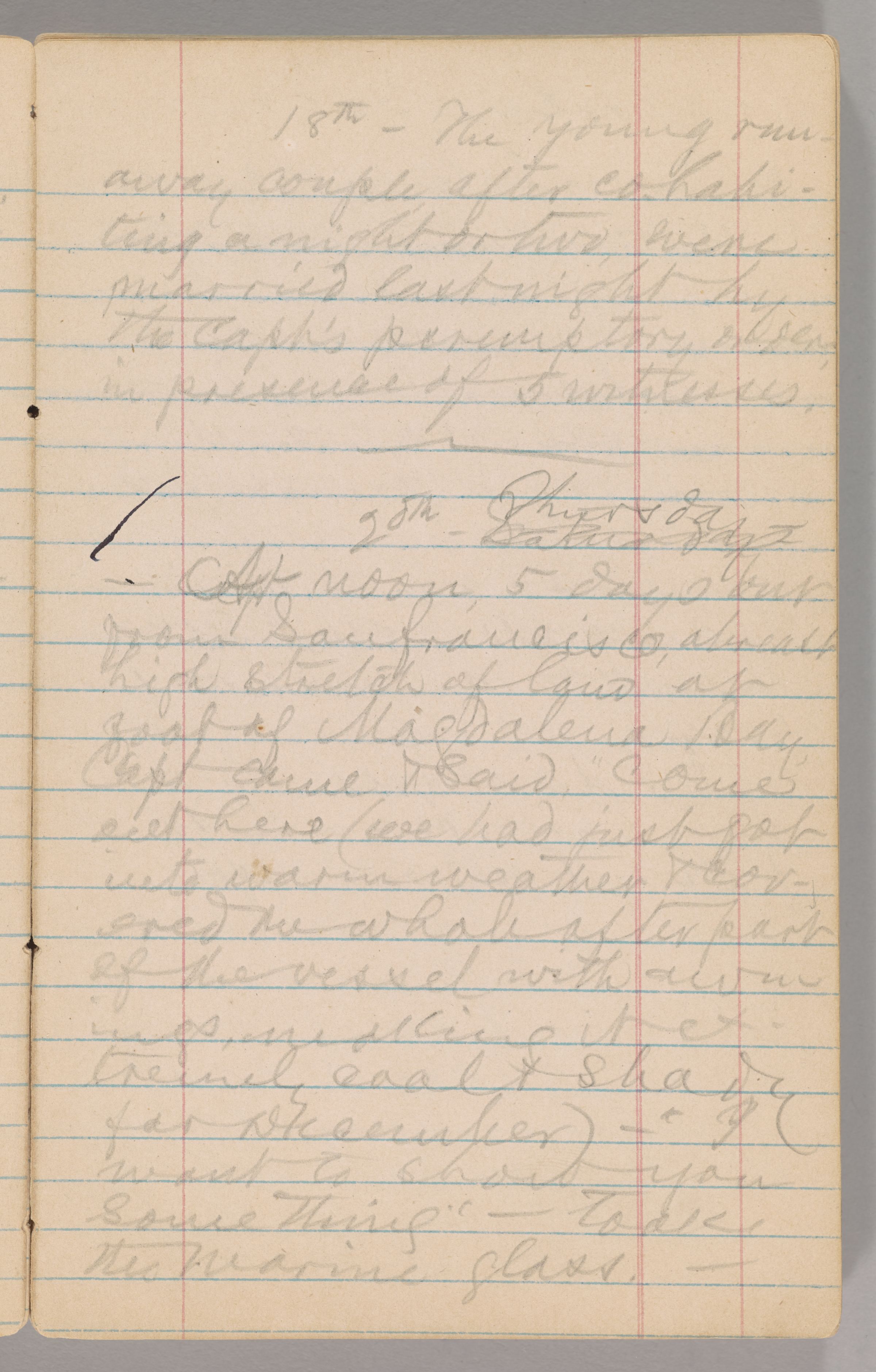
18th—The young
run-
away
runaway
couple, after
co-habi-
ting
co-habiting
a night or two, were
married last night by
the Capt's peremptory order,
in presence of 5 witnesses.
[MTP: N&J1_249]
20th—Saturday—
Thursday
—Cap At noon, 5 days out
from Sanfrancisco, abreast
high stretch of land at
foot of Magdalena Bay,
Capt came & said, “Come
out here (we had just got
into warm weather &
cov-
ered
covered
the whole after part
of the vessel with
awn-
ings
awnings
, making it
ex-
tremely
extremely
cool & shady
for December)—“I
want to show you
something”—took
the marine glass.—
[MS: N7_leaf_011v]
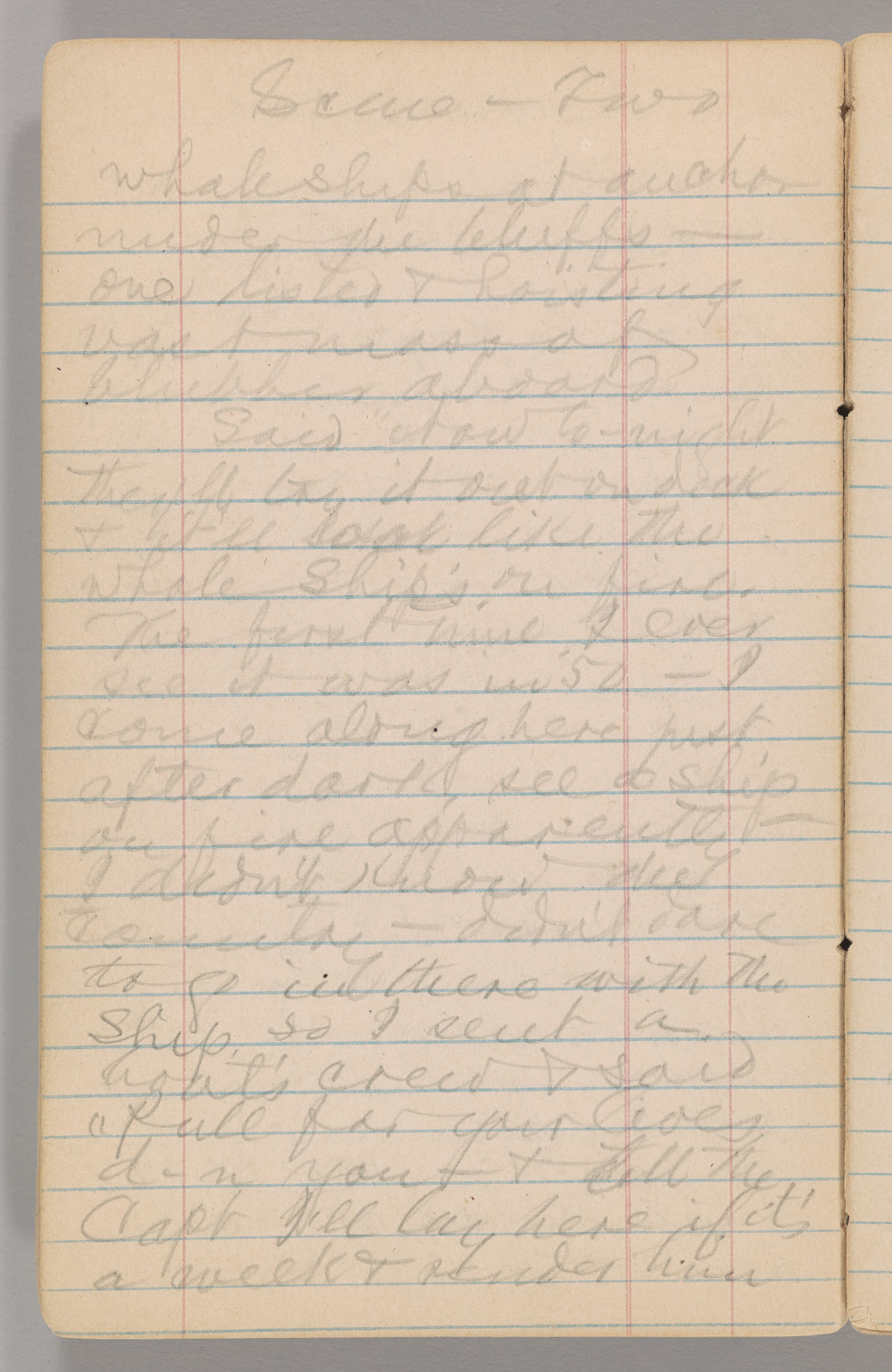
Scene—Two
whale ships at anchor
under the bluffs—
one listed & hoisting
vast mass of
blubber aboard.
Said “Now to-night
they'll try it out on deck
& it'll like look like the
whole ship's on fire.
The first time I ever
see it was in '50—I
come along here just
after dark, see a ship
on fire apparently—
I didn't know the
country—didn't dare
to go in there with the
ship, so I sent a
boat's crew & said
“Pull for your lives
d—n you—& tell the
Capt I'll lay here if it's
a week & render him
[MS: N7_leaf_012r]
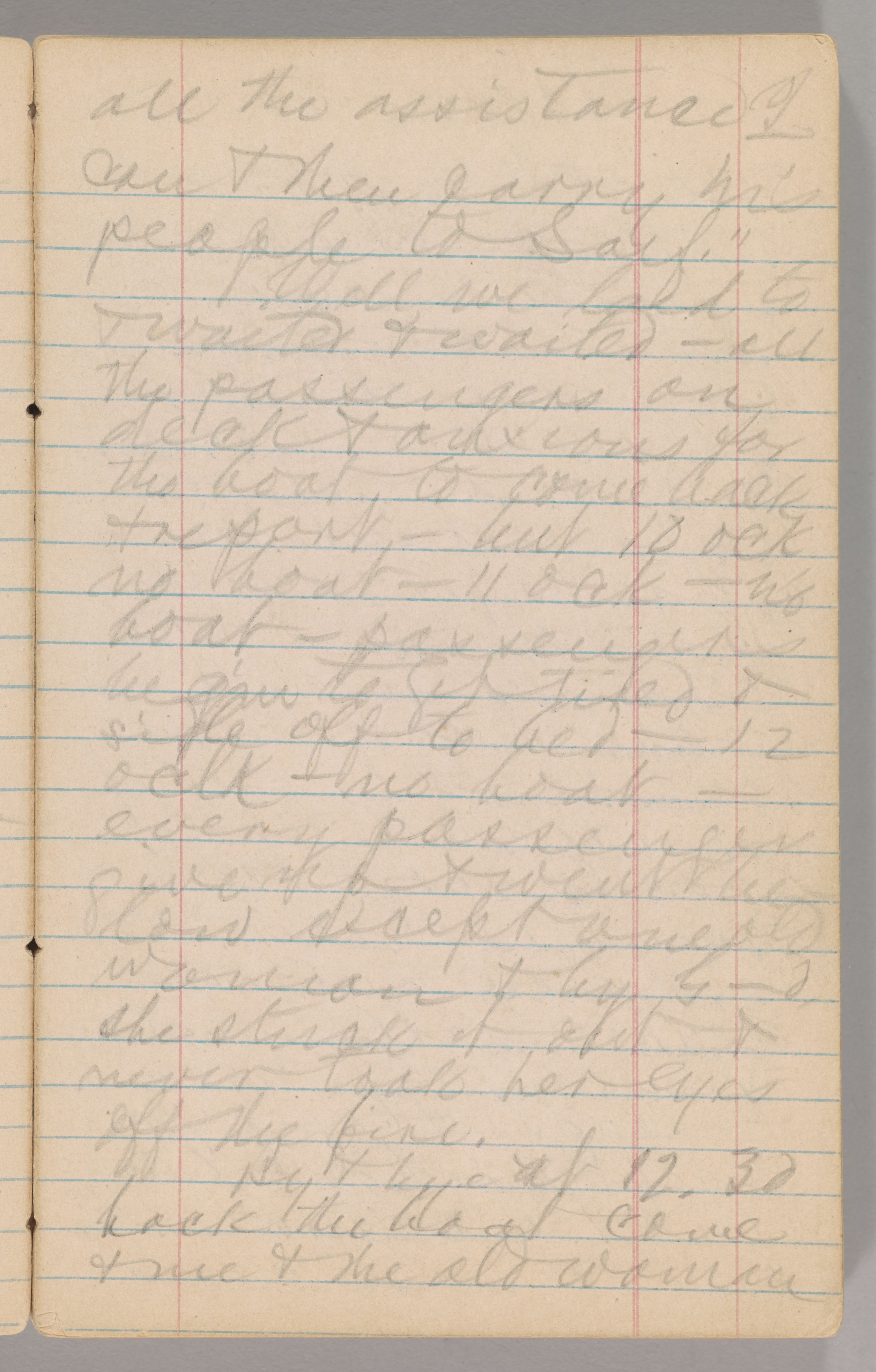
all the assistance I
can & then carry his
people to Sanf.”
Well, we laid to
& waited & waited—all
the passengers on
deck & anxious for
the boat to come back
& report—but 10 ock,
no boat—11 ock—no
boat—passengers
begin to get tired &
sidle off to bed—12
oclk—no boat—
every passenger
give up & went
be-
low
below
except one old
woman & by G-d,
she stuck it out &
never took her eyes
off the fire.
By & bye & at 12.30
back the boat come
& me & the old woman
[MS: N7_leaf_012v]
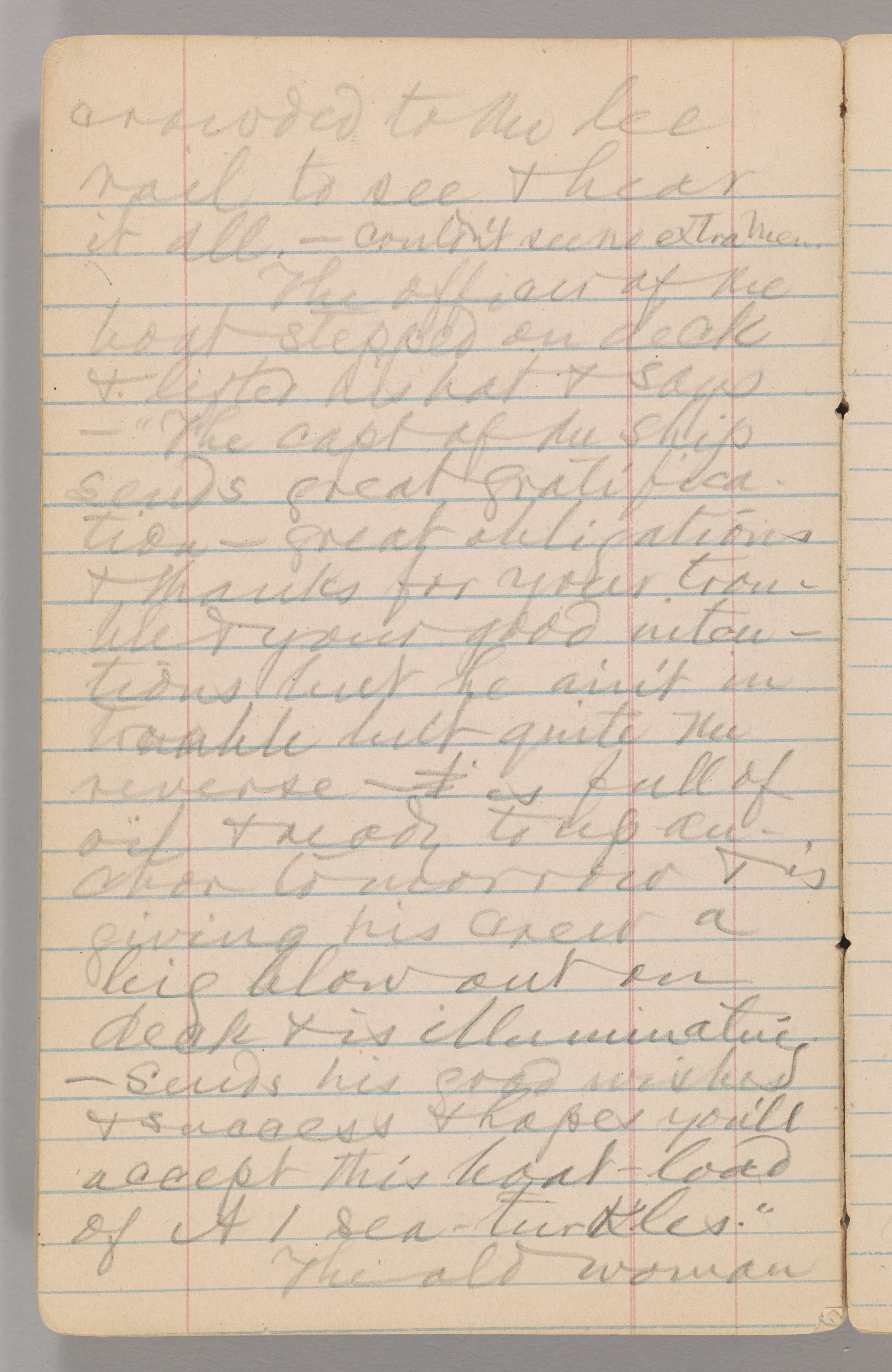
crowded to the lee
rail to see & hear
it all,—couldn't see no extra men.
The officer of the
boat stepped on deck
& lifted his hat & says
—“The capt of the ship
sends great
gratifica-
tion
gratification
—great obligations
& thanks for your
trou-
ble
trouble
& your good
inten-
tions
intentions
but he ain't in
trouble but quite the
reverse—& is full of
oil & ready to up
an-
chor
anchor
to-morrow & is
giving his crew a
big blow out on
deck & is illuminating
—sends his good wishes
& success & hopes you'll
accept this boat-load
of A 1
sea-turtkles.”
The old woman
[MS: N7_leaf_013r]
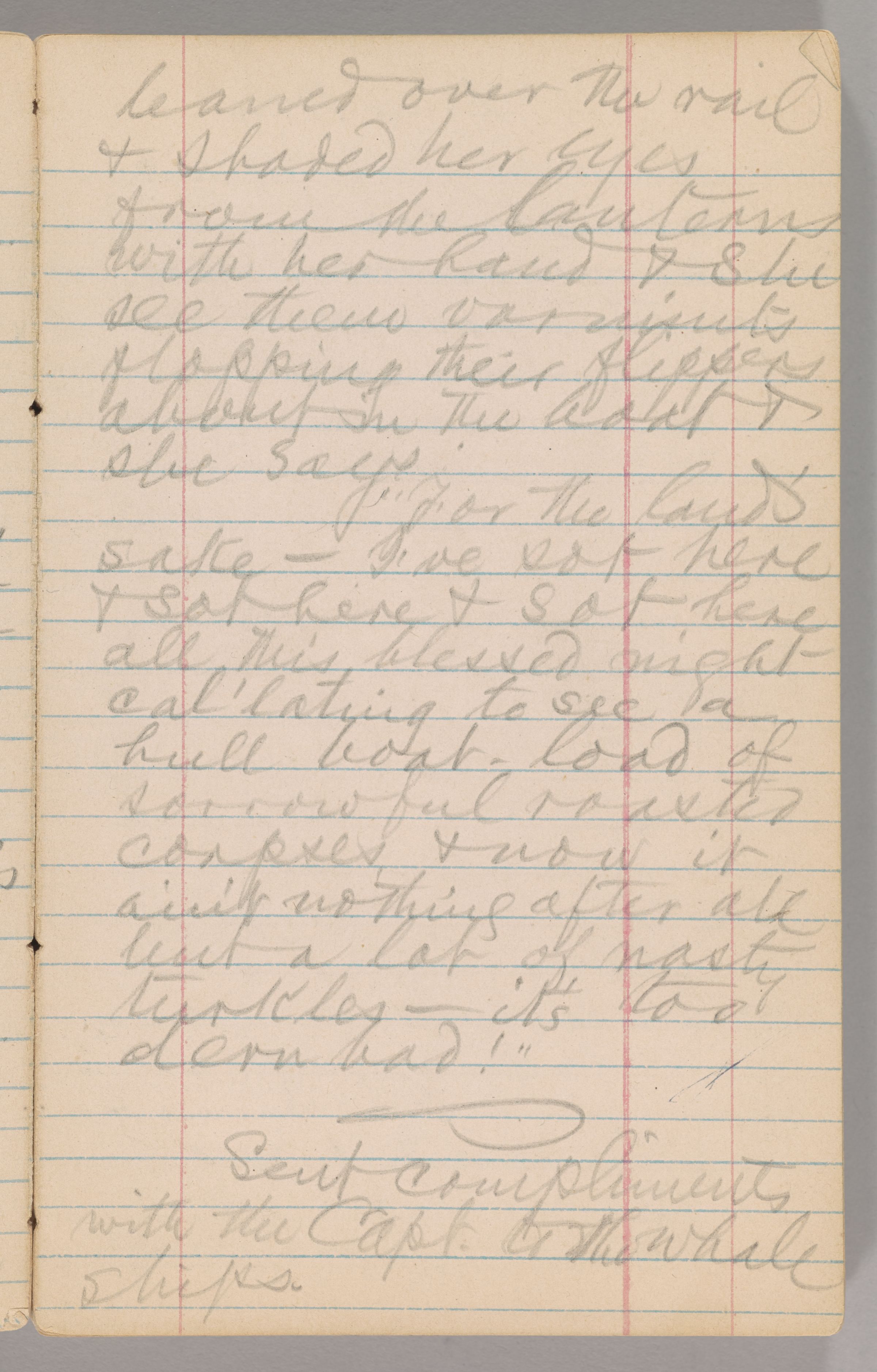
leaned over the rail
& shaded her eyes
from the
[MTP: N&J1_250] lanterns
with her hand & she
see them varmints
flopping their flippers
about in the boat &
she says:
“For the land's
sake—I've sot here
& sot here & sot here
all this blessed night
cal'lating to see a
hull boat-load of
sorrowful roasted
corpses, & now it
ain't nothing after all
but a lot of nasty
turkles—it's too
dern bad!”
Sent compliments
with the Capt. to the whale
ships.
[MS: N7_leaf_013v]
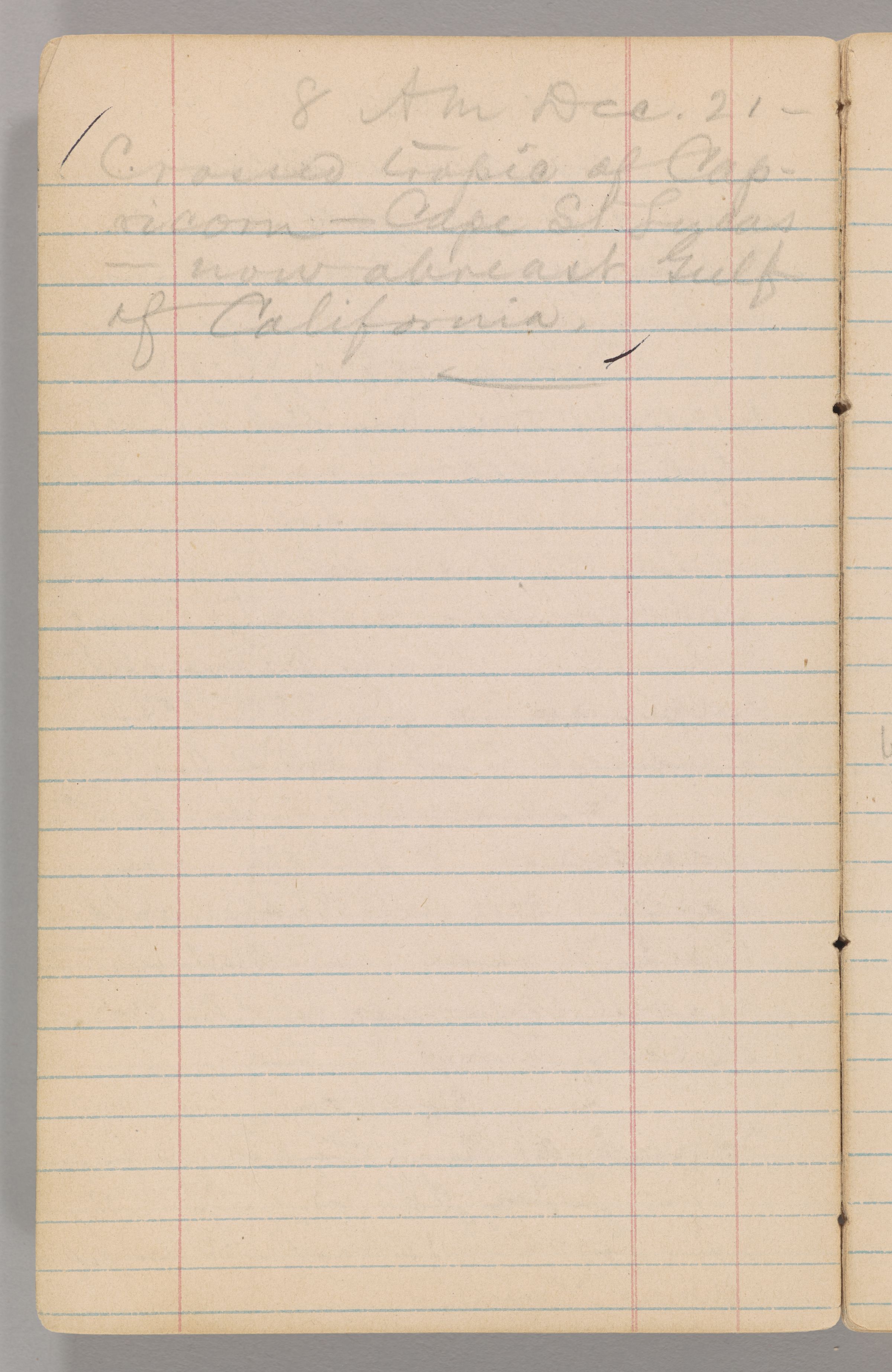
8 AM Dec. 21—
Crossed tropic of
Cap-
ricorn
Capricorn
—Cape St Lucas
—now abreast Gulf
of California.
[MS: N7_leaf_014r]
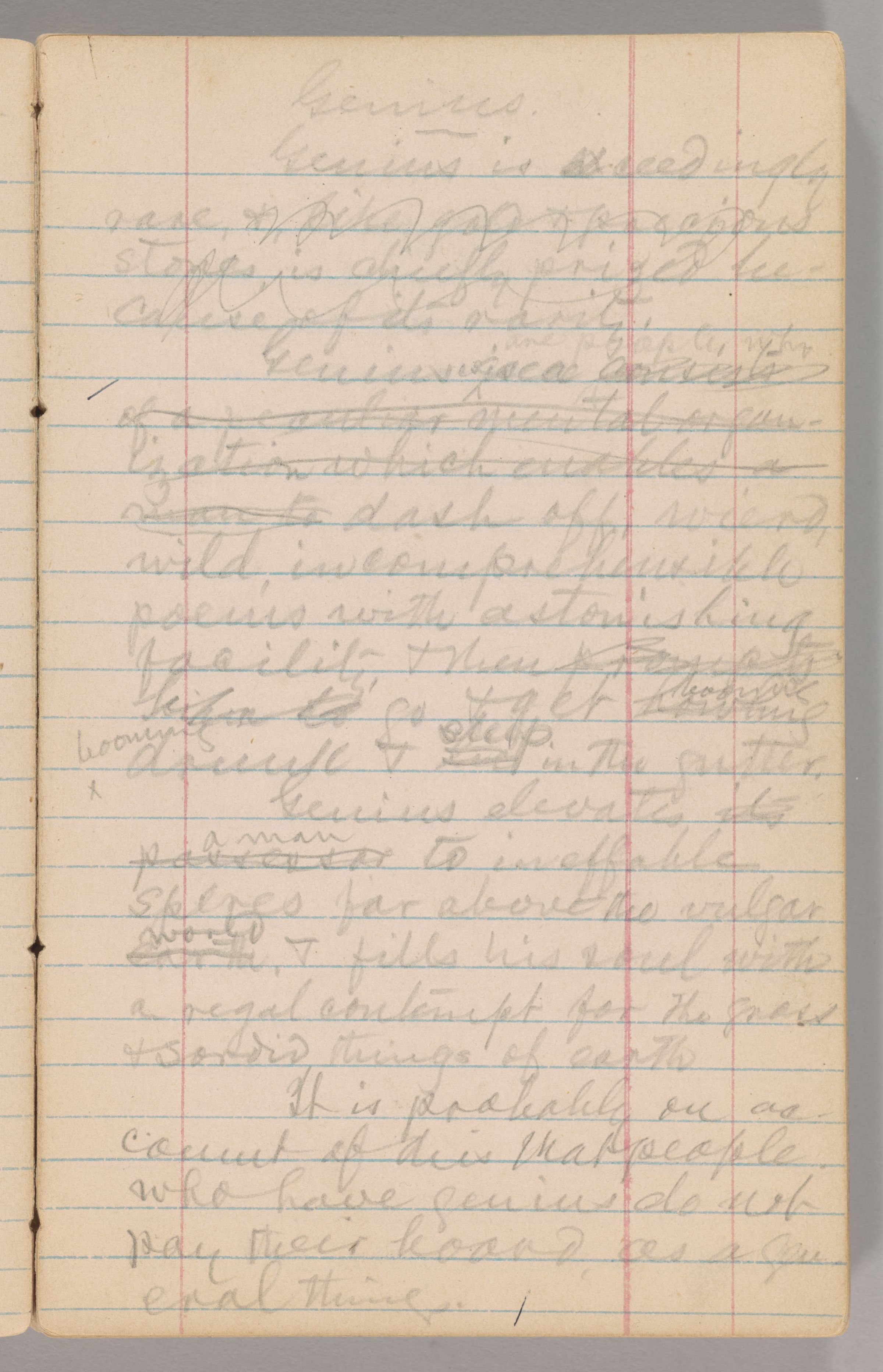
Genius.
Genius is a exceedingly
rare, &, like gold & precious
stones, is chiefly prized
be-
cause
because
of its rarity.
Geniuses
is a
are people who
consists
of a peculiar mental
organ-
ization
organization
which enables a
man to dash off wierd,
wild, incomprehensible
poems with astonishing
facility, & then prompts
him to go & get howling
booming drunk & lie
sleep in the gutter.
Genius elevates its
possessor
a man
to ineffable
speres far above the vulgar
earth
world
, & fills his soul with
a regal contempt for the gross
& sordid things of earth
It is probably on
ac-
count
account
of this that people
who have genius do not
pay their board, as a
gen-
eral
general
thing.
[MS: N7_leaf_014v]
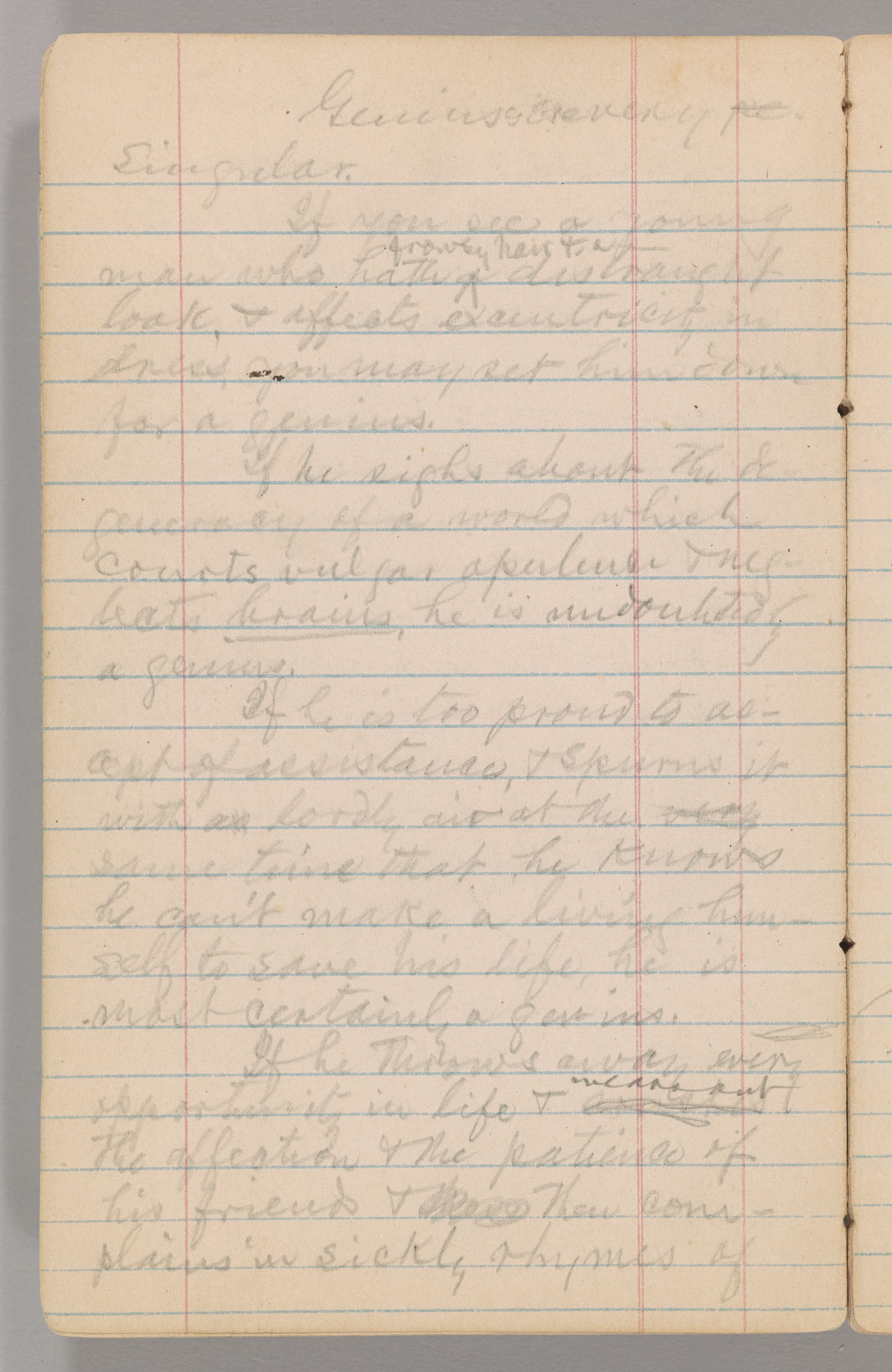
Geniuses
is
are
very pe
singular.
If you see a young
man who hath a
frowsy hair & a
distraught
look, & affects excentricity in
dress, you may set him down
for a genius.
If he sighs about the
de-
generacy
degeneracy
of a world which
courts vulgar opulence &
neg-
lects
neglects
brains, he is undoubtedly
a genius.
[MTP: N&J1_251]
If he is too proud to
ac-
cept
accept
of assistance, & spurns it
with as lordly anir
at the very
same time that he knows
he can't make a living
him-
self
himself
to save his life, he is
most certainly a genius.
If he throws away every
opportunity in life & crushes
wears out
the affection & the patience of
his friends & then
com-
plains
complains
in sickly rhymes of
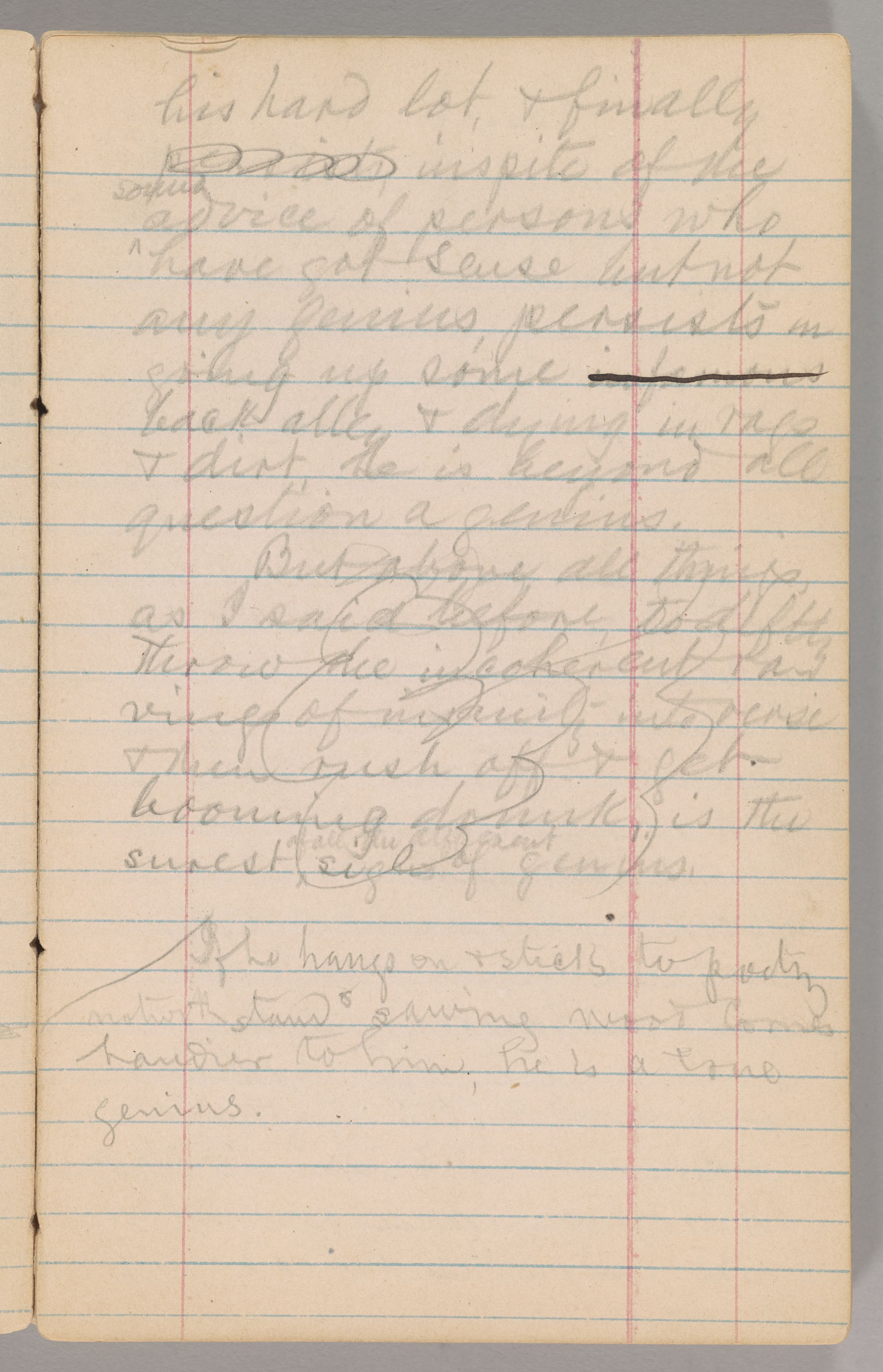
[MS: N7_leaf_015r]
his hard lot, & finally
persists, in spite of the
sound
advice of persons who
have got sense but not
any genius, persists in
going up some
infamous
back alley & dying in rags
& dirt, he is beyond all
question a genius.
But above all things,
as I said before, to deftly
throw the incoherent
ra-
vings
ravings
of insanity into verse
& then rush off & get
booming drunk, is the
surest of all the different signs
of genius.
If he hangs on & sticks to poetry
notwithstandg sawing wood comes
handier to him, he is a true
genius.
[MS: N7_leaf_015v]
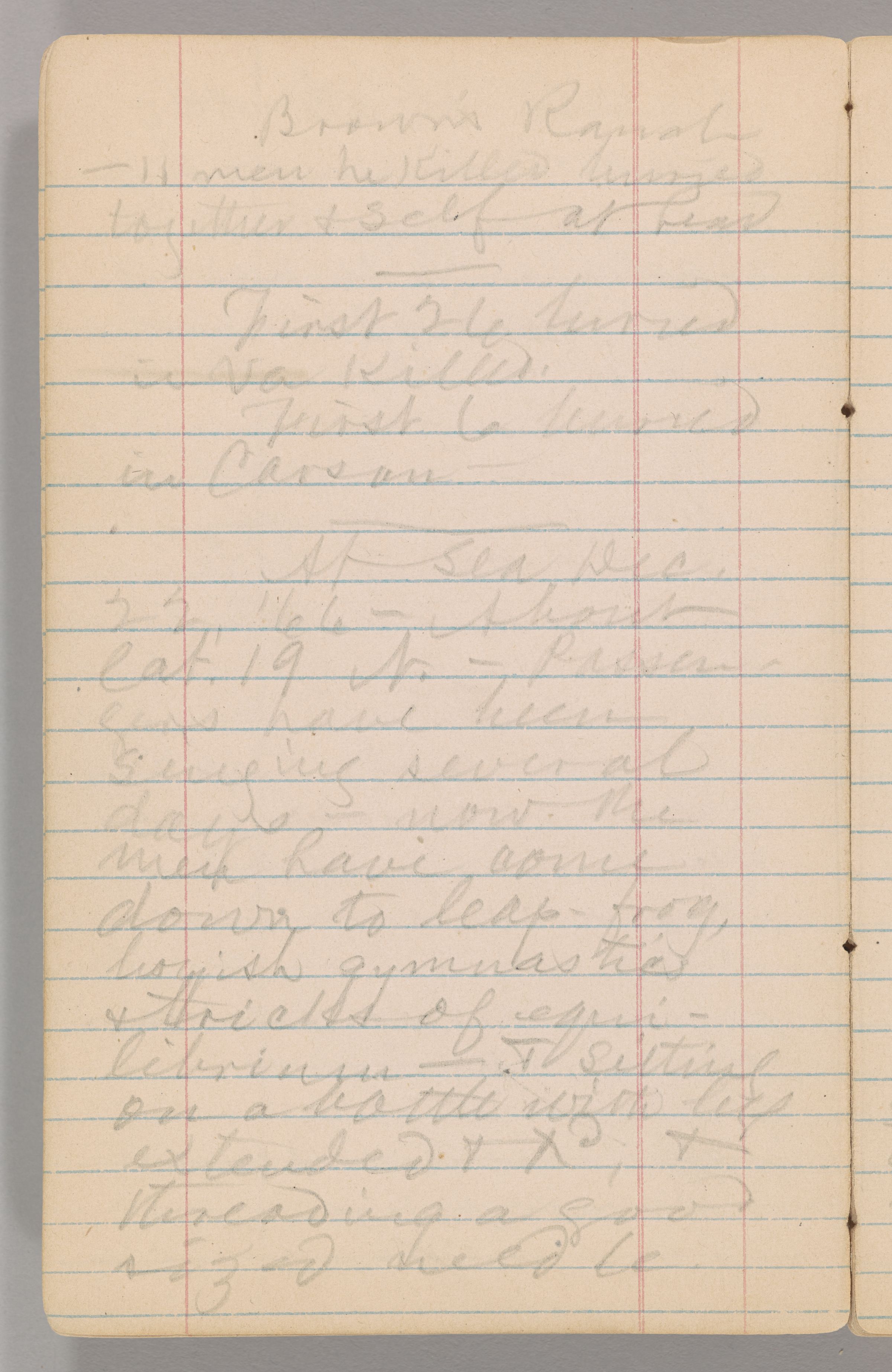
Brown's Ranch
—11 men he killed buried
together & self at head
First 6 buried
in Carson—
At sea Dec.
22, '66—About
lat. 19 N.—
Passen-
gers
Passengers
have been
singing several
days—now the
men have come
down to leap-frog,
[MTP: N&J1_252] boyish gymnastics
& tricks of
equi-
librium
equilibrium
—& sitting
on a bottle with legs
extended & Xd, &
threading a good
sized needle.
[MS: N7_leaf_016r]
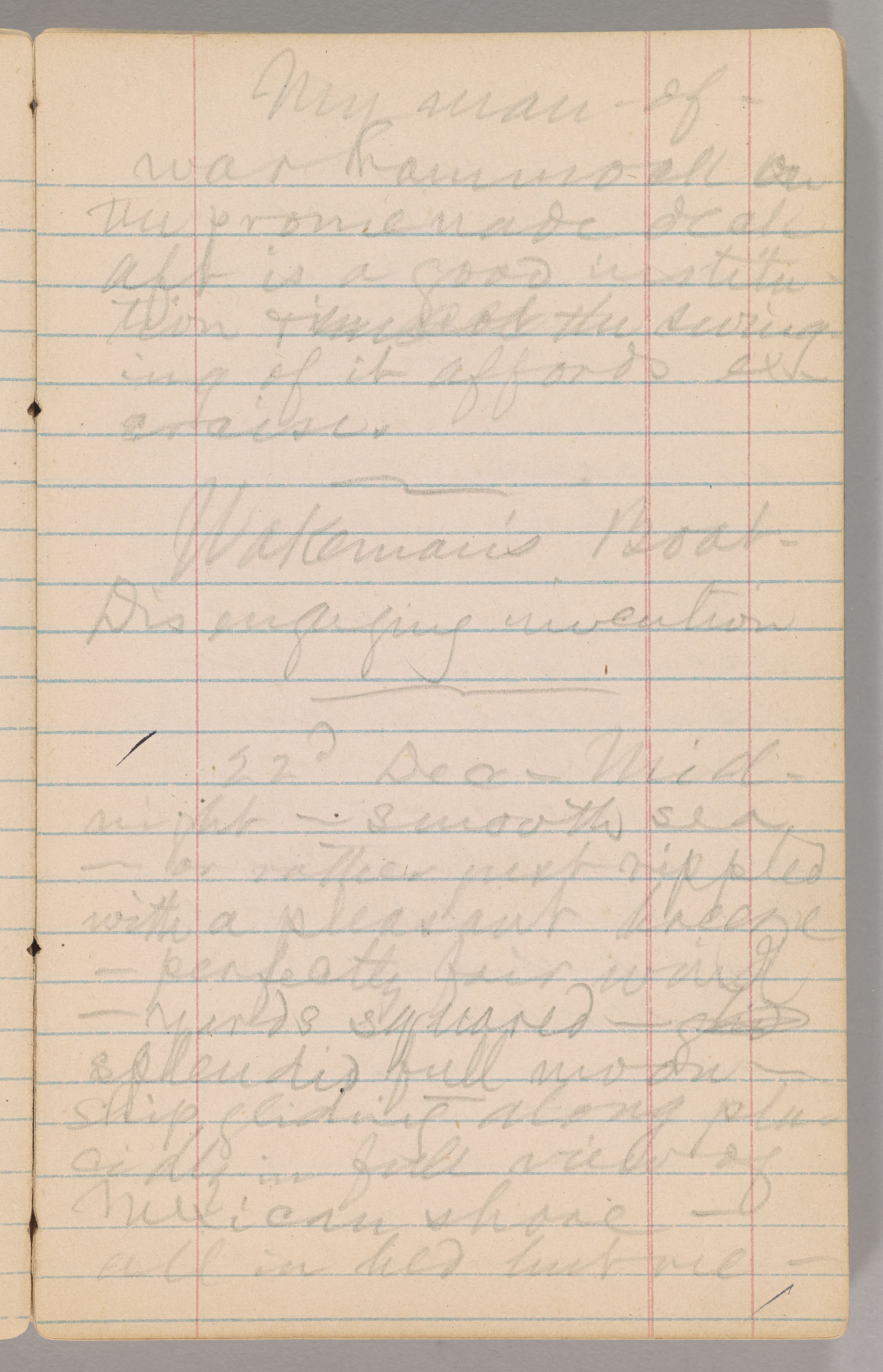
My man-of-
war hammock on
the promenade deck
aft is a good
institu-
tion
institution
& is not the
swing-
ing
swinging
of it affords
ex-
ercise
exercise
.
Wakeman's Boat-
Disengaging invention
22d Dec—
Mid-
night
Midnight
—smooth sea
—or rather just rippled
with a pleasant breeze
—perfectly fair wind
—yards squared—glid
splendid full moon—
ship gliding along
pla-
cidly
placidly
in full view of
Mexican shore—
all in bed but me—
[MS: N7_leaf_016v]
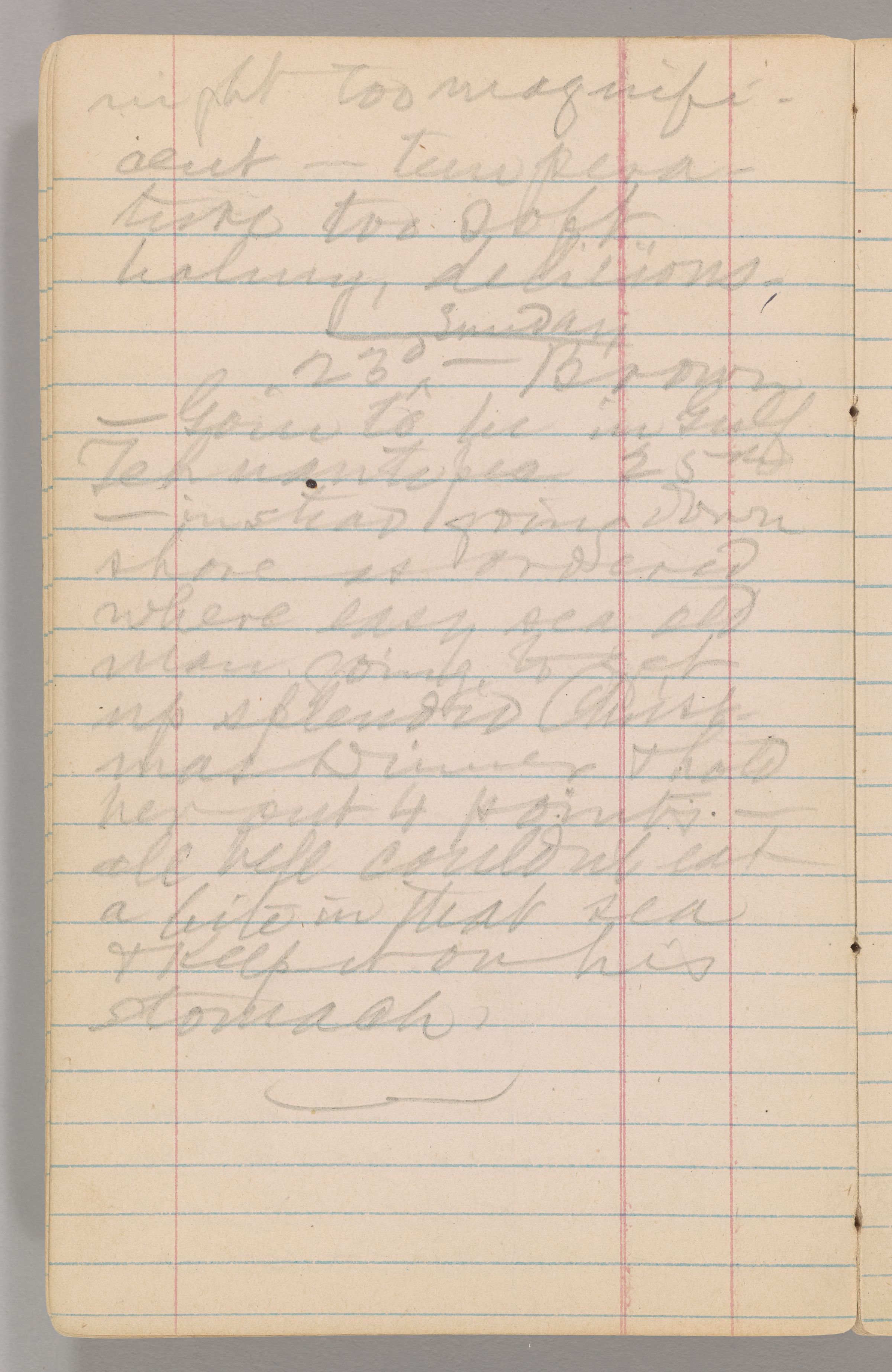
night too
magnifi-
cent
magnificent
—
tempera-
ture
temperature
too soft, balmy, delicious.
23d
Sunday
—Brown
—Goin to be in Gulf
Tehuantepec 25th
—instead going down
shore as ordered,
where easy sea, old
man going to get
up splendid
Christ-
mas
Christmas
Dinner & hold
her out 4 points—
all hell couldn't eat
a bite in that sea
& keep it on his
stomach.
[MS: N7_leaf_017r]
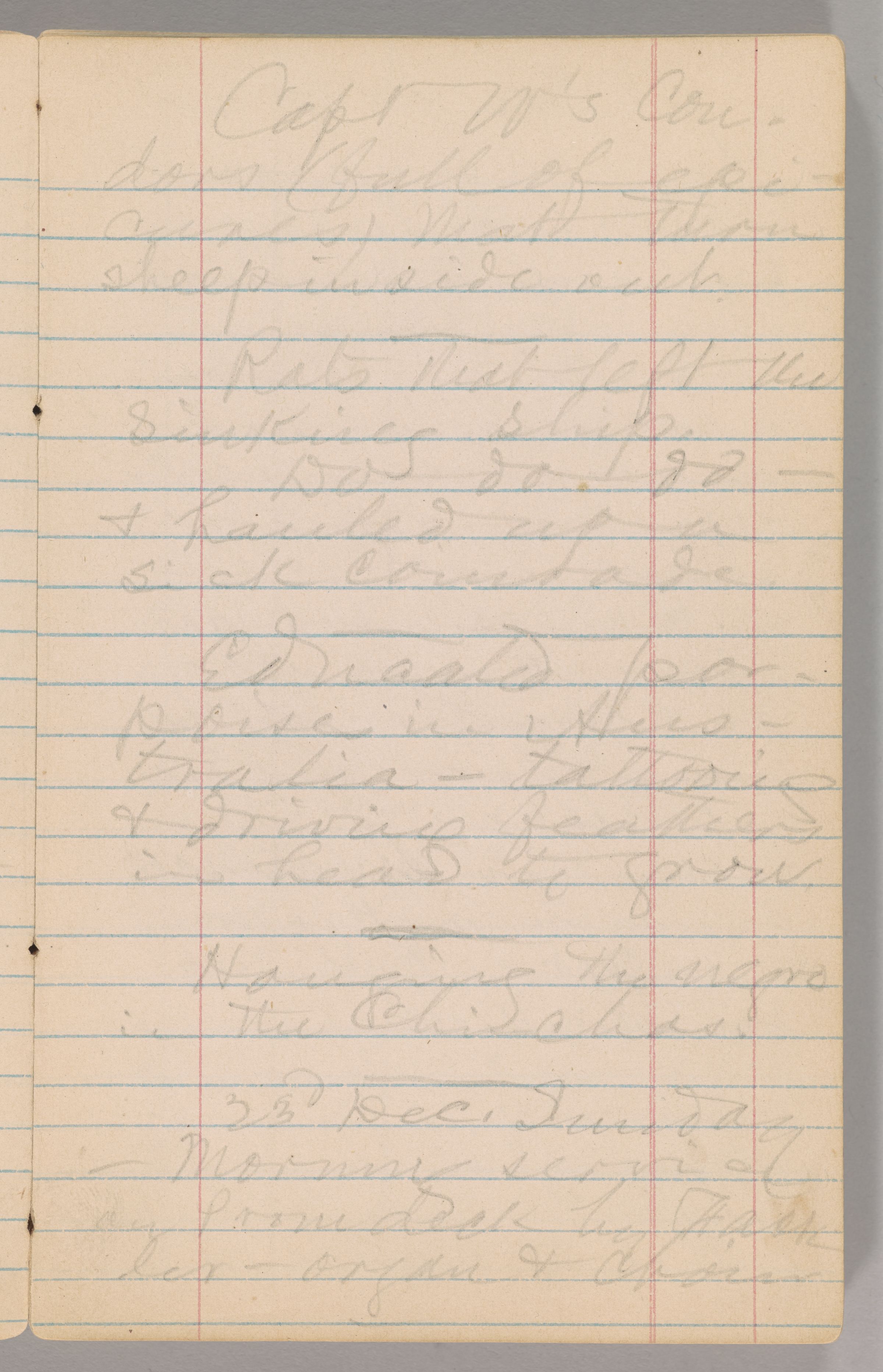
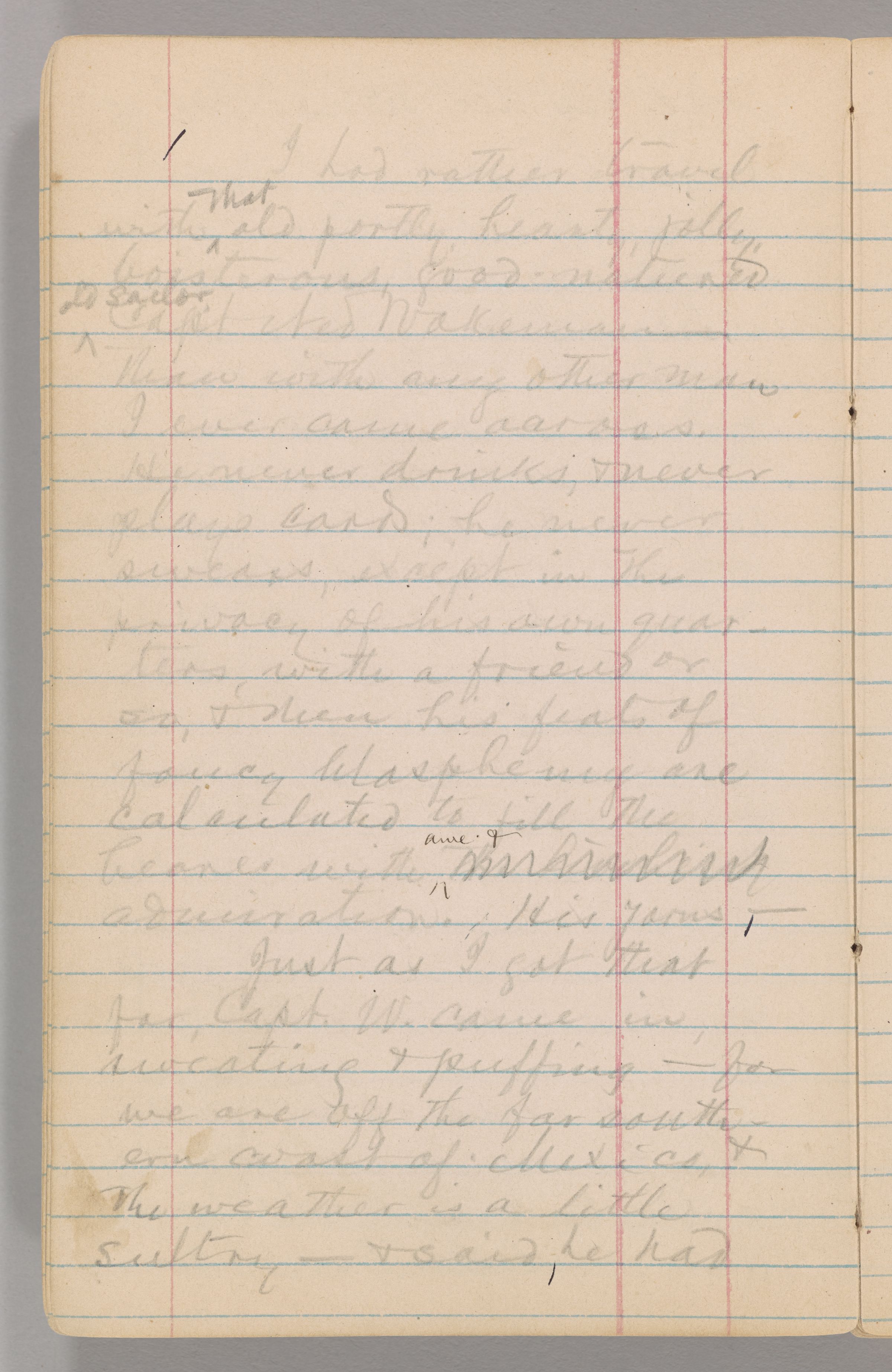
Capt W's
Con-
dors
Condors
(full of
epi-
cures
epicures
) that turn
sheep inside out.
Rats that left the
sinking ship.
Dododo —
& hauled up a
sick comrade.
Educated
por-
poises
porpoises
in
Aus-
tralia
Australia
—tattooing
& driving feathers
in head to grow.
[MTP: N&J1_253]
Hanging the negro
in the Chinchas.
23d Dec. Sunday
—Morning service
on Prom deck by
Fack-
ler
Fackler
—organ & choir
[MS: N7_leaf_017v]
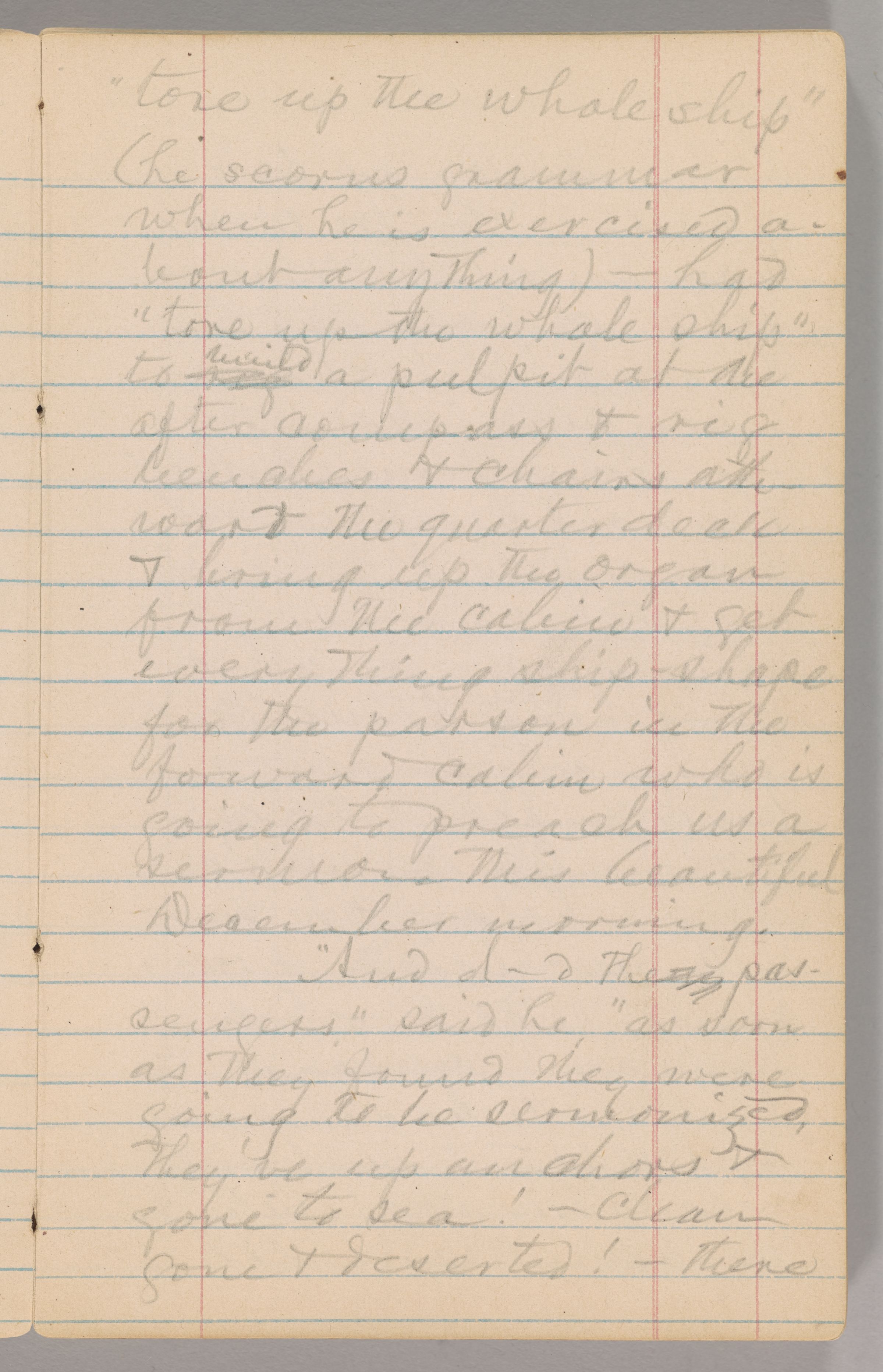
I had rather travel
with that old portly, hearty, jolly,
boisterous, good-natured
old sailor,
Capt Ned Wakeman
than with any other man
I ever came across.
He never drinks, & never
plays cards; he never
swears, except in the
privacy of his own
quar-
ters
quarters
, with a friend or
so, & then his feats of
fancy blasphemy are
calculated to fill the
hearer with
awe &
the liveliest
admiration. His yarns—
Just as I got that
far, Capt. W. came in,
sweating & puffing—for
we are off the far
south-
ern
southern
coast of Mexico, &
the weather is a little
sultry—& said he had
[MS: N7_leaf_018r]
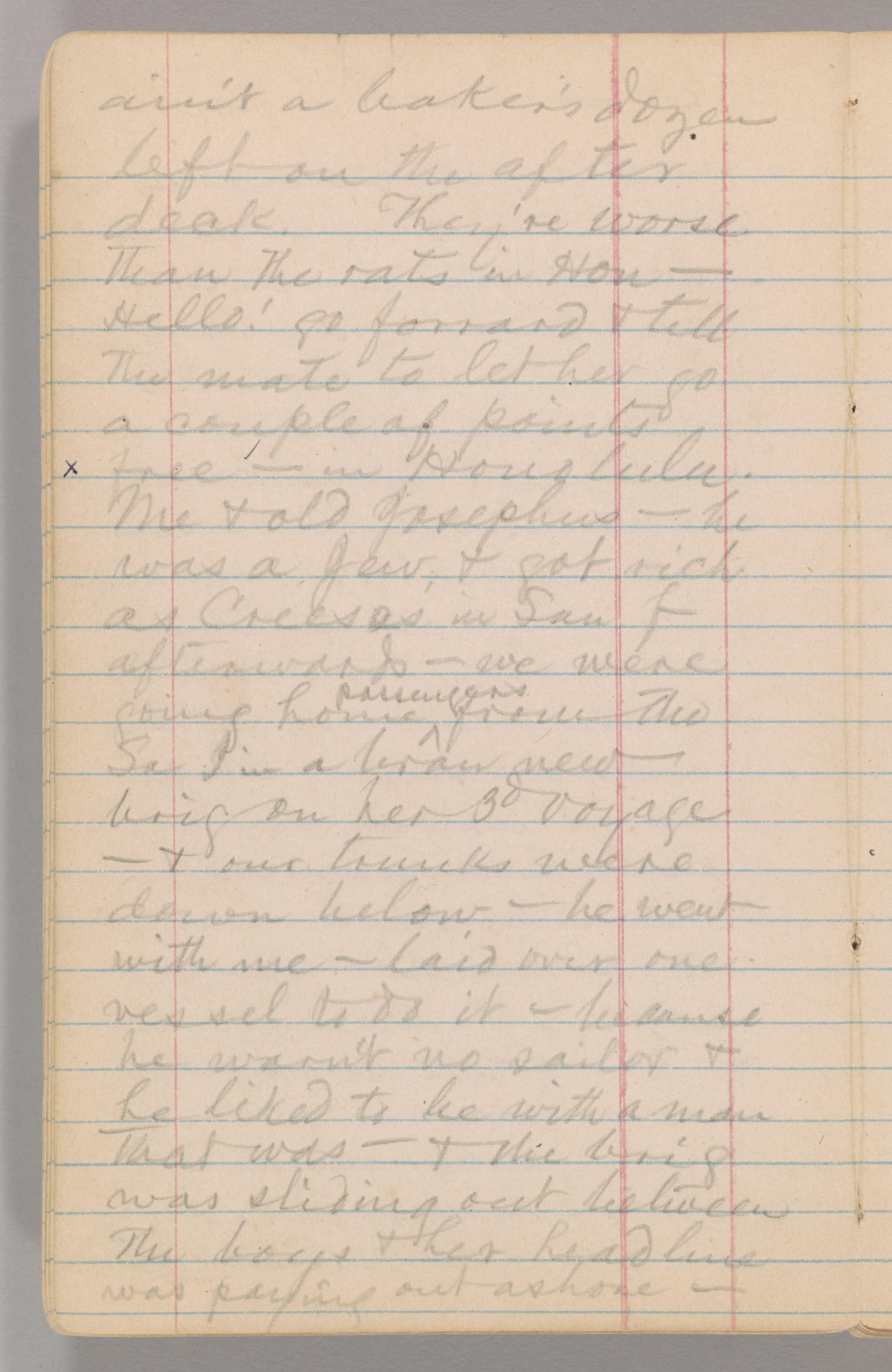
“tore up the whole ship”
(he scorns grammar
when he is exercised
a-
bout
about
anything)—had
“tore up the whole ship”
to rig
build
a pulpit at the
after compass & rig
benches & chairs
ath-
wardt
athwardt
the quarter deck
& bring up the organ
from the cabin & get
everything ship-shape
for the parson in the
forward cabin who is
going to preach us a
sermon this beautiful
December morning.
“And d—d the m
pas-
sengers
passengers
,” said he, “as soon
as they found they were
going to be sermonized,
they've up anchors &
gone to sea!—clean
gone & deserted!—there
[MS: N7_leaf_018v]
ain't a baker's dozen
left on the after
deck. They're worse
than the rats in Hon—
Hello! go forrard & tell
the mate to let her go
a couple of points
free—in Honolulu.
Me & old Josephus—he
was a Jew, & got rich
as Creesas in San f
[MTP: N&J1_254] afterwards—we were
going home passengers
from the
Sa I in a bran new
brig on her 3d voyage
—& our trunks were
down below—he went
with me—laid over one
vessel to do it—because
he warn't no sailor &
he liked to be with a man
that was—& the brig
was sliding out between
the boys & her headline
was paying out ashore—
[MS: N7_leaf_019r]
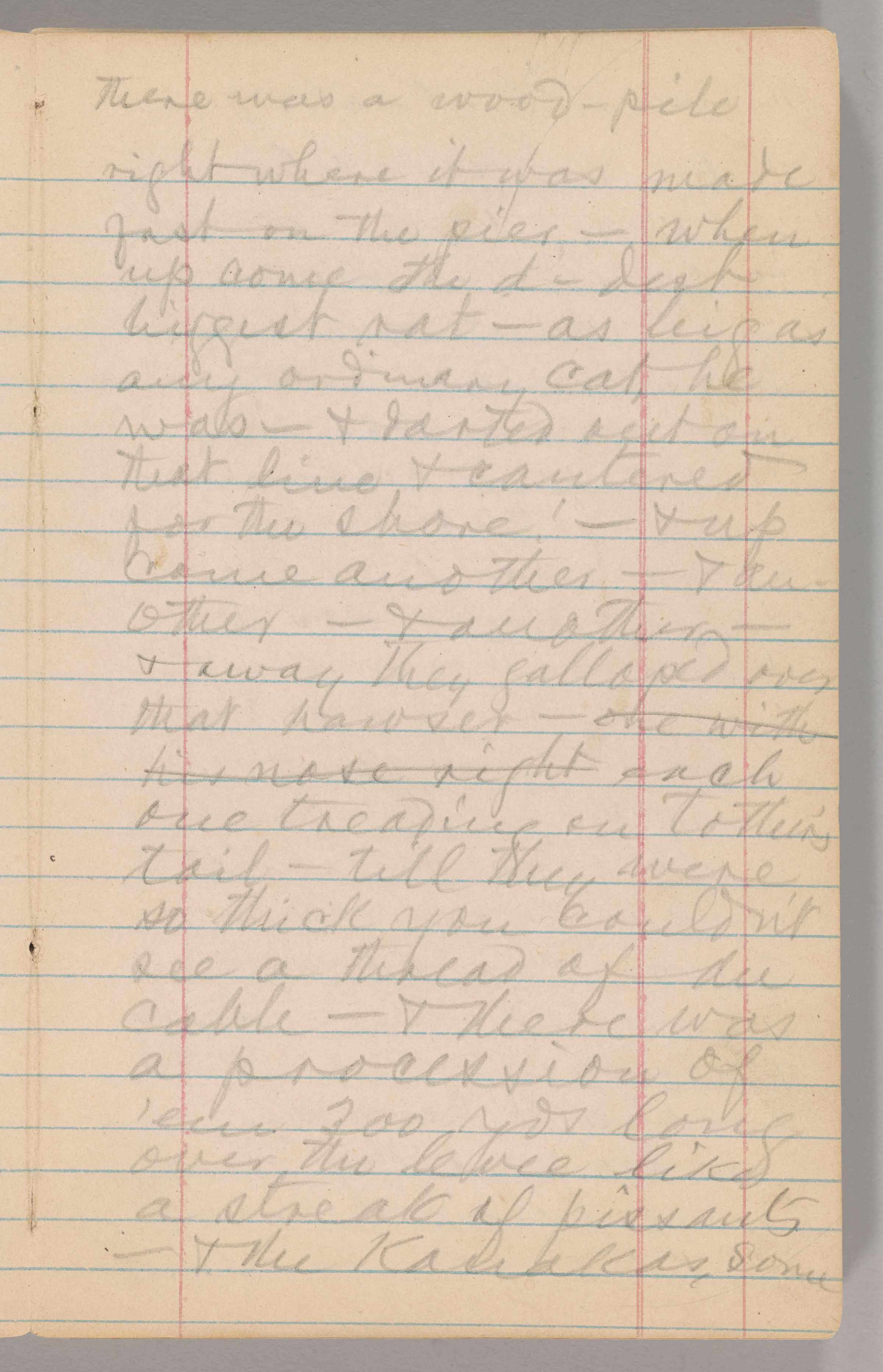
there was a wood-pile
right where it was made
fast on the pier—when
up come the d—dest
biggest rat—as big as
any ordinary cat, he
was—& darted out on
that line & cantered
for the shore!—& up
come another—&
an-
other
another
—& another—
& away they galloped over
that hawser—one with
his nose right each
one treading on tother's
tail—till they were
so thick you couldn't
see a thread of the
cable—& there was
a procession of
'em 300 yds long
over the levee like
a streak of pissants
—& the Kanakas, some
[MS: N7_leaf_019v]
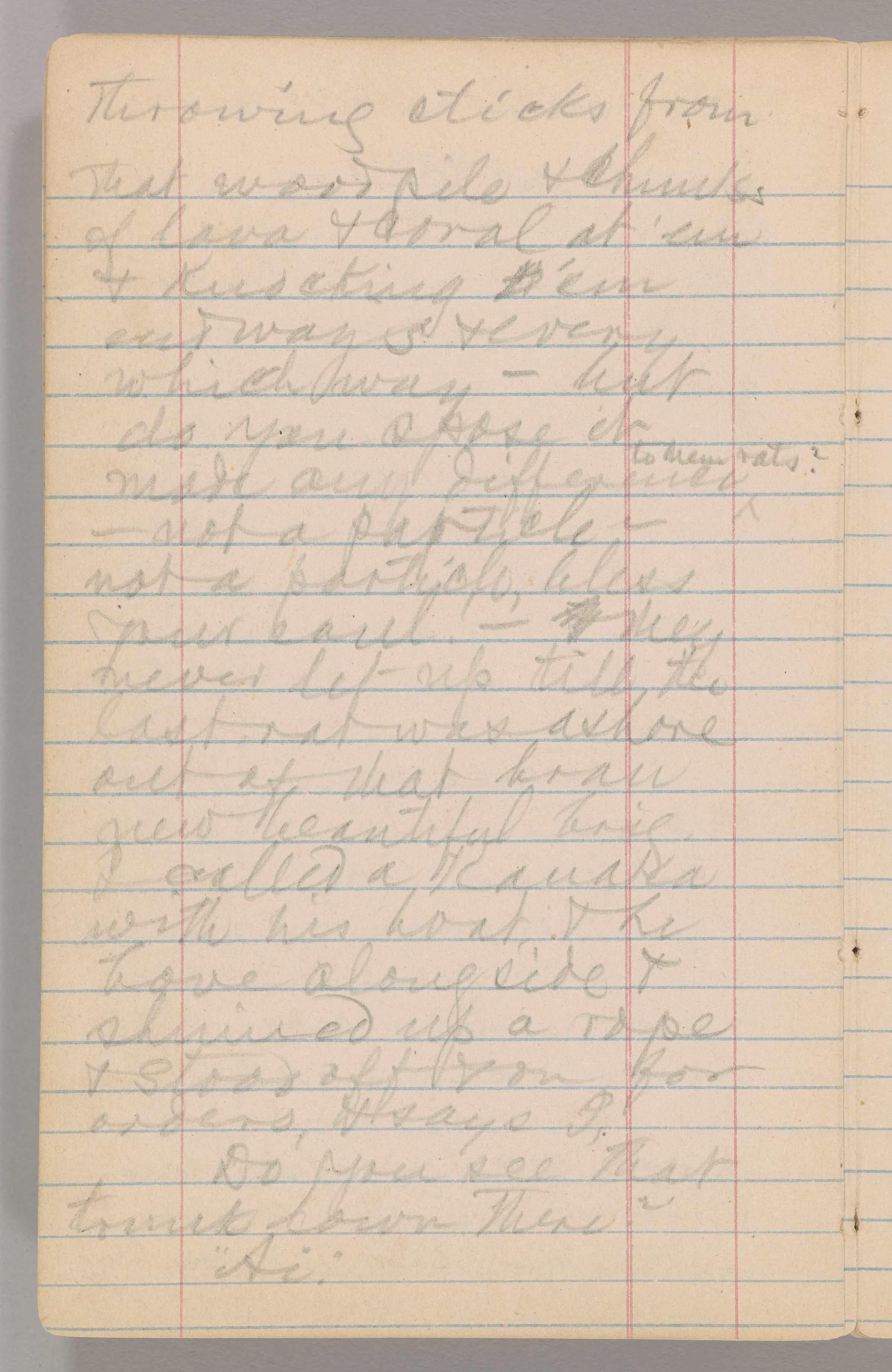
throwing sticks from
that woodpile & chunks
of lava & coral at 'em
& knocking th 'em
endways & every
which way—but
do you spose it
made any difference to them rats?
—not a particle—
not a particle, bless
your soul!—& they
never let up till the
last rat was ashore
out of that bran
new beautiful brig.
I called a Kanaka
with his boat, & he
hove alongside &
shinned up a rope
& stood off & on for
orders, & says I,
Do you see that
trunk down there?
“Ai.”
[MS: N7_leaf_020r]
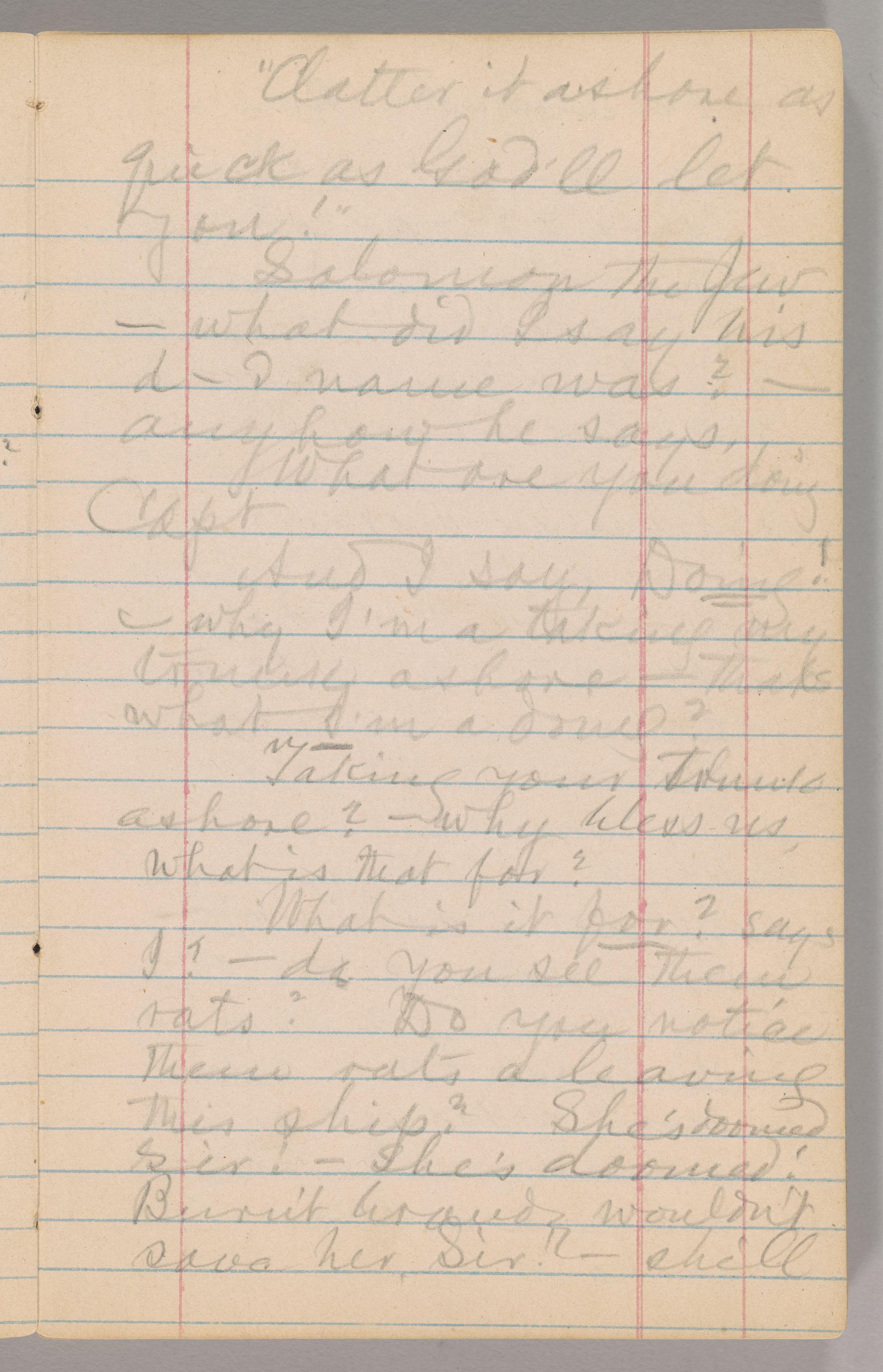
“Clatter it ashore as
quick as God'll let
you!”
Solomon the Jew
—what did I say his
d—d name was?—
anyhow he says,
What are you doing
Capt
And I say, Doing
? !
—why I'm a taking my
trunk ashore—thats
what I'm a doing?
Taking your
sh trunk
ashore?—why bless us,
what is that for?
What is it for? says
I?—do you see them
rats?
T Do you notice
them rats a leaving
this ship? She's doomed
sir!—she's doomed!
Burn't brandy wouldn't
save her, Sir!—she'll
[MS: N7_leaf_020v]
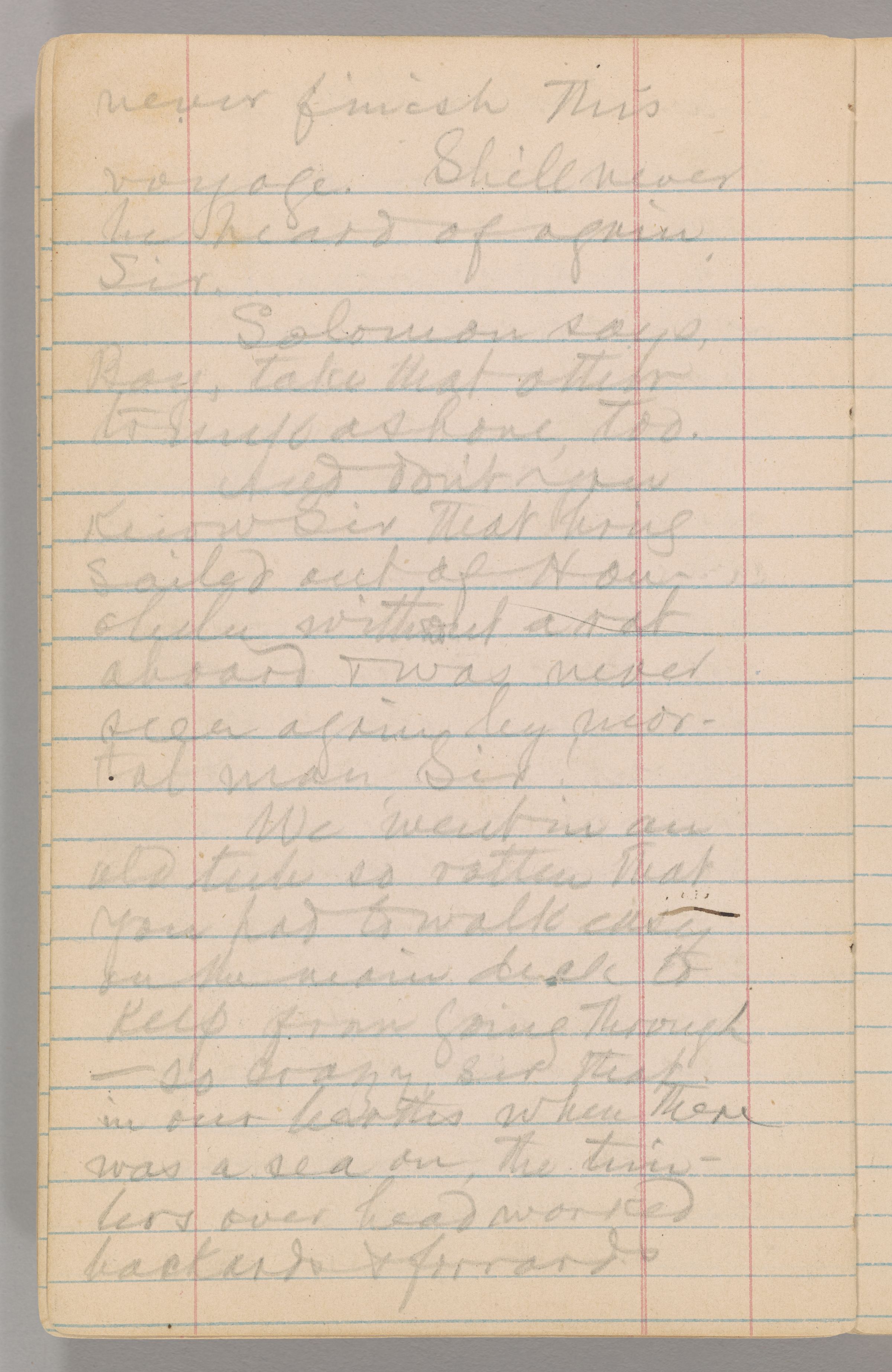
never finish this
voyage. She'll never
be heard of again,
Sir.
[MTP: N&J1_255]
Solomon says,
Boy, take that other
trunk ashore, too.
And don't you
know Sir that brig
sailed out of
Hon-
olulu
Honolulu
without a rat
aboard & was never
seen again by
mor-
tal
mortal
man, Sir!
We went in an
old tub so rotten that
you had to walk easy
on the main deck to
keep from going through
—so crazy, sir that
in our berths when there
was a sea on, the
tim-
bers
timbers
over head worked
backards & forrards
[MS: N7_leaf_021r]
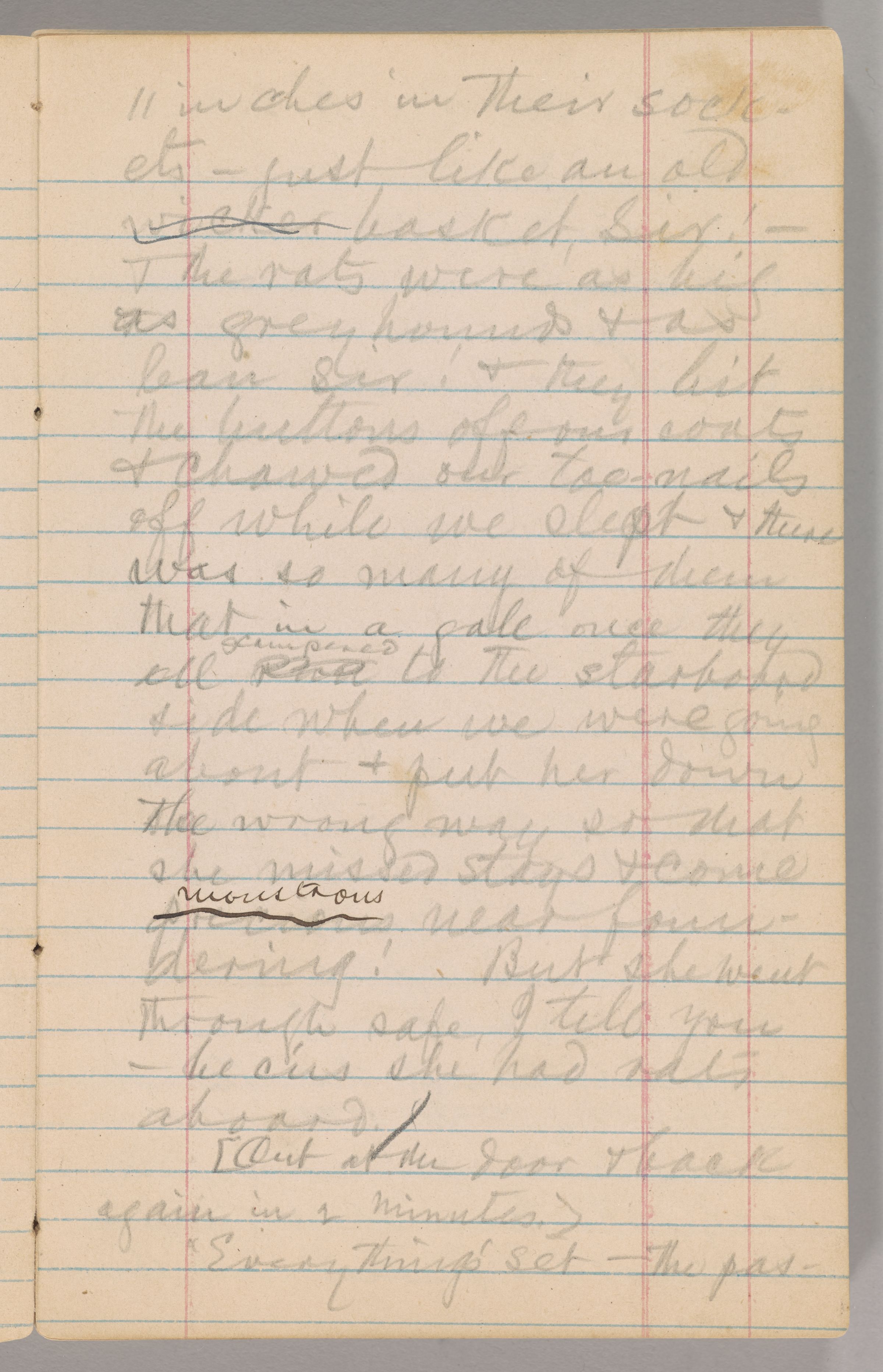
11 inches in their
sock-
ets
sockets
—just like an old
wicker
basket, Sir!—
& the rats were as big
& as greyhounds & as
lean sir! & they bit
the buttons off our coats
& chawed our toe-nails
off while we sleept & there
was so many of them
that in a gale once they
all ran
scampered
to the starboard
side when we were going
about & put her down
so
the
wrong way so that
she missed stays & come
precious
monstrous
near
foun-
dering
foundering
! But she went
through safe, I tell you
—becus she had rats
aboard.
⟦Out at the door & back
again in 2 minutes.⟧
“Everything's set—the pas-
[MS: N7_leaf_021v]
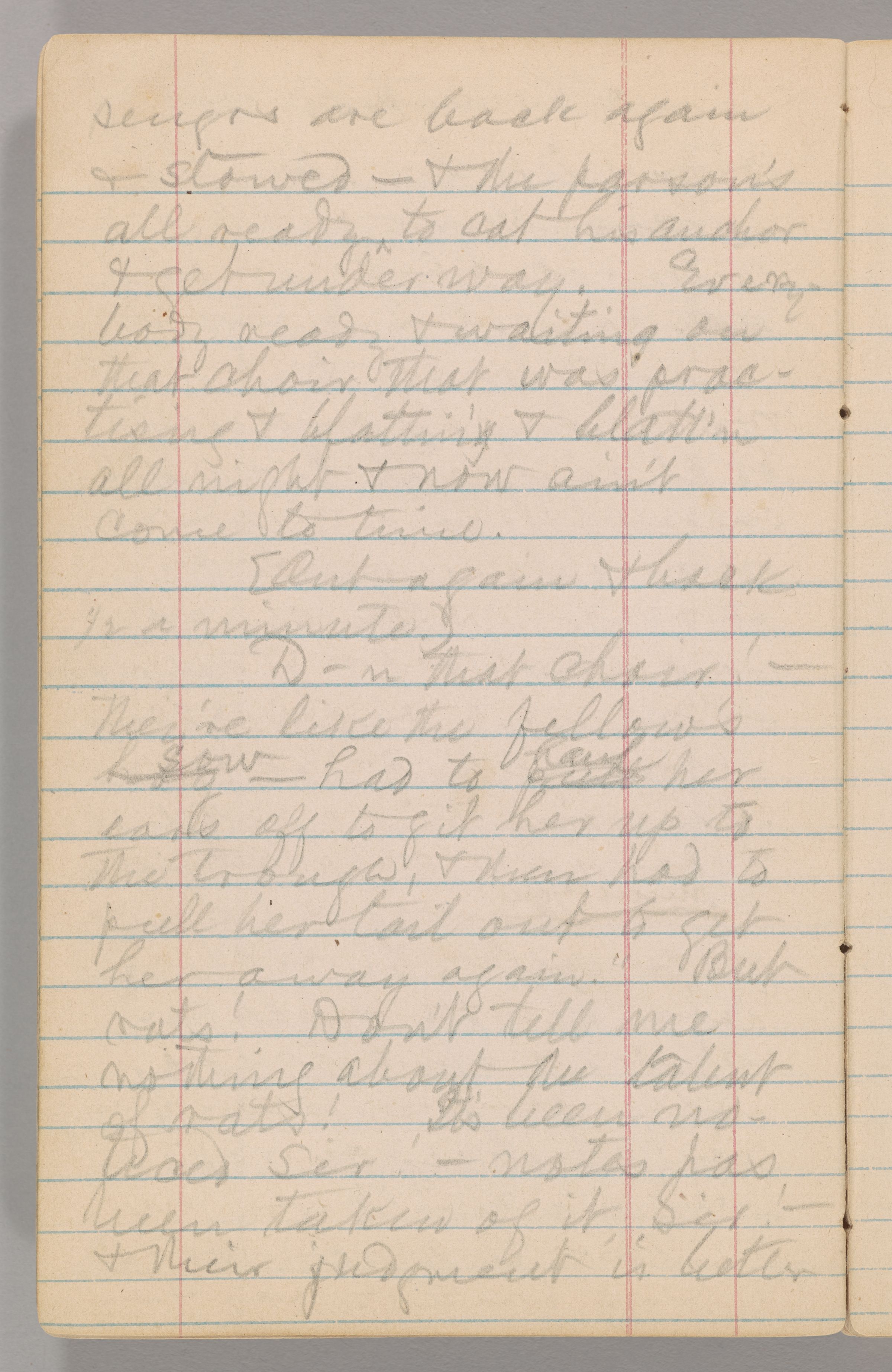
sengers are back again
& stowed—& the parson's
all ready to cat his anchor
& get under way.
Every-
body
Everybody
ready & waiting on
that choir that was
prac-
ticing
practising
& blatting' & blatt'n
all night & now ain't
come to time.
⟦Out again & back ½ a minute.⟧
D—n that choir!—
they're like the fellow's
hog
sow—had to pull
haul
her
ears off to git her up to
the trough, & then had to
pull her tail out to get
her away again.” But
rats! Don't tell me
nothing about the talent
of rats! It's been
no-
ticed
noticed
Sir!—notes has
been taken of it, Sir!—
& their judgment is better
[MS: N7_leaf_022r]
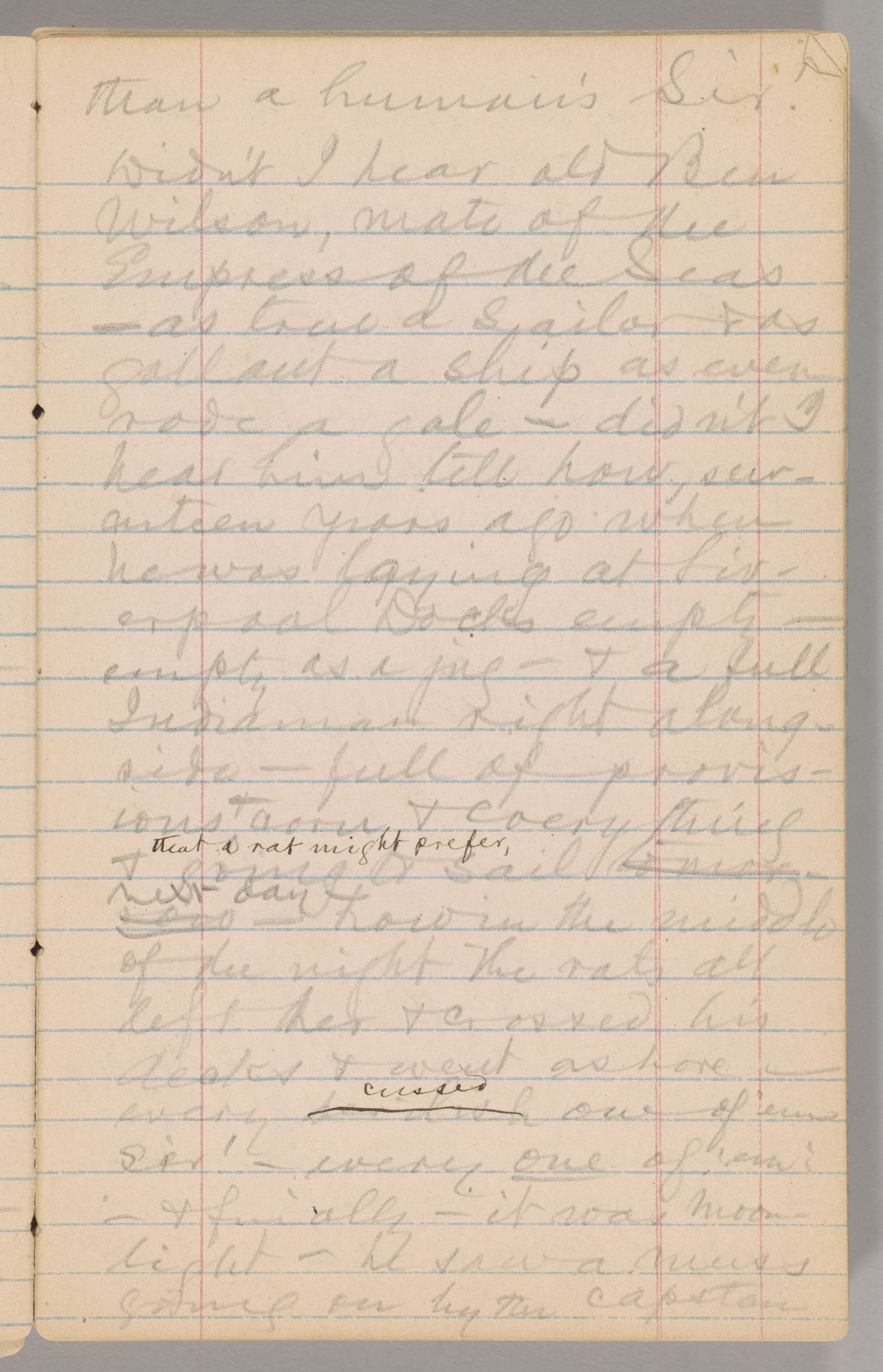
than a human's Sir!
Didn't I hear old Ben
Wilson, mate of the
Empress of the Seas
—as true a sailor & as
gallant a ship as ever
rode a gale—didn't I
hear him tell how,
sev-
enteen
seventeen
years ago when
he was
lyaying at
Liv-
erpool
Liverpool
Docks empty—
empty as a jug—& a full
Indiaman right
along-
side
alongside
—full of
provis-
ions
provisions
&
corn & everything
that a rat might prefer,
& going to sail
to-mor-
row
to-morrow
—
next day—
—how in the middle
of the night the rats all
left her & crossed his
decks & went ashore—
every
devilish
cussed
one of 'em
sir!—every one of 'em!
—& finally—it was
moon-
light
moonlight
—he saw a muss
going on by the capstan
[MS: N7_leaf_022v]
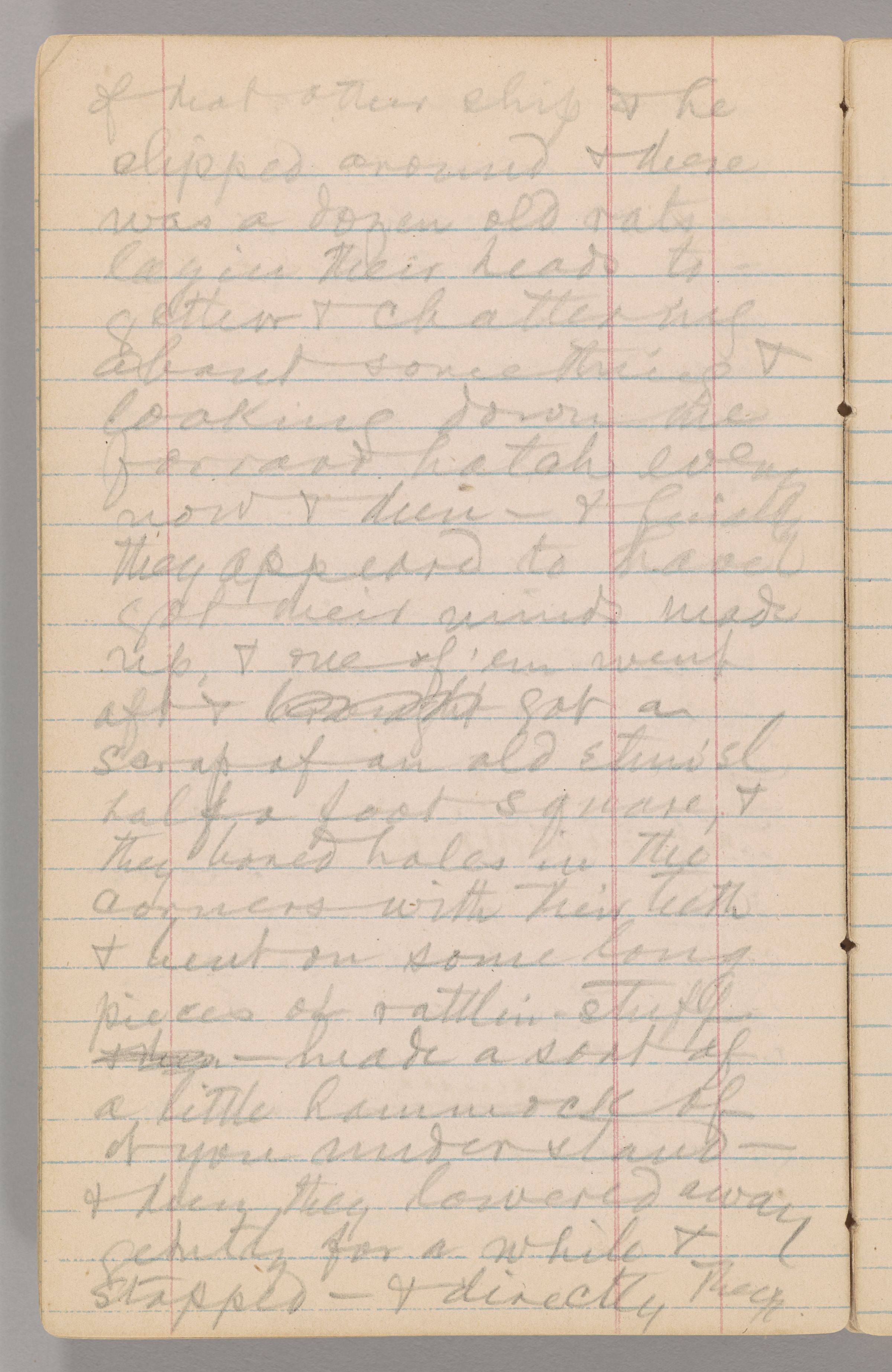
of that other ship & he
slipped around & there
was a dozen old rats
[MTP: N&J1_256] layin their heads
to-
gether
together
& chattering
about something &
looking down the
forrard hatch every
now & then—& finally
they appeared to have
got their minds made
up, & one of 'em went
aft & brought got a
scrap of an old stun'sl,
half a foot square, &
they bored holes in the
corners with their teeth
& bent on some long
pieces of rattlin-stuff
& then—made a sort of
a little hammock of
it you understand—
& then they lowered away
gently for a while &
stopped—& directly they
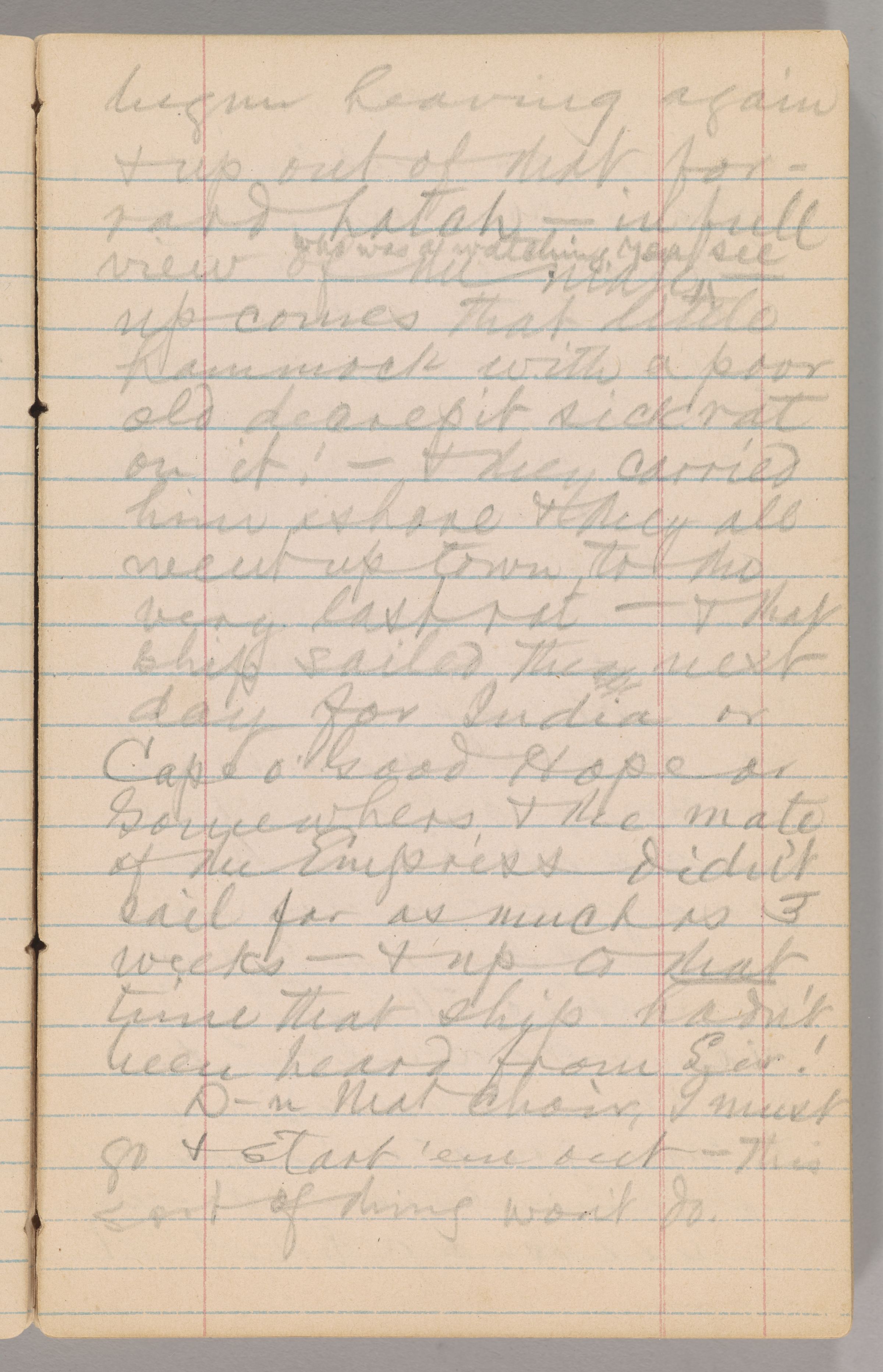
[MS: N7_leaf_023r]
begun heaving again
& up out of that
for-
rard
forrard
hatch—in full
view of the mate who was a watching, you see
—
up comes that little
hammock with a poor
old decrepit sick rat
on it!—& they carried
him ashore & they all
went up town to the
very last rat—& that
ship sailed the ◊ next
day for India or
Cape o' Good Hope or
Somewhers, & the mate
of the Empress didn't
sail for as much as 3
weeks—& up to that
time that ship hadn't
been heard from Sir!
D—n that choir, I must
go & start 'em out—this
sort of thing won't do.
[MS: N7_leaf_023v]
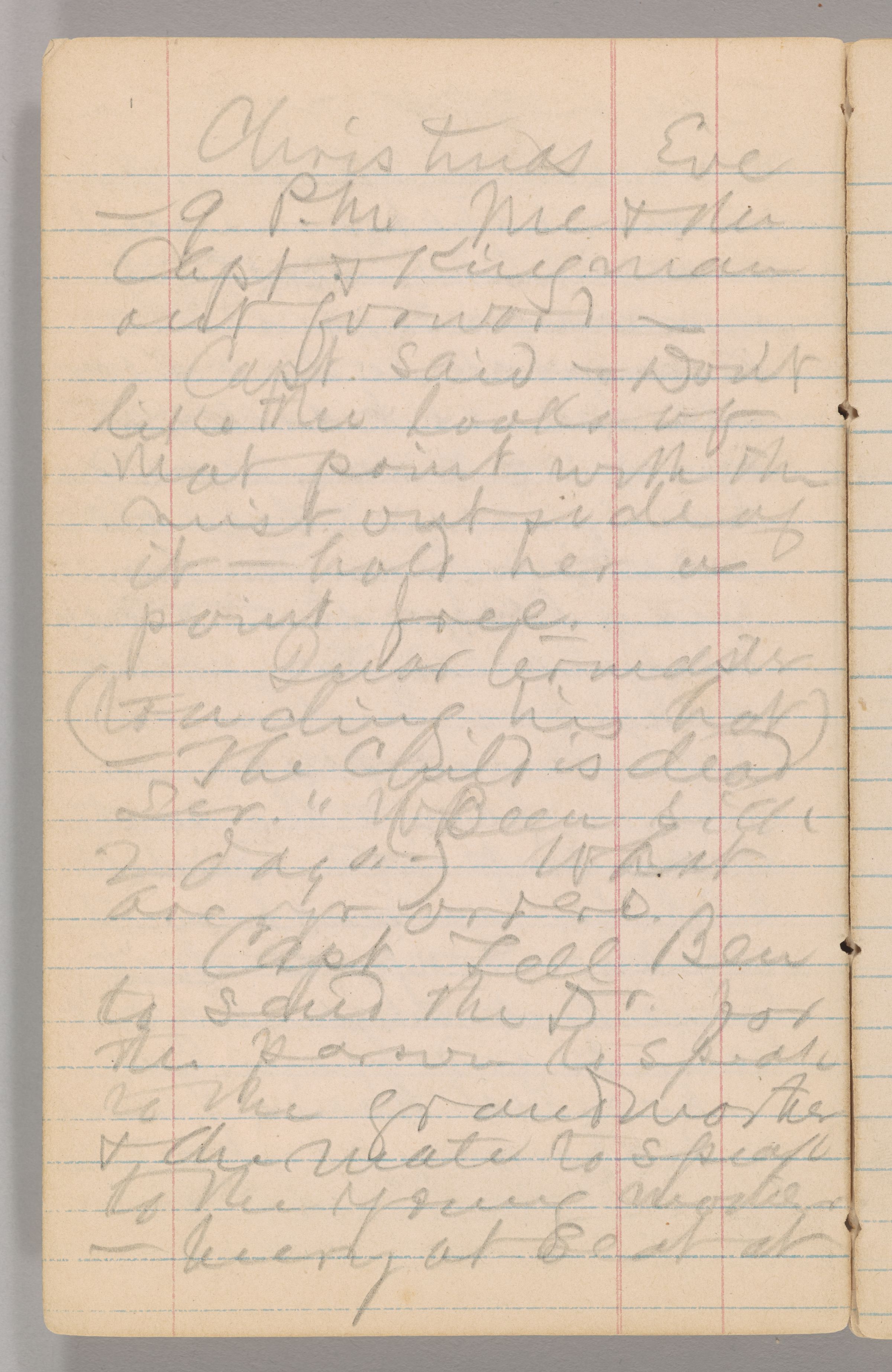
Christmas Eve
—9 P.M. Me & the
Capt & Kingman
out forward—
Capt. said—Don't
like the looks of
that point with the
mist outside of
it—hold her a
point free.
Quartermaster
(touching his hat)
—The child is dead
sir.”
Wh (Been sick
2 days.—) What
are yr orders.
Capt. Tell Ben
to send the Dr. for
the parson to speak
to the grandmother
& the mate to speak
to the young mother
—bury at seat at
[MS: N7_leaf_024r]
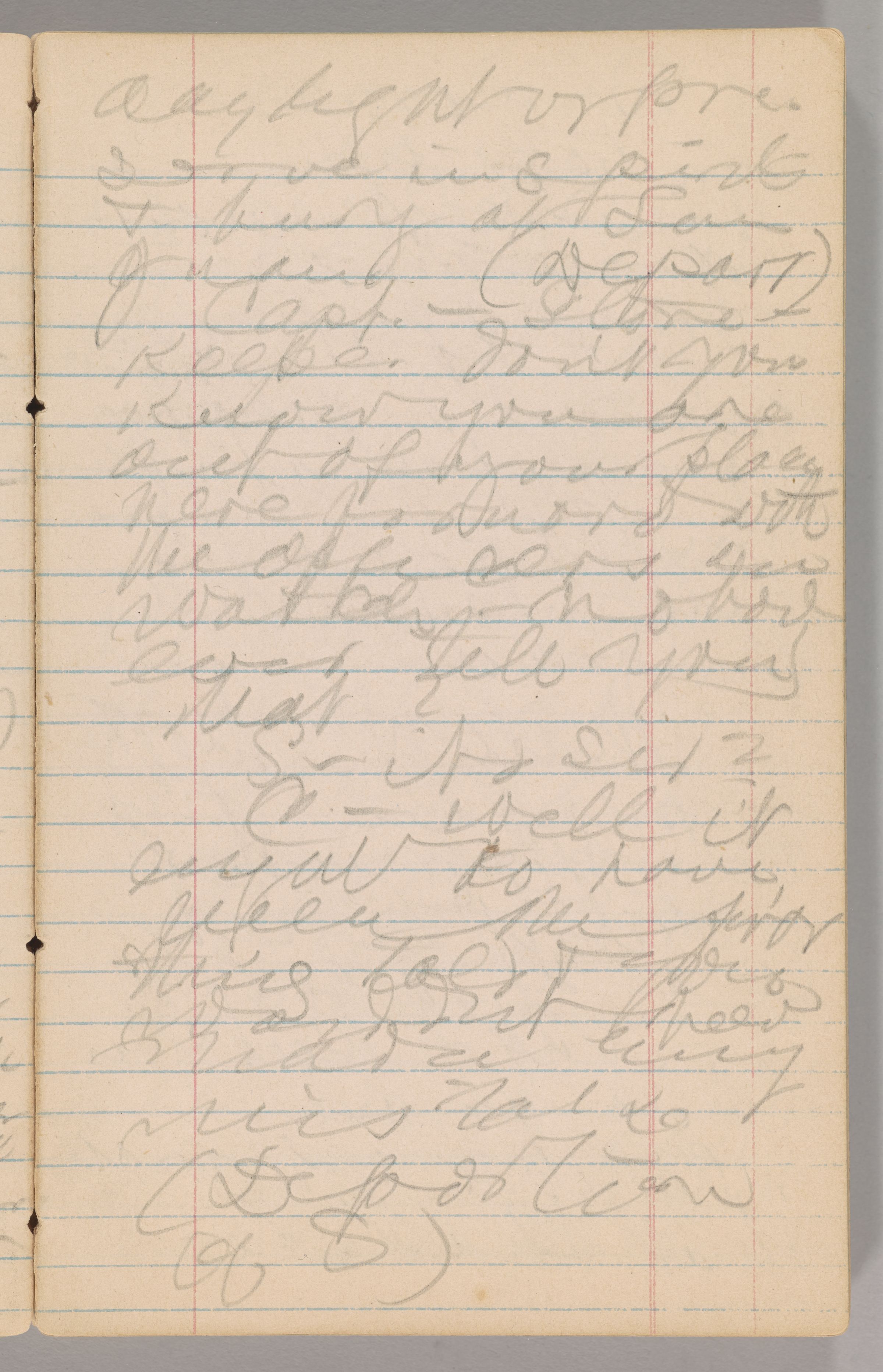
daylight or
pre-
serve
preserve
in spirits
& bury at San
Juan (Depart)
Capt.—
Store-
keeper
Store-keeper
don't you
know you are
out of your place
here forward with
the officers on
watch—nobody
ever tell you
that?
S—No sir?
C—Well it
ought to have
been the first
thing told & you
wouldnt have
made any
mistake
(Departure of S)
[MS: N7_leaf_024v]
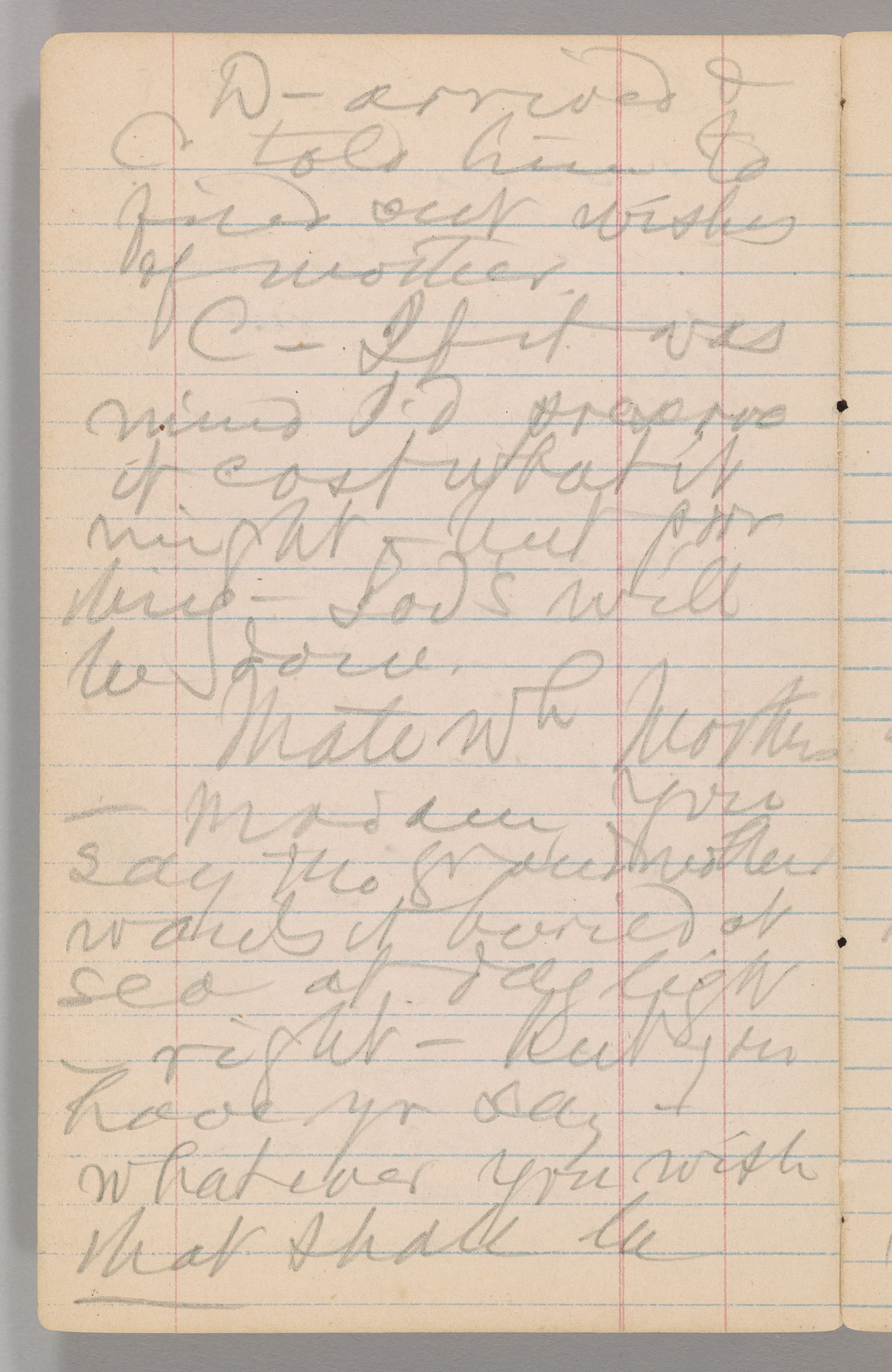
D—arrived &
C told him to
find out wishes
of mother.
C—If it was
mine I'd preserve
it cost what it
might—but poor
thing—God's will
be done.
Mate wh Mother
—Madam, you
say the grandmother
wants it
[MTP: N&J1_257] buried at
sea at daylight
—right—but you
have yr say—
whatever you wish
that shall be
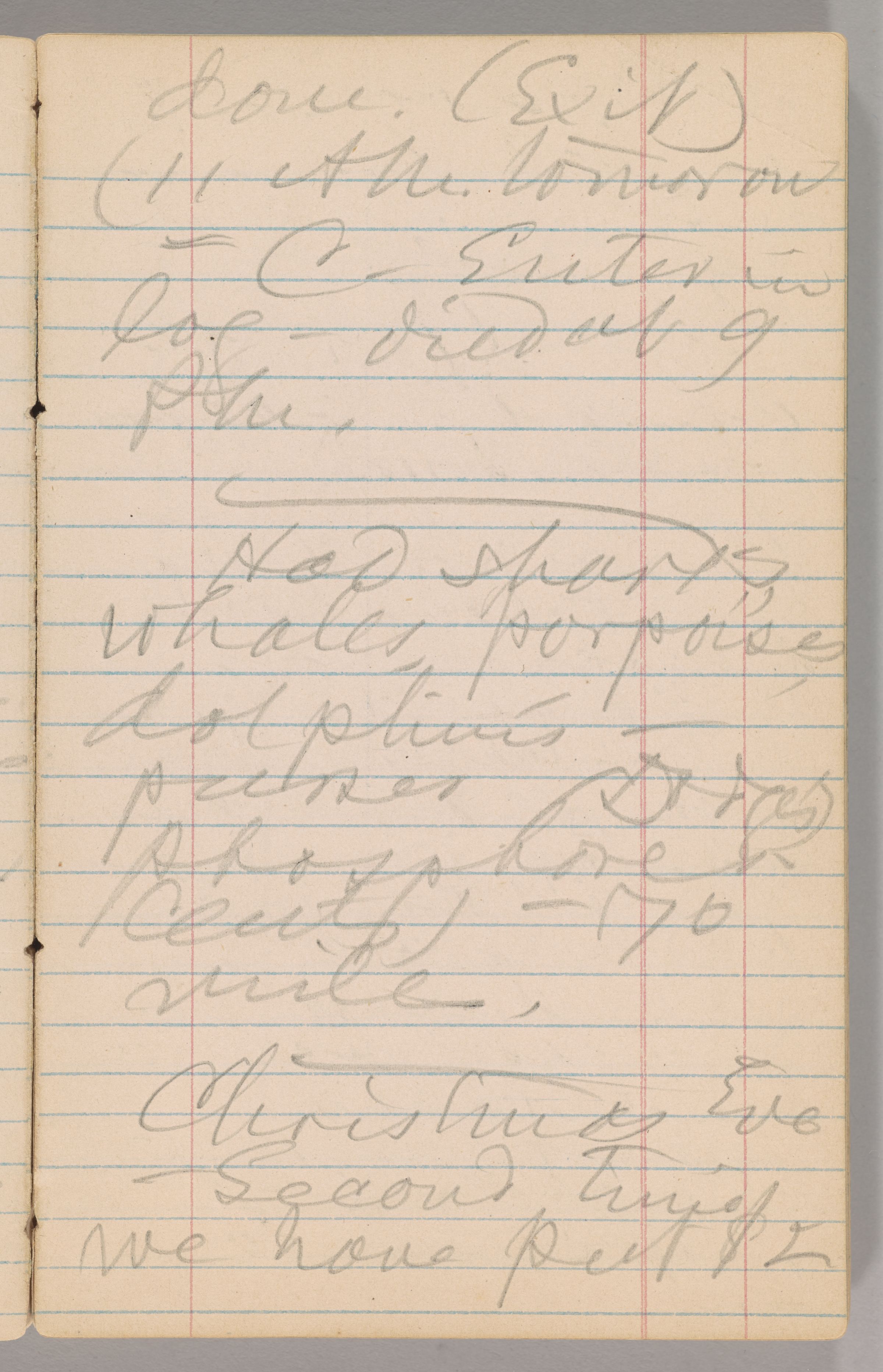
[MS: N7_leaf_025r]
done. (Exit)
(11 AM. tomorow
—C—Enter in
log—died at 9
PM.
Had sharks,
whales, porpoises,
dolphins—
purser (Dodge's)
phosphores-
cents
phosphorescents
)—70
miles.
Christmas Eve
—Second time
we have put $2
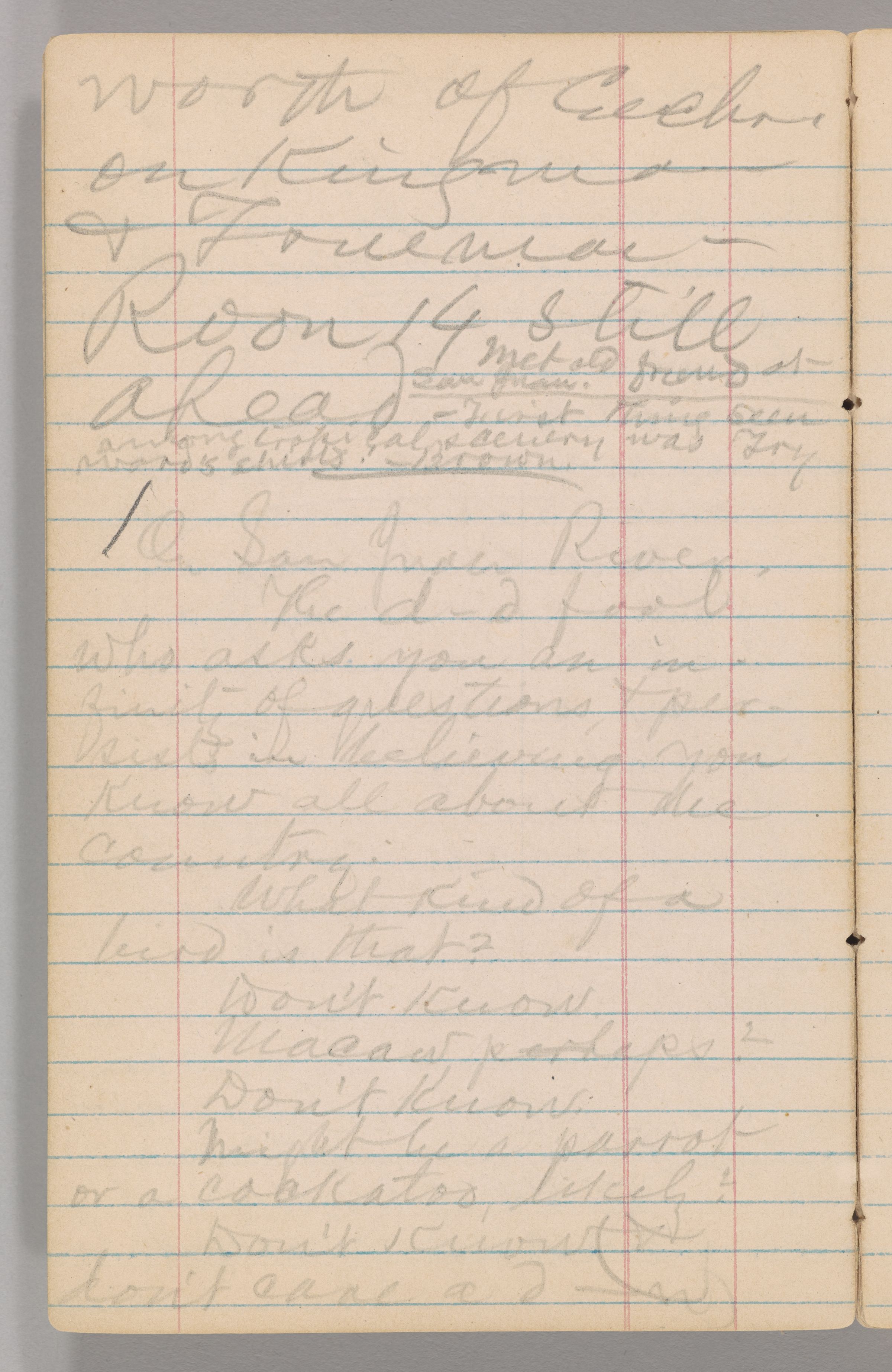
[MS: N7_leaf_025v]
worth of Euchre
on Kingman
& Trueman—
Roon 14 still
ahead.
Met old friend at San Juan.
—First thing seen
among tropical scenery was Try
Ward's shirts!—Brown.
On San Juan River.
The d—d fool
who asks you an
in-
finity
infinity
of questions, &
per-
sists
persists
in believing you
know all about the
country.
What kind of a
bird is that?
Don't know.
Don't know.
Might be a parrot
or a cockatoo, likely?
Don't know (&
don't care a d—n)
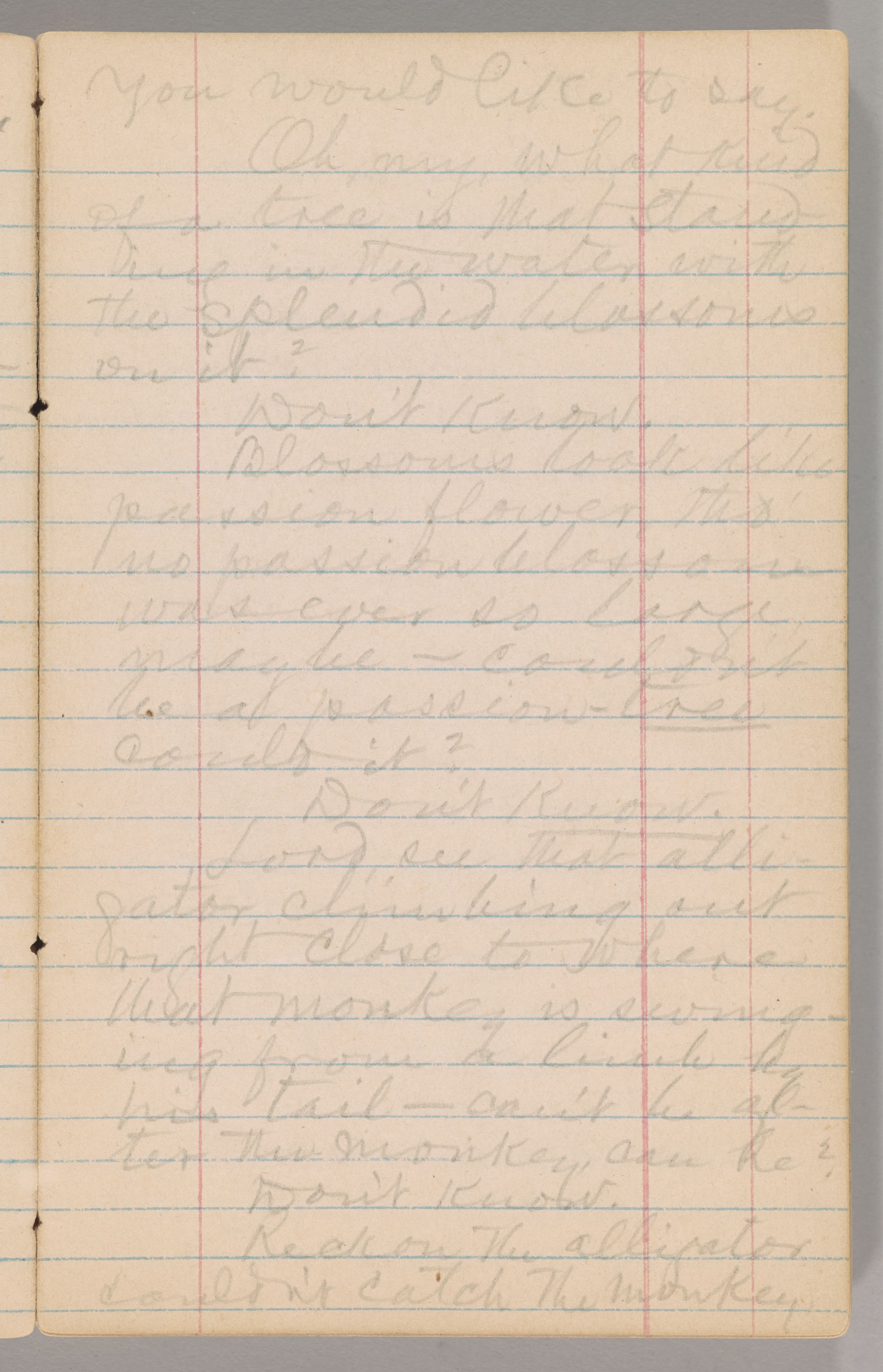
[MS: N7_leaf_026r]
you would like to say.
[MTP: N&J1_258]
Oh, my, what kind
of a tree is that
stand-
ing
standing
in the water with
the splendid blossoms
on it?
Don't know.
Blossoms look like
passion flower, tho'
no passion blossom
was ever so large,
maybe—couldn't
be a passion-tree
could it?
Don't know.
Lord, see that
alli-
gator
alligator
climbing out
right close to where
that monkey is
swing-
ing
swinging
from a limb by
his tail—can't be
af-
ter
after
the monkey, can he?
Don't know.
Reckon the alligator
couldn't catch the monkey,
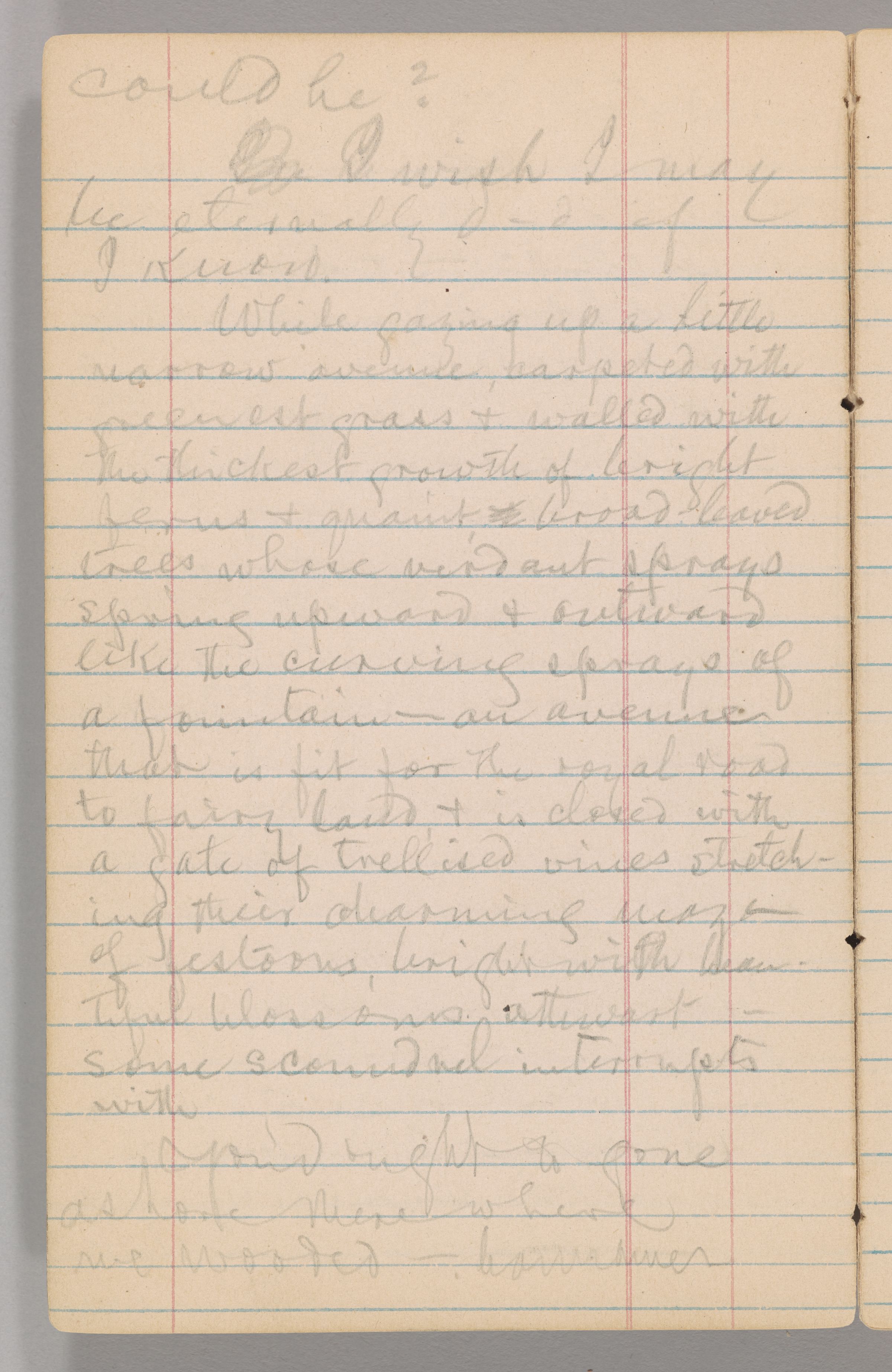
[MS: N7_leaf_026v]
could he?
In h I wish I may
be eternally d—d if
I know.
While gazing up a little
narrow avenue, carpeted with
greenest grass & walled with
the thickest growth of bright
ferns & quaint &
, broad-leaved
trees whose verdant sprays
spring upward & outward
like the curving sprays of
a fountain—an avenue
that is fit for the royal road
to fairy land, & is closed with
a gate of trellised vines
stretch-
ing
stretching
their charming maze
of festoons, bright with
beau-
tiful
beautiful
blossoms athwart—
some scoundrel interrupts
with
You'd ought to gone
ashore there where
we wooded—bannaner
[MS: N7_leaf_027r]
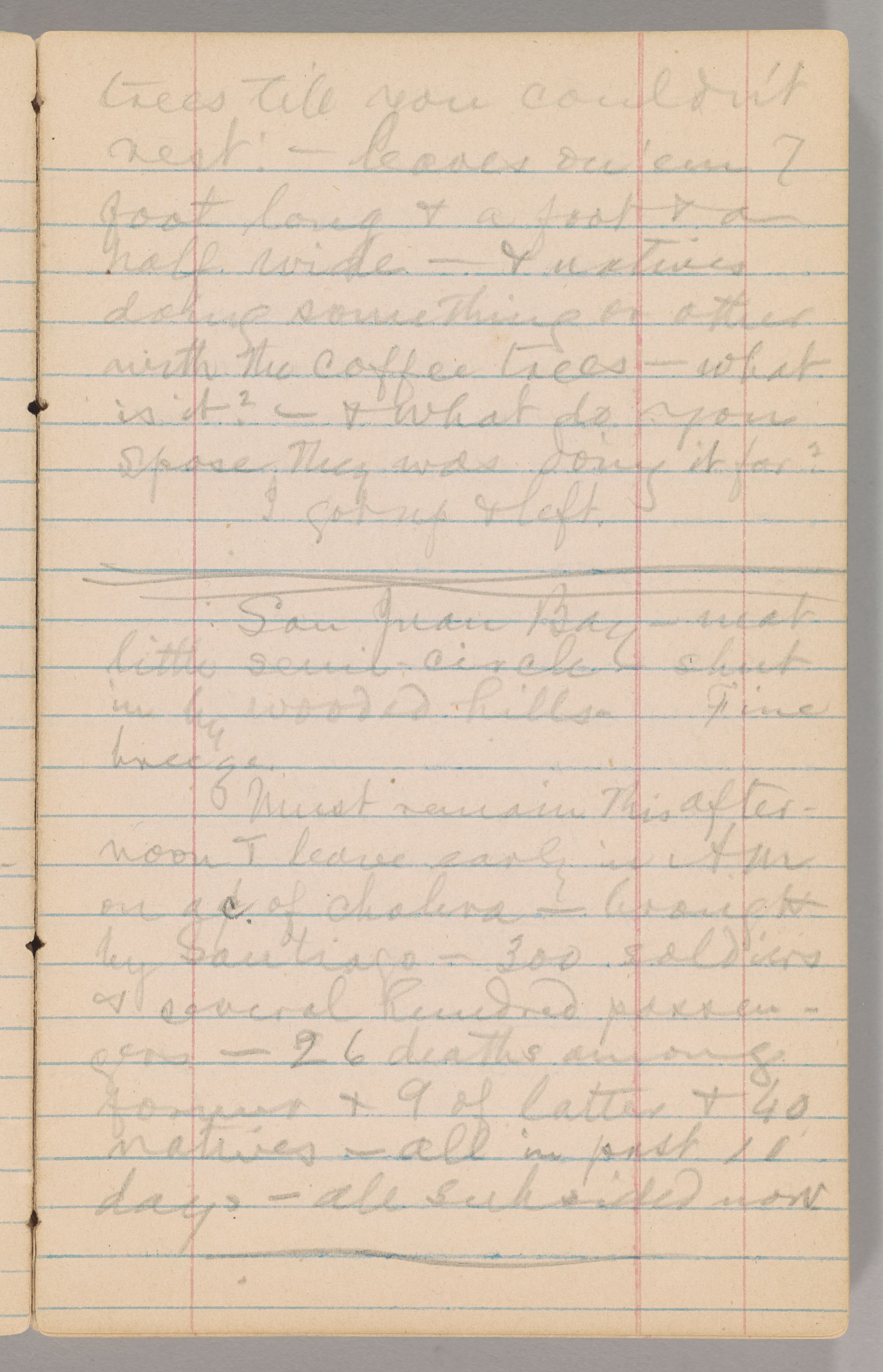
trees till you couldn't
rest!—leaves on 'em 7
foot long & a foot & a
half wide—& natives
doing something or other
with the coffee trees—what
is it?—& what do you
spose they was doing it for?
I got up & left.
San Juan Bay—neat
little semi-circle shut
in by wooded hills. Fine breeze.
Must remain this
after-
noon
afternoon
& leave early in AM
on ac. of cholera—brought
by Santiago—300 soldiers
& several hundred
passen-
gers
passengers
—26 deaths among
former & 9 of latter & 40
natives—all in past 10
days—all subsided now.
[MS: N7_leaf_027v]
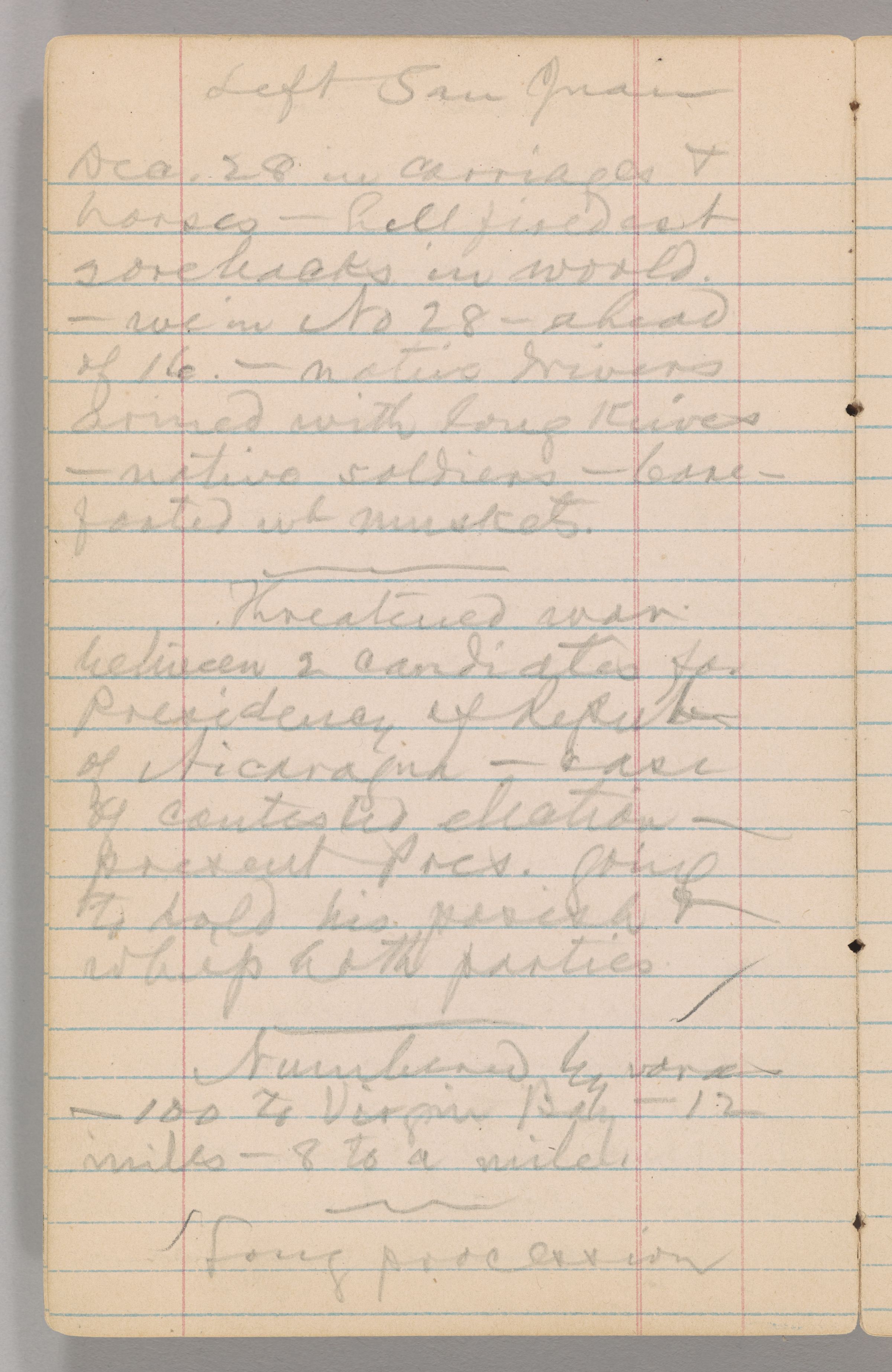
Left San Juan
Dec. 28 in carriages &
horses—hellfiredest
sorebacks in world.
—we in No 28—ahead
of 16.—native drivers
armed with long knives
—native soldiers—
bare-
footed
barefooted
wh muskets.
[MTP: N&J1_259]
Threatened war
between 2 candidates for
Presidency of Repub
of Nicaragua—case
of contested election—
present Pres. going
to hold his posish &
whip both parties.
Numbered by varas
—100 to Virgin Bay—12
miles—8 to a mile.
Long procession
[MS: N7_leaf_028r]
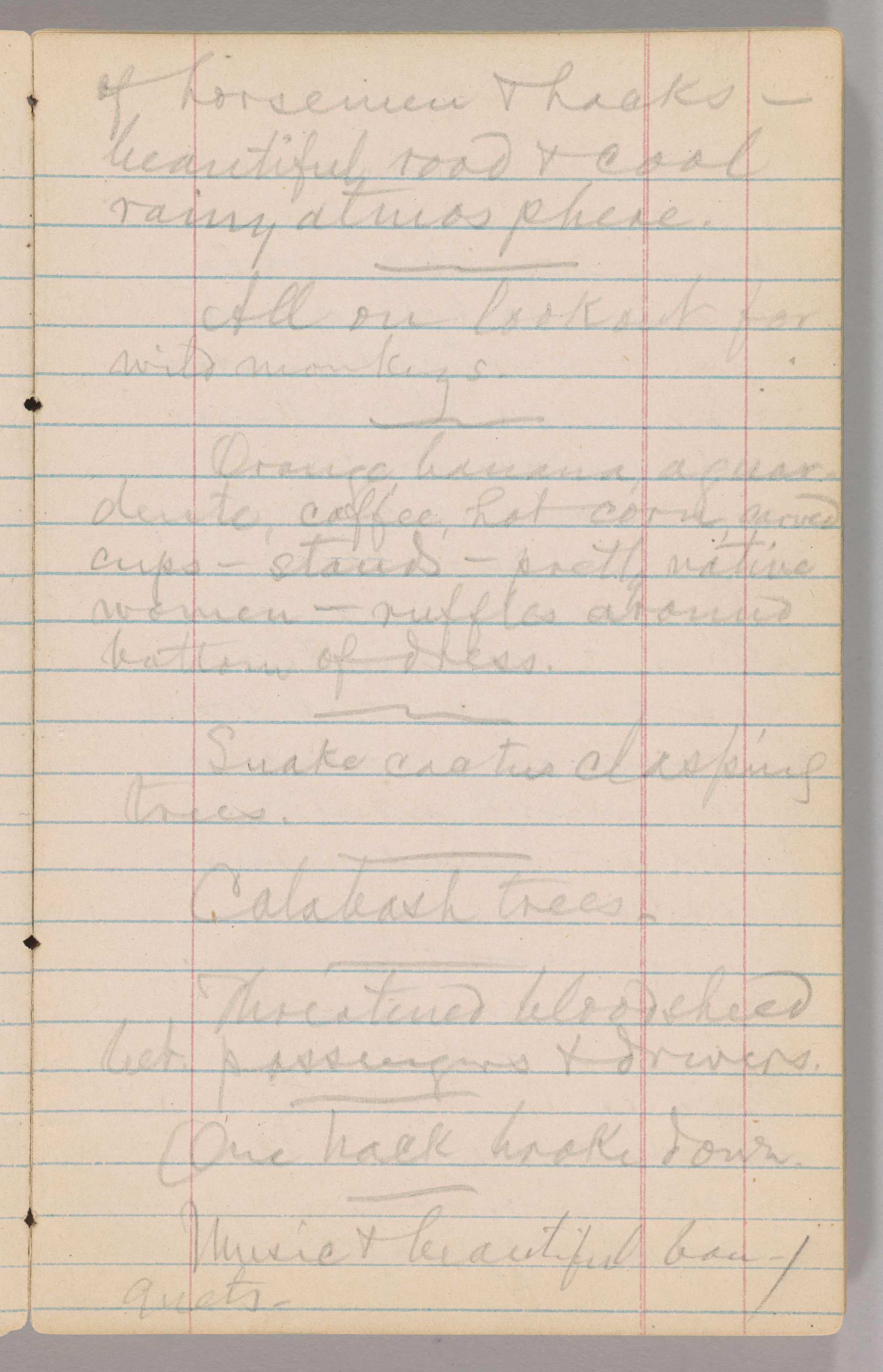
of horsemen & hacks—
beautiful road & cool
rainy atmosphere.
All on lookout for
wild monkeys.
Orange, banana,
aguar-
dente
aguardente
, coffee, hot corn, carved
cups—stands—pretty native
women—ruffles around
bottom of dress.
Snake cactus clasping
trees.
Calabash trees.
Threatened bloodsheed
bet. passengers & drivers.
One hack broke down.
Music & beautiful
bou-
quets
bouquets
.
[MS: N7_leaf_028v]
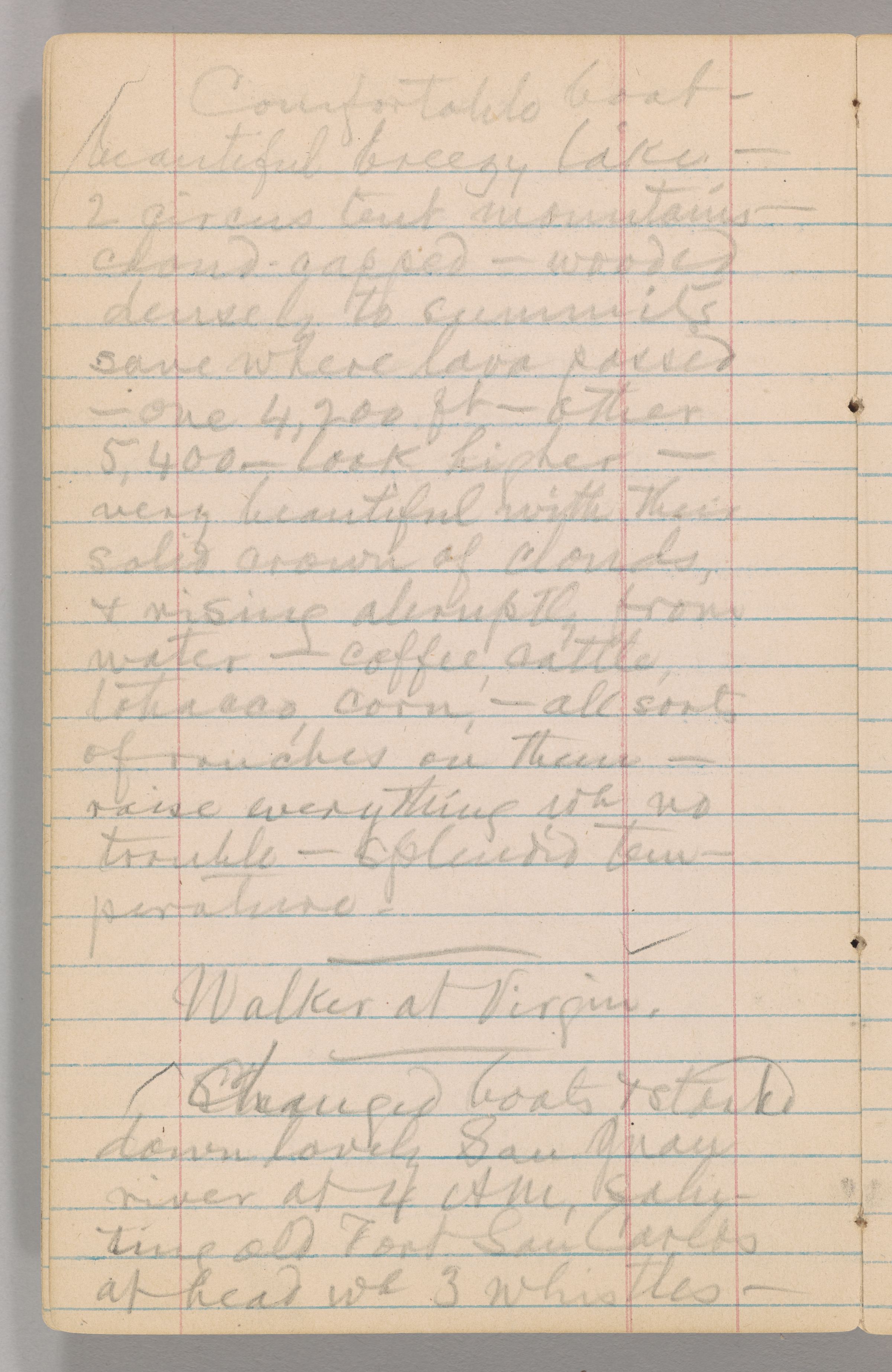
Comfortable boat—
beautiful breezy lake—
2 circus tent mountains—
cloud-capped—wooded
densely to summits
save where lava passed
—one 4,200 ft—other
5,400—look higher—
very beautiful with their
solid crown of clouds,
& rising abruptly from
water—coffee, cattle,
tobacco, corn,—all sorts
of ranches on them—
raise everything wh no
trouble—splendid
tem-
perature
temperature
.
[MTP: N&J1_260]
Sta Changed boats & started
down lovely San Juan
river at 4 AM,
salu-
ting
saluting
old Fort San Carlos
at head wh 3 whistles—
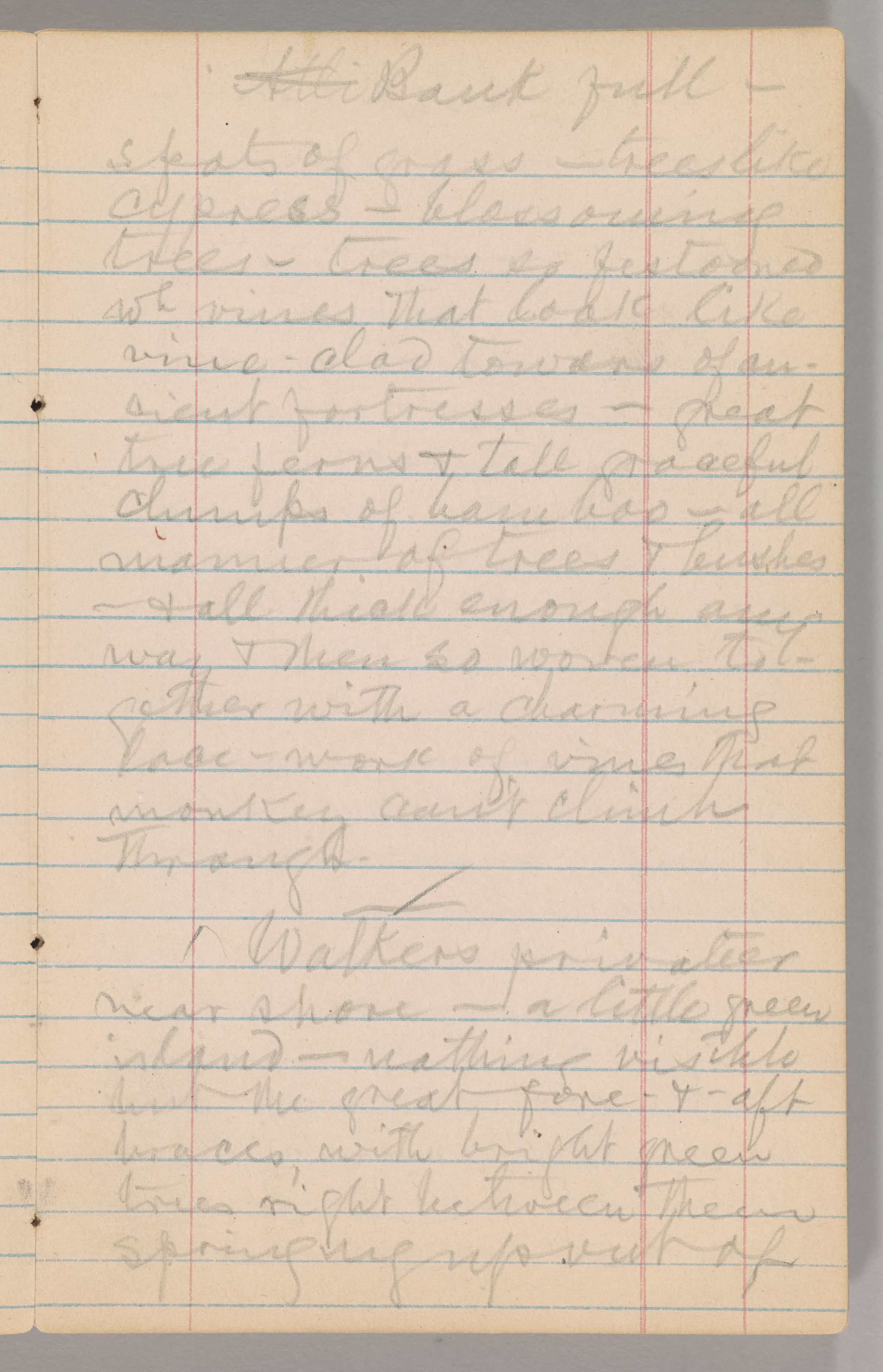
[MS: N7_leaf_029r]
Alli Bank full—
spots of grass—trees like
cypress—blossoming
trees—trees so festooned
wh vines that look like
vine-clad towers of
an-
cient
ancient
fortresses—great
tree ferns & tall graceful
clumps of bamboo—all
manner of trees & bushes
—& all thick enough
any-
way
anyway
& then so woven
to-
gether
together
with a charming
lace-work of vines that
monkey can't climb
through.
Walkers privateer
near shore—a little green
island—nothing visible
but the great fore-&-aft
braces, with bright green
trees right between them
springing up out of
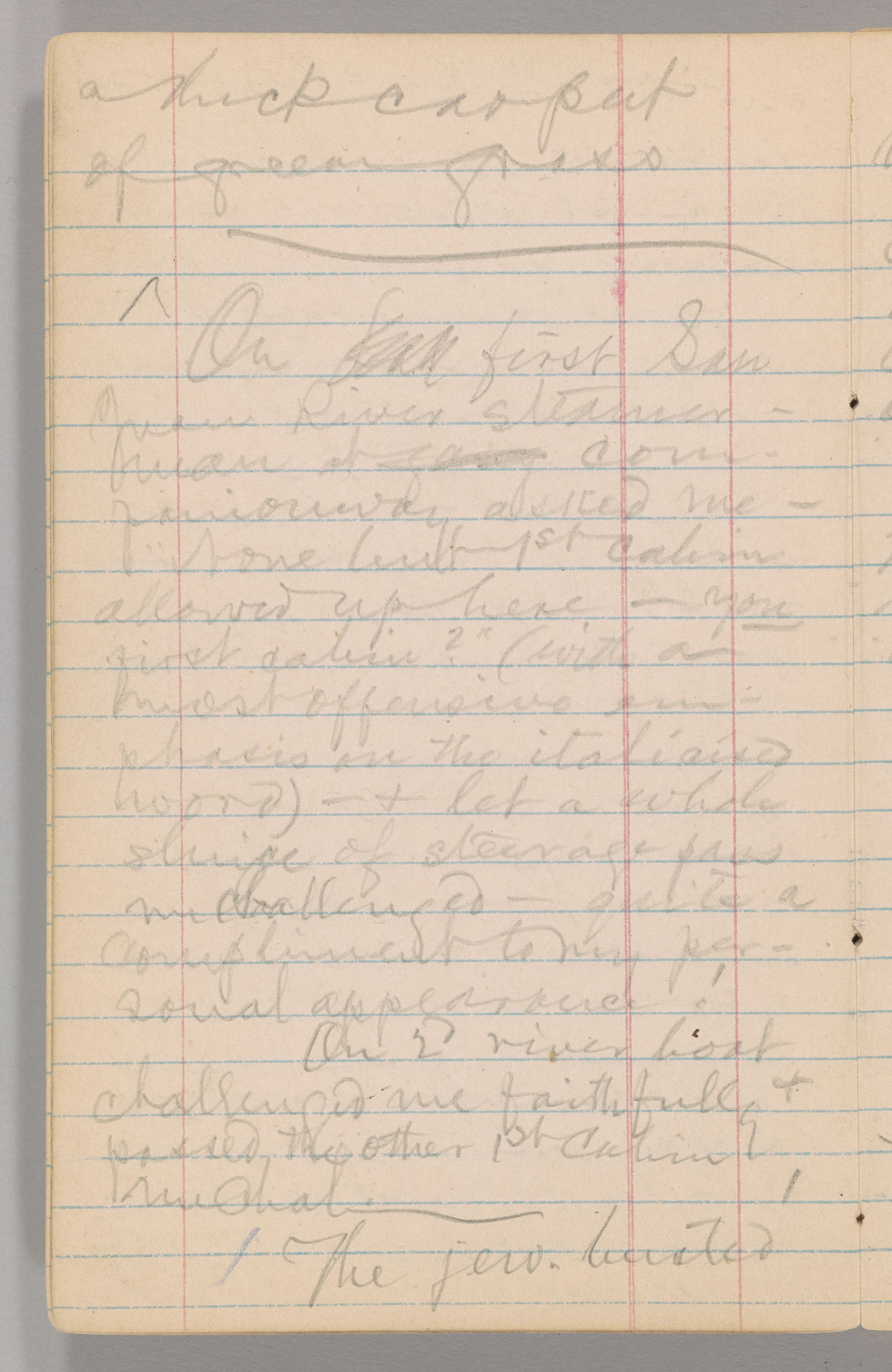
[MS: N7_leaf_029v]
a thick carpet
of green grass
On San first San
Juan River steamer—
man at gang
com-
panionway
companionway
asked me—
“None but 1st cabin
allowed up here—you
first cabin?” (with a
most offensive
em-
phasis
emphasis
on the italicised
word)—& let a whole
sluice of steerage pass
unchallenged—quite a
compliment to my
per-
sonal
personal
appearance!
On 2d river boat
challenged me faithfully &
passed the other 1st cabin
unchal.
The jew. busted
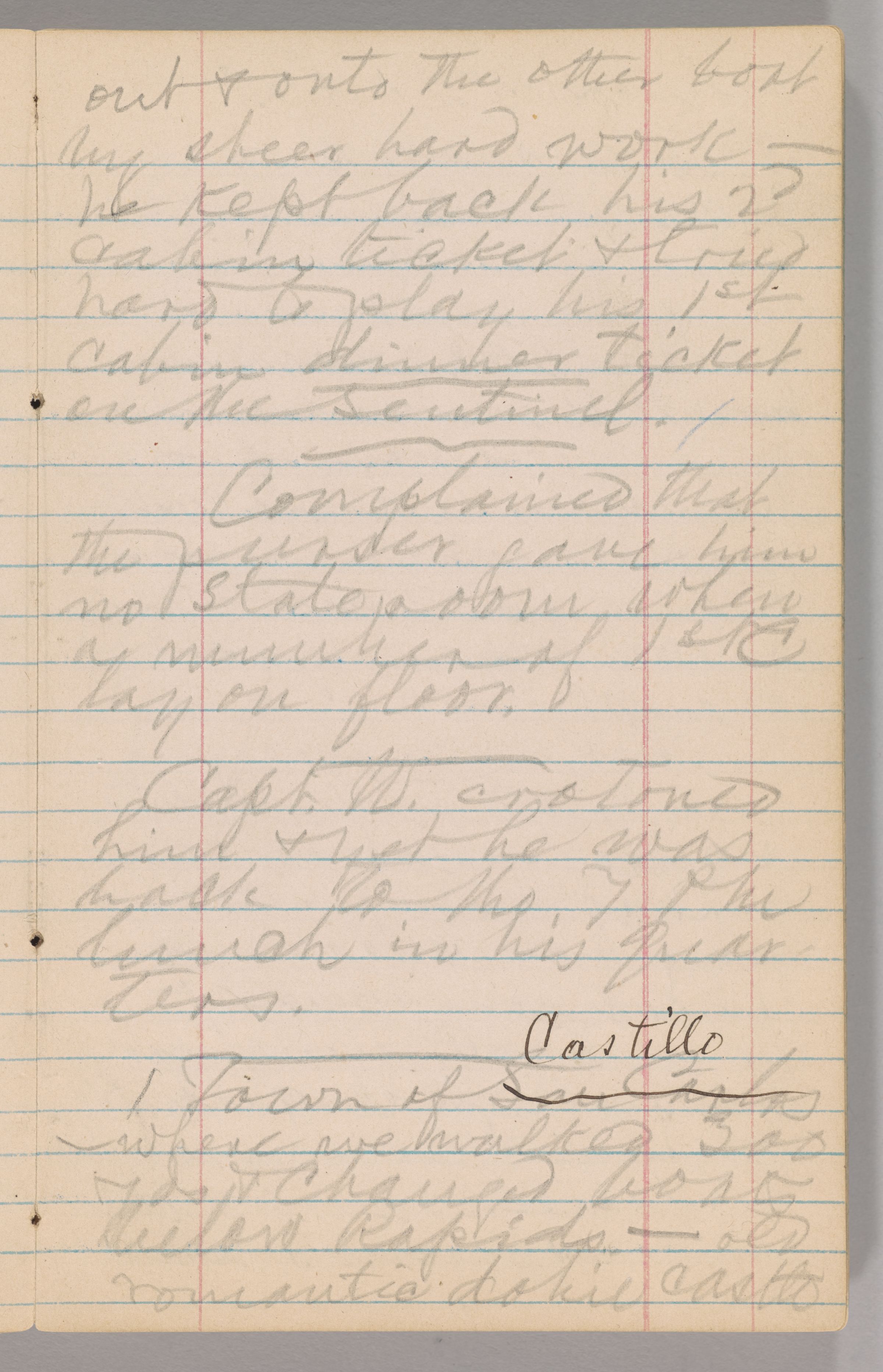
[MS: N7_leaf_030r]
out & onto the other boat
by sheer hard work—
he kept back his 2d
cabin ticket & tried
hard to play his 1st
cabin dinner ticket
on the sentinel.
Complained that
the purser gave him
no state room when
a number of 1st C
lay on floor.
Capt. W. crotoned
him & yet he was
back to the 7 PM
lunch in his
quar-
ters
quarters
.
Town of
San Carlos
Castillo
—where we walked 300
yds & changed boats
below Rapids.—old
romantic dobie castle
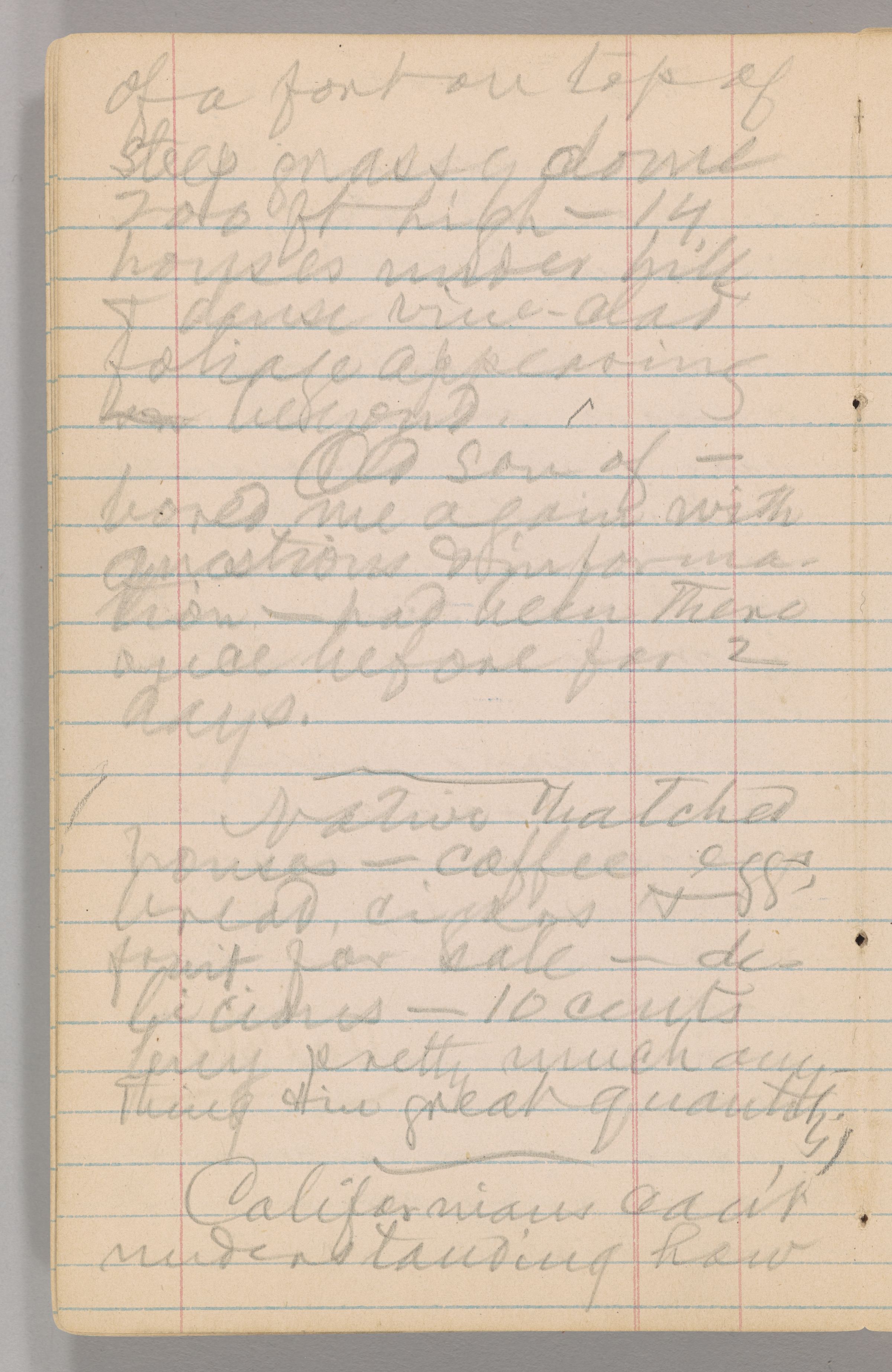
[MS: N7_leaf_030v]
of a fort
[MTP: N&J1_261] on top of
steep grassy dome
200 ft high—14
houses under hill
& dense vine-clad
foliage appearing
on beyond.
Old son of —
bored me again with
questions &
informa-
tion
information
— had been there
once before for 2
days.
Native thatched
houses—coffee, eggs,
bread, cigars &
fruit for sale—
de-
licious
delicious
—10 cents
buy pretty much
any-
thing
anything
& in great quantity.
Californians can't
understanding how
[MS: N7_leaf_031r]
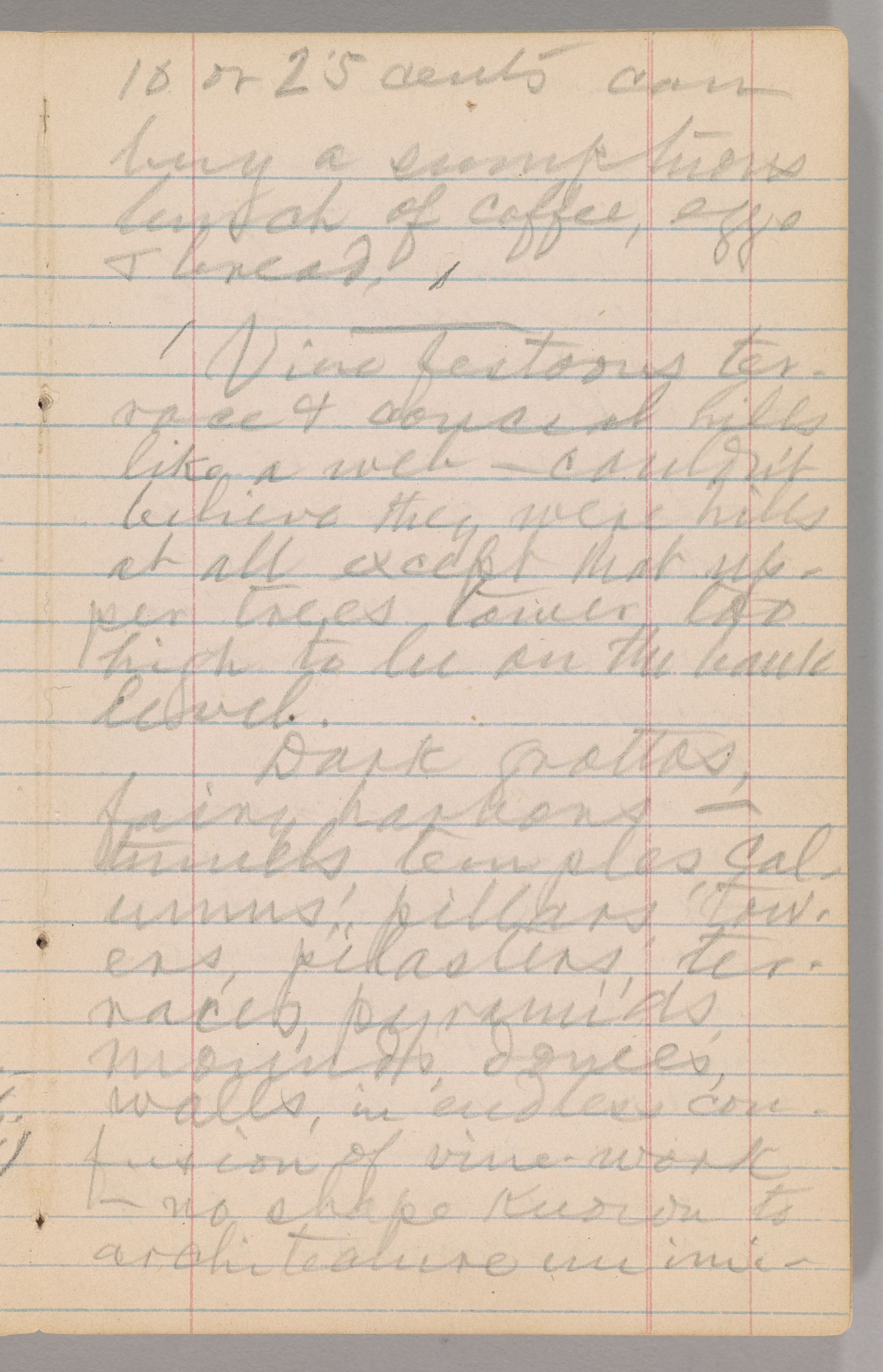
10 or 25 cents can
buy a sumptuous
lunch of coffee, eggs
& bread.
Vine festoons
ter-
race
terrace
& conceal hills
like a web—couldn't
believe they were hills
at all except that
up-
per
upper
trees tower too
high to be on the bank
level.
Dark grottos,
fairy harbors—
tunnels, temples,
col-
umns
columns
, pillars,
tow-
ers
towers
, pilasters,
ter-
races
terraces
, pyramids,
mounds, domes,
walls, in endless
con-
fusion
confusion
of vine-work
—no shape known to
architecture unimi-
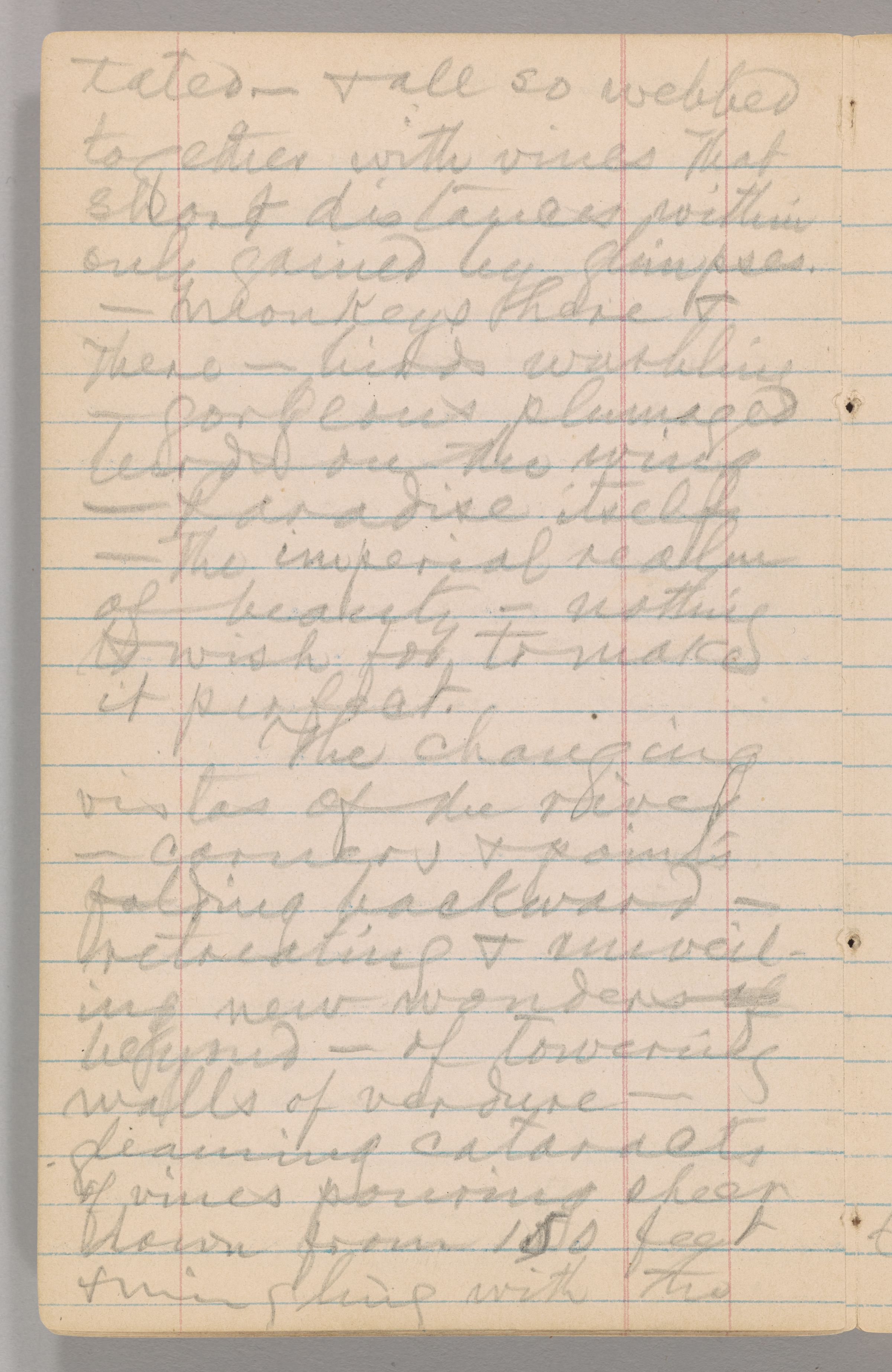
[MS: N7_leaf_031v]
tated —& all so webbed
together with vines that
short distances within
only gained by glimpses.
—monkeys here &
there—birds warbling
— gorgeous plumaged
birds on the wing
—Paradise itself
—the imperial realm
of beauty—nothing
to wish for to make
it perfect.
The changing
vistas of the river
—corners & points
folding backward—
retreating &
unveil-
ing
unveiling
new wonders of
beyond— of towering
walls of verdure—
gleaming cataracts
of vines pouring sheer
down from 150 feet
& mingling with the
[MS: N7_leaf_032r]
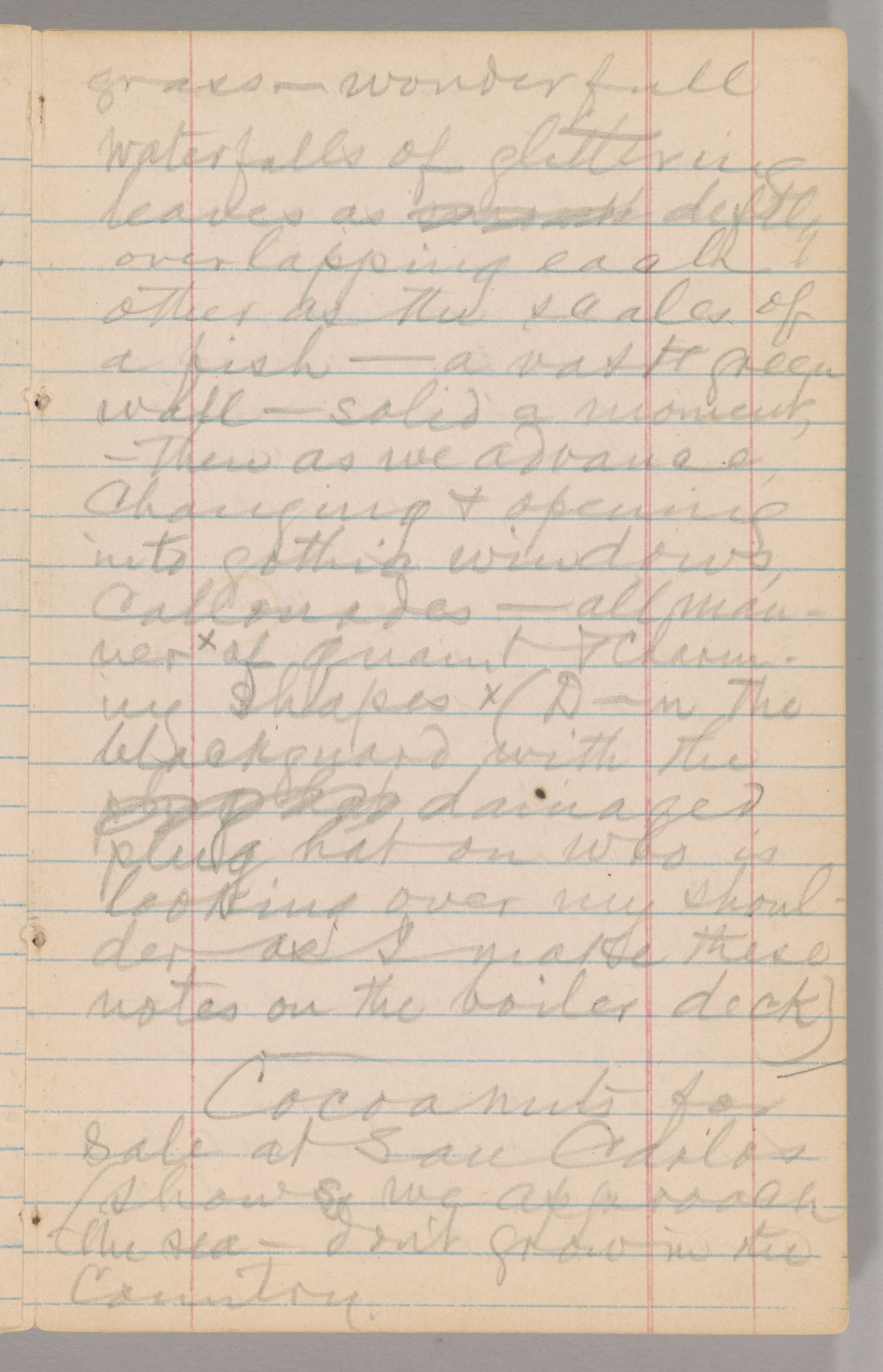
grass—wonderfull
waterfalls of glittering
leaves as smooth deftly
overlapping each
other as the scales of
a fish—a vast green
wall—solid a moment,
—then as we advance,
changing & opening
into gothic windows,
collonades—all
man-
ner
manner
of quaint &
charm-
ing
charming
shapes (D—n the
blackguard with the
plug hat damaged
plug hat on who is
looking over my
shoul-
der
shoulder
as I make these
notes on the boiler deck)
Cocoanuts for
sale at San Carlos
(shows we approach
the sea— don't grow in the
country.
[MS: N7_leaf_032v]
[MTP: N&J1_262]
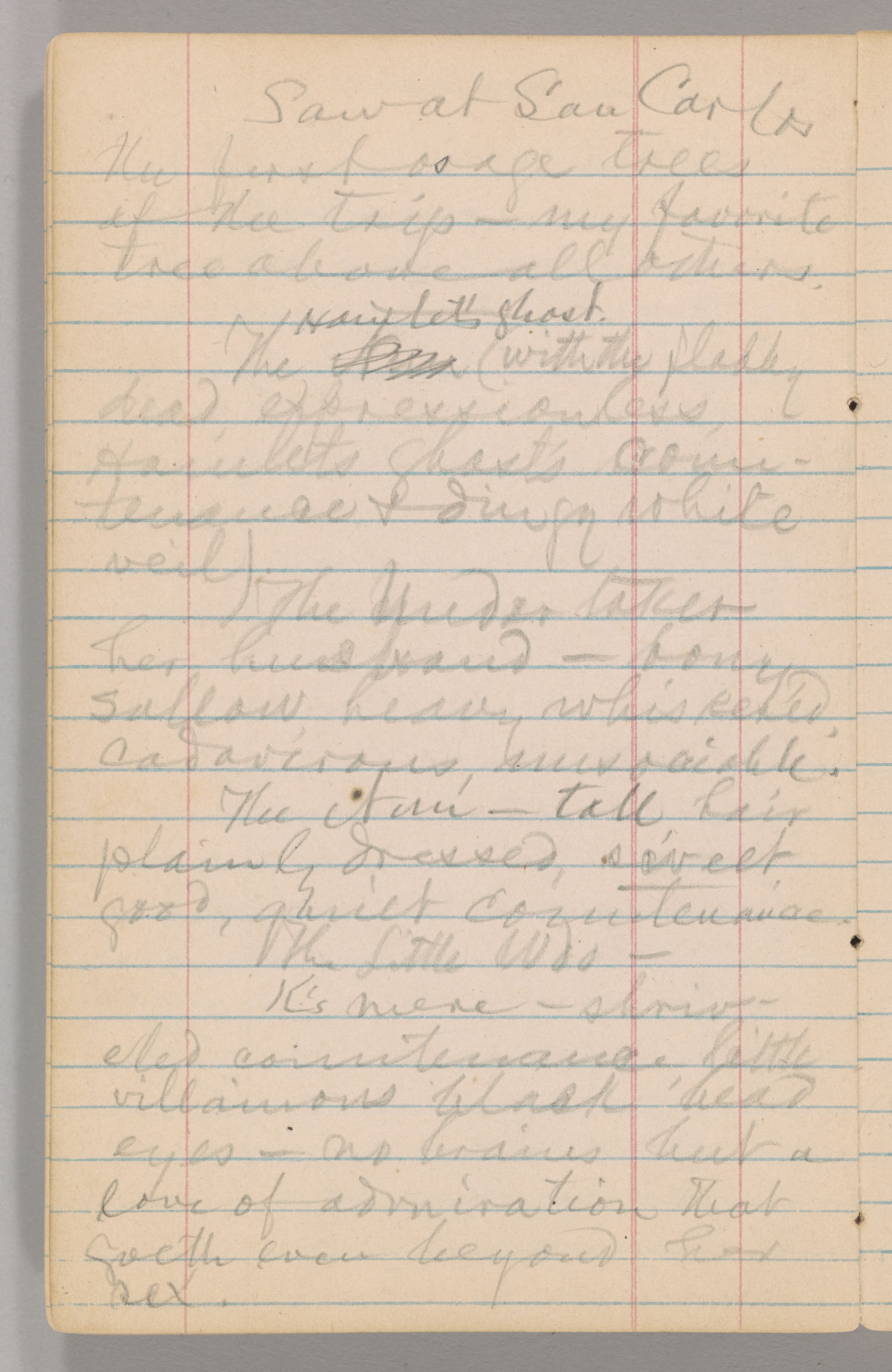
Saw at San Carlos
the first osage trees
of the trip—my favorite
tree above all others.
The Nun
Hamlet's ghost.
(with the flabby
dead, expressionless,
Hamlets ghost's
coun-
tenance
countenance
& dingy white
veil).
The uUndertaker
her husband—bony,
sallow, heavy whiskered,
cadaverous, unsociable.
The Nun—tall, hair
plainly dressed, sweet,
good, quiet countenance.
The Little Wdo—
K's mere—
shriv-
eled
shriveled
countenance, little
villainous black bead
eyes —no brains but a
love of admiration that
goeth even beyond her
sex.
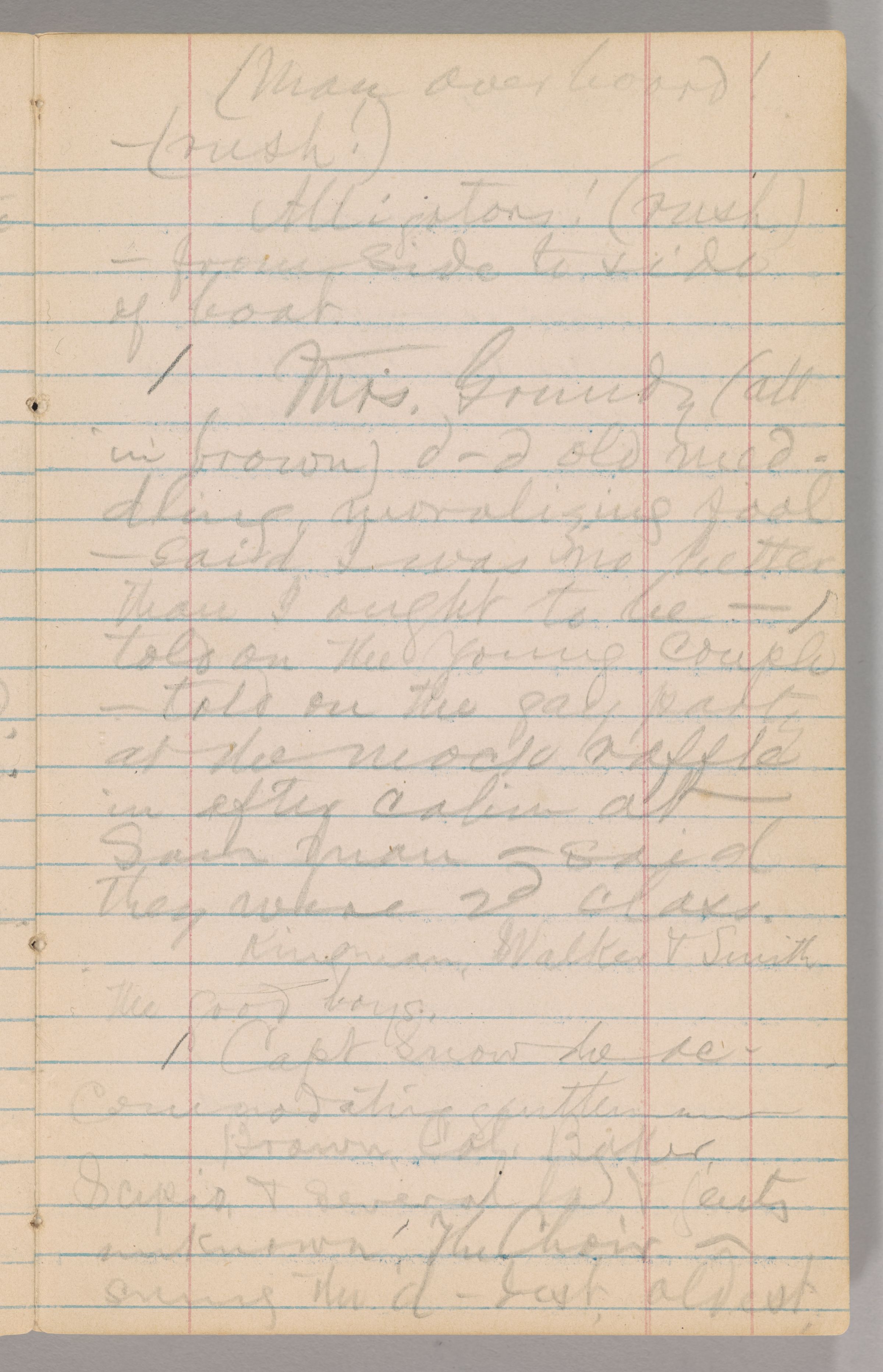
[MS: N7_leaf_033r]
(Man overboard!
—(rush!)
Alligators! (rush)
—from side to side
of boat.
Mrs. Grundy (all
in brown) d—d old
med-
dling
meddling
, moralizing fool
— said I was no better
than I ought to be—
told on the young couple
— told on the gay party
at the mock raffle
in after cabin at
San Juan— said
they were 2d class.
Kingman, S Walker & Smith
the good boys.
Capt Snow the
ac-
commodating
accommodating
gentleman
Brown, Col. Baker,
Scipio, & several lad & gents
unknown. The Choir—
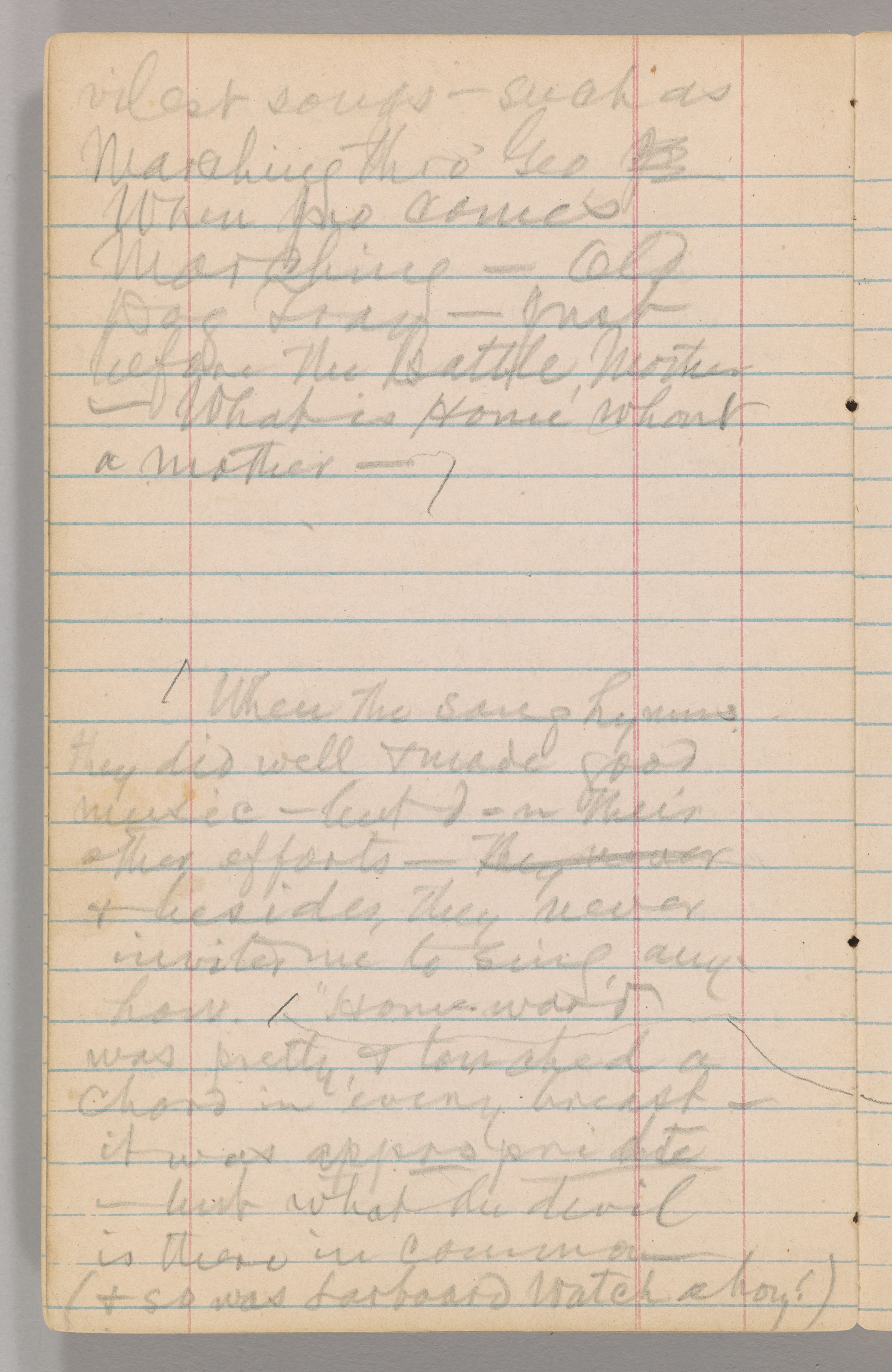
sung the d—dest, oldest,
[MS: N7_leaf_033v]
vilest songs—such as
Marching thro' Geo, J
When Jno comes
Marching—Old
Dog Tray— Just
before the Battle, Mother
—What is Home whout
a mother—
When they sang hymns,
they did well & made good
music—but d—n their
other efforts—they never
& besides, they never
invited me to sing,
any-
how
anyhow
. “Homeward
was pretty, & touched a
chord in every breast—
it was appropriate
—but what the devil
is there in common
(& so was Larboard Watch ahoy!)
[MS: N7_leaf_034r]
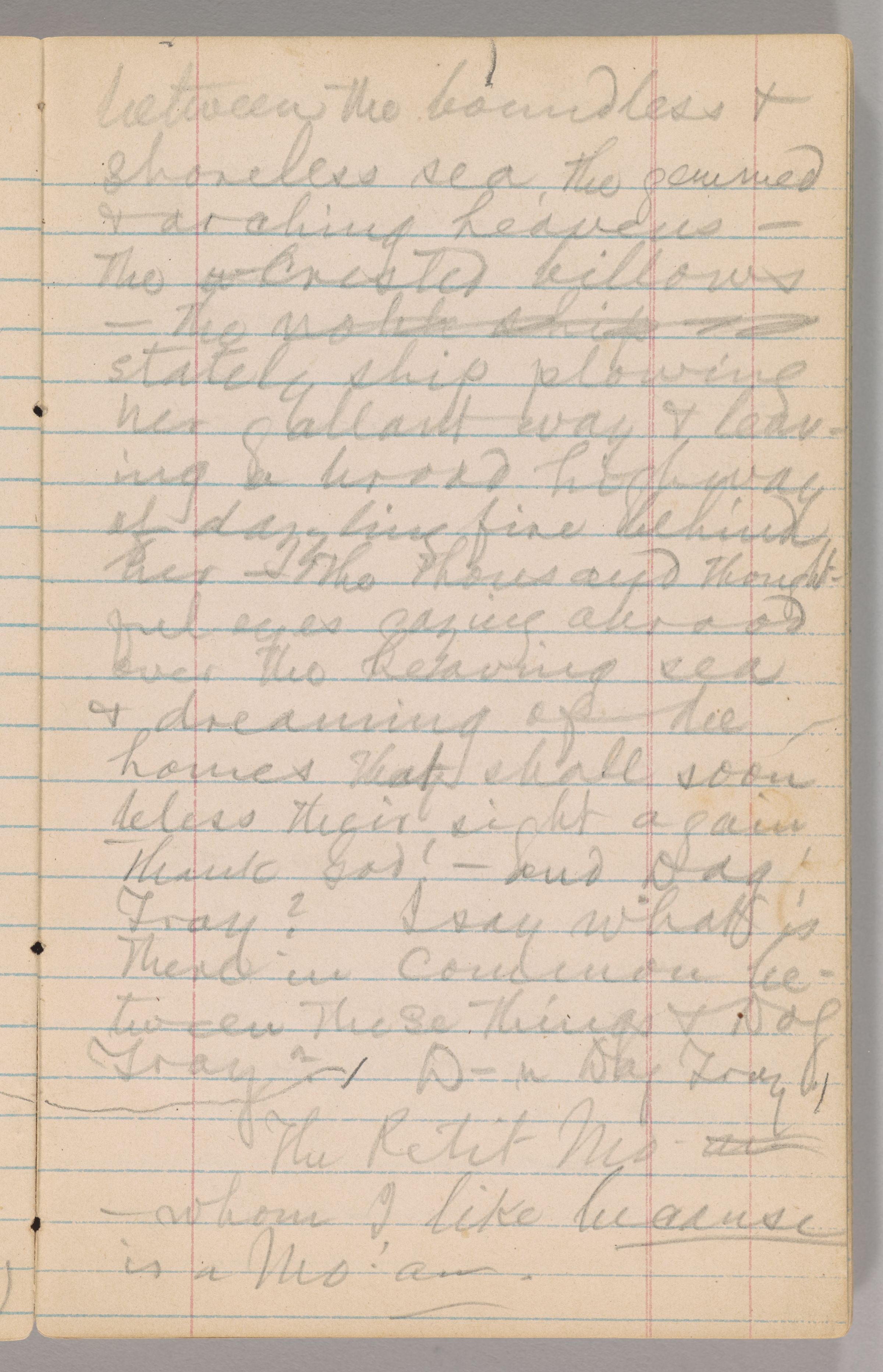
between the boundless &
shoreless sea, the gemmed
& arching heavens—
the w crested billows
—the noble ship—
stately ship plowing
her gallant way &
leav-
ing
leaving
a broad highway
of dazzling fire behind
her—the thousand
thought-
ful
thoughtful
eyes gazing abroad
over the heaving sea
& dreaming of the
homes theyat shall soon
bless their sight again,
thank
[MTP: N&J1_263] God!—and Dog
Tray? I say what is
there in common
be-
tween
between
these things & Dog
Tray? D—n Dog Tray.
The Petit Mo-an
—whom I like because
is a Mo'an.
[MS: N7_leaf_034v]
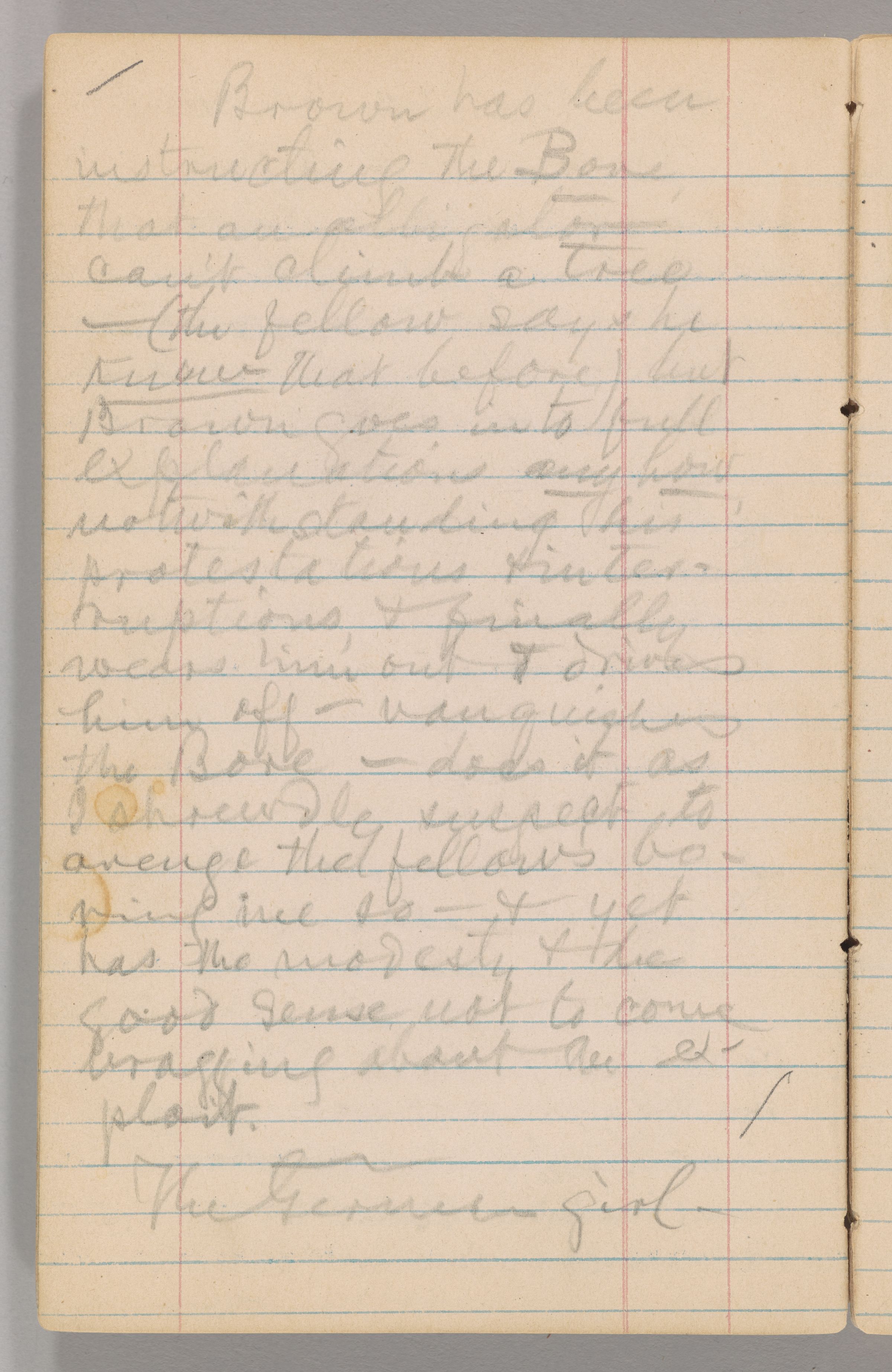
Brown has been
instructing the Bore,
that an alligator
can't climb a tree
—(the fellow says he
knew that before,) but
Brown goes into full
explanations anyhow,
notwithstanding his
protestations &
inter-
ruptions
interruptions
, & finally
wears him out & drives
him off—vanquishes
the Bore—does it as
I shrewdly suspect to
avenge the fellow's
bo-
ring
boring
me so—& yet
has the modesty & the
good sense not to come
bragging about the
ex-
ploit
exploit
.
The German girl.
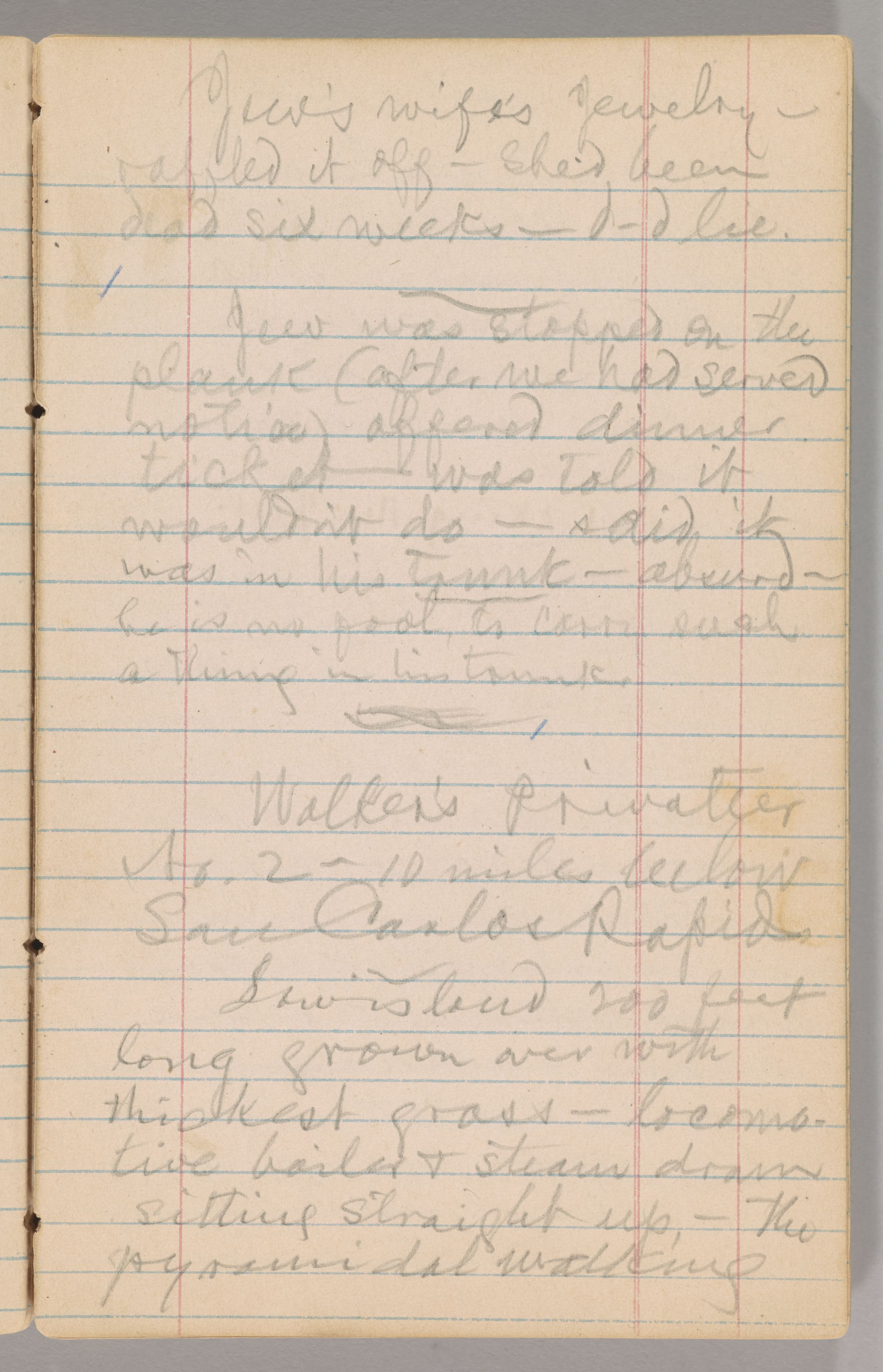
[MS: N7_leaf_035r]
Jew's wife's Jewelry—
raffled it off—she'd been
dead six weeks— d—d lie.
Jew was stopped on the
plank (after we had served
notice) offered dinner
ticket—was told it
wouldn't do—said it
was in his trunk— absurd—
he is no fool, to carry such
a thing in his trunk.
Walker's privateer
No. 2—10 miles below
San Carlos Rapids
Saw island 200 feet
long grown over with
thickest grass—
locomo-
tive
locomotive
boiler & steam drum
sitting straight up,—the
pyramidal walking
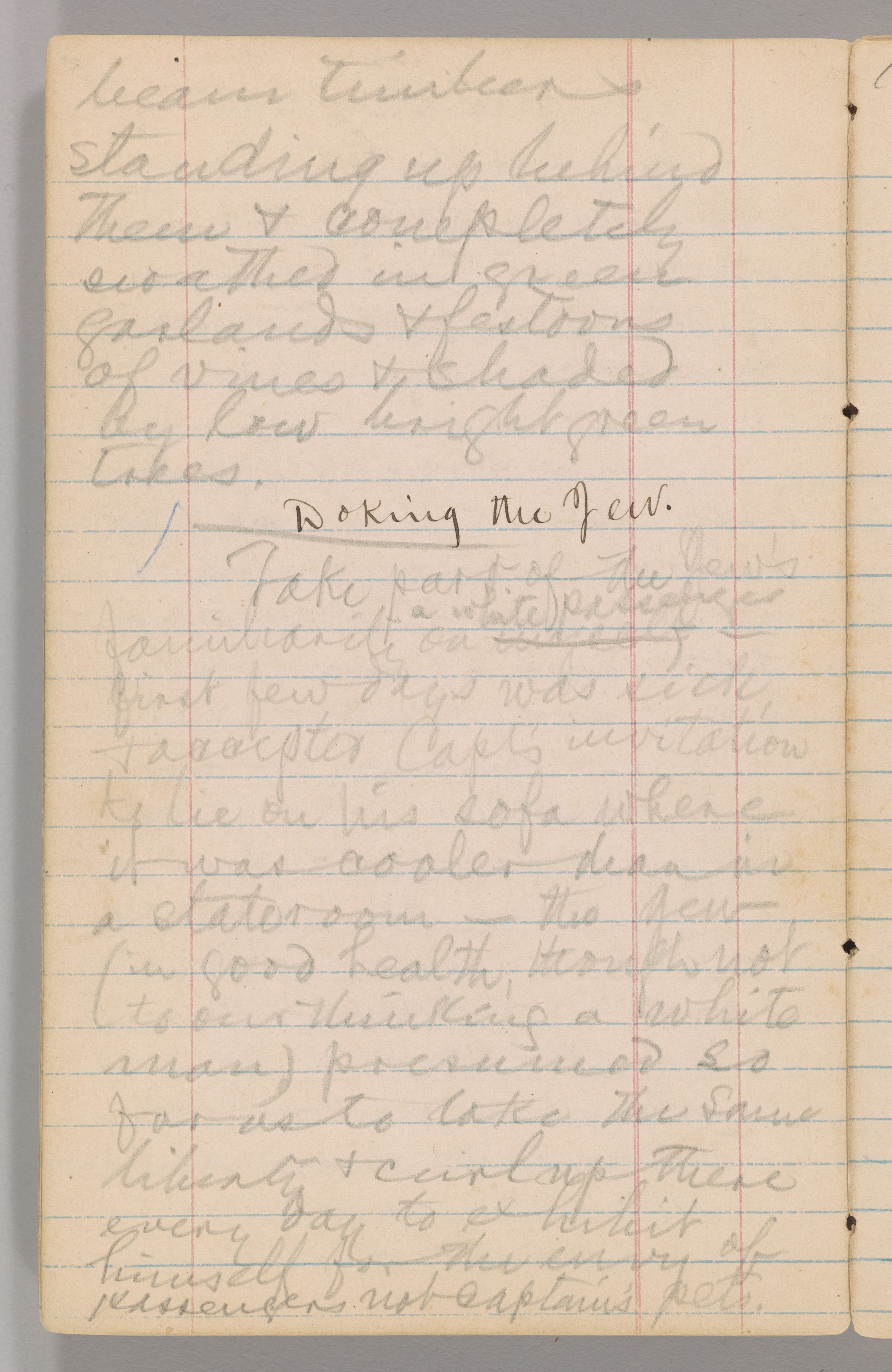
[MS: N7_leaf_035v]
beam timbers
standing up behind
them & completely
swathed in green
garlands & festoons
of vines & shaded
by low bright green
trees.
Take part of the Jew's
familiarity on myself
a white passenger
[MTP: N&J1_264] —
first few days was sick,
& accepted Capt's invitation
to lie on his sofa where
it was cooler than in
a state room—the Jew
(in good health, though not
to our thinking a white
man,) presumed so
far as to take the same
liberty & curl up there
every day to exhibit
himself for the envy of
passengers not captain's pets.
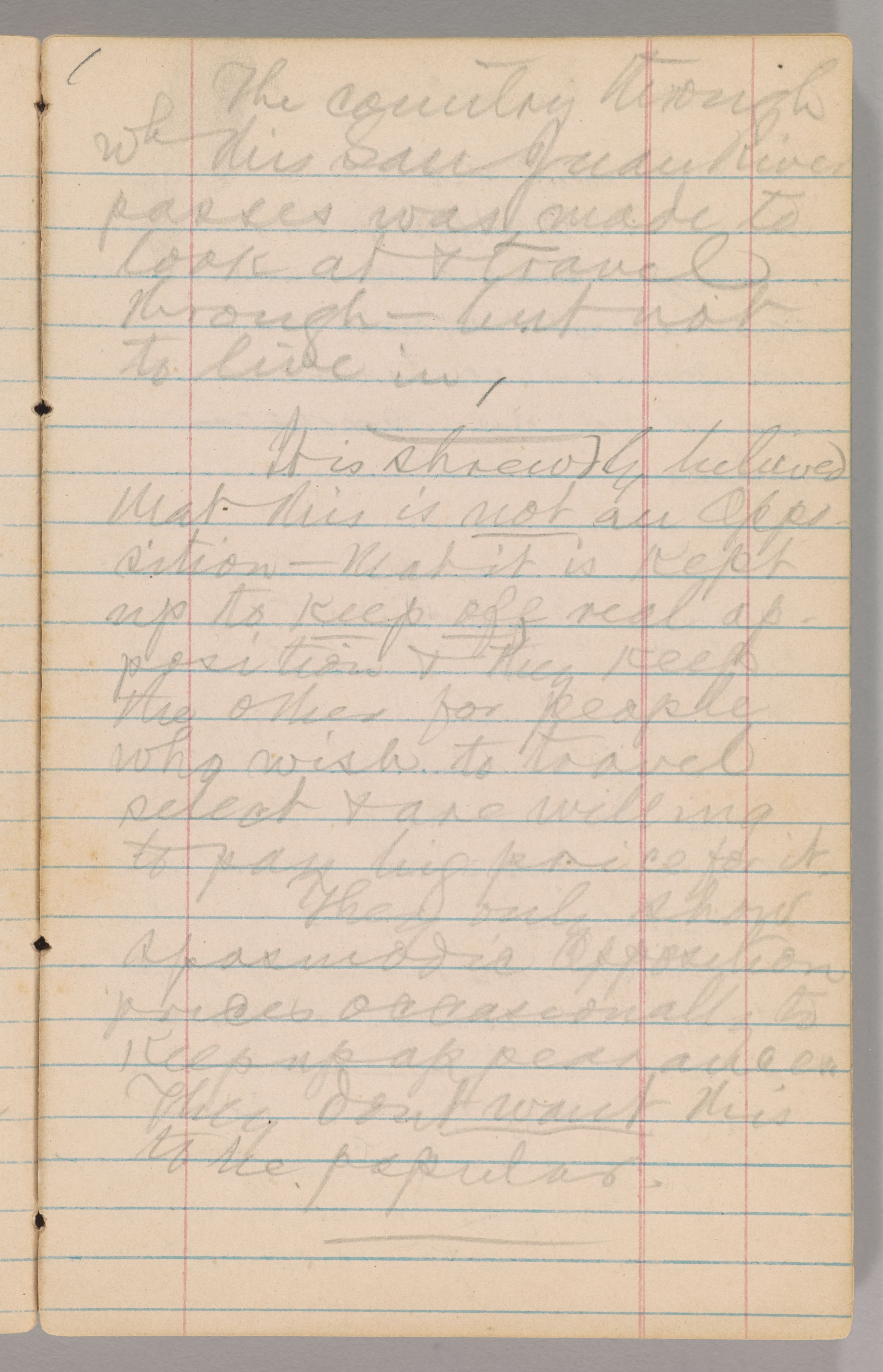
[MS: N7_leaf_036r]
The country through
wh this San Juan River
passes was made to
look at & travel
through—but not
to live in
It is shrewdly believed
that this is not an
Oppo-
sition
Opposition
—that it is kept
up to keep off real
op-
position
opposition
& they keep
the other for people
who wish to travel
select & are willing
to pay big price for it.
They only show
spasmodic Opposition
prices occasionally to
keep up appearances.
They dont want this
to be popular.
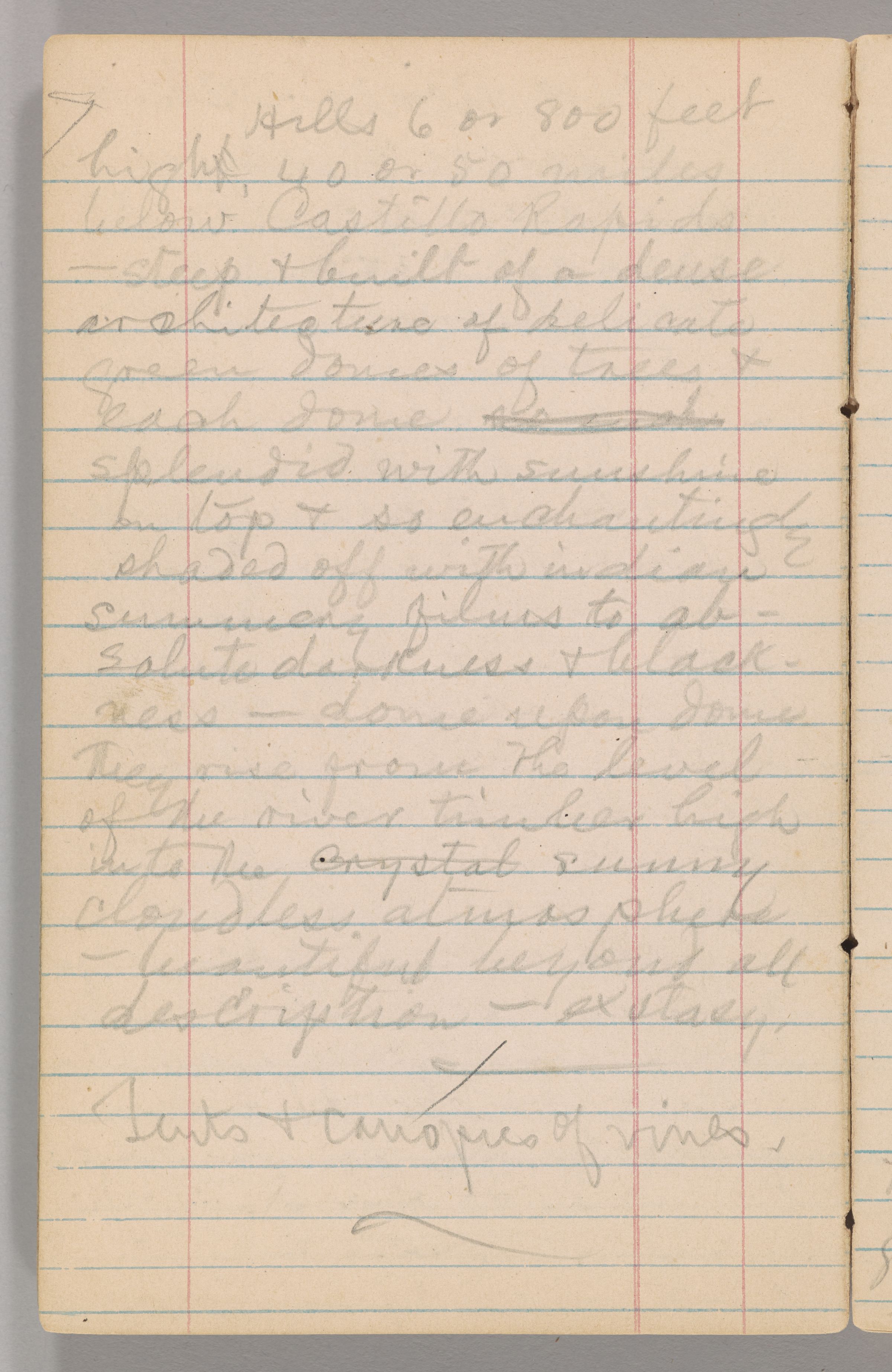
[MS: N7_leaf_036v]
Hills 6 or 800 feet
hight, 40 or 50 miles
below Castillo Rapids
—steep & built of a dense
architecture of delicate
green domes of trees &
each dome so ench
splendid with sunshine
on top & so enchantingly
shaded off with indian
summery films to
ab-
solute
absolute
darkness &
black-
ness
blackness
—dome upon dome
they rise from the level
of the river timber high
into the crystal sunny
cloudless atmosphere
—beautiful beyond all
description—exstasy.
Tents & canopies of vines.
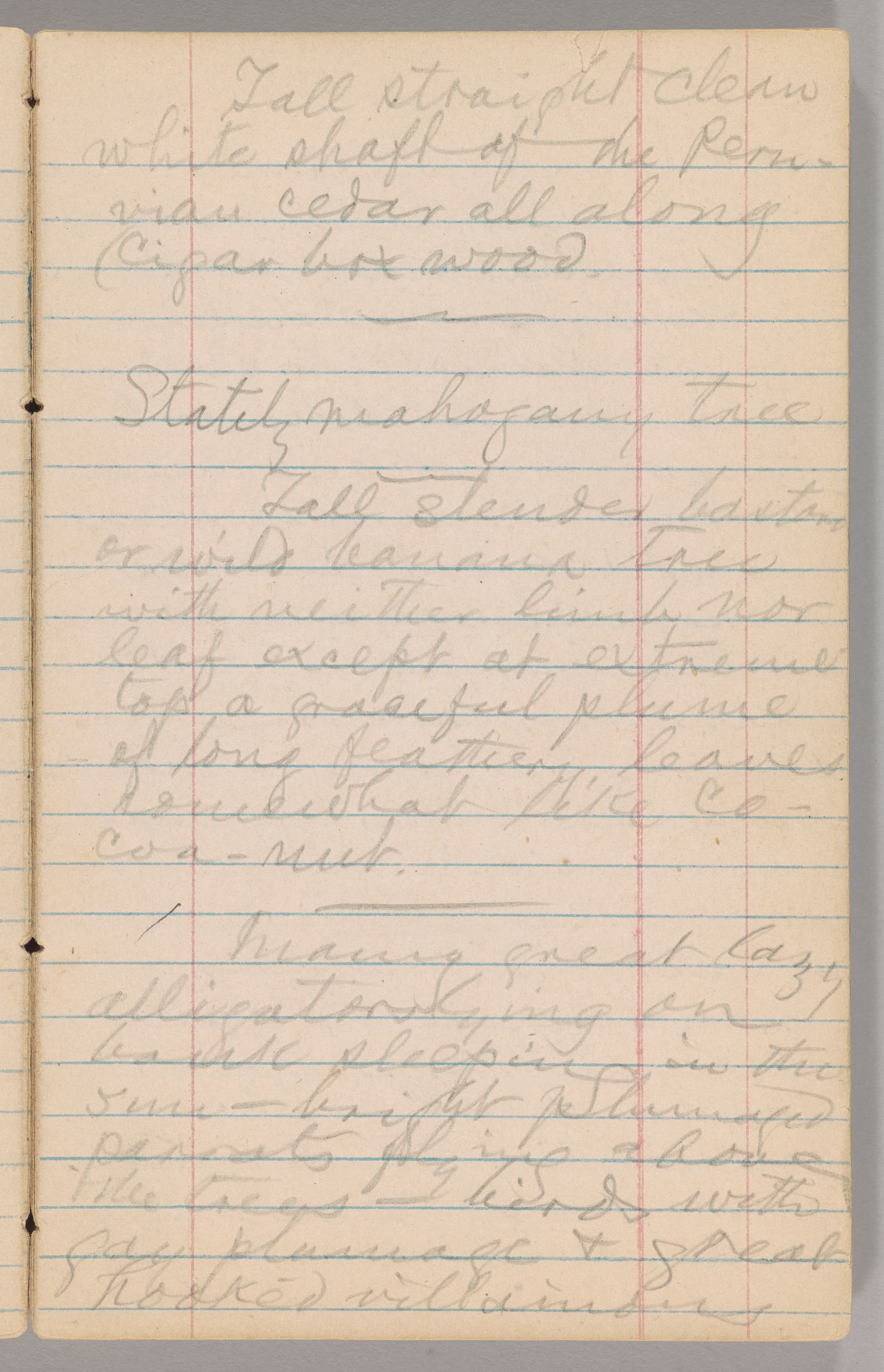
[MS: N7_leaf_037r]
Tall straight clean
white shaft of the
Peru-
vian
Peruvian
cedar all along
(Cigar box wood.
Stately mahogany tree
Tall slender bastard
or wild banana tree
with neither limb nor
leaf except at extreme
top a graceful plume
of long feathery leaves
somewhat like
co-
coa-nut
cocoa-nut
.
[MTP: N&J1_265]
Many great lazy
alligators lying on
bank sleeping in the
sun— bright plumaged
parrots flying above
the trees—birds with
gay plumage & great
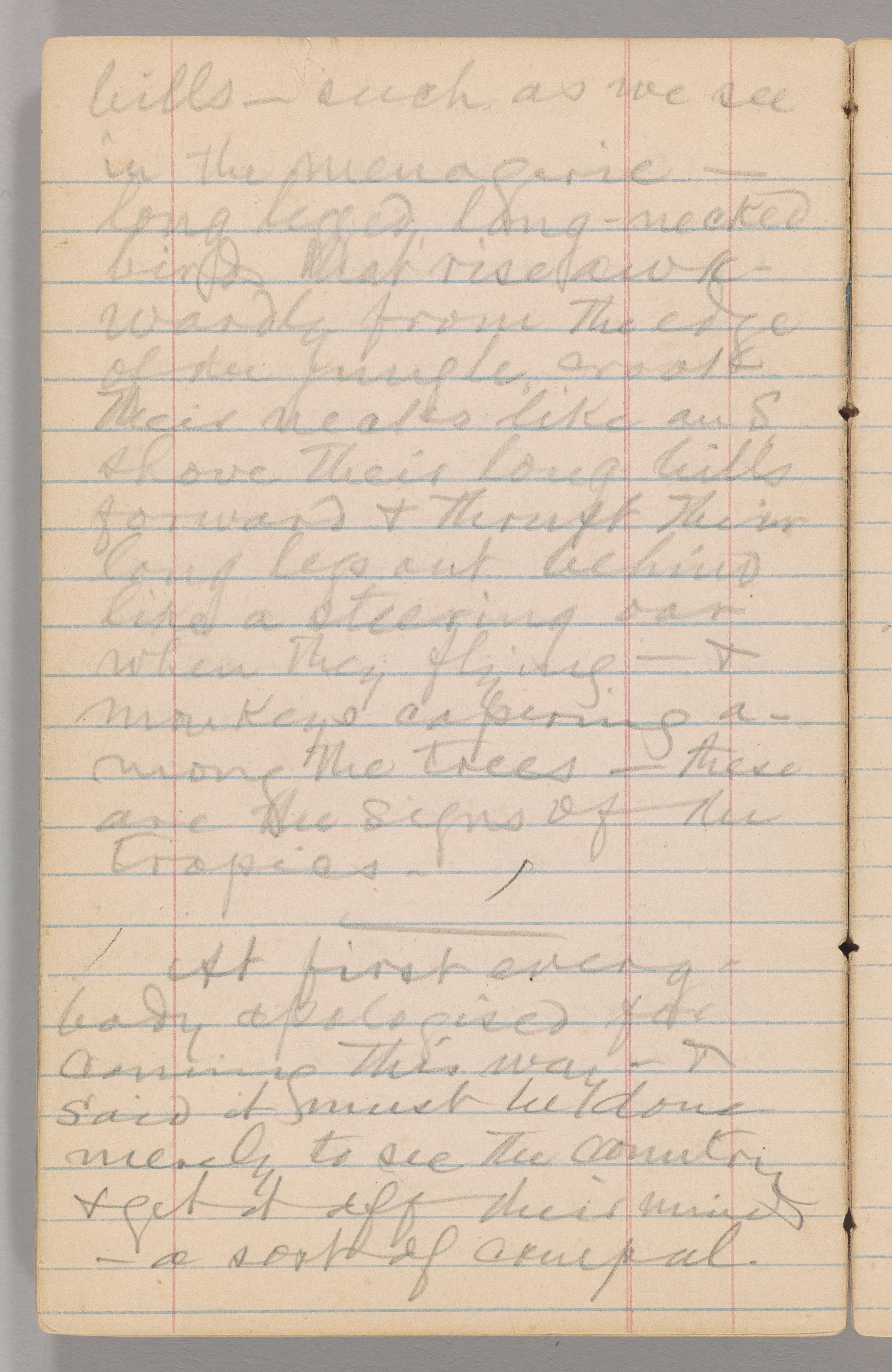
hooked villainous
[MS: N7_leaf_037v]
bills—such as we see
in the menagerie—
long legged, long-necked
birds that rise
awk-
wardly
awkwardly
from the edge
of the jungle, crook
their necks like an S,
shove their long bills
forward & thrust their
long legs out behind
like a steering oar
when they flying—&
monkeys capering
a-
mong
among
the trees—these
are the signs of the
tropics.
At first
every-
body
everybody
apologised for
coming this way—&
said it must be done
merely to see the country
& get it off their minds
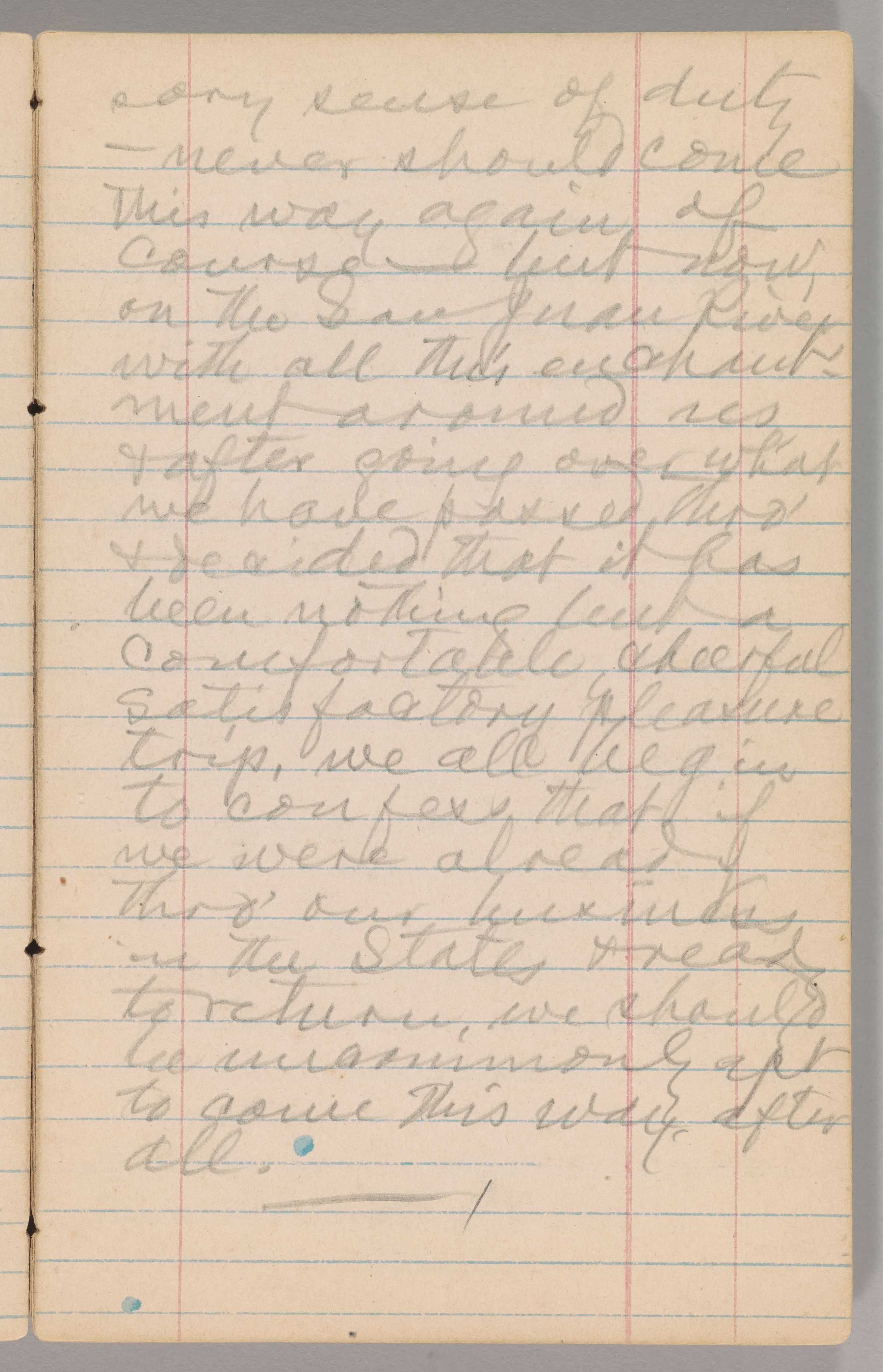
—a sort of compul-
[MS: N7_leaf_038r]
sory sense of duty
—never should come
this way again of
course—but now,
on the San Juan River
with all this
enchant-
ment
enchantment
around us,
& after going over what
we have passed thro'
& decided that it has
been nothing but a
comfortable, cheerful
satisfactory pleasure
trip, we all begin
to confess that if
we were already
thro' our business
in the States & ready
to return, we should
be uncommonly apt
to come this way, after
all.
[MS: N7_leaf_038v]
blank verso
[MS: N7_leaf_039r]
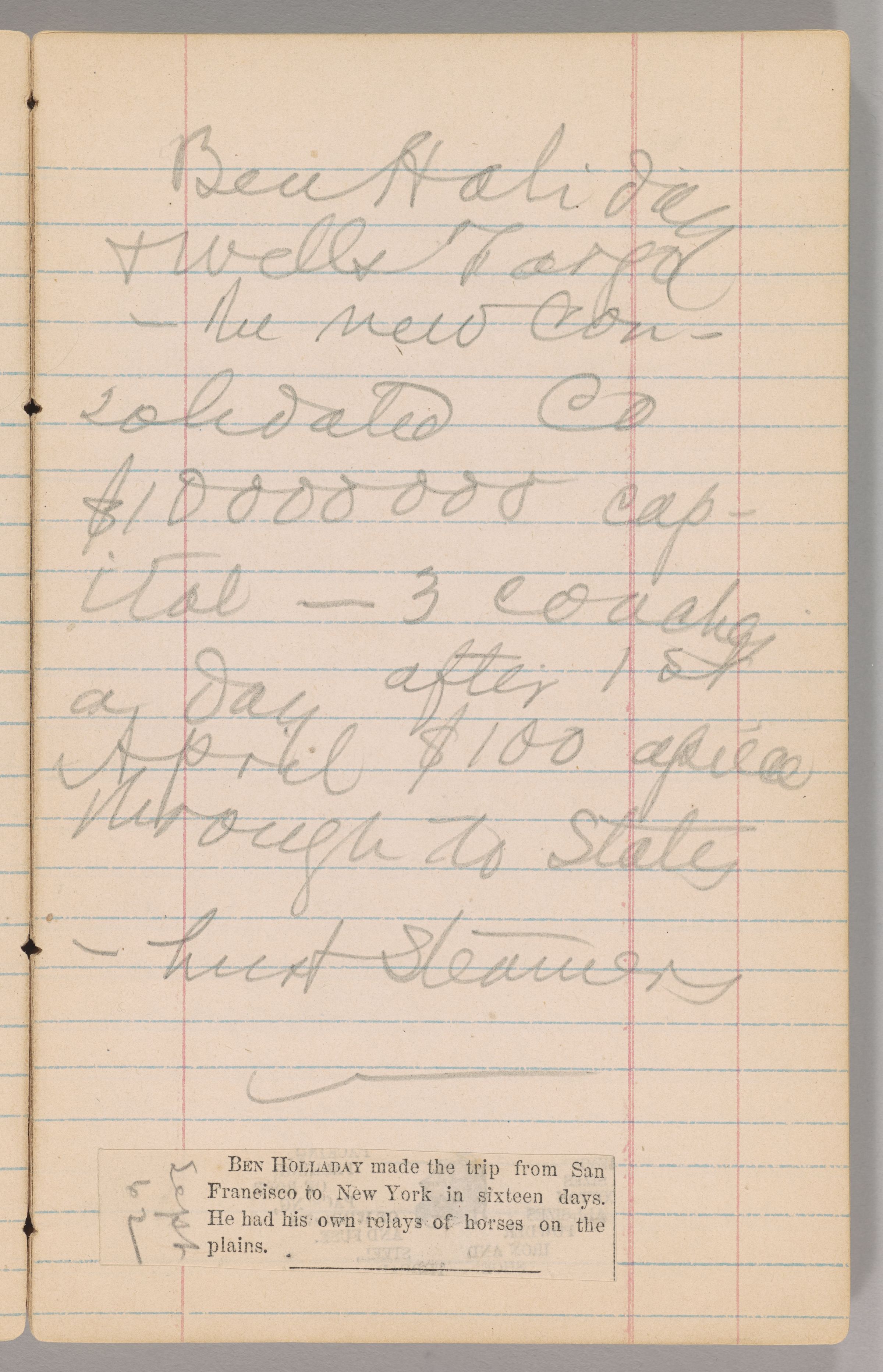
Ben Holiday
& Wells Fargo
—the new
Con-
solidated
Consolidated
Co
$10000000
cap-
ital
capital
—3 coaches
a day after 1st
April $100 apiece
through to States
—hurt steamers
clipping (see facsimile and footnote 30)
[MS: N7_leaf_039v]
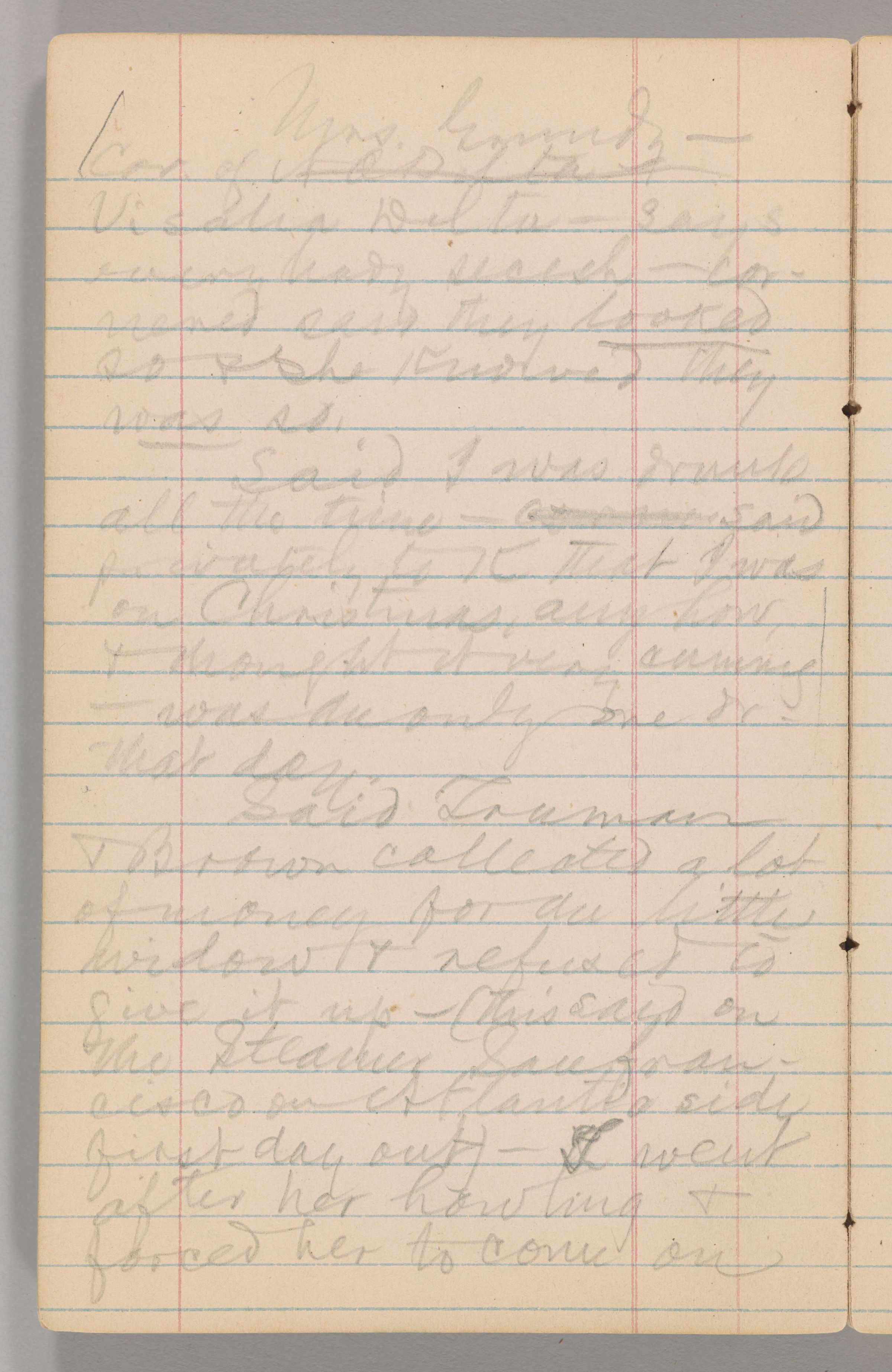
Mrs. Grundy—
Cor. of NO Delta—
Visalia Delta—says
[MTP: N&J1_266] everybody secesh—
cor-
nered
cornered
said they looked
so & she knowed they
was so.
Said I was drunk
all the time—corner said
privately to K that I was
on Christmas, anyhow,
& thought it very cunning
—was the only one dr.
that day.
Said Truman
& Brown collected a lot
of money for the little
widow & refused to
give it up—(this said on
the Steamer
Sanfran-
cisco
Sanfrancisco
on Atlantic side
first day out)—KT went
after her howling &
forced her to come on
[MS: N7_leaf_040r]
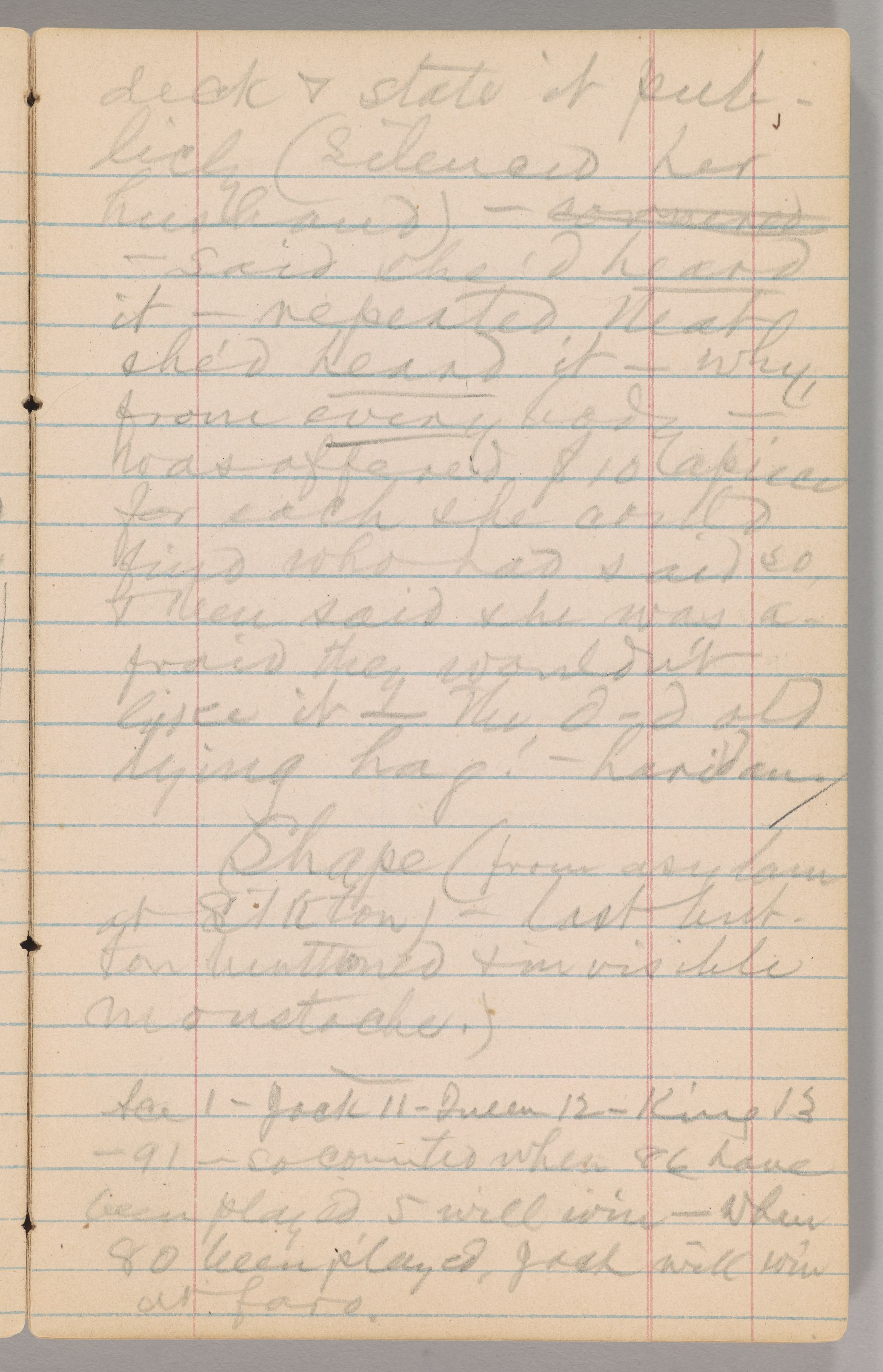
deck & state it
pub-
licly
publicly
(silenced her
husband) —cornered
—said she'd heard
it— repeated that
she'd heard it—why,
from everybody—
was offered $10 apiece
for each she could
find who had said so,
& then said she was
a-
fraid
afraid
they wouldn't
like it—the d—d old
lying hag!—haridan.
(Shape (from asylum
at Stkton)—last
but-
ton
button
buttoned & invisible
moustache.)
Ace 1—Jack 11—Queen 12—King 13
—91—so counted when 86 have
been played, 5 will win—when
80 been played, Jack will win
at faro.

[MS: N7_leaf_040v]
blank verso
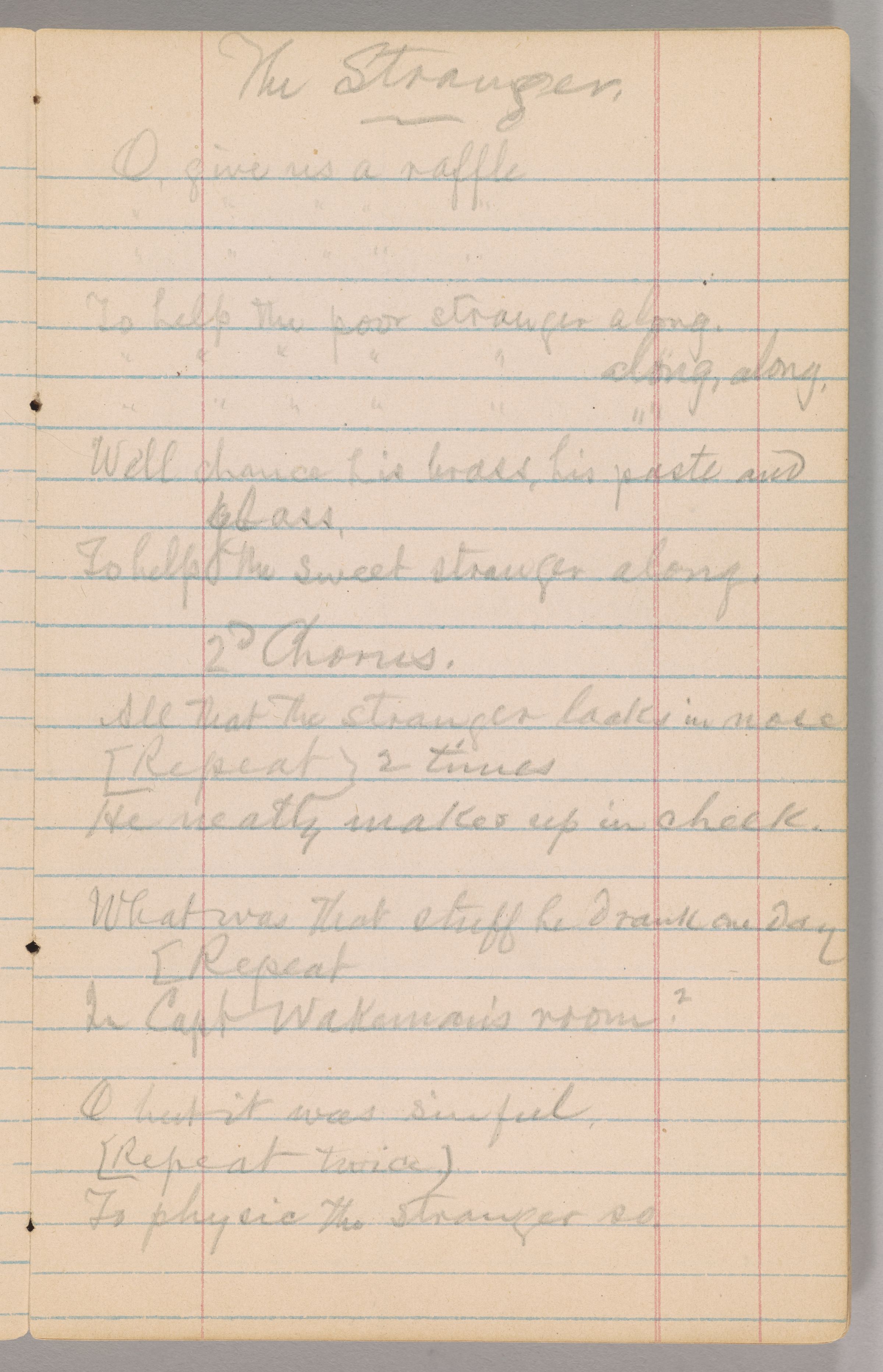
[MS: N7_leaf_041r] O, give us a raffle
“ “ “ “ “
“ “ “ “ “
To help the poor stranger along.
“ “ “ “ “ along, along,
“ “ “ “ “ “
[MTP: N&J1_267] We'll chance his brass, his paste and brglass,
To help the sweet stranger along.
⟦Repeat⟧ 2 times
He neatly makes up in cheek.
What was that stuff he drank one day
O but it was sinful,
⟦Repeat twice.⟧
To physic the stranger so.
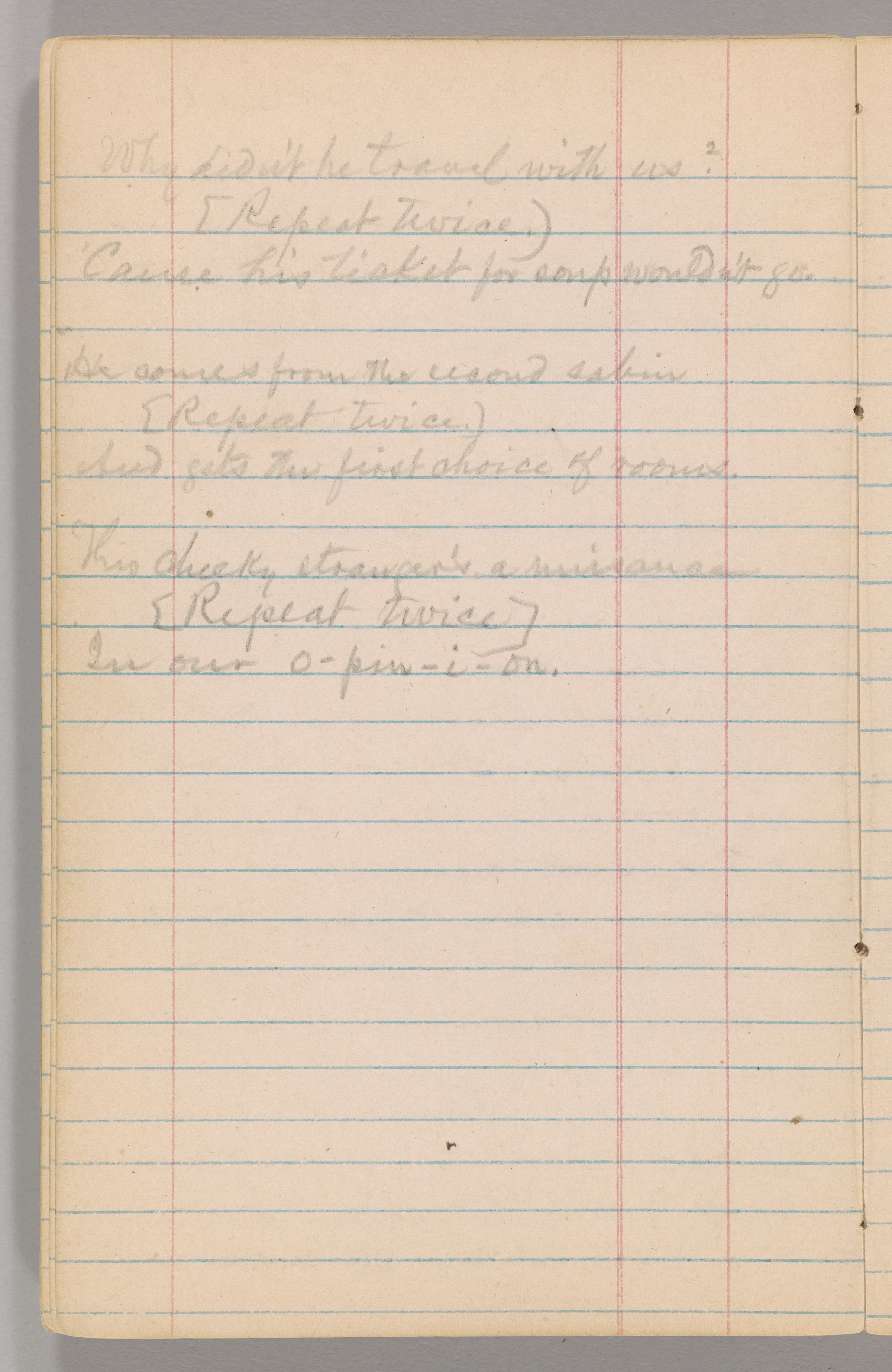
[MS: N7_leaf_041v] Why didn't he travel with us?
He comes from the second cabin
This cheeky stranger's a nuisance
[MS: N7_leaf_042r]
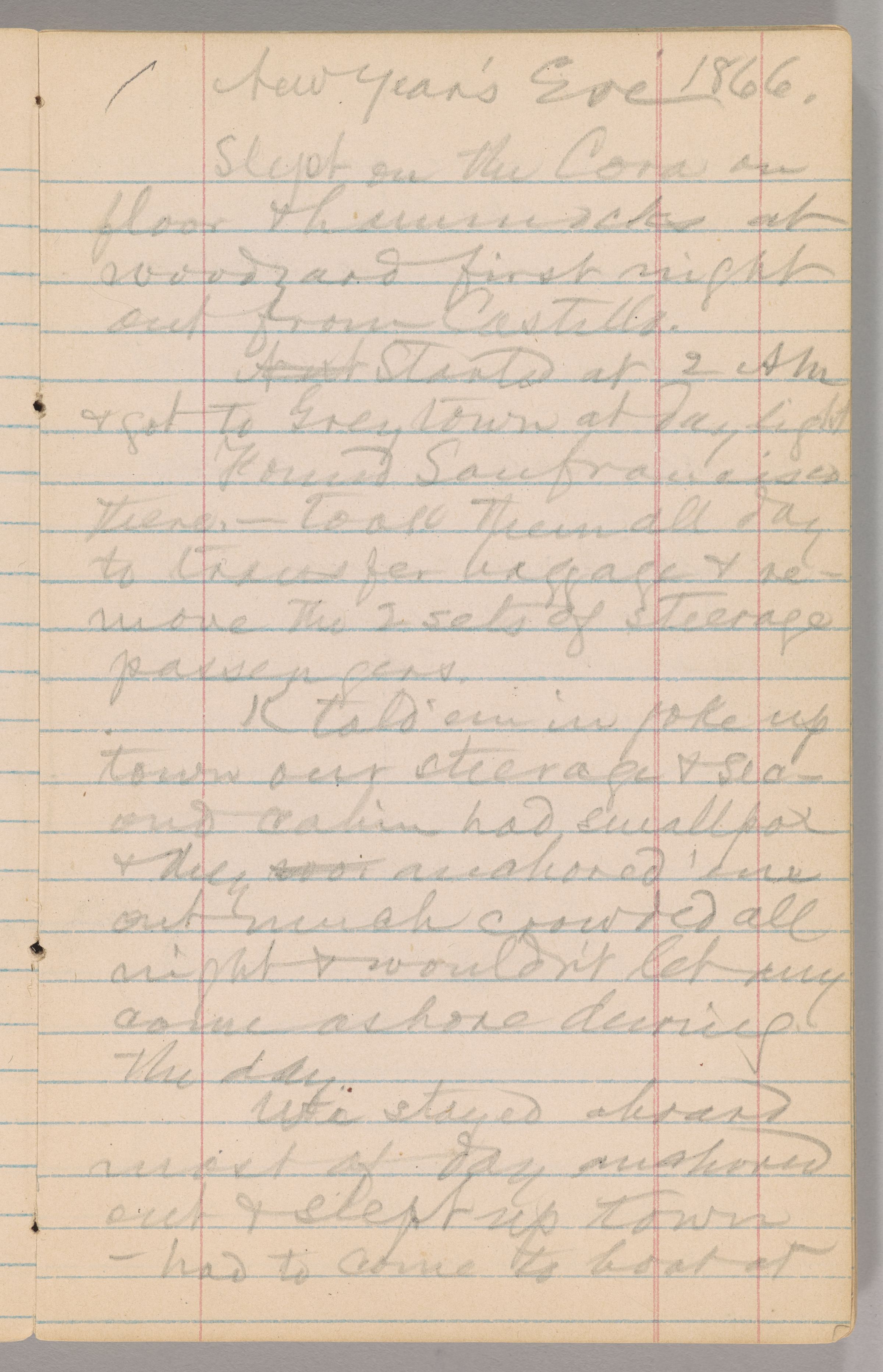
New Year's Eve 1866.
Slept on the Cora on
floor & hammocks at
woodyard first night
out from Castillo.
Next Started at 2 AM
& got to Greytown at daylight
Found Sanfrancisco
there.—took them all day
to transfer baggage &
re-
move
remove
the 2 sets of steerage
passengers.
K told 'em in joke up
town our steerage &
sec-
ond
second
cabin had smallpox
& they
soo
anchored 'em
out much crowded all
night & wouldn't let any
come ashore during
the day.
[MTP: N&J1_268]
We stayed aboard
most of day anchored
out & slept up town
— had to come to boat at
[MS: N7_leaf_042v]
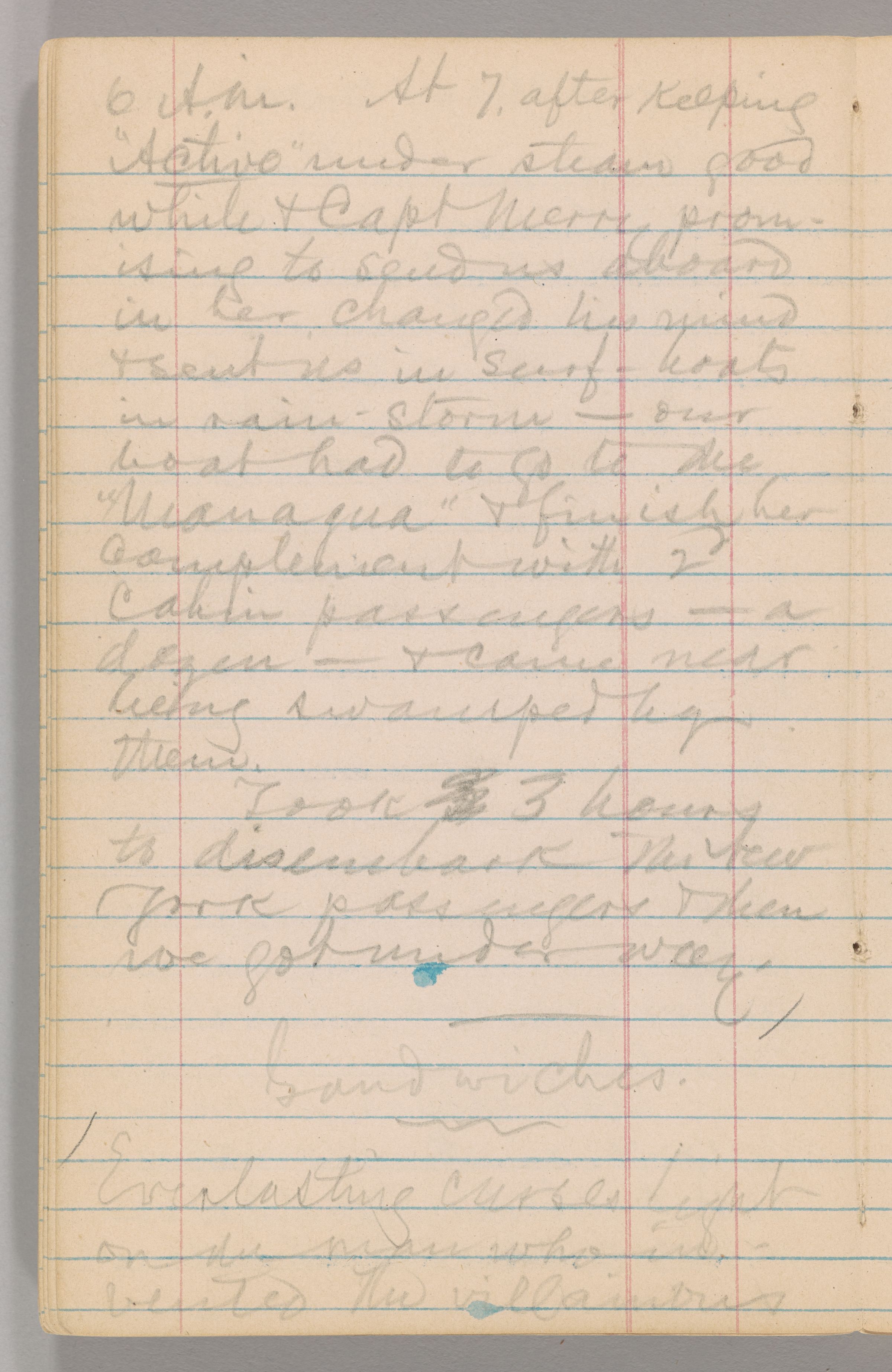
6 A.M. At 7, after keeping
“Active” under steam good
while & Capt Merry
prom-
ising
promising
to send us aboard
in her, changed his mind
& sent us in surf-boats
in rain-storm—our
boat had to go to the
“Managua” & finish her
complement with 2d
cabin passengers—a
dozen—& came near
being swamped by
them.
Took 3 3 hours
to disembark the New
York passengers & then
we got under way.
Sandwiches.
Everlasting curses light
on the man who
in-
vented
invented
the villainous
[MS: N7_leaf_043r]
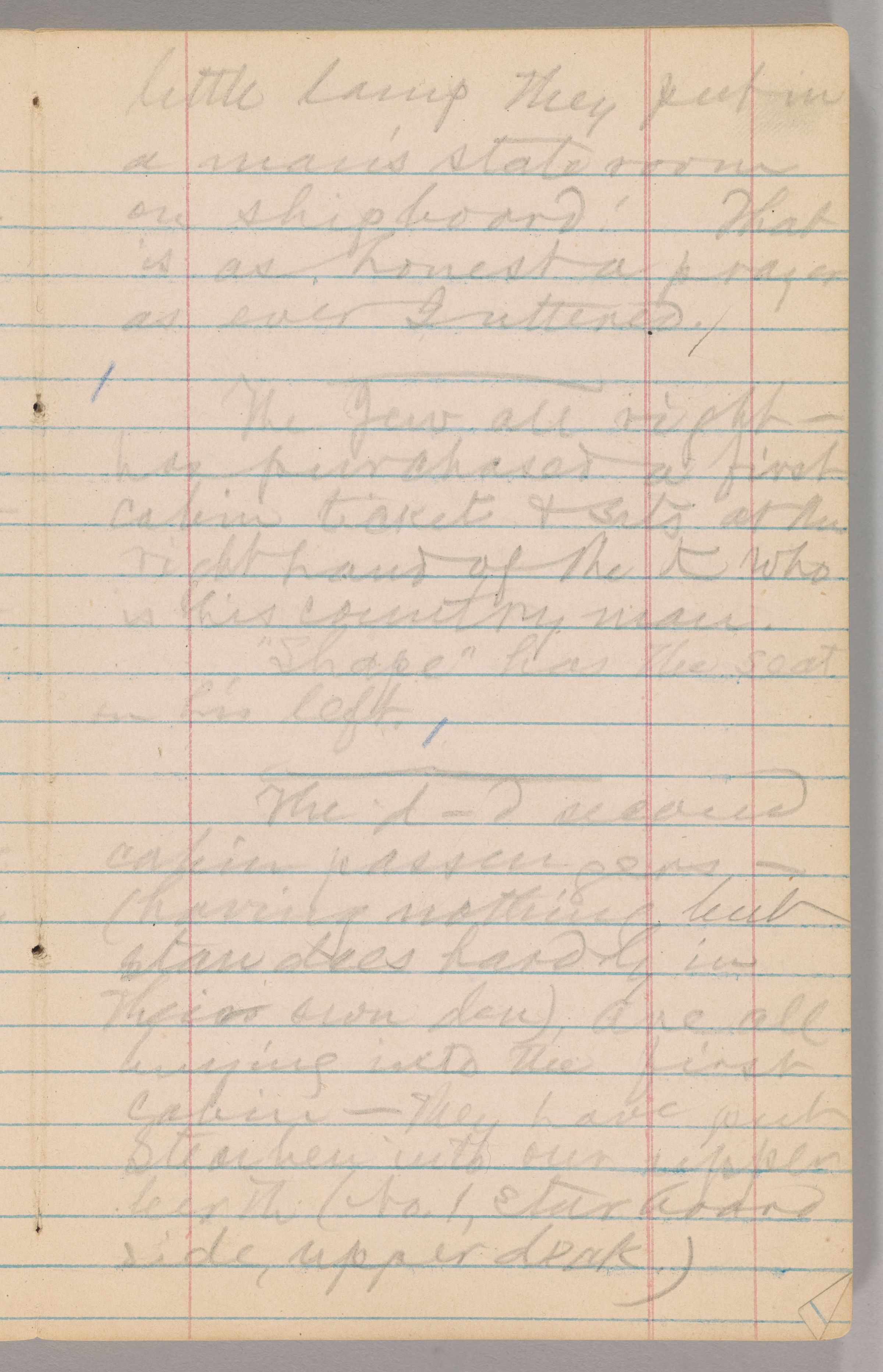
little lamp they put in
a man's state room
on shipboard! That
is as honest a prayer
as ever I uttered.
The Jew all right—
has purchased a first
cabin ticket & sits at the
right hand of the K who
is his countryman.
“Shape” has the seat
on his left.
The d—d second
cabin passengers—
(having nothing but
standees hardly in
their own den), are all
buying into the first
cabin—they have put
Steuben into our upper
berth (No. 1, starboard
side, upper deck.)
[MS: N7_leaf_043v]
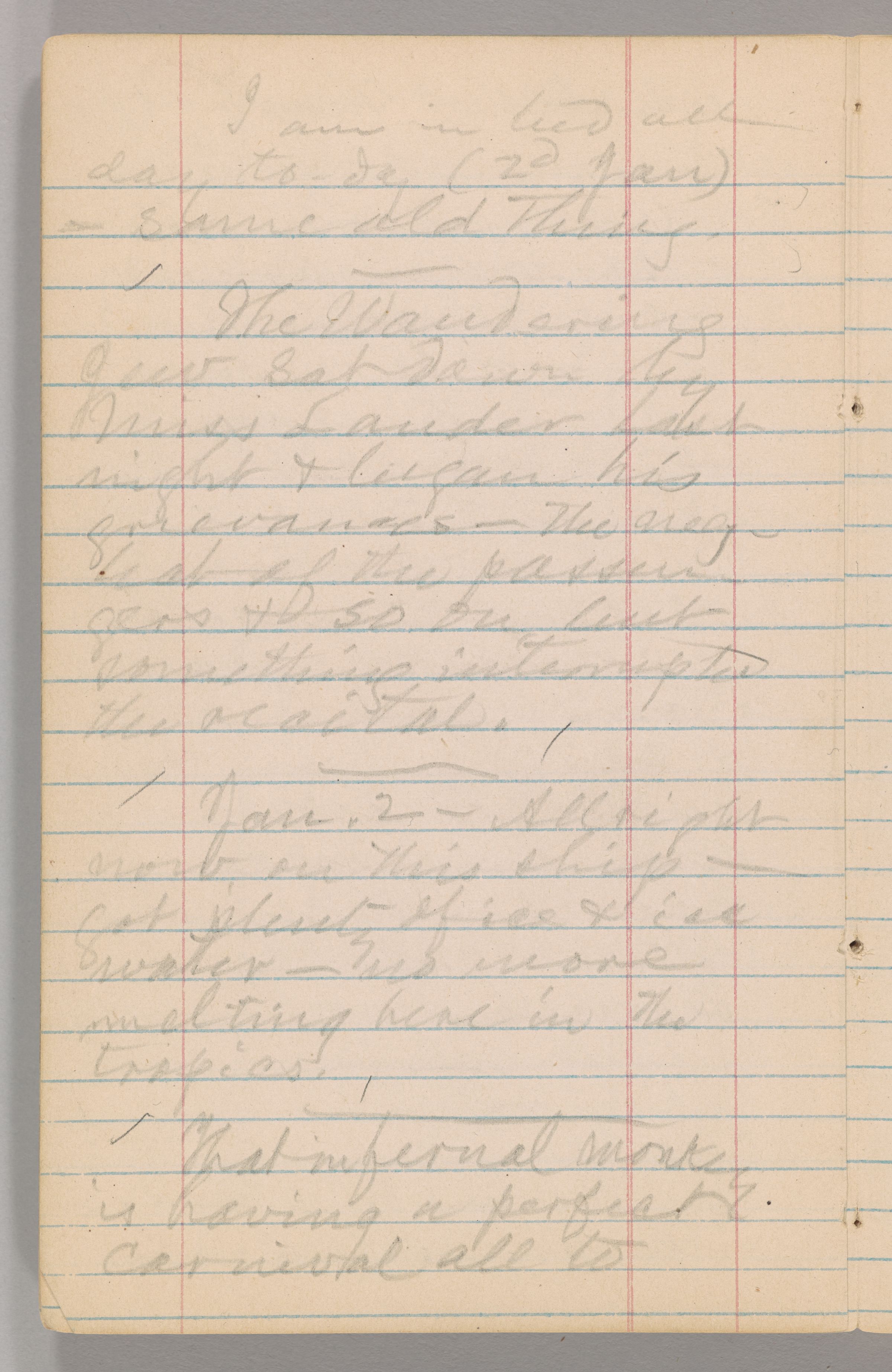
I am in bed all
day to-day (2d Jan)
—same old thing.
The Wandering
Jew sat down by
Miss Lander last
night & began his
grievances—the
ned-
lect
neglect
of the
passen-
gers
passengers
& so on, but
something interrupted
the recital.
Jan. 2—All right
now, on this ship—
got plenty of ice & ice
water— no more
melting here in the
tropics.
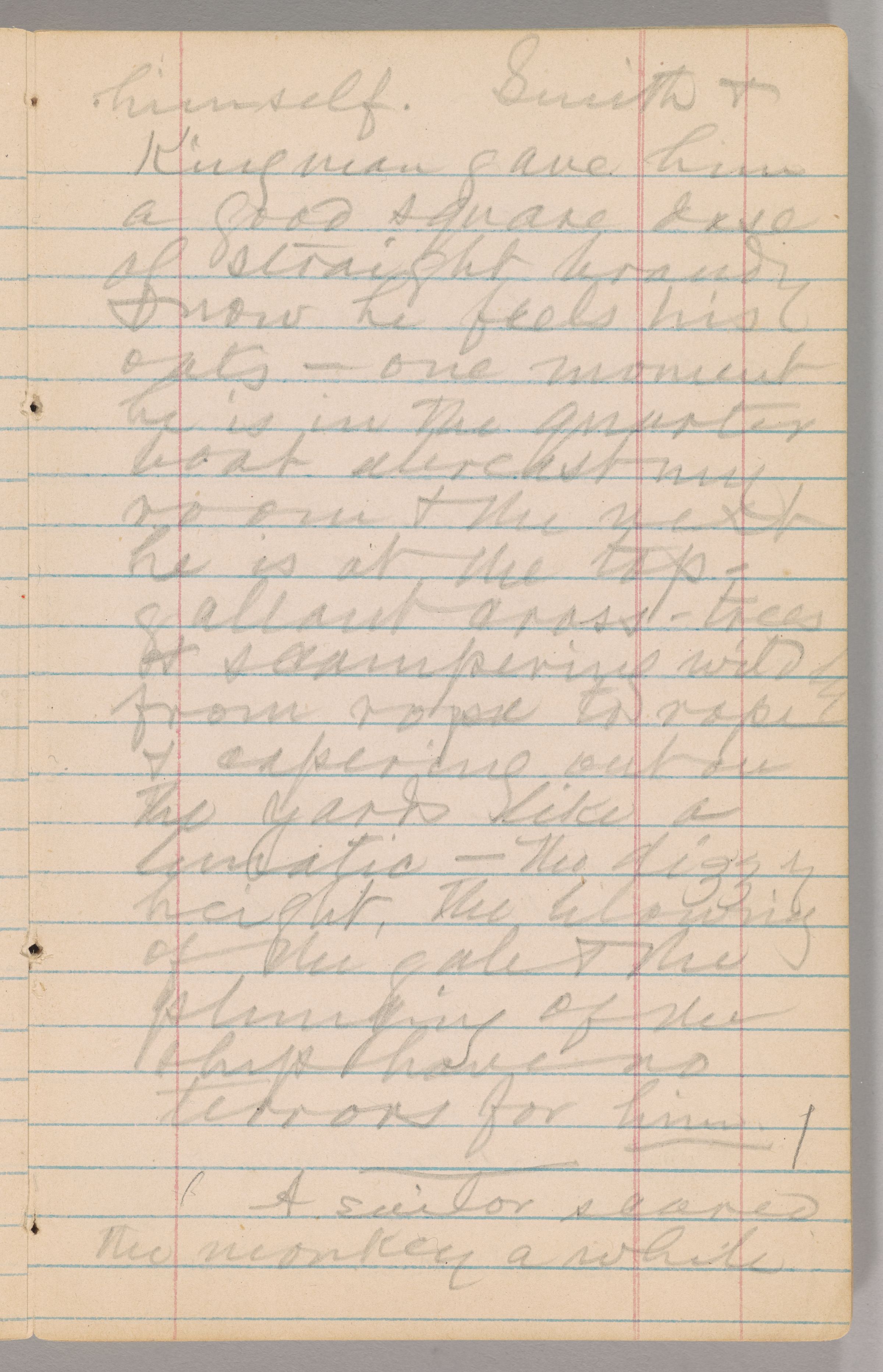
That infernal monkey
is having a perfect
carnival all to
[MS: N7_leaf_044r]
himself. Smith &
Kingman gave him
a good square dose
of straight brandy
& now he feels his
oats—one moment
he is in the quarter
boat abreast my
room & the next
he is at the top-
gallant cross-trees
& scampering wildly
from rope to rope
& capering out on
the yards like a
lunatic—the dizzy
height, the blowing
of the gale & the
plunging of the
ship have no
terrors for him.
[MTP: N&J1_269]
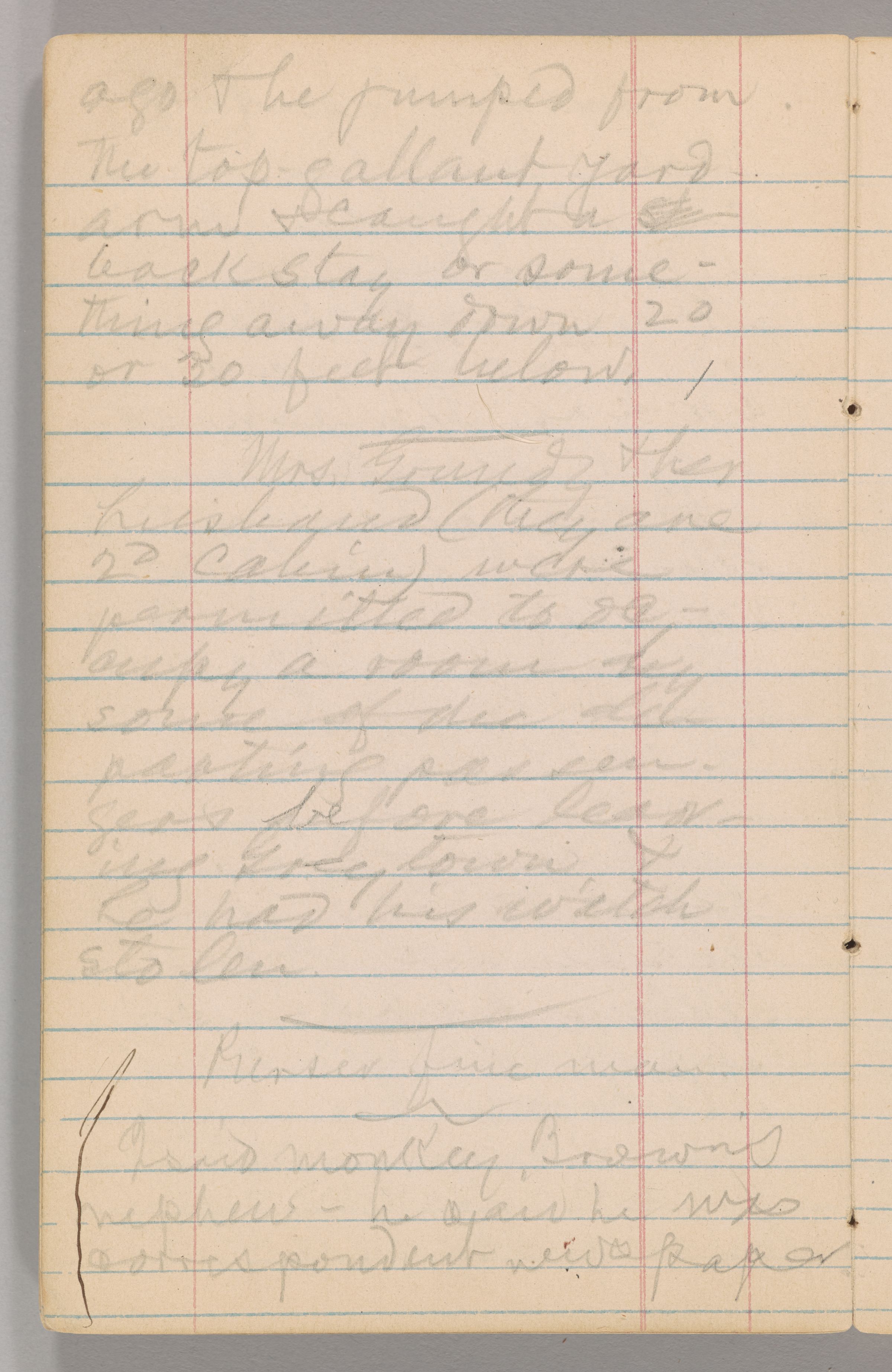
A sailor scared
the monkey a while
[MS: N7_leaf_044v]
ago & he jumped from
the top-gallant
yard-
arm
yard-arm
& caught a st
backstay or
some-
thing
something
away down 20
or 30 feet below.
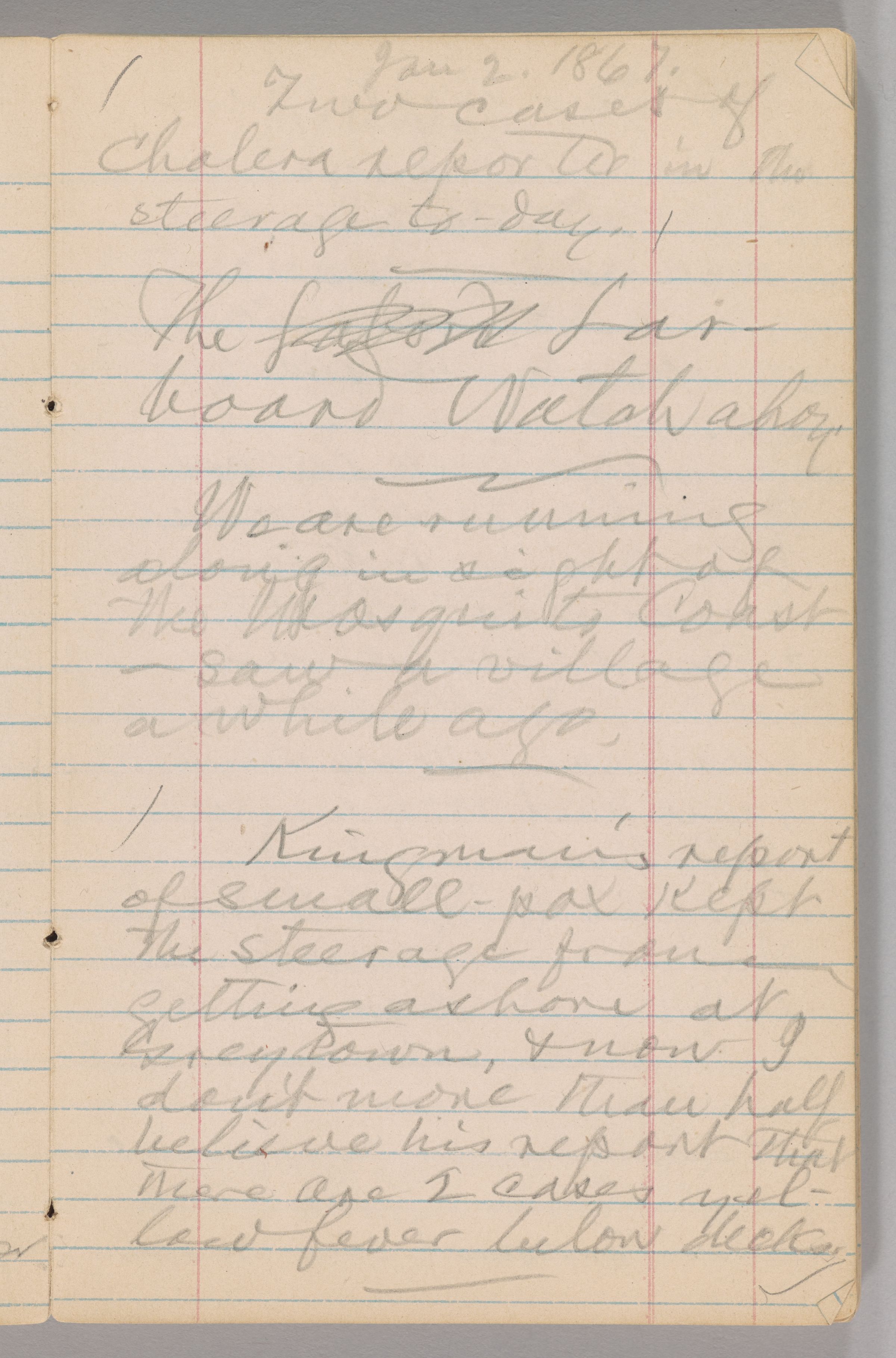
Mrs. Grundy & her
husband (they are
2d cabin) were
permitted to
oc-
cupy
occupy
a room by
some of the
de-
parting
departing
passen-
gers
passengers
before
leav-
ing
leaving
Greytown, &
he had his watch
stolen.
Purser fine man.
I said monkey Brown's
nephew—he said he was
correspondent newspaper.
[MS: N7_leaf_045r]
Jan 2. 1867.
Two cases of
cholera reported in the
steerage to-day.
The Labord
Lar-
board
Larboard
Watch ahoy.
We are running
along in sight of
the Mosquito Coast
—saw a village
a while ago.
Kingman's report
of small-pox kept
the steerage from
getting ashore at
Greytown, & now I
don't more than half
believe his report that
there are 2 cases
yel-
low
yellow
fever below decks.
[MS: N7_leaf_045v]
Got Capt's
per-
mission
permission
to have a
safety lantern in my
room.
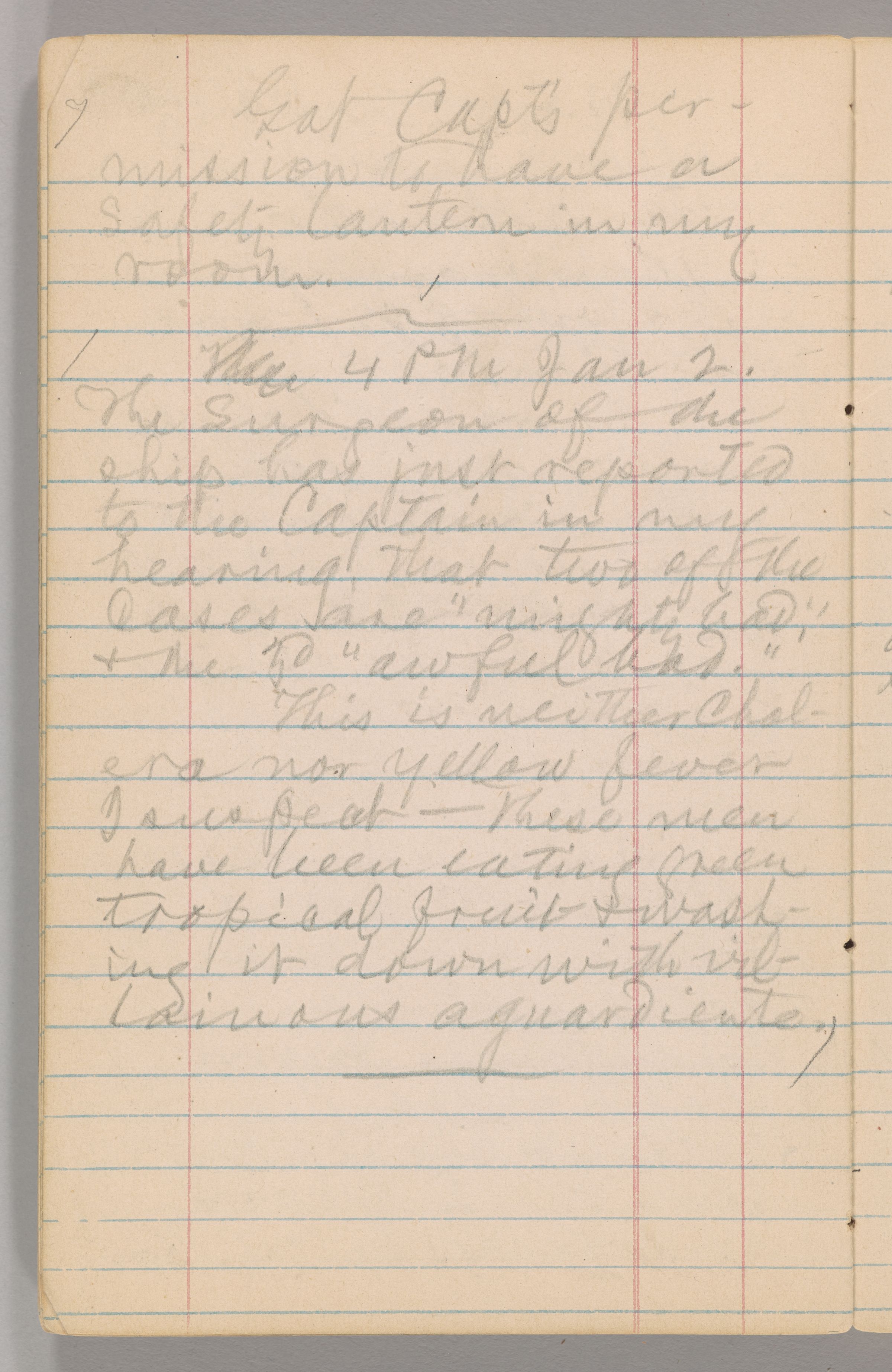
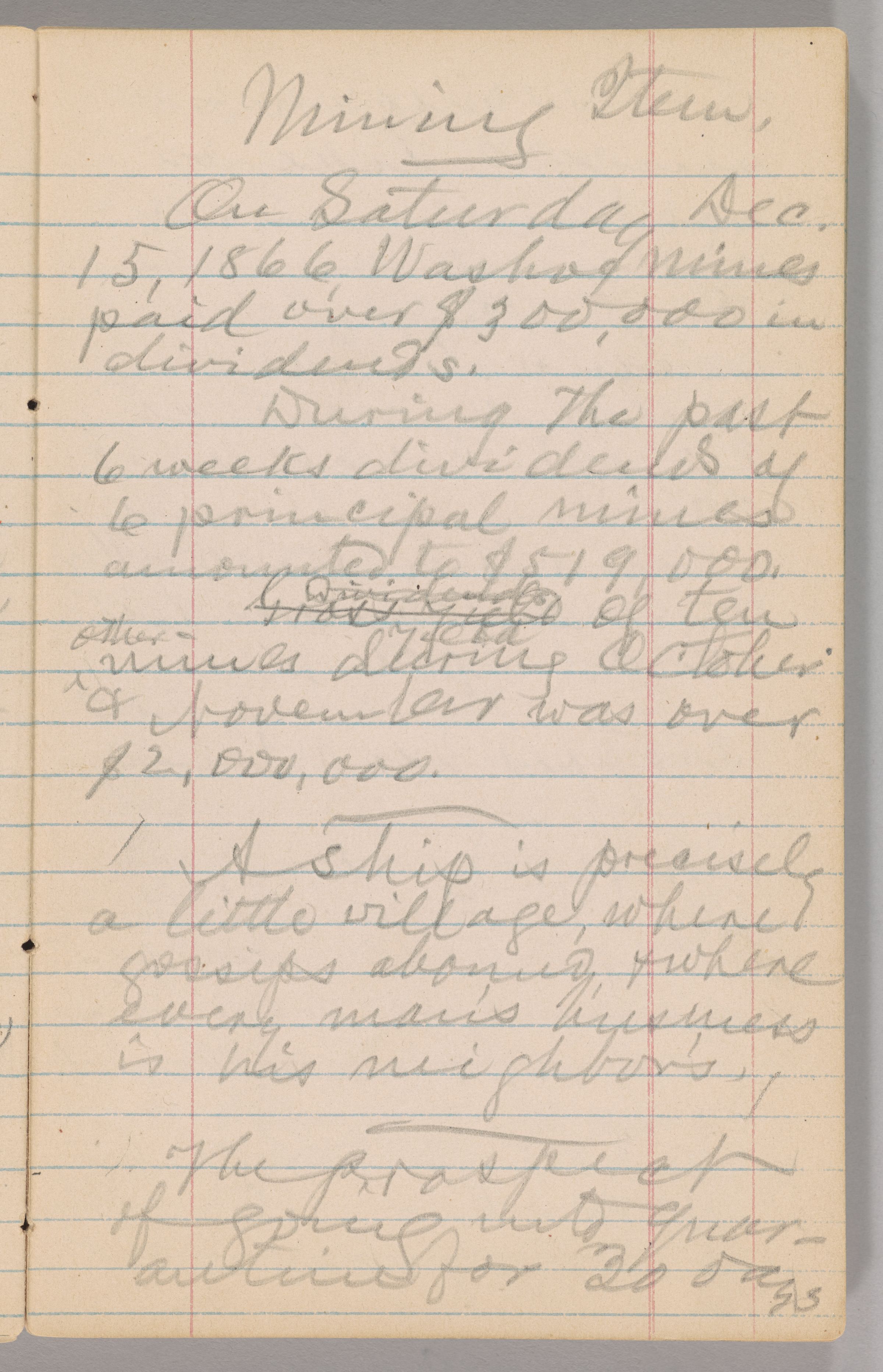
The 4 PM Jan 2.
The surgeon of the
ship has just reported
to the Captain in my
hearing, that two of the
cases are “mighty bad,”
& the 3d “awful bad.”
This is neither
chol-
era
cholera
nor yellow fever
I suspect—these men
have been eating green
tropical fruit &
wash-
ing
washing
it down with
vil-
lainous
villainous
aguardiente.
[MS: N7_leaf_046r]
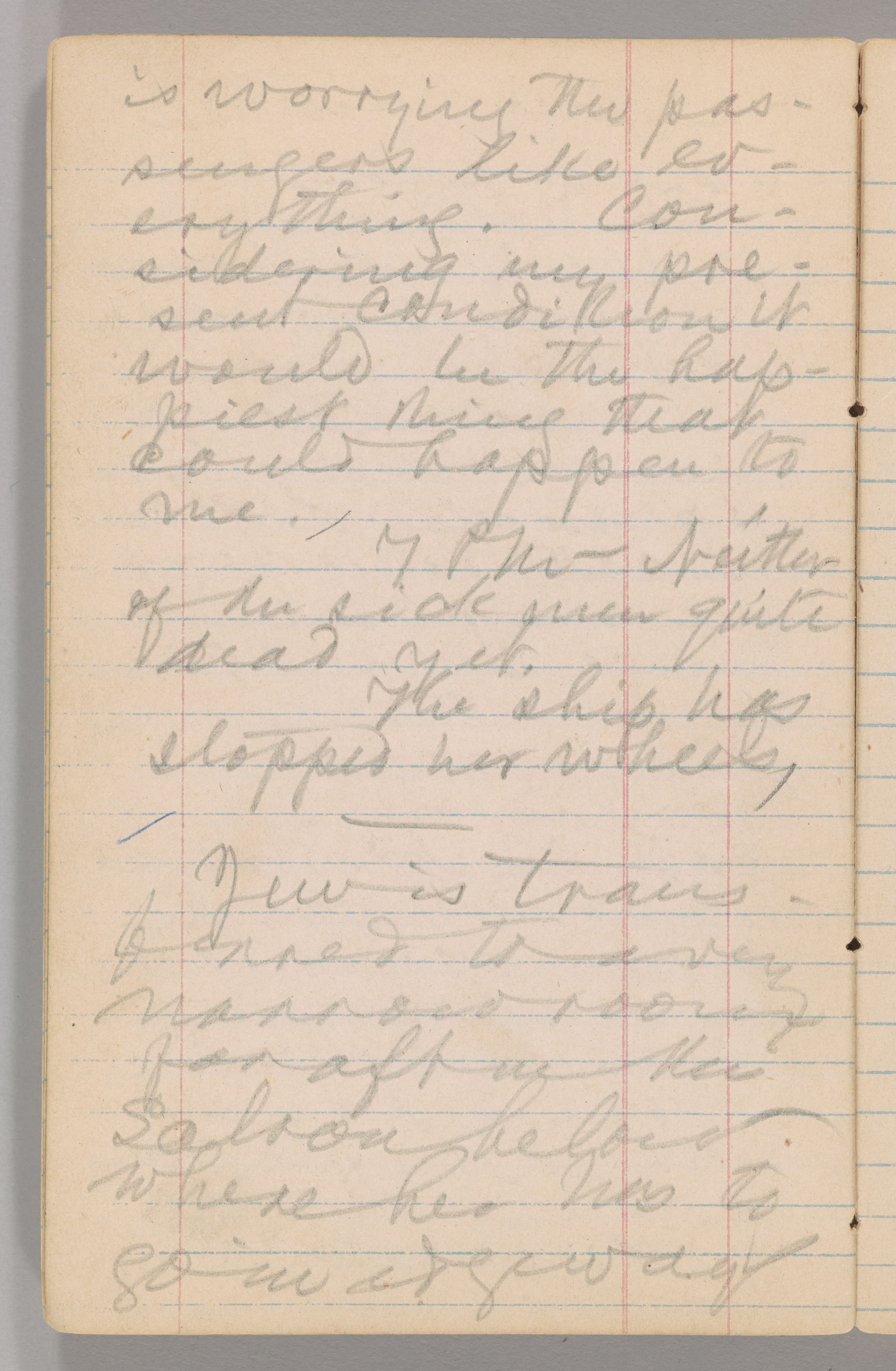
On Saturday Dec.
15, 1866, Washoe mines
paid over $300,000 in
dividends.
[MTP: N&J1_270]
During the past
6 weeks dividends of
6 principal mines
amounted to $519,000.
Gross yield
Dividends
Yield of ten
other
mines during October
& November was over
$2,000,000.
A ship is precisely
a little village, where
gossips abound, & where
every man's business
is his neighbor's.
The prospect
of going into
quar-
antine
quarantine
for 30 days
[MS: N7_leaf_046v]
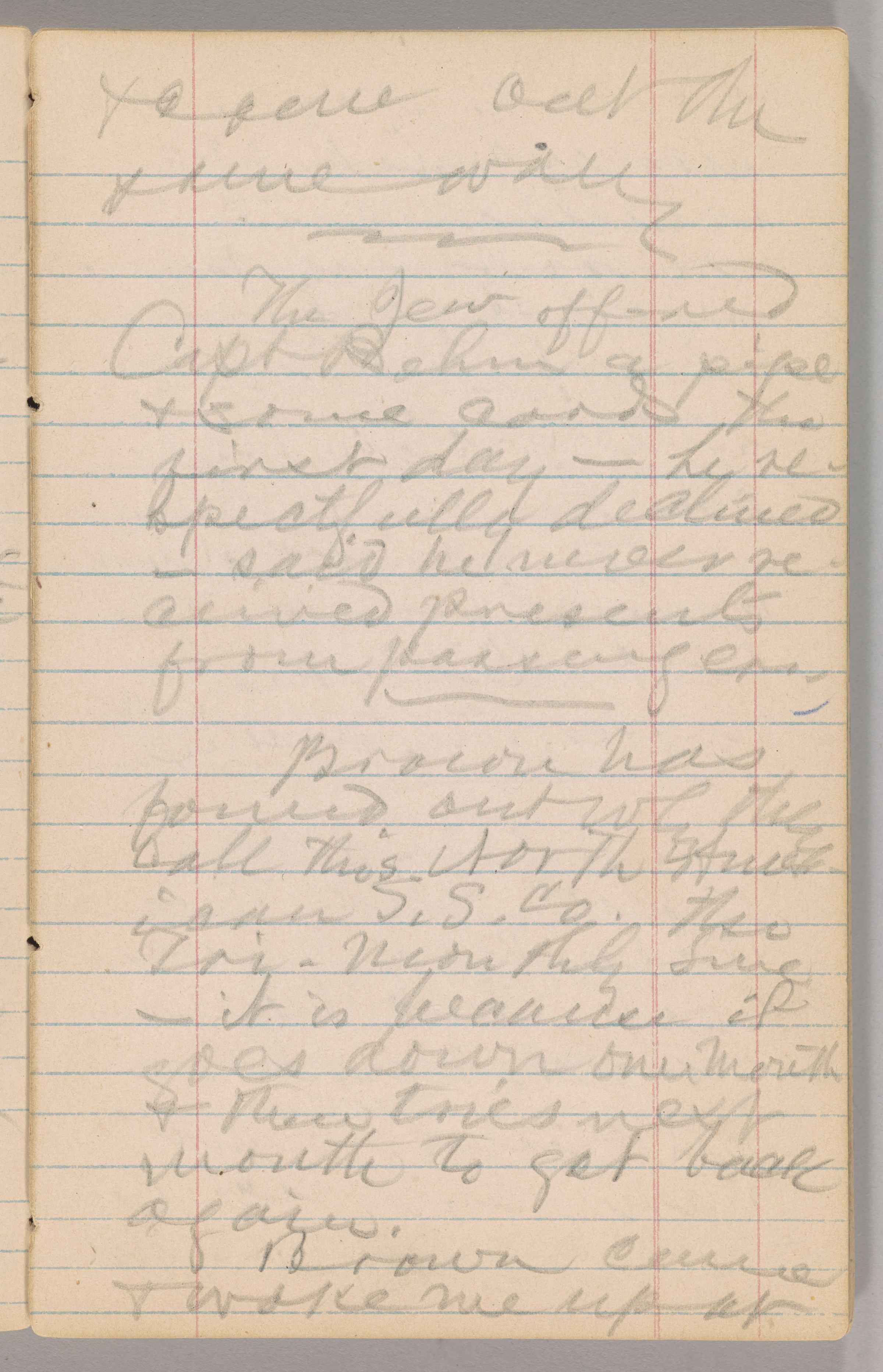
is worrying the
pas-
sengers
passengers
like
ev-
erything
everything
.
Con-
sidering
Considering
my
pre-
sent
present
condition it
would be the
hap-
piest
happiest
thing that
could happen to
me.
7 PM—Neither
of the sick men quite
dead yet.
The ship has
stopped her wheels.
Jew is
trans-
ferred
transferred
to a very
narrow room
far aft in the
Saloon below
where he has to
go in edgeways
[MS: N7_leaf_047r]
& come out the
same way
The Jew offered
Capt Behm a pipe
& some cards the
first day—he
re-
spectfully
respectfully
declined
—said he never
re-
ceived
received
presents
from passengers.
Brown has
found out why they
call this North
Amer-
ican
American
S.S. Co. the
Tri-Monthly Line
—it is because it
goes down one month
& then tries next
month to get back
again.
[MTP: N&J1_271]
Brown came
& woke me up at
[MS: N7_leaf_047v]
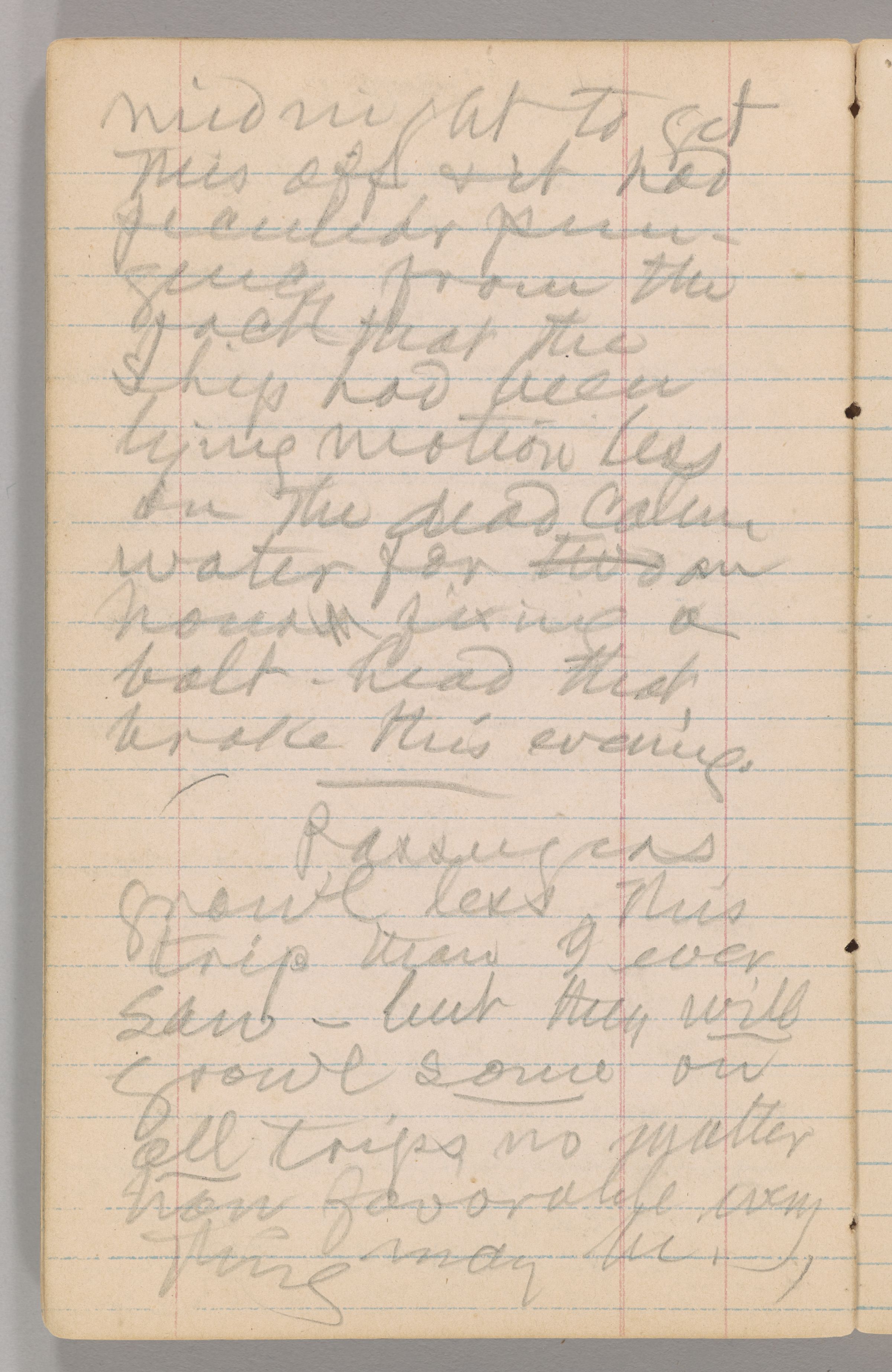
midnight to get
this off, & it had
peculiar
pun-
gency
pungency
from the
fact that the
ship had been
lying motionless
on the dead calm
water for
two
an
hours
fixing a
bolt-head that
broke this evening.
Passengers
growl less this
trip than I ever
saw—but they will
growl some on
all trips, no matter
how favorable every
thing may be.
[MS: N7_leaf_048r]
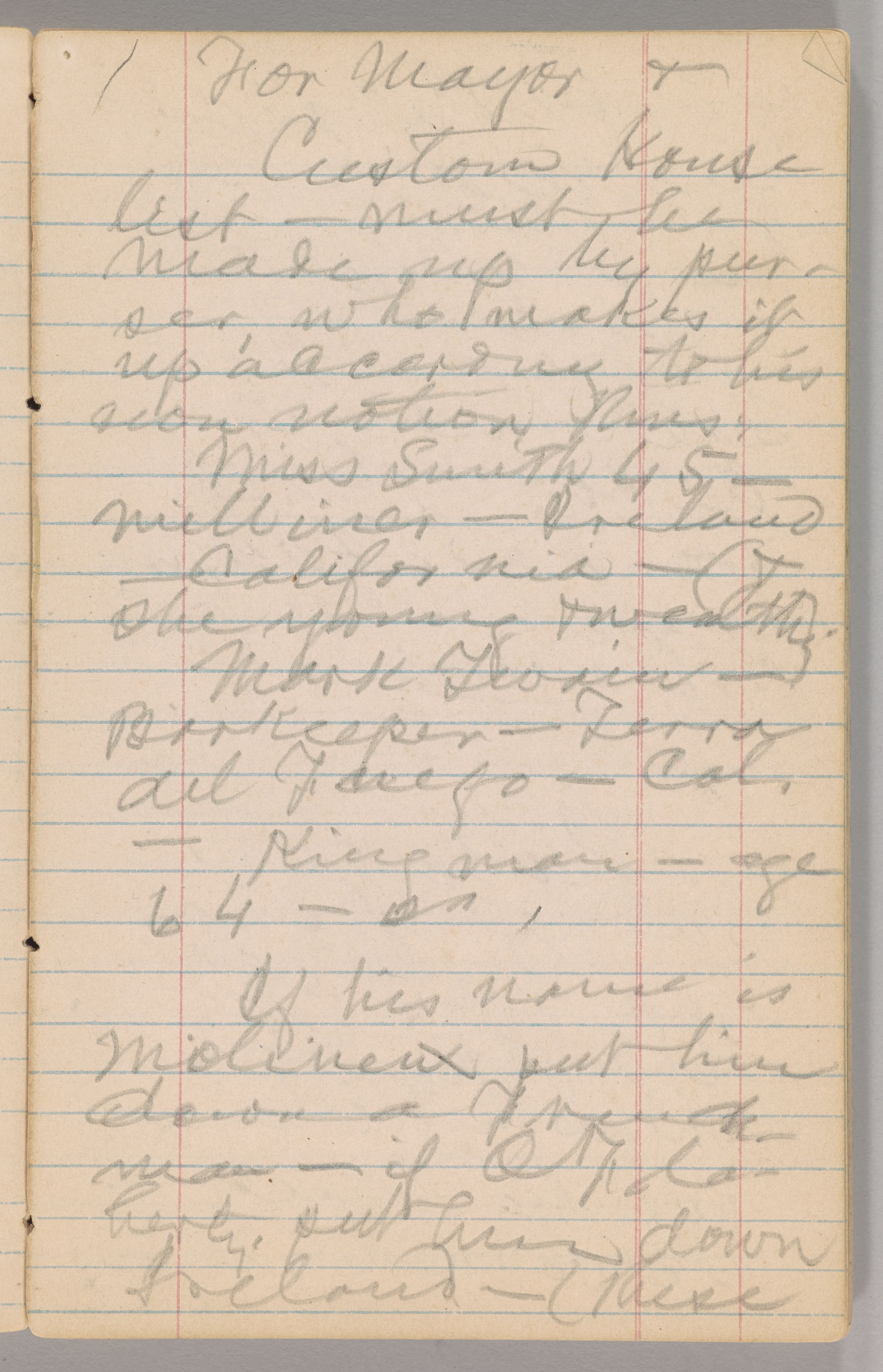
For Mayor &
Custom House
list—must be
made up by
pur-
ser
purser
, who makes it
up according to his
own notion thus:
Miss Smith 45—
milliner—Ireland
—California—(&
she young & wealthy).
Mark Twain—
Barkeeper—Terra
del Fuego—Cal.
—Kingman—age
64—◊◊
If his name is
Molineux put him
down a
French-
man
Frenchman
—if O
Fla-
herty
Flaherty
, put him down
Ireland—(these
[MS: N7_leaf_048v]
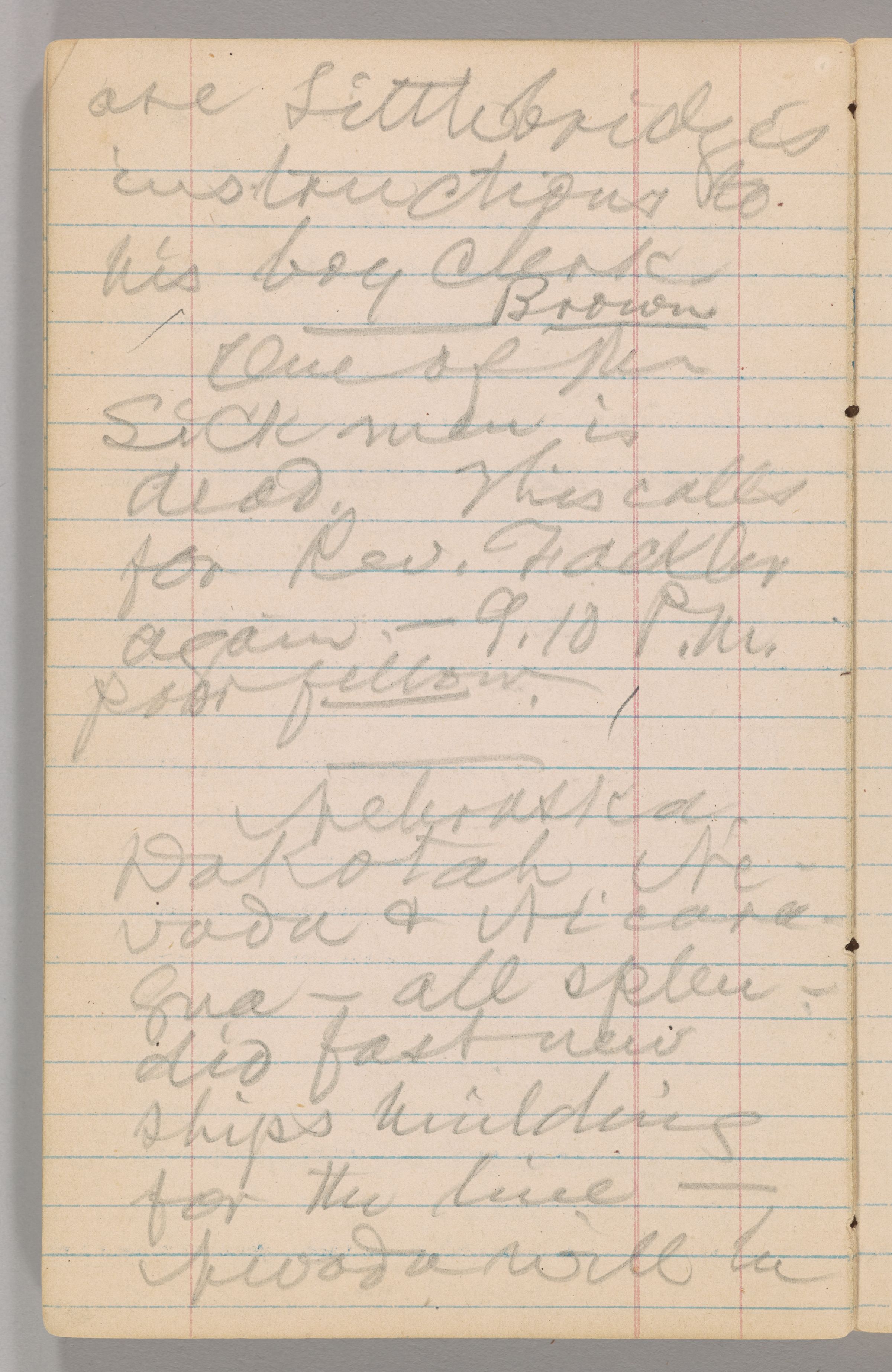
are Littlebridge's
instructions to
his boy clerk
One of the
sick men is
dead. This calls
for Rev. Fackler
again. —9.10 P.M.
poor fellow.
Nebraska,
Dakotah,
Ne-
vada
Nevada
&
Nicara-
gua
Nicaragua
—all
splen-
did
splendid
fast new
ships building
for the line—
Nevada will be
[MS: N7_leaf_049r]
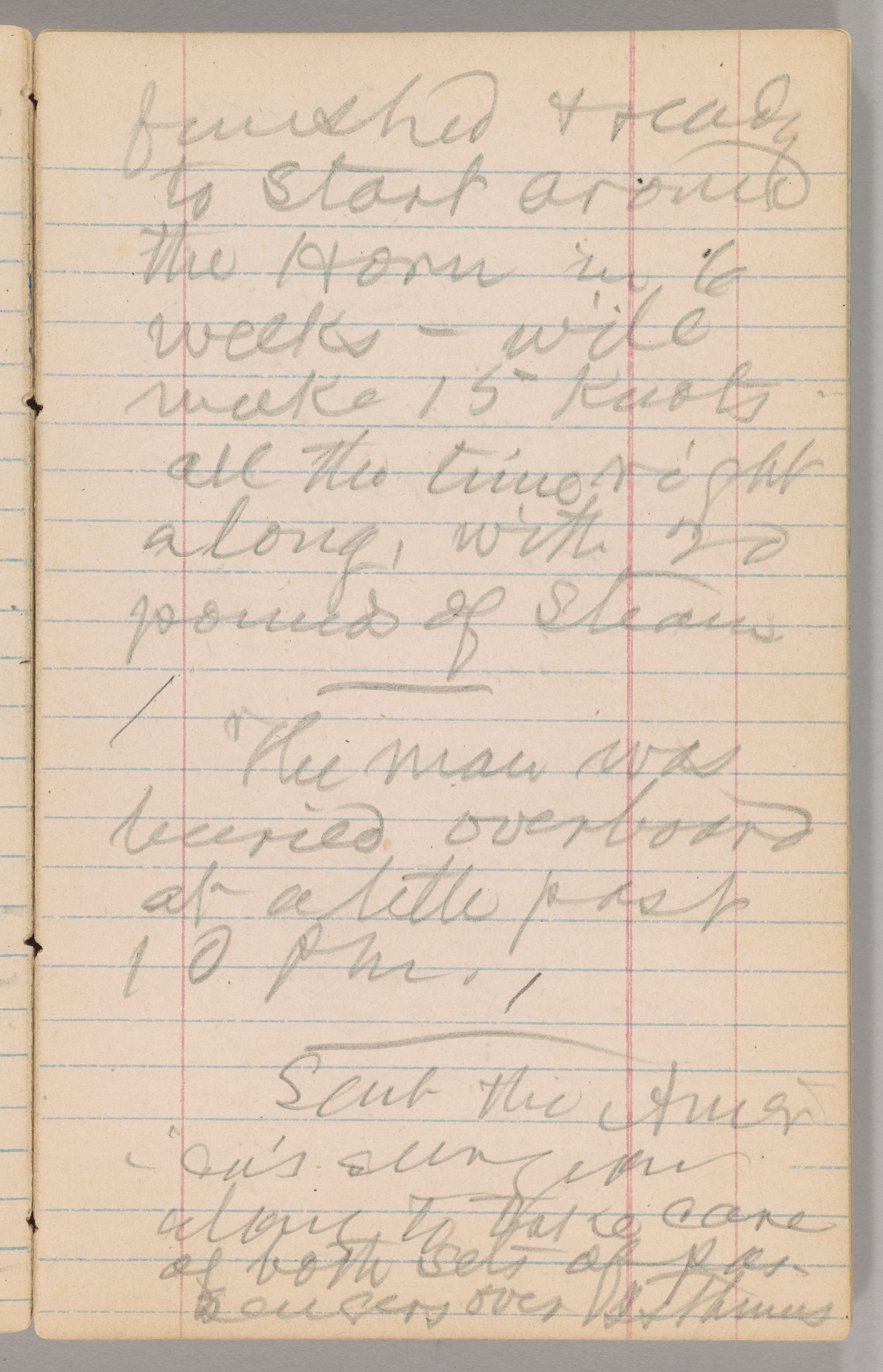
finished & ready
to start around
the Horn in 6
weeks—will
make 15 knots
all the time right
along, with 20
pounds of steam.
The man was
buried overboard
at a little past
10 PM.
Sent the
Amer-
icas’s
America's
surgeon
along to take care
of both sets of
pas-
sengers
passengers
over Isthmus
[MS: N7_leaf_049v]
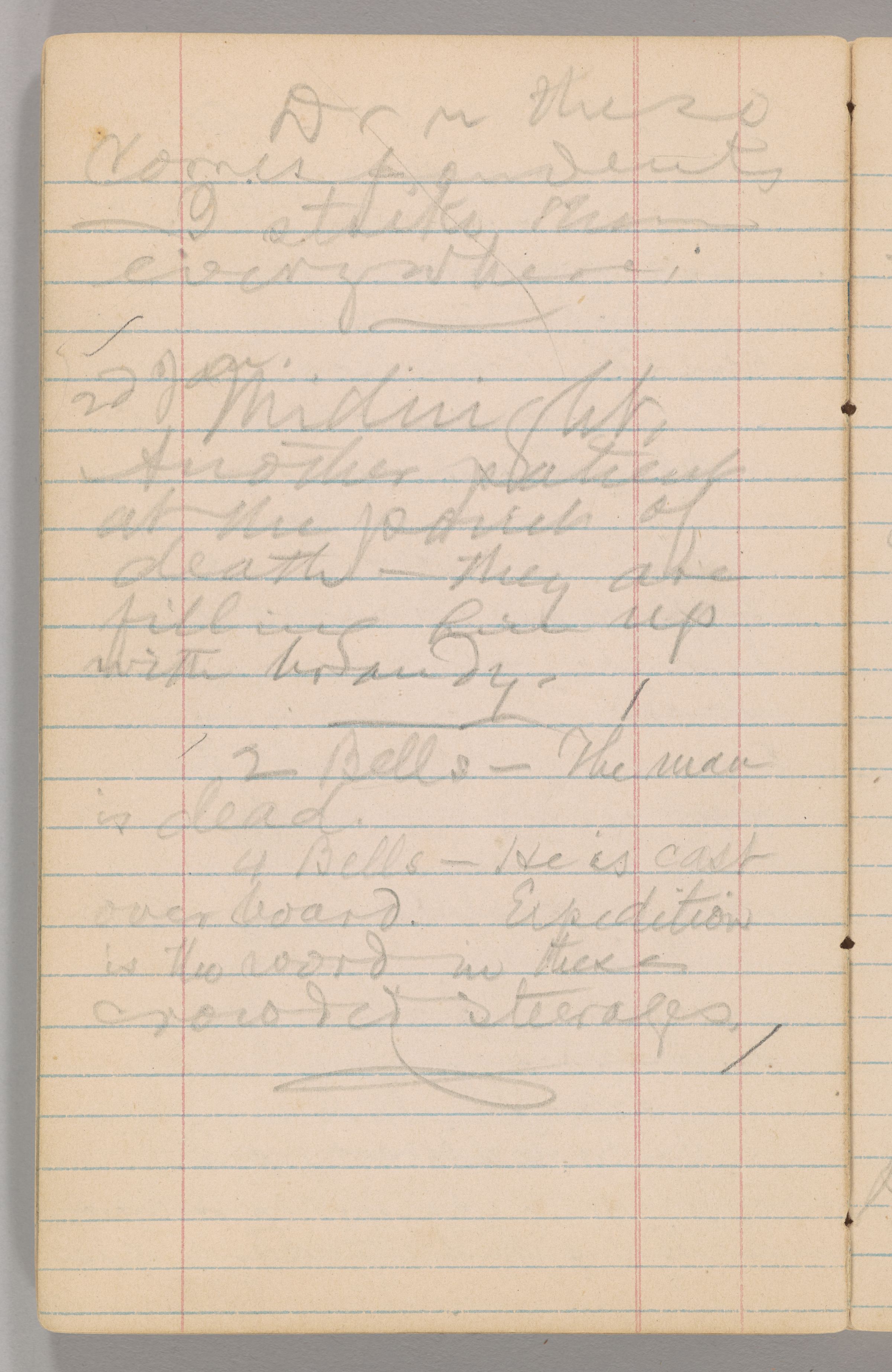
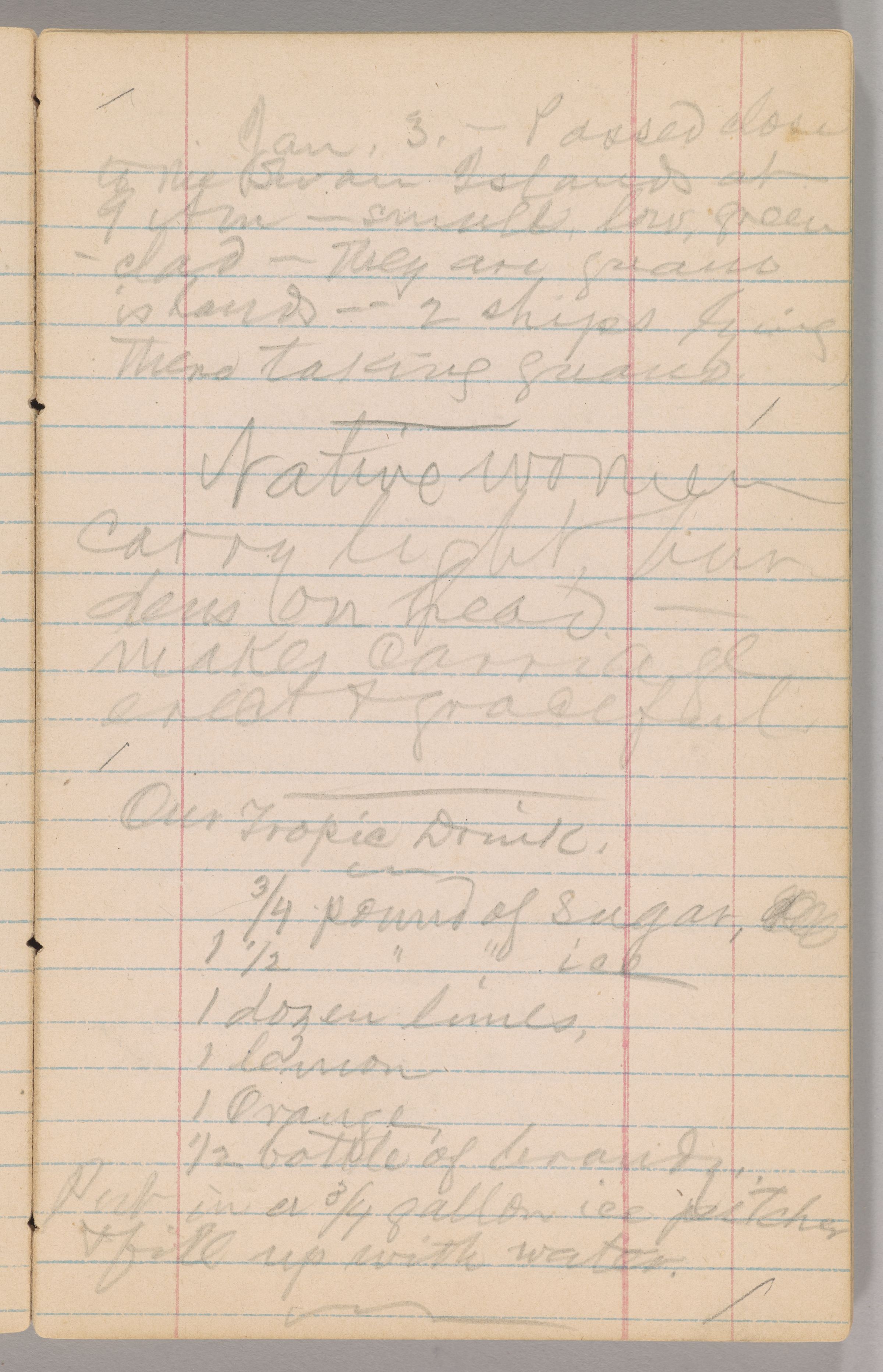
D—n these
correspondents
—I strike them
everywhere.
[MTP: N&J1_272]
2d Jan. Midnight.
Another patient
at the point of
death—they are
filling him up
with brandy.
2 Bells—The man
is dead.
4 Bells—He is cast
overboard. Expedition
is the word in these
crowded steerages.
[MS: N7_leaf_050r]
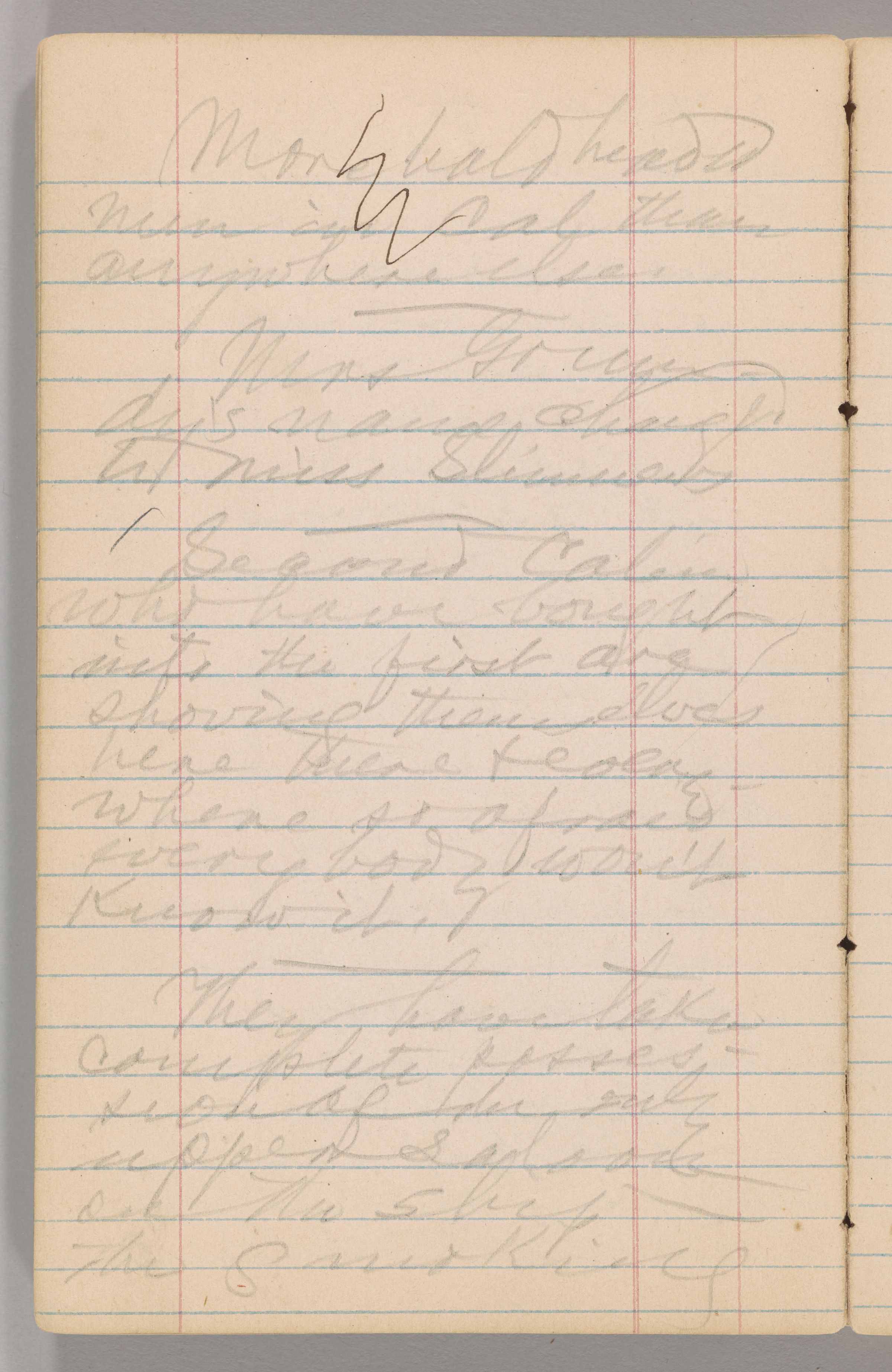
Jan. 3.—Passed close
to the Swan Islands at
9 AM—small, low,
green
-clad
green-clad
—they are guano
islands—2 ships lying
there taking guano.
Native women
carry light,
bur
dens
burdens
on head—
makes carriage
erect & graceful.
Our Tropic Drink.
¾ pound of sugar, &
1½ ” ” ice
1 dozen limes,
1 lemon
1 Orange,
½ bottle of brandy.
Put in a ¾ gallon ice pitcher
& fill up with water.
[MS: N7_leaf_050v]
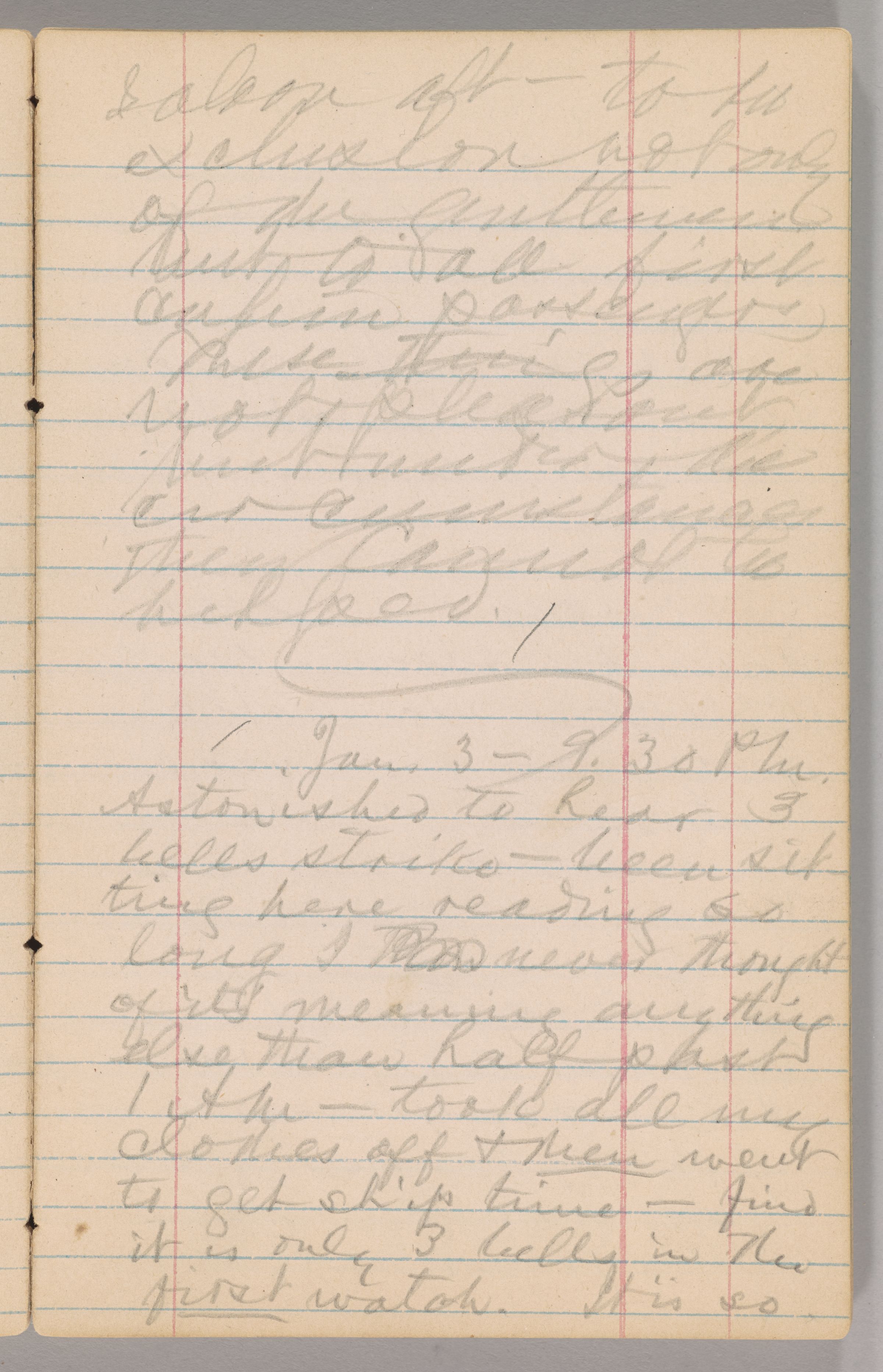
More baldheaded
men in Cal than
anywhere else.
Mrs
Grun-
dy’s
Grundy's
name changed
to Miss Slimmens
Second Cabin
who have bought
into the first are
shoving themselves
here there &
every-
where
everywhere
so afraid
everybody won't
know it.
They have taken
complete
posses-
sion
possession
of the only
upper Saloon
on the ship—
the Smoking
[MS: N7_leaf_051r]
Saloon aft—to the
exclusion not only
of the gentlemen
but to all first
cabin passengers.
These things are
not pleasant,
but under the
circumstances
they cannot be
helped.
[MTP: N&J1_273]
Jan. 3—9.30 PM.
Astonished to hear 3
bells strike—been
sit
ting
sitting
here reading so
long I thou never thought
of it's meaning anything
else than half past
1 AM—took all my
clothes off & then went
to get ship time—find
it is only 3 bells in the
first watch. It is so
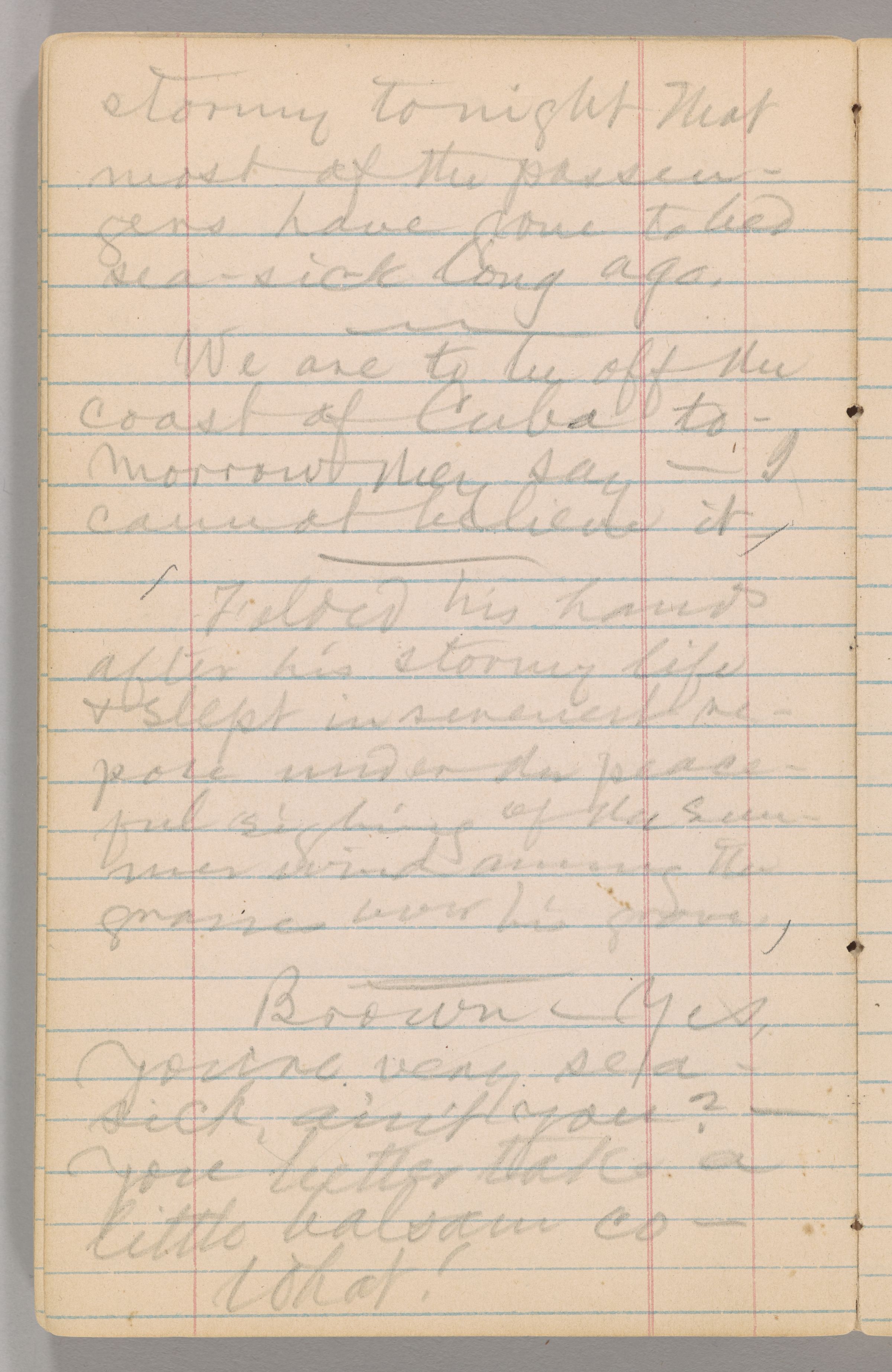
[MS: N7_leaf_051v]
stormy to-night that
most of the
passen-
gers
passengers
have gone to bed
sea-sick long ago.
We are to be off the
coast of Cuba
to-
morrow
to-morrow
they say—I
cannot believe it.
Folded his hands
after his stormy life
& slept in serenest
re-
pose
repose
under the
peace-
ful
peaceful
sighing of the
sum-
mer
summer
wind among the
grasses over his grave.
Brown—yes,
you're very
sea-
sick
sea-sick
, ain't you?—
you better take a
little balsam co—
What!
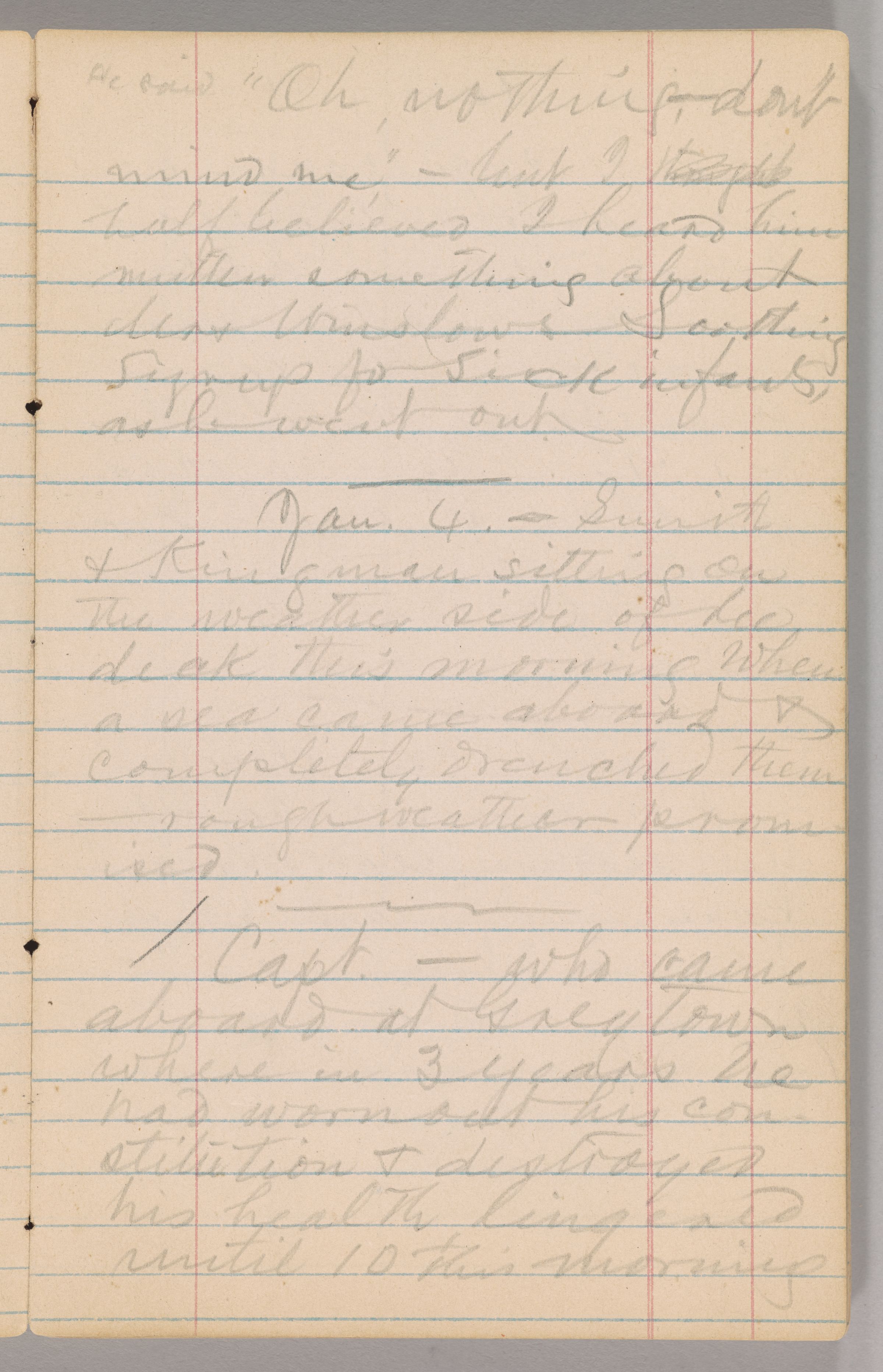
[MS: N7_leaf_052r]
He said
“Oh, nothing,—don't
mind me,”—but I thought
half believed I heard him
mutter something about
Mrs Winslows Soothing
Syrup for sick infants,
as he went out.
Jan. 4.—Smith
& Kingman sitting on
the weather side of Lee
deck this morning when
a sea came aboard &
completely drenched them
—rough weather
prom-
ised
promised
.
Capt.—who came
aboard at Greytown
where in 3 years he
had worn out his
con-
stitution
constitution
& destroyed
his health lingered
until 10 this morning
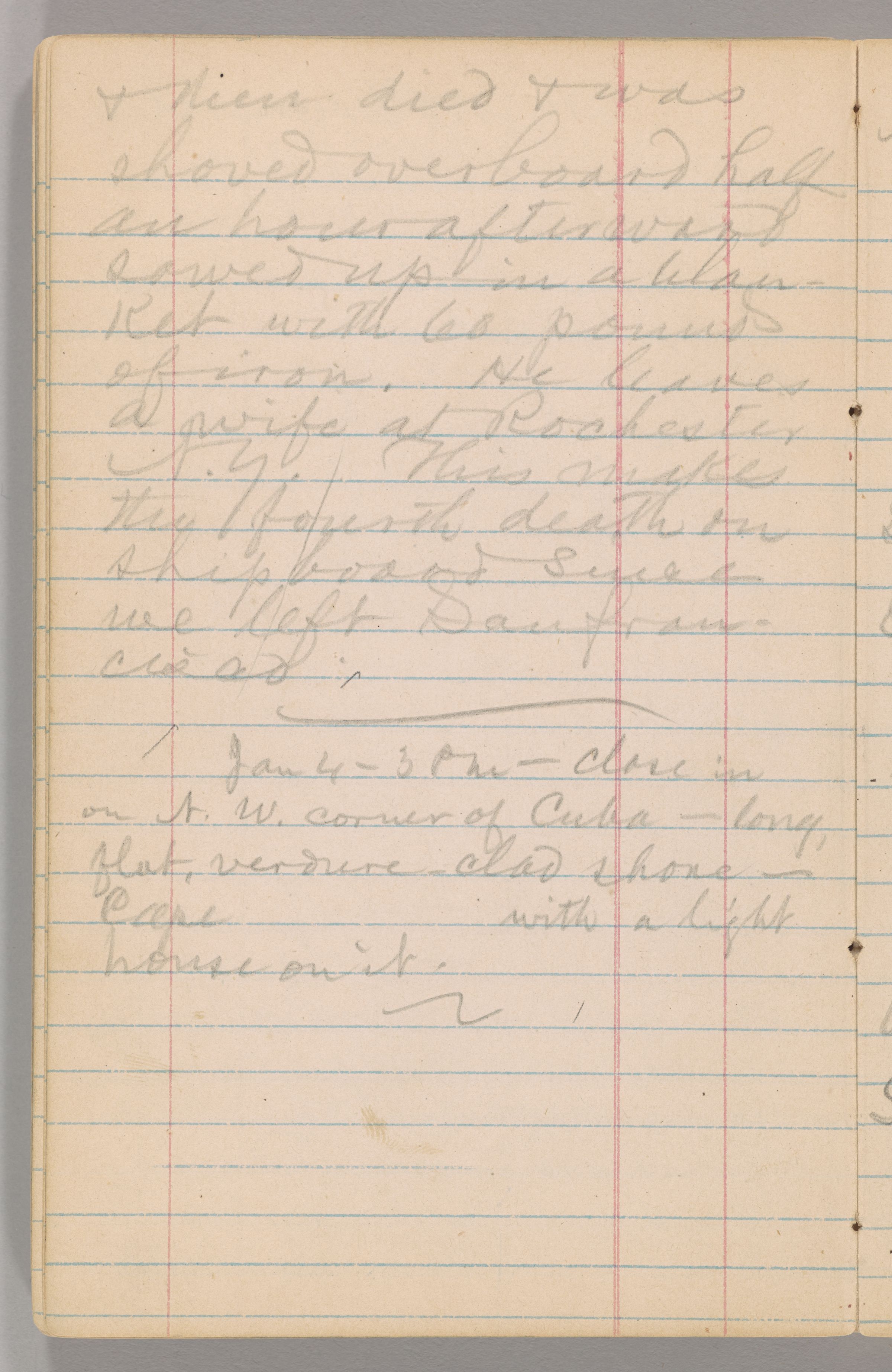
[MS: N7_leaf_052v]
& then died & was
shoved overboard half
an hour afterward
sowed up in a
blan-
ket
blanket
with 60 pounds
of iron. He leaves
a wife at Rochester
N.Y. This makes
the fourth death on
shipboard since
we left
Sanfran-
cisco
Sanfrancisco
.
Jan 4—3 PM—close in
on N.W. corner of Cuba—long,
flat, verdure-clad shore—
Cape with a light
house on it.
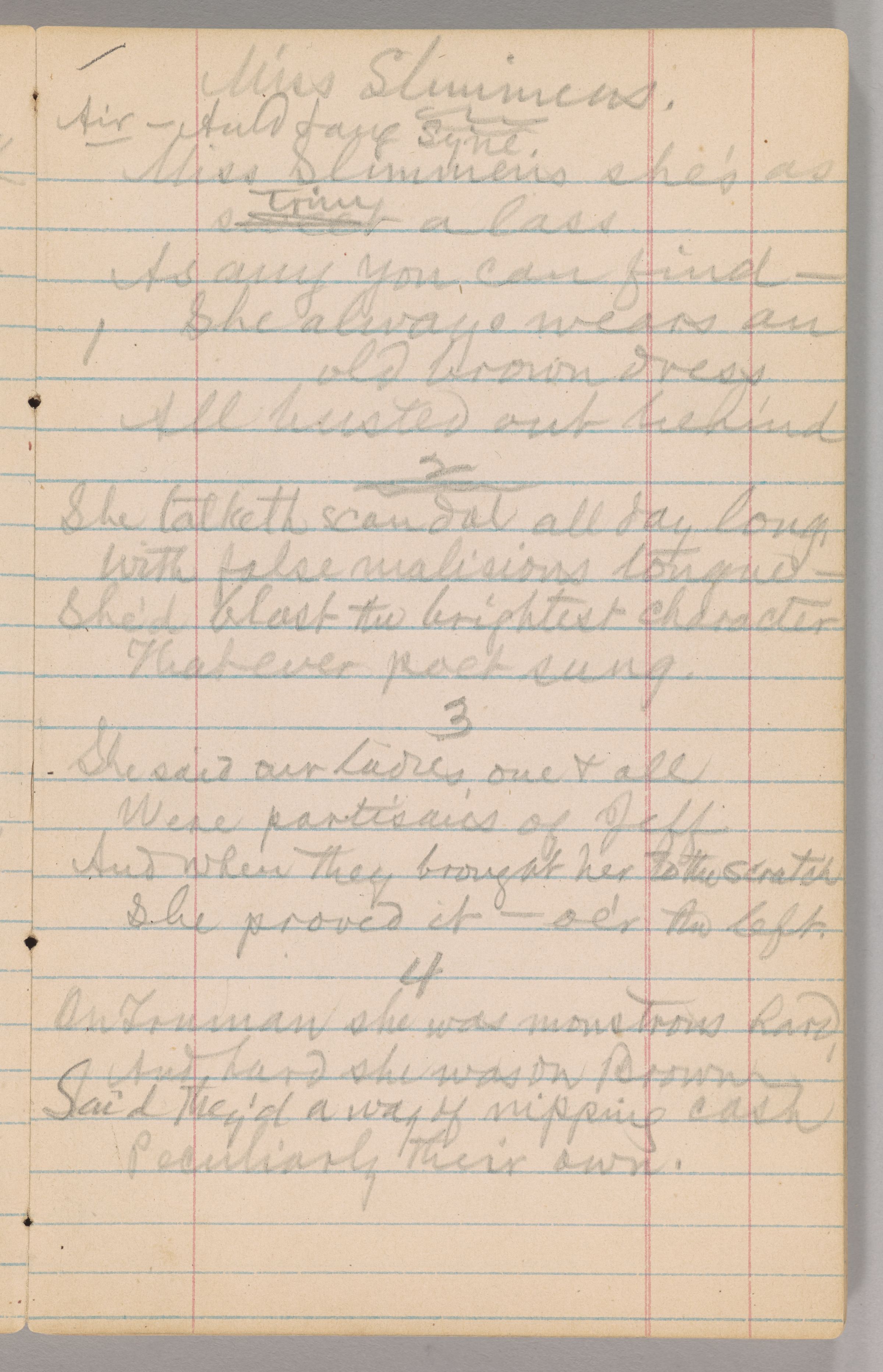
[MS: N7_leaf_053r]
[MTP: N&J1_274]
Miss Slimmens.
Air—Auld Lang Syne.
1sweet trim a lass
old brown dress

[MS: N7_leaf_053v]
blank verso
[MS: N7_leaf_054r]
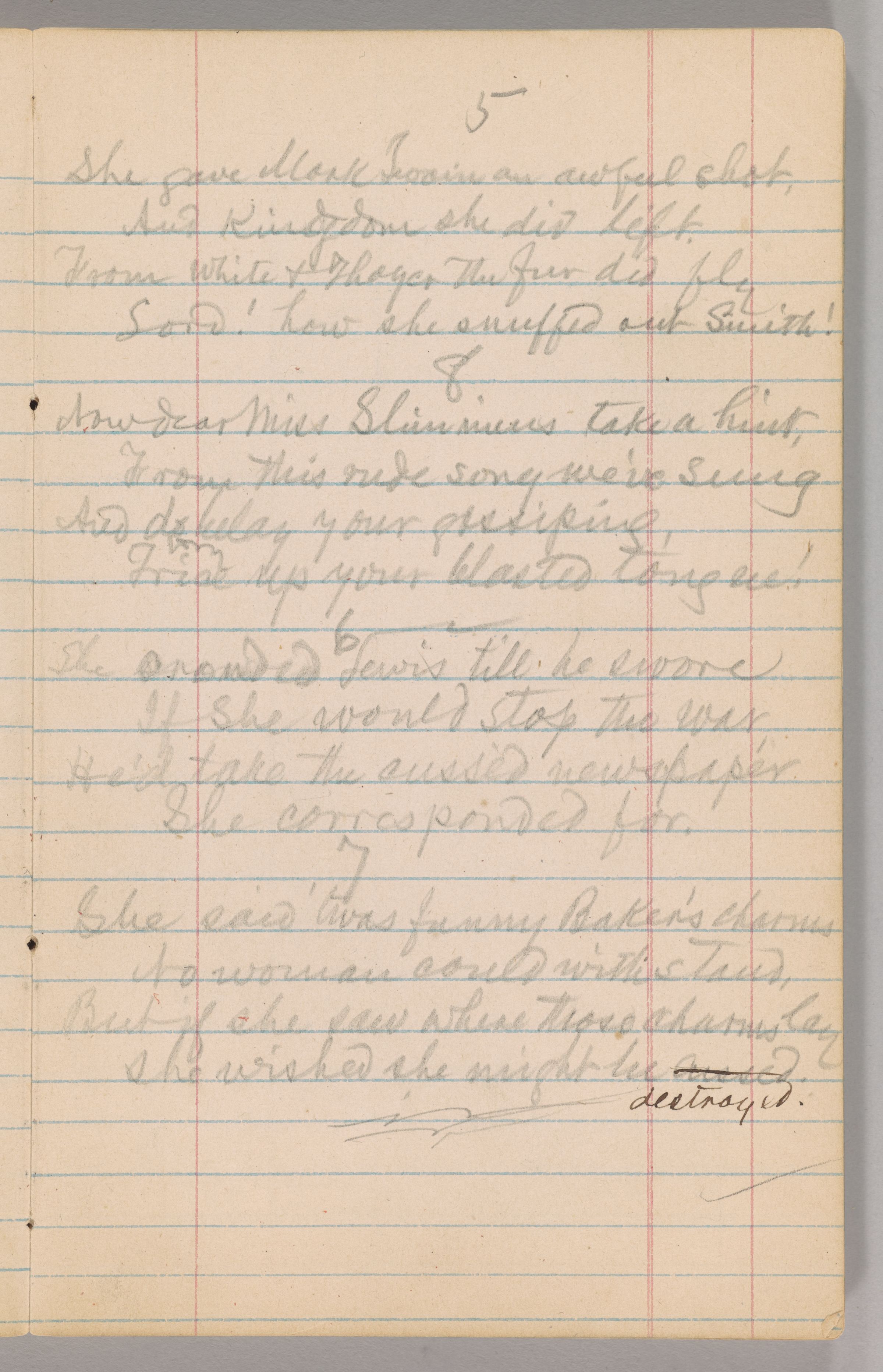
She crowded Lewis till he swore
[MTP: N&J1_275]

[MS: N7_leaf_054v]
blank verso
[MS: N7_leaf_055r]
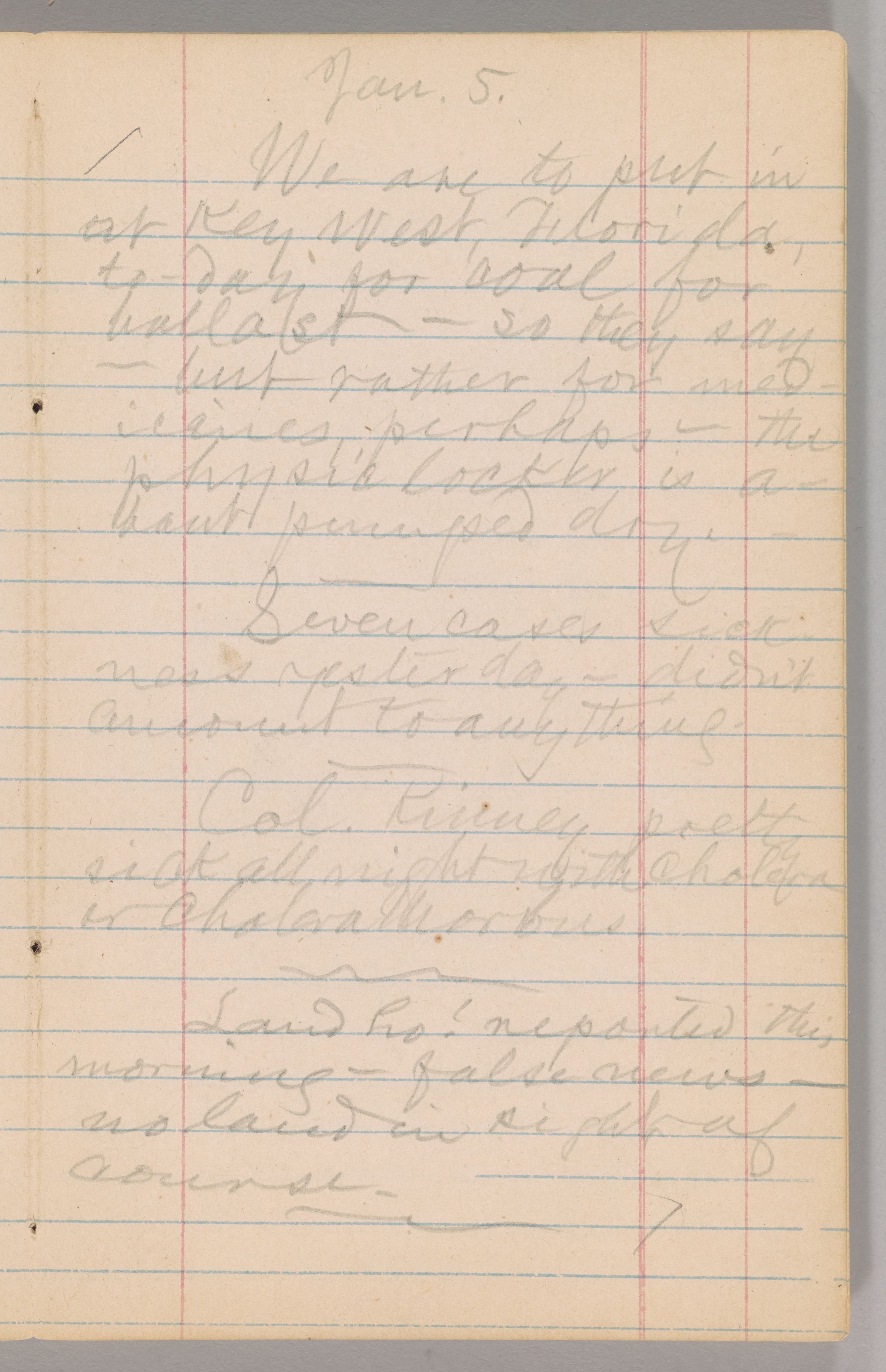
Jan. 5.
We are to put in
at Key West, Florida,
to-day for coal for
ballast—so they say
—but rather for
med-
icines
medicines
, perhaps—the
physic locker is
a-
bout
about
pumped dry.
Seven cases
sick-
ness
sickness
yesterday—didn't
amount to anything.
Col. Kinney pretty
sick all night with Cholera
or Cholera Morbus
Land ho! reported this
morning—false news—
no land in sight, of
course.
[MS: N7_leaf_055v]
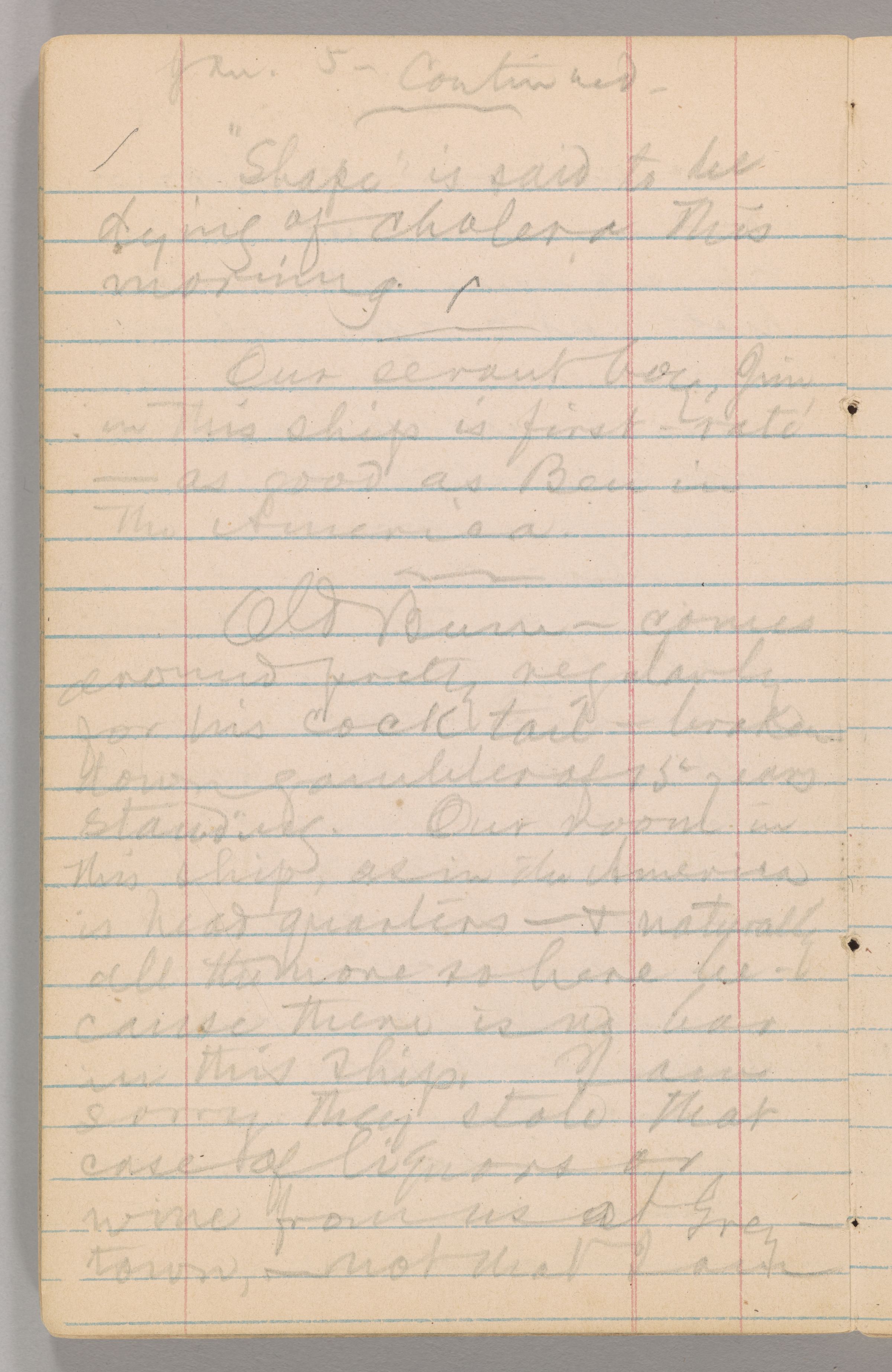
Jan. 5—Continued.
“Shape” is said to be
dying of cholera this
morning.
Our servant boy, Jim,
in this ship is first-rate
—as good as Ben in
the America.
Old Bum—comes
around pretty regularly
for his cock tail—broken
down gambler of 15 years
standing. Our room in
this ship, as in the America
is headquarters—& naturally
all the more so here
be-
cause
because
there is no bar
in this ship. I am
sorry they stole that
case of liquors or
wine from us at
Grey-
town
Greytown
,—not that I am
[MS: N7_leaf_056r]
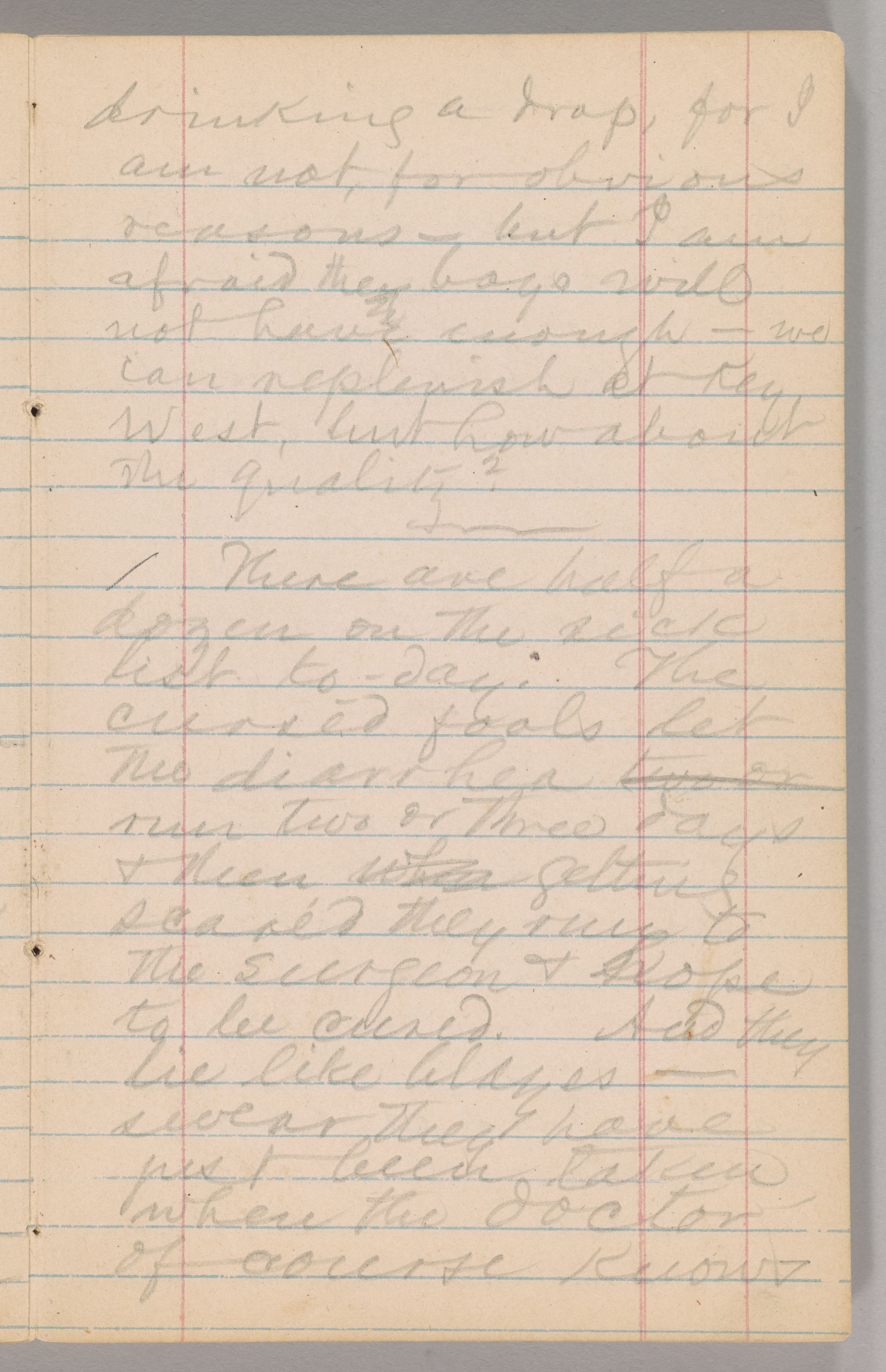
drinking a drop, for I
am not, for obvious
reasons—but I am
afraid the y boys will
not have enough—we
can replenish at Key
West, but how about
the quality?
There are half a
dozen on the sick
list to-day. The
cursèd fools let
the diarrhea two or
run two or three days
& then, when getting
[MTP: N&J1_276] scared they run to
the surgeon &
e hope
to be cured. And they
lie like blazes—
swear they have
just been taken
when the doctor
of course knows
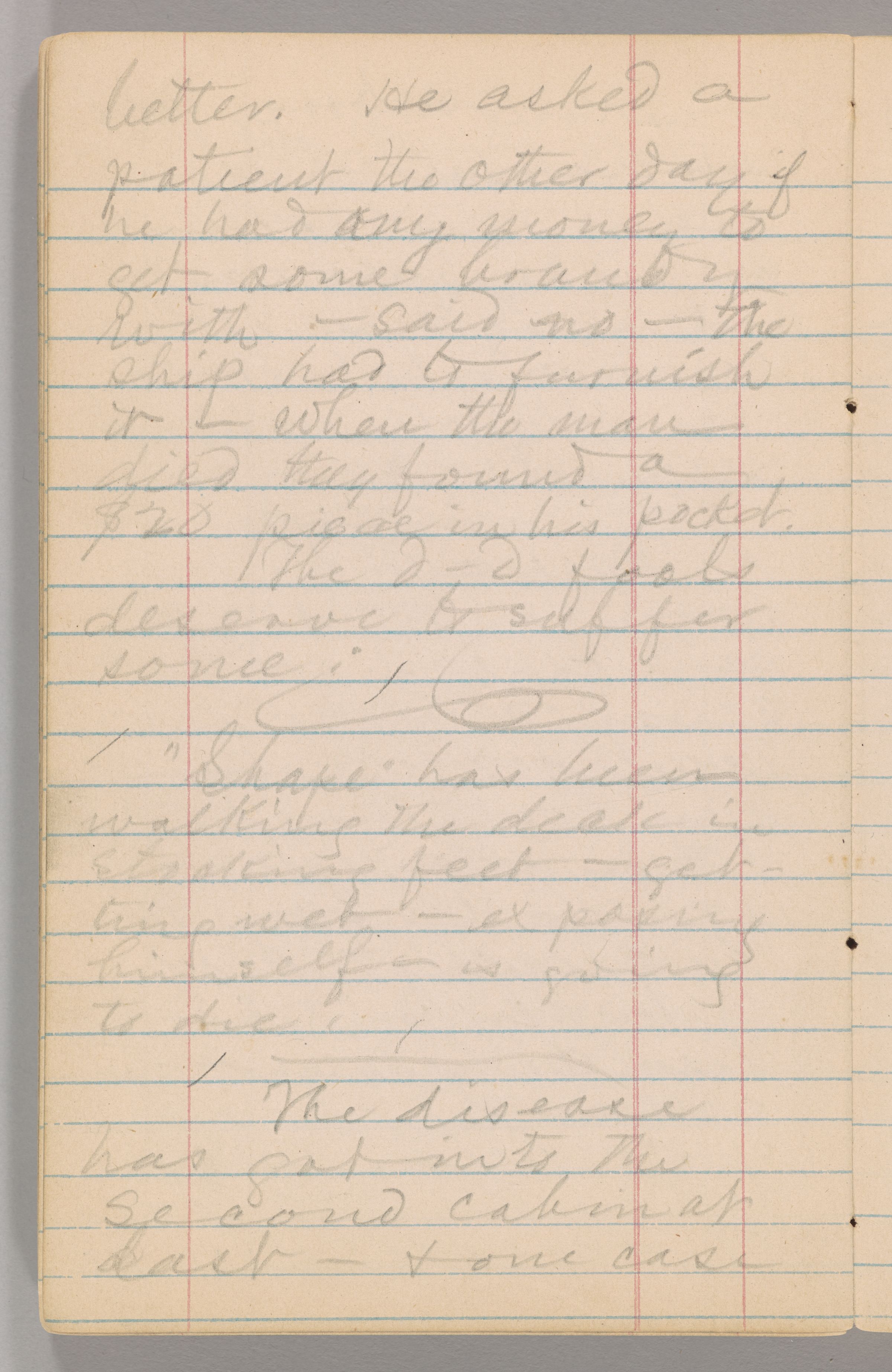
[MS: N7_leaf_056v]
better. He asked a
patient the other day if
he had any money to
get some brandy
with—said no—the
ship had to furnish
it—when the man
died they found a
$20 piece in his pocket.
The d—d fools
deserve to suffer
some.
“Shape” has been
walking the deck in
stocking feet—
get-
ting
getting
wet—exposing
himself—is going
to die.
The disease
has got into the
second cabin at
last—& one case
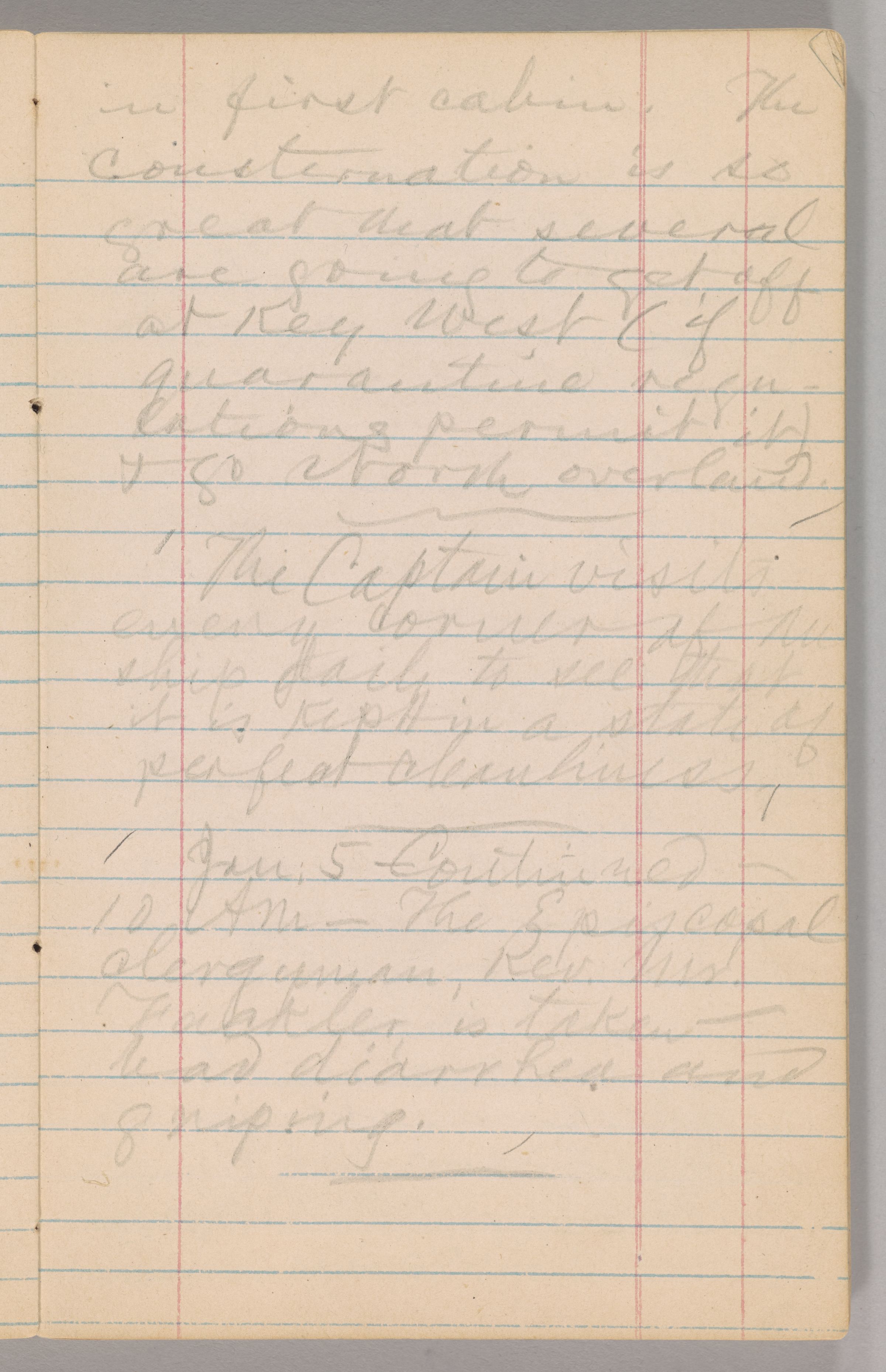
[MS: N7_leaf_057r]
in first cabin. The
consternation is so
great that several
are going to get off
at Key West (if
quarantine
regu-
lations
regulations
permit it)
& go North overland.
The Captain visits
every corner of the
ship daily to see that
it is kept in a state of
perfect cleanliness.
Jan. 5—Continued—
10 AM—The Episcopal
clergyman, Rev. Mr.
Fackler, is taken—
bad diarrhea and
griping.
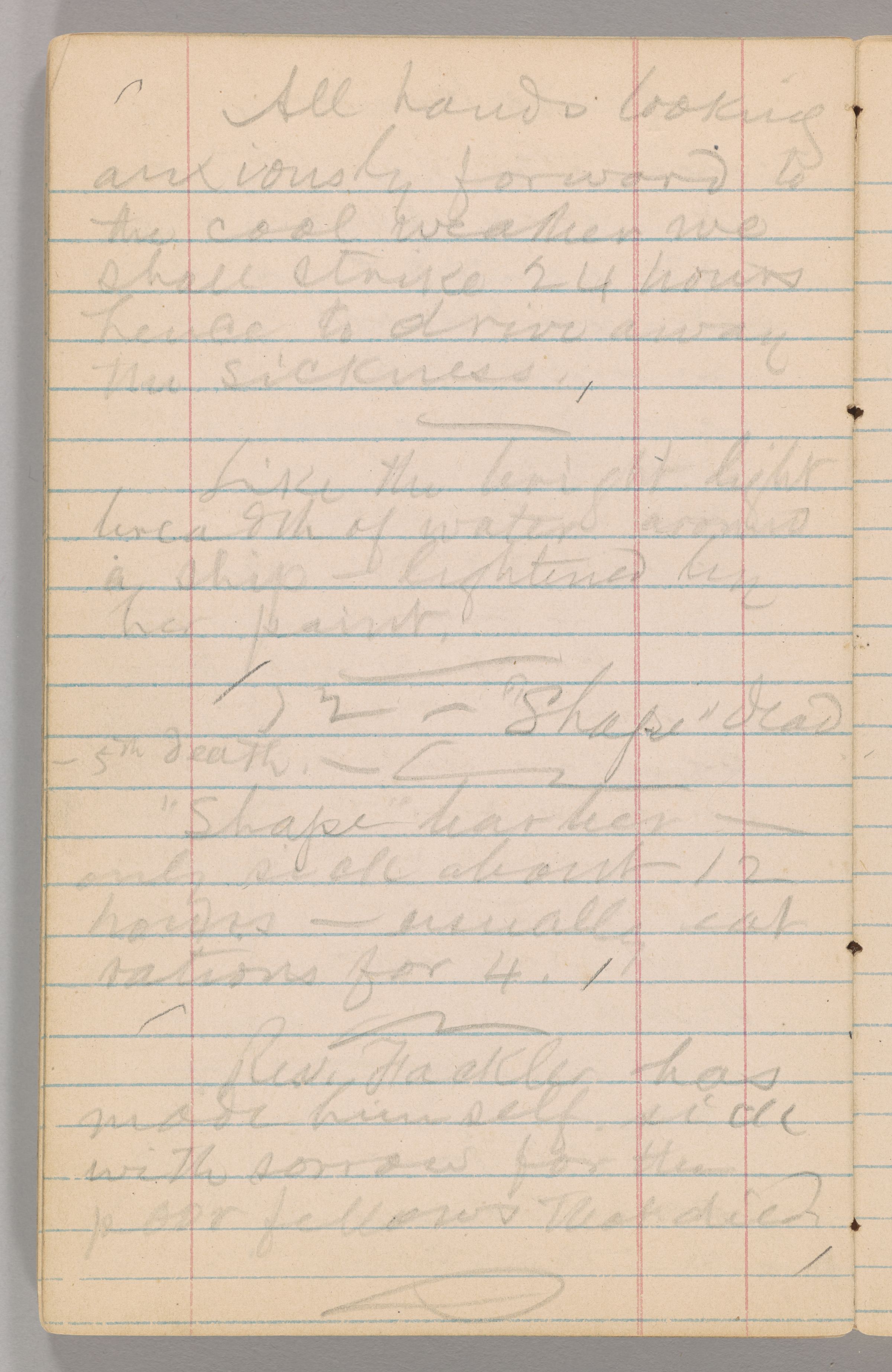
[MS: N7_leaf_057v]
All hands looking
anxiously forward to
the cool weather we
shall strike 24 hours
hence to drive away
the sickness.
Like the bright light
breadth of water around
a ship—lightened by
her paint.
“Shape” barber—
only sick about 12
hours—usually eat
rations for 4.
Rev. Fackler has
made himself sick
with sorrow for the
poor fellows that died.
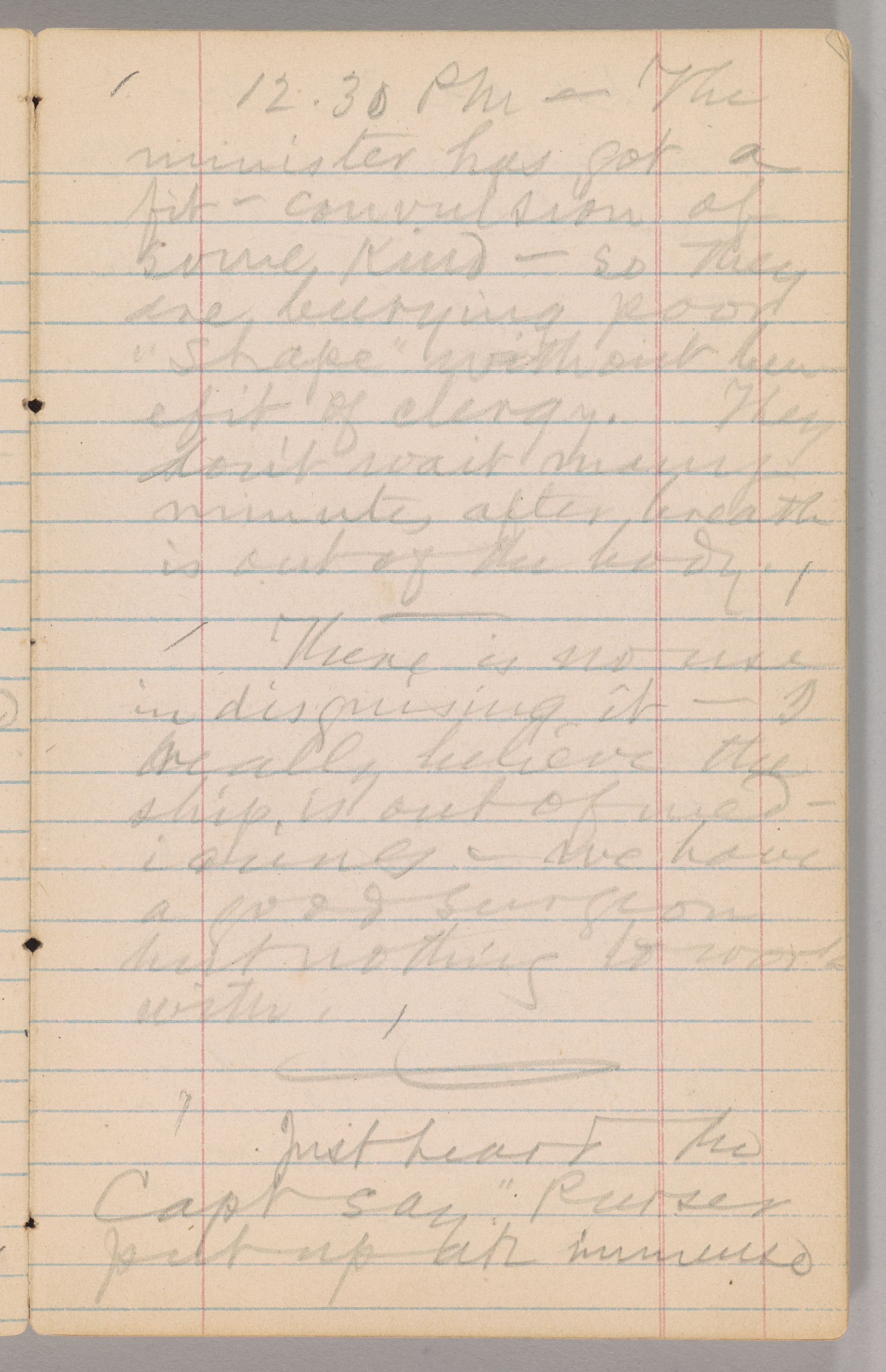
[MS: N7_leaf_058r]
12.30 PM—The
minister has got a
fit—convulsion of
some kind—so they
are burying poor
“Shape” without
ben-
efit
benefit
of clergy. They
don't wait many
minutes after breath
is out of the body.
There is no use
in disguising it—I
b really believe the
ship is
[MTP: N&J1_277] out of
med-
icines
medicines
—we have
a good surgeon
but nothing to work
with.
Just heard the
Capt say “Purser
put up an immense
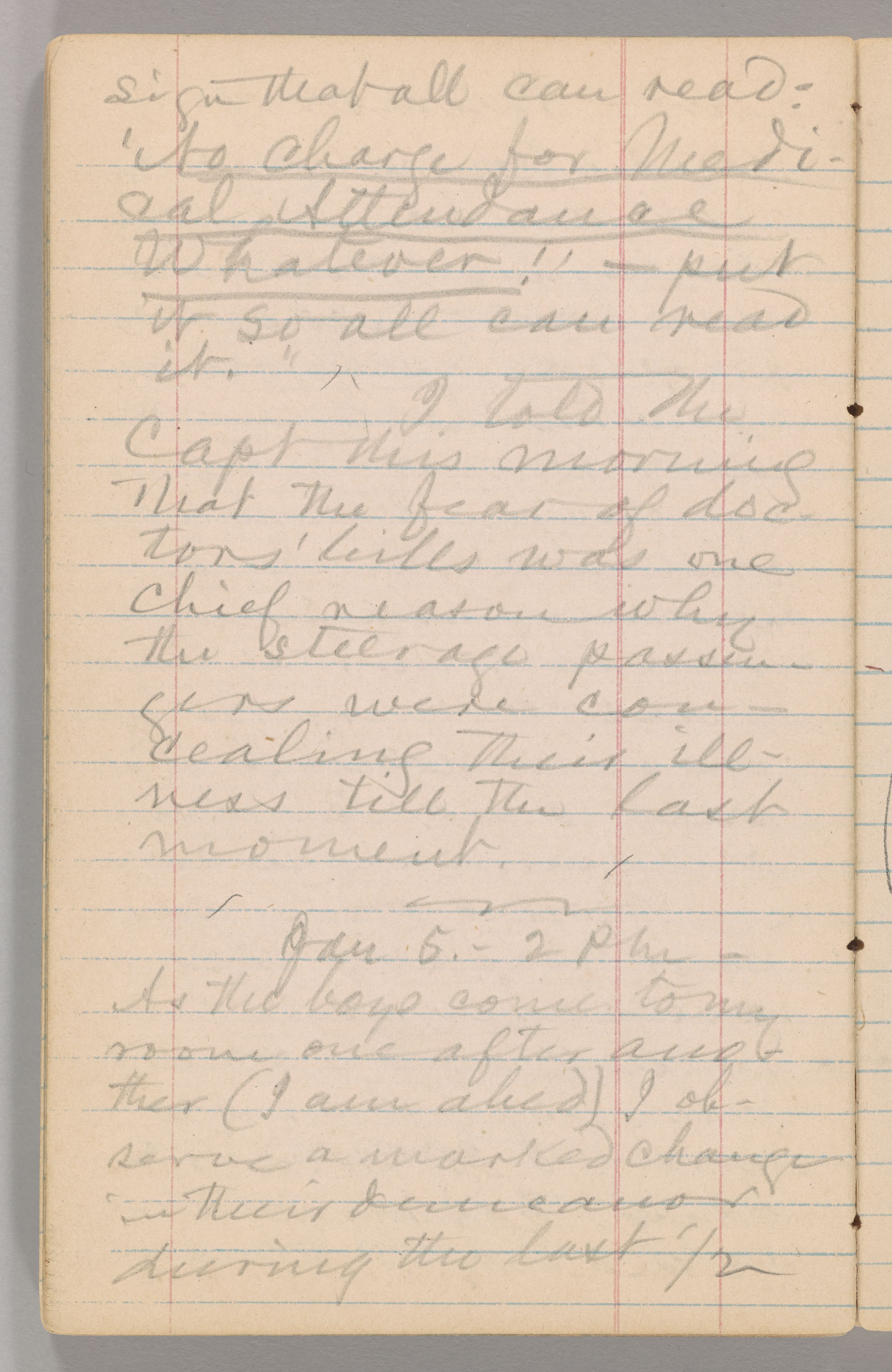
[MS: N7_leaf_058v]
sign that all can read:
‘No Charge for
Medi-
cal
Medical
Attendance
Whatever!’—put
it so all can read
it.”
I told the
Capt this morning
that the fear of
doc-
tors’
doctors'
bills was one
chief reason why
the steerage
passen-
gers
passengers
were
con-
cealing
concealing
their
ill-
ness
illness
till the last
moment.
Jan 5.—2 PM—
As the boys come to my
room one after
ano-
ther
another
(I am abed) I
ob-
serve
observe
a marked change
in their demeanor
during the last ½
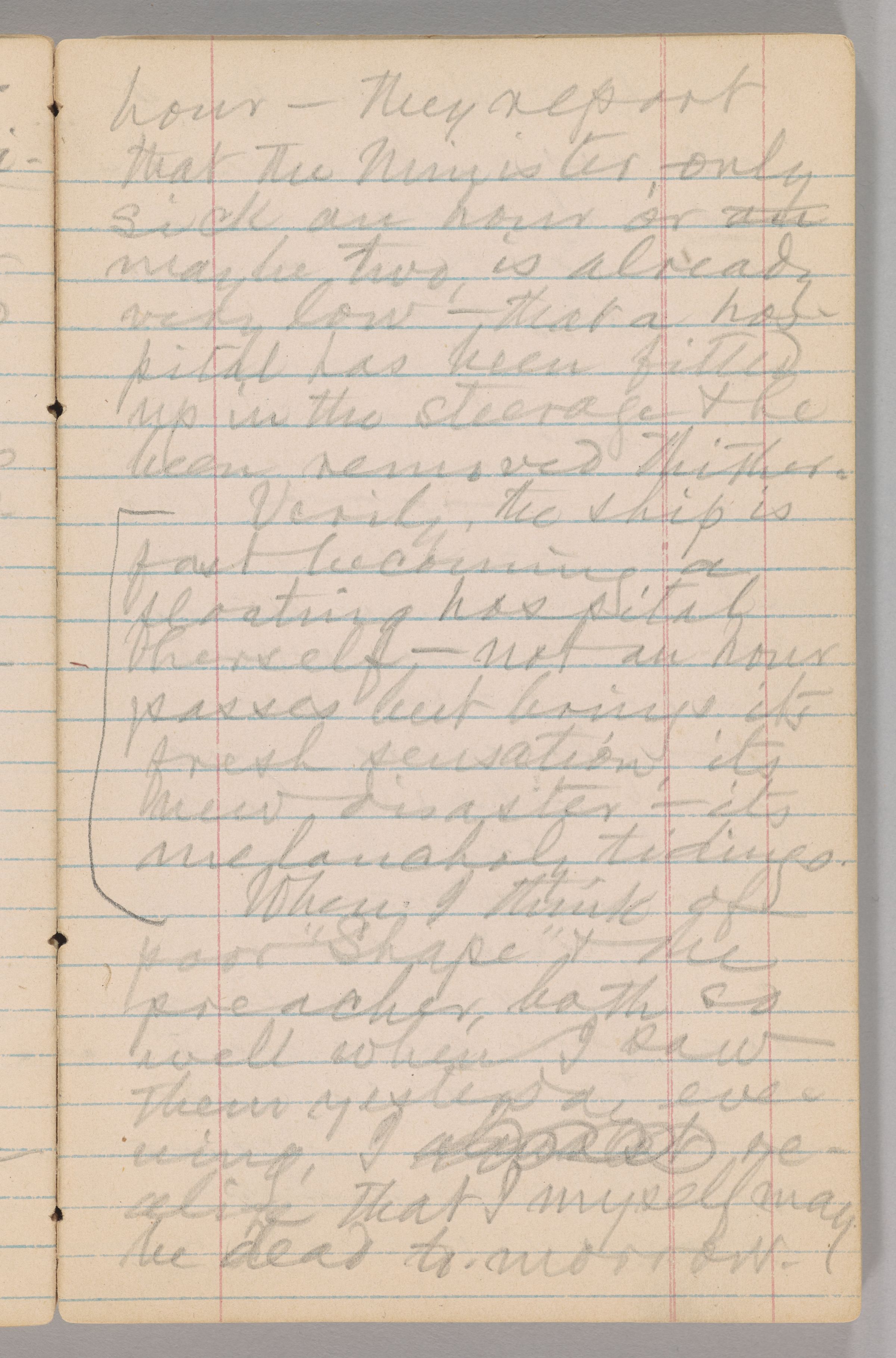
[MS: N7_leaf_059r]
hour—they report
that the Minister,
— only
sick an hour or an
maybe two, is already
very low—that a
hos-
pital
hospital
has been fitted
up in the steerage & he
been removed thither.
Verily, the ship is
fast becoming a
floating hospital
herself—not an hour
passes but brings its
fresh sensation, its
new disaster—its
melancholy tidings.
When I think of
poor “Shape” & the
preacher, both so
well when I saw
them yesterday
eve-
ning
evening
, I almost
re-
alize
realize
that I myself may
be dead to-morrow.
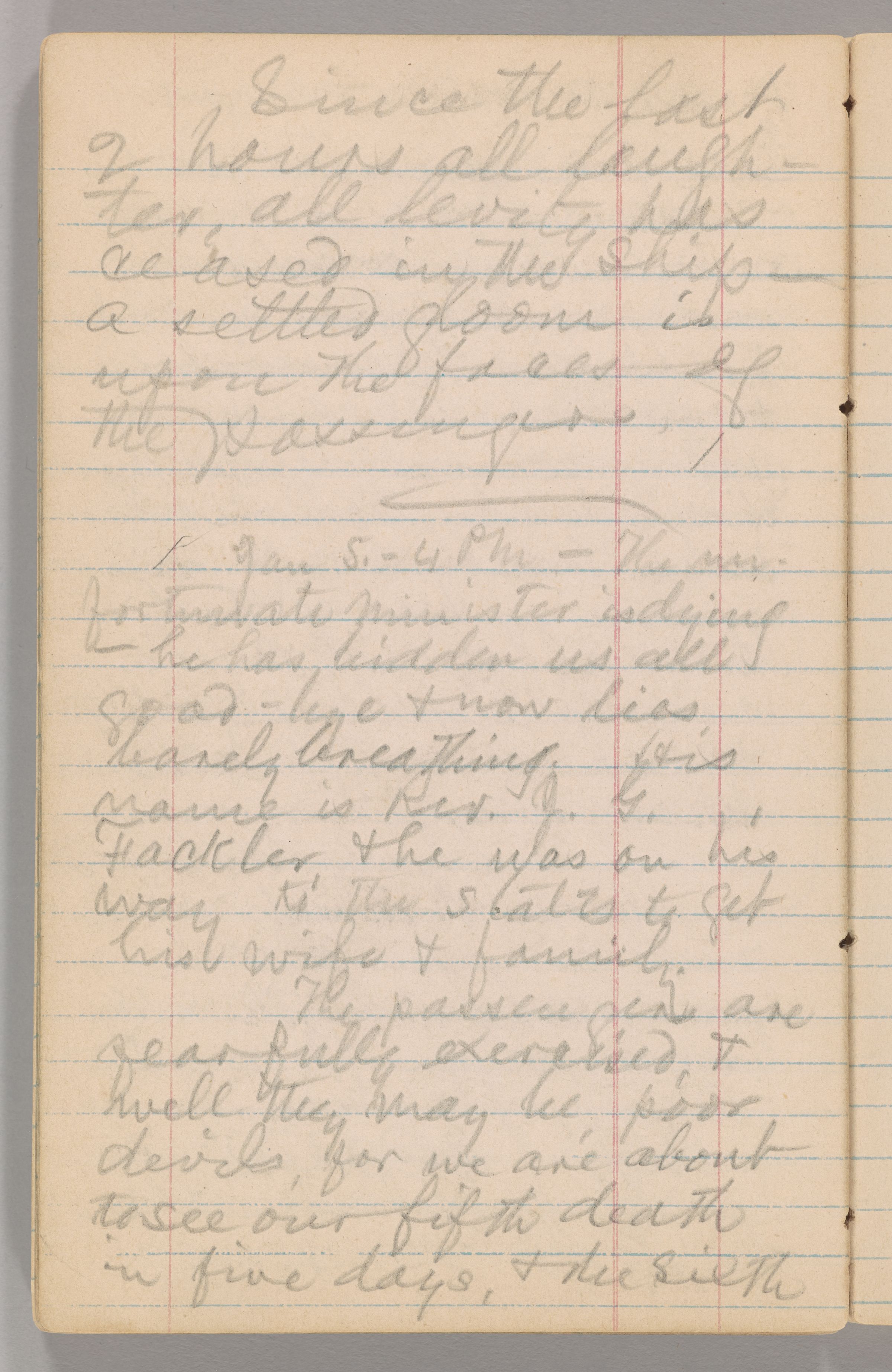
[MS: N7_leaf_059v]
Since the last
2 hours all
laugh-
ter
laughter
, all levity has
ceased in the ship—
a settled gloom is
upon the faces of
the passengers.
Jan 5.—4 PM—The
un-
fortunate
unfortunate
minister is dying
—he has bidden us all
good-bye & now lies
barely breathing. His
name is Rev. J. G.
Fackler, & he was on his
way to the States to get
his wife & family.
The passengers are
fearfully exercised, &
well they may be, poor
devils, for we are about
to see our fifth death
in five days, & the sixth
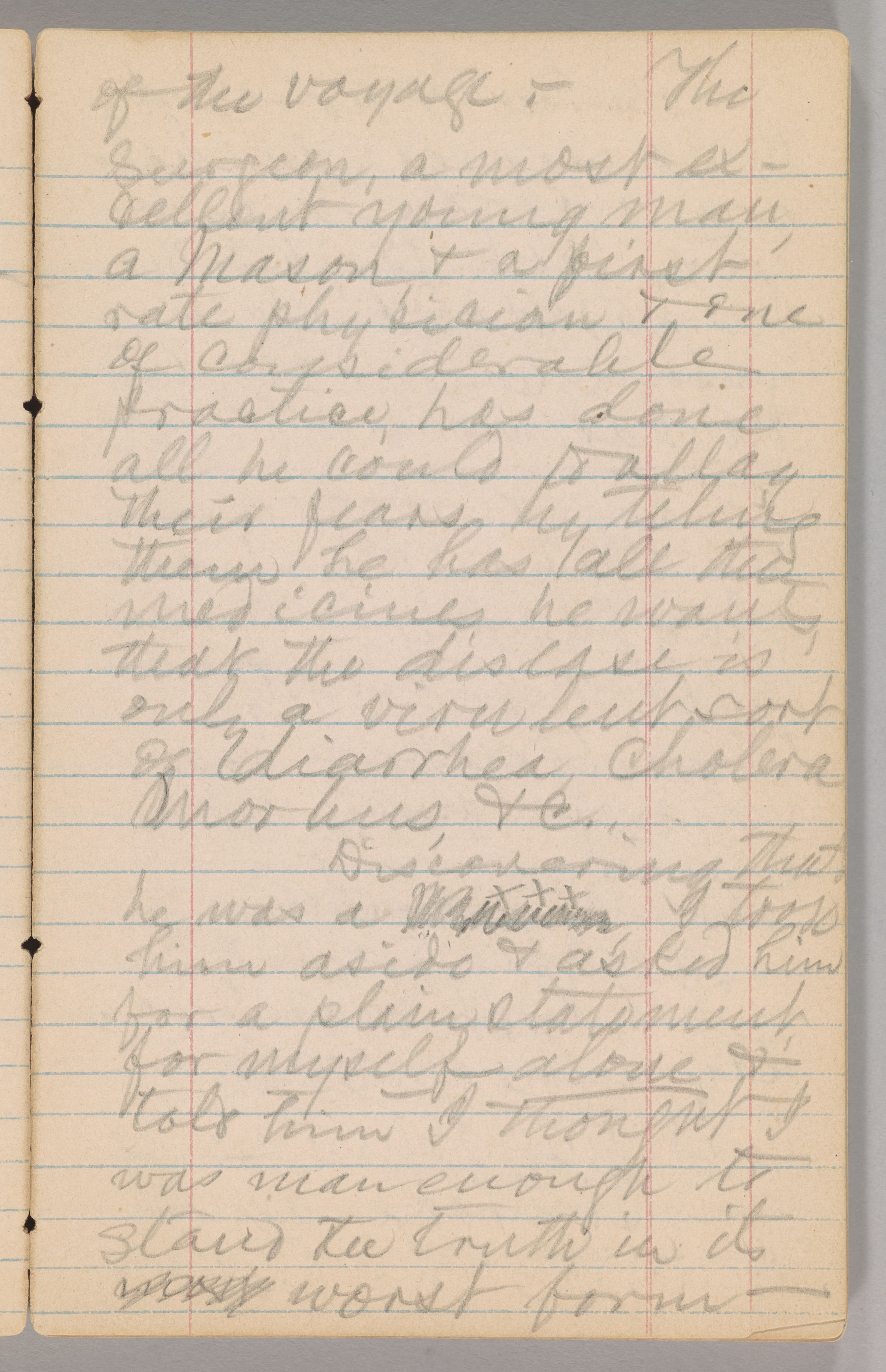
[MS: N7_leaf_060r]
of the voyage.—The
Surgeon, a most
ex-
cellent
excellent
young man,
a Mason, & a
p first
rate physician & one
of considerable
practice, has done
all he could to allay
their fears by telling
them he has all the
medicines he wants,
that the disease is
only a virulent sort
of diarrhea, Cholera
Morbus, &c.
[MTP: N&J1_278]
Discovering that
he was a Mason
XXX
, I took
him aside & asked him
for a plain statement,
for myself alone
&
told him I thought I
was man enough to
stand the truth in its
most worst form—
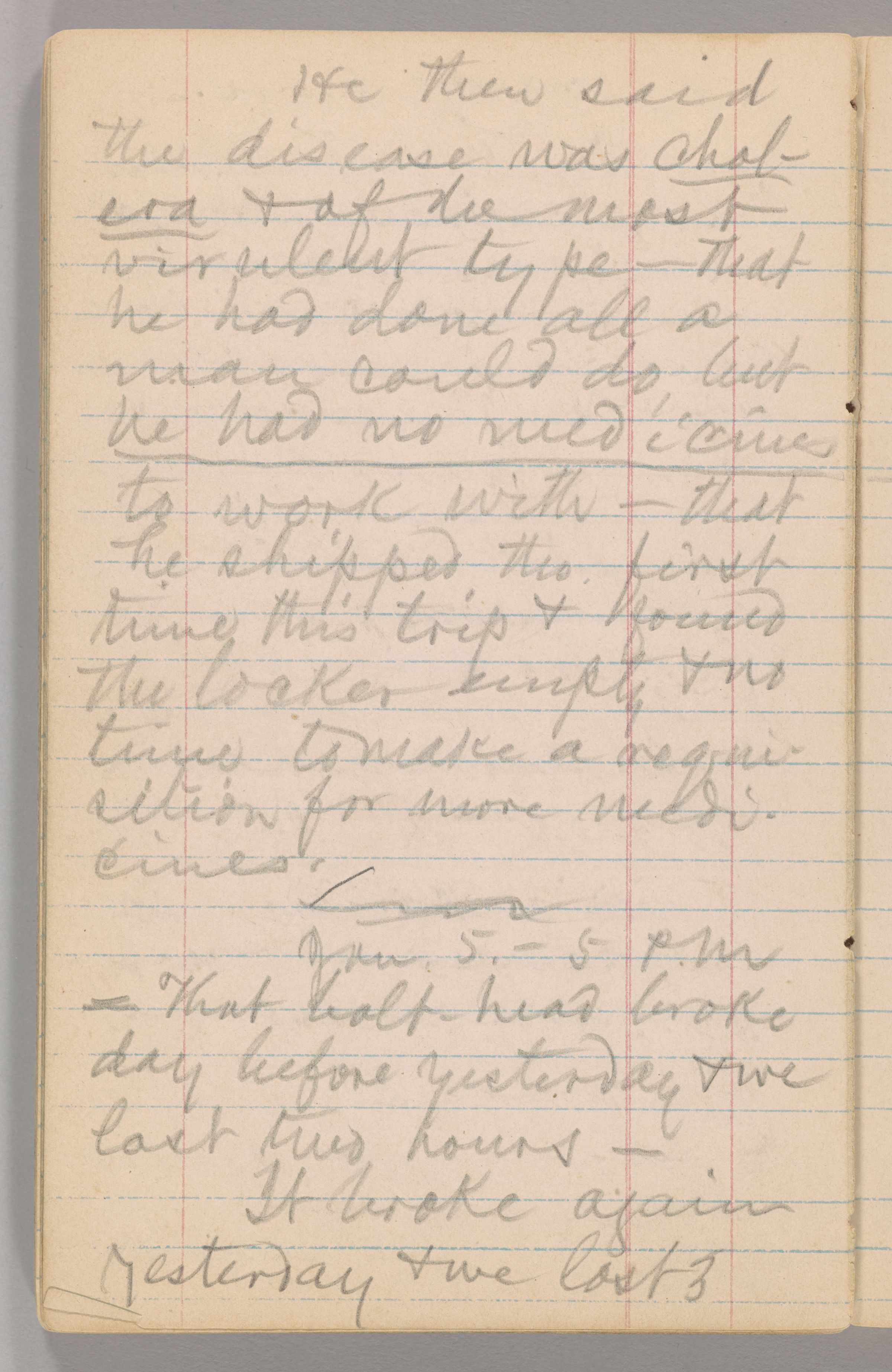
[MS: N7_leaf_060v]
He then said
the disease was
chol-
era
cholera
& of the most
virulent type—that
he had done all a
man could do, but
he had no medicines
to work with—that
he shipped the first
time this trip & found
the locker empty & no
time to make a
requi-
sition
requisition
for more
medi-
cines
medicines
.
Jan. 5.—5 PM
—That bolt-head broke
day before yesterday & we
lost two hours—
It broke again
yesterday & we lost 3
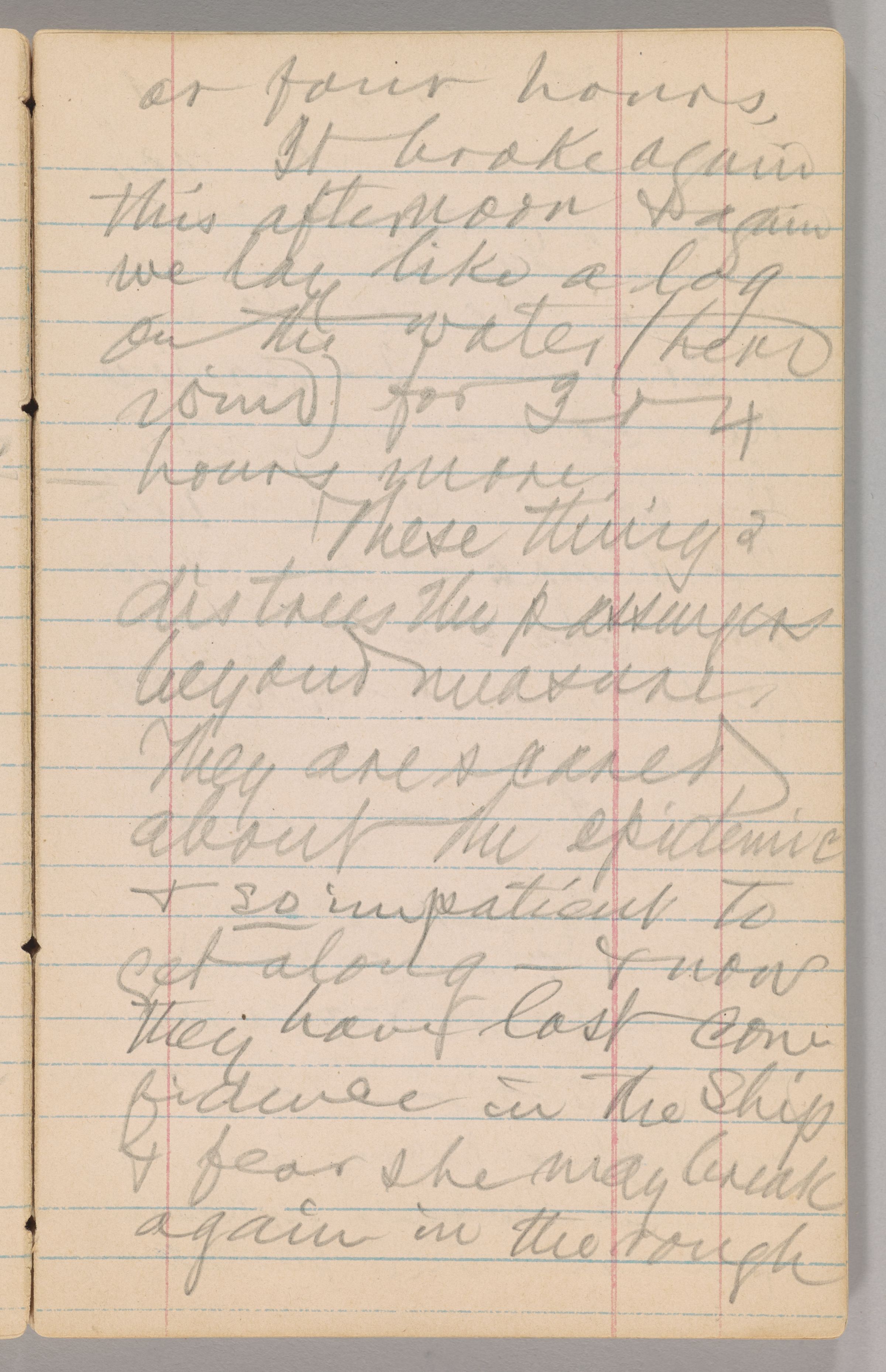
[MS: N7_leaf_061r]
or four hours.
It broke again
this afternoon & again
we lay like a log
on the water (head
wind) for 3 or 4
hours more.
These things
distress the passengers
beyond measure.
They are scared
about the epidemic
& so impatient to
get along—& now
they have lost
con-
fidence
confidence
in the ship
& fear she may break
again in the rough
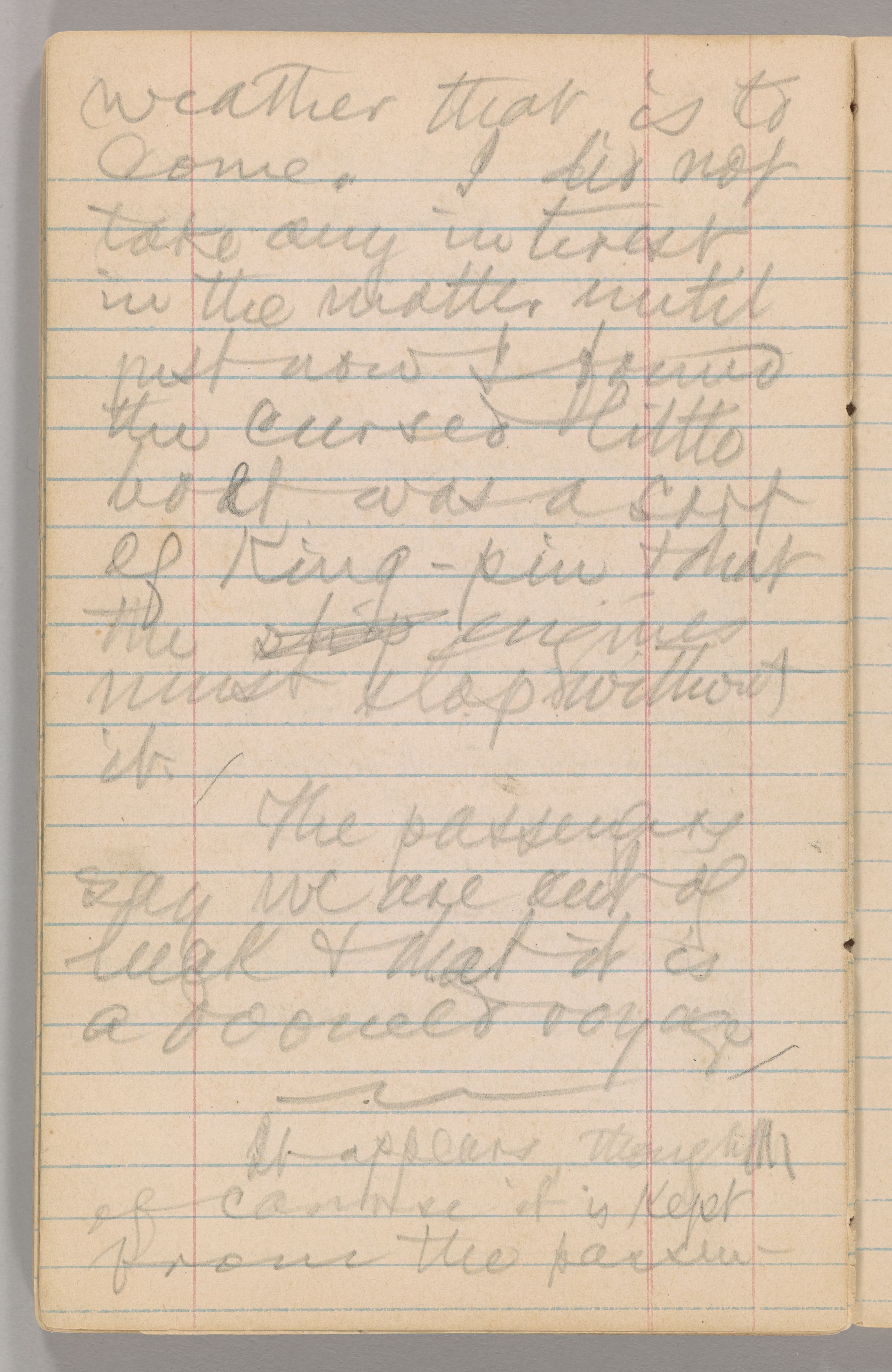
[MS: N7_leaf_061v]
weather that is to
come. I did not
take any interest
in the matter until
just now I found
the cursed little
boalt was a sort
of King-pin & that
the ship engines
must stop without
it.
The passengers
say we are out of
luck & that it is
a doomed voyage
It appears, though◊
of course it is kept
from the passen-
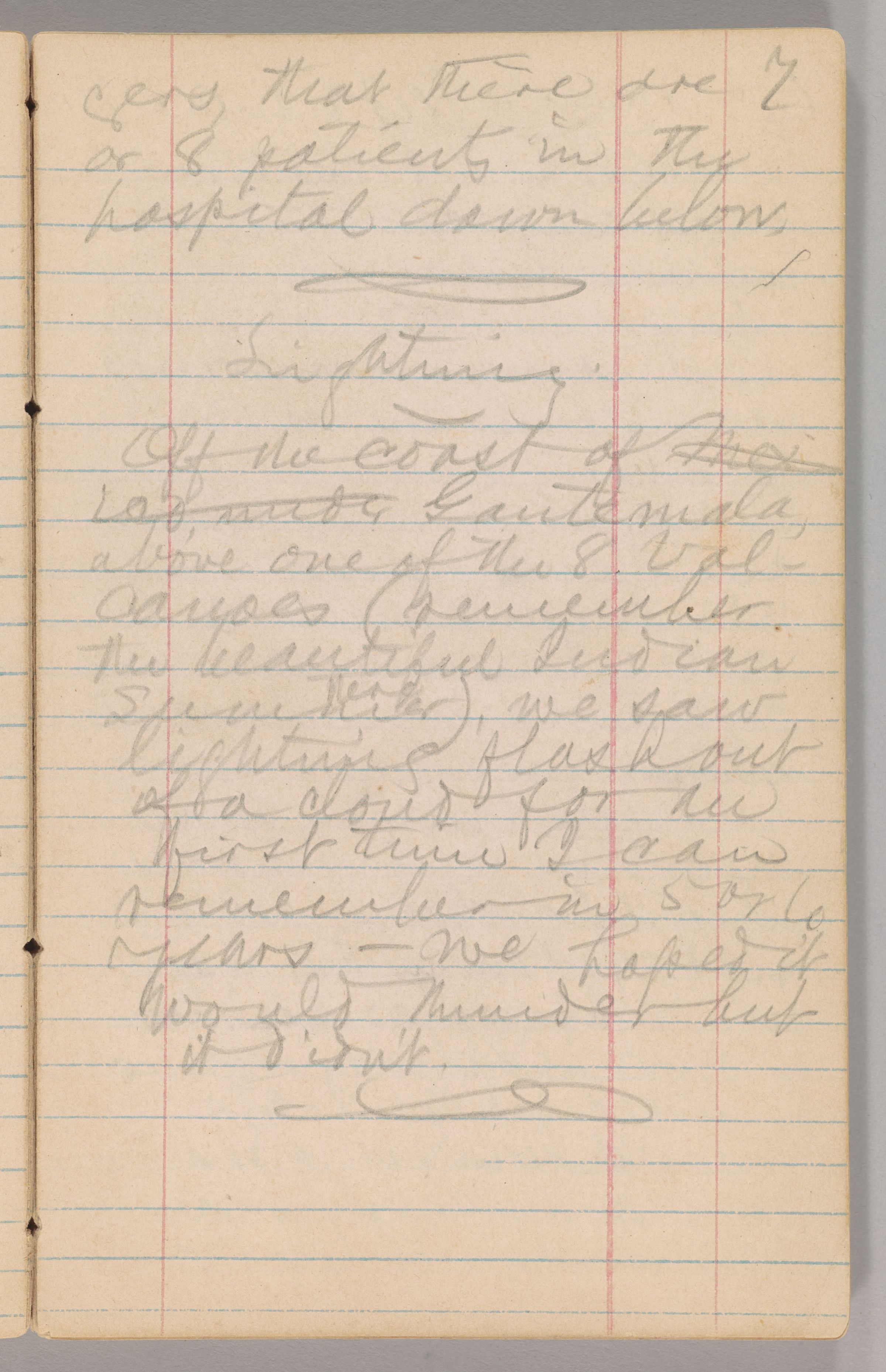
[MS: N7_leaf_062r]
gers, that there are 7
or 8 patients in the
hospital down below.
Lightning.
Off the coast of
Mex-
ico
Mexico
, under Gautemala,
above one of the 8
vol-
canoes
volcanoes
(remember
the beautiful Indian
Summer there
), we saw
lightning flash out
of a cloud for the
first time I can
remember in 5 or 6
years—we hoped it
would thunder but
it didn't.
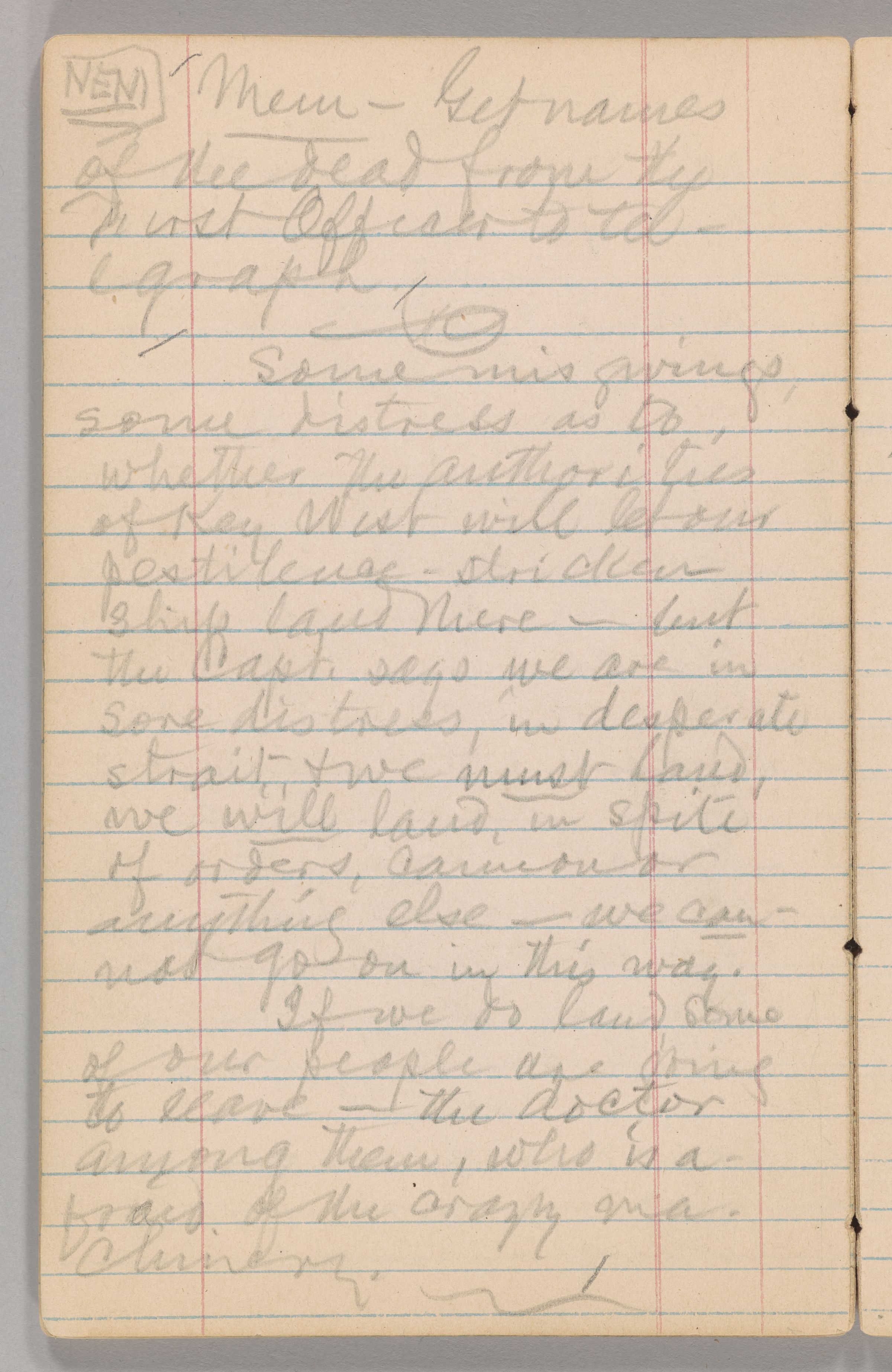
[MS: N7_leaf_062v]
MEM
Mem—Get names
of the dead from the
First Officer to
tel-
egraph
telegraph
.
[MTP: N&J1_279]
Some misgivings,
some distress as to
whether the authorities
of Key West will let our
pestilence-stricken
ship land there—but
the Capt. says we are in
sore distress, in desperate
strait, & we must land,
we will land, in spite
of orders, cannon or
anything else—we
can-
not
cannot
go on in this way.
If we do land, some
of our people are going
to leave—the doctor
among them, who is
a-
fraid
afraid
of the crazy
ma-
chinery
machinery
.
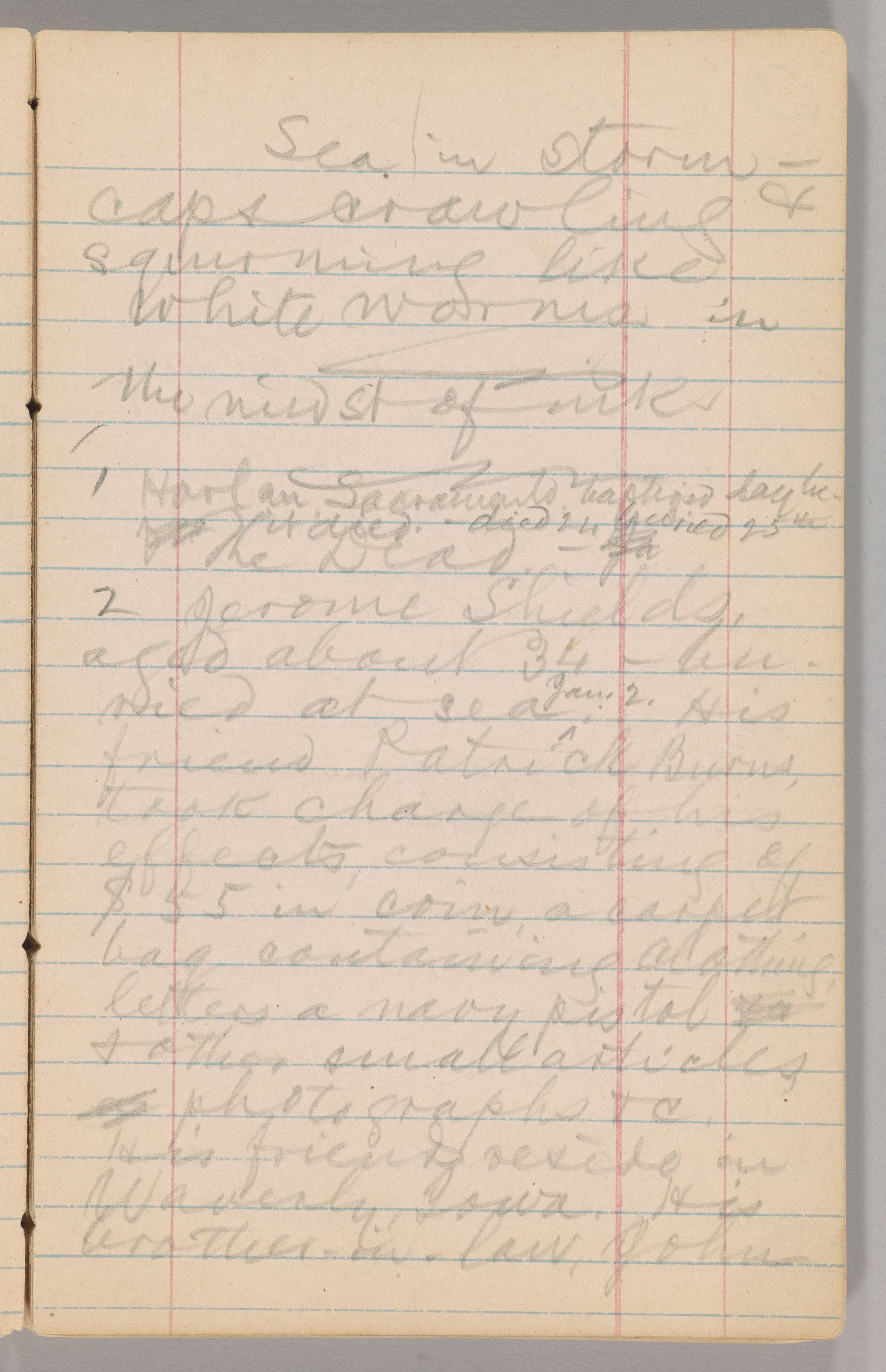
[MS: N7_leaf_063r]
Sea in storm—
caps crawling &
squirming like
white worms.
in
the midst of ink.
The Dead. —Ja
1 Harlan, Sacramento, baptized day
be-
fore
before
it died.
—died 24 buried 25th
2 Jerome Shields,
aged about 34—
bu-
ried
buried
at sea .
Jan. 2.
His
friend Patrick Burns,
took charge of his
effects, consisting of
$55 in coin, a carpet
bag containing clothing,
letters a navy pistol & a
& other small articles,
a photographs &c.
His friends reside in
Waverly, Iowa. His
brother-in-law, John
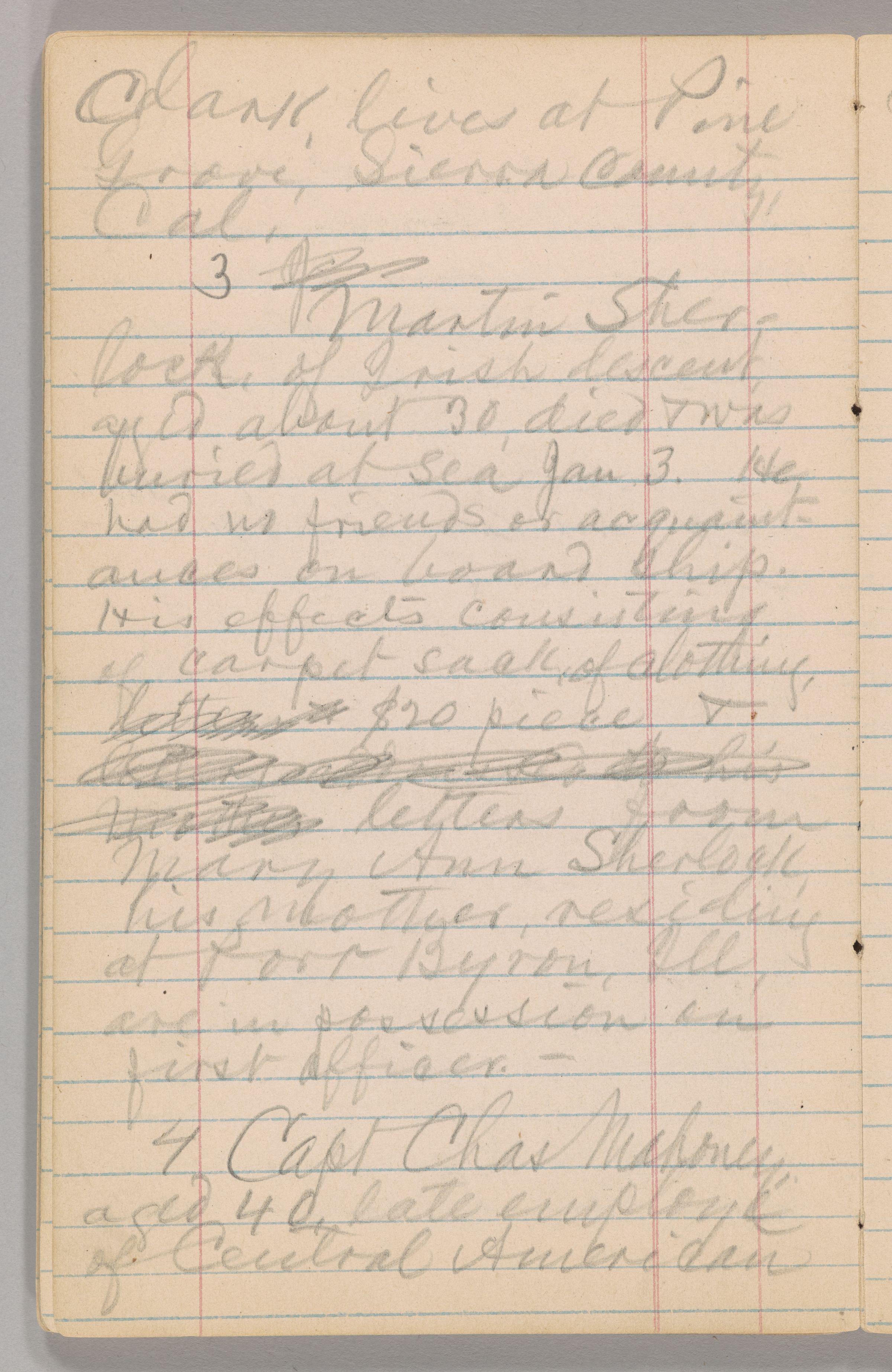
[MS: N7_leaf_063v]
Clark, lives at Pine
Grove, Sierra County,
Cal.
3 J
Martin
Sher-
lock
Sherlock
, of Irish descent,
aged about 30, died & was
buried at sea Jan. 3. He
had no friends or
acquaint-
ances
acquaintances
on board ship.
His effects consisting
of carpet sack, of clothing,
letters & $20 piece, &
letters addressed to his
Mother letters from
Mary Ann Sherlock,
his mother, residing
at Port Byron, Ill,
are in possession on
first officer.—
4 Capt Chas Mahoney,
aged 40, late employe
of Central American
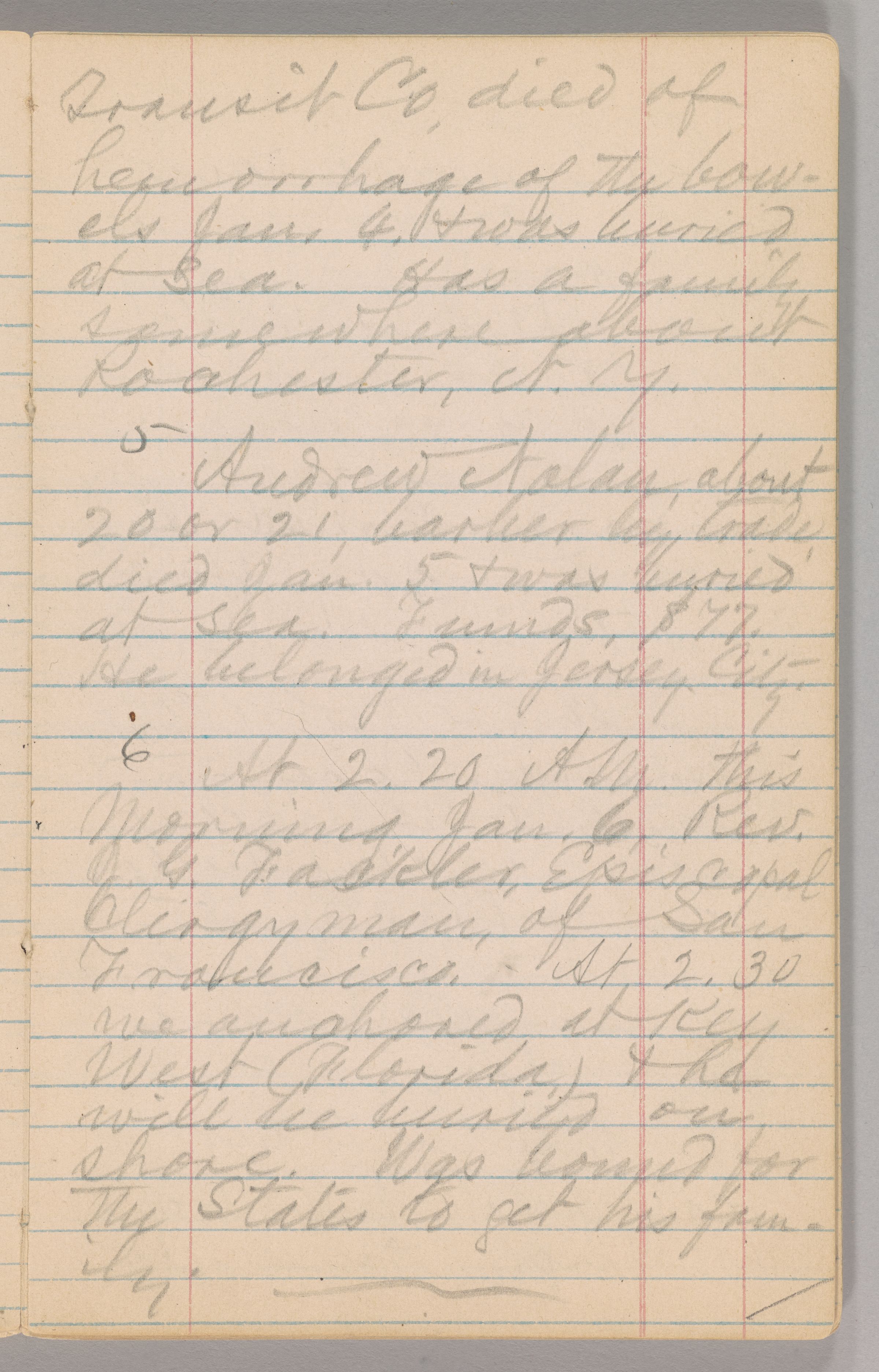
[MS: N7_leaf_064r]
Transit Co, died of
hemorrhage of the
bow-
els
bowels
Jan. 4. & was buried
at sea. Has a family
somewhere about
Rochester, N.Y.
5 Andrew Nolan, about
20 or 21, barber by trade,
died Jan. 5 & was buried
at sea. Funds, $77.
He belonged in Jersey City.
6 At 2.20 A.M. this
Morning, Jan. 6, Rev.
J. G. Fackler, Episcopal
clergyman, of San
Francisco. At 2.30
we anchored at Key
West (Florida,) & he
will be buried on
shore. Was bound for
the States to get his
fam-
ily
family
.
[MTP: N&J1_280]
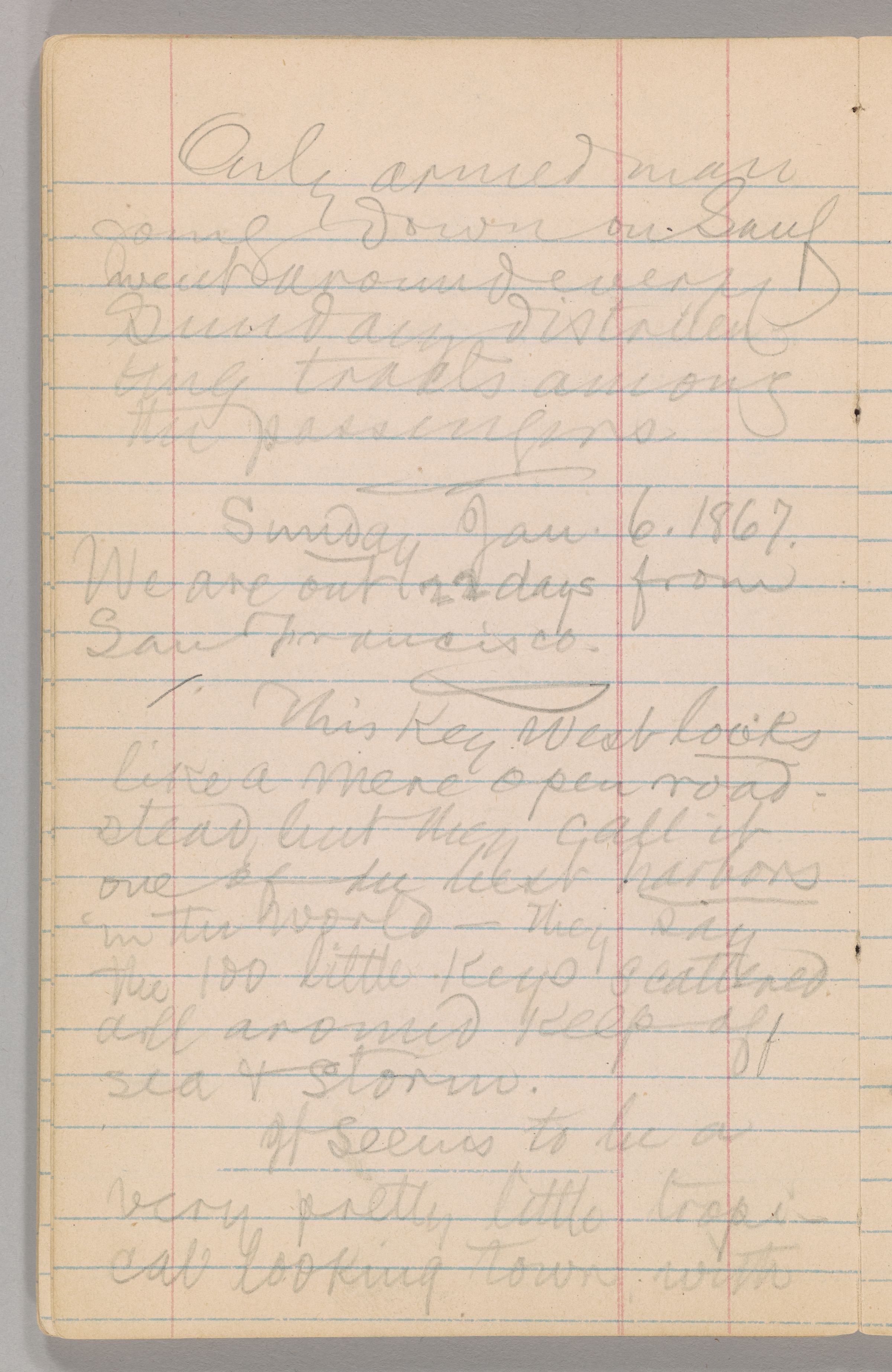
[MS: N7_leaf_064v]
Only armed man
going down on Sanf
went around every
Sunday
distribu-
ting
distributing
tracts among
the passengers.
Sunday Jan. 6. 1867.
We are out 22 days from
San Francisco.
This Key West looks
like a mere open
road-
stead
roadstead
, but they call it
one of the best harbors
in the world—they say
the 100 little keys scattered
all around keep of[f]
sea & storm.
It seems to be a
very pretty little
tropi-
cal
tropical
looking town, with
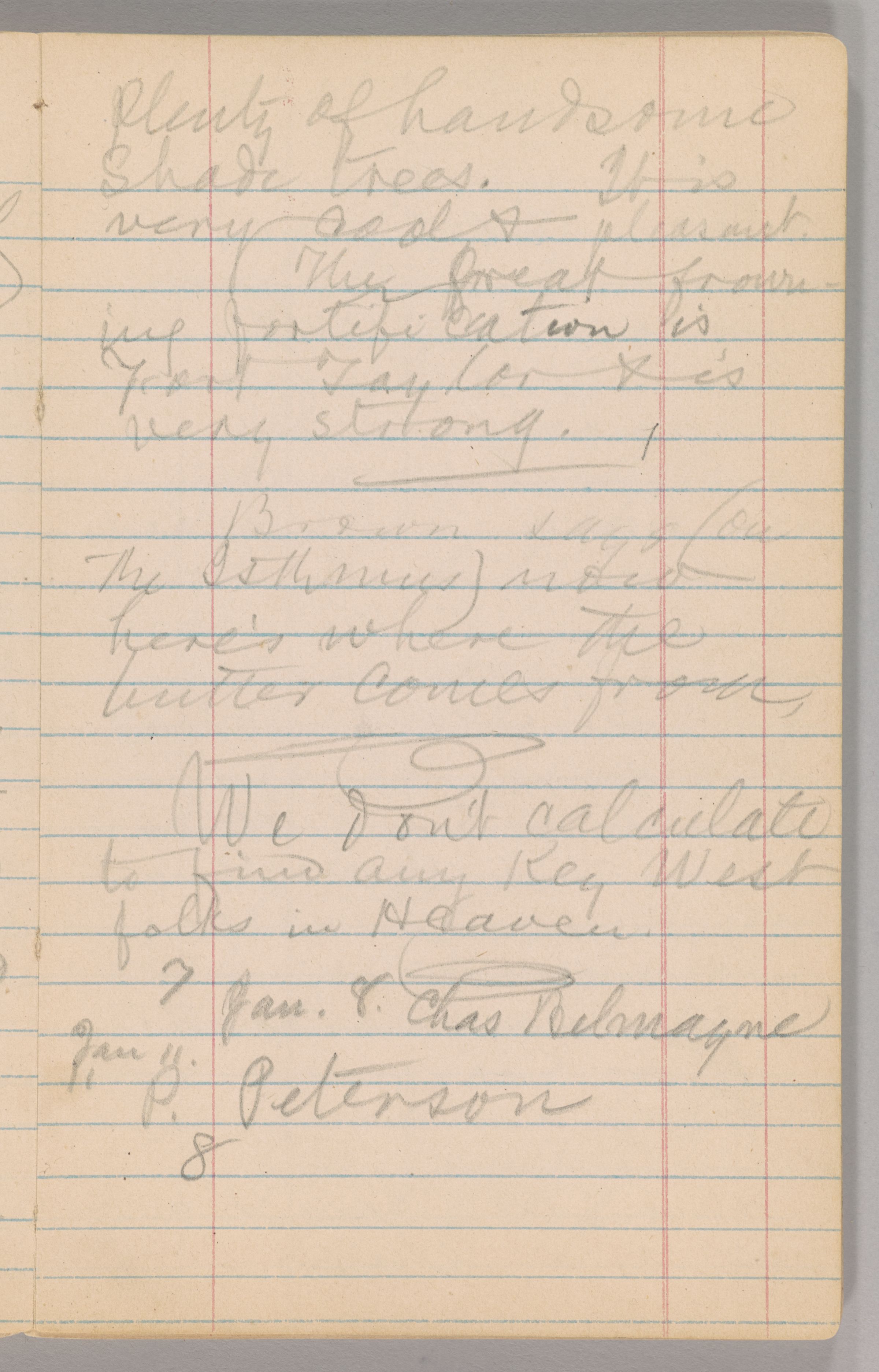
[MS: N7_leaf_065r]
plenty of handsome
shade trees. It is
very cool & pleasant.
The
fr great
frown-
ing
frowning
fortification is
Fort Taylor & is
very strong.
Brown says (on
the Isthmus) now
here's where the
butter comes from.
We don't calculate
to find any Key West
folks in Heaven.
7 Jan. 8. Chas Belmayne

[MS: N7_leaf_065v]
blank verso
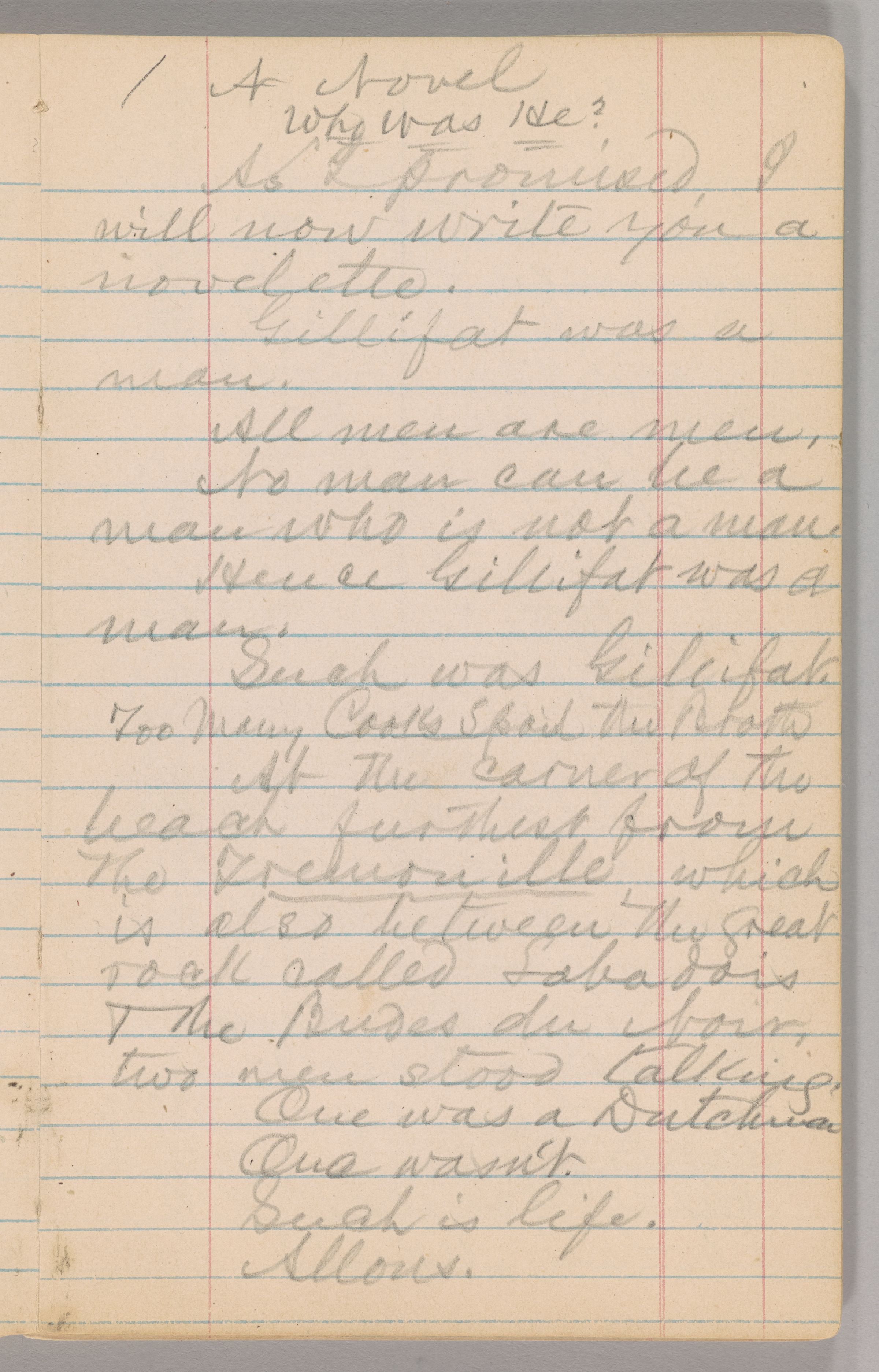
[MS: N7_leaf_066r]
A Novel
Who Was He?
As I promised, I
will now write you a
novelette.
Gillifat was a
man.
All men are men.
No man can be a
man who is not a man.
[MTP: N&J1_281]
Hence Gillifat was a
man.
Such was Gillifat.
Too Many Cooks Spoil the Broth
At the corner of the
beach furthest from
the Tremouille, which
is also between the great
rock called Labadois
& the Budes du Noir,
two men stood talking.
One was a Dutchman
One wasn't.
Such is life.
Allons.
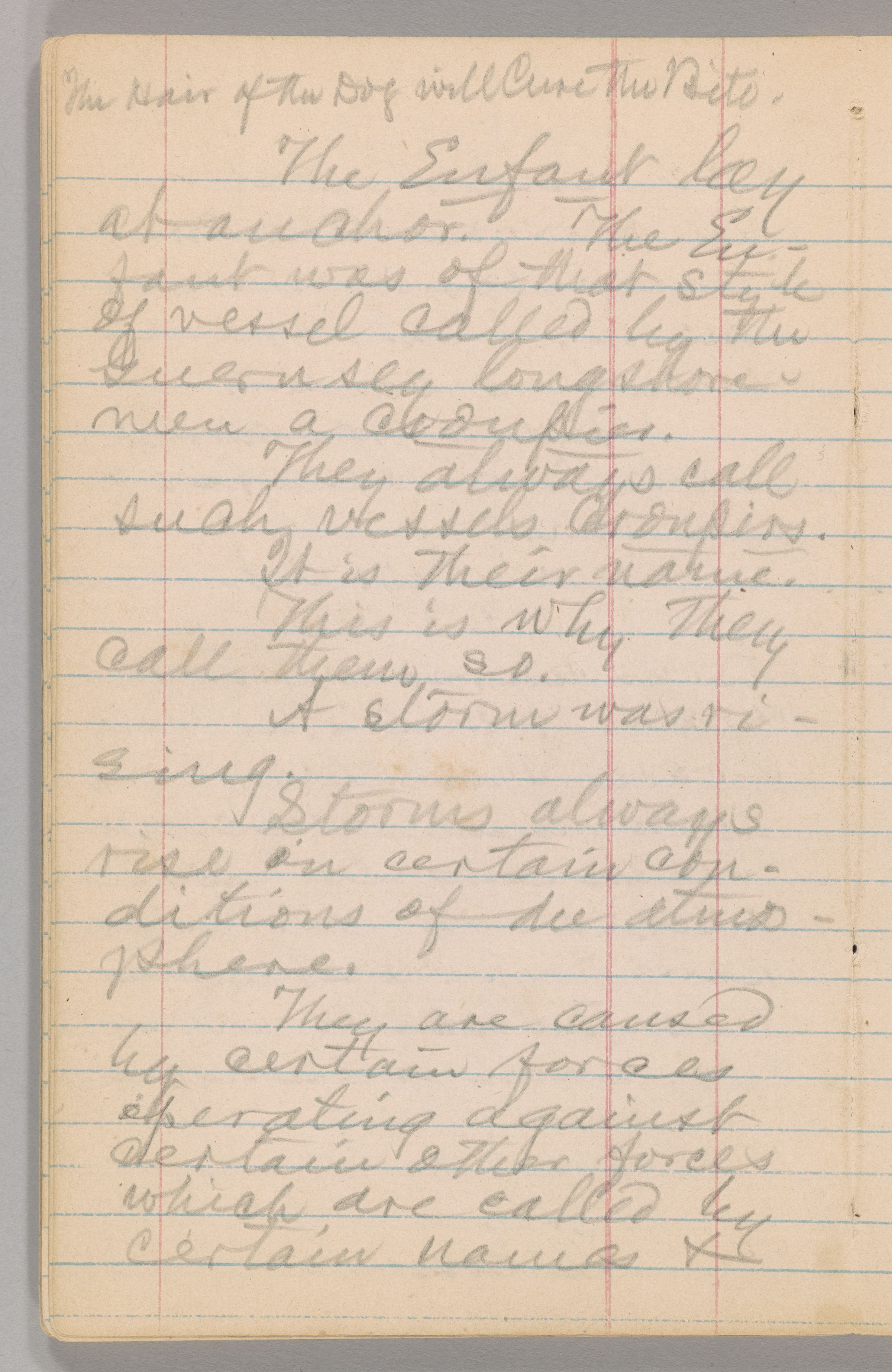
[MS: N7_leaf_066v]
The Hair of the Dog will Cure the Bite.
The Enfant lay
at anchor. The
En-
fant
Enfant
was of that style
of vessel called by the
Guernsey
longshore-
men
longshoremen
a croupier.
They always call
such vessels croupiers.
It is their name.
This is why they
call them so.
A storm was
ri-
sing
rising
.
Storms always
rise
oin certain
con-
ditions
conditions
of the
atmos-
phere
atmosphere
.
They are caused
by certain forces
operating against
certain other forces
which are called by
certain names &
[MS: N7_leaf_067r]
are well known
by persons who are
familiar with
them. In 1492
Co-
lumbus
Columbus
sailed.
There was no storm
but he discovered—
What?
A new world!
Oct. 23, 1835, a
storm burst upon the
coasts of England which
drove ships high & dry
& upon the land—a storm
which carried sloops
& schooners far
in-
land
inland
& perched them
upon the tops of hills.
Such is the nature
of storms.
Let the Sinless Cast the first
Stone.
The house was in
[MS: N7_leaf_067v]
flames. From the
cellar gratings flames
burst upward.
From the ground
floor windows, from
the doorways, from
obscure crevices in
the weather boarding
flames burst forth.
And black
vol-
umes
volumes
of smoke.
From the second
story windows, flames
& smoke burst forth
—the
[MTP: N&J1_282] flames licking
the smoke hungrily
—the smoke retreating,
— from threatened
devourment as it
were.
The third story
was a lashing and
hissing world of
[MS: N7_leaf_068r]
gloomy smoke, stained
with splashes of bloody
flame.
At a window of
the second story
ap-
peared
appeared
a wild vision
of beauty—appeared
for a moment, with
disheveled hair, with
agonized face, with
uplifted, imploring
hands—appeared
for a second, then
vanished amid
roll-
ing
rolling
clouds of smoke
—appeared again,
glorified with a rain
of fiery sp cinders
from above—&
a-
gain
again
was swallowed
from sight by the
re-
moreseless
remorseless
smoke.
It was Demaschette
[MS: N7_leaf_068v]
In another
sec-
ond
second
Gillifat had siezed
a ladder & placed it
against the house.
In another moment
he had ascended half
way up.
A thousand
anx-
ious
anxious
eyes were fixed
upon him.
They old mother
& the distracted father
fell upon their knees
—looked up at him
with streaming
eyes—blessed him
—prayed for him.
The roof was
threatening to fall
in.
Not a moment
was to be lost.
Gillifat held his
[MS: N7_leaf_069r]
breath to keep from
inhaling the smoke
—then took one,
two, six strides &
laid his hand upon
the window sill.
There are those who
believe window sills
are sentient beings.
There are those
who believe that the
moving springs of
hu-
man
human
action are the
Principle of Good & the
Principle of Evil—that
window may, & they may
not, have something
to do with these.
It is wonderful.
If they have, where
are the labors of our
philosophers of a
thousand years?
[MS: N7_leaf_069v]
If they have not, have we
not God? Let us be
content.
Everything goes.
Time is. The
heav-
ens
heavens
are above us still.
Everything goes.
The fatal difference betwixt
Tweedledum & Tweedledee.
The two men glared
at each other eight
minutes—time is
ter-
rible
terrible
in circumstances
of danger—men
have grown old
un-
der
under
the effects of fright
while the fleetest horse
could canter a mile
—eight minutes
[MTP: N&J1_283] —
eight terrible
min-
utes
minutes
they glared at
each other & then—
Why does the
hu-
man
human
contract un-
[MS: N7_leaf_070r]
der the influence
of fear
joy
& dilate
under the influence
of fear?
It is strange. It
is one of the conditions
of our being.
The human eye
is round. It
pro-
trudes
protrudes
from the socket,
but it does not fall
out. Why? Because
certain ligatures,
invisible because
hidden by from
sight, chain it to the
interior apparatus.
The pupil of the
eye is also round.
We do not pretend to
account for this.
We simply accept it
as a truth. A man
[MS: N7_leaf_070v]
might see as well
with a square pupil,
perhaps, but what
then? The absence
of uniformity, of
harmony in the
species.
The human eye is
a beautiful & an
ex-
pressive
expressive
feature. In
November 1642, John
Duke of Sebastiano
in-
sulted
insulted
the Monseigneur
de Torbay, Knight of
the Cross, Keeper of the
Seals, Grand Equerry
to the King—insulted
him grossly. What
did Torbay do?
Split him in the
eye.
In 1322 Durande
Montesqueiu broke
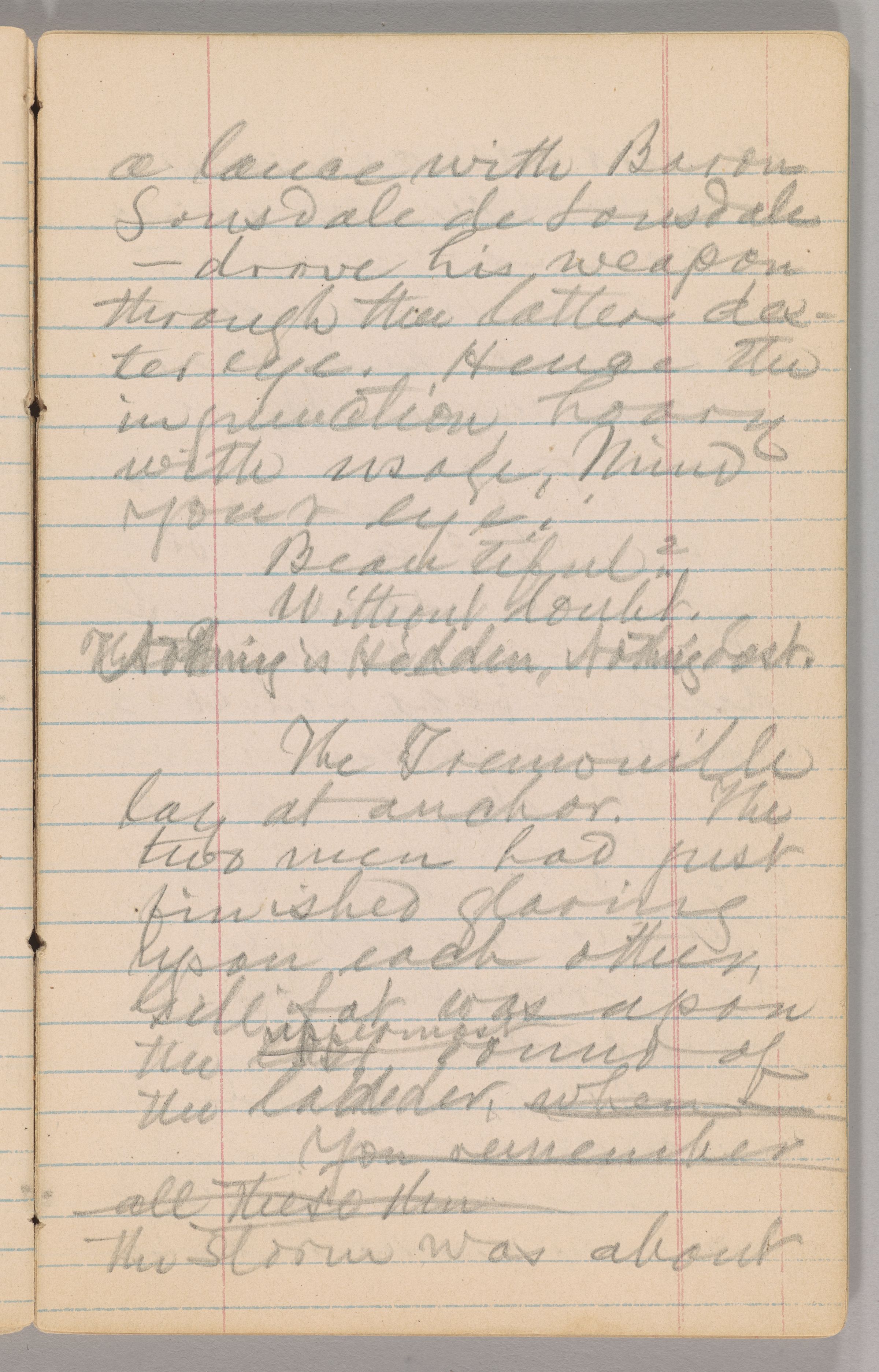
[MS: N7_leaf_071r]
a lance with Baron
Lonsdale de Lonsdale
—drove his weapon
through the latters
dex-
ter
dexter
eye. Hence the
injunction, hoary
with usage, Mind
your eye.
Beautiful?
Without doubt.
The ◊ Nothing is Hidden, Nothing Lost.
The Tremouille
lay at anchor. The
two men had just
finished glaring
upon each other,
Gillifat was upon
the last
uppermost
round of
the
lattdder, when—
You remember
all these thi
the storm was about
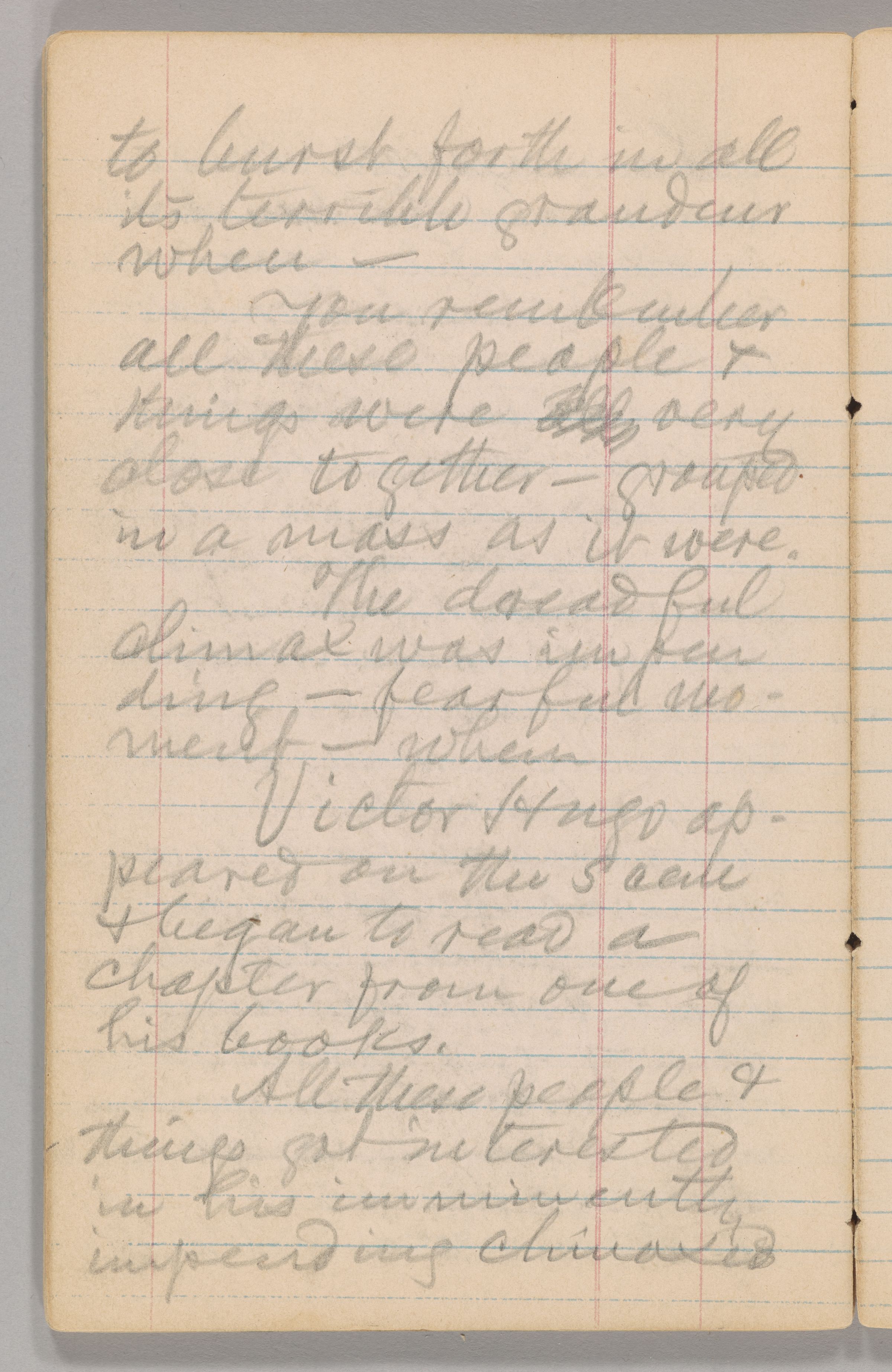
[MS: N7_leaf_071v]
to burst forth in all
its terrible grandeur
when—
You remember
all these people &
things were all very
close together—grouped
in a mass as it were.
The dreadful
climax was
impen
ding
impending
—fearful
mo-
ment
moment
—when
Victor Hugo
ap-
peared
appeared
on the scene
& began to read a
chapter from one of
his books.
All these people &
things got interested
in his imminently
impending climaxes
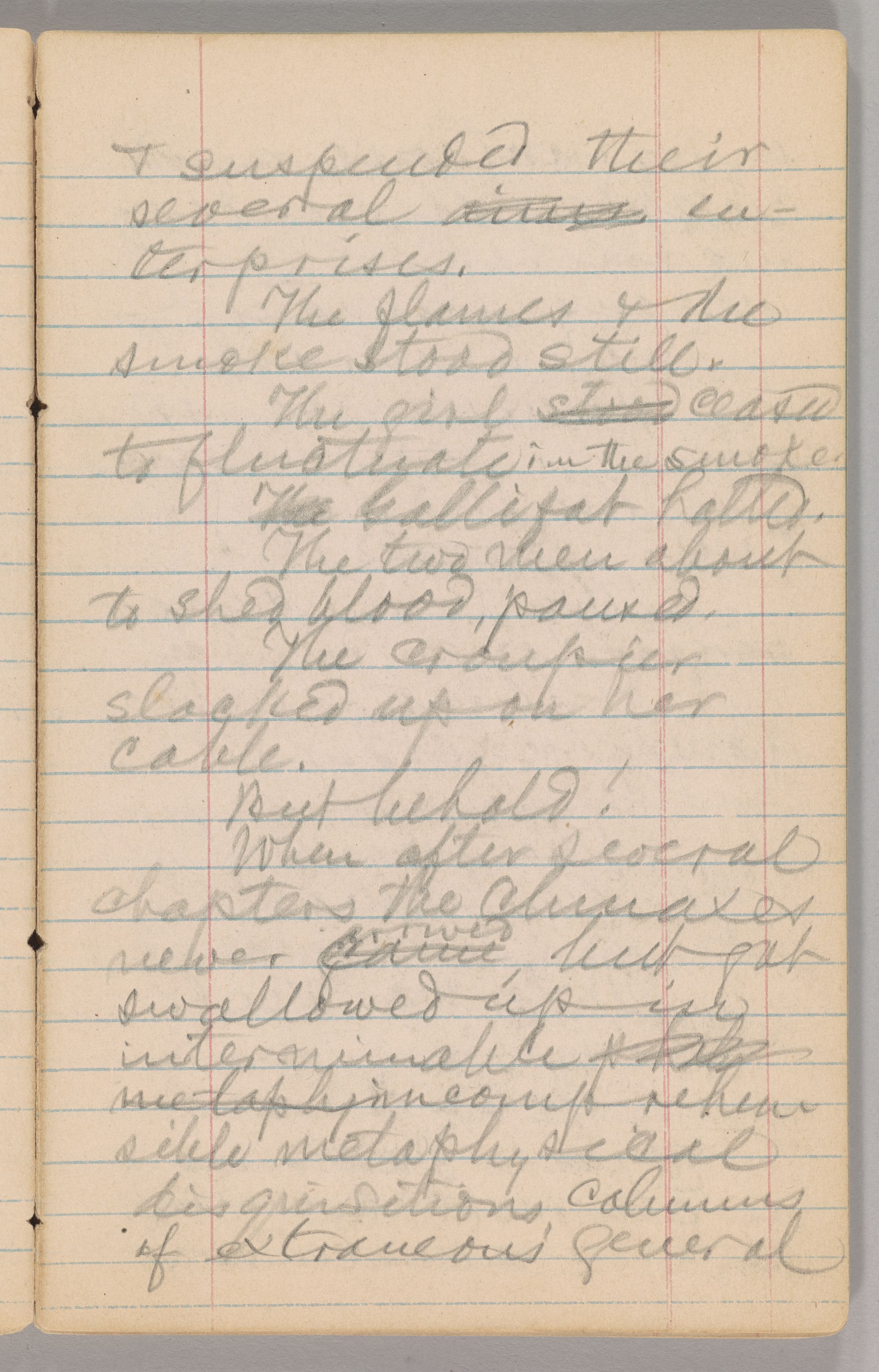
[MS: N7_leaf_072r]
& suspended their
several aims.
en-
terprises
enterprises
.
The flames & the
smoke stood still.
[MTP: N&J1_284]
The girl stood ceased
to fluctuate.
in the smoke.
The Gillifat halted.
The two men about
to shed blood, paused.
The croupier
slacked up on her
cable.
But behold!
When after several
chapters the climaxes
never came
arrived
, but got
swallowed up in
interminable phil
metaphy
incomprehen-
sible
incomprehensible
metaphysical
disquisitions, columns
of extraneous general
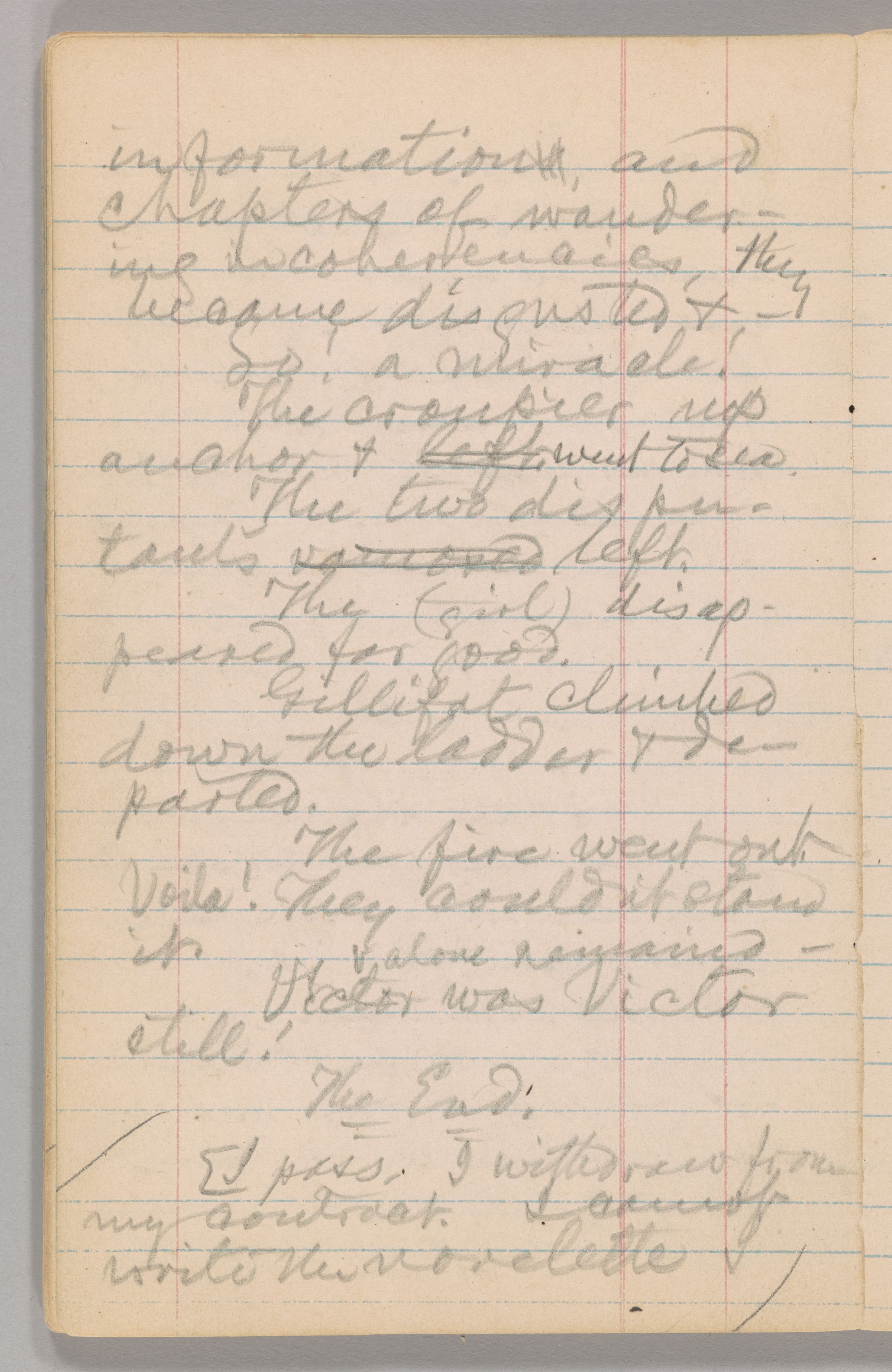
[MS: N7_leaf_072v]
informations, and
chapters of
wander-
ing
wandering
incoherencies, they
became disgusted &—
Lo! a miracle!
The croupier up
anchor & left.
went to sea.
The two
dispu-
tants
disputants
vamosed left.
The (girl)
disap-
peared
disappeared
for good.
Gillifat climbed
down the ladder &
de-
parted
departed
.
The fire went out.
Voila! They couldn't stand
it.
V alone remained—
Victor was Victor
still!
The End.
⟦I pass. I withdraw from
my contract. I cannot
write the novelette I
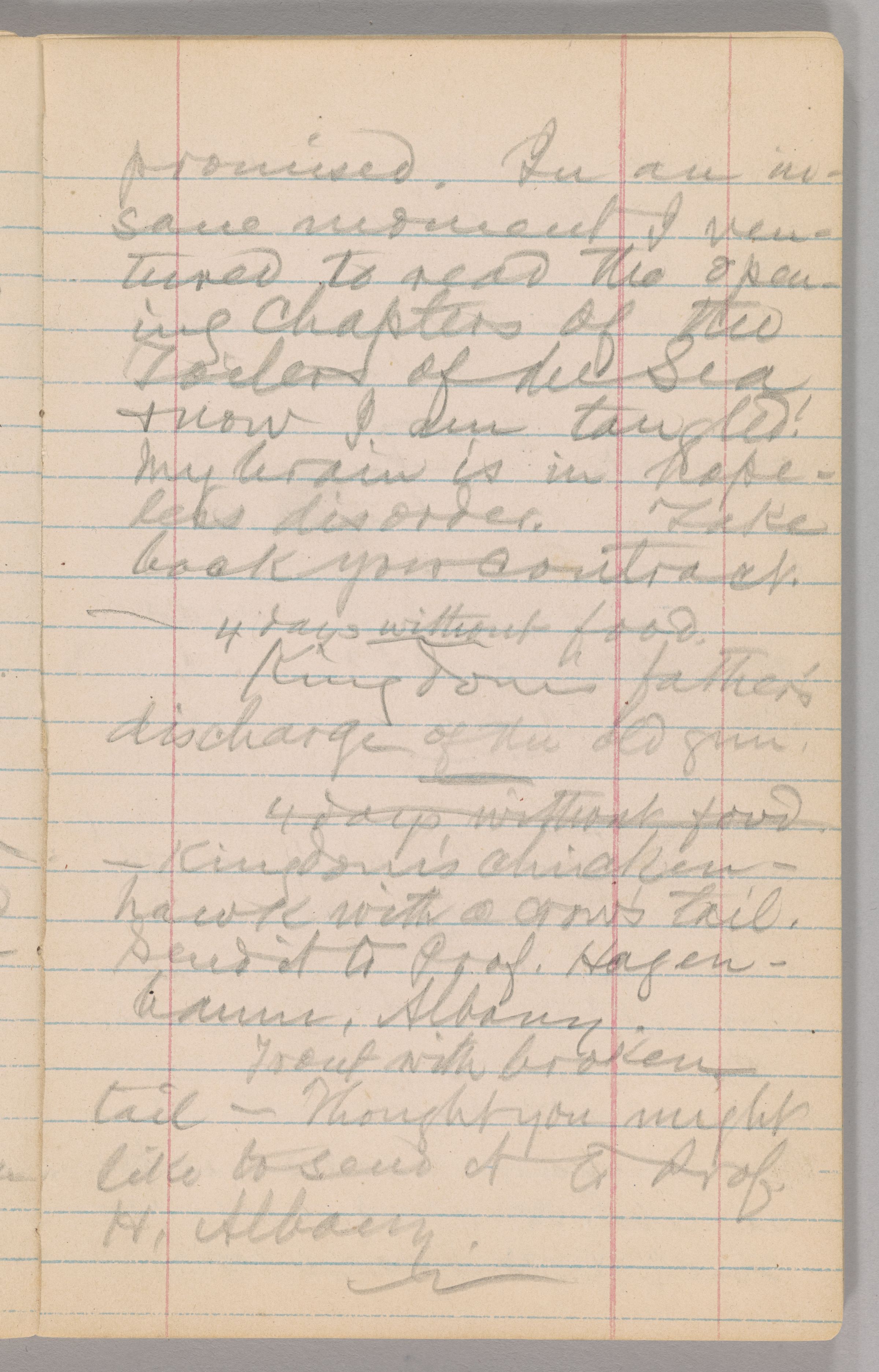
[MS: N7_leaf_073r]
promised. In an
in-
sane
insane
moment I
ven-
tured
ventured
to read the
open-
ing
opening
chapters of the
Toilers of the Sea
& now I am tangled!
My brain is in
hope-
less
hopeless
disorder. Take
back your contract.
—4 days without food.
Kingdom's father's
discharge of the old gun.
[MTP: N&J1_285]
4 days without food.
—Kingdom's chicken-
hawk with a crow's tail.
Send it to Prof.
Hagen-
baum
Hagenbaum
, Albany.
Trout with broken
tail—Thought you might
like to send it to Prof.
H. Albany.
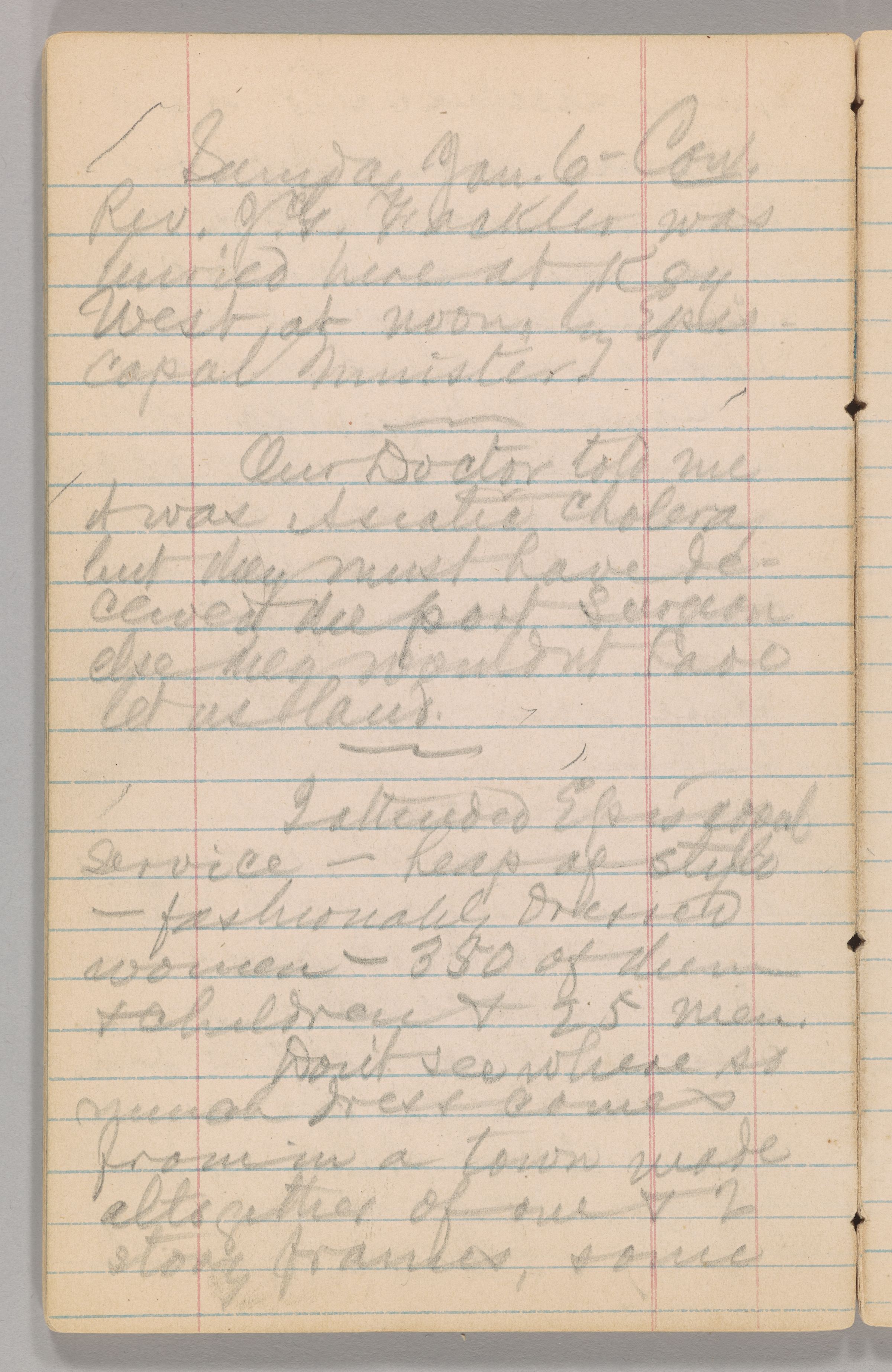
[MS: N7_leaf_073v]
Sunday Jan. 6—Cont.
Rev. J. G. Fackler was
buried here at Key
West at noon, by
Epis-
copal
Episcopal
Minister.
Our Doctor told me
it was Asiatic Cholera,
but they must have
de-
ceived
deceived
the port surgeon
else they wouldnt have
let us land.
I attended Episcopal
service—heap of style
—fashionably dressed
women—350 of them
& children & 25 men.
Don't see where so
much dress comes
from in a town made
altogether of one & 2
story frames, some
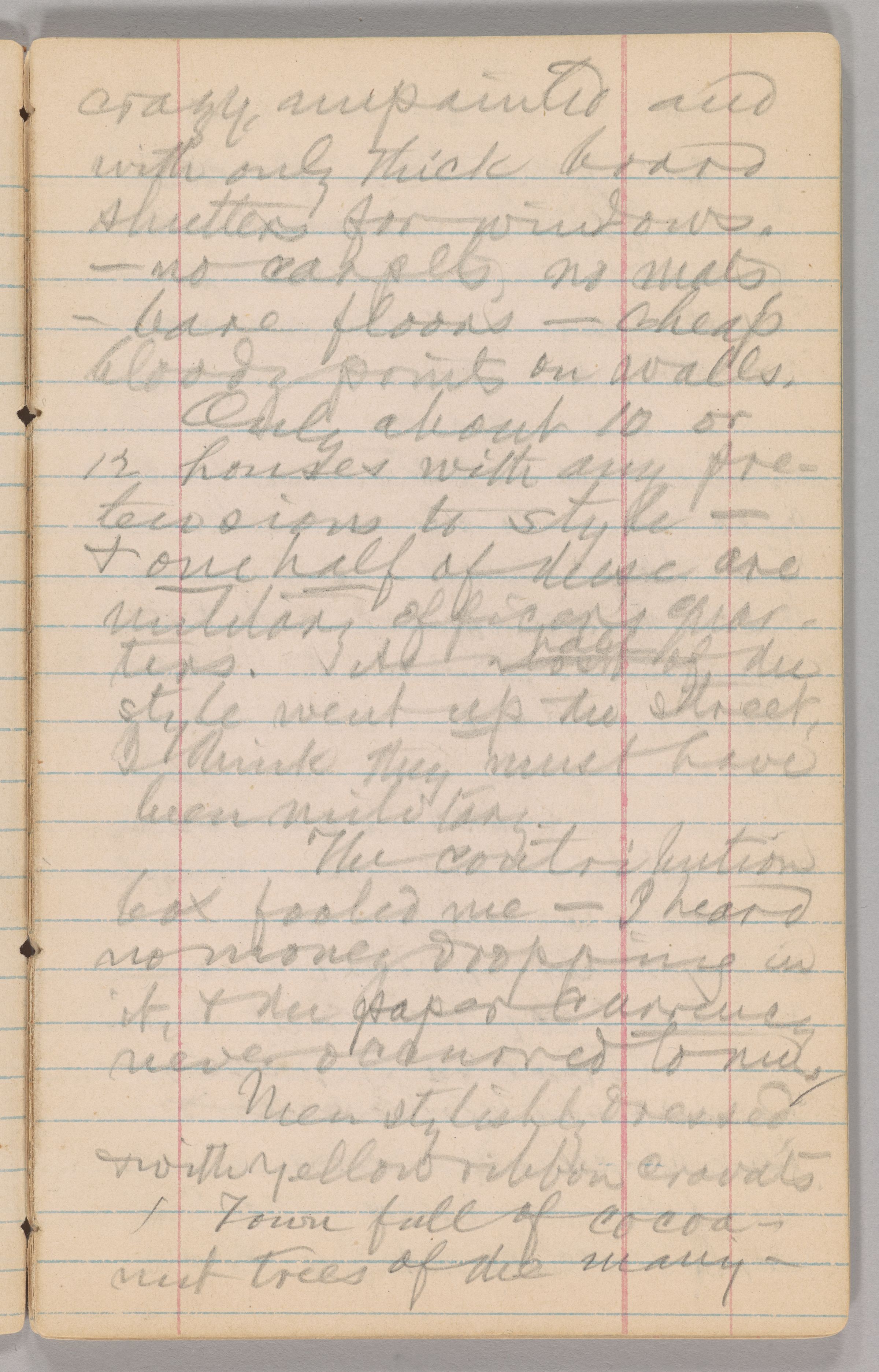
[MS: N7_leaf_074r]
crazy, unpainted and
with only thick board
shutters for windows.
—no carpets, no mats,
—bare floors—cheap
bloody prints on walls.
Only about 10 or
12 houses with any
pre-
tensions
pretensions
to style—
& one half of these are
military officer's
quar-
ters
quarters
. As most of
half
the
style went up the street,
I think they must have
been military.
The contribution
box fooled me—I heard
no money dropping in
it, & the paper currency
never occurred to me.
Men stylishly dressed,
& with yellow ribbon cravats.
Town full of cocoa-
nut trees of the many-
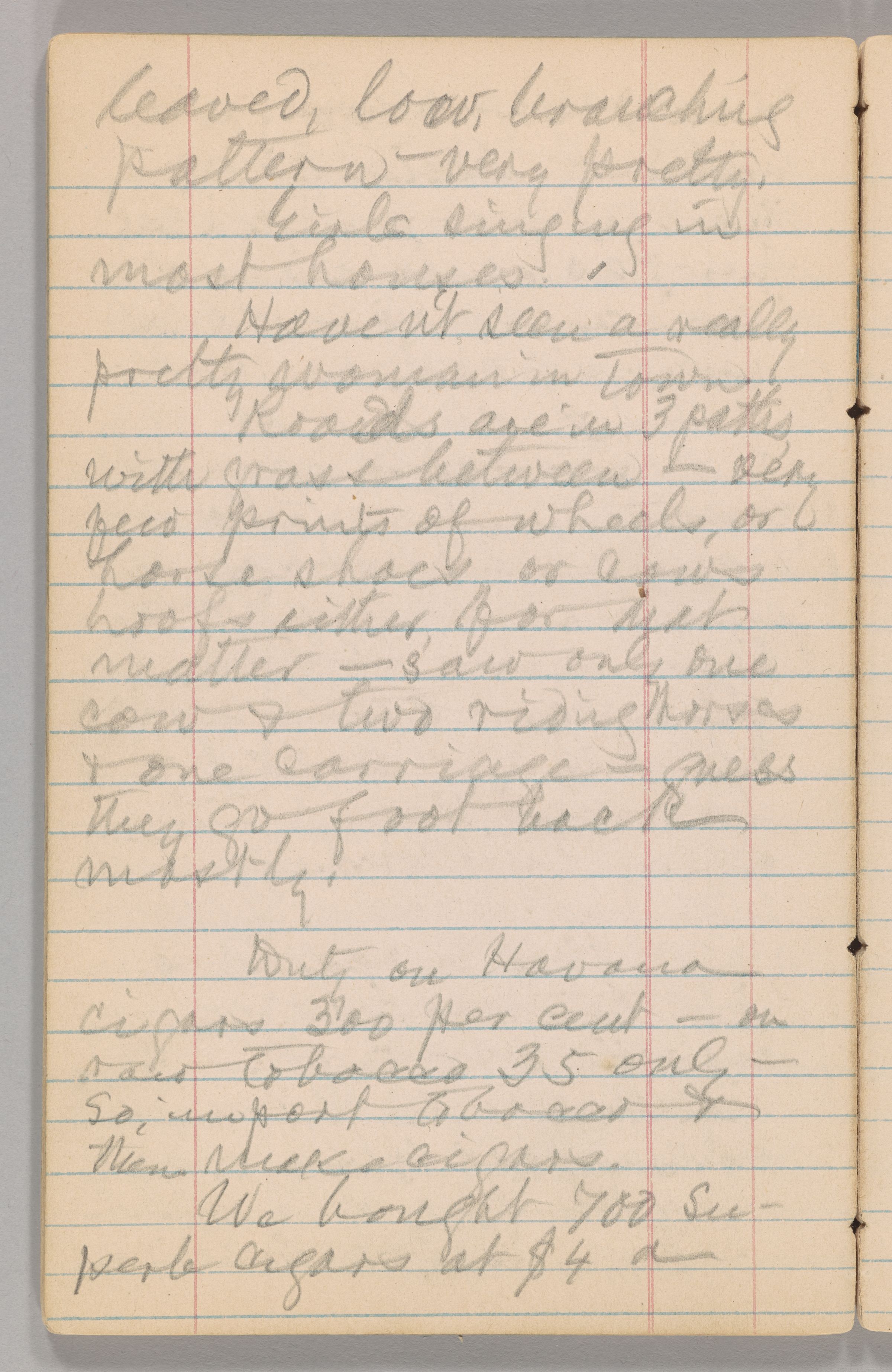
[MS: N7_leaf_074v]
leaved, low, branching
pattern—very pretty.
Girls singing in most houses.
Haven't seen a really
pretty woman in town.
Roads are in 3 paths,
with grass between—very
few prints of wheels, or
horse shoes, or cows
hoofs either, for that
matter—saw
[MTP: N&J1_286] only one
cow & two riding horses
& one carriage—guess
they go foot back
mostly.
Duty on Havana
cigars 300 per cent—on
raw tobacco 35 only—
so, import tobacco &
then make cigars.
We bought 700
su-
perb
superb
cigars at $4 a
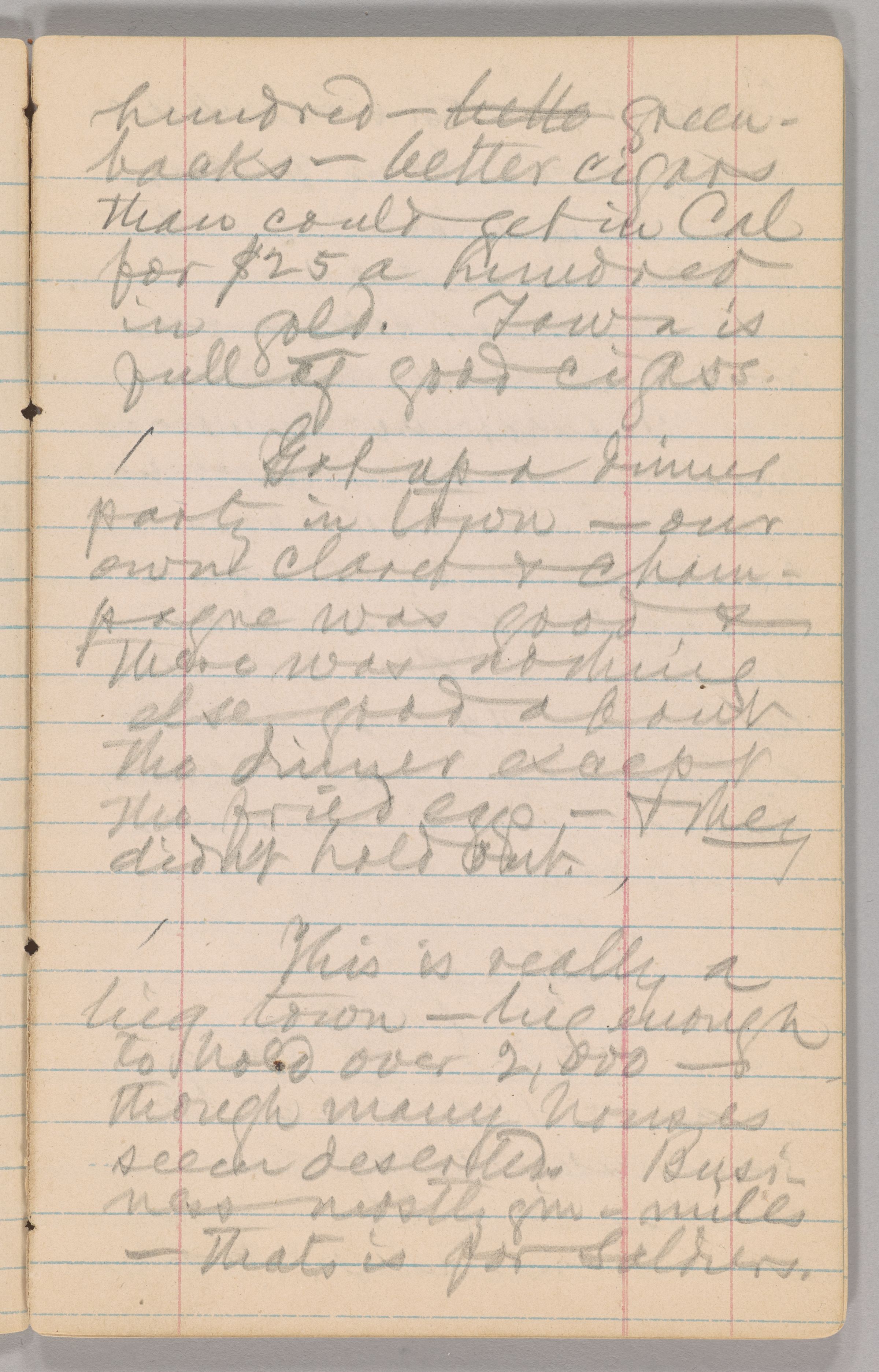
[MS: N7_leaf_075r]
hundred—bette
green-
backs
greenbacks
—better cigars
than could get in Cal
for $25 a hundred
in gold. Town is
full of good cigars.
T Got up a dinner
party in town—our
own claret &
cham-
pagne
champagne
was good, &
there was nothing
else good about
the dinner except
the fried eggs—& they
didn't hold out.
This is really a
big town—big enough
to hold over 2,000—
though many houses
seem deserted.
Busi-
ness
Business
mostly gin-mills
—thats is for soldiers.
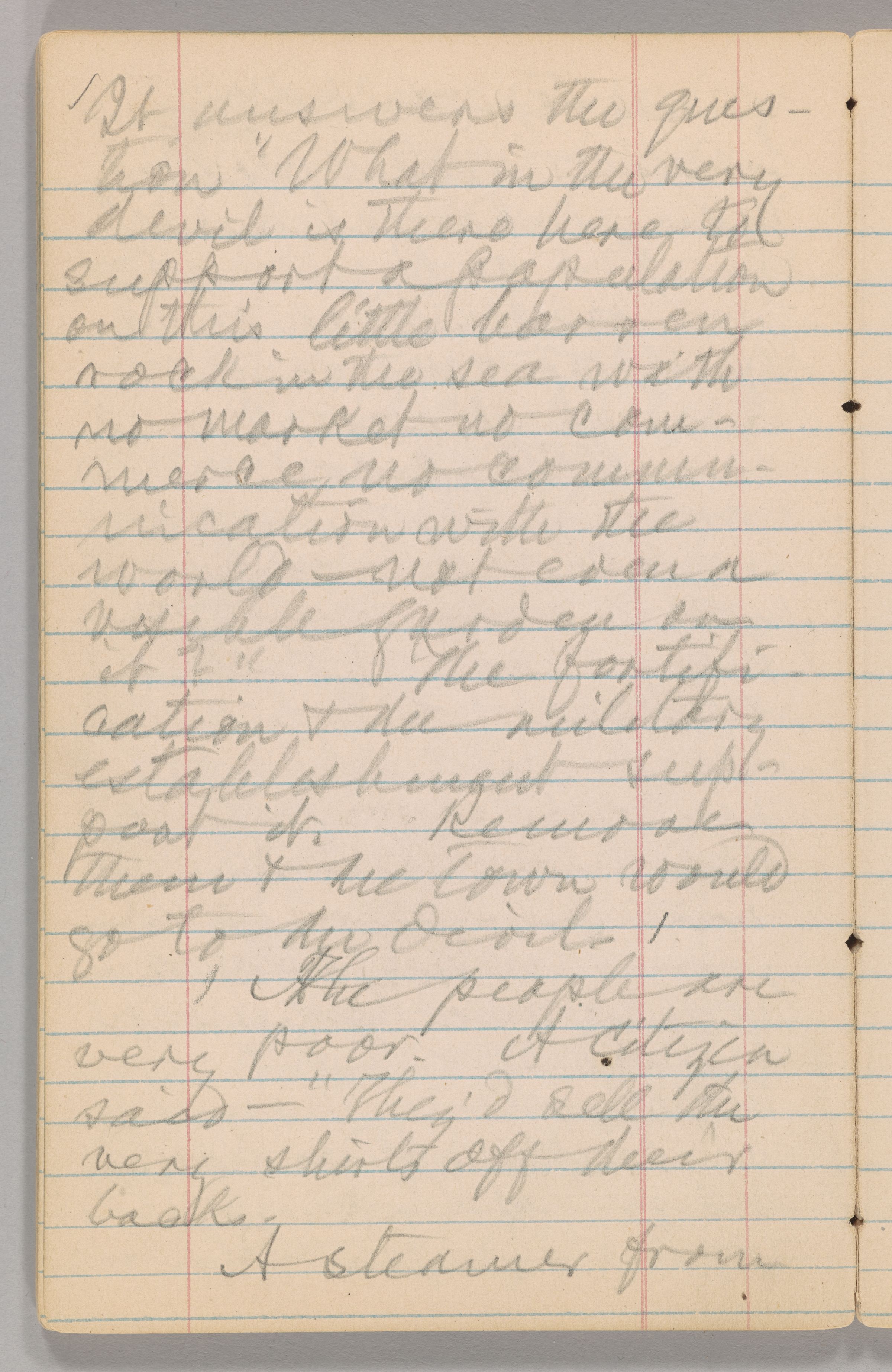
[MS: N7_leaf_075v]
It answers the
ques-
tion
question
“What in the very
devil is there here to
support a population
on this little barren
rock in the sea with
no market no
com-
merce
commerce
, no
commun-
ication
communication
with the
world—not even a
visible garden on
it?” The
fortifi-
cation
fortification
& the military
establishment
sup-
port
support
it. Remove
them & the town would
go to the devil.
A The people are
very poor. A citizen
said—“They'd sell the
very shirts off their
backs.
A steamer from
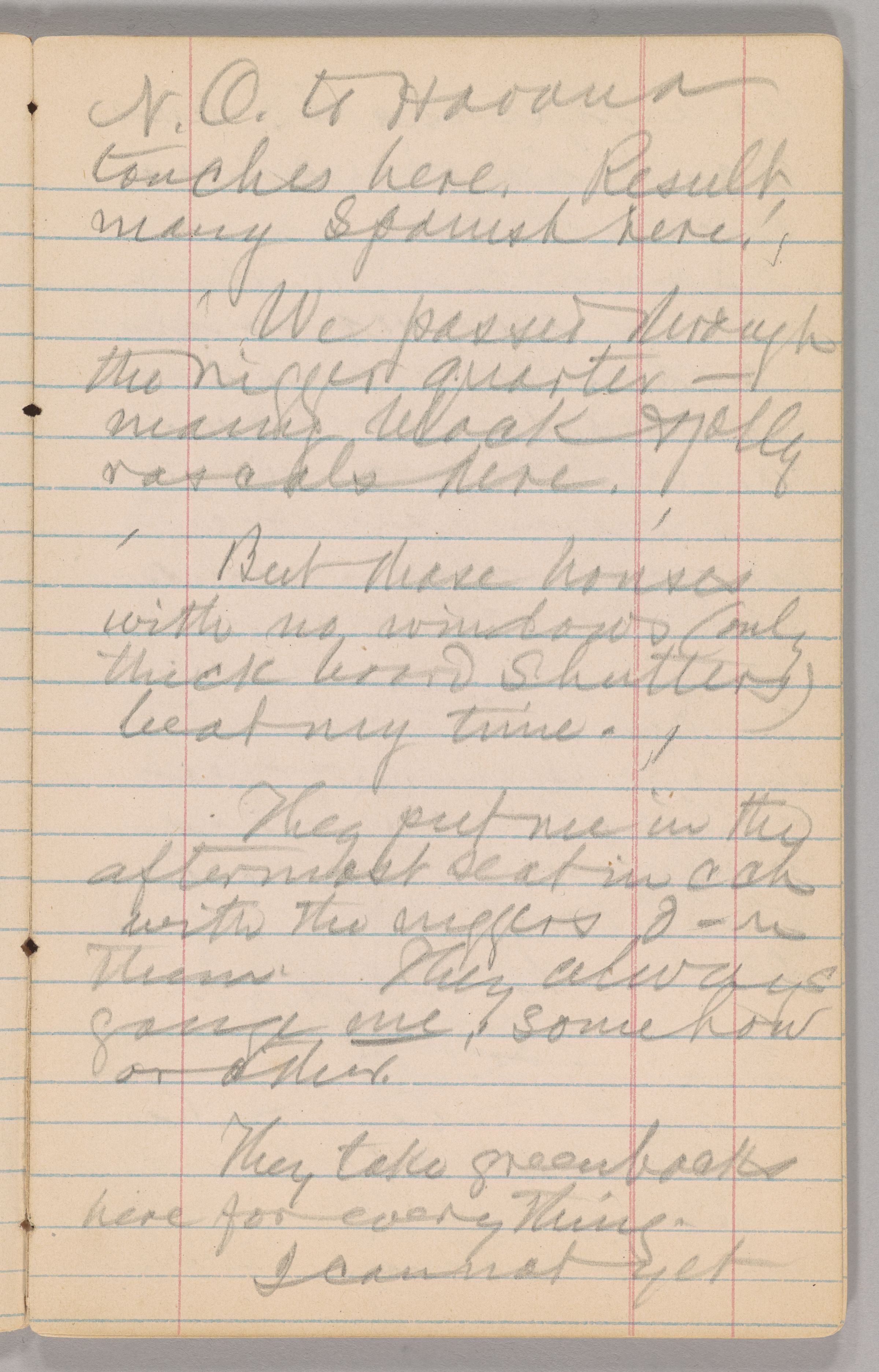
[MS: N7_leaf_076r]
N.O. to Havana
touches here. Result,
many Spanish here.
We passed through
the nigger quarter—
many black & jolly
rascals here.
But those houses
with no windows (only
thick board shutters)
beat my time.
They put me in the
aftermost seat in cch
with the niggers d—n
them. They always
gauge me, somehow
or other.
They take greenbacks
here for everything.
I cannot yet
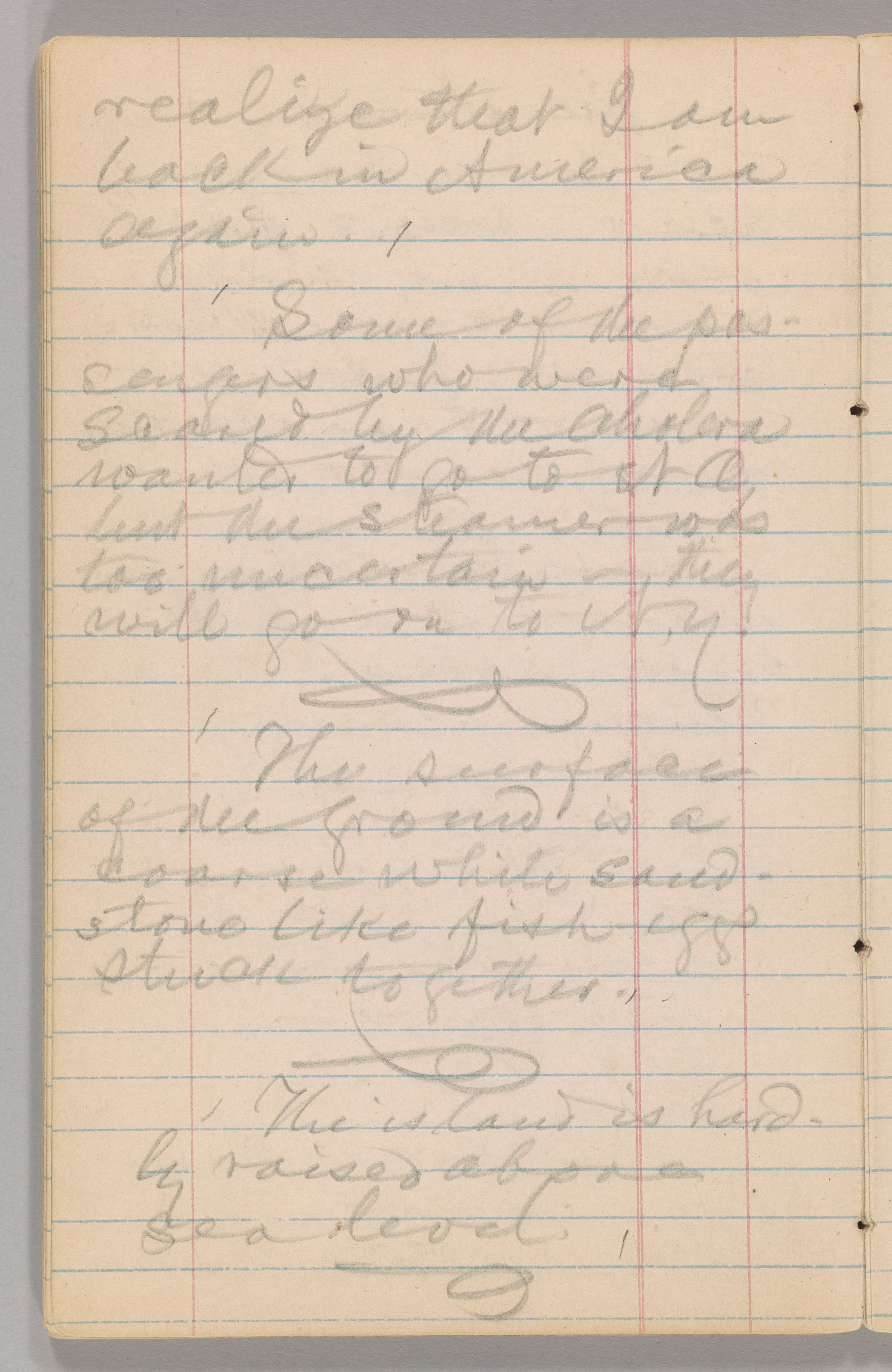
[MS: N7_leaf_076v]
realize that I am
back in America
again.
[MTP: N&J1_287]
Some of the
pas-
sengers
passengers
who were
scared by the Cholera
wanted to go to NO,
but the steamer was
too uncertain—they
will go on to N.Y.
The surface
of the ground is a
coarse white
sand-
stone
sandstone
like fish-eggs
stuck together.
The island is
hard-
ly
hardly
raised above
sea level.
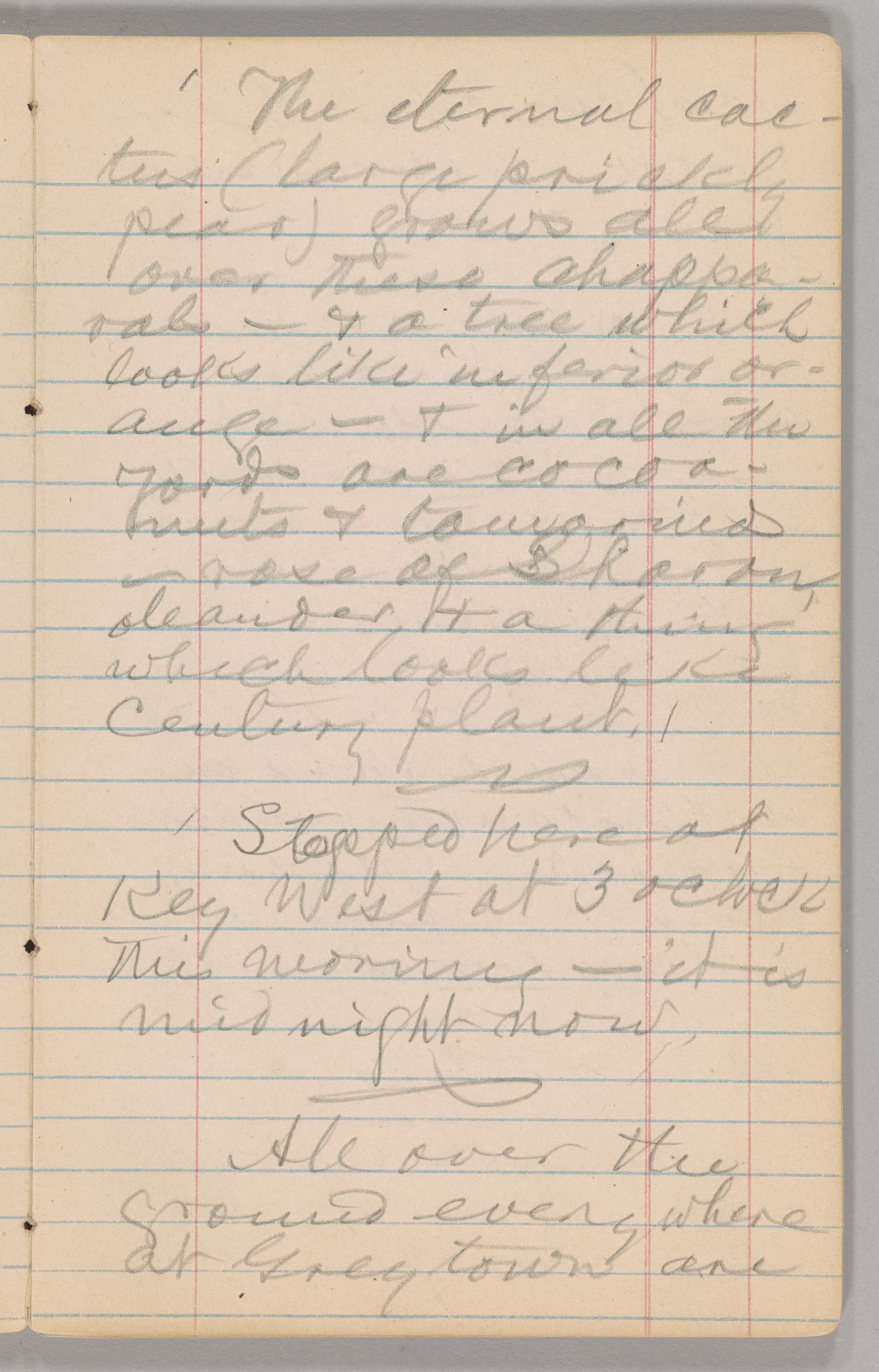
[MS: N7_leaf_077r]
The eternal
cac-
tus
cactus
(large prickly
pear) grows all
over these
chappa-
rals
chapparals
—& a tree which
looks like inferior
or-
ange
orange
—& in all the
yards are cocoa-
nuts & tamarinds
—rose of
Ssharon,
oleander & a thing
which looks like
century plant.
Stopped here at
Key West at 3 oclock
this morning—it is
midnight now.
All over the
ground everywhere
at Greytown are
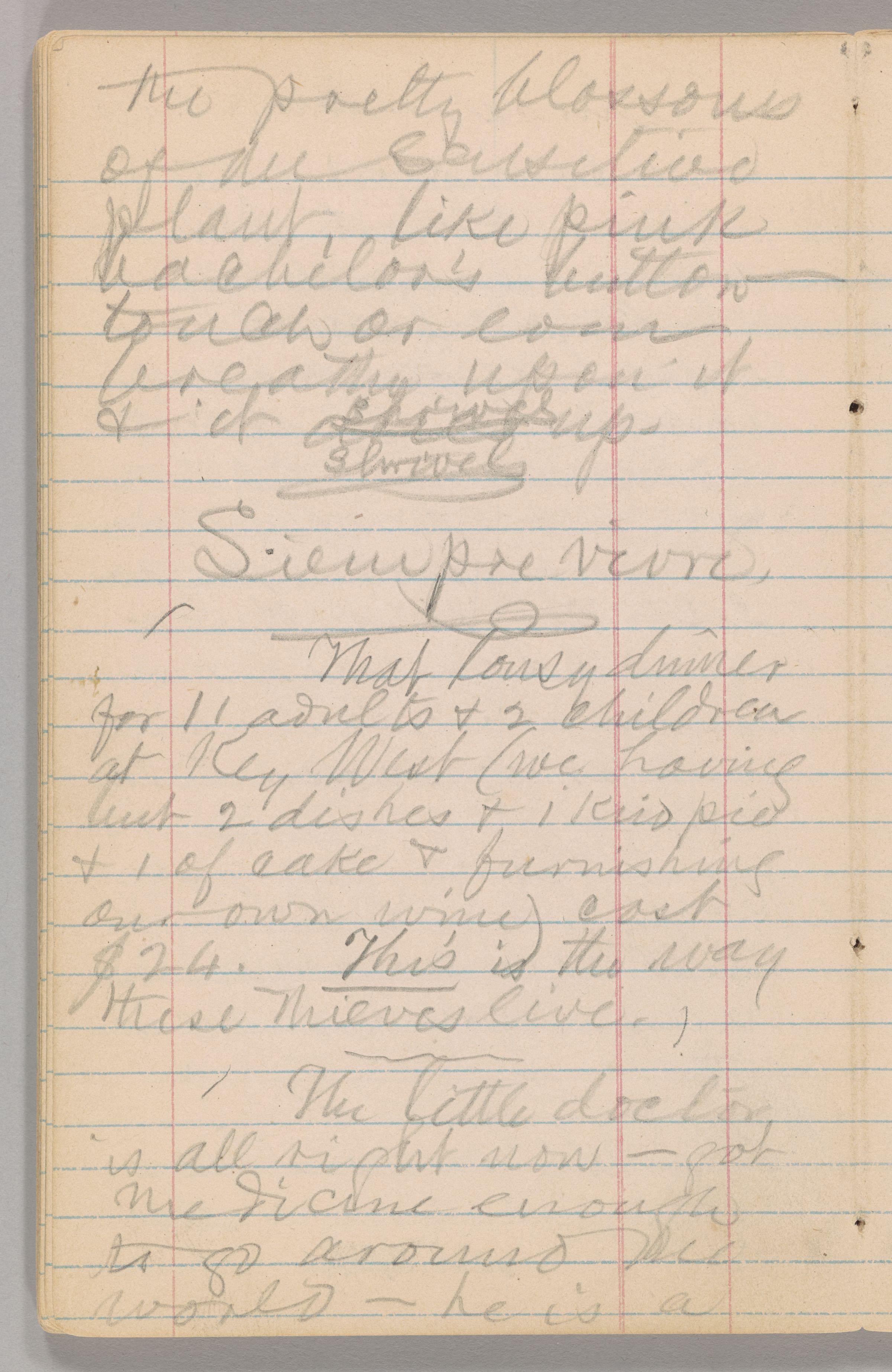
[MS: N7_leaf_077v]
the pretty blossoms
of the sensitive
plant, like pink
bachelor's button—
touch or even
breathe upon it
& it
dries
shrivels
up.
Siempre vivre.
That lousy dinner
for 11 adults & 2 children
at Key West (we having
but 2 dishes & 1 kind pie
& 1 of cake & furnishing
our own wine) cost
$24. This is the way
these thieves live.
The little doctor
is all right now—got
medicine enough
to go around the
world—he is a
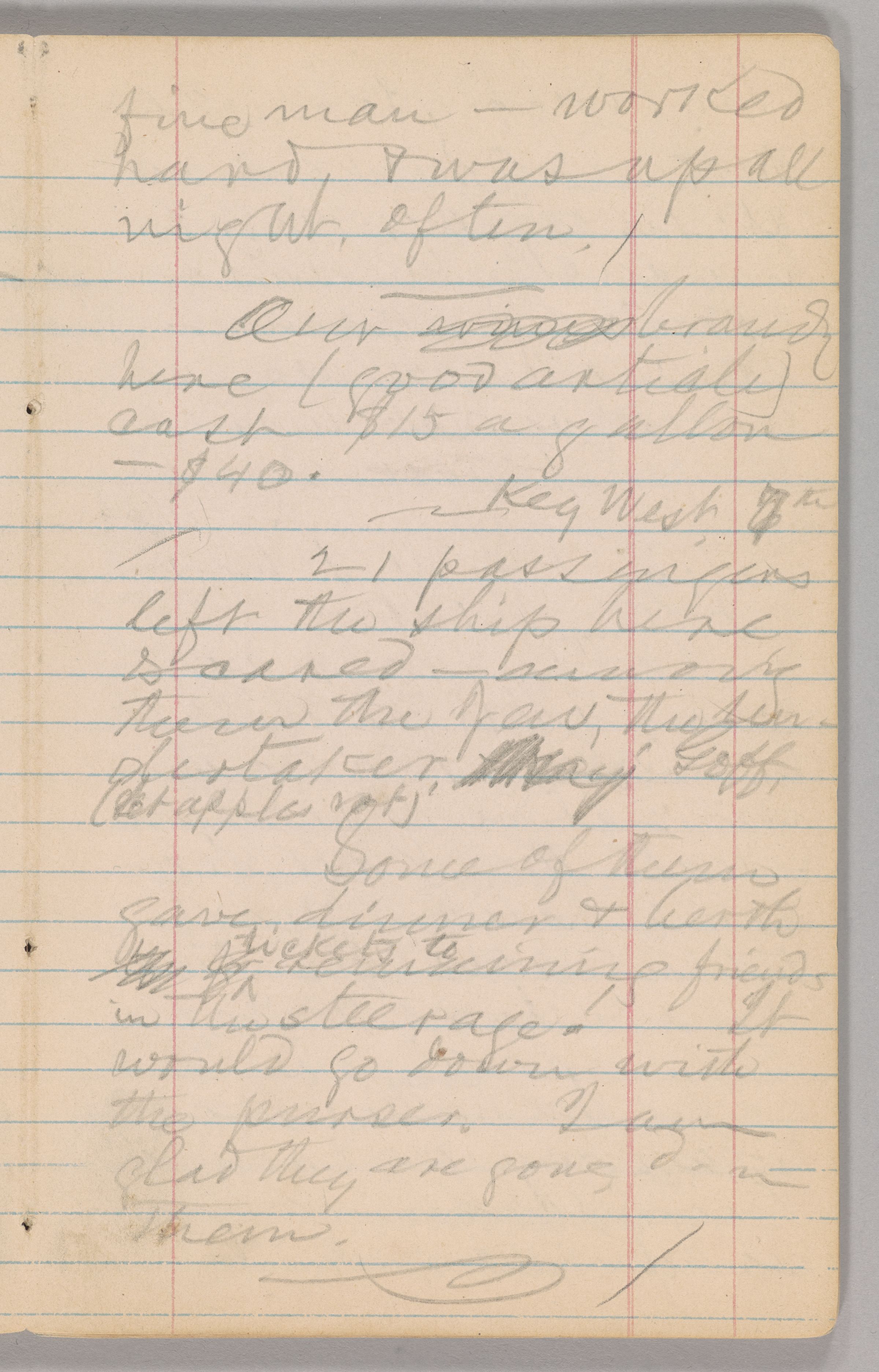
[MS: N7_leaf_078r]
fine man—worked
hard & was up all
night, often.
Our wines brandy
here (good article)
cost $15 a gallon
—$40.
21 passengers
left the ship here,
scared—among
them the Jew, the
Un-
dertaker
Undertaker
, & ◊◊’ Goff,
(let apples rot)
Some of them
gave dinner & berth
to fr
tickets to remaining friends
in the steerage! It
would go down with
the purser. I am
glad they are gone, d—n
them.
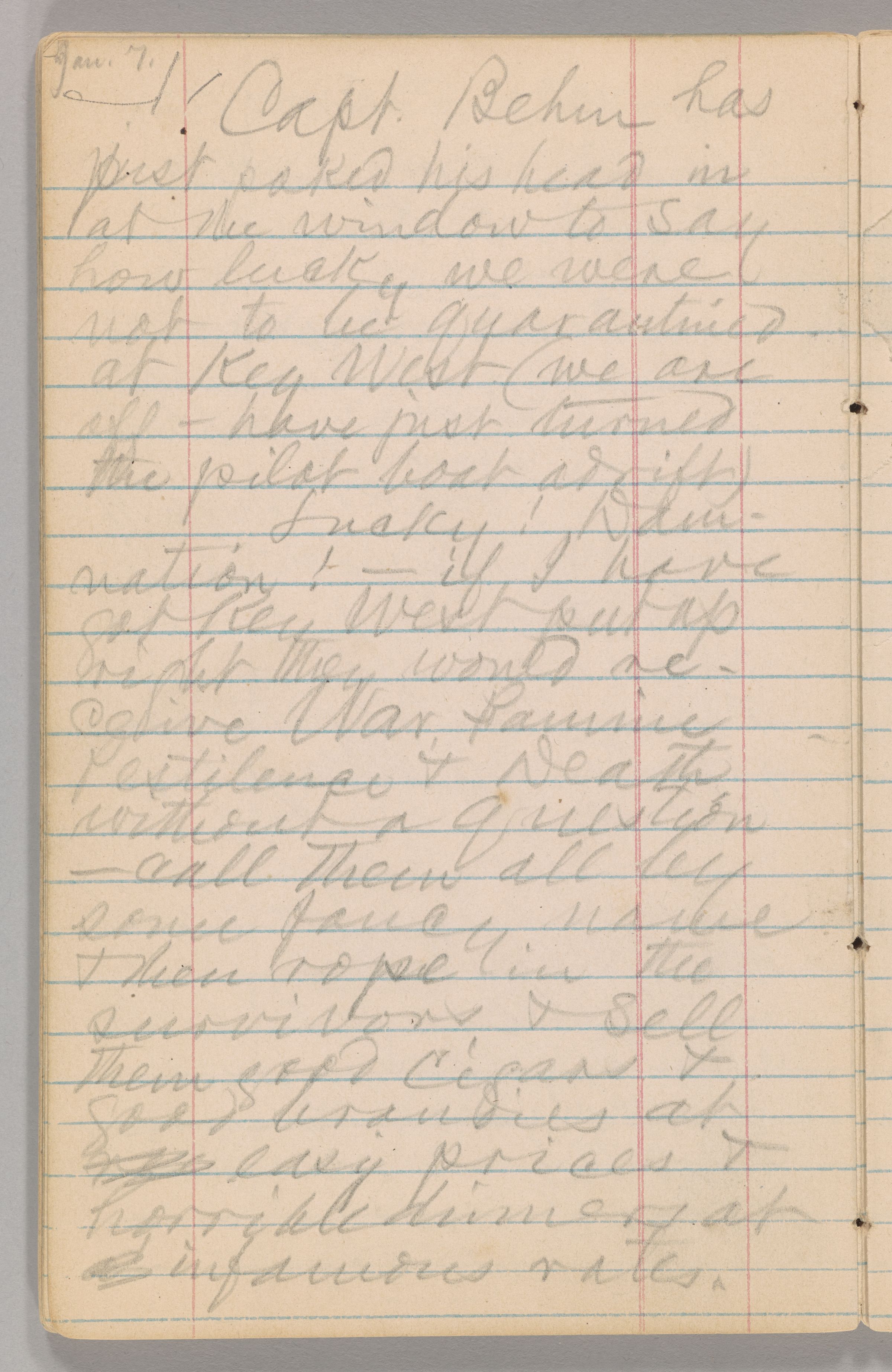
[MS: N7_leaf_078v]
Capt. Behm has
pjust poked his head in
at the
[MTP: N&J1_288] window to say
how lucky we were
not to be quarantined
at Key West (we are
off—have just turned
the pilot boat adrift)
Lucky!
Dam-
nation
Damnation
!—if I have
got Key West put up
right they would
re-
ceive
receive
War,
PFamine
Pestilence & Death
without a question
—call them all by
some fancy name
& then rope in the
survivors & sell
them good cigars &
good brandies at
re easy prices &
horrible dinners at
a
infamous rates.
One leaf torn out here (leaf_079r and 079v)
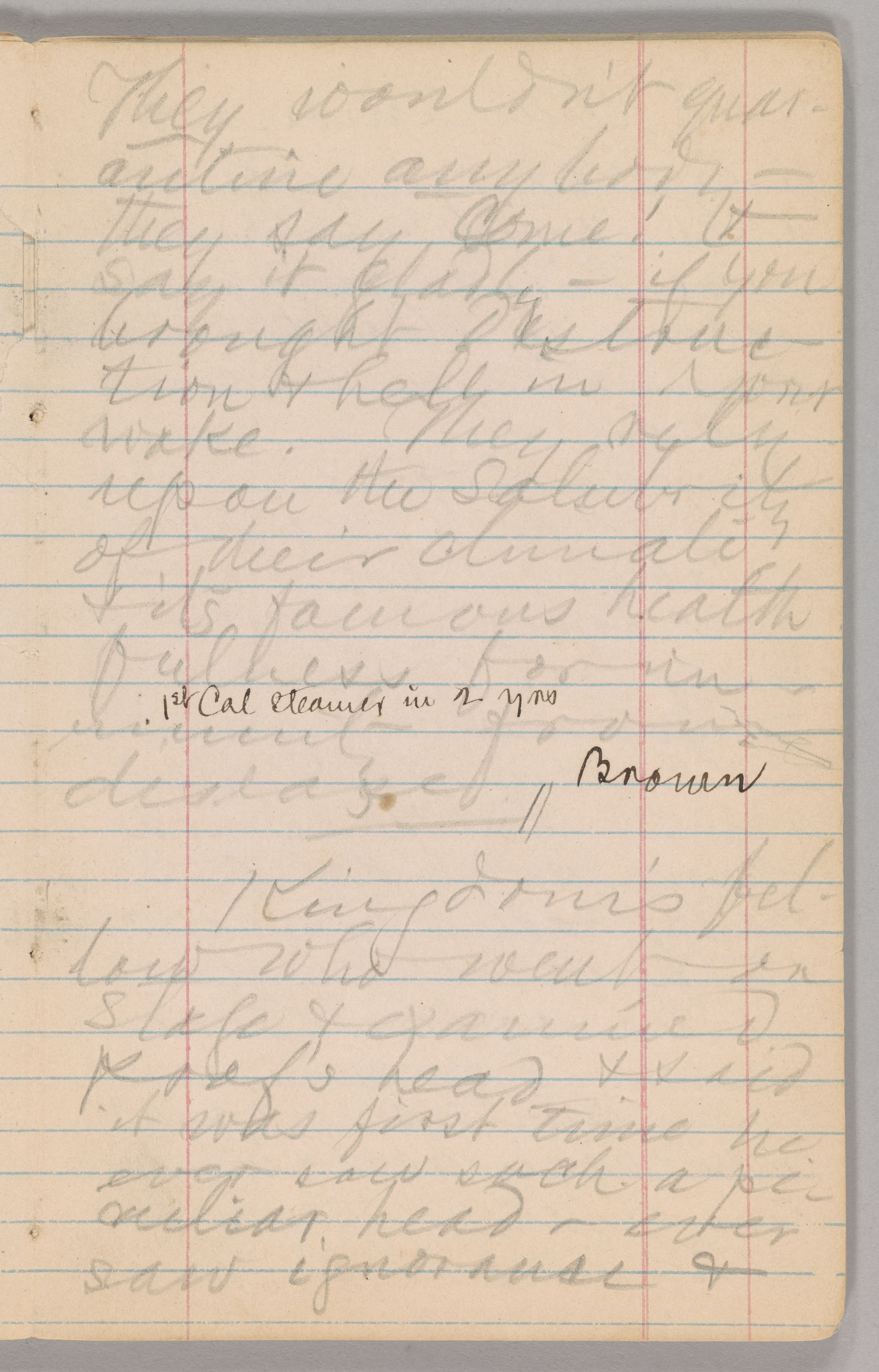
[MS: N7_leaf_080r]
They wouldn't
quar-
antine
quarantine
anybody—
they say Come! &
say it gladly—if you
brought
destruc-
tion
destruction
& hell in your
wake. They rely
upon the salubrity
of their climate,
& its famous
health
fulness
healthfulness
for
im-
munity
immunity
from
disease.
1st Cal steamer in 2 yrs
Kingdom's
fel-
low
fellow
who went on
stage & examined
prof's head & said
it was first time he
ever saw such a
pe-
culiar
peculiar
head—ever
saw ignorance &
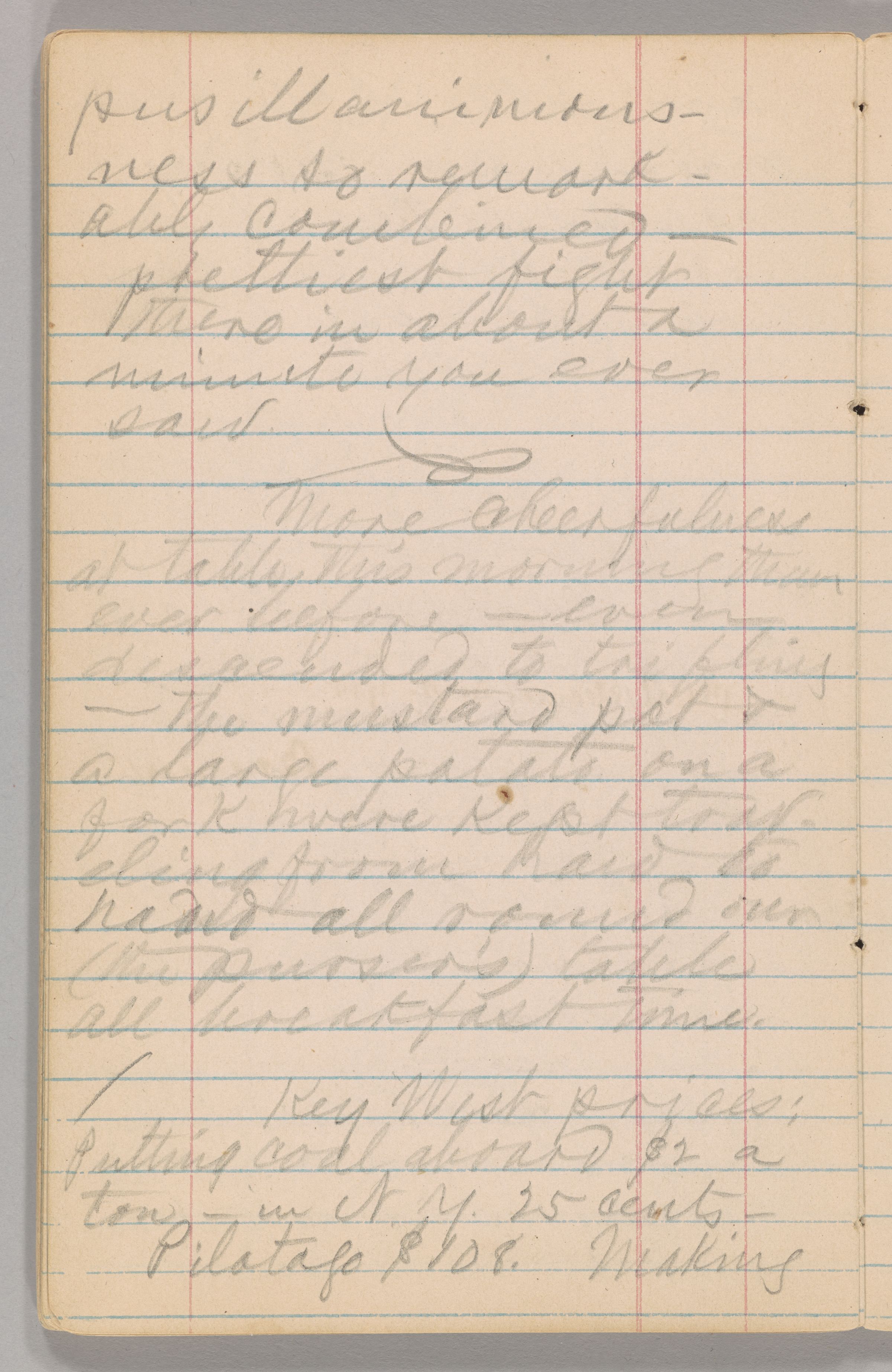
[MS: N7_leaf_080v]
pusillanimous-
ness
pusillanimousness
so
remark-
ably
remarkably
combined—
prettiest fight
there in about a
minute you ever
saw.
More cheerfulness
at table this morning than
ever before—even
descended to trifling
—the mustard pot &
a large potato on a
fork were kept
trav-
eling
traveling
from hand to
hand all round our
(the purser's) table
all breakfast time.
Key West prices:
Putting coal aboard $2 a
ton—in N.Y. 25 cents—
Pilotage $108. Making
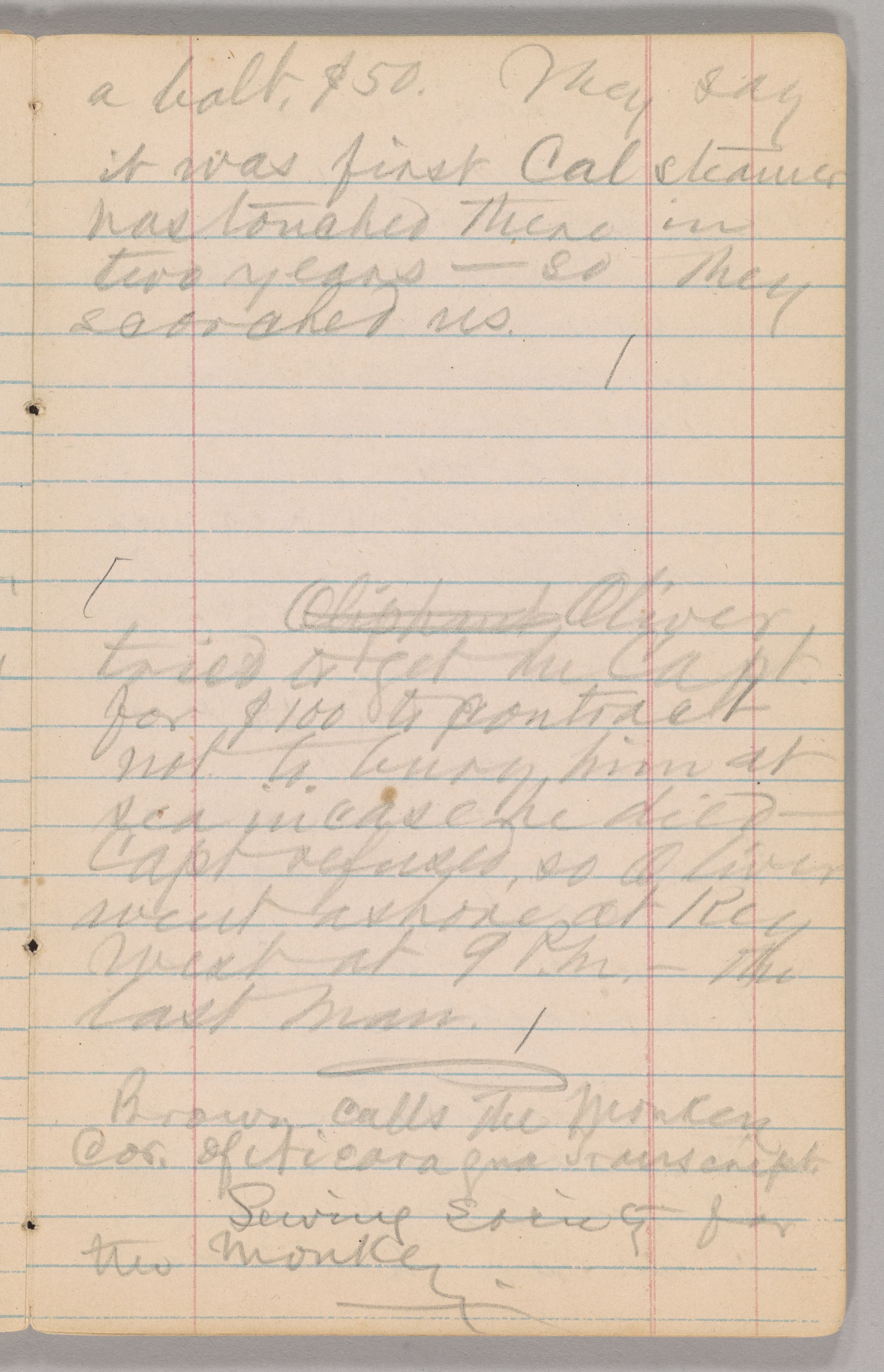
[MS: N7_leaf_081r]
a bolt, $50. They say
it was first Cal steamer
has touched there in
two years—so they
scorched us.
gap of five lines
Oliphant Oliver
tried to get the Capt.
for $100 to contract
not to bury him at
sea in case he died—
Capt refused, so Oliver
went ashore at Key
West at 9 P.M.—the
last man.
Brown calls the Monkey
Cor. of Nicaragua Transcript.
Sewing society for
the monkey.
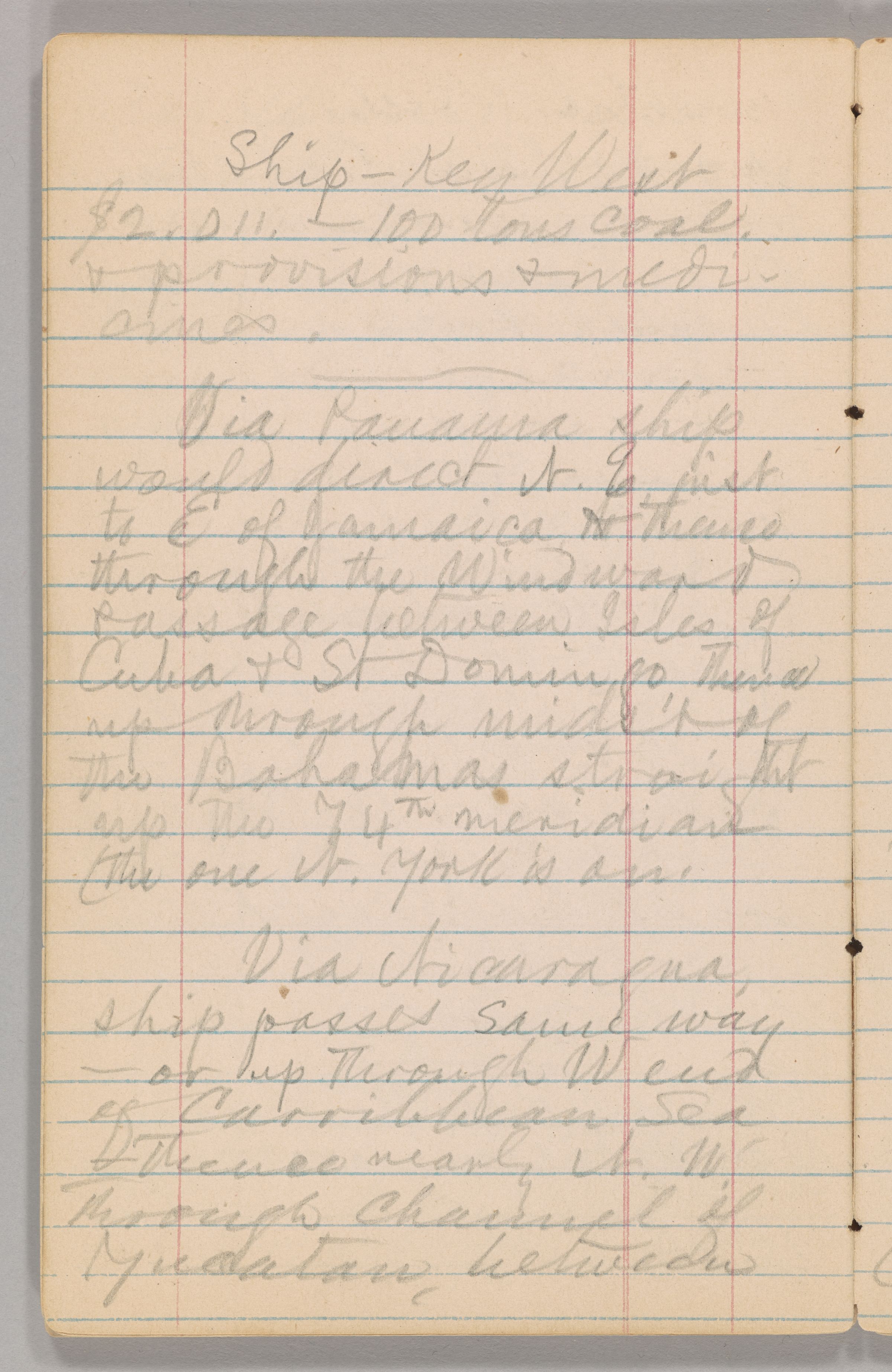
[MS: N7_leaf_081v]
Ship—Key West
$2,011.—100 tons coal.
& provisions &
medi-
cines
medicines
.
BVia Panama ship
would direct N.E. just
to E of Jamaica, & thence
through the Windward
passage between Isles of
[MTP: N&J1_289] Cuba & St Domingo, thence
up through midst of
the Bahamas straight
up the 74th meridian
(the one N. York is on.
Via Nicaragua,
ship passes same way
—or up through W end
of Carribbean Sea,
—thence nearly N.W.
through channel of
Yucatan, between
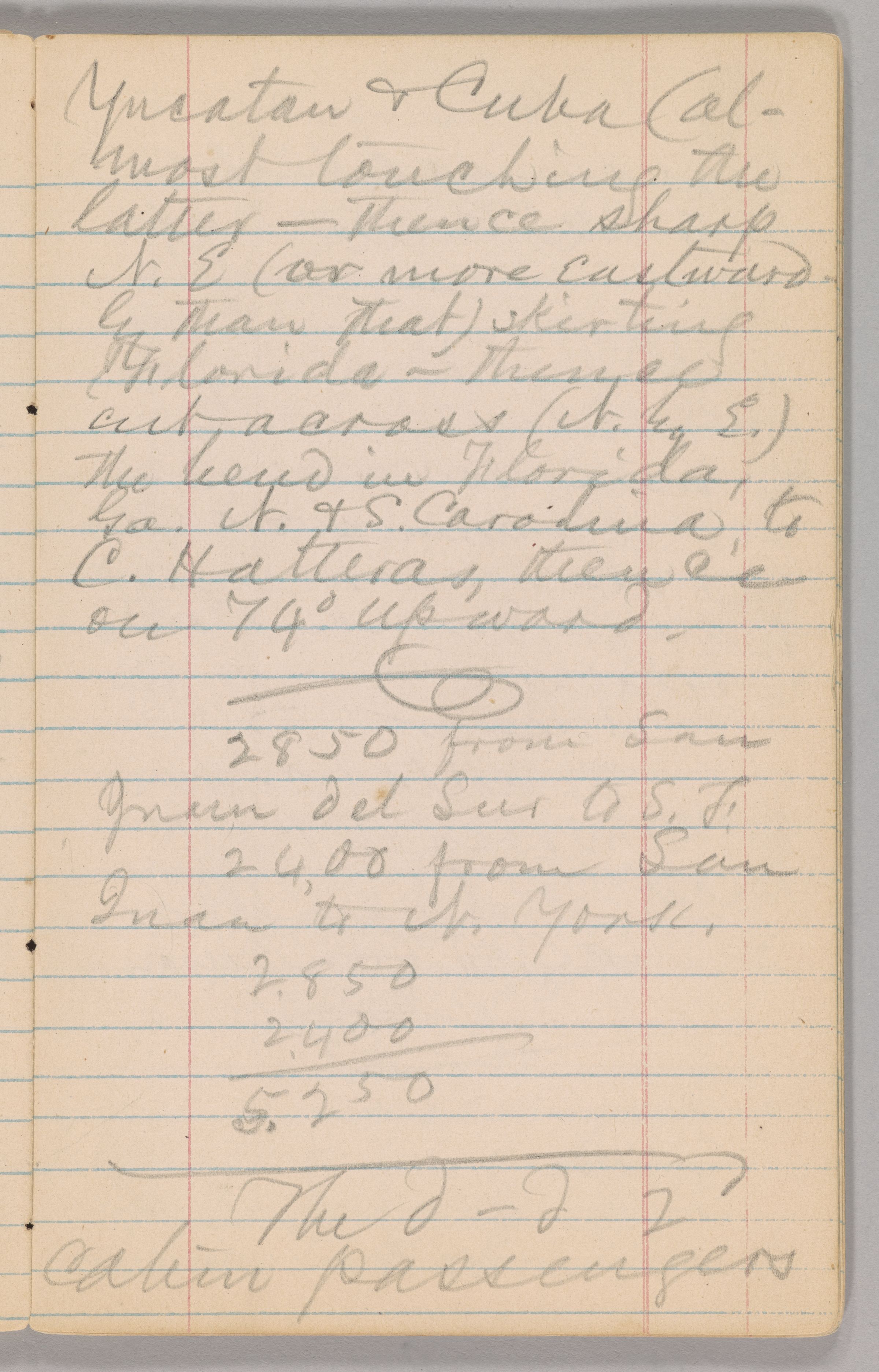
[MS: N7_leaf_082r]
Yucatan & Cuba (
al-
most
almost
touching the
latter—thence sharp
N.E (mor more
Eastward-
ly
Eastwardly
than that) skirting
Florida—thence
cut across (N. by E.)
the bend in Florida,
Ga. N. & S. Carolina, to
C. Hatteras, thence
on 74⁰ upward.
2850 from San
Juan del Sur to S. F.
24,00 from San
Juan to N. York.
2,850
2,400
5,250
The d—d 2d
cabin passengers
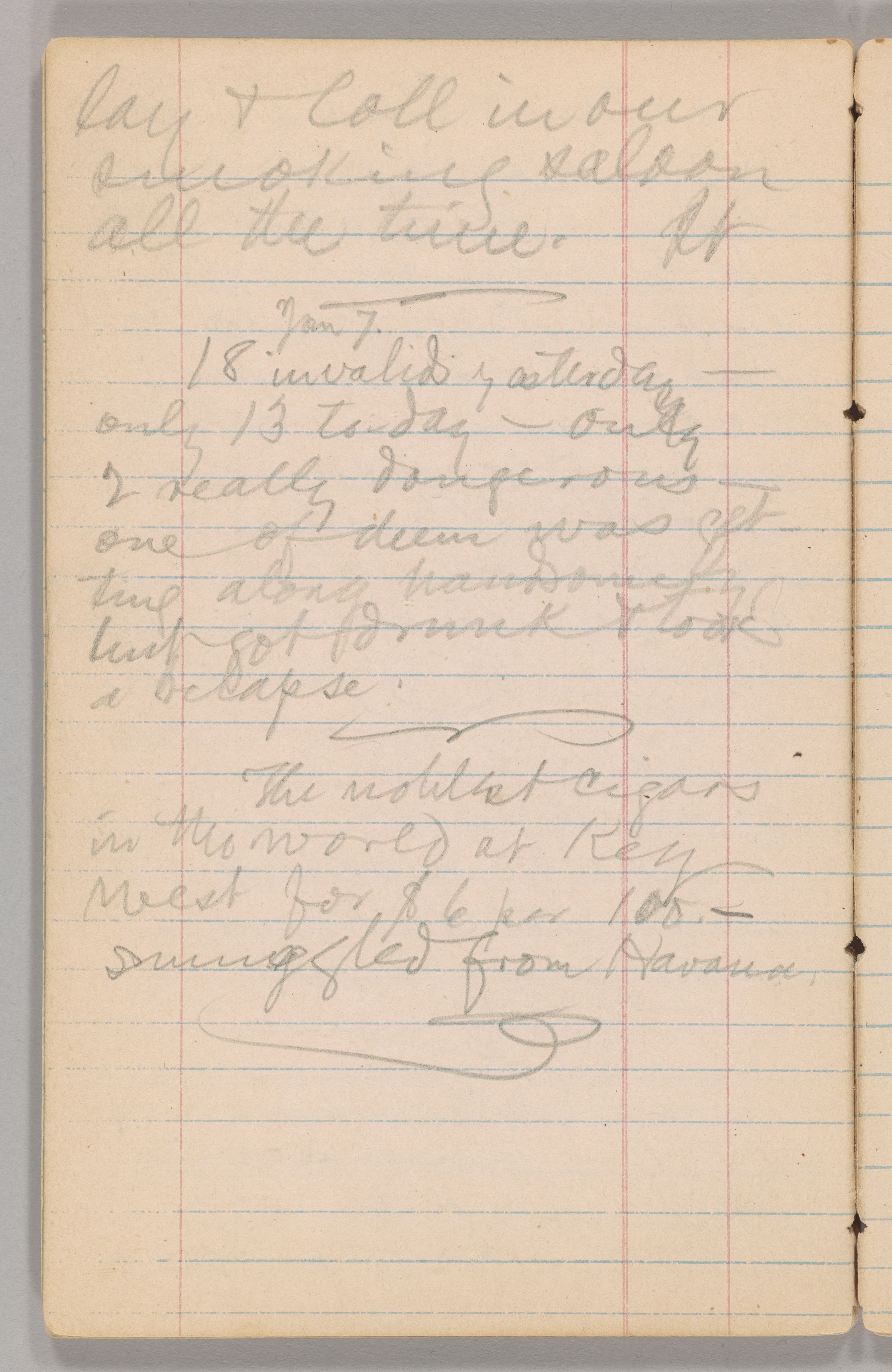
[MS: N7_leaf_082v]
lay & loll in our
smoking saloon
all the time. It
Jan 7.
18 invalids yesterday—
only 13 to-day—only
2 really dangerous—
one of them was
get-
ting
getting
along handsomely,
but got drunk & took
a relapse.
The noblest cigars
in the world at Key
West for $6 per 100.—
smuggled from Havana.
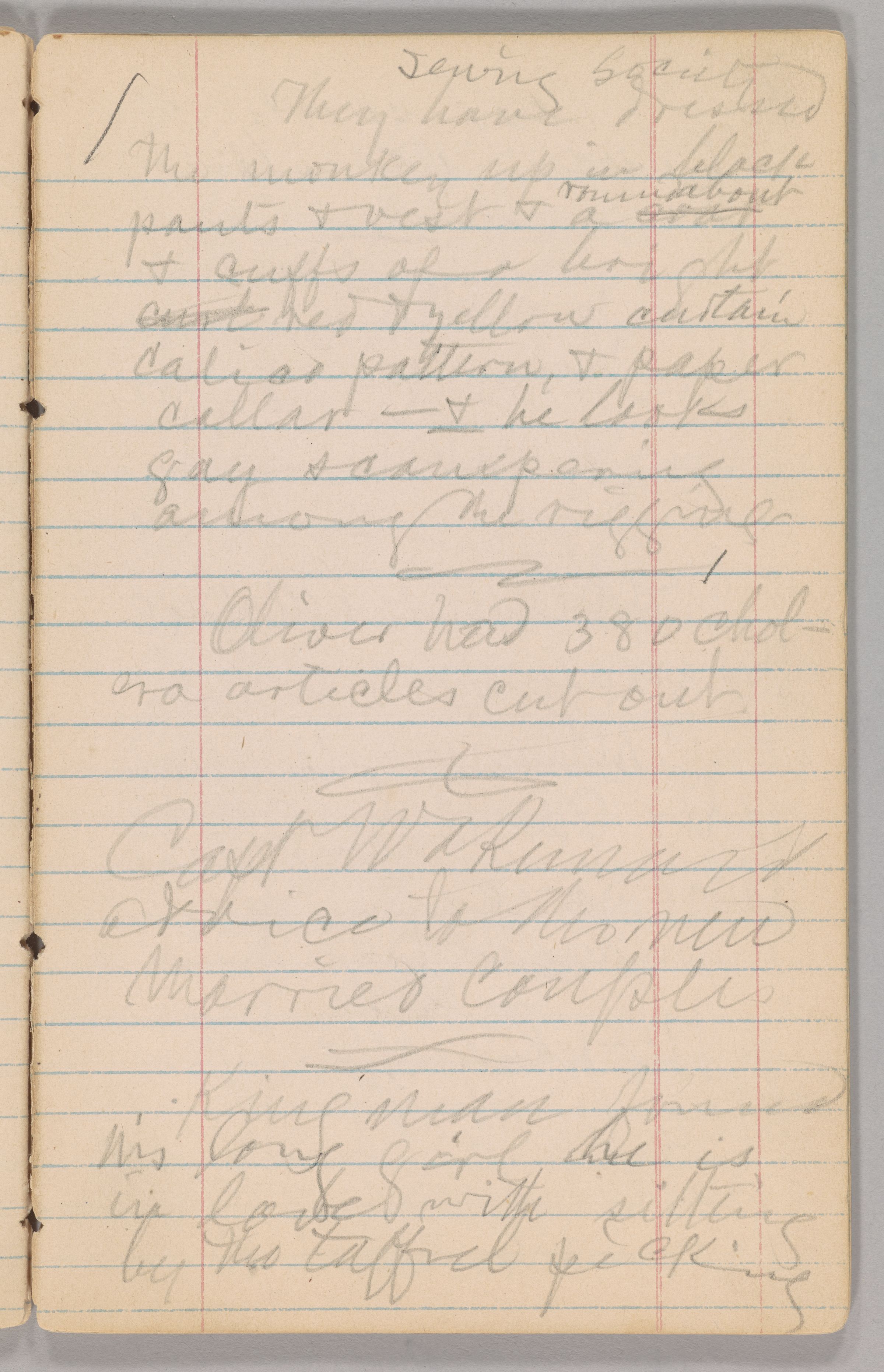
[MS: N7_leaf_083r]
Sewing Society
They have dressed
the monkey up in black
pants & vest & a coat
roundabout
& cuffs of a bright
curt red & yellow curtain
calico pattern, & paper
collar—& he looks
gay scampering
among the rigging.
Oliver had 380
chol-
era
cholera
articles cut out.
Capt Wakeman's
advice to the new
married couple.
[MTP: N&J1_290]
Kingman found
his long girl
in he is
in love with sitting
by the taffrel picking
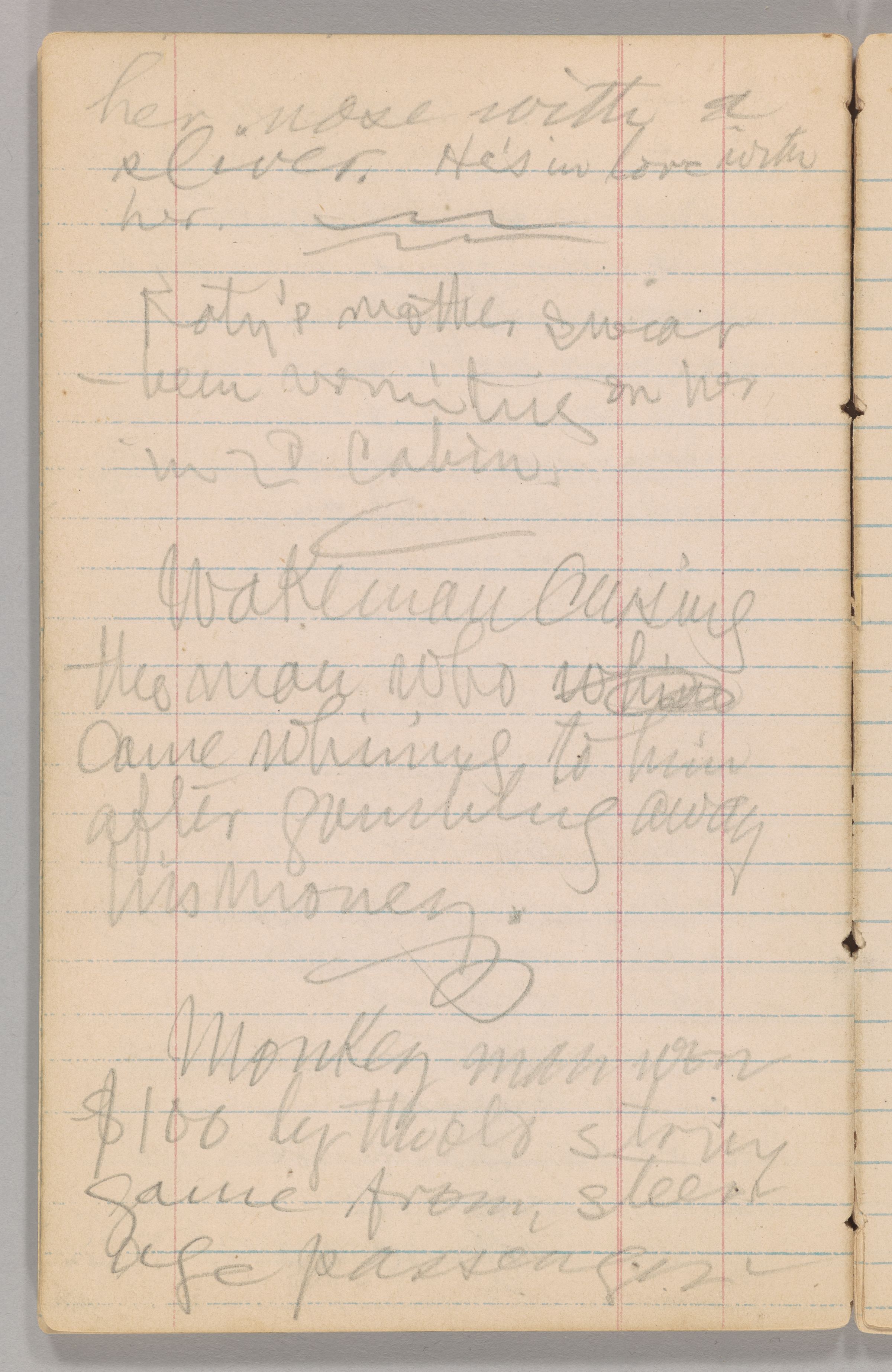
[MS: N7_leaf_083v]
her nose with a
sliver. He's in love with her.
Katy's mother swear
—been vomiting on her
in 2d cabin.
Wakeman cursing
the man who whine
came whining to him
after gambling away
his money.
Monkey man won
$100 by the old string
game from,
steer-
age
steerage
passenger—
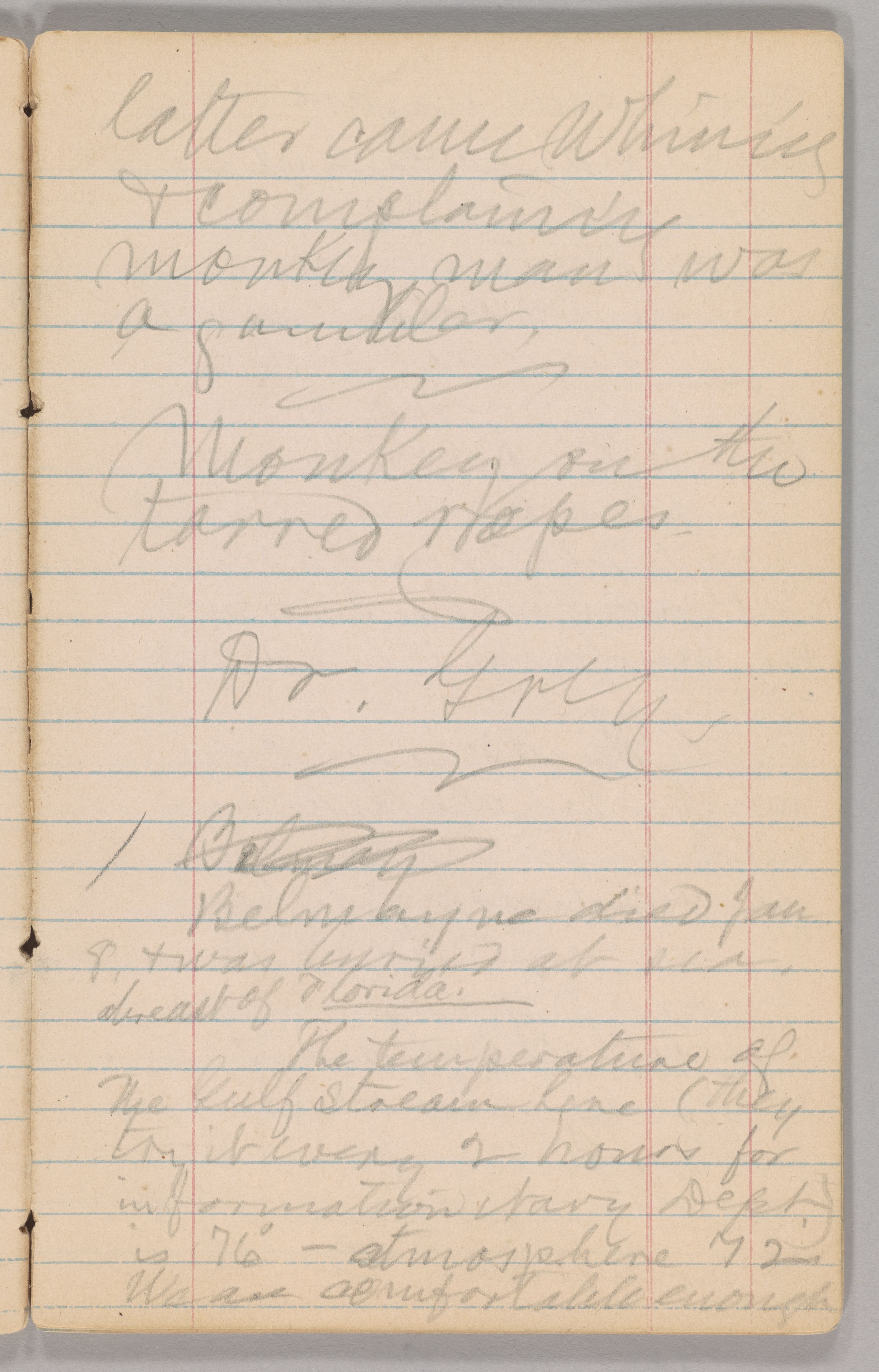
[MS: N7_leaf_084r]
latter came whining
& complaining
monkey man was
a gambler.
Monkey on the
tarred ropes.
Dr. Grey.
Belmay
Belmayne died Jan.
8, & was buried at sea.
abreast of Florida.
The temperature of
the Gulf Stream here (they
try it every 2 hours for
information Navy Dept.)
is 76⁰—atmosphere 72.
We are comfortable enough
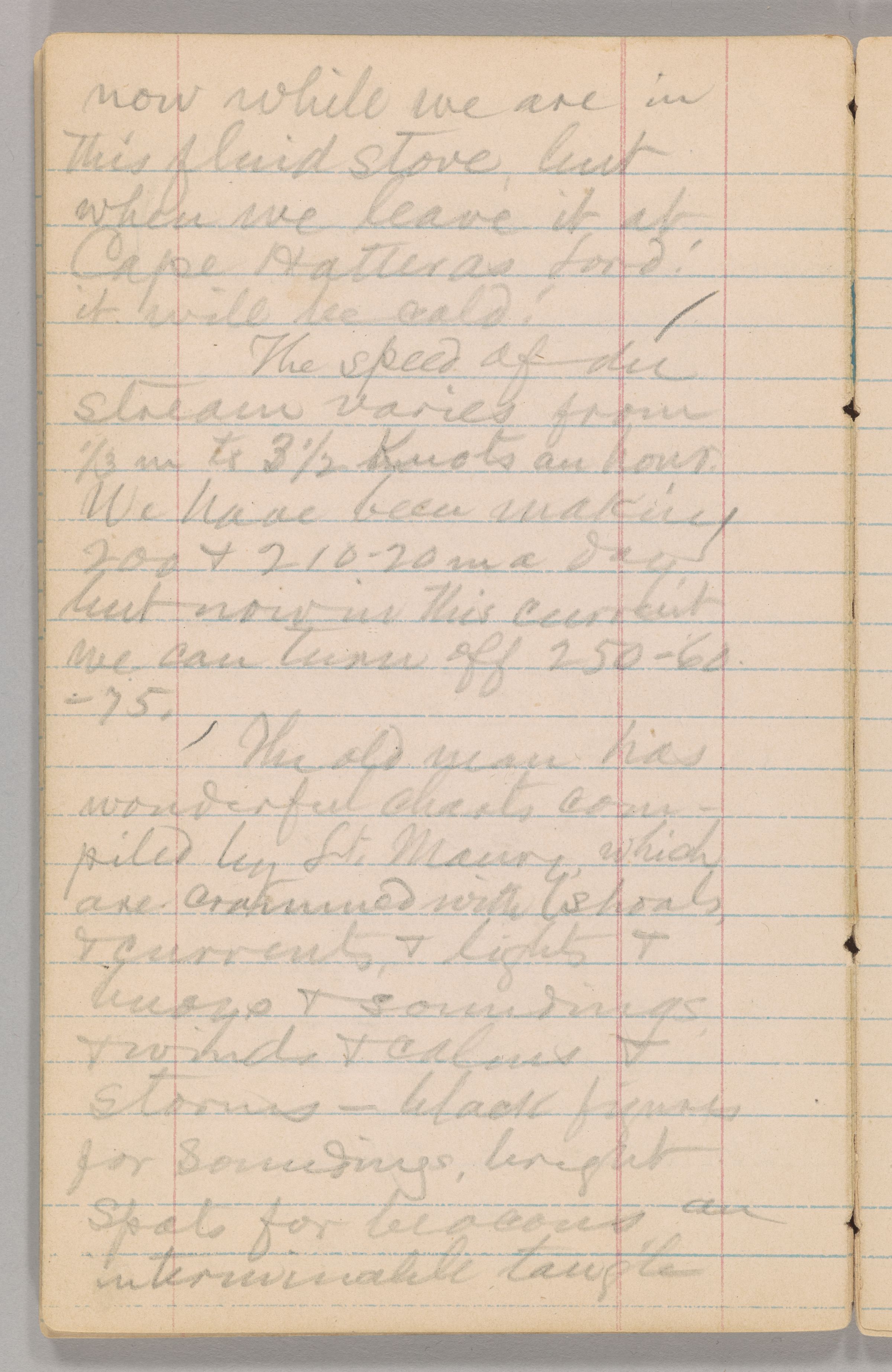
[MS: N7_leaf_084v]
now while we are in
this fluid stove, but
when we leave it at
Cape Hatteras Lord!
it will be cold!
The speed of the
stream varies from
⅓ m to 3½
mknots an hour.
We have been making
200 & 210–20 m a day,
but now in this current
we can turn off 250–60
–75.
The old man has
wonderful charts
com-
piled
compiled
by Lt. Maury, which
are crammed with shoals,
& currents, & lights &
buoys & soundings,
& winds & calms &
storms—black figures
for soundings, bright
spots for beacons, an
interminable tangle
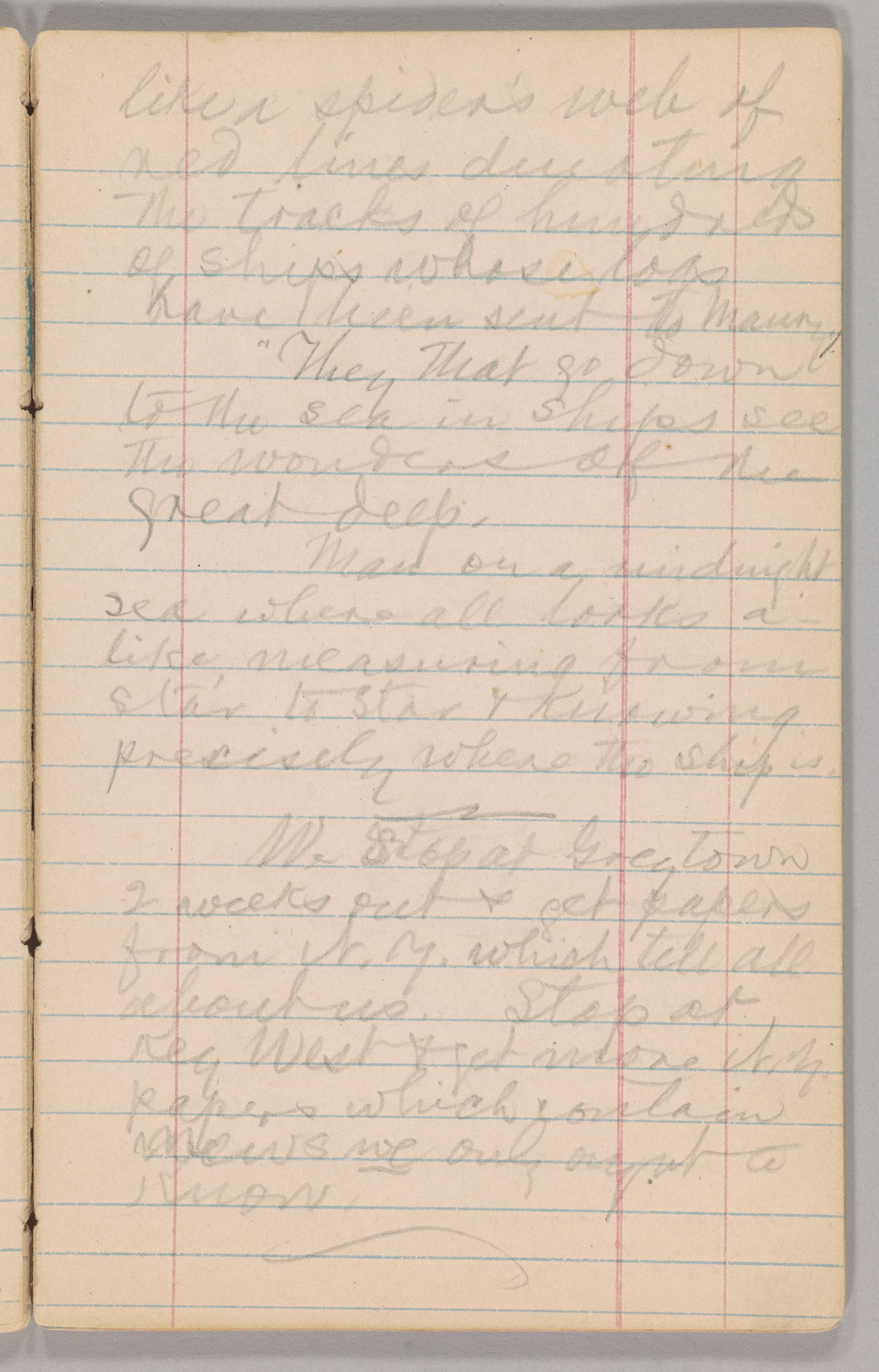
[MS: N7_leaf_085r]
like a spider's web of
red lines denoting
the tracks of hundreds
of ships whose logs
have been sent to Maury.
[MTP: N&J1_291]
“They that go down
to the sea in ships see
the wonders of the
great deep.
Man on a midnight
sea where all looks
a-
like
alike
, measuring from
star to star & knowing
precisely where the ship is.
We stop at Greytown
2 weeks out & get papers
from N.Y. which tell all
about us. Stop at
Key West & get more N.Y.
papers which contain
we news
we only ought to
know.
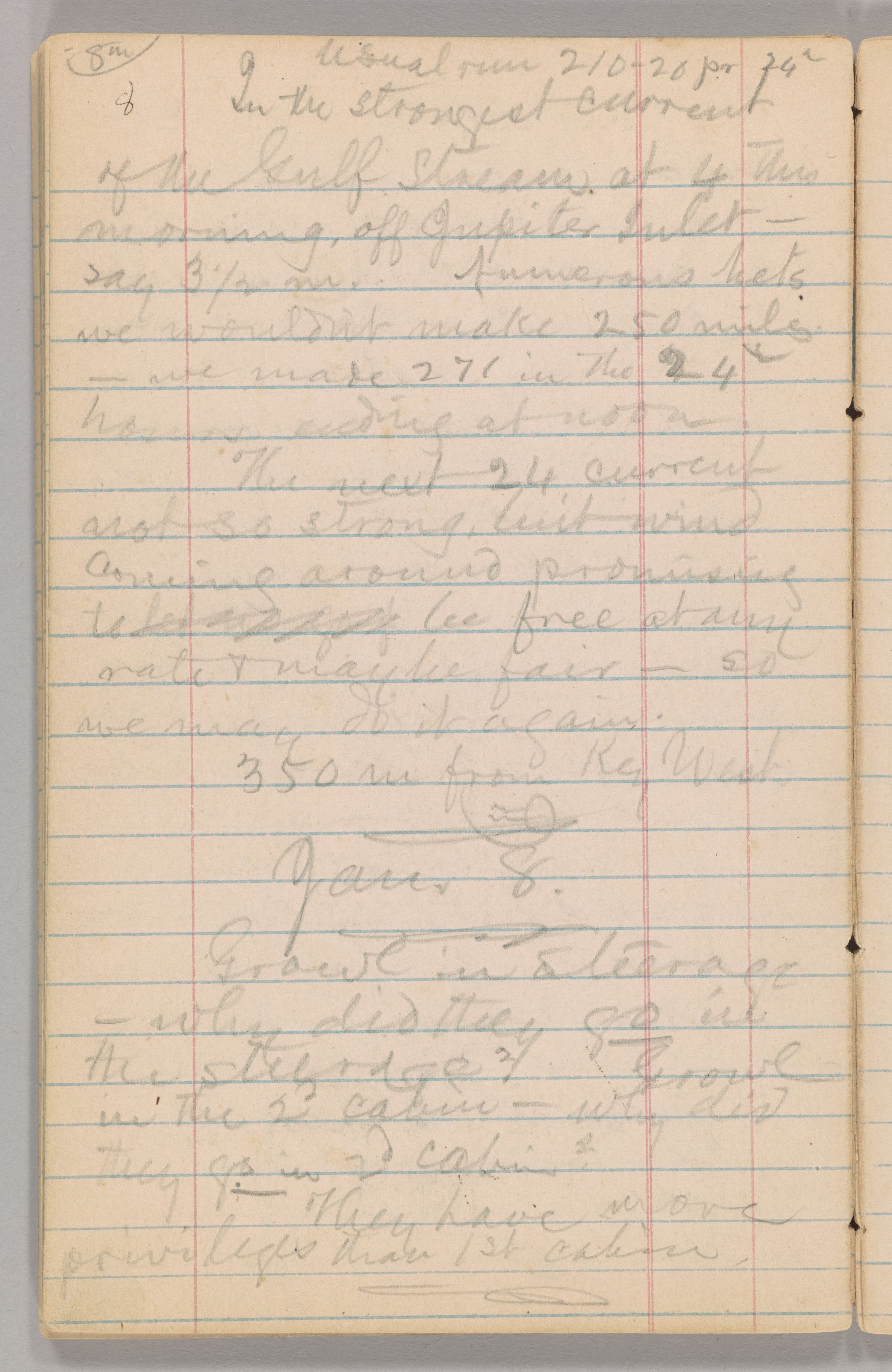
[MS: N7_leaf_085v]
Usual run 210–20 per 24h
In the strongest current
of the Gulf Stream at 4 this
morning, off Jupiter Inlet—
say 3½ m. Numerous bets
we wouldn't make 250 miles.
—we made 271 in the 24
h
hours ending at noon.
The next 24, current
not so strong, but wind
coming around promising
to let us go f be free at any
rate & maybe fair—so
we may do it again.
350 m from Key West.
Jan. 8.
Growl in steerage
—why did they go in
the steerage? Growl
in the 2d cabin—why did
they go in 2d cabin?
They have more
privileges than 1st cabin.
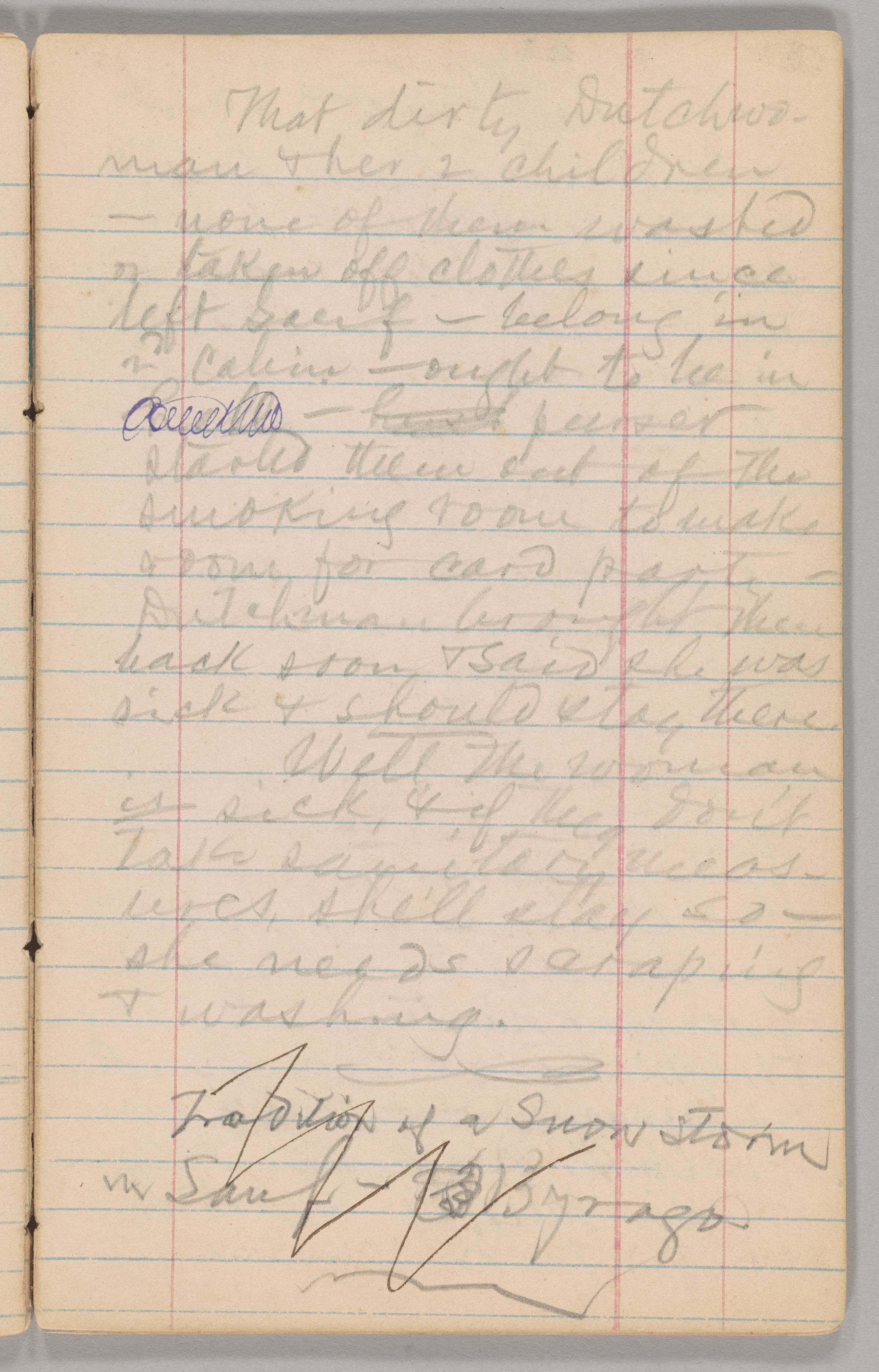
[MS: N7_leaf_086r]
That dirty
Dutchwo-
man
Dutchwoman
& her 2 children
—none of them washed
or taken off clothes since
left Sanf—belong in
2d cabin—ought to be in
hell
—husb purser
started them out of the
smoking room to make
room for card party—
Dutchman brought them
back soon & said she was
sick & should stay there.
Well, the woman
is sick, & if they don't
take sanitary
meas-
ures
measures
, she'll stay so—
she needs scraping
& washing.
[MTP: N&J1_292]
Tradition of a snow storm
in Sanf— 3 13 yr ago.
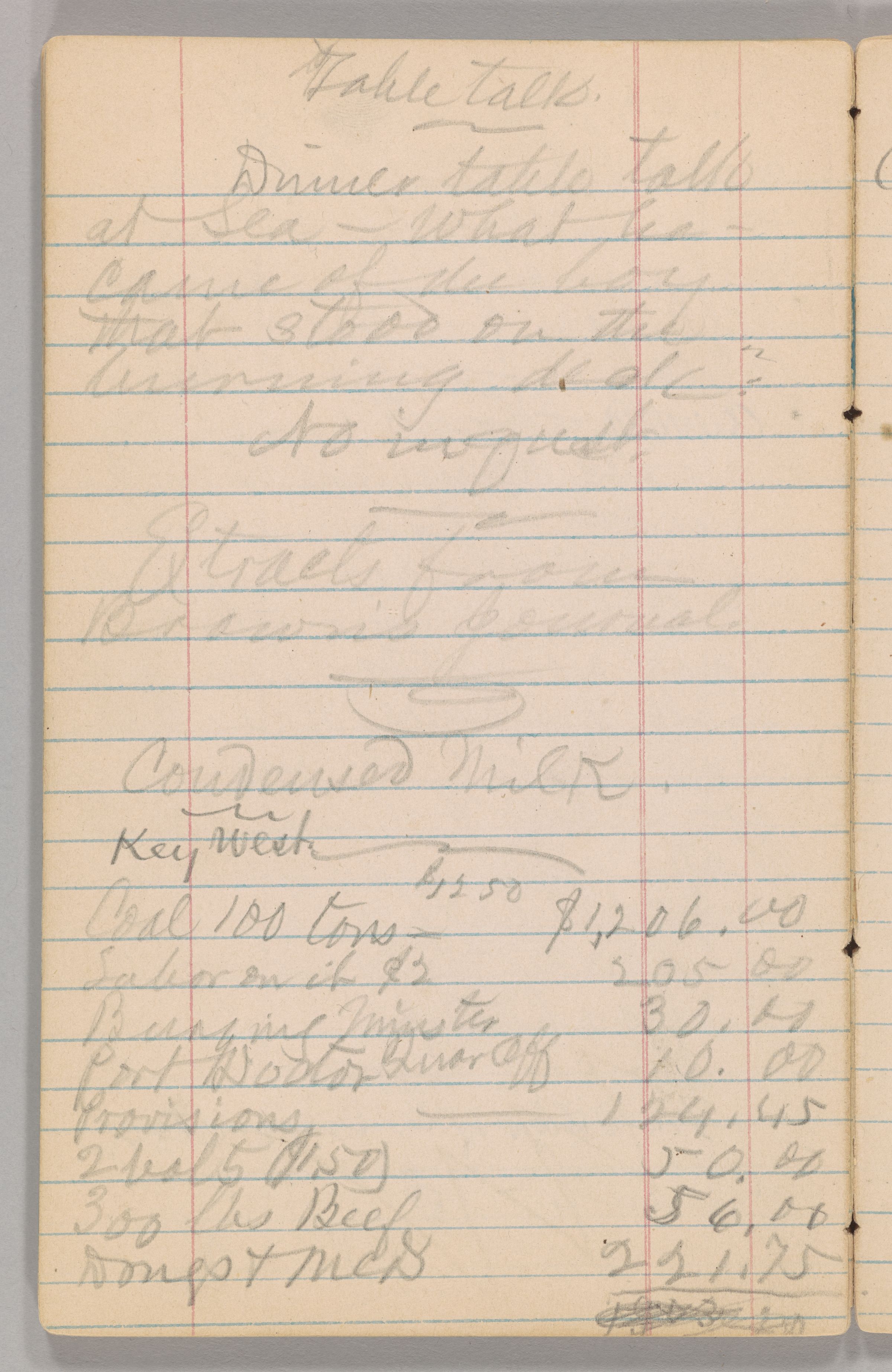
[MS: N7_leaf_086v]
Dinner table talk
at Sea—what
be-
came
became
of the boy
that stood on the
burning deck?
No inquest.
Extracts from Brown's Journal.
Condensed Milk.
Key West.
$1250
| Coal 100 tons | $1,20600 |
| Labor on it $2 | 205.00 |
| Burying Minister | 30.00 |
| Port Doctor Quar Off | 10.00 |
| Provisions | 124.45 |
| 2 bolts ($1.50) | 50.00 |
| 300 lbs Beef | 56.00 |
| Drugs & Meds | 221.75 |
| ________ | |
| 1903.20 |
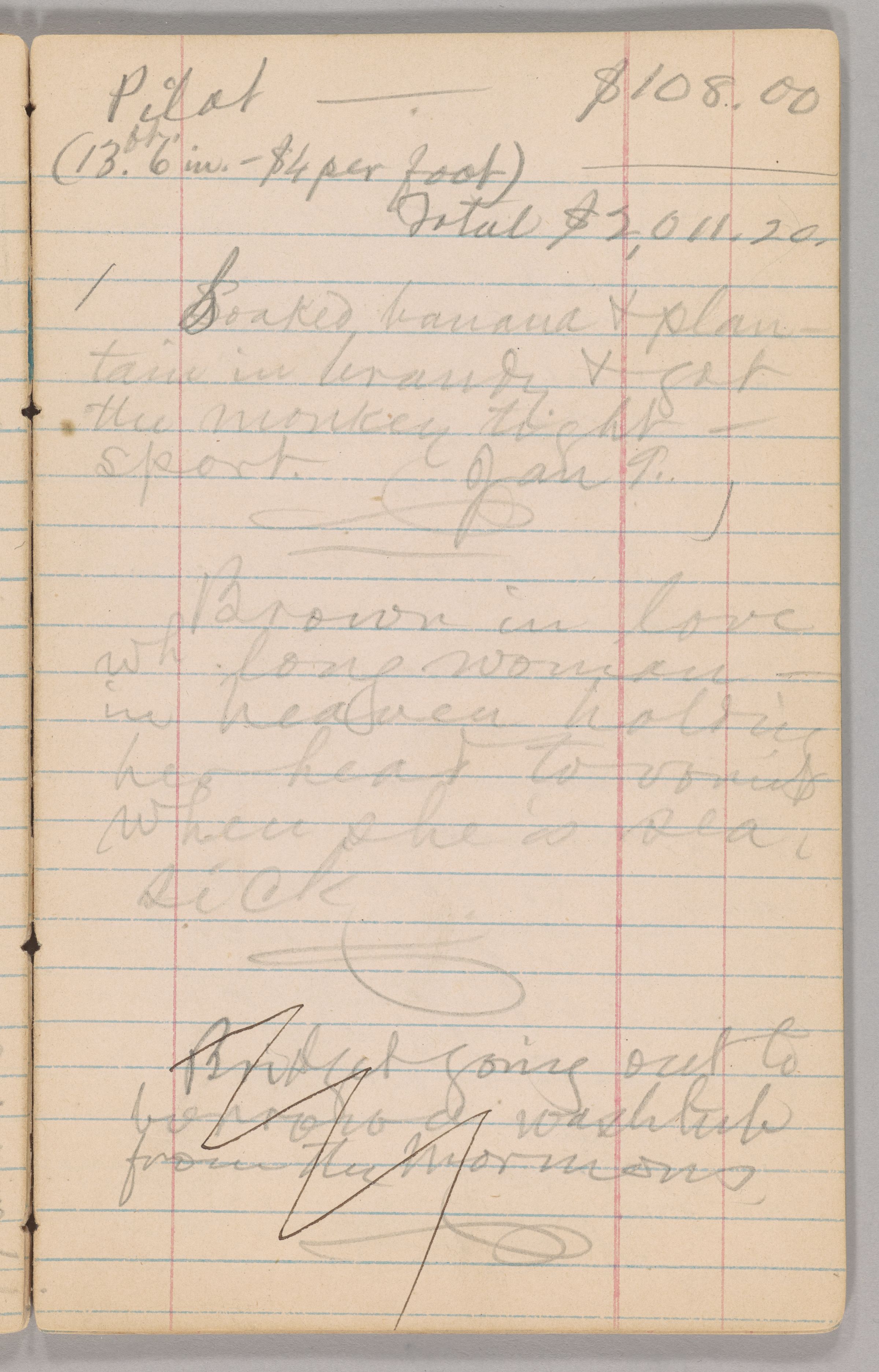
[MS: N7_leaf_087r]
| Pilot | $108.00 |
| (13. ft. 6 in.—$4 per foot) | ________ |
| Total | $2,011.20. |
Soaked banana &
plan-
tain
plantain
in brandy & got
the monkey tight—
sport. Jan 9.
Brown in love
wh long woman—
in heaven holding
her head to vomit
when she is
sea-
sick
sea-sick
[MTP: N&J1_293]
Bridget going out to
borrow a washtub
from the Mormons.
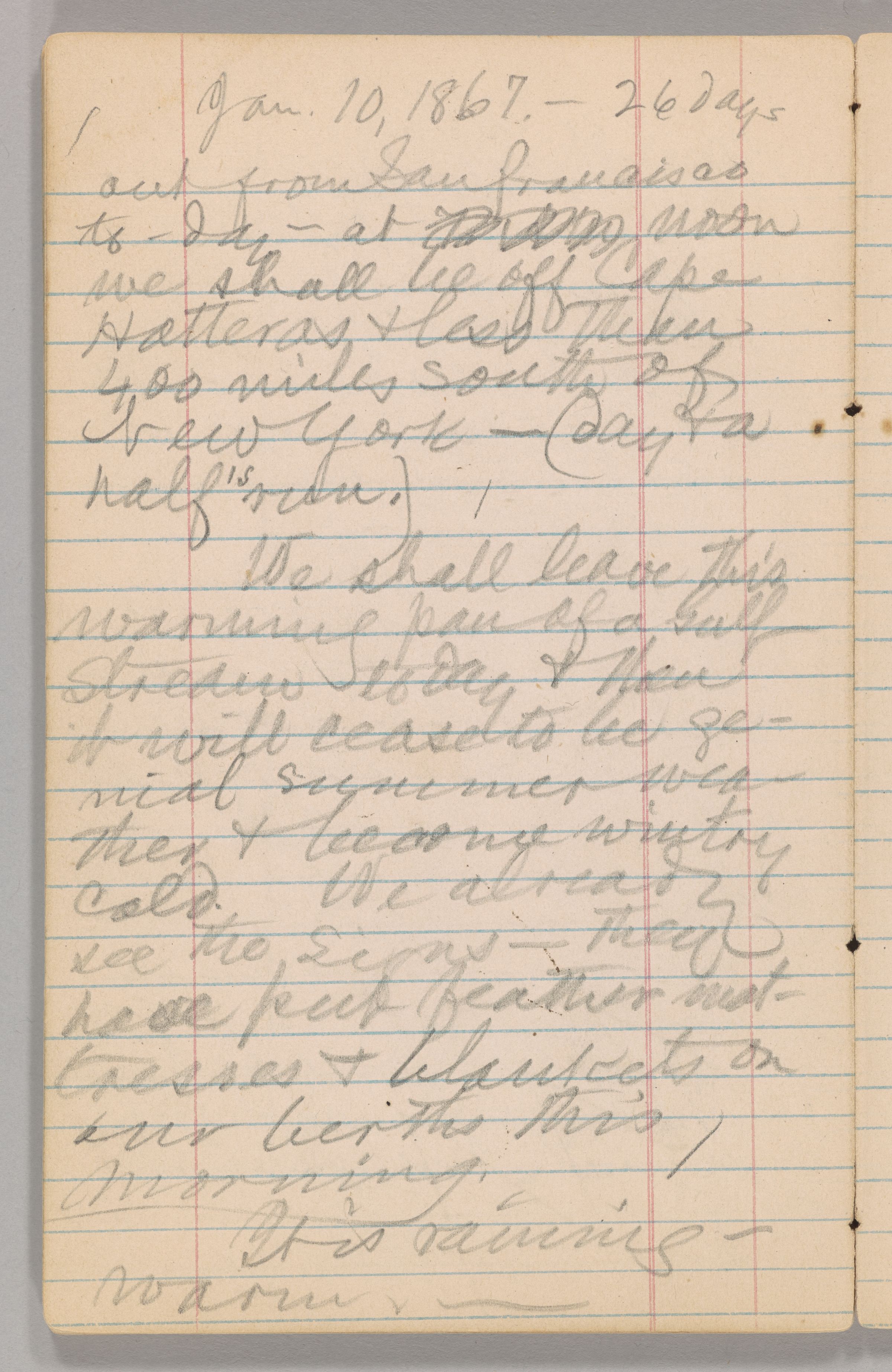
[MS: N7_leaf_087v]
Jan. 10, 1867.–26 days
out from Sanfrancisco
to-day—at 7 AM noon
we shall be off Cape
Hatteras & less than
400 miles south of
New York—(day & a
half's
run.)
We shall leave this
warming pan of a Gulf
Stream to-day & then
it will cease to be
ge-
nial
genial
summer
wea-
ther
weather
& become wintry
cold. We already
see the signs—they
have put feather
mat-
tresses
mattresses
& blankets on
our berths this
morning.
It is raining—
warm.
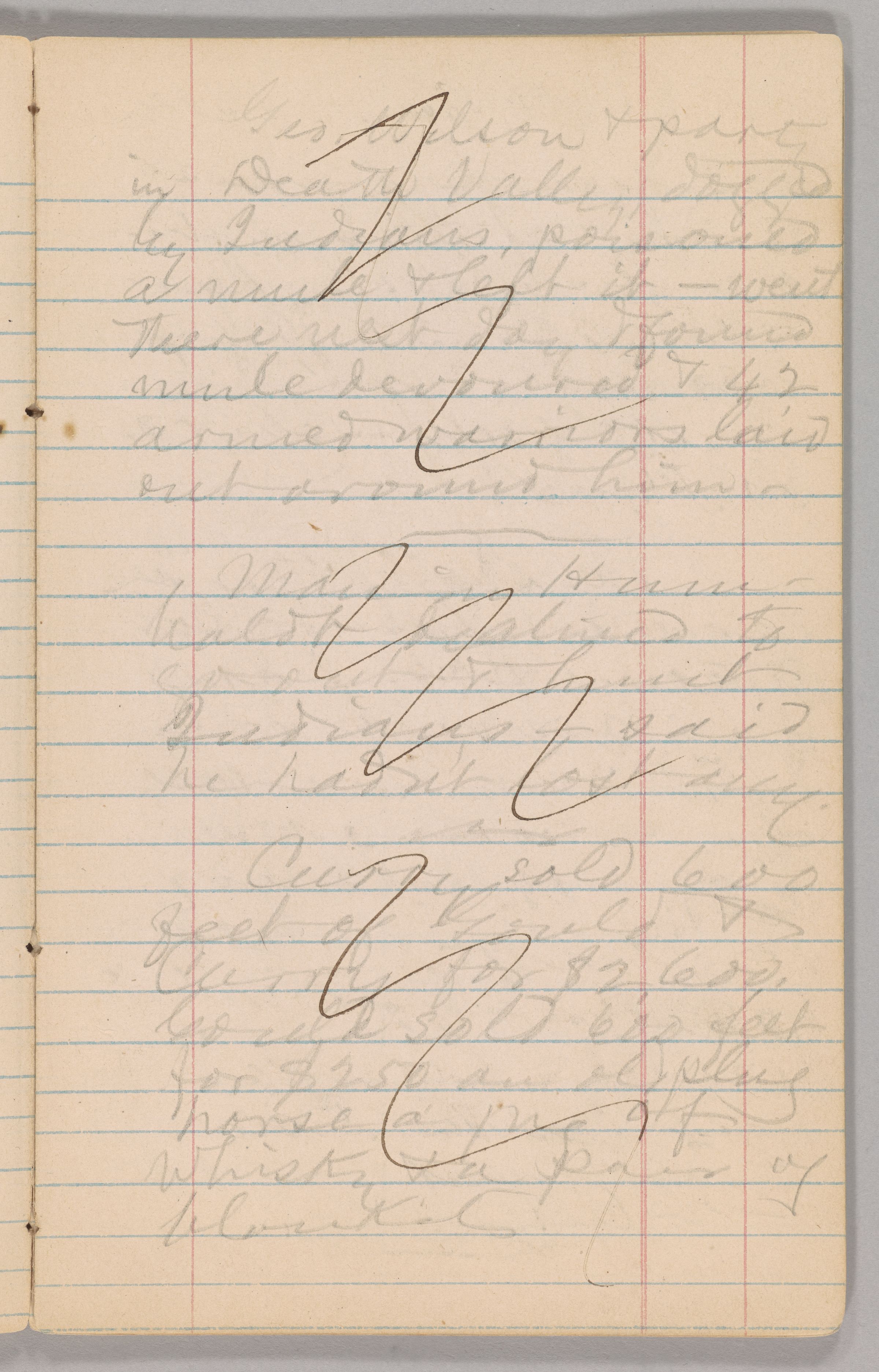
[MS: N7_leaf_088r]
Geo. Wilson & party
in Death Valley, dogged
by Indians, poisoned
a mule & left it—went
there next day & found
mule devoured & 42
armed warriors laid
out around him.
Man in
Hum-
boldt
Humboldt
declined to
go out & hunt
Indians—said
he hadn't lost any.
Curry sold 600
feet of Gould &
Curry for $2,600.
Gould sold 600 feet
for $250, an old plug
horse, a jug of
whisky & a pair of
blankets.
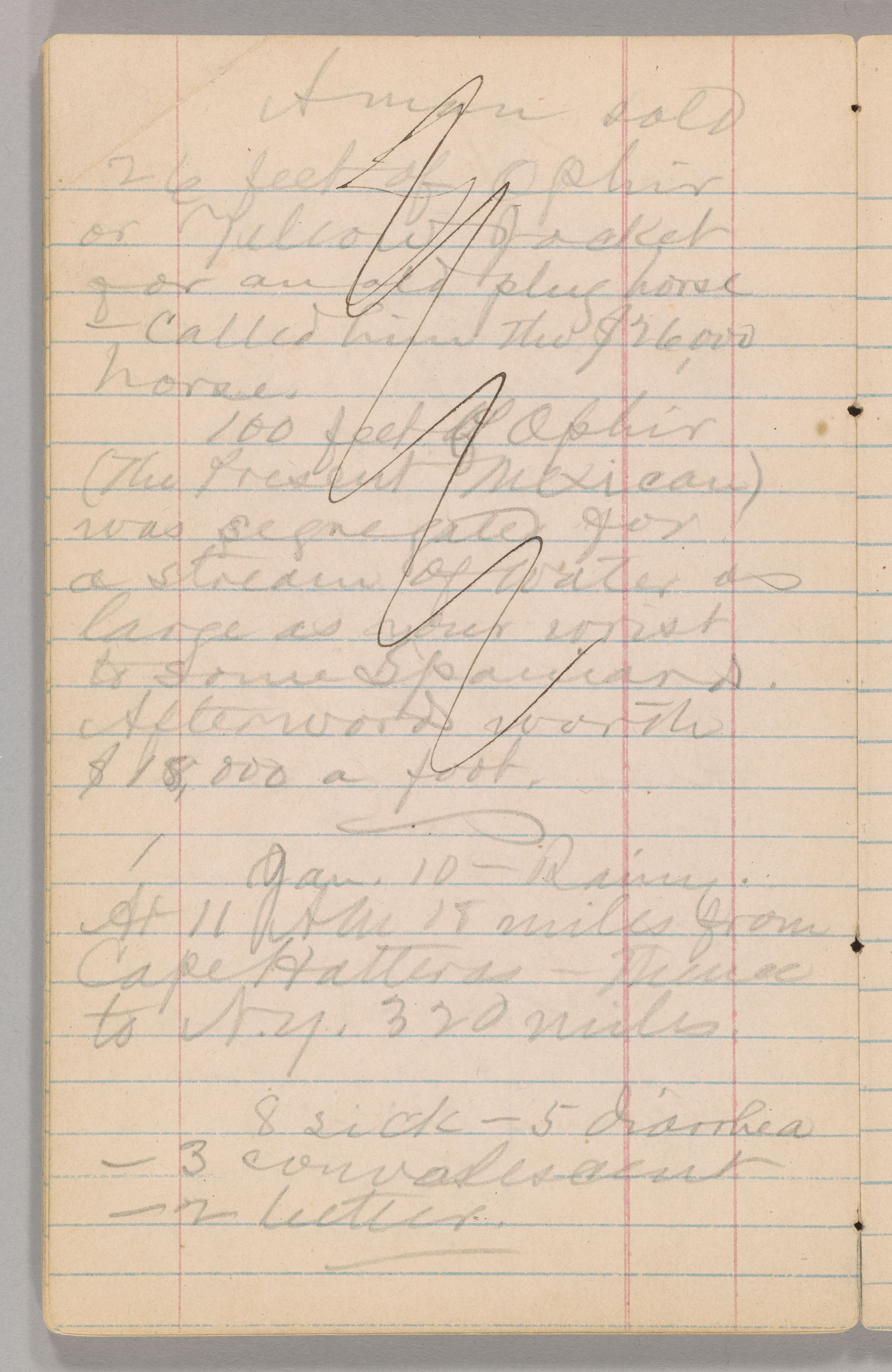
[MS: N7_leaf_088v]
A man sold
26 feet of Ophir
or Yellow Jacket
for an old plug horse
—called him the $26,000
horse.
[MTP: N&J1_294]
100 feet (of Ophir
(the present Mexican)
was segregated for
a stream of water as
large as your wrist
to some Spaniards.
Afterwards worth
$18,000 a foot.
Jan. 10—Rainy.
At 11 AM 18 miles from
Cape Hatteras—thence
to N.Y. 320 miles.
8 sick—5 diarrhea
—3 convalescent
—2 better.
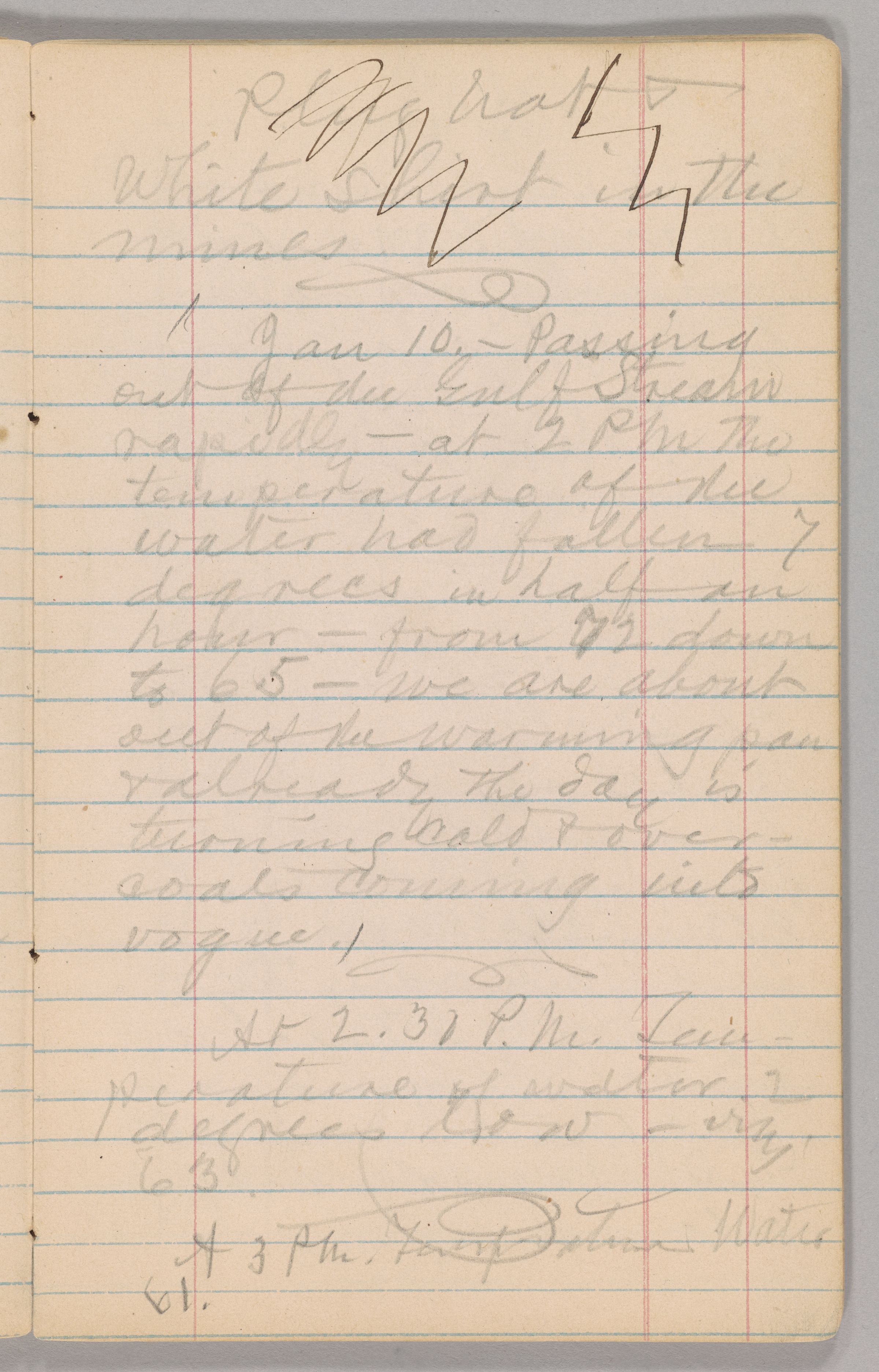
[MS: N7_leaf_089r]
Plug hat &
white shirt in the
mines.
Jan 10.—Passing
out of the Gulf Stream
rapidly—at 2 PM the
temperature of the
water had fallen 7
degrees in half an
hour—from
672down
to 65—we are about
out of the warming pan
& already the day is
turning cold & over-
coatsovercoats coming into vogue.
At 2.30 P.M. Tem-
peratureTemperature of water 2
degrees low—only
63.
A 3 PM. Temperature Water 61.
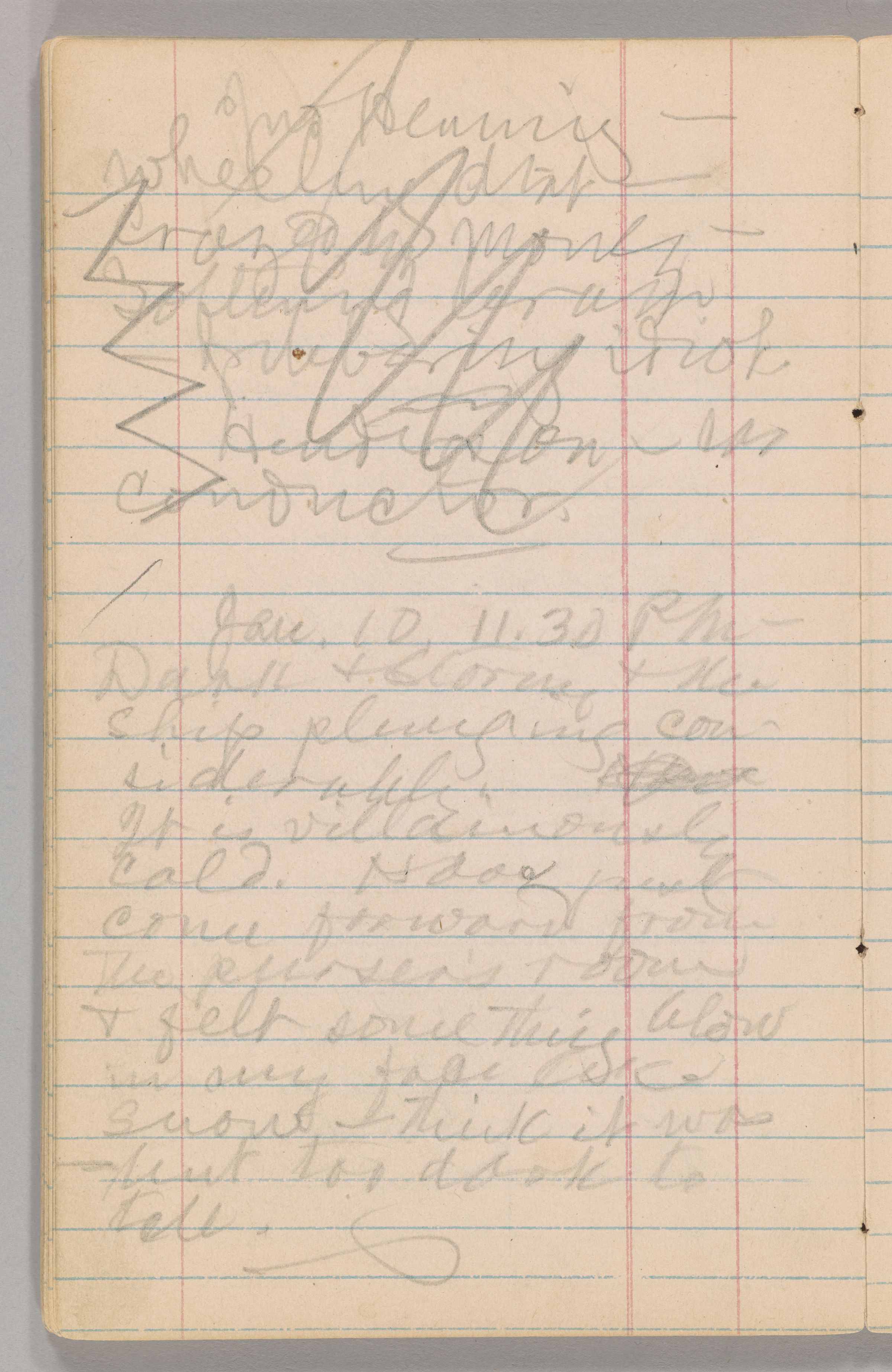
[MS: N7_leaf_089v]
Jno Henning—
wheeling dirt—
crazed by money—
Softening brain
—gibbering idiot.
Jan. 10, 11.30 PM—
Dark & stormy & the
ship plunging con-
siderablyconsiderably. Have
It is villainously
cold. Have just
come forward from
the purser's room
& felt something blow
in my face like
snow—think it was
—but too dark to
tell.
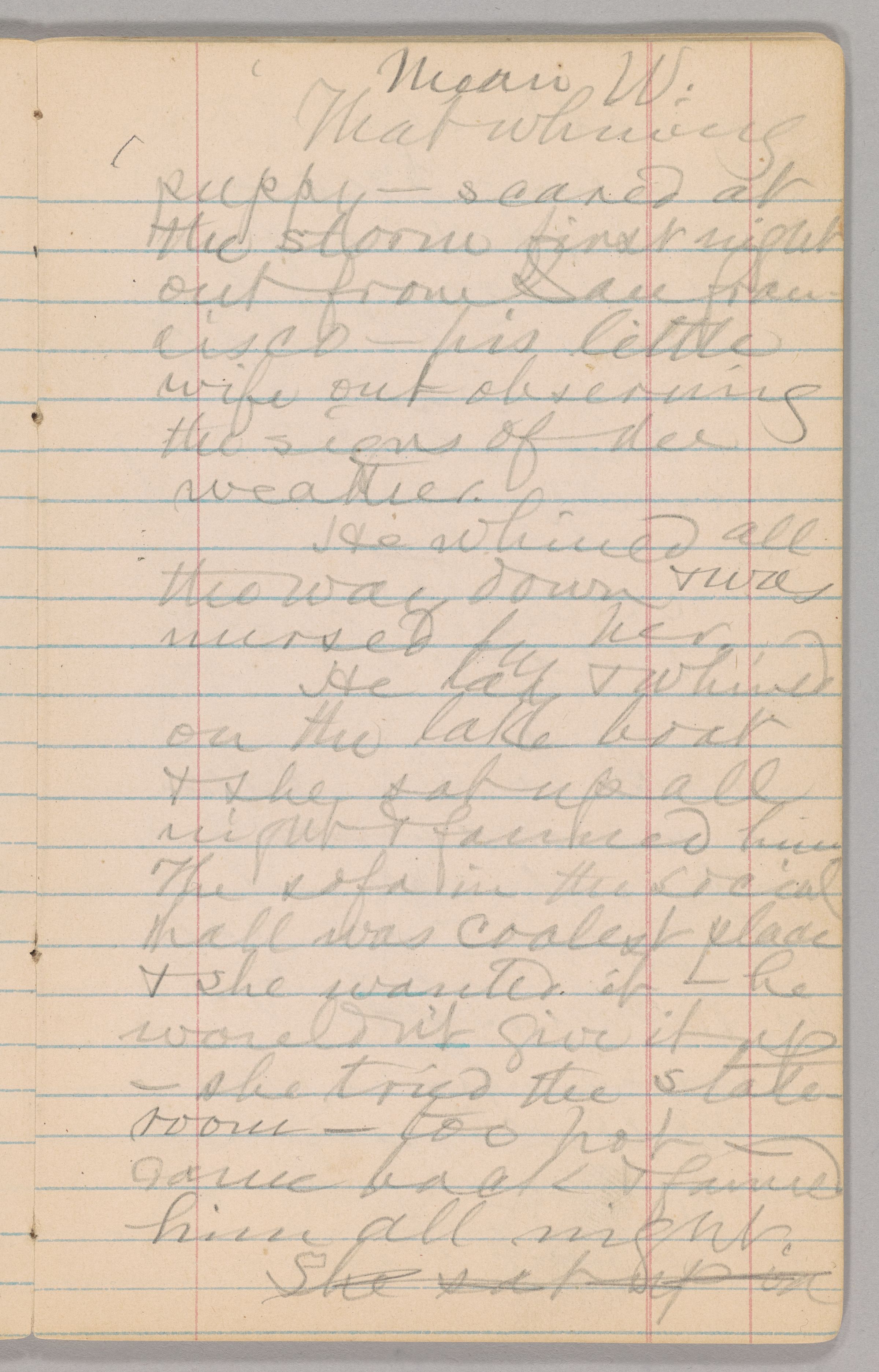
[MS: N7_leaf_090r]
[MTP: N&J1_295]
Mean W.
That whining
puppy—scared at
the storm first night
out from Sanfran-
ciscoSanfrancisco—his little
wife out observing
the signs of the
weather.
He whined all
the way down & was
nursed by her.
He lay & whined
on the lake boat
& she sat up all
night & fanned him.
The sofa in the social
hall was coolest place
& she wanted it—he
wouldn't give it up
—she tried the state-
roomstateroom—too hot—
came back & fanned
him all night.
She sat up in
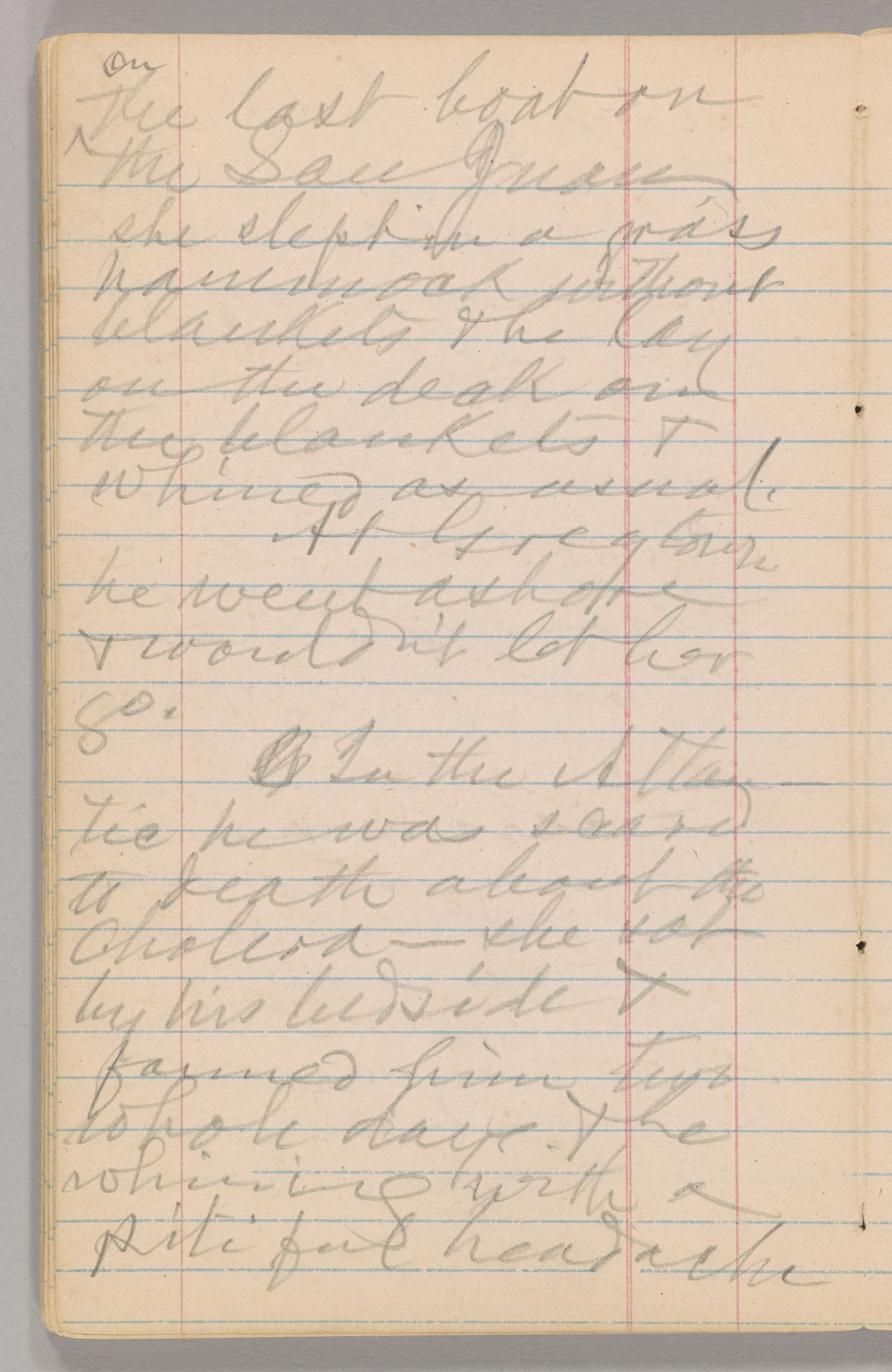
[MS: N7_leaf_090v]
Onthe last boat on
the San Juan,
she slept in a grass
hammock without
blankets & he lay
on the deck on
the blankets &
whined as usual.
At Greytown
he went ashore
& wouldn't let her
go.
I In the Atlan-
ticAtlantic he was scared
to death about the
cholera—she sat
by his bedside &
fanned him two
whole days & he
whining with a
pitiful headache
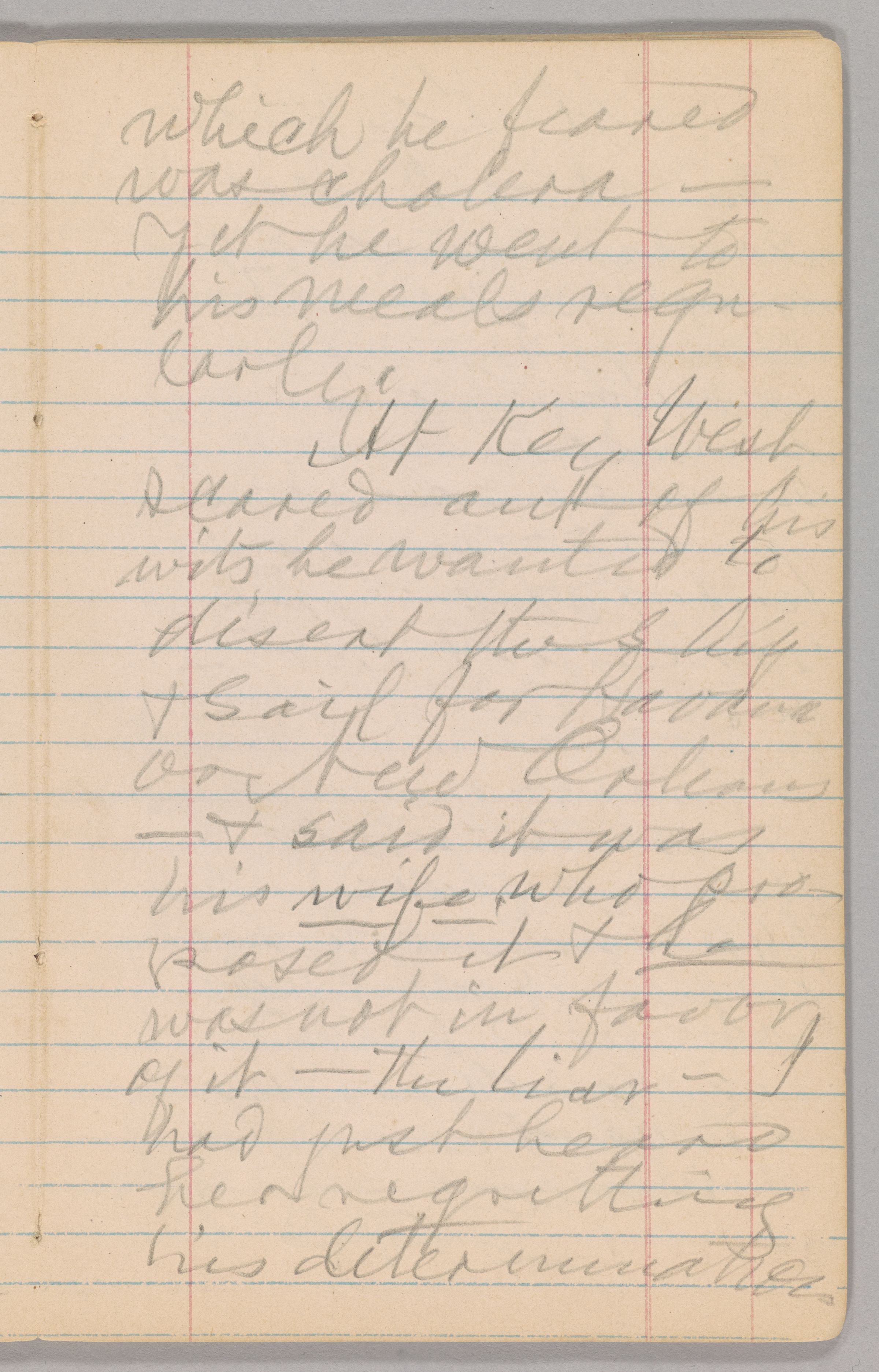
[MS: N7_leaf_091r]
which he feared
was cholera—
yet he went to
his meals regu-
larlyregularly.
At Key West
scared out of his
wits, he wanted to
desert the ship
& sail for Havana
or New Orleans
—& said it was
his wife who pro-
posedproposed it & he
was not in favor
of it—the liar—I
had just heard
her regretting
his determination
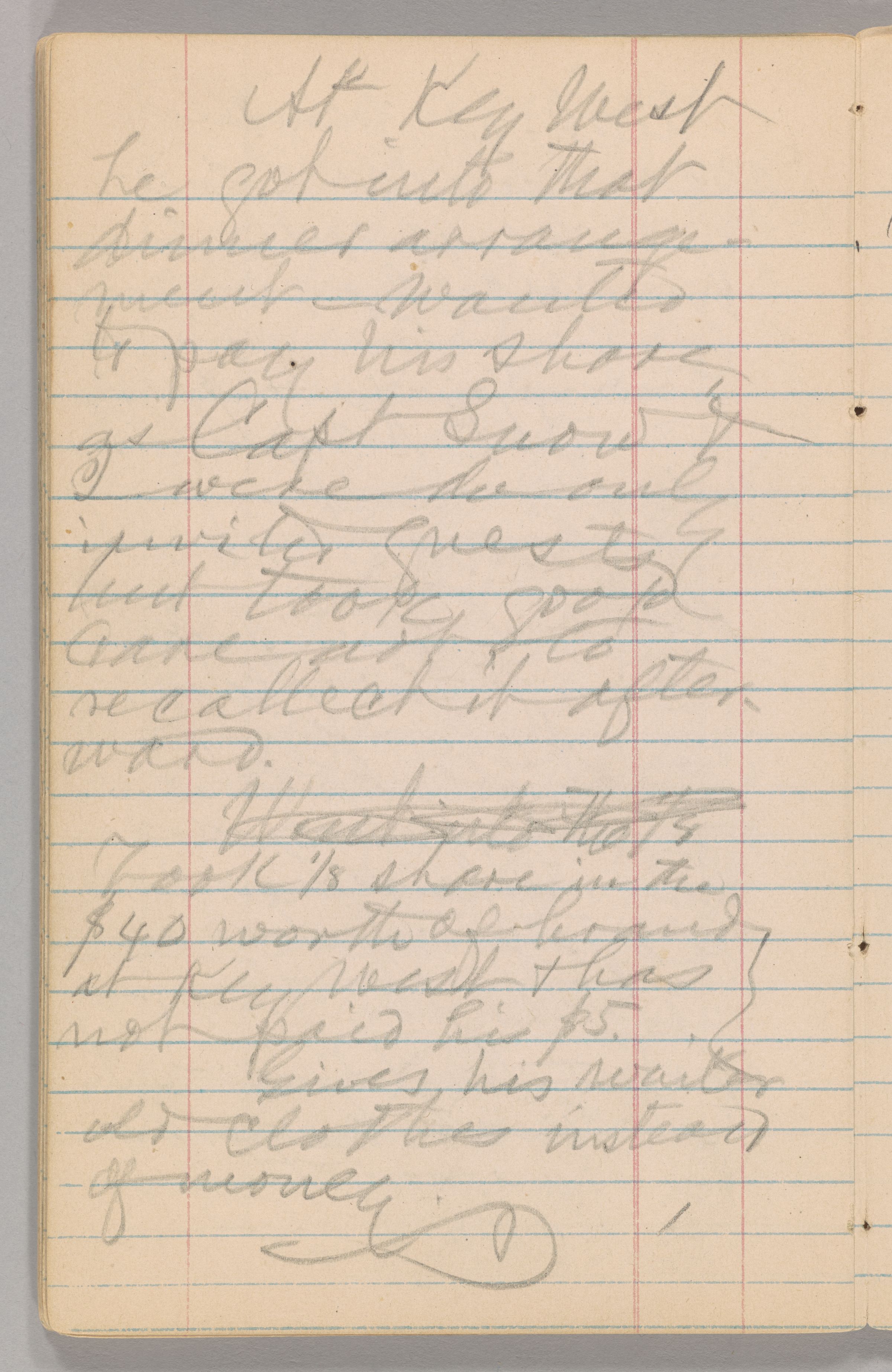
[MS: N7_leaf_091v]
At Key West
he got into that
dinner arrange-
mentarrangement—wanted
to pay his share,
as Capt Snow &
I were the only
invited guests
but took good
care not to
recollect it after-
wardafterward.
Went into the ⅛ Took ⅛ share in the
$40 worth of brandy
at Key West & has
not paid his $5.
Gives his waiter
old clothes instead
of money.
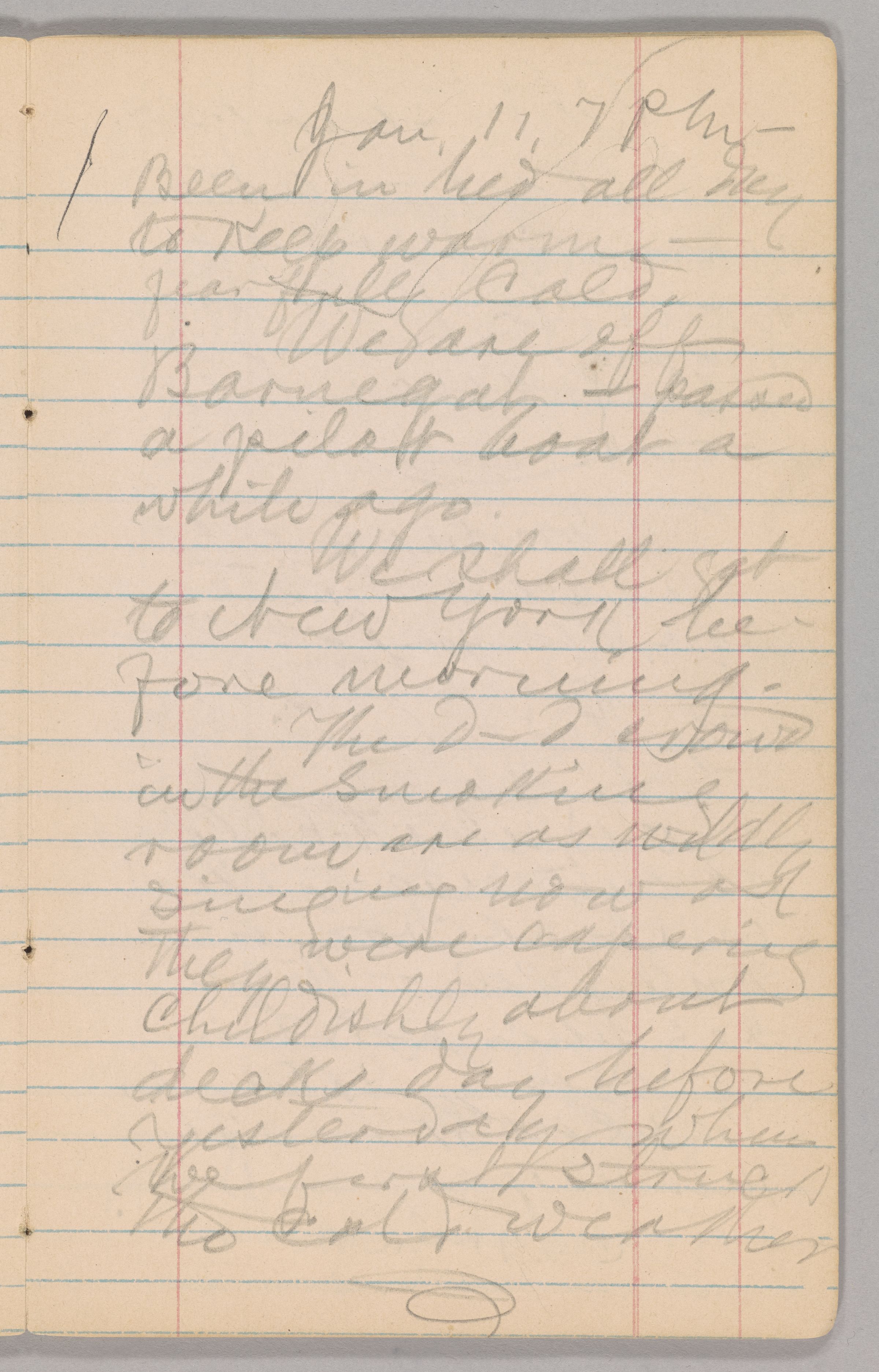
[MS: N7_leaf_092r]
Jan. 11, 7 PM—
Been in bed all day
to keep warm—
fearfully cold.
We are off
Barnegat—passed
a pilot boat a
while ago.
We shall get
to New York be-
forebefore morning.
The d—d crowd
in the smoking
room are as wildly
singing now as
they were capering
childishly about
deck day before
yesterday when
we first struck
the cold weather
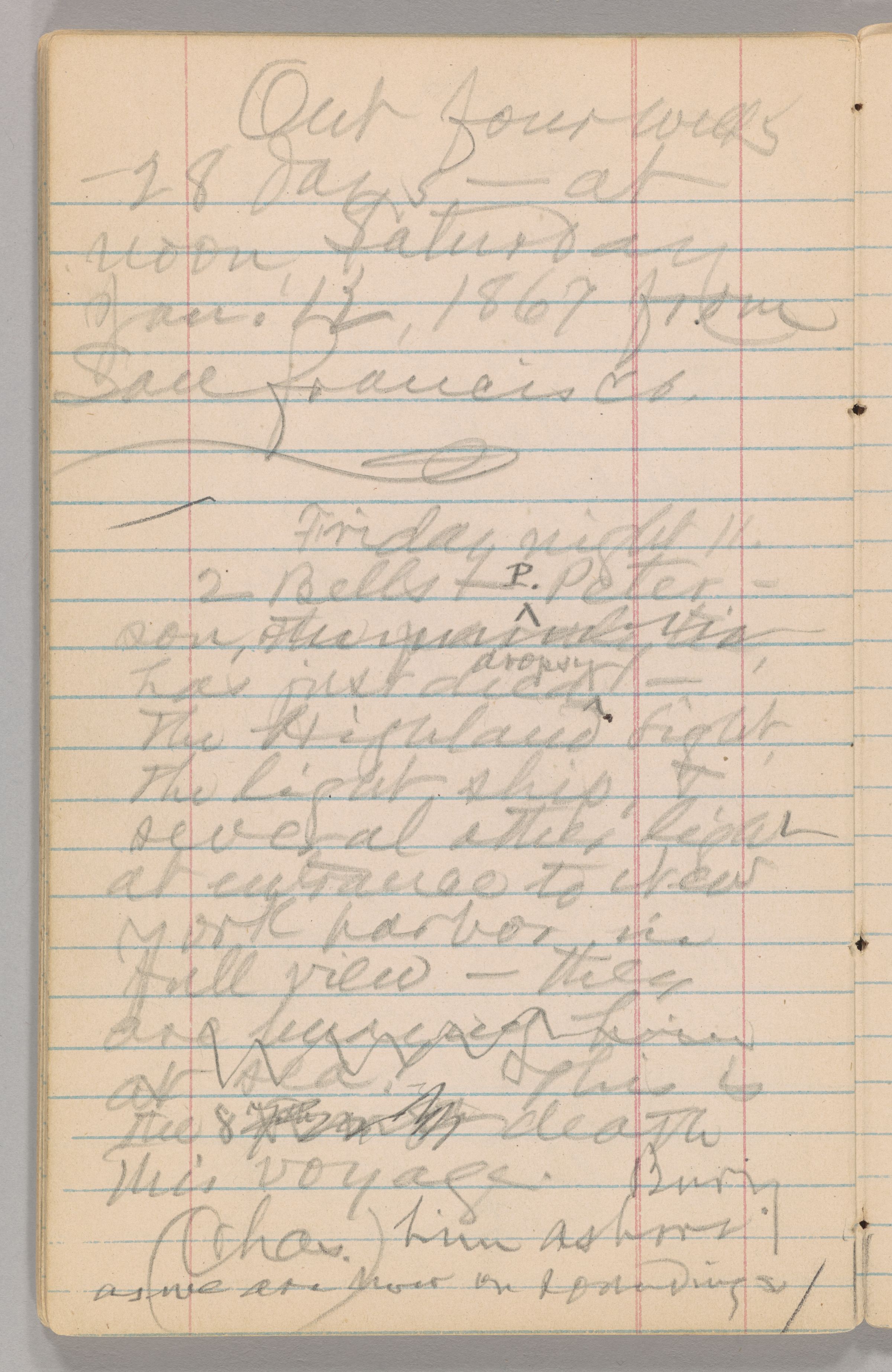
[MS: N7_leaf_092v]
[MTP: N&J1_296]
Out four weeks
—28 days—at
noon, Saturday
Jan. 12, 1867 from
Sanfrancisco.
Friday night 11.
2 Bells—P. Peter-
sonPeterson , the paralytic,
has just died dropsy—
the Highland Light,
the light ship, &
several other light
at entrance to New
York harbor in
full view—they
are burying him
at sea. This is
the
7th or 8th
8 death
this voyage. Bury
him ashore
as we are now on soundings.
(Chas.)
[MS: N7_leaf_093r]
Kingdom's can
di opposition candi-
datescandidates one of whom
got the other to write
him a little speech
—his sole canvass
capital—
Opp always
led off & always
rung in the little
speech & took
all the winds
out of his sails

[MS: N7_leaf_093v]
blank verso
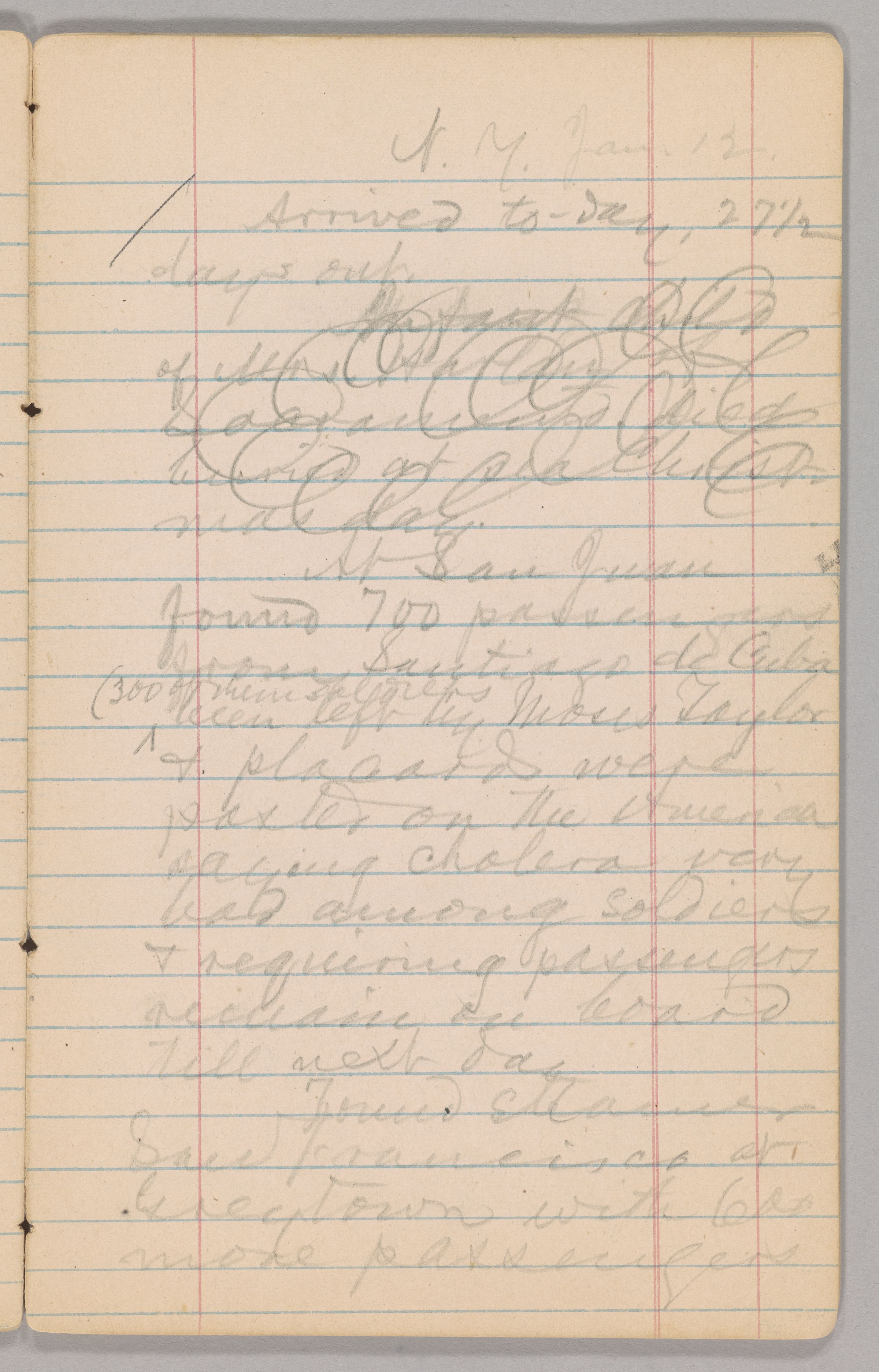
[MS: N7_leaf_094r]
Arrived to-day, 27½
days out.
Infant child
of Mrs. Harlan of
Sacramento died
buried at sea Christ-
masChristmas day.
At San Juan
found 700 passengers
from Santiago de Cuba
(300 of them soldiers been left by Moses Taylor
& placards were
posted
[MTP: N&J1_297] on the America
saying cholera very
bad among soldiers
& requiring passengers
remain on board
till next day
Found steamer
San Francisco at
Greytown with 600
more passengers
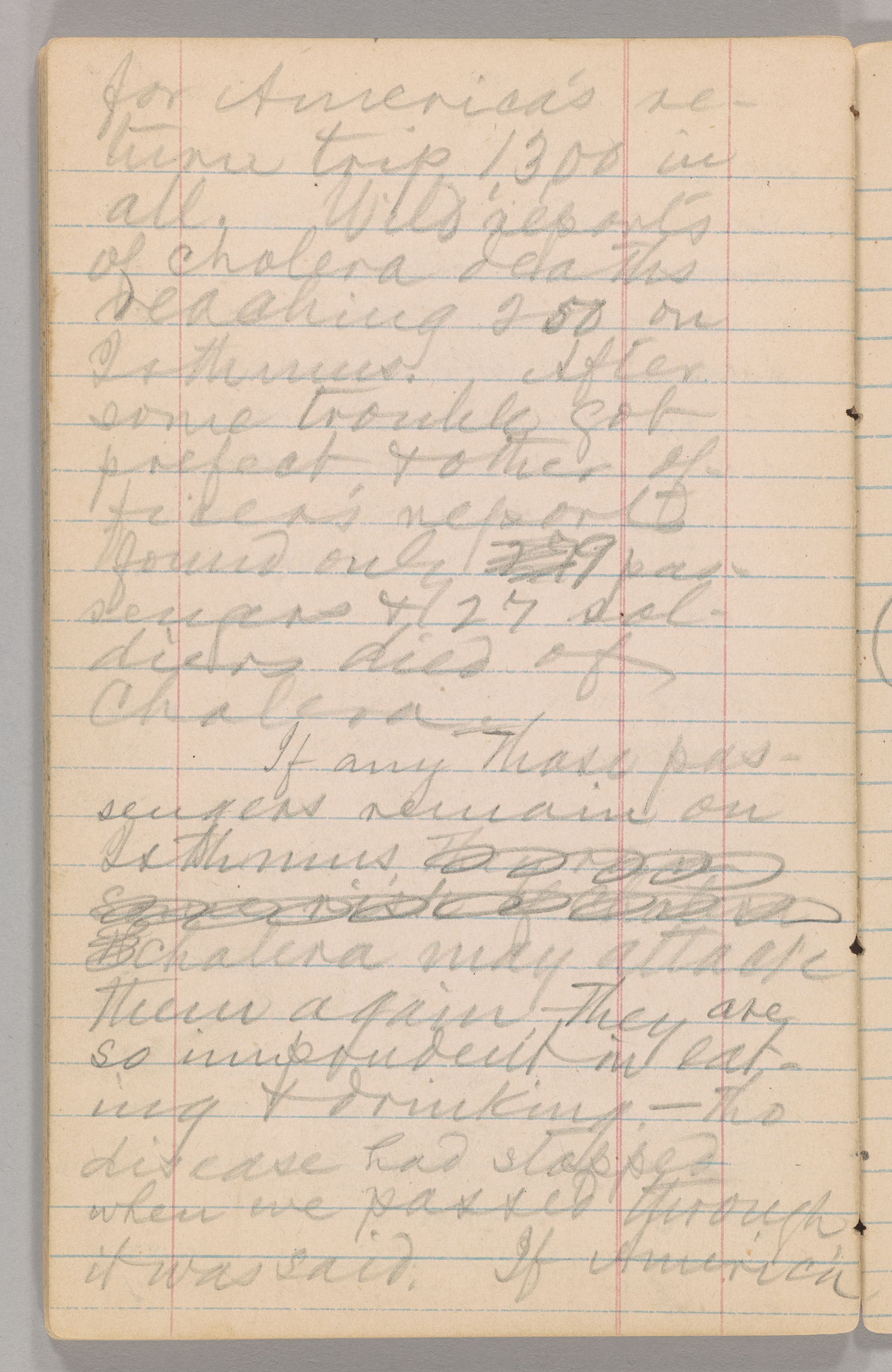
[MS: N7_leaf_094v]
for America's re-
turnreturn trip 1,3,00 in
all. Wild reports
of cholera deaths
reaching
20050on
Isthmus. After
some trouble got
prefect & other of-
ficer'sofficer's reports
found only 27 9 pas-
sengerspassengers & 27 sol-
dierssoldiers died of
Cholera.
If any those pas-
sengerspassengers remain on
Isthmus, they run
some risk of cholera
th cholera may attack
them again,—they are
so imprudent in eat-
ingeating & drinking,—tho
disease had stopped
when we passed through,
it was said. If America
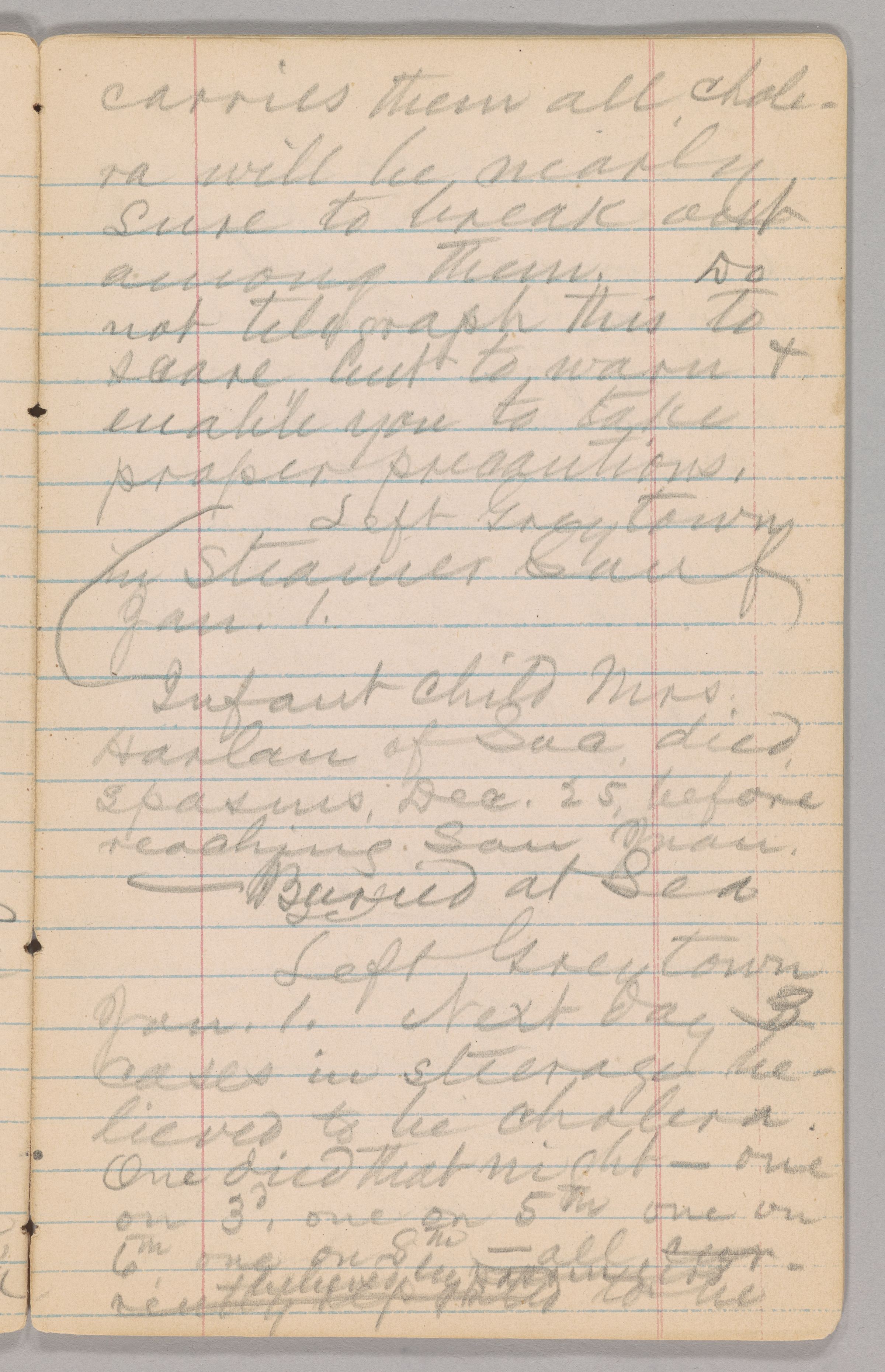
[MS: N7_leaf_095r]
carries them all, chole-
racholera will be nearly
sure to break out
among them. Do
not telegraph this to
scare, but to warn &
enable you to take
proper precautions.
Left Greytown
in Steamer Sanf
Jan. 1.
[MTP: N&J1_298]
Infant child Mrs.
Harlan of Sac, died,
spasms, Dec. 25, before
reaching San Juan.
—Buried at Sea
Left Greytown
Jan. 1. Next day 2 3
cases in steerage be-
lievedbelieved to be cholera.
One died that night—one
on 3d, one on 5th one on
6th, one on 8th—all
cur-
rentlycurrently reported believed by passengersto be
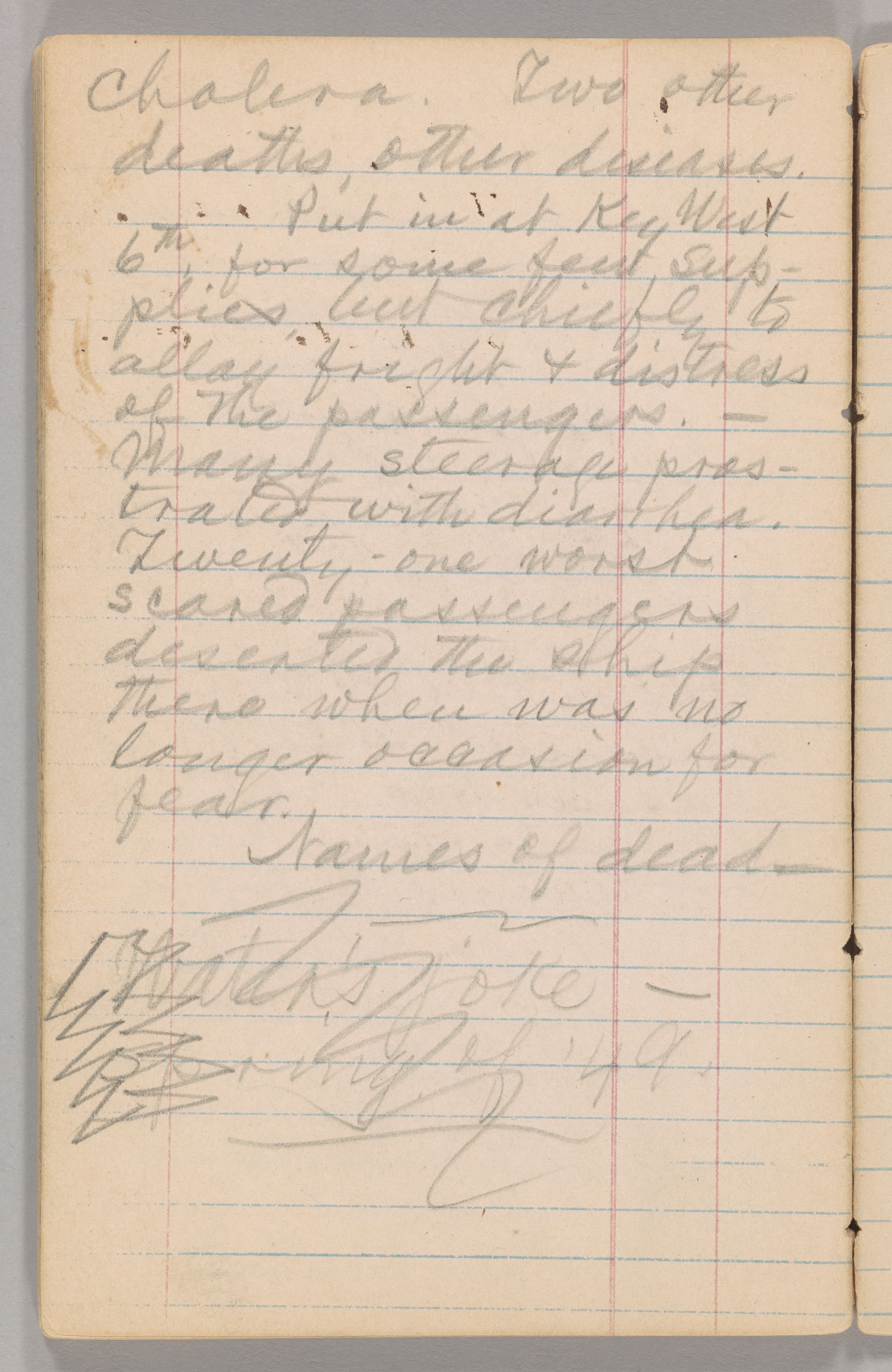
[MS: N7_leaf_095v]
cholera. Two other
deaths, other diseases.
Put in at Key West
6th, for some few sup-
pliessupplies, but chiefly to
allay fright & distress
of the passengers.—
Many steerage pros-
tratedprostrated with diarrhea.
Twenty-one worst
scared passengers
deserted the ship
there when was no
longer occasion for
fear.
Names of dead—
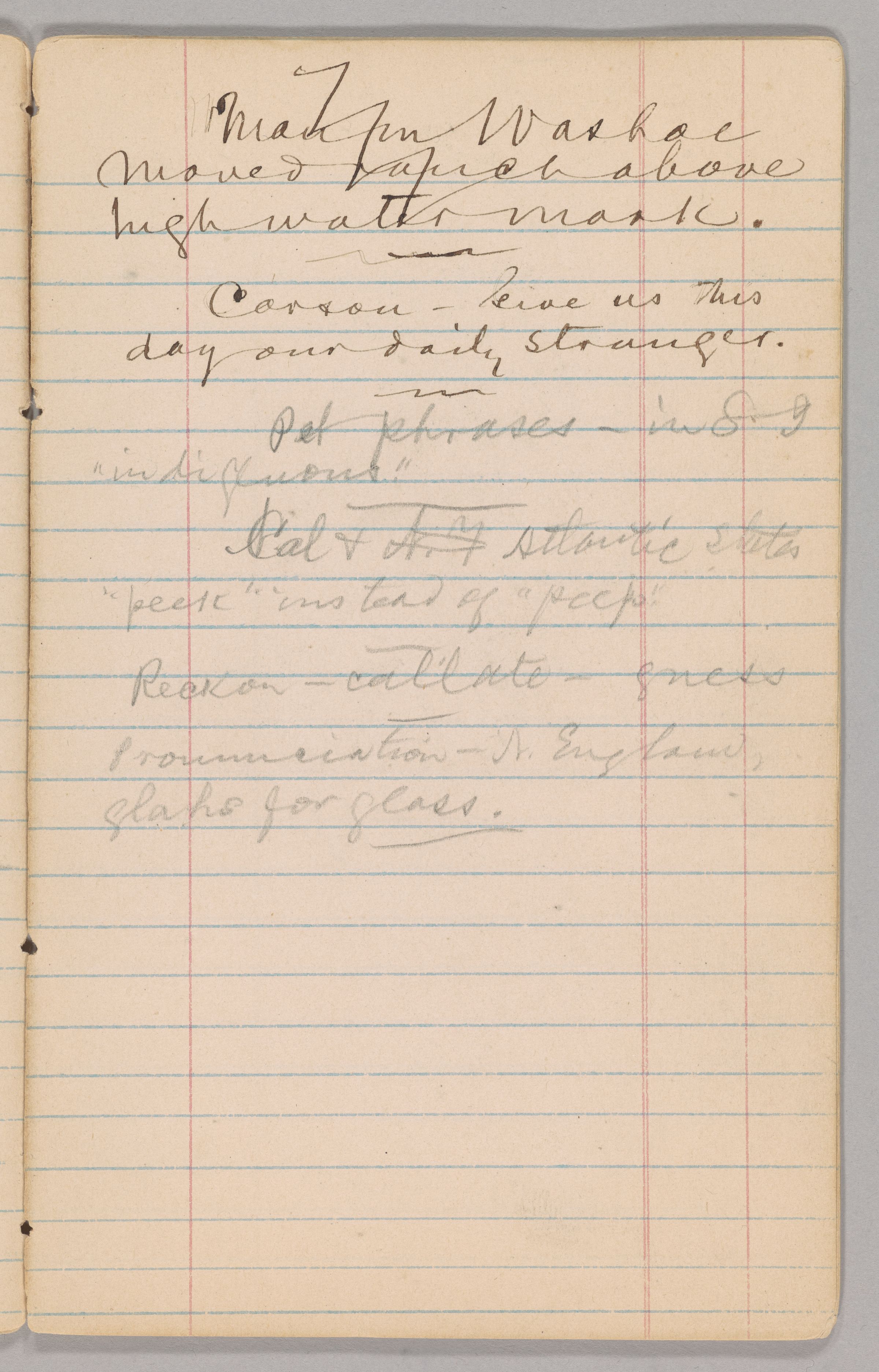
[MS: N7_leaf_096r]
Man in Washoe
moved ranch above
high water mark.
Carson—Give us this
day our daily stranger.
Pet phrases—in S I
“indigenous.”
N.Cal & N.Y Atlantic states
“peek” instead of “peep.”
Reckon—cal'late—guess
Pronunciation—N. England,
glahs for glass.
twenty-four blank pages follow leaf_096r
the following three pages are presented in the sequence in which Clemens inscribed them, beginning at the back of the notebook
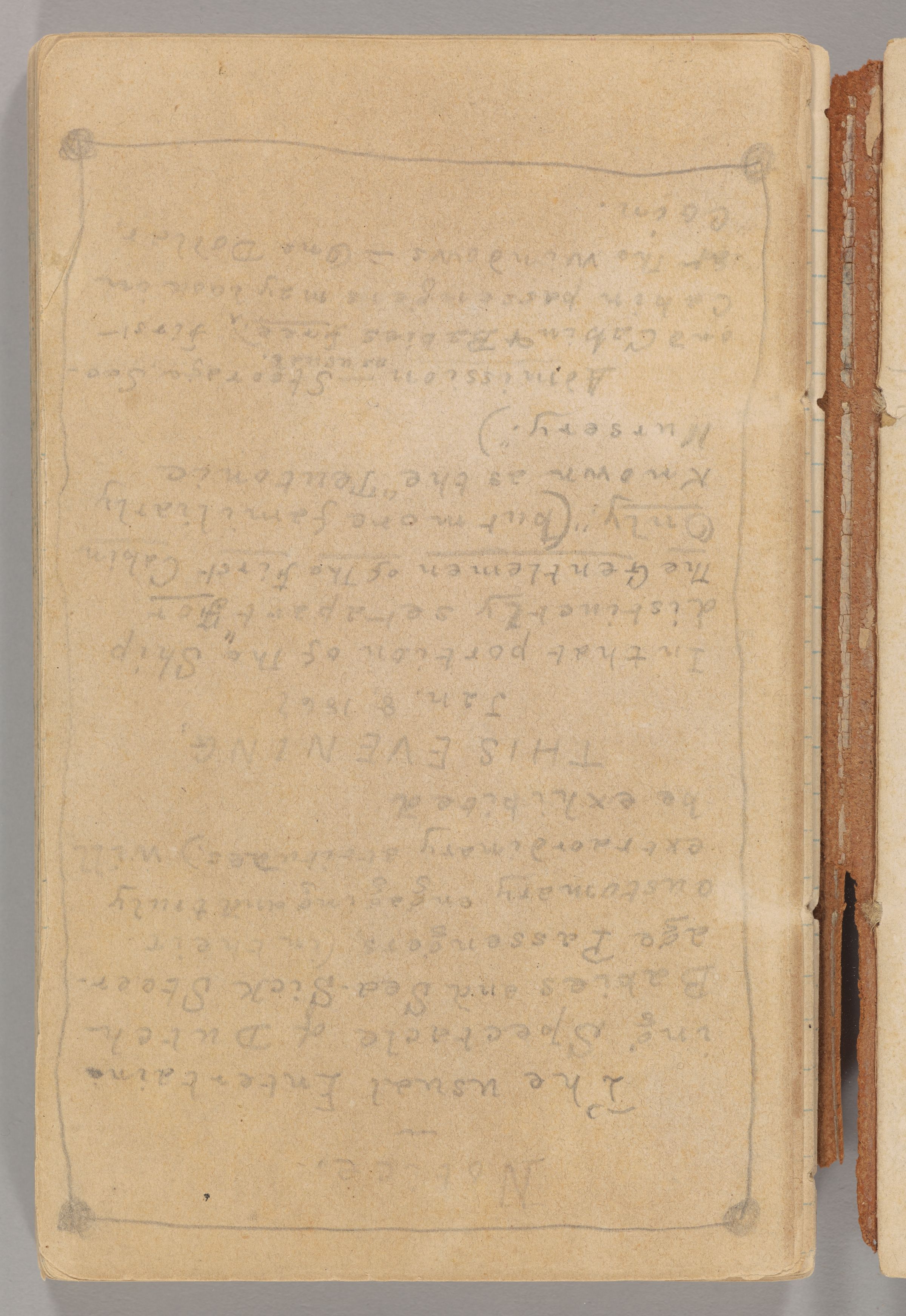
[MS: N7_back flyleaf verso]
[MTP: N&J1_299]
The usual Entertain-
ingEntertaining Spectacle of Dutch
Babies and Sea-Sick Steer-
ageSteerage Passengers, (in their
customary engaging and truly
extraordinary attitudes,) will
be exhibited
THIS EVENING,
Jan. 8, 1867.
In that portion of the Ship
distinctly set apart “For
the Gentlemen of the First Cabin
Only,” (but more familiarly
known as the “Teutonic
Nursery.”)
Admission—Steerage, Sec-
ondSecond Cabin & Babies
free. as usual. First
Cabin passengers may look in
at the windows—One Dollar,
coin.

[MS: N7_back flyleaf recto]
blank recto
[MS: N7_leaf_108v]
[MS: N7_back endpaper]
Song “Pass Under
the Rod,”
2 cases 2d—
[MS: N7_back cover]
In The Log of an Ancient Mariner (p. 240) Wakeman claimed that on a voyage from San Francisco to New York he “invented the best detaching gear, to let go a boat from the davits, that has ever been invented.” Just before this voyage Wakeman apparently tried to interest the America's proprietors in his device, for on 12 December 1866 William H. Webb, president of the North American Steamship Company wrote him:
Should be pleased to see model (if already made) of your plan of sending down topmasts, disengaging boats etc, but do not wish you to incur the expense of models etc expressly to be sent here, for many such arrangements are now before us here. (Edgar Wakeman Papers, San Francisco Public Library)
Although Mark Twain admitted in the Alta California that “we used to be very regular about getting the room crammed full of cigar-smoke and boys, and listening to the purser's infamous old stories, and playing pitch seven-up till mid-night” ( MTTB , p. 62), he described a more solemn Christmas Eve than this entry suggests:
It has been an exceedingly quiet Christmas Eve, to-day. It is because a young child of one of the cabin passengers is lying very ill—suddenly taken last night—and so no one is willing to be noisy, or even passably cheerful, for that matter. All act as if they were related by blood to the child. And it is natural it should be so—a ship's passengers on a long voyage become as one family. ( MTTB , p. 34)
Although he misdated his note, Mark Twain evidently made it from the following notice, which appeared in the New York Tribune on 17 December 1866 as part of a telegraphic dispatch from San Francisco:
Over $300,000 was paid out in dividends to-day. The mines located on the Comstock lead and silver ores are yielding immense quantities of bullion. During the months of November and December, the dividends of six principal mines amounted to $519,000; and the yield of ten mines during October and November amounted to over $2,000,000.
The steamship San Francisco, which Mark Twain boarded in Greytown for the final leg of this trip, undoubtedly had copies of recent New York newspapers, including this issue of the Tribune.
A similar episode had apparently taken place aboard the America at the outset of the voyage from San Francisco. Mark Twain reported to the Alta California ( MTTB , p. 21) that “Broad-shouldered, kinky-haired Isaac”
writes cards for a living, and came on board with a pack ready written and elaborately decorated with the familiar old tiresome flowers, cupids and birds of unknown species, for half the officers of the ship—and was surprised to learn that nautical etiquette forbade those gentlemen to accept of presents from passengers. He offered Captain Waxman . . . a meerschaum pipe (bogus) and was utterly confounded at its non-acceptance.
In the Alta California ( MTTB , p. 26), Mr. Brown makes similar remarks about one of the America's passengers, attributing them to “old Slimmens”:
She says she knew that innocent old fat girl that's always asleep and has to be shovelled out of her room at four-bells for the inspection, and always eats till her eyes bug out like the bolt-heads on a jail door . . . and knows the clothes she's got on now she's travelled in eleven weeks without changing—says her stockings are awful—they're eleven weeks gone, too—and when she complained of the weather being so hot, old Slimmens said “Why don't she go and scrape herself and then wash—it would be equal to taking off two suits of flannel!”
Mark Twain's telegram undoubtedly aggravated fear of a cholera epidemic in San Francisco. On 16 January 1867, the Alta California found it necessary to refute “Exaggerated Rumors” that the America had arrived the previous day carrying cholera which had “killed two hundred and fifty of her passengers.” The America did not actually arrive until about 12:30 a.m. on 17 January. That day the San Francisco quarantine officer reported:
Of the thousand passengers on board, five soldiers and four civilians died of cholera on the passage . . . the condition of the vessel is very favorable, but as a matter of precaution it is deemed necessary to put her in quarantine. The passengers will be landed at Saucelito, and sheltered by tents. . . . The number of days for the quarantine is not yet determined. (Alta, 17 January 1867)
Despite this uncertain conclusion, on 18 January the Alta could report that “no real Asiatic cholera exists at this time among the passengers, civilians, or soldiers.” Plans for a prolonged quarantine were abandoned, and by unanimous vote of the San Francisco Board of Health steam tugs were allowed to disembark cabin passengers in San Francisco on 18 January and steerage passengers the following day.