(11 August–11 October 1867)
The last dated entry in Notebook 8 (2 July 1867) left Clemens at sea, bound for Marseilles, while the entry bearing the earliest date in Notebook 9 (11 August 1867) marks his departure from the harbor of Naples. A notebook was certainly kept for the intervening period, but no evidence refutes Paine’s surmise that the “notes of this period are lost. We shall never know just what memoranda he made on the spot of the doings” of his companions as they traveled to Paris, Genoa, “then by rail through Italy to Milan, Venice, Florence and the rest, joining the ship again at Naples” ( MTN , p. 69). However, Mark Twain did include two references to this missing notebook in The Innocents Abroad. An engraving in chapter 19 ostensibly reproduces two pages from the notebook, even though the reproduction is obviously not a facsimile. On the right-hand page of an open notebook appears:
Picture by Titian in the Cathedral—
subject forgotten
size of a slate—
Priest said History of it was very curious
It was painted in the dark—
Train leaves at 10 AM—
October one unrecoverable word
On the left-hand page are the pencil dots recording the “astonishing clatter of reverberations” of “the most remarkable echo in the world” that Mark Twain witnessed just outside Milan. When Clemens saw specimen illustrations for Innocents in April 1869, he wrote Elisha Bliss: “Your idea about the ‘Echo’ diagram is correct—glad it is to be engraved” ( MTLP , p. 19). It is conceivable that Clemens sent his original notebook to the engraver, who failed to return it. A passage in chapter 24 of Innocents indicates that the notebook was lost subsequent to the writing of the book: the travelers “were a little fatigued with sight seeing, and so we rattled through a good deal of country by rail without caring to stop. I took few notes. I find no mention of Bologna in my memorandum book, except that we arrived there in good season, but saw none of the sausages for which the place is so justly celebrated.”
Notebook 9 takes Clemens through the remainder of the itinerary for the excursion, concluding with his departure from Alexandria and the voyage back through the Mediterranean, but omits all details of his brief trip through Spain, the Atlantic crossing, the stopover in Bermuda, and the arrival in New York on 19 November 1867. “We were all lazy and satisfied, now,” Clemens wrote in chapter 59 of Innocents, “as the meager entries in my note-book (that sure index, to me, of my condition,) prove. What a stupid thing a note-book gets to be at sea, any way.” Then, to make up for the absence of notebook entries or Alta letters covering the final stages of the journey, Mark Twain created a passage that he represented as a transcription from his notebook:
Sunday—Services, as usual, at four bells. Services at night, also. No cards.
Monday—Beautiful day, but rained hard. The cattle purchased at Alexandria for beef ought to be shingled. Or else fattened. The water stands in deep puddles in the depressions forward of their after shoulders. Also here and there all over their backs. It is well they are not cows—it would soak in and ruin the milk. The poor devil eagle from Syria looks miserable and droopy in the rain, perched on the forward capstan. He appears to have his own opinion of a sea voyage, and if it were put into language and the language solidified, it would probably essentially dam the widest river in the world.
Tuesday—Somewhere in the neighborhood of the island of Malta. Can not stop there. Cholera. Weather very stormy. Many passengers seasick and invisible.
Wednesday—Weather still very savage. Storm blew two land birds to sea, and they came on board. A hawk was blown off, also. He circled round and round the ship, wanting to light, but afraid of the people. He was so tired, though, that he had to light, at last, or perish. He stopped in the foretop, repeatedly, and was as often blown away by the wind. At last Harry caught him. Sea full of flying-fish. They rise in flocks of three hundred and flash along above the tops of the waves a distance of two or three hundred feet, then fall and disappear.
Thursday—Anchored off Algiers, Africa. Beautiful city, beautiful green hilly landscape behind it. Staid half a day and left. Not permitted to land, though we showed a clean bill of health. They were afraid of Egyptian plague and cholera.
Friday—Morning, dominoes. Afternoon, dominoes. Evening, promenading the deck. Afterwards, charades.
Saturday—Morning, dominoes. Afternoon, dominoes. Evening, promenading the decks. Afterwards, dominoes.
Sunday—Morning service, four bells. Evening service, eight bells. Monotony till midnight.—Whereupon, dominoes.
Monday—Morning, dominoes. Afternoon, dominoes. Evening, promenading the decks. Afterward, charades and a lecture from Dr. C. Dominoes.
No date—Anchored off the picturesque city of Cagliari, Sardinia. Staid till midnight, but not permitted to land by these infamous foreigners. They smell inodorously—they do not wash—they dare not risk cholera.
Thursday—Anchored off the beautiful cathedral city of Malaga, Spain.—Went ashore in the captain’s boat—not ashore, either, for they would not let us land. Quarantine. Shipped my newspaper correspondence, which they took with tongs, dipped it in sea water, clipped it full of holes, and then fumigated it with villainous vapors till it smelt like a Spaniard. Inquired about chances to run the blockade and visit the Alhambra at Granada. Too risky—they might hang a body. Set sail—middle of afternoon.
And so on, and so on, and so forth, for several days. Finally, anchored off Gibraltar, which looks familiar and home-like.
Although the passage is arbitrarily dated, and although Clemens inadvertently placed Algiers ahead of Cagliari on the itinerary, the facts are essentially as he presents them. Mark Twain borrowed several details—the storm, the land birds blown to sea, and the flying fish—from Notebook 9. Although not a genuine notebook entry, the passage approximates what Clemens would have written if he had kept a record of the trip through the Mediterranean.
It had been an exhausting two months since the group had left Italy in early August, proceeding south past Sicily through the western isles of Greece to arrive finally at Athens. Encountering a strict quarantine for cholera, the party sailed almost immediately for Constantinople, although not before Clemens and three comrades made a surreptitious midnight excursion to the Acropolis. After three days in Constantinople most of the passengers sailed through the Bosporus to the Black Sea, and then visited Sebastopol, Odessa, and finally Yalta, where they were received by Czar Alexander II. Returning to Constantinople, they encountered a five-day delay for coaling and so saw more of the city than they had planned. But by early September they were bound for Smyrna, took a side trip to the ruins of Ephesus in their first encounter with ancient, biblical ground. By September 10 they had arrived in Beirut and the Holy Land, the climax of their voyage to the East. Despite unforeseen complications about transportation and routes, they soon divided into several small parties with itineraries to suit their members’ varying tastes for roughing it. Clemens joined with Dr. Birch and William Denny (who had both gone along on the moonlight hike to the Acropolis), Dan Slote, Jack Van Nostrand, Julius Moulton, Joshua William Davis, and William F. Church in a three-week overland trip to Baalbek and Damascus, then down through the length of Palestine to Jerusalem, over to the Dead Sea, the Jordan, and Bethlehem, and then finally to Jaffa (Joppa), where they rejoined the ship. Leaving Palestine (which all the travelers found “lovely only in books”) early in October, they spent several days in Alexandria, which seemed pleasantly European and modern. They traveled by train to Cairo and the pyramids, finally turning homeward on October 7. The last dated entry in Notebook 9 is for October 11 and appears slightly rephrased in the bogus notebook passage of chapter 59 of The Innocents Abroad: “At sea, somewhere in the neighborhood of Malta. Very stormy.”
The notebook maintains the highly professional, detailed, and detached style that prevailed in the latter part of Notebook 8. Most entries were designed as brief memoranda of sights and incidents from which Clemens could construct his letters to the Alta. Since he tended to write those letters soon after the experience, it is only occasionally that we find extended, circumstantial accounts in the notebook. Leisure on shipboard encouraged greater expansion—both the trip to the Acropolis and the visit with the czar are given in some detail—but Notebook 9 was less a journal than a memorandum book, from which Clemens wrote his Alta letters and eventually The Innocents Abroad.
The factual, mnemonic form of the notebook demonstrates how Clemens’ “reportorial instinct” worked. In a letter of 1875 he would counsel Dan De Quille, who was planning to write The Big Bonanza, to “bring along lots of dry statistics—it’s the very best sauce a humorous book can have. Ingeniously used, they just make a reader smack his chops in gratitude” (William Wright Papers, The Bancroft Library). Clemens’ use of this method is documented by the kind of detail he preserved. There is a sense of almost indiscriminate note-taking. Clemens’ frequent, often phonetic, misspellings show that he recorded what he heard from guides and fellow travelers, as well as what he read in guidebooks. He traveled, as he would write in the preface to The Innocents Abroad, with the intention of eventually showing his reader “how he would be likely to see Europe and the East if he looked at them with his own eyes instead of the eyes of those who travelled in those countries before him.” Penciled sketches, especially rough maps or panoramas, to jog his memory and keep the physical reality clearly before him, appear frequently and are sometimes labeled “(Not copied)” or “(This drawing is not copied).” He kept a scrupulous chronology of arrivals, departures, and delays—often to the hour—not because these details would be used directly for letters, but in anticipation of the need to reconstruct actual events. Julia Newell wrote scornfully to the Janesville (Wis.) Gazette of 30 November 1867 that in Jerusalem she had witnessed guides leading “travelers with the inevitable note book, swallowing and recording it all, with the greatest apparent credulity.” Clemens’ note-taking, however, was that of an ambitious, professional reporter at work.
Despite Clemens’ remarkable stamina in traveling, sight-seeing, and not least of all in writing, the next two months were marked by fatigue and waning interest, especially in Turkey and Palestine. Only two events seemed to break the gathering pattern: Clemens’ hike to the Acropolis and the audience with Czar Alexander Nicholas. The first probably endorsed his image of himself as the wild westerner, willing to defy law and physical danger for the sake of adventure, while the second flattered the emerging image of the polite and articulate writer, the man who would naturally be called upon to write the group’s formal address to the czar.
The visit with Russian royalty was certainly one of the high points of the trip, both for Clemens and for his fellow travelers, but the origin of the visit is not entirely clear. Clemens says in his notebook that the original suggestion came from the friendly Russians at Sebastopol, and there seems no reason to doubt this private record. He also says there that for “certain reasons” they at first declined to seek an audience, “& everybody was sorry enough, very naturally.” In his Alta letter he explained that “our time is so short . . . and more especially our coal is so nearly out, that we judged it best to forego the rare pleasure of holding social intercourse with an Emperor” ( TIA , p. 134). But on 25 August in a letter home he indicated the fear of a rebuff: “we knew that a great English Excursion party, and also the Viceroy of Egypt, in his splendid yacht, had been refused an audience within the last fortnight, so we thought it not safe to try it” ( MTL , p. 132).
Although the passengers were initially unaware of it, one of the motives that had led the owners of the vessel to charter the Quaker City for this excursion was their hope of finding a purchaser for the ship. This somewhat cynical exploitation of the high-minded plans initiated by members of the congregation of the Plymouth Church is documented by Daniel D. Leary’s letter commenting on the decision to incorporate Yalta in the itinerary. Leary, who was a passenger, wrote to his brother on August 29 that he “was induced to go there in the hope that the steamer might tempt the Emperor to purchase. . . . I had telegraphed from Odessa at the suggestion of the Governor there to the Governor at Yalta, announcing my intention to visit the Emperor, so when we arrived an aide of the Governor came out to receive us, and invited me ashore to call on the Governor General, who said the Emperor would receive us the next day at the palace, which he did in a most cordial manner.” Although commerce brought him to Yalta, it was not his only satisfaction: “Of course I was king pin, and walked about on the most familiar footing with the Emperor and Empress.” And, he assured his brother, “they are splendid people and no mistake in going through the conservatories I had the Grand duchess Marie on my arm, what do you think of that?” (Lewis Leary, “More Letters from the Quaker City,” American Literature 42 May 1970: 201).
William E. James, for one, took a more sardonic view of Leary’s inept commercial efforts in a letter published by the Brooklyn Eagle on 20 September 1867. James wrote that after the consul had read the address the czar was
surrounded and buttonholed by Leary . . . urging him to come on board of the Quaker City; he stood there awhile, looking ill at ease and nervous, and finally turned to get to the rest of the party to speak to them, but was headed off by Leary, who would post himself directly in front of him, with his mouth wide open, showing his teeth, and putting his hand on his shoulder, urging him to come on board; three times was this repeated.
Even though Leary’s unsuccessful commercial ambition was known, his primary role in arranging for the reception itself was gratefully acknowledged by twenty-seven members of the Quaker City party. A petition addressed to him, thanking him for his “kindness in affording us an opportunity to visit the Emperor of Russia at Yalta” survives, and Clemens’ name is among those on the list.
Clemens’ enthusiasm in Notebook 8 for the foreignness of Tangier and his excitement about the illicit excursion to the Acropolis and the unexpected reception by the czar contrast with his relatively jaded reactions to Constantinople and Palestine. As Clemens traveled through Italy, the eagerness of the relatively green westerner gave way to the ennui of a homesick and occasionally chauvinistic traveler. “What,” he wrote the New York Tribune on August 31, “is a Turkish bath in Constantinople to a Russian one in New-York? What are the dancing dervishes to the negro minstrels?—and Heaven help us, what is Oriental splendor to the Black Crook? New-York has fifty wonders where Constantinople has one!” ( TIA , p. 132).
This disillusionment is consistently reflected in the reactions of Clemens, and of the other passengers, to the cities of the Near East, with their “picturesque” associations and reputations. Constantinople, seen “from a mile or so up the Bosphorus,” Clemens wrote the Alta, “is by far the handsomest city we have seen.” But “its attractiveness begins and ends with its picturesqueness. From the time you start ashore till you get back again, you damn it.” Likewise, “Damascus is beautiful from the mountain. . . . If I were to go to Damascus again, I would camp on Mahomet’s hill about a week, and then go away. There is no need to go inside the walls. . . . It is so crooked and cramped and dirty that one cannot realize that he is in the splendid city he saw from the hill top” ( TIA , pp. 112–113, 194–195). The notebook entry is laconic, but firm: “got enough of Damascus. Don’t want to see any more of it.”
Julia Newell wrote to the Janesville (Wis.) Gazette on 3 September 1867 (published 31 October 1867):
Out in the bay before the city which disputes with Naples the claim to the loveliest situation in the world, with the rays of the declining sun lighting up its innumerable gilded mosques and minarets, it seems in truth as fair a city as the sun ever shone upon—yes, as magnificent as the most vivid imagination could paint. But when we come to toil up the steep, rough, wretchedly-paved, filthy streets, picking our way through the miserable mangy curs asleep in the sun, and so thickly laid out as to hardly leave a path, we began to think that if distance ever did lend enchantment to the view, that statement is peculiarly true of Constantinople.
She found Jerusalem, “even without the aids of imagination and association, . . . imposing and beautiful, as from the distant hill tops it rises, gleaming against the sky. But when you are fairly within her walls, the spell is broken, and you find modern Jerusalem only another dirty Turkish town. . . . However prepared, I think that every one must feel a certain disappointment at the almost total obliteration of every trace of the Jerusalem of Holy Writ.” And Moses S. Beach in his eighteenth letter to the New York Sun, spoke for the entire company:
As a child, I supposed Constantinople to be a paradise on earth, and one of my greatest ambitions was to look upon its glistening domes and its forest of minarets while I listened to the oft-repeated calls of the faithful to prayer. That I have unravelled the enchantment and found in it but the effect of distance is not surprising; yet must I confess myself wholly unprepared for the utter disappointment experienced in common with nearly every one of my fellow passengers. . . . Except in size and in an unequalled beauty of position, Constantinople ranks among the least and last of the European cities.
Clemens found the East discomforting, even threatening, for other reasons. Remarking on the Moslem disdain for Christians he fumed: “I never hated a Chinaman as I hate these degraded Turks and Arabs” ( TIA , p. 203). His irascibility extended to the people who surrounded and watched the sleeping travelers in Cesarea Phillippi:
They sat in silence, and with tireless patience watched over our every motion with that vile, uncomplaining impoliteness which is so truly Indian, and which makes a white man so nervous, and uncomfortable and savage that he wants to exterminate the whole tribe. ( TIA , p. 211)
The role of the western maverick, slyly puncturing the grandeur of European culture, as well as the smug pretentiousness of the eastern pilgrims, had been one of the chief pleasures of the early part of the voyage. But, confronted with cultures that had no pretense and that uncomfortably reminded him of his own western background, Clemens expressed a hostility that was often masked by genteel humor. Watching the women of Palestine gather camel dung for fuel, he remarked:
I am susceptible, but even up to this very moment I have never taken what you might seriously regard as a shine to one of these young women. They are not fastidious enough for me. I may be too particular, but such is my bias, anyway. ( TIA , p. 246)
The poverty of the landscape had become as offensive as the residents. At Capernaum he was reminded of the desolate parts of Nevada:
This country reminds me of Washoe all the time. Take Washoe Valley, and you have this Valley of the Sources of the Jordan; take Washoe Lake and you have the Waters of Merom exactly; take the swamps that border it and you have the dwelling-place of the Bedouin goat herdsmen; take the forbidding mountains that surround the picture, and strip them of every tree, every shrub, and batter from their outlines every semblance of grace and beauty, and you have the mountains that border Merom. . . . They say it is a most favorable specimen of Palestine. If it is a favorable specimen of Palestine, surely Palestine is Washoe’s born mate. ( TIA , p. 227)
Yet, despite this dissatisfaction, Clemens continued to approach every jaunt and journey with energy and enthusiasm. Four days before beginning this notebook he wrote to Frank Fuller that he had “had a good deal of fun on this trip, but it is costing like Sin. I will be a busted community some time before I see America again. The worst of it is, that a ship is a bad writing desk and I can’t write on shore because I have too much to see there. So I neglect my correspondence half the time and botch it the balance” (TS in MTP). Although he actually maintained a very regular correspondence, it seems clear that he was rarely tempted to stay on board to write or rest. While the ship was delayed at Constantinople, he walked throughout the town before leaving for nearby Scutari. Although disillusioned by Jerusalem, he set off on a three-day trip to the Dead Sea and Bethlehem. After three weeks of riding through Palestine, he sailed with relief for Egypt, where he and Jack Van Nostrand, unlike the rest of the travelers, immediately disembarked at Alexandria instead of waiting until morning. Toward the end of the voyage, when others hesitated and delayed, Clemens impetuously set out with three others for a grueling overland trip through Spain.
Clemens’ disillusionment with Palestine did not diminish. When he reported the dream of a revised excursion in his Alta letter of November 20, he indicated his opinion of this portion of the trip. While a projected, idealized voyage with Ned Wakeman allowed forty days in London, forty in Vienna, forty in Rome, and so on, it allotted only a total of six days for Egypt, two days for Constantinople, and “two hours and a half in the Holy Land.”
Notebook 9 now contains 184 pages, 21 of them blank. The pages measure 6½ by 3 15/16 inches (16.4 by 10 centimeters), and their edges are marbled in red, black, and gold. They are ruled with twenty-four blue horizontal lines. The endpapers and remaining flyleaf are white; the front flyleaf and at least the first ruled leaf have been torn out and are missing. The notebook is bound in a stiff cover of tan calf. The front cover and the first gathering are only loosely attached to the binding; portions of some gatherings have come loose altogether. Someone, probably Paine, has written “1867” in ink on the front cover. All entries are in pencil, with occasional blue or black pencil use marks made by Paine.
The great bulk of the notebook comprises a continuous journal, beginning in Naples and ending near Malta. But Clemens inverted the notebook to isolate at the back such entries as the petition to Captain Duncan, a sketch of Athens, a list of passengers, cryptic notes on Egypt, and the nubs of several jokes used in The Innocents Abroad.
On many notebook pages Clemens entered headings, some apparently written at the time of the initial inscription, some added later. These are usually simply such things as “Constantinople” or “Syria,” but they occasionally include dates mentioned elsewhere on the page or on a preceding page. Since these headings, which serve to index the contents of the manuscript page, would interrupt the continuity of the printed page, they have been omitted here except at their first occurrence. Omitted headings are recorded as emendations. On the back cover Clemens wrote, in ink, a brief summary of his itinerary; this appears in the present text where the notebook is inverted (p. 447.4–6). A small piece of paper, with three entries on it, is pasted on the back cover, and these appear at page 447.7–9.
sequence 1
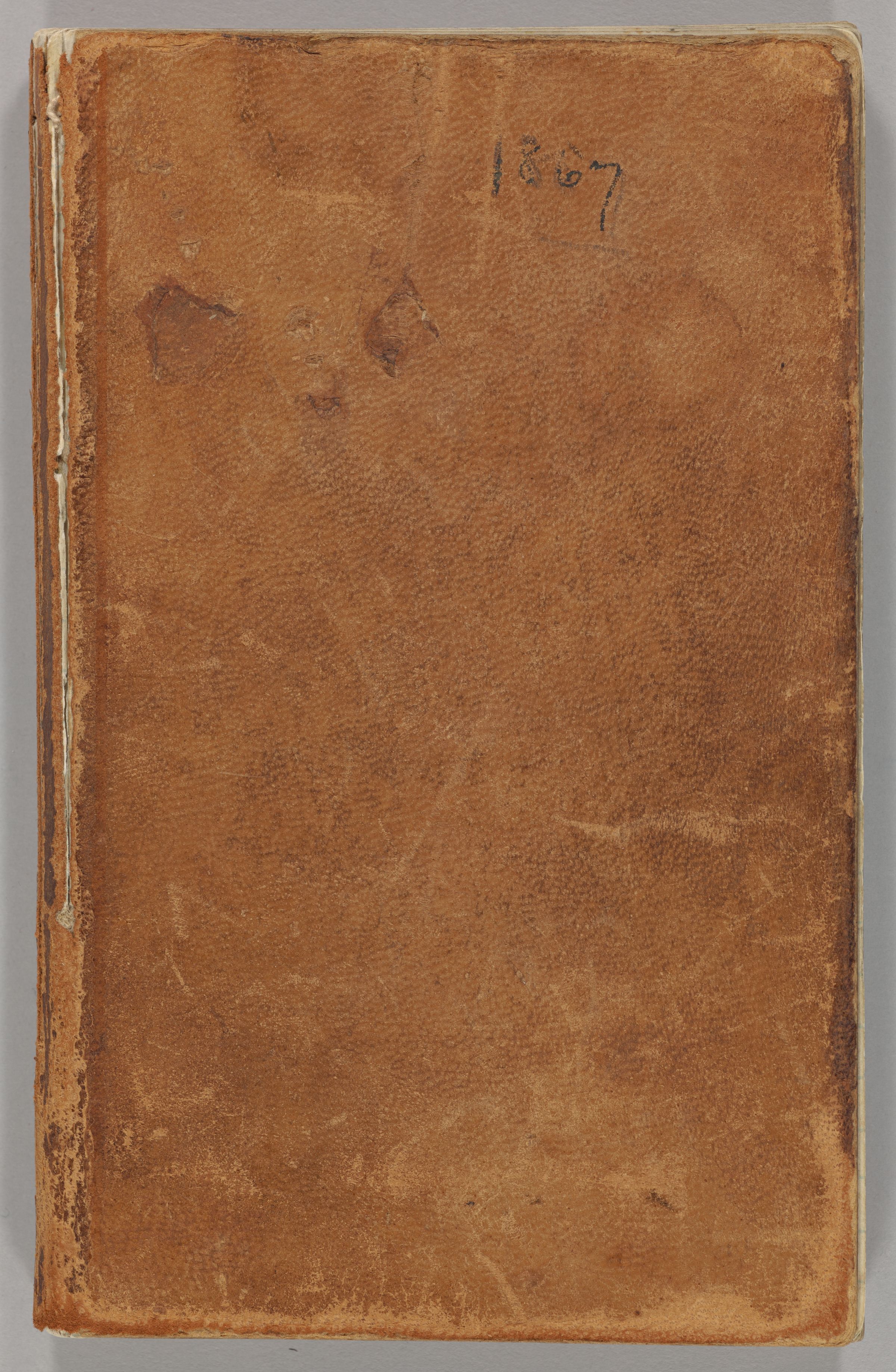
[MS: N9_outside front cover]
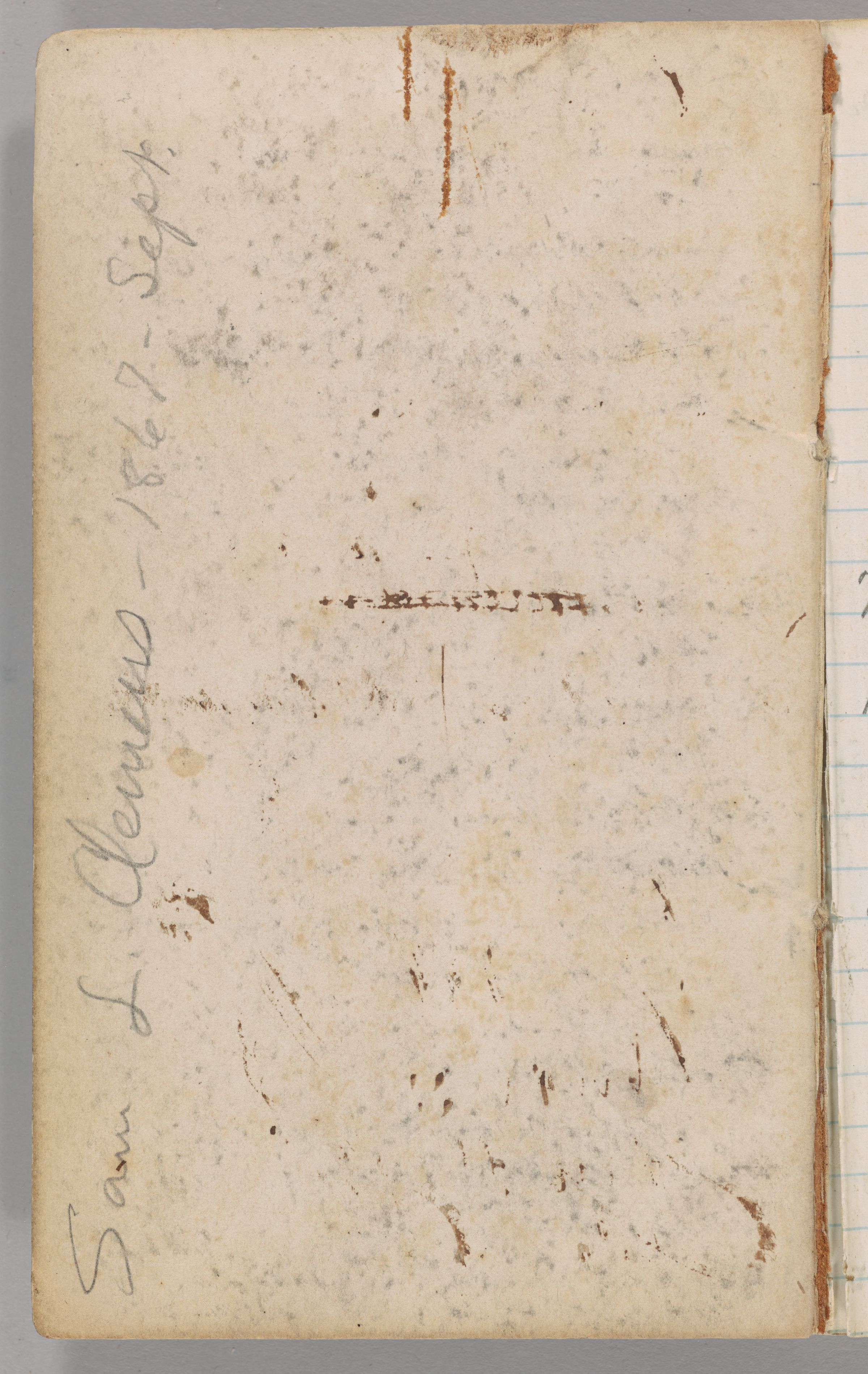
[MS: N9_front endpaper]
[MTP: N&J1_380]
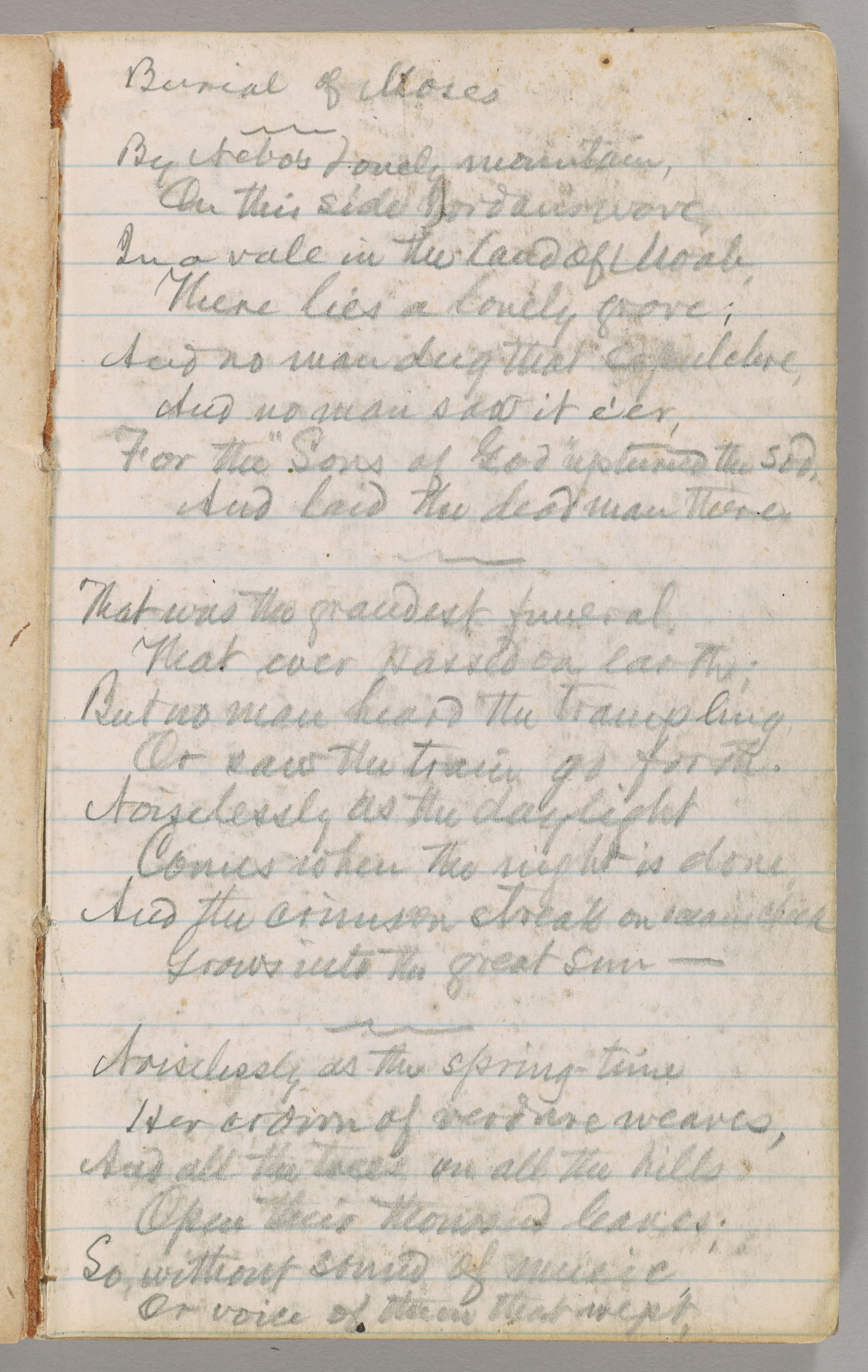
[MS: N9_leaf_001r]
By Nebo’s lonely mountain,

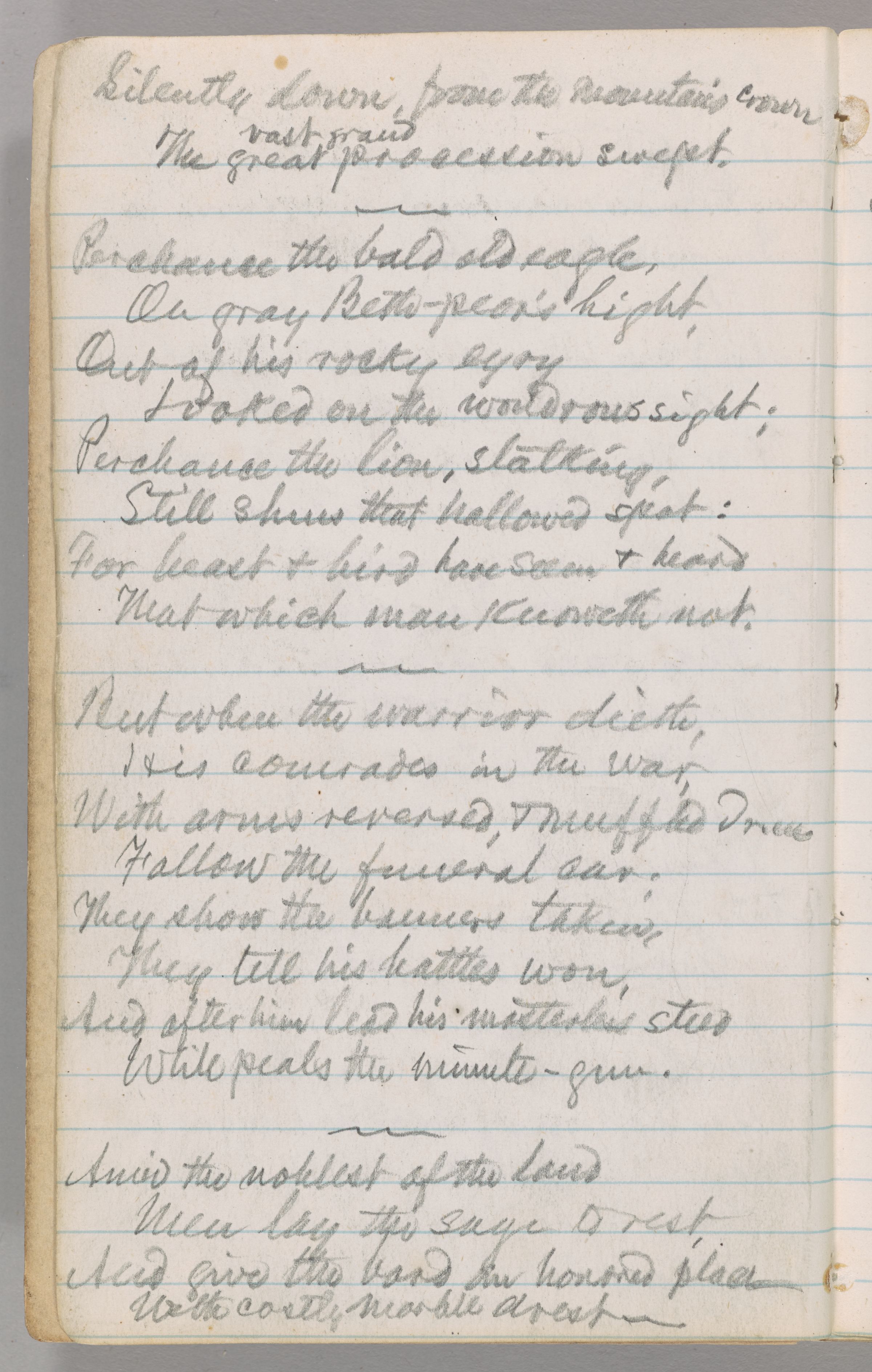
[MS: N9_leaf_001v] Silently down, from the mountan’s crown
[MTP: N&J1_381] Perchance the bald old eagle,
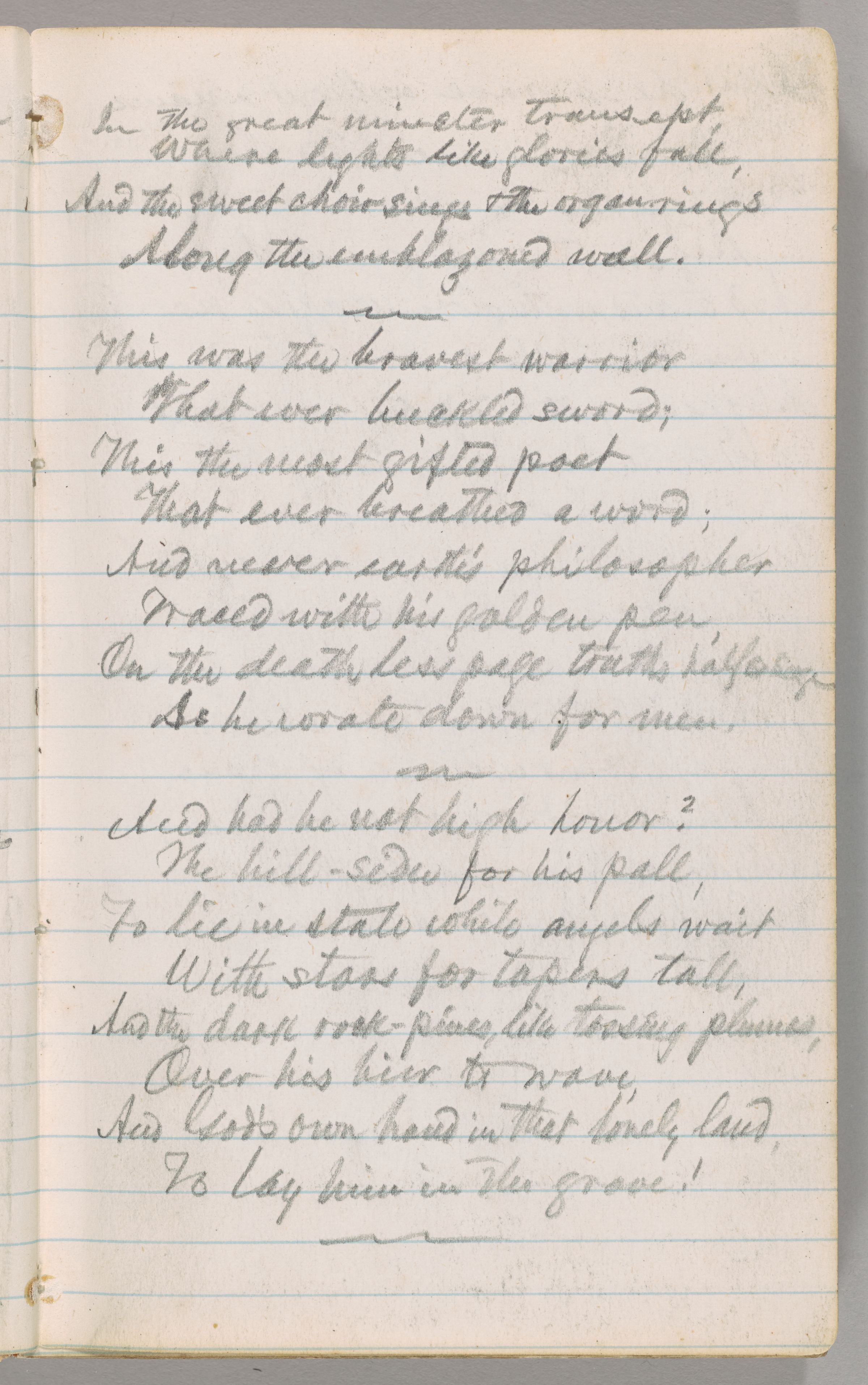
[MS: N9_leaf_002r] In the great minster transept,
[MTP: N&J1_382] To lie in state while angels wait
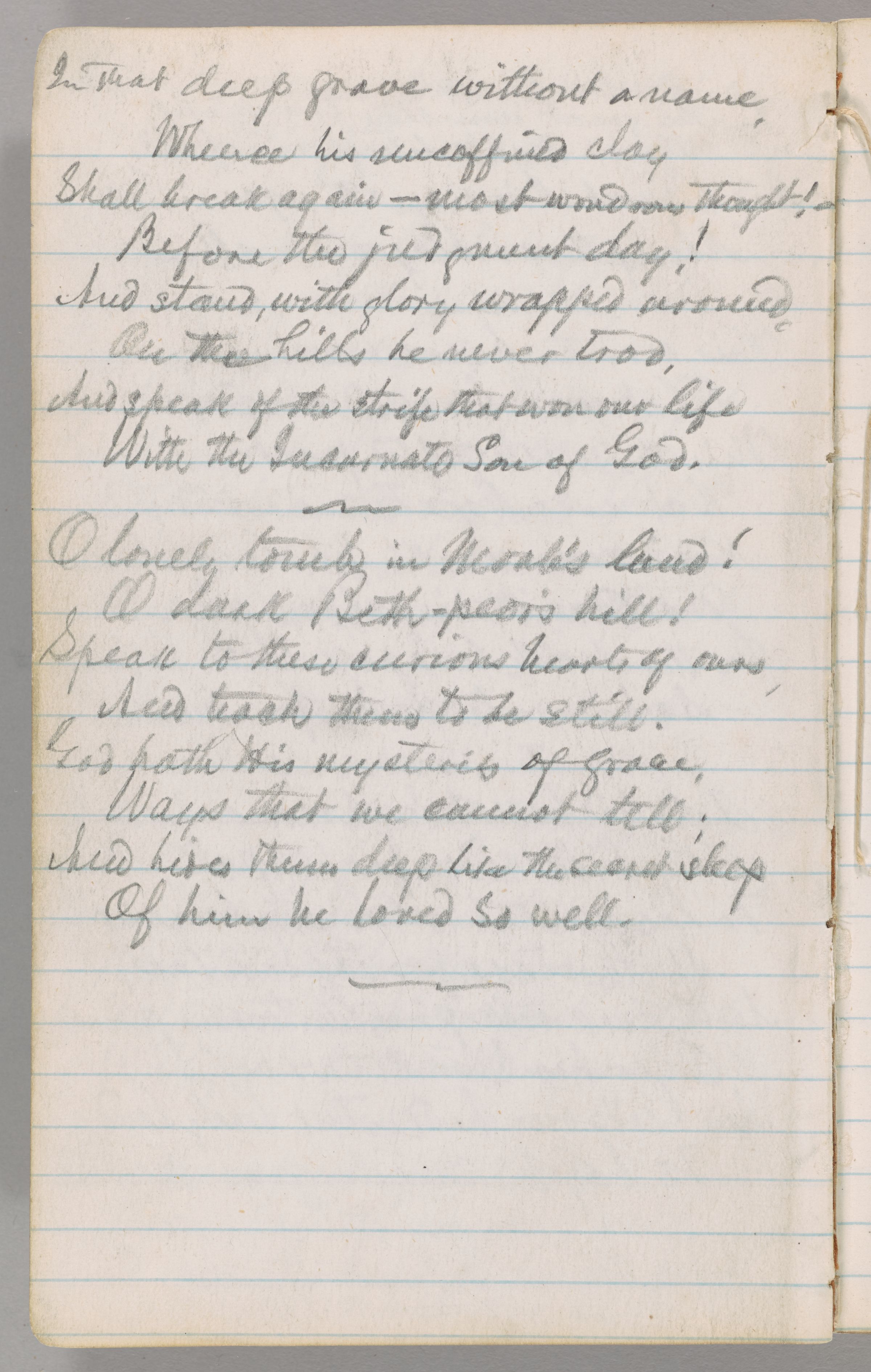
[MS: N9_leaf_002v] In that deep grave without a name,
[MS: N9_leaf_003r]
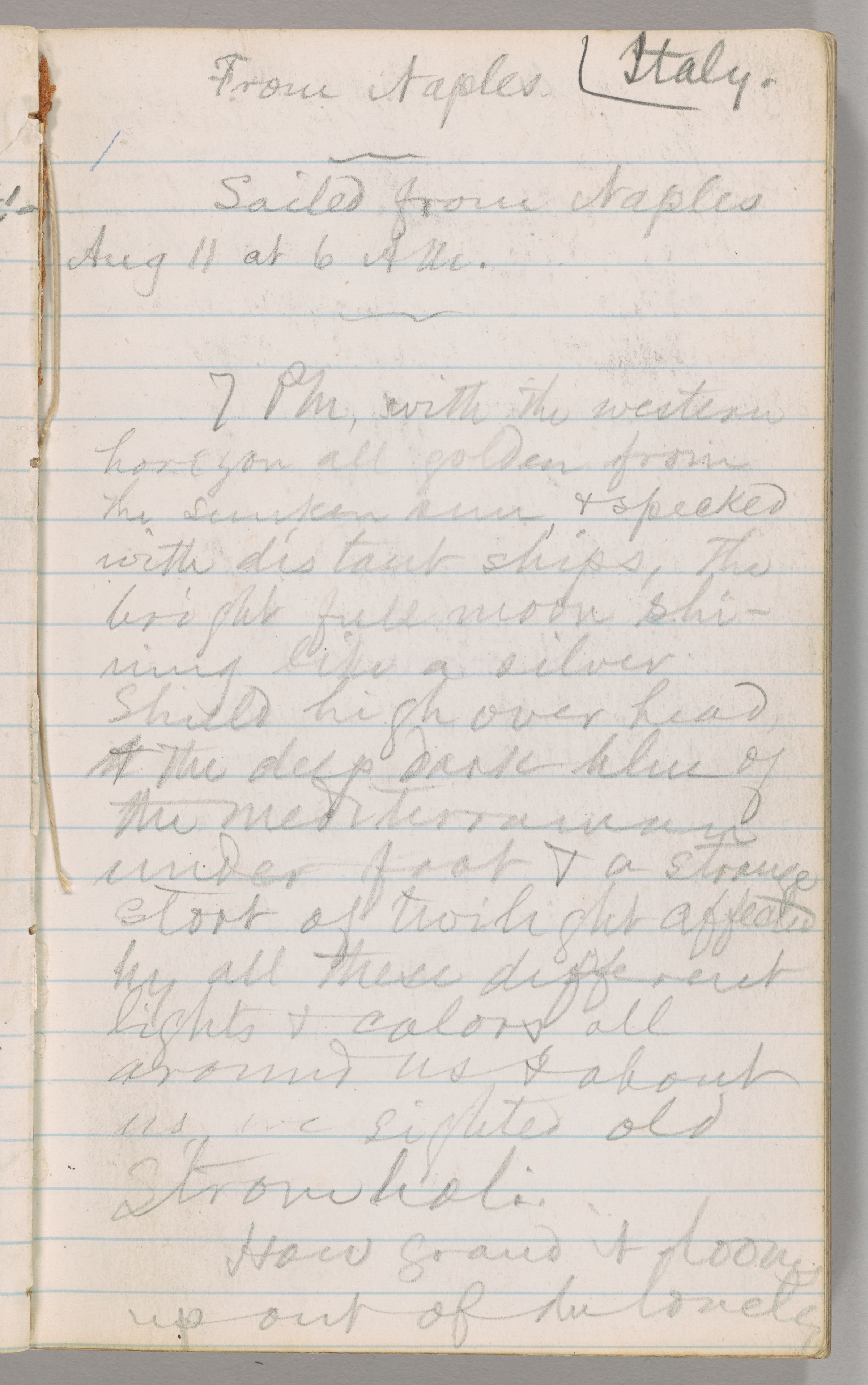
From Naples.
Sailed from Naples
Aug 11 at 6 AM.
[MTP: N&J1_383]
7 PM, with the western
horizon all golden
from
the sunken sun, & specked
with distant
ships, the
bright full moon
shi-
ning
shining
like a silver
shield high over head,
th & the deep dark blue of
the Mediterranean
under foot & a strange
stort of twilight
affected
by all these different
lights &
colors, all
around us & about
us, we sighted
old
Stromboli.
How grand it looms
up out of the lonely 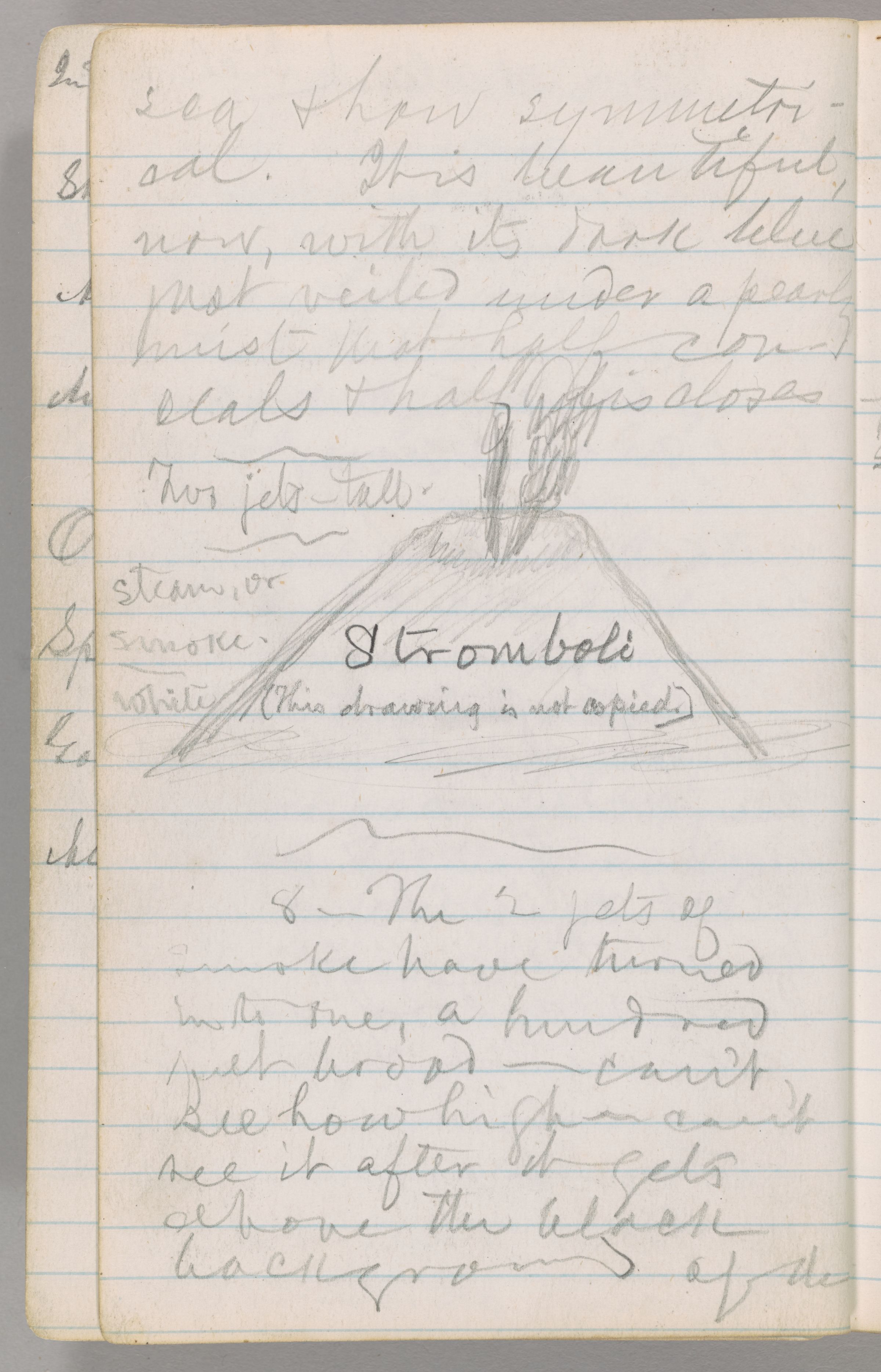
[MS: N9_leaf_003v]
sea & how
symmetri-
cal
symmetrical
. It is beautiful,
now, with its dark blue
just veiled under a pearly
mist that half
con-
ceals
conceals
& half discloses
drawing,
labeled:
Stromboli
(This drawing is not copied.)
Two jets—tall.
steam, or
smoke.
white
8—The 2 jets of
smoke have turned
into one, a hundred
feet broad—can’t
see how
high—can’t
see it after it gets
above the
black
background of the 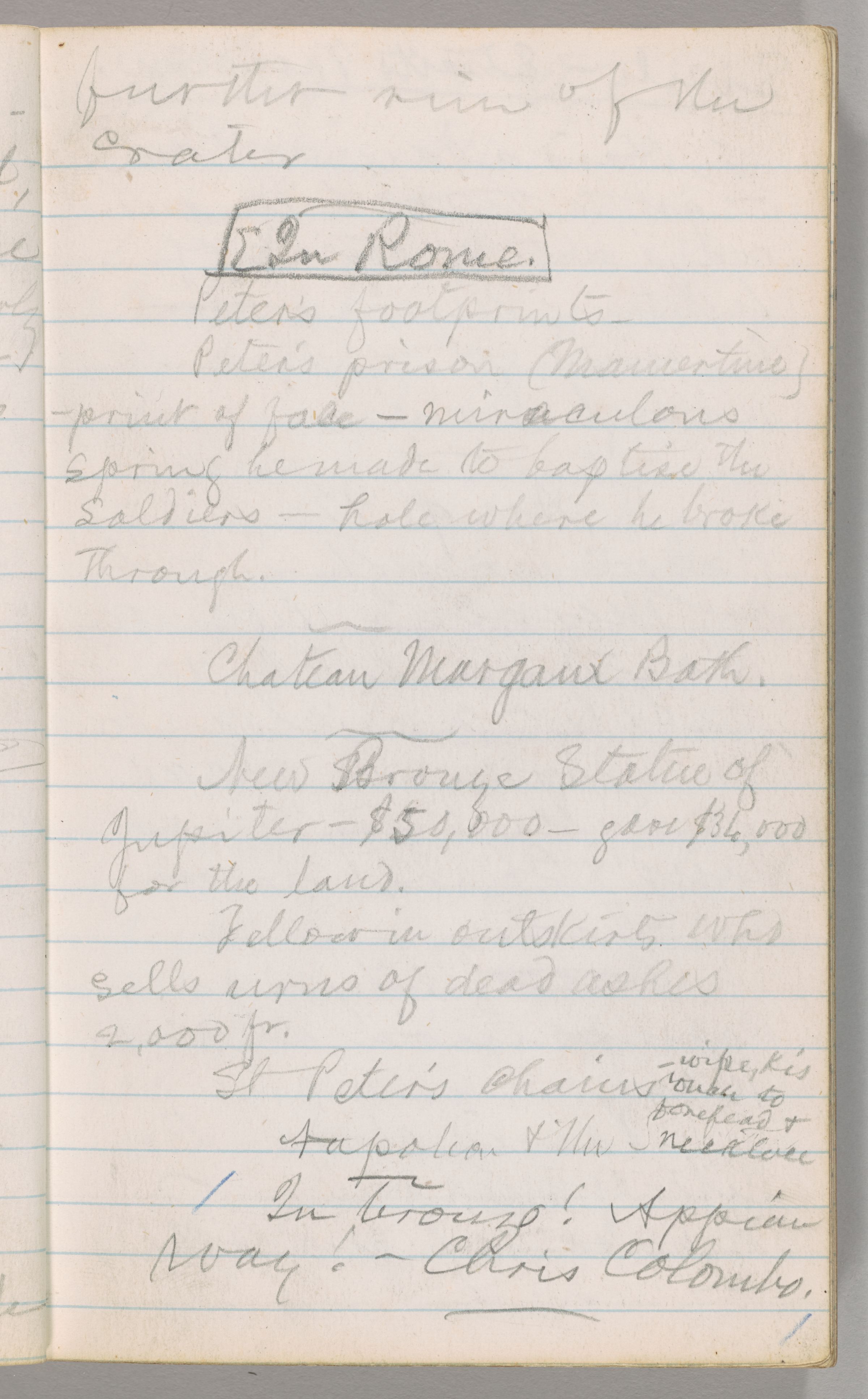
[MS: N9_leaf_004r] further rim of the
crater.
Peter’s footprints.
Peter’s prison (Mamertine)
—print of
face—miraculous
spring he made to baptise the
soldiers—hole where he broke
through.
[MTP: N&J1_384]
New St Bronze Statue of
Jupiter—$350,000—gave $36,000
for the
land.
Fellow in outskirts who
sells urns of dead
ashes
2,000 fr.
In bronze! Appian
Way!—Chris Colombo.
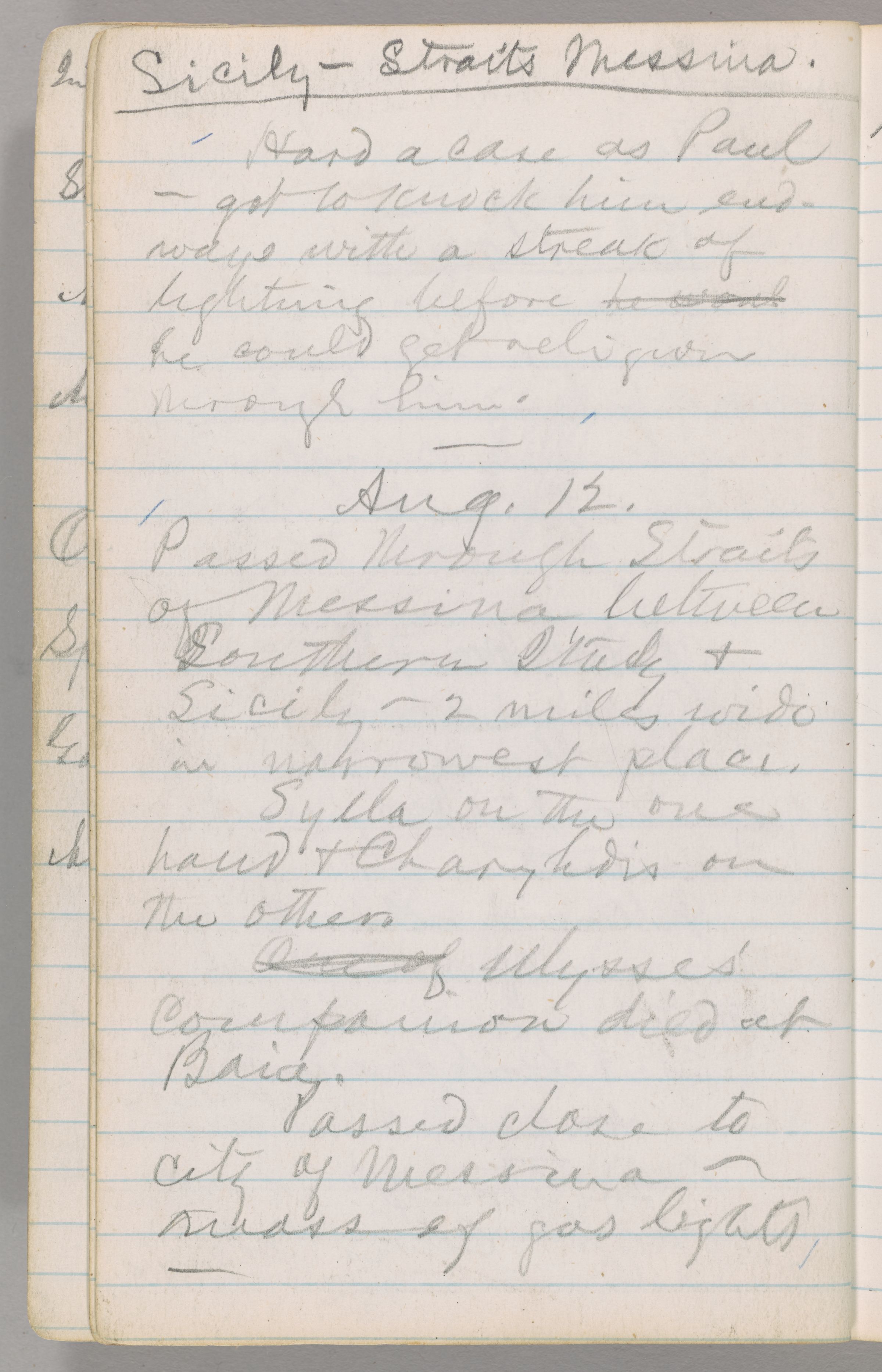
[MS: N9_leaf_004v]
Sicily—Straits Messina.
Hard a case as Paul
—got to knock him
end-
ways
endways
with a streak of
lightning before he woul
he could get religion
through him.
Aug. 12.
Passed through Straits
of Messina, between
I Southern Italy &
Sicily—2 miles wide
in narrowest place.
Sylla on the one
hand & Charybdis on
the other.
One of Ulysses’
companion died
at
Baia.
Passed close to
city of Messina—
mass of gas lights,
—
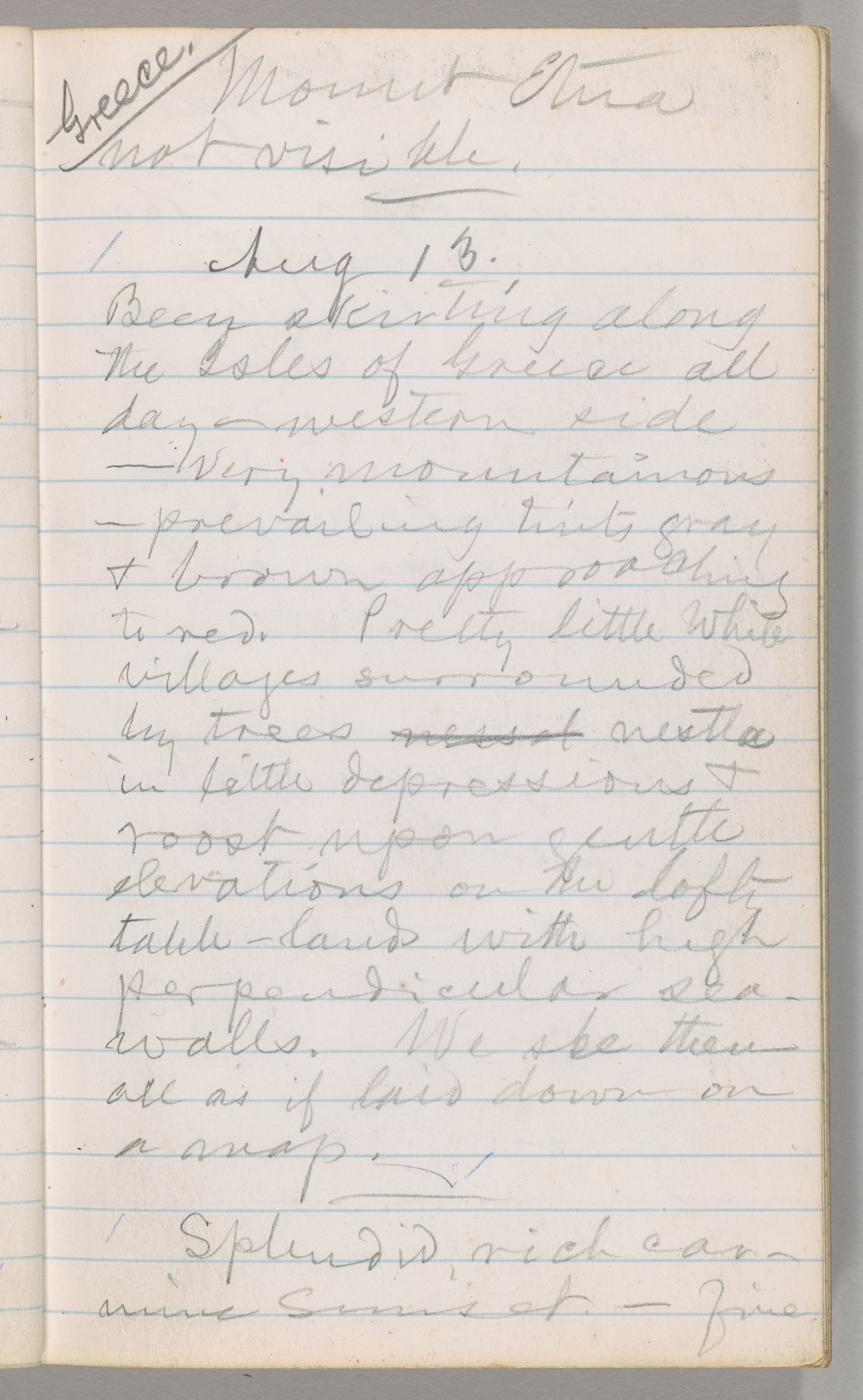
[MS: N9_leaf_005r]
Mount Etna
not visible.
[MTP: N&J1_385]
Aug 13.
Been skirting along
the Isles of Greece all
day—western side
—very mountainous
—prevailing tints gray
& brown approaching
to
red. Pretty little white
villages surrounded
by
trees nessel
nestle
in little depressions &
roost upon
gentle
elevations on the lofty
table-lands with
high
perpendicularsea-
walls. We see them
all as if laid down on
a
map.
Splendid, rich
car-
mine
carmine
sunset.—fine 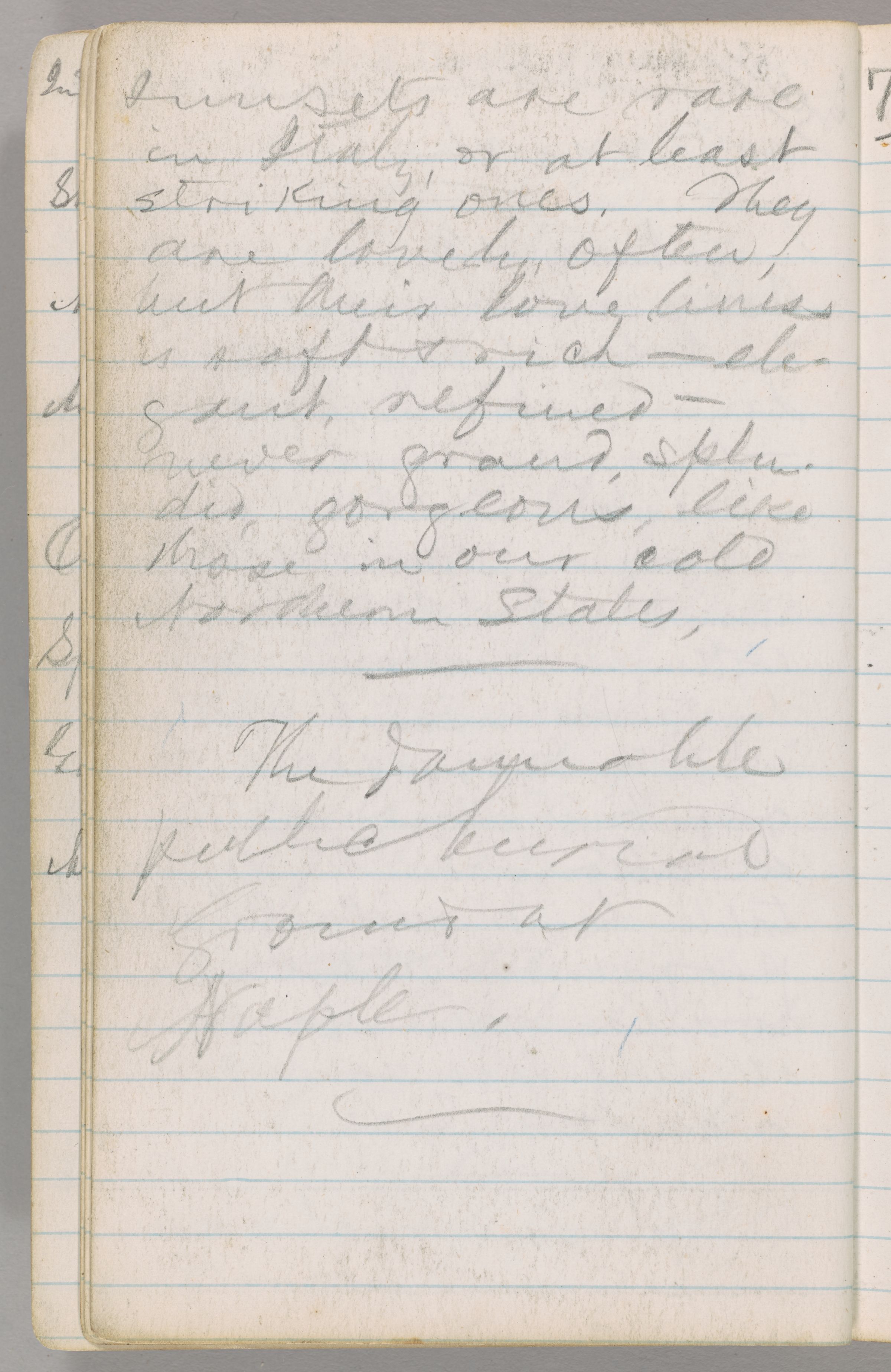
[MS: N9_leaf_005v] sunsets are rare
in Italy, or at
least
striking ones. They
are lovely, often,
but their loveliness
is soft & rich—
ele-
gant
elegant
, refined—
never grand,
splen-
did
splendid
, gorgeous, like
those in our cold
Northern
States.
The damnable
public burial
ground at
Naple.
[MS: N9_leaf_006r]
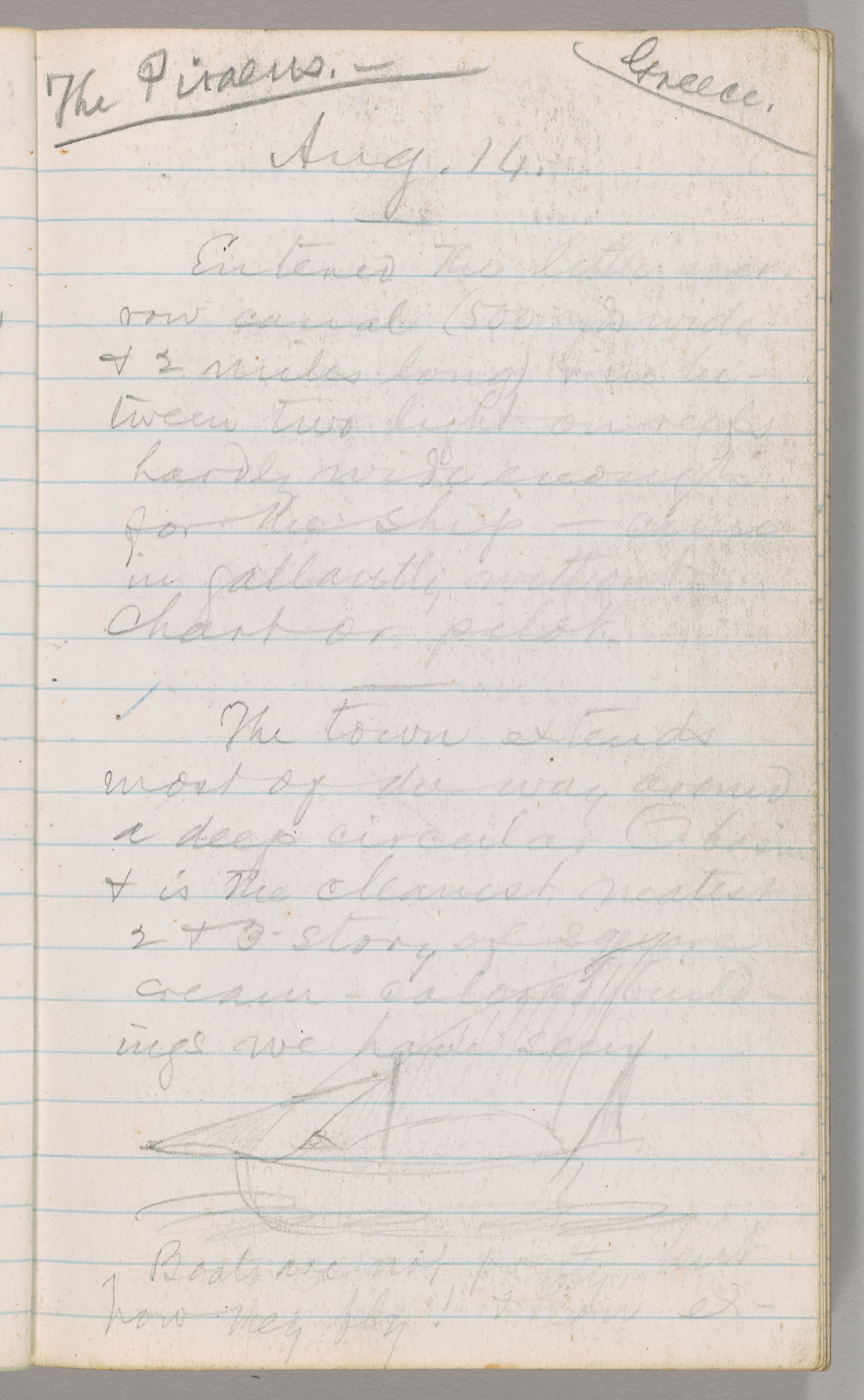
Aug. 14.
Entered the little
nar-
row
narrow
canal (500 yds wide
& 2 miles long) & in
be-
tween
between
two light on reefs
hardly wide enough
for
the ship—came
in gallantly without
chart or
pilot.
The town extends
most of the way around
a deep circular
 basin
basin
& is the cleanest, neatest
2
& 3-story of square
cream-colored
build-
ings
buildings
we have seen.
[MTP: N&J1_386]
drawing
Boats are not pretty, but
how they fly! &
how ex- 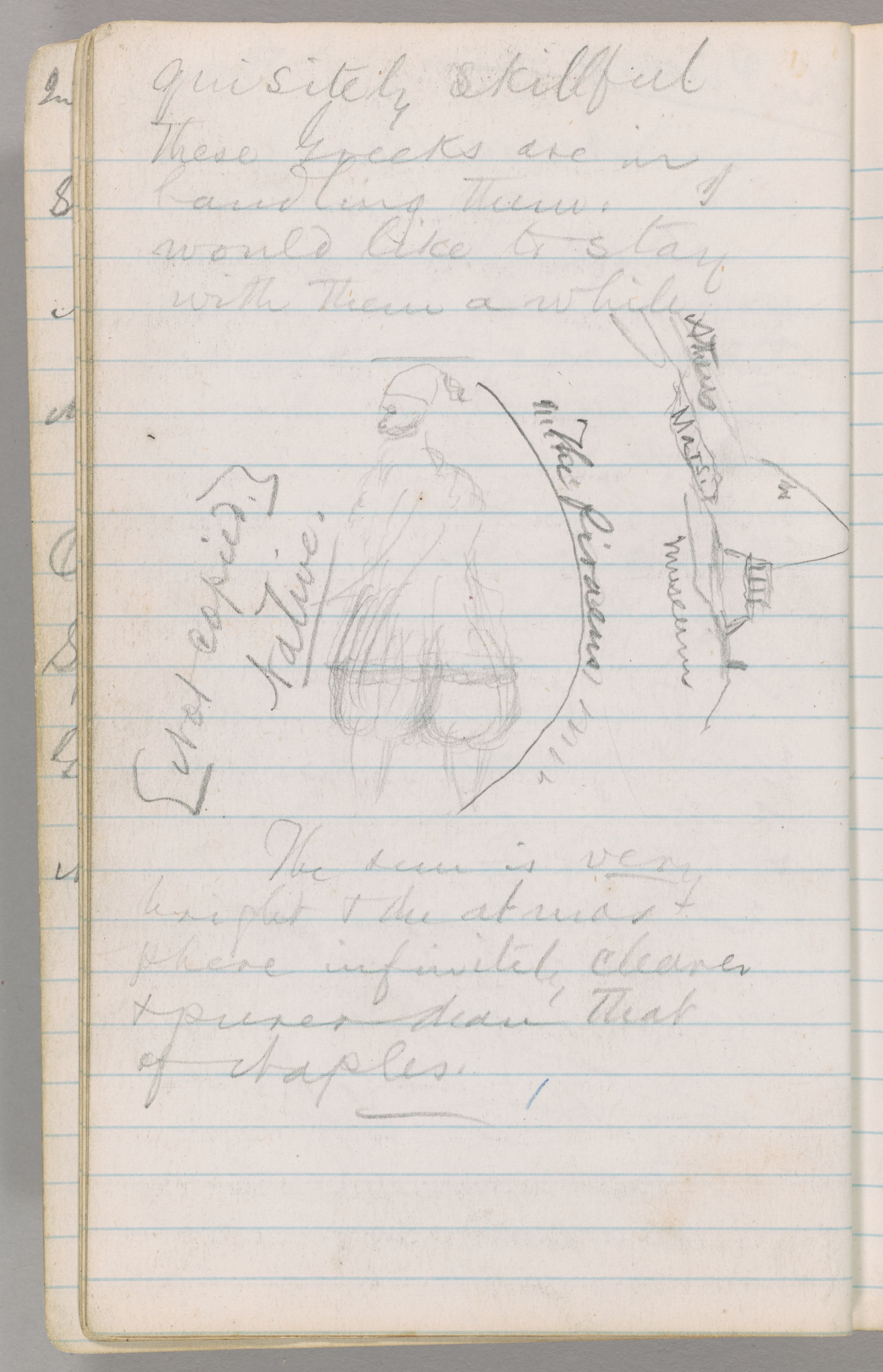
[MS: N9_leaf_006v] quisitely skillful
these Greeks are in
handling them. I
would like to stay
with them a while.
drawing, labeled:
Athens Mats.
Museum
The Piraeus
Native.
⟦Not copied.⟧
The sun is very
bright
& the
atmos-
phere
atmosphere
infinitely clearer
& purer than that
of Naples.
[MS: N9_leaf_007r]
[MTP: N&J1_387]
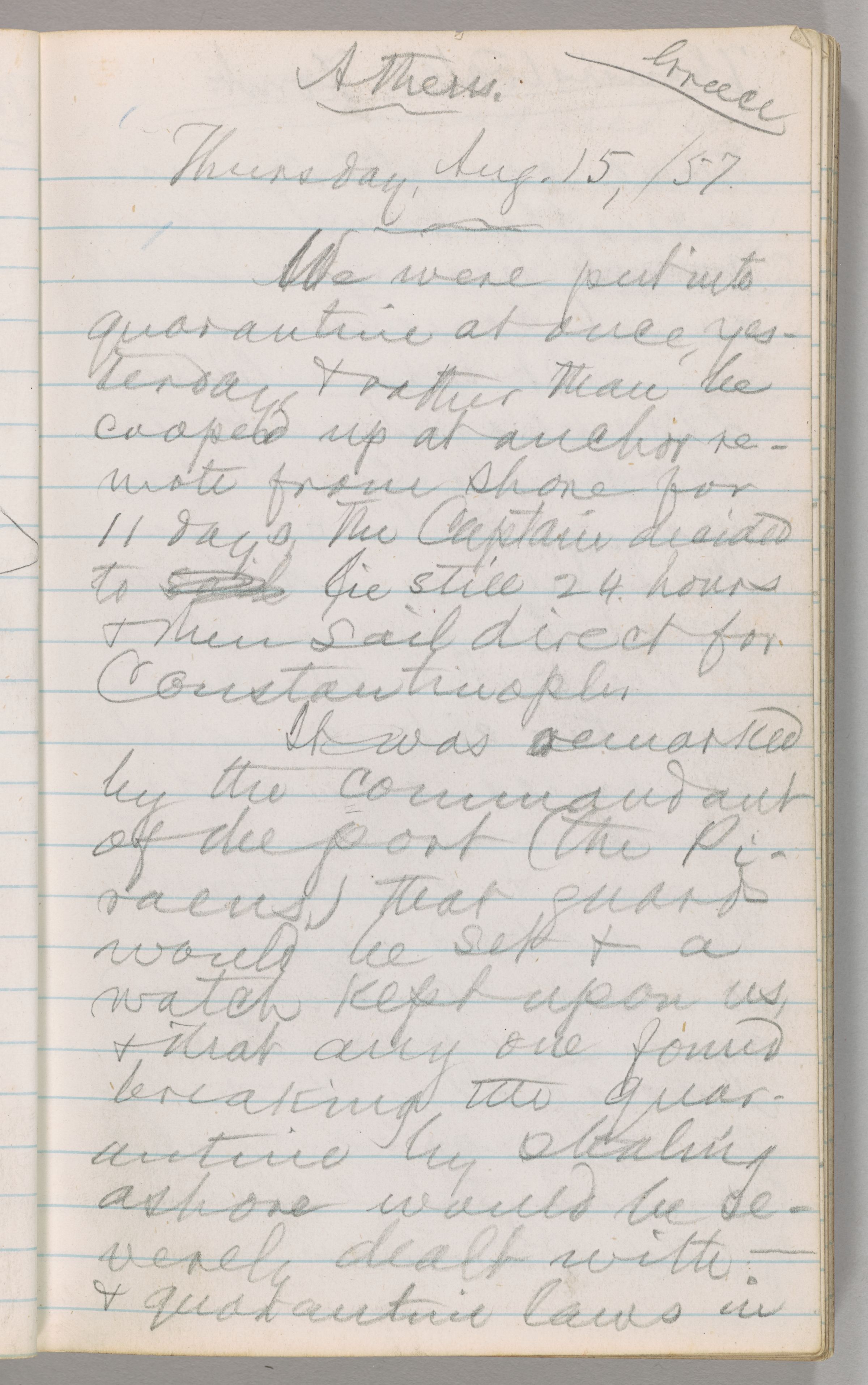
Athens. Greece
Thursday, Aug. 15,/57.
At We were put into
quarantine at once,
yes-
terday
yesterday
, & rather than be
cooped up at anchor
re-
mote
remote
from shore for
11 days, the Captain decided
to
sail lie still 24 hours
& then sail direct for
Constantinople.
It was a remarked
by the commandant
of the port (the
Pi-
raeus
Piraeus
,) that
guards
would be set & a
watch kept upon us,
& that any one found
breaking
the
quar-
antine
quarantine
by stealing
ashore would be
se-
verely
severely
dealt with—
& quarantine
laws in
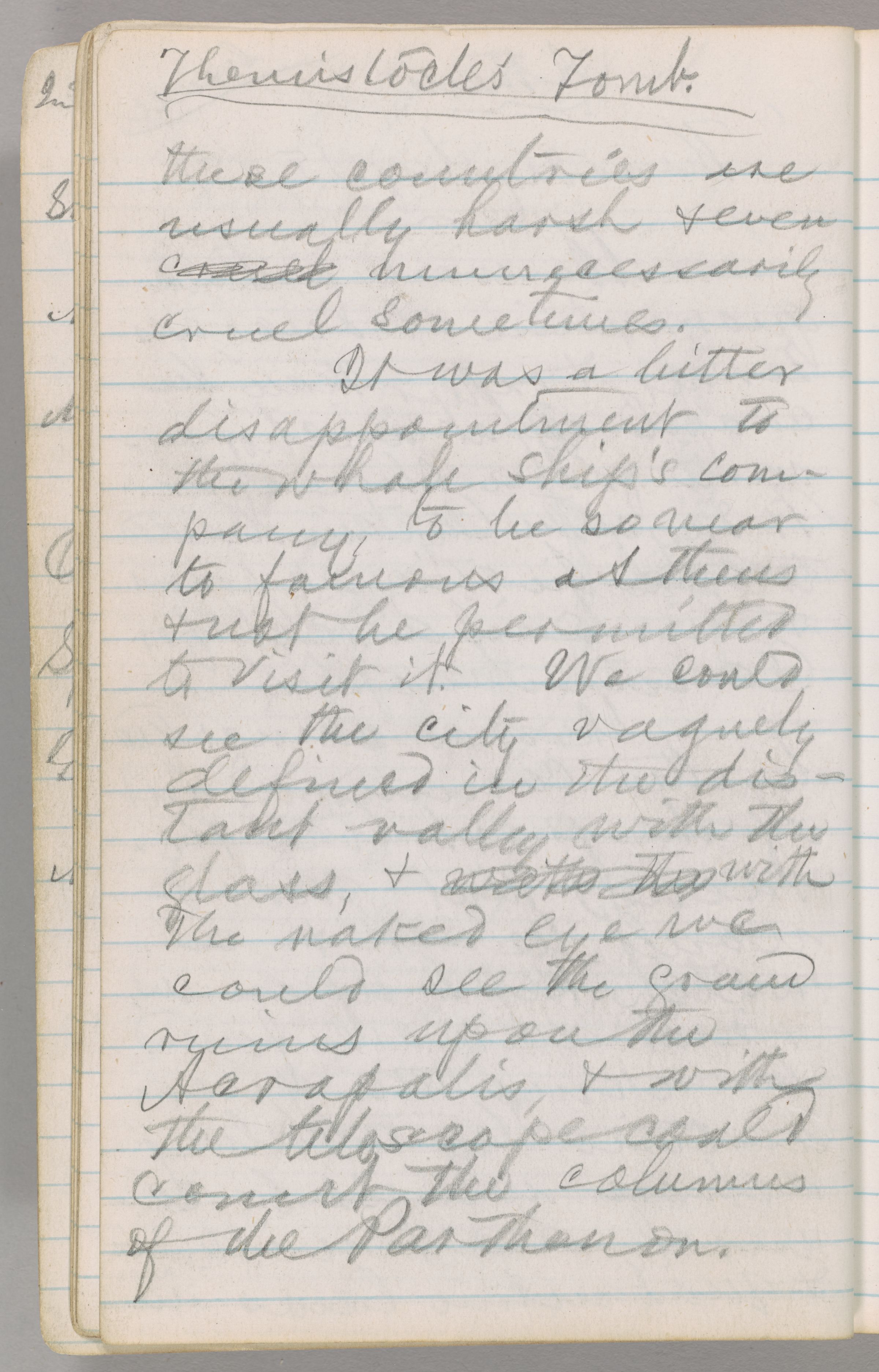
[MS: N9_leaf_007v]
usually harsh & even
cruel unnecessarily
cruel sometimes.
[MTP: N&J1_388]
It was a bitter
disappointment to
the whole ship’s
com-
pany
company
, to be so near
to
famous Athens
& not be permitted
to visit it. We could
see the city vaguely
defined in the
dis-
tant
distant
valley with the
glass, & with the with
the
naked eye we
could see the grand
ruins upon
[MTP: N&J1_389] the
Acropolis, & with
the
telescope could
count the columns
of the Parthenon.
[MS: N9_leaf_008r]
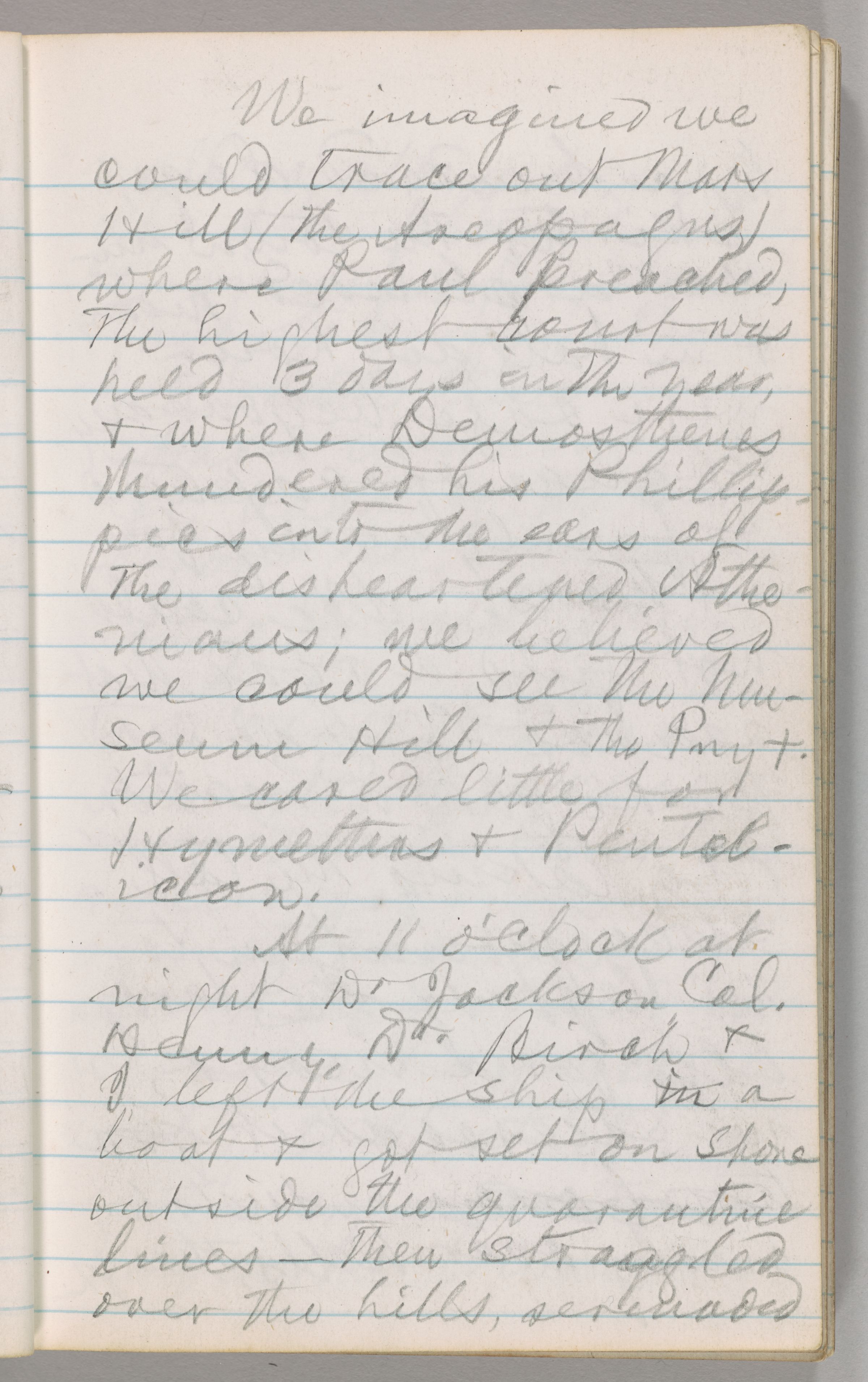
We imagined we
could trace out Mars
Hill (the Areopagus,)
where Paul preached,
the
highest court was
held 3 days in the year,
& where Demosthenes
thundered his
Phillip-
pics
Phillippics
into the ears of
the disheartened
Athe-
nians
Athenians
; we believed
we could see
the
Mu-
seum
Museum
Hill & the Pnyx.
We cared little for
Hymettus &
Pentel-
icon
Pentelicon
.
At 11 o’clock at
night Dr Jackson, Col.
Denny, Dr. Birch &
I, left the ship & in a
boat & got set on shore
outside the quarantine
lines—then stranggled
over the hills, serenaded
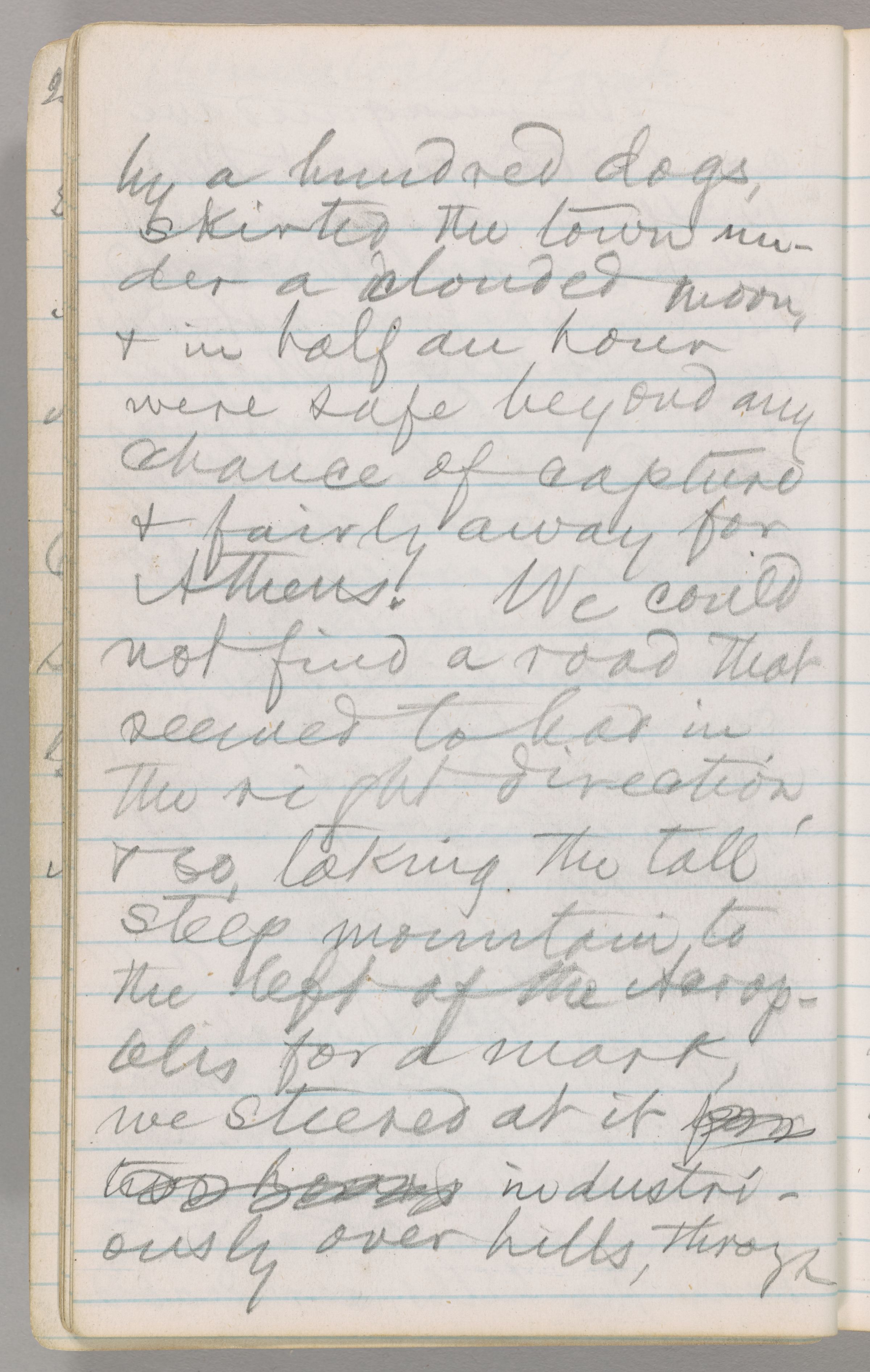
[MS: N9_leaf_008v]
by a hundred dogs,
skirted the town
un-
der
under
a d clouded moon,
& in
half an hour
were safe beyond any
chance of capture
& fairly away for
Athens.
We could
not find a road that
seemed to lead in
the right direction,
& so,
taking the tall
steep mountain to
the left of the
Acrop-
olis
Acropolis
for a mark,
we steered
at it for
two hours
industri-
ously
industriously
over hills, throgh
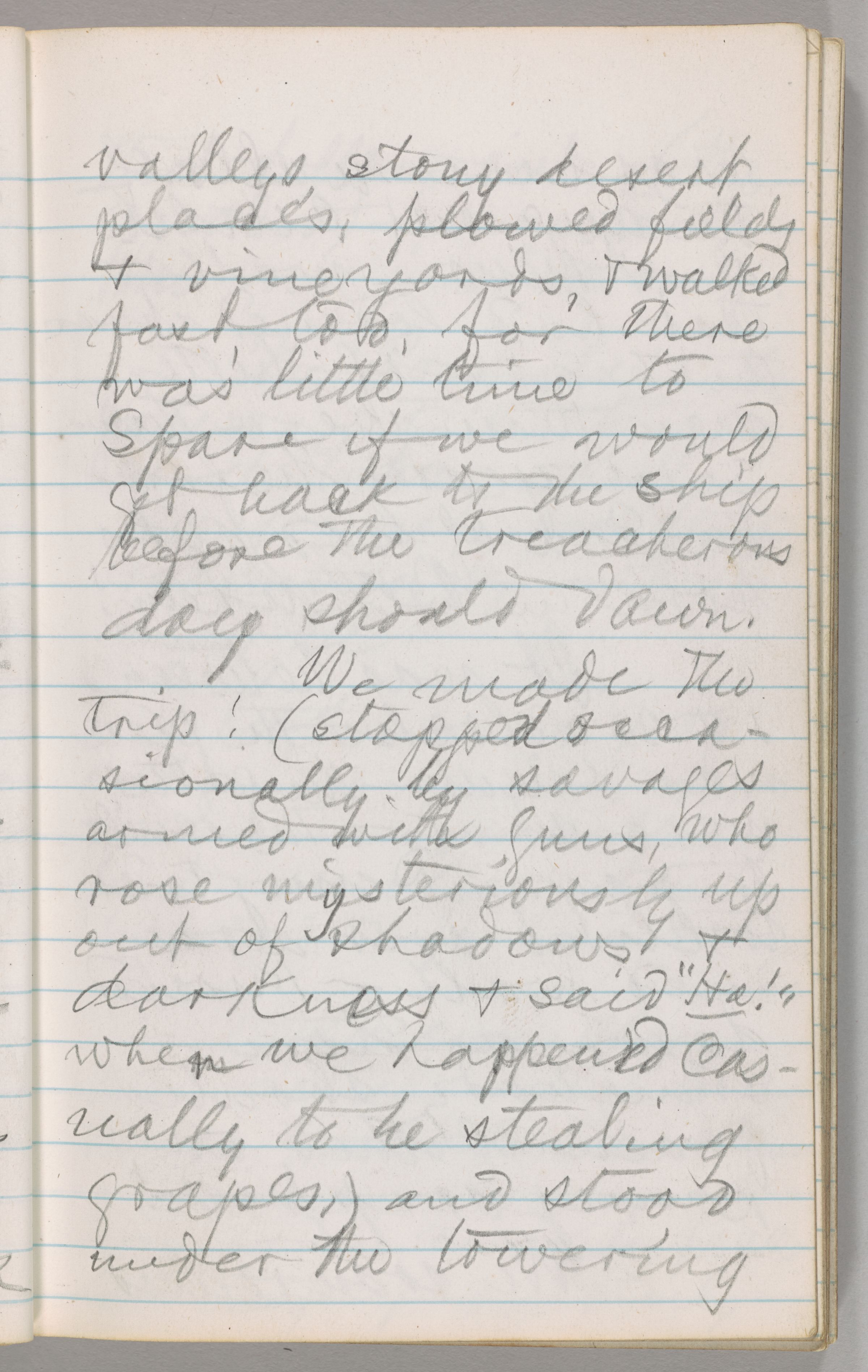
[MS: N9_leaf_009r]
valleys,
stony desert
places, plowed fields
& vineyards, & walked
fast, too, for
there
was little time to
spare if we would
get back to the ship
before the
treacherous
day should dawn.
We made the
trip! (stopped
occa-
sionally
occasionally
by savages
armed with guns, who
rose
mysteriously up
out of shadows &
darkness & said
[MTP: N&J1_390]
“Ho!”
when we happened
cas-
ually
casually
to be stealing
grapes,) and stood
under
the towering
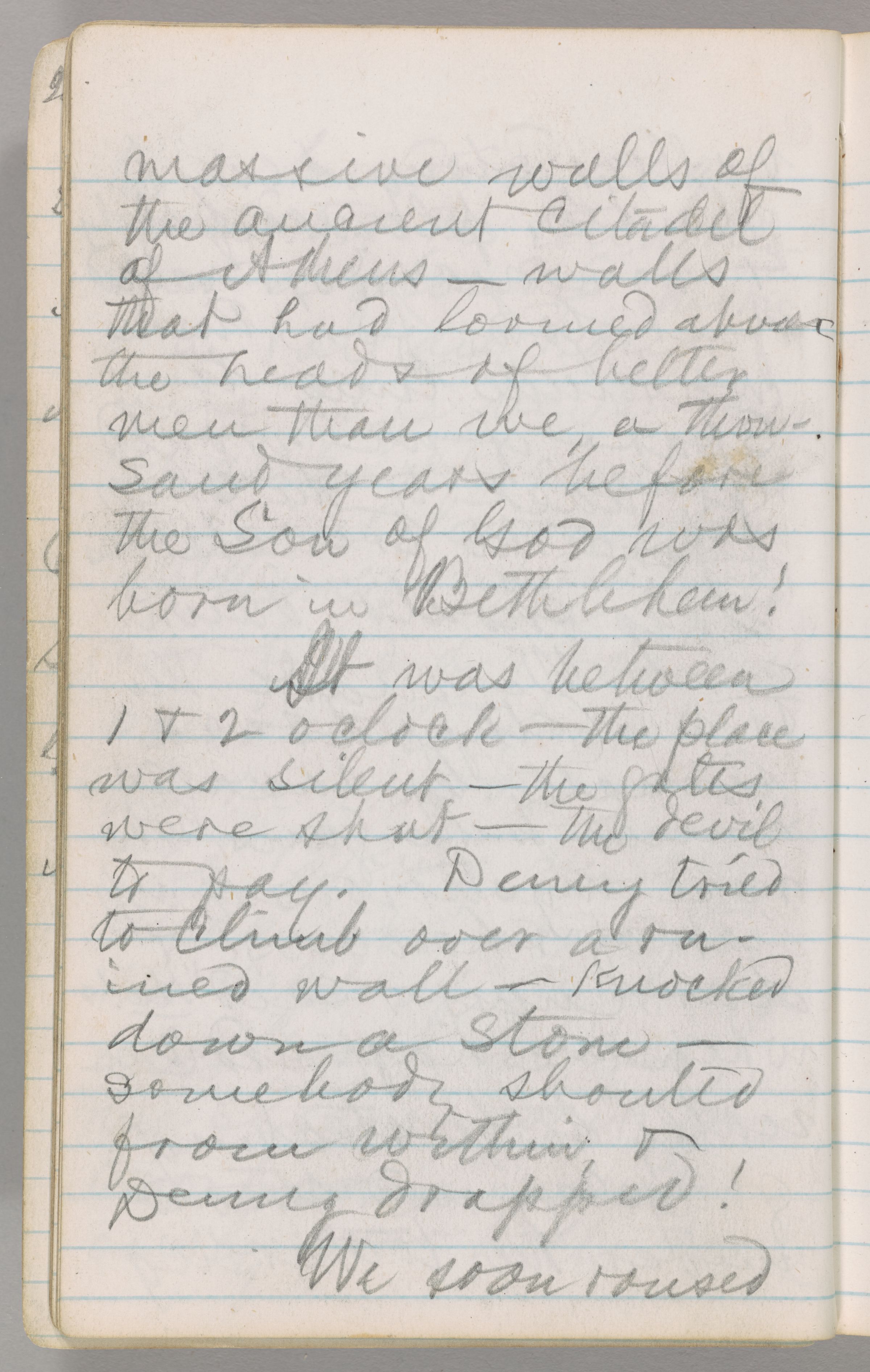
[MS: N9_leaf_009v]
massive walls of
the ancient citadel
of Athens—walls
that had
loomed above
the heads of better
men than we, a
thou-
sand
thousand
years before
the Son of
God was
born in b Bethlehem!
At It was between
1 & 2 oclock—the place
was silent—the gates
were
shut—the devil
to pay. Denny tried
to climb over a
ru-
ined
ruined
wall—knocked
down a
stone—
somebody shouted
from within, &
Denny dropped!
We soon roused
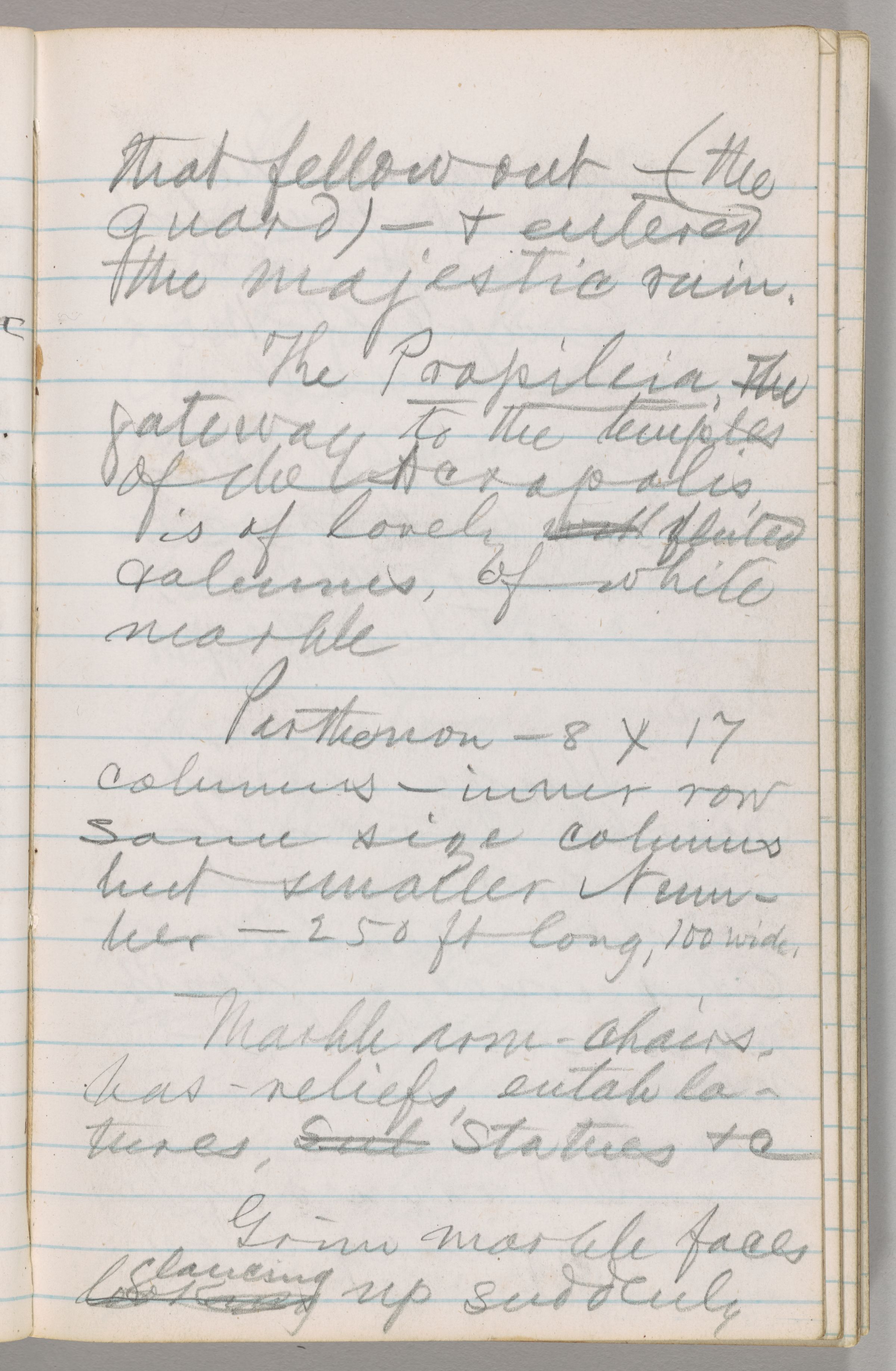
[MS: N9_leaf_010r]
that fellow out—(the
guard)—& entered
the majestic
ruin.
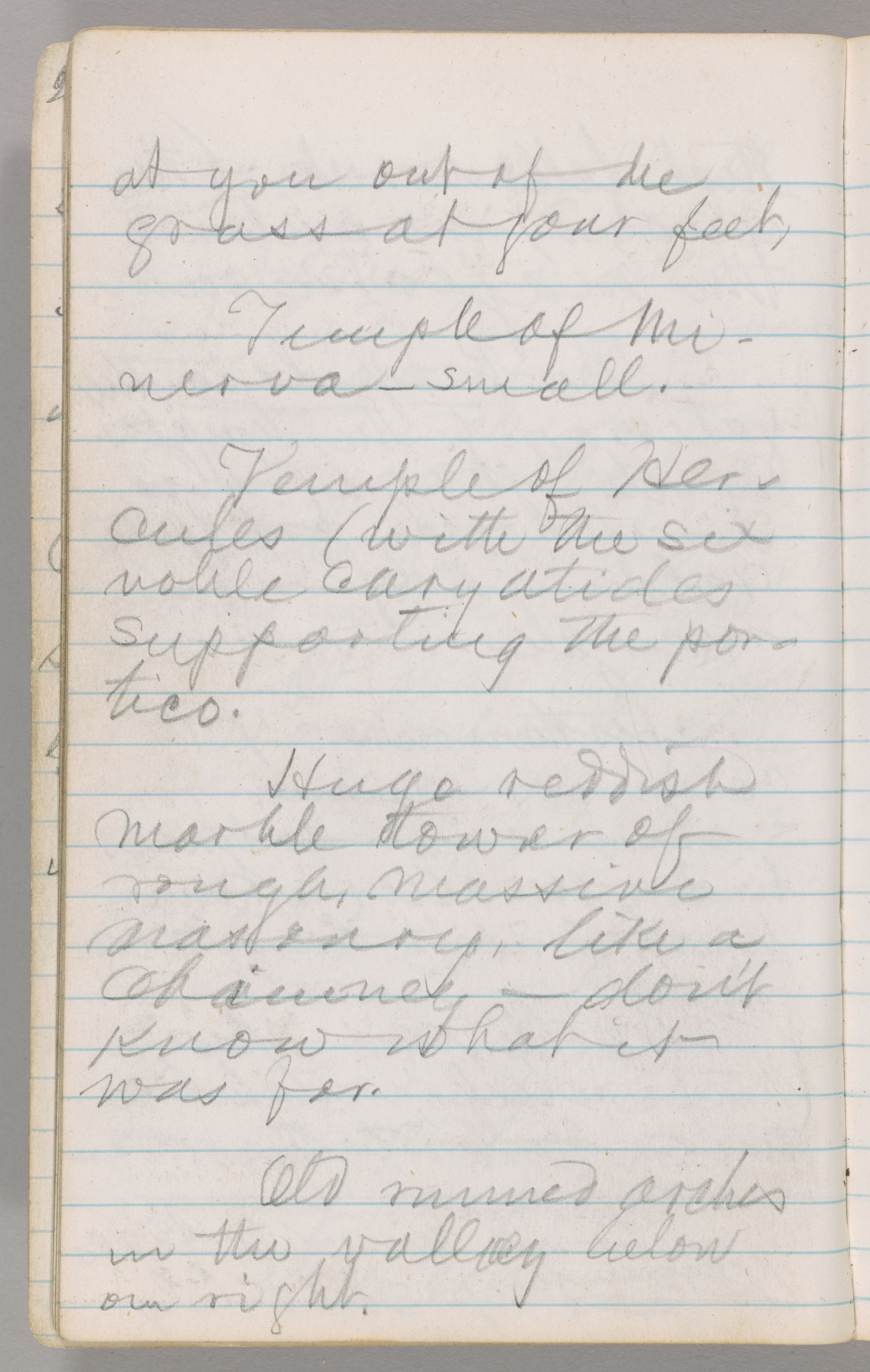
The Propileia, — the
gateway to the temples
of
the Acropolis,
is of lovely
well
r fluted
columns, of white
marble
Parthenon—8 × 17
columns—inner row
same size columns
but smaller
Num-
ber
Number
—250 ft
long, 100 wide.
Marble arm-chairs,
bas-reliefs,
entabla-
tures
entablatures
, sul statues &c
Grim marble faces
looking
glancing
up suddenly
[MS: N9_leaf_010v]
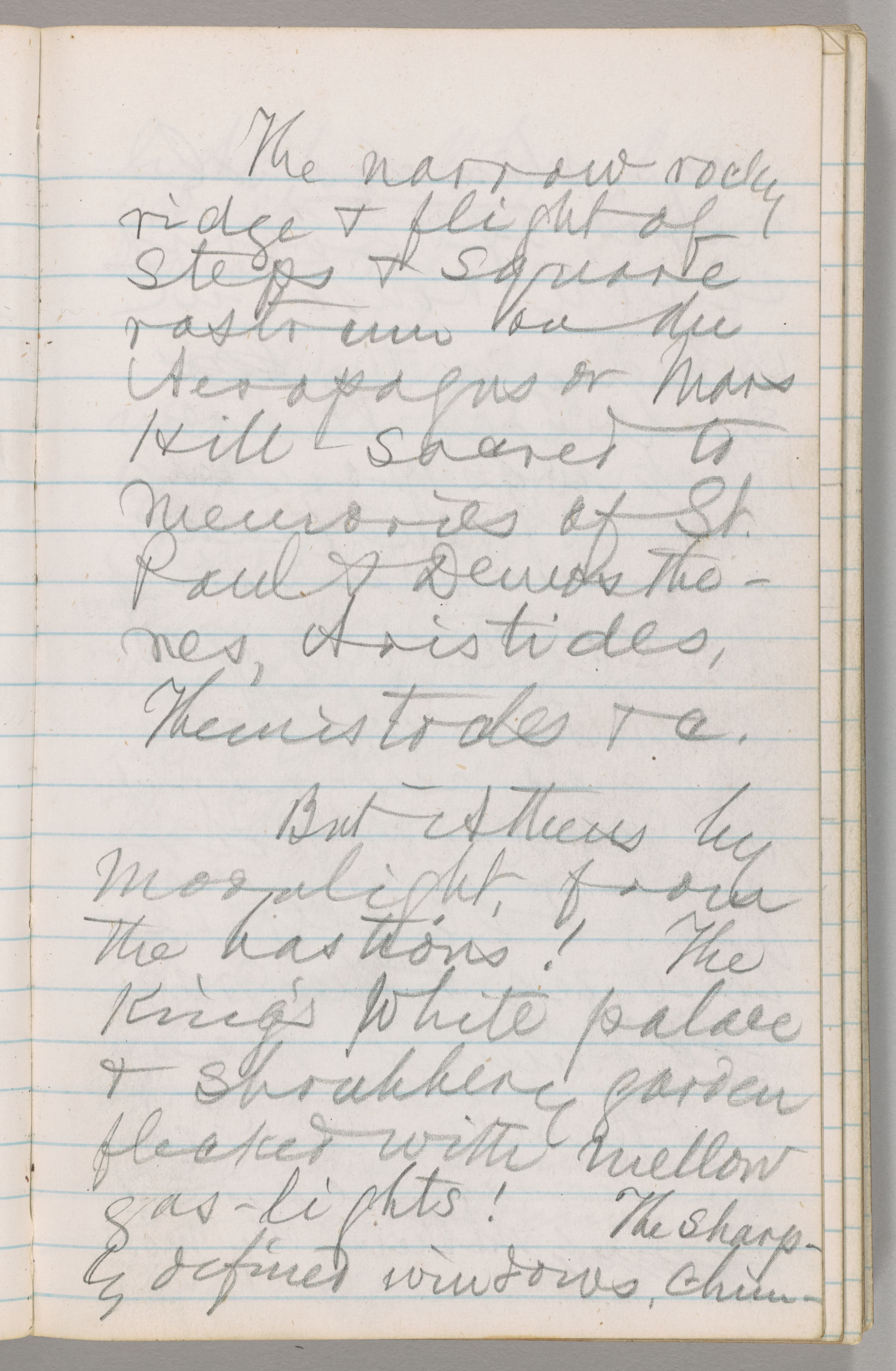
at you out of the
grass at your feet,
Temple of
Mi-
nerva
Minerva
—small.
Temple of
Her-
cules
Hercules
(with the six
noble caryatides
supporting the
por-
tico
portico
.
Huge reddish
marble tower of
rough, massive
masonry, like a
chaimney—don’t
know what it
was for.
Old ruined arches
in the valley below
our right.
[MS: N9_leaf_011r]
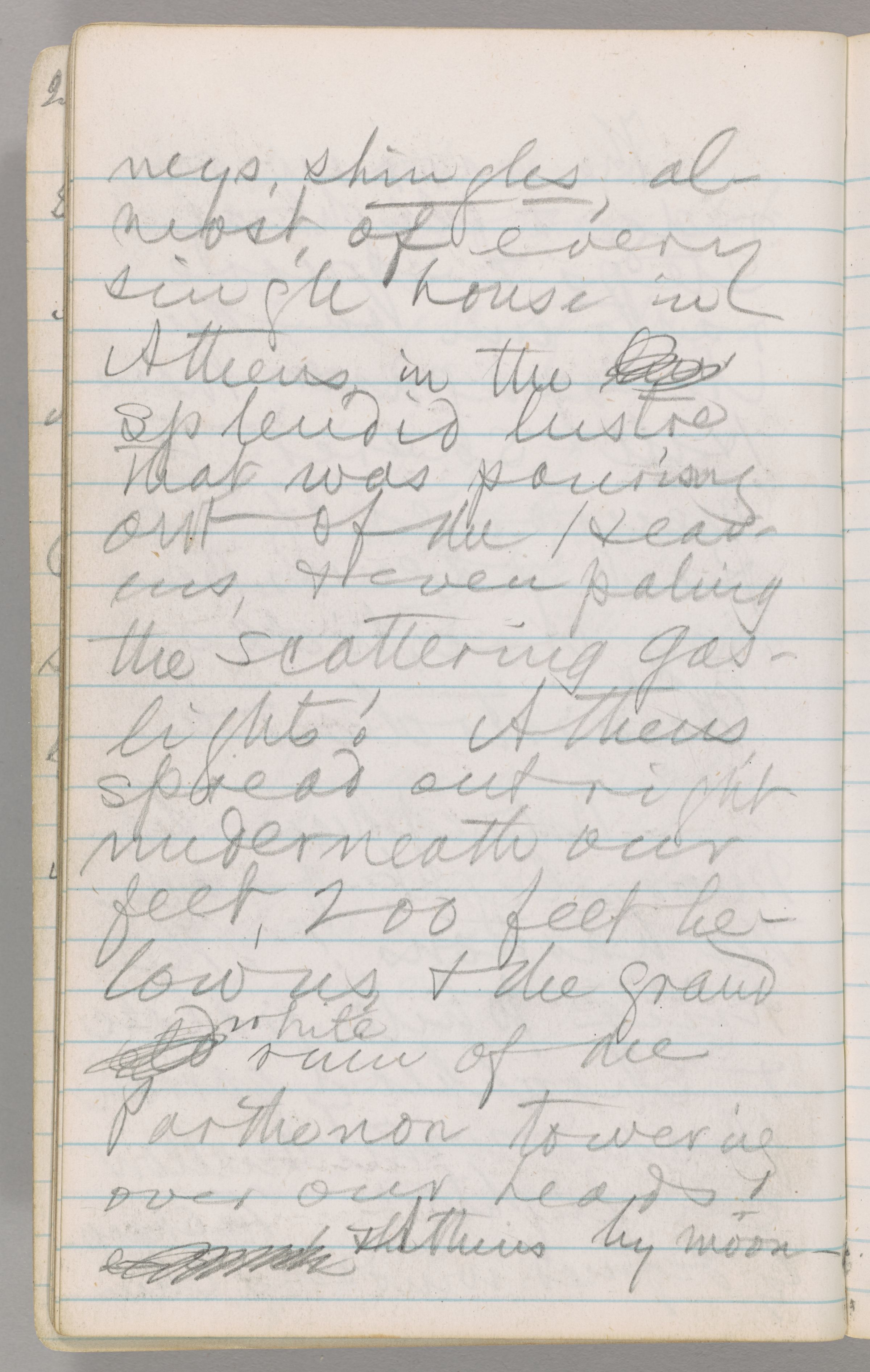
The narrow rocky
ridge & flight of
steps & square
rostrum on the
Aeropagus
or Mars
Hill—sacred to
memories of St.
Paul &
Demosthe-
nes
Demosthenes
, Aristides,
Themistocles &c.
But Athens by
moonlight, from
the bastions! The
King’s white palace
&
shrubbery garden
flecked with mellow
gas-lights! The
[MTP: N&J1_391]
sharp-
ly
sharply
defined windows,
chim-
[MS: N9_leaf_011v]
neys, shingles,
al-
most
almost
, of every
single
house in
Athens, in the lus
splendid lustre
that was pouring
out of the
Heav-
ens
Heavens
, & even paling
the scattering gas-
lights! Athens
spread out right
underneath our
feet, 200 feet
be-
low
below
us, & the
grand
old
white
ruin of the
Parthenon towering
over our
heads!
—such
the Athens by moon-
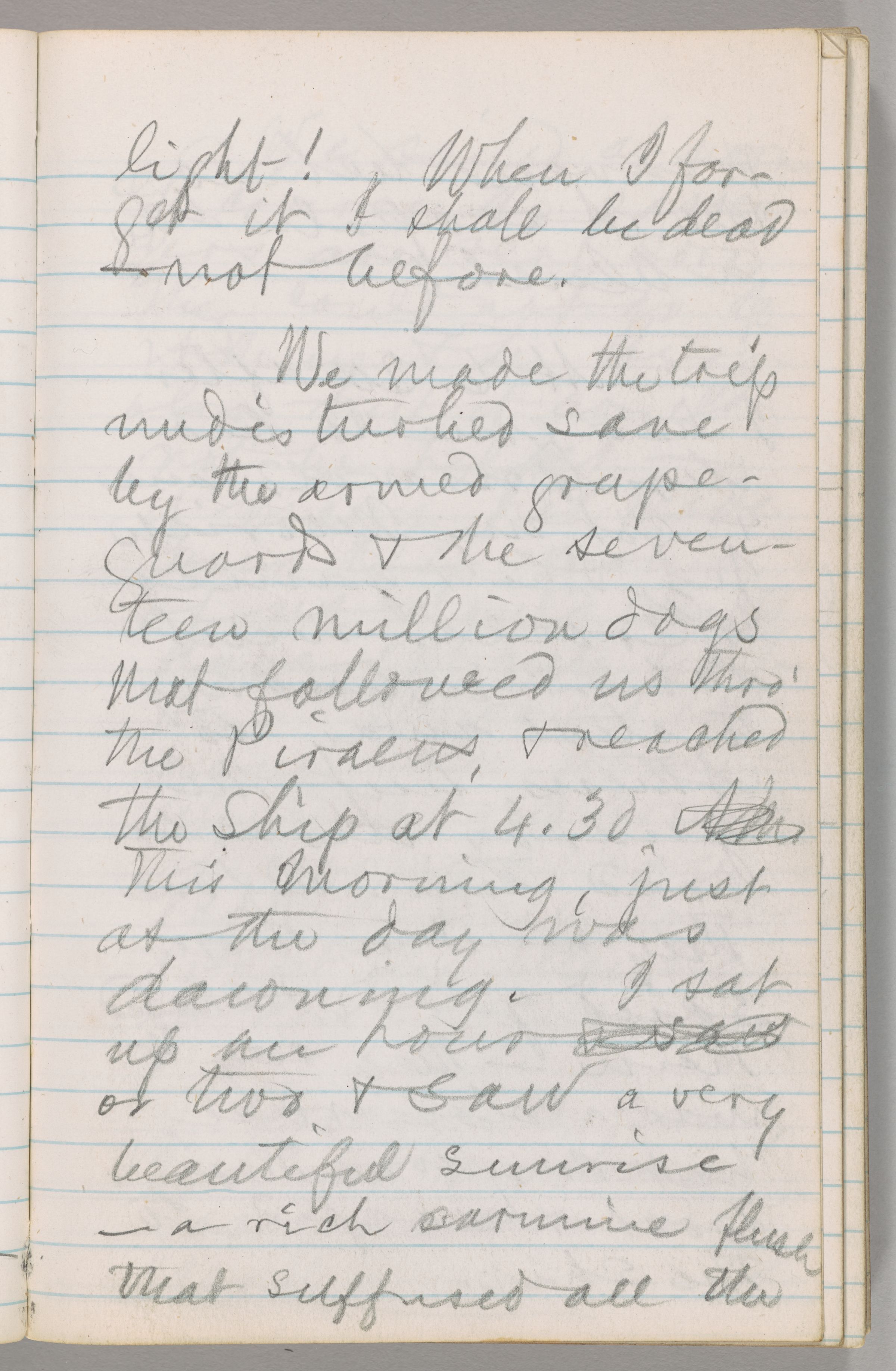
[MS: N9_leaf_012r] light! When I
for-
get
forget
it I shall be dead
—not before.
We made the trip
undisturbed save
by the armed grape-
guards & the
seven-
teen
seventeen
million dogs
that followed us thro’
the Piraeus, & reached
the ship at 4.30
A.M.
this morning, just
as the day was
dawning. I sat
up an hour
& saw
or two & saw a very
beautiful sunrise
—a rich
s carmine flush
that suffused all the
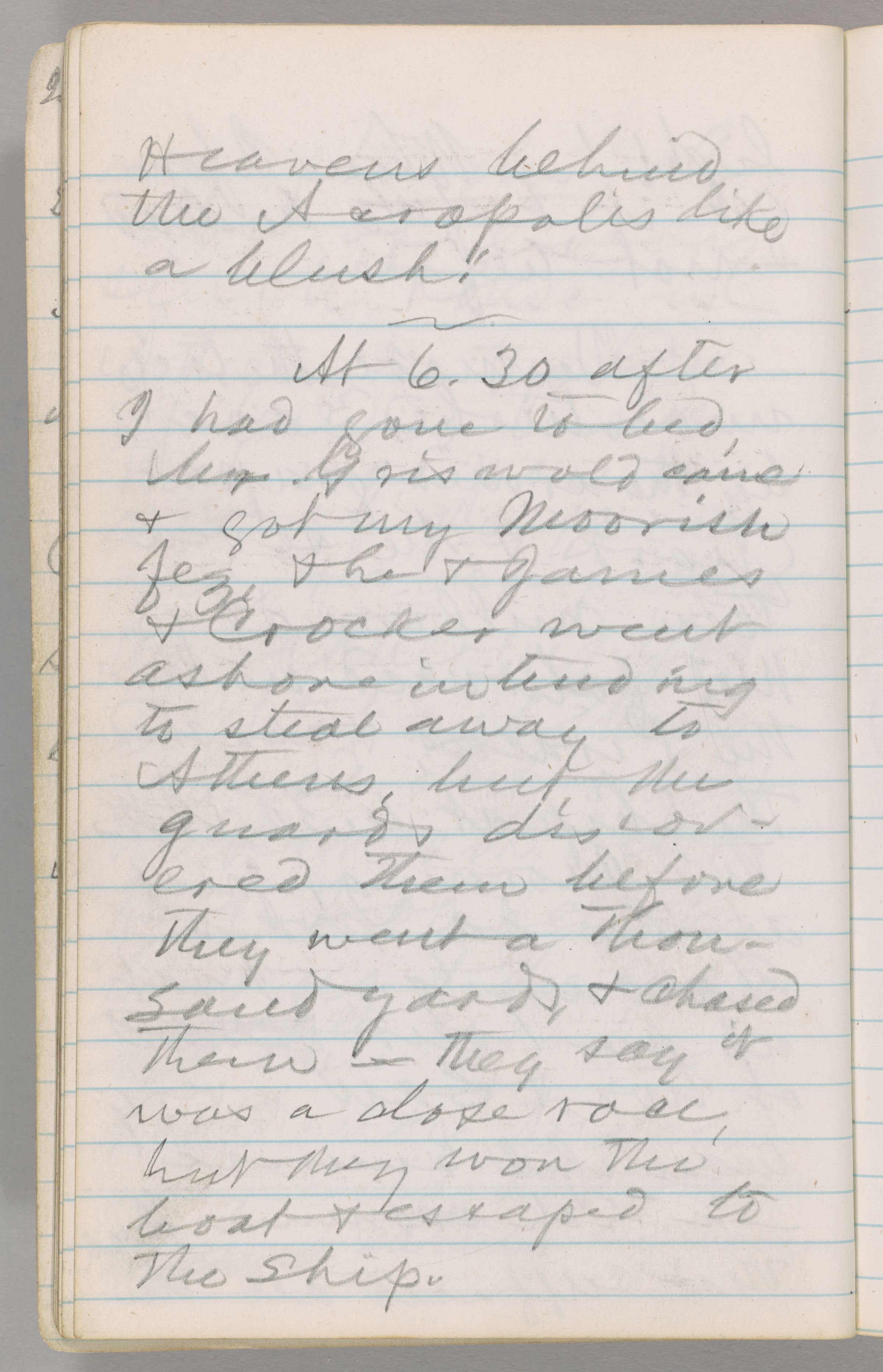
[MS: N9_leaf_012v]
Heavens
behind
the Acropolis like
a blush!
At 6.30 after
I had gone to bed,
Mr. Griswold came
& got my Moorish
fez, &
he & James
& Crocker went
ashore intending
to steal away to
Athens, but
the
guards
discov-
ered
discovered
them before
they went a
thou-
sand
thousand
yards, & chased
them—they say it
was a close race,
but they won the
boat & escaped to
the
ship.
[MS: N9_leaf_013r]
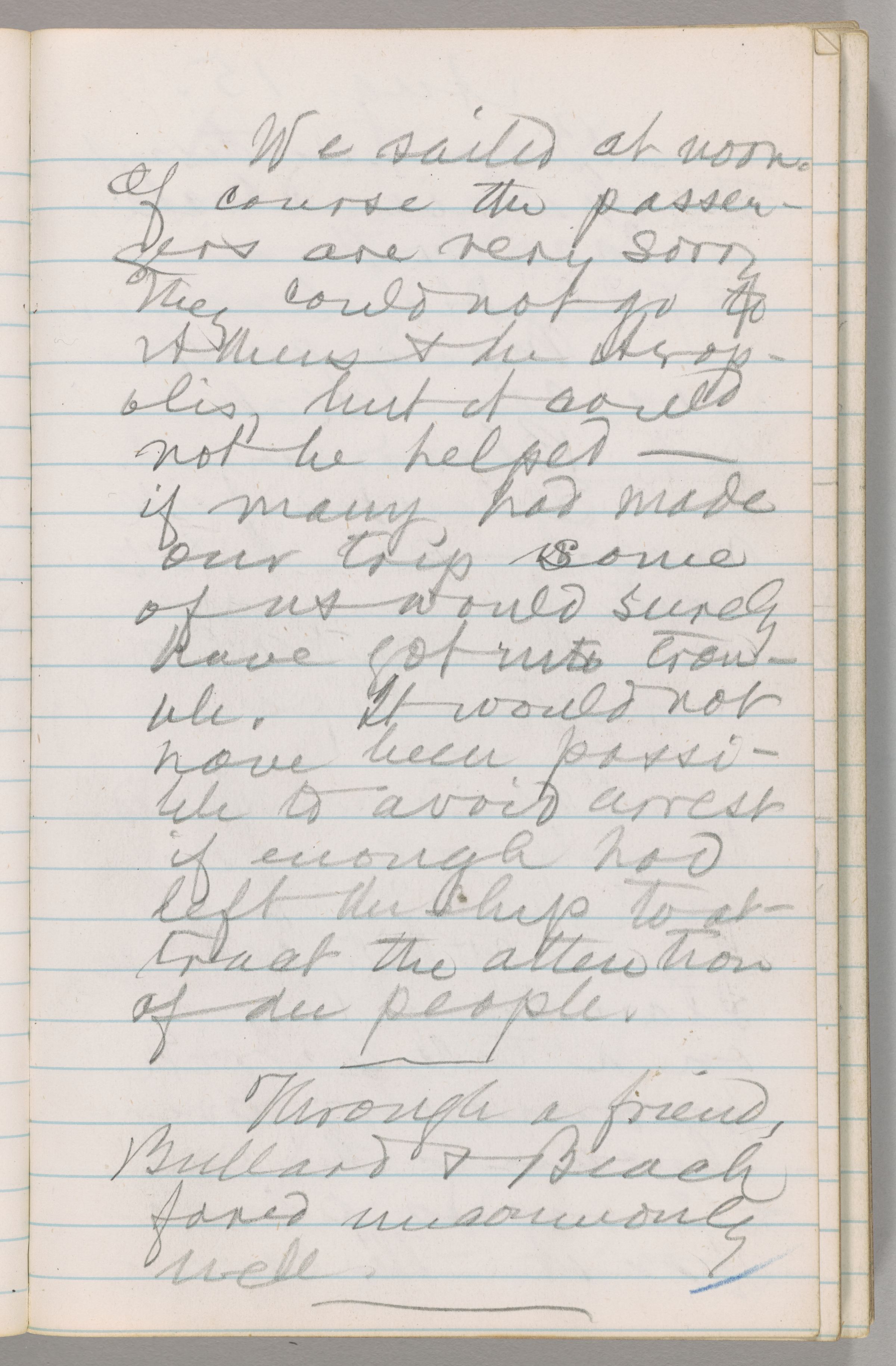
We sailed at noon.
Of course the
passen-
gers
passengers
are very sorry
they could not go to
Athens & the
Acrop-
olis
Acropolis
, but it could
not be helped—
if many had made
our trip
w some
of us would surely
have got into
trou-
ble
trouble
. It would not
have
been
possi-
ble
possible
to avoid arrest
if enough had
left the ship to
at-
tract
attract
the attention
of the people.
Through a friend,
Bullard & Beach
fared uncommonly
well.
[MS: N9_leaf_013v]
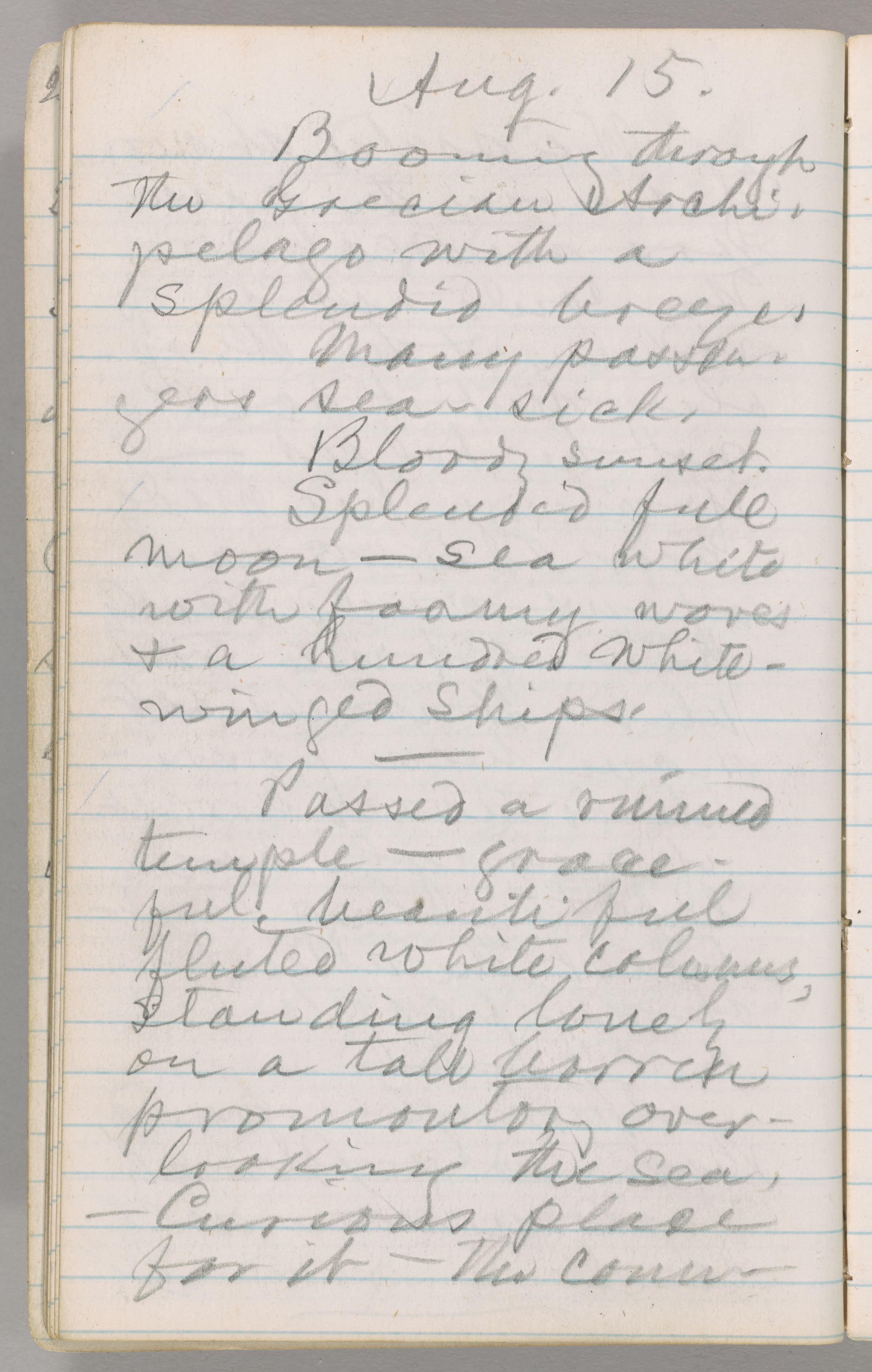
Aug. 15.
Booming through
the Grecian
Archi-
pelago
Archipelago
with a
splendid breeze.
Many
passen-
gers
passengers
sea-sick.
[MTP: N&J1_392]
Bloody sunset.
Splendid full
moon—sea white
with foamy waves
& a hundred white-
winged
ships.
Passed a ruined
temple—
grace-
ful
graceful
, beautiful
fluted white columns,
standing lonely
on a tall barren
promontory
over-
looking
overlooking
the sea,
—Curious place
for it—the coun-
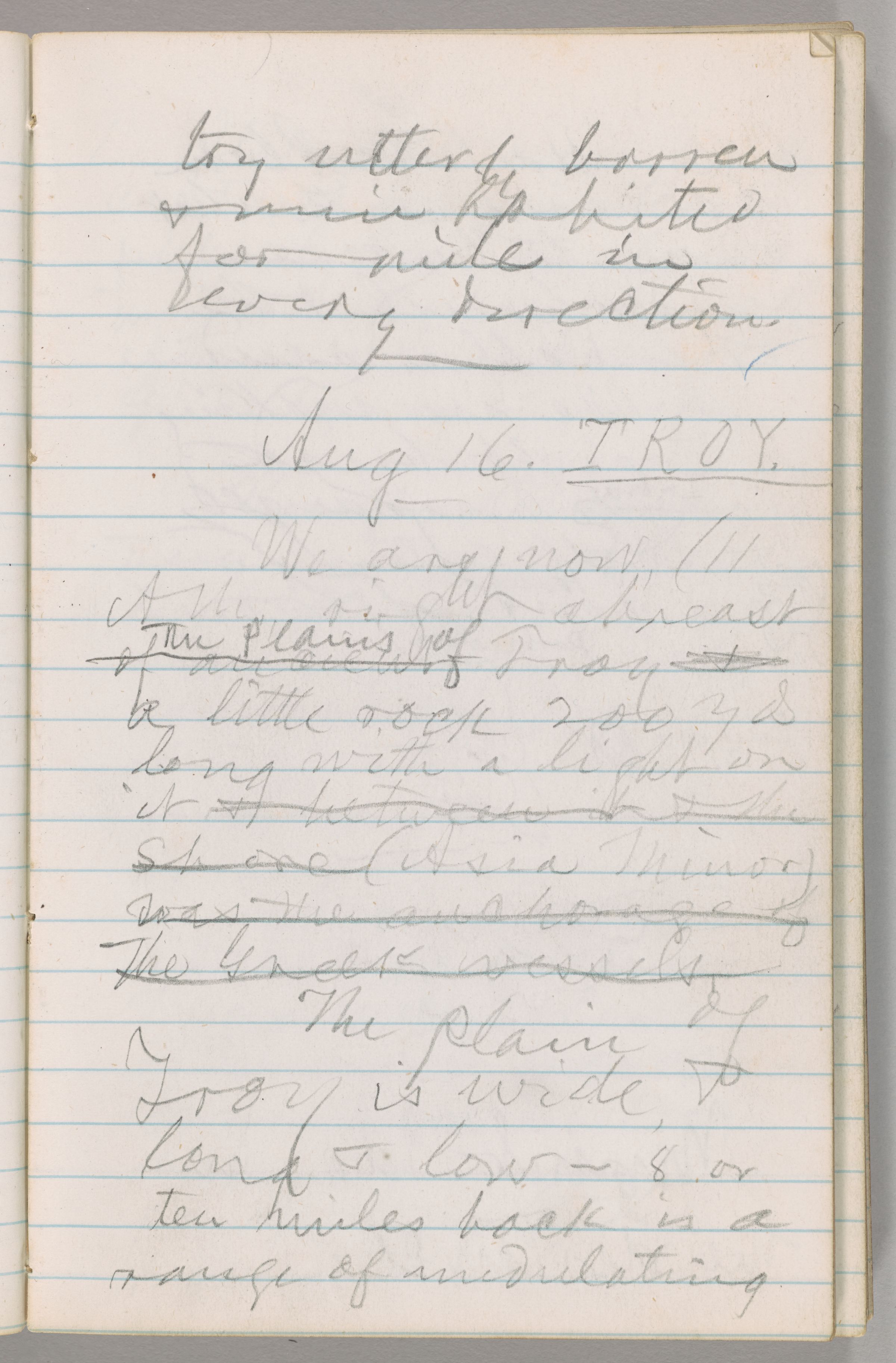
[MS: N9_leaf_014r]
try utterly barren
&
uninhabited
for miles in
every direction.
Aug 16. TROY.
We are now, (11
AM., right abreast
of
ancient
the Plains of
Troy &
a little rock 200 yds
long with a light on
it &
between it & the
shore (Asia Minor)
was the anchorage of
the
Greek vessels.
The Plain of
Troy is wide, &
long & low—8 or
ten miles back is a
range of
undulating
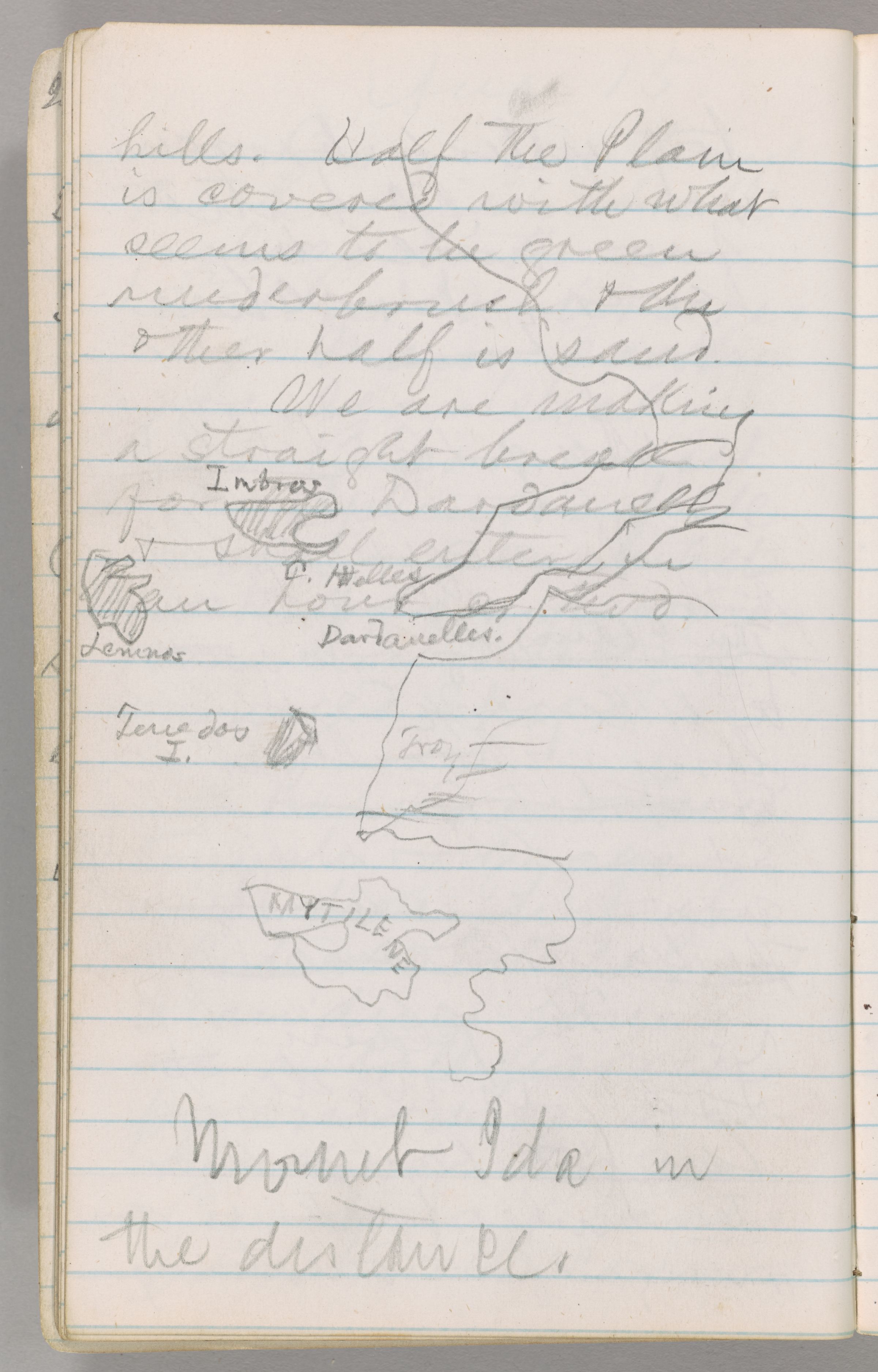
[MS: N9_leaf_014v]
hills. Half the Plain
is covered with what
seems to be green
underbrush & the
other half is sand.
We are making
a straight break
for the Dardanells
& shall enter in
an hour or
two.
drawing, labeled:
Imbros
C. Helles
Lemnos
Dardanelles
Tenedos I.
Troy
MYTILENE
Mount Ida in
the distance.
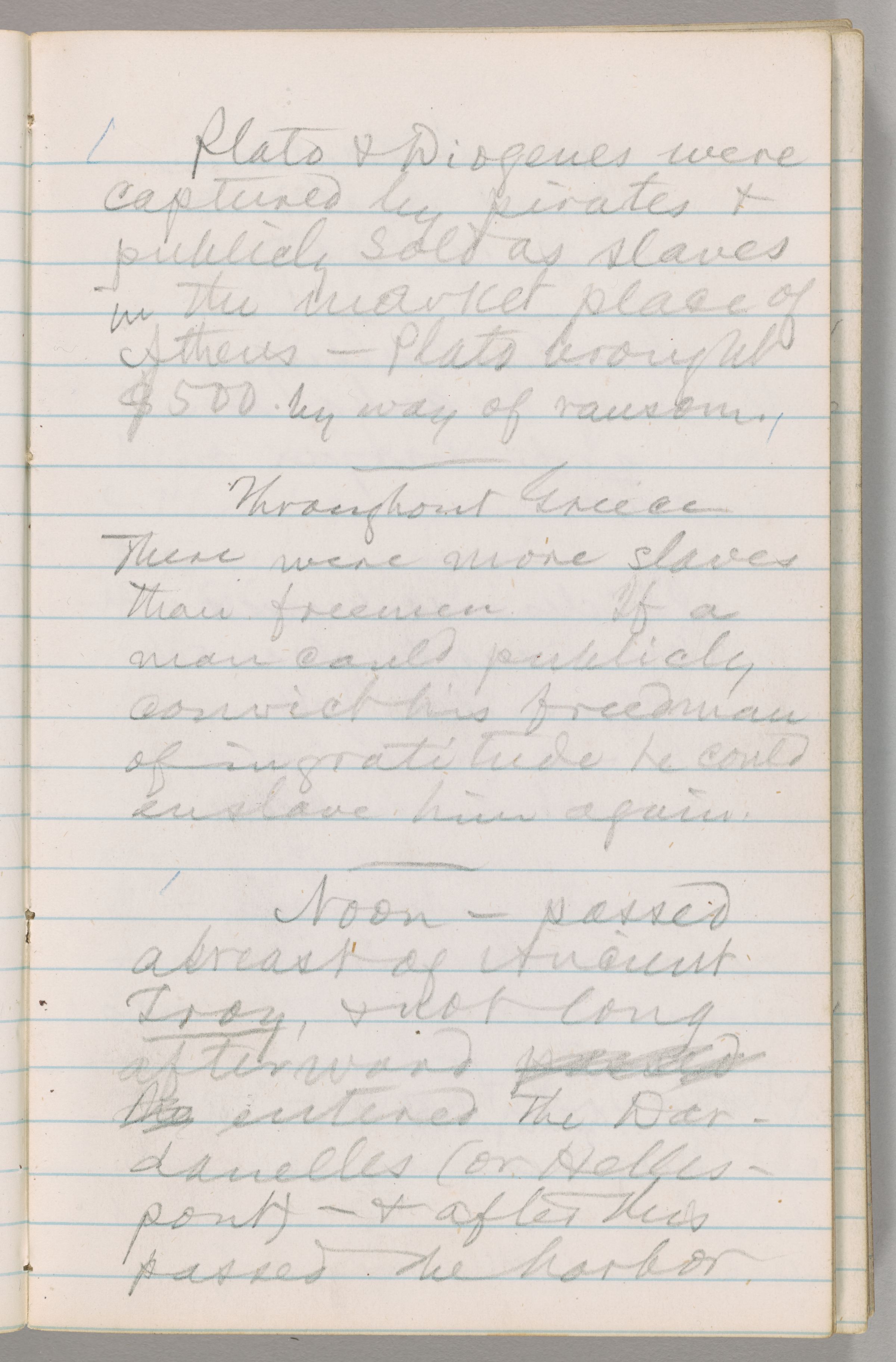
[MS: N9_leaf_015r]
Plato & Diogenes were
captured by pirates &
publicly sold as slaves
in the
market place of
Athens—Plato brought
$500. by way of ransom.
Throughout Greece
there were more slaves
than freemen. If a
man could publicly
convict his freedman
of ingratitude he could
enslave him again.
Noon—passed
abreast of Ancient
Troy, & not long
afterward passed
the entered the
Dar-
danelles
Dardanelles
(or
Helles-
pont
Hellespont
)—&
after this
passed the harbor
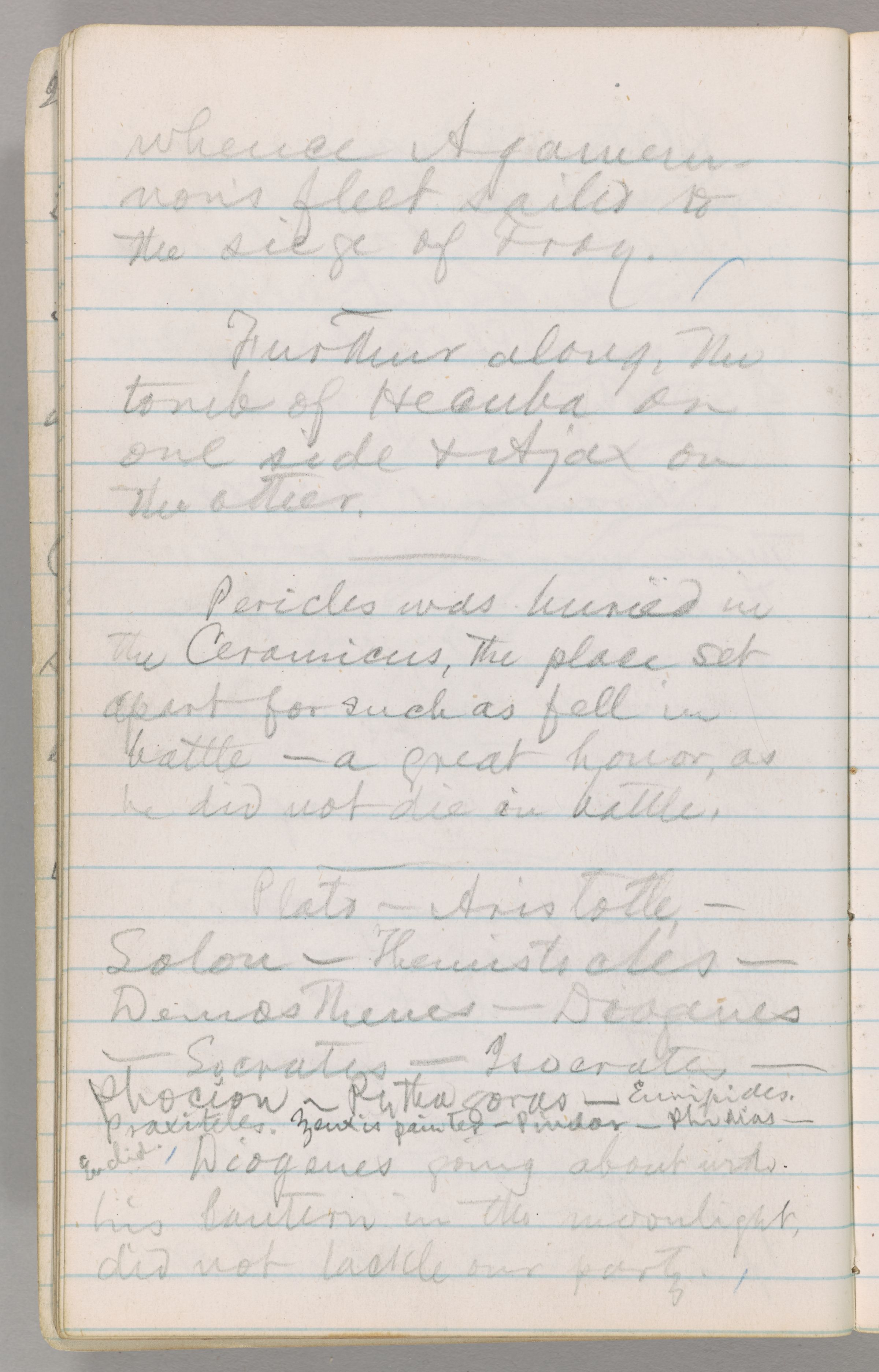
[MS: N9_leaf_015v]
whence
Agamem-
non’s
Agamemnon’s
fleet
sailed to
the siege of Troy.
Further along, the
tomb of Hecuba on
one side & Ajax on
the other.
Pericles was buried in
the Ceramicus, the place set
apart for such as fell in
battle—a great honor, as
he did not die
o in battle.
[MTP: N&J1_393]
Plato—Aristotle,—
Solon—Themistocles—
Demosthenes—Diogenes
—Socrates—Isocrates—
Phocion—Pythagoras—Euripides.
Praxiteles. Zeuxis
painter—Pindar—Phidias
—Euclid.
Diogenes going about with
his lantern in the moonlight,
did not tackle our
party.
[MS: N9_leaf_016r]
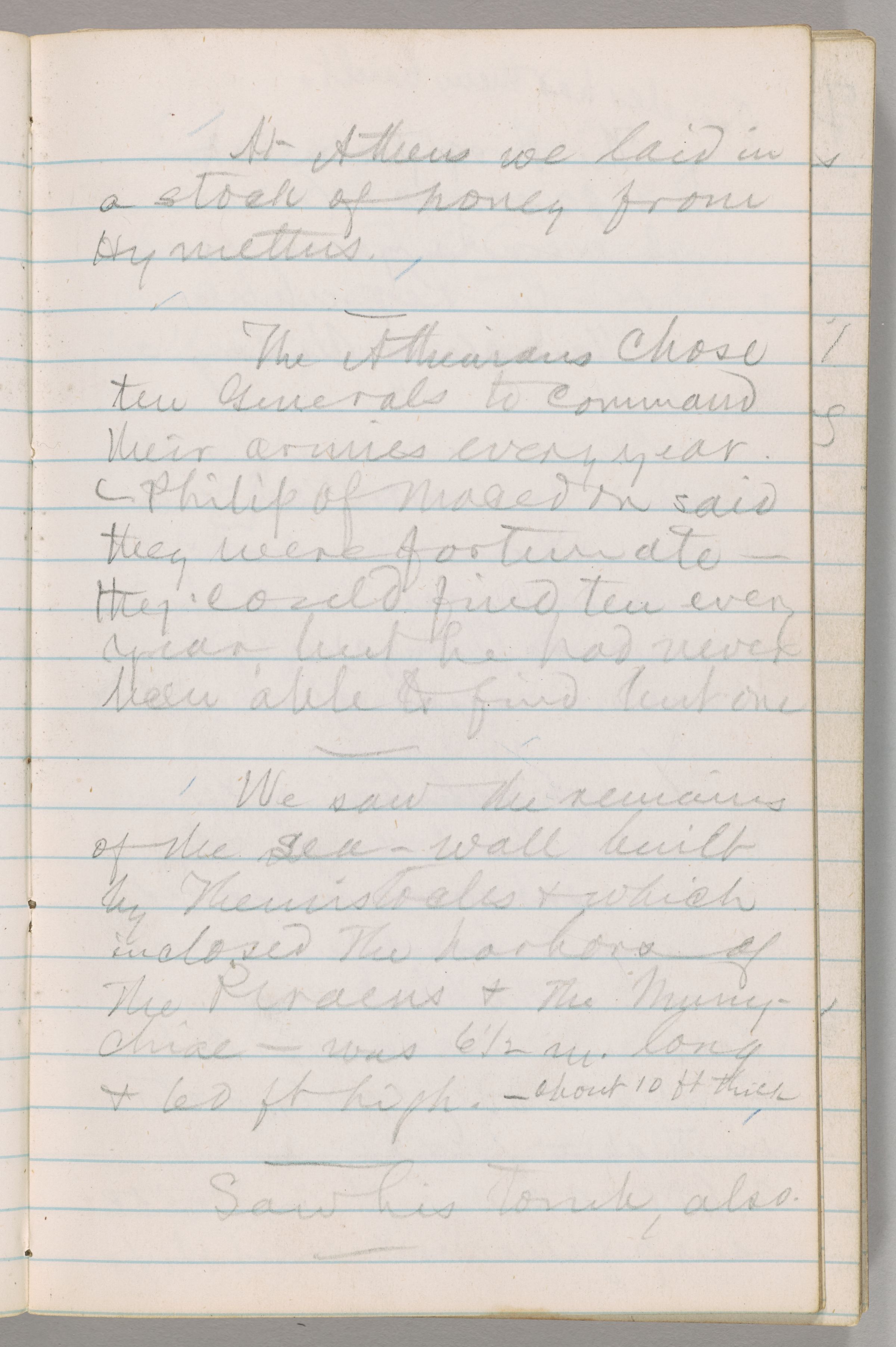
At Athens we laid in
a stock of honey from
Hymettus.
The Athenians chose
ten Generals to command
their armies every year.
—Philip of
Macedon said
they were fortunate—
they could find ten every
year, but he had never
been able to find but one
[MTP: N&J1_394]
We saw the remains
of the w sea-wall built
by Themistocles & which
inclosed the harbors of
the Piraeus & the
Muny-
chiae
Munychiae
—was 6½ m. long
& 60 ft
high.—about 10 ft thick
Saw his tomb, also.
[MS: N9_leaf_016v]
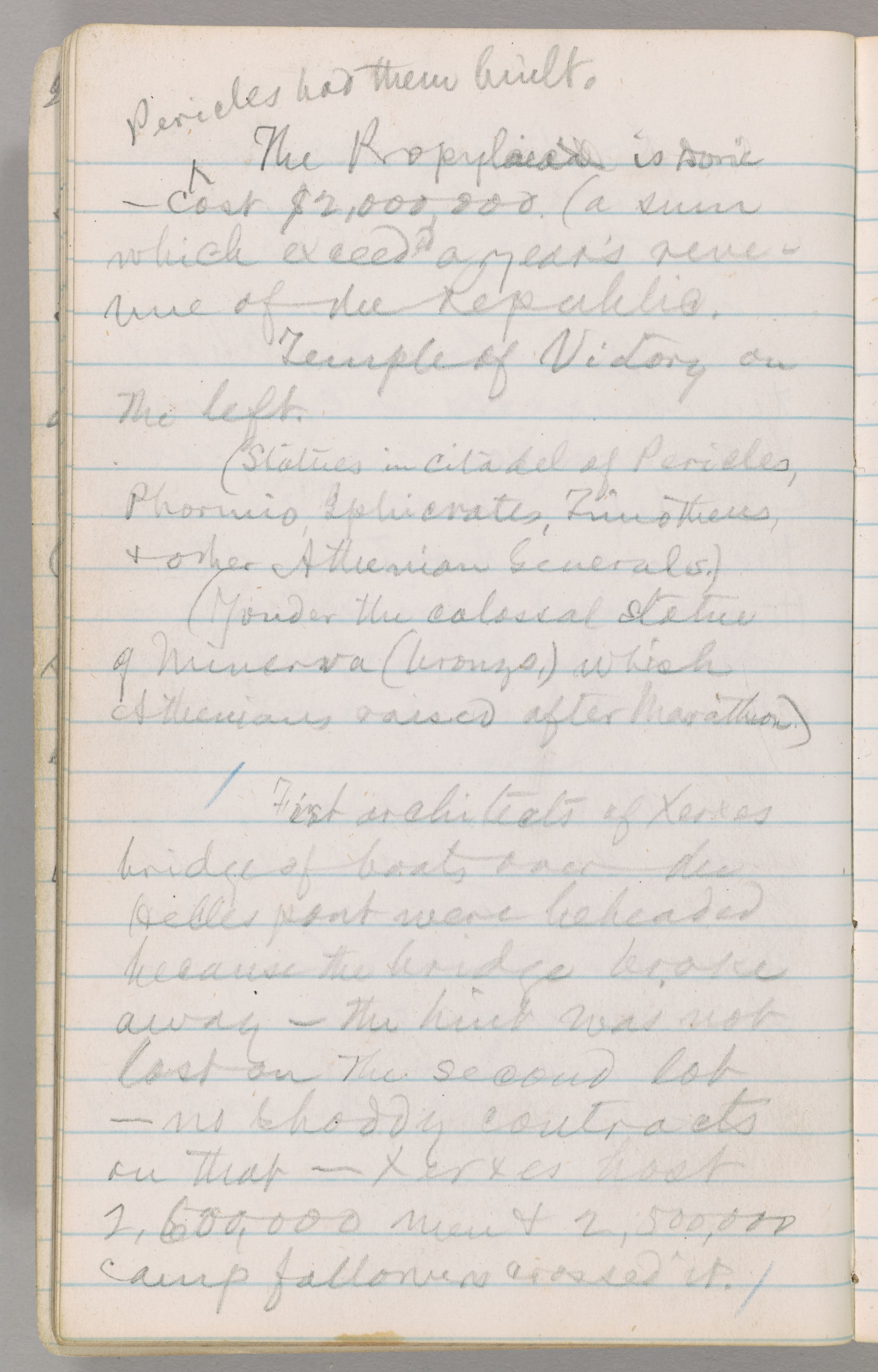
Pericles had them built.
The
Propyliaeeaa
is Doric
—cost $2,000,000. (a sum
which
exceeded a year’s
reve-
nue
revenue
of the Republic.
Temple of Victory on
the left.
(Statues in citadel of Pericles,
Phormio, Iphicrates, Timotheus,
& other
Athenian Generals.)
(Yonder the colossal statue
of Minerva (bronze,) which
Athenians raised after
Marathon.)
First architects of Xerxes
bridge of boats over the
Hellespont were beheaded
because the bridge broke
away—the hint was not
lost on the second lot
—no shoddy
contracts
on that—Xerxes host
2,5600,000 men & 2,500,000
camp followers crossed it.
[MS: N9_leaf_017r]
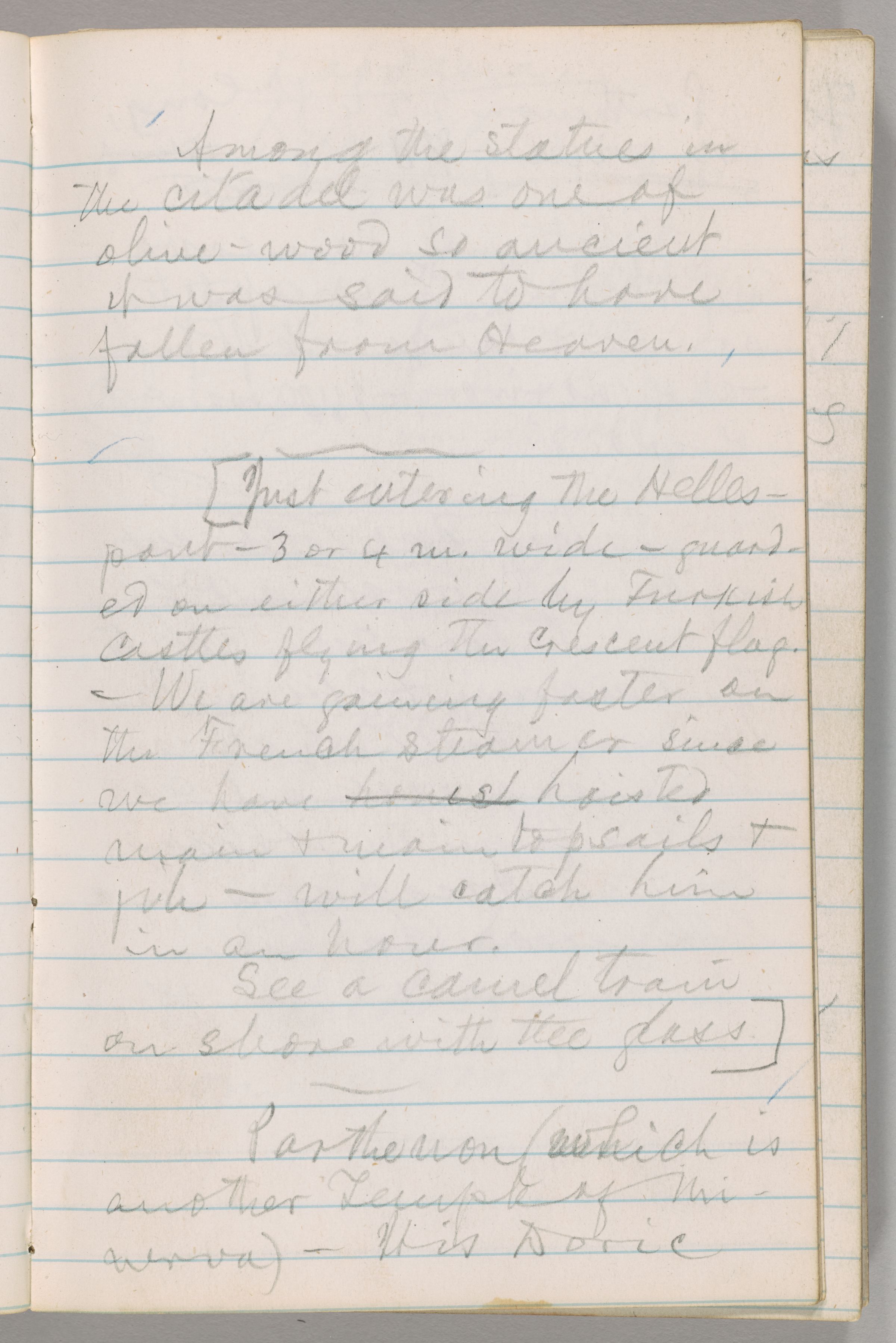
Among the statues in
the citadel was one of
olive-wood so ancient
it was said to
have
fallen from Heaven.
⟦Just entering the
Helles-
pont
Hellespont
—3 or 4 m.
wide—
guard-
ed
guarded
on either side by Turkish
castles flying the crescent flag.
—We are
gaining faster on
the French steamer since
we have houist hoisted
main & main
topsails &
jib—will catch him
in an hour.
See a camel train
on shore with the glass.⟧
Parthenon (an which is
another Temple of
Mi-
nerva
Minerva
)—It is Doric
[MS: N9_leaf_017v]
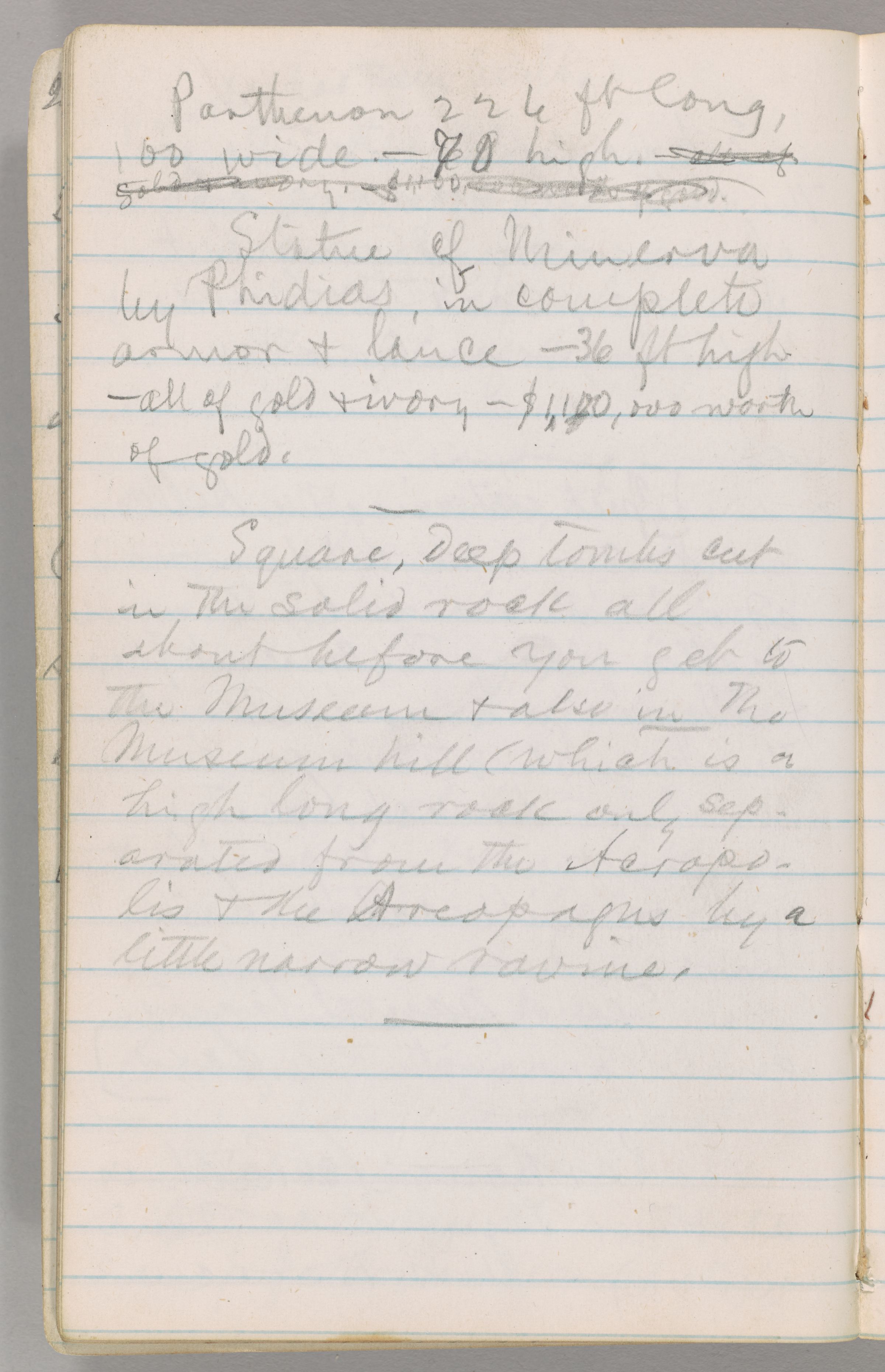
Parthenon 226 ft long,
100 wide.—69 70 high.
—all of
gold & ivory,—$1,100,000 worth of gold.
[MTP: N&J1_395]
Statue of Minerva
by Phidias, in complete
armor & lance—36 ft high
—all of gold
& ivory—$1,100,000 worth
of gold.
Square, deep tombs cut
in the solid rock all
about before you get to
the Museum
& also in the
Museum hill (which is a
high long rock
only
sep-
arated
separated
from the
Acropo-
lis
Acropolis
& the Areopagus by a
little narrow
ravine.
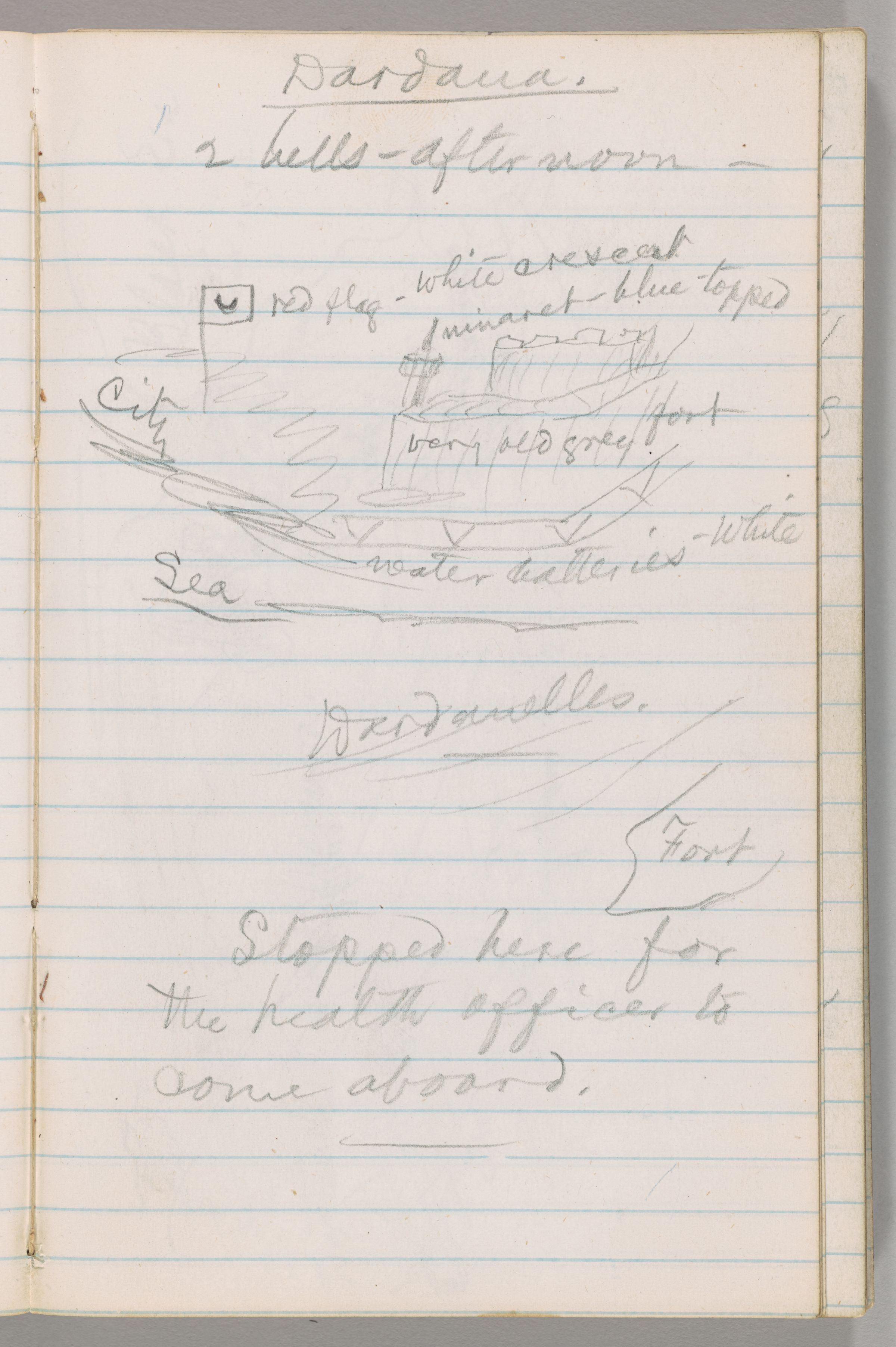
[MS: N9_leaf_018r]
2 bells—afternoon—
drawing, labeled:
red-flag—white crescent
minaret—blue-topped
very old grey fort
City
water betteries—white
Sea
Dardanelles
Fort
Stopped here for
the health officer to
come aboard.
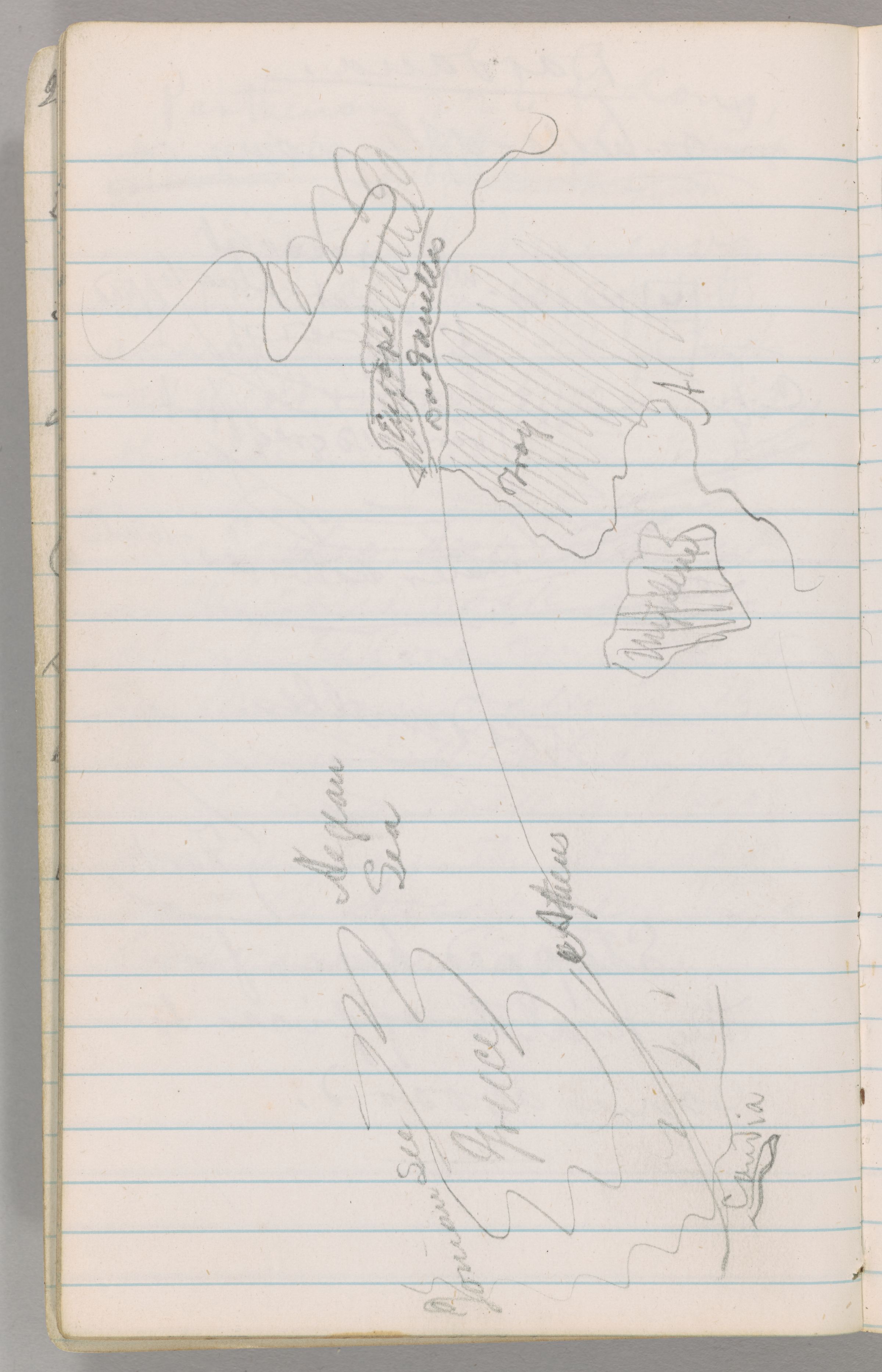
[MS: N9_leaf_018v]
drawing, labeled:
Ionian Sea
Greece
Aegean Sea
Europe
Dardanelles
Athens
Troy
Candia
Mytilene
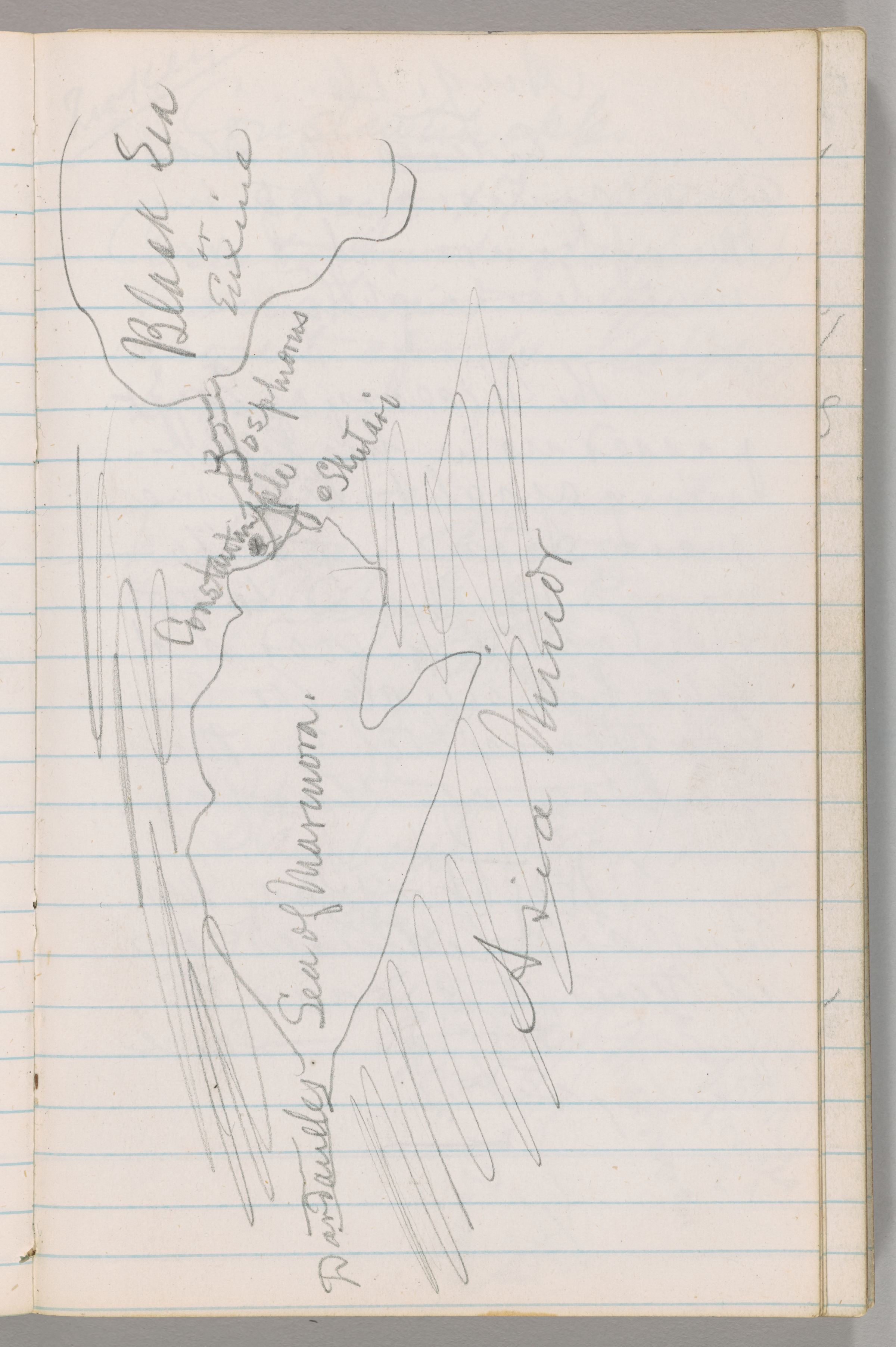
[MS: N9_leaf_019r]
drawing, labeled:
Dardanelles
Sea of Marmora
Constantinople
Bosphorus
Skutari
Black Sea or Euxine
Asia Minor
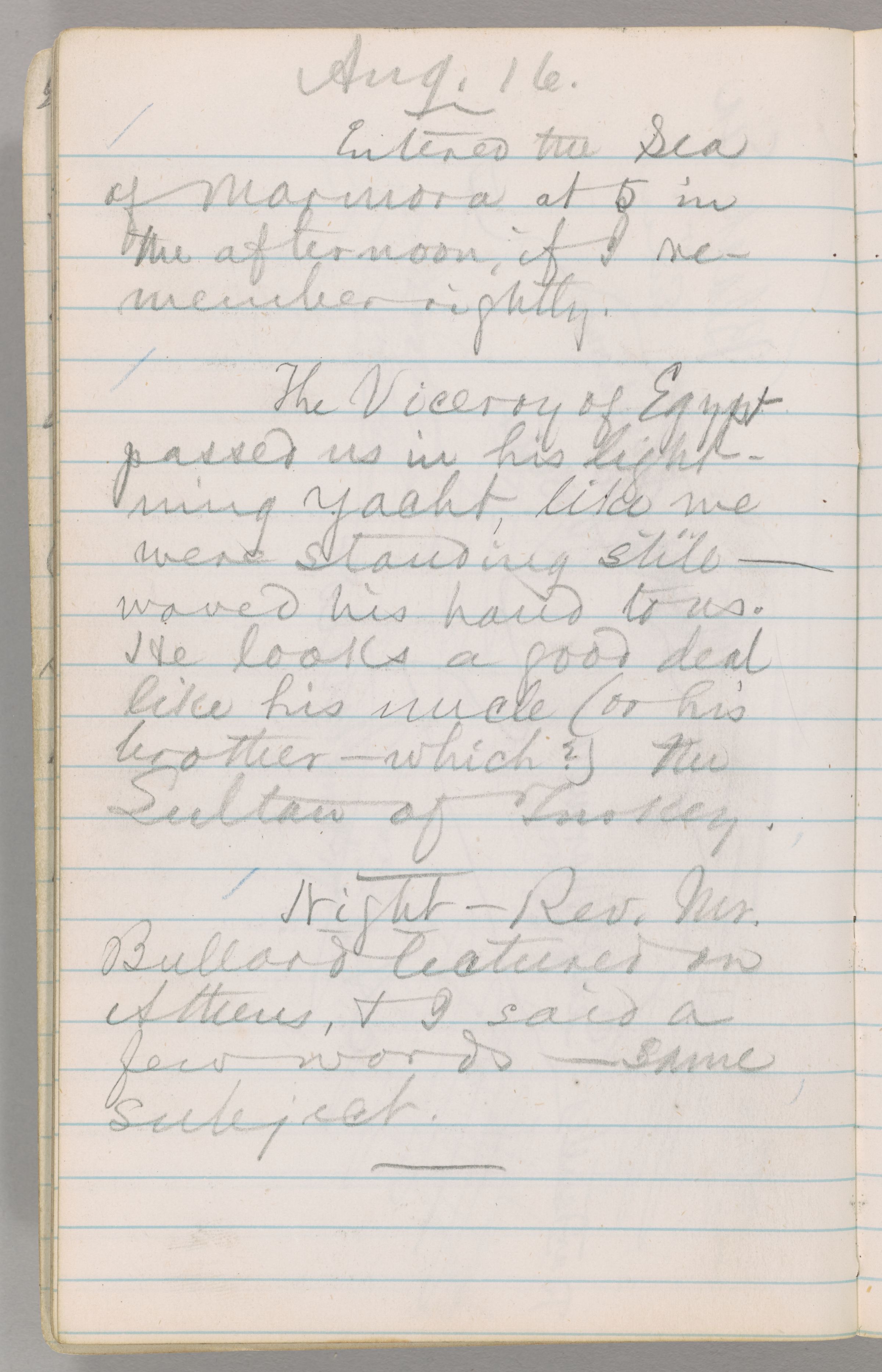
[MS: N9_leaf_019v]
Aug. 16.
Entered the Sea
of Marmora at 6 5 in
the afternoon, if I
re-
member
remember
rightly.
[MTP: N&J1_396]
The Viceroy of Egypt
passed us in his
light-
ning
lightning
yacht, like we
were standing
still—
waved his hand to us.
He looks a
good deal
like his uncle (or his
brother—which?) the
Sultan of Turkey.
[MTP: N&J1_397]
Night—Rev. Mr.
Bullard lectured on
Athens, & I said a
few words—same
subject.
[MS: N9_leaf_020r]
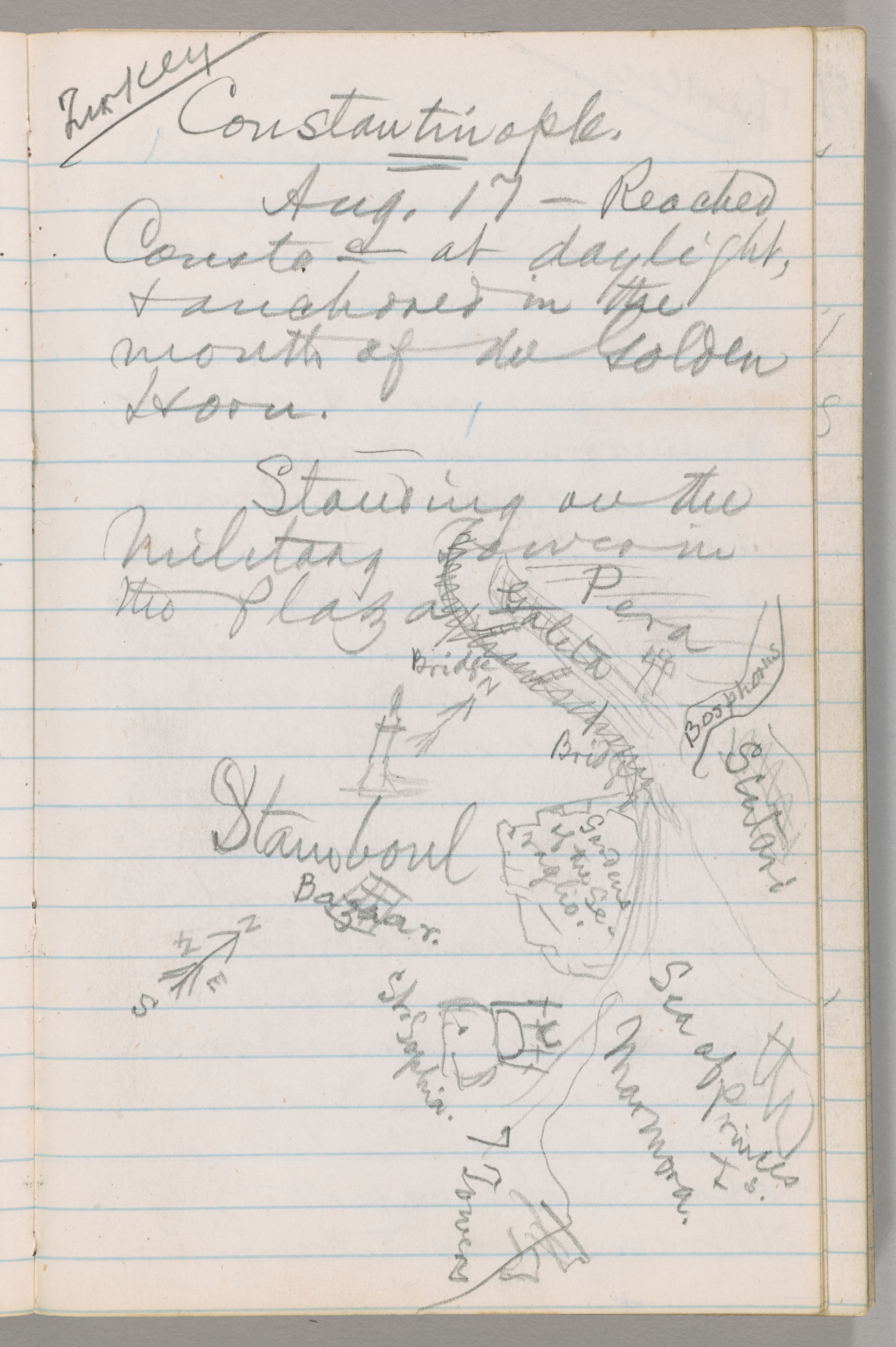
Constantinople.
Aug. 17—Reached
Constae at daylight,
& anchored in
the
mouth of the Golden
Horn.
Standing on the
Military Tower in
the Plaza—
drawing, labeled:
Pera
Galeta
Bridge
Bosphorous
Scutari
Bridge
Gardens of the Seraglio
Stamboul
Bazaar
Sea of Marmora
Princes Is.
St. Sophia
7 Towers
[MS: N9_leaf_020v]
[MTP: N&J1_398]
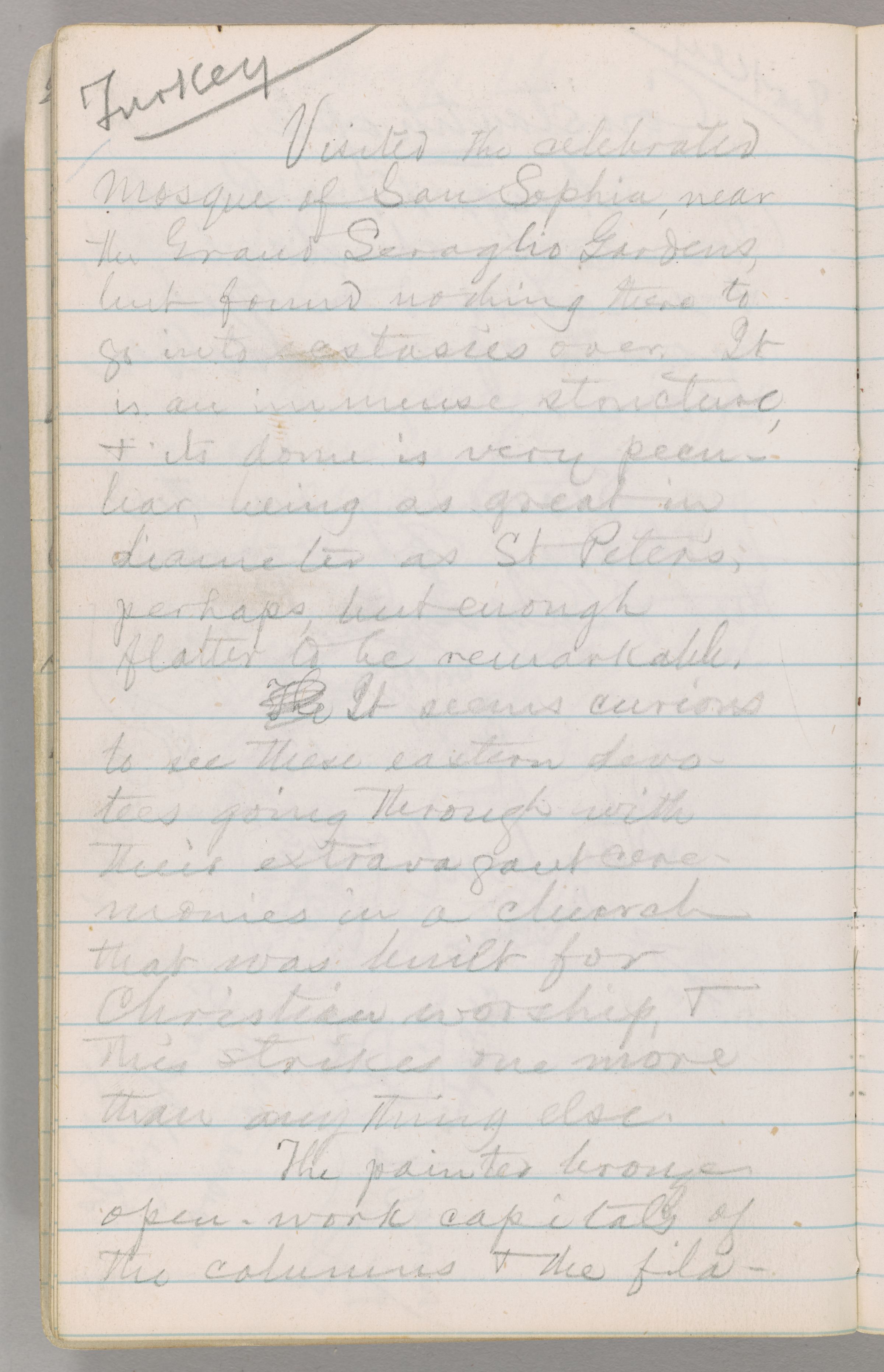
Turkey
Visited the celebrated
Mosque of San Sophia, near
the Grand Seraglio Gardens,
but
found nothing there to
go into ecstasies over. It
is an immense structure,
&
its dome is very
pec-
uliar
peculiar
, being as great in
diameter as St Peter’s,
perhaps, but
enough
flatter to be remarkable.
The It seems curious
to see these eastern
devo-
tees
devotees
going through with
their extravagant
cere-
monies
ceremonies
in a church
that was built for
Christian worship,
&
this strikes one more
than anything else.
The painted bronze
open-work capitals of
the columns & the fila-
[MS: N9_leaf_021r]
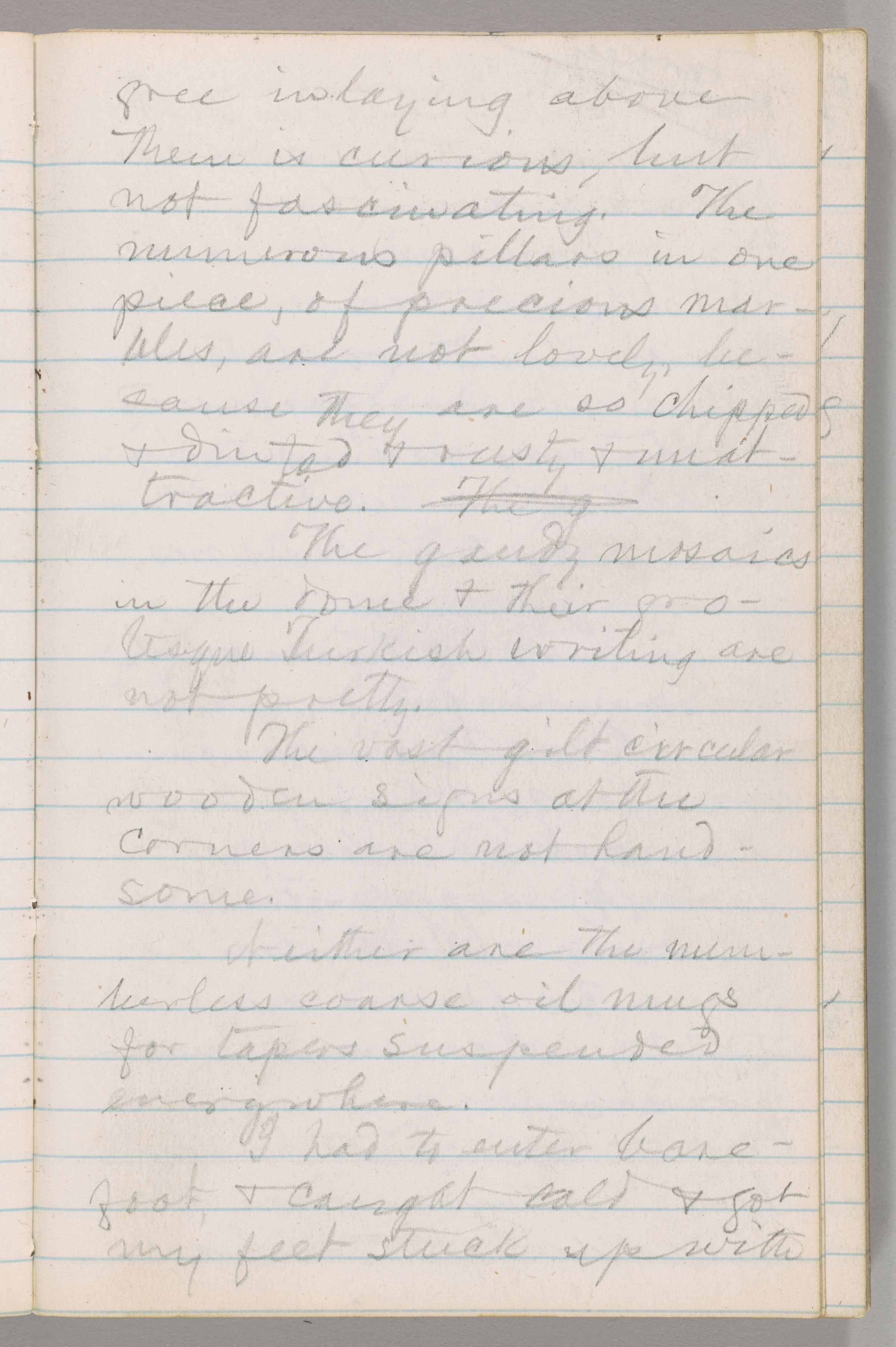
gree
inlaying above
them is curious, but
not fascinating. The
numerous pillars in one
piece, of precious
mar-
bles
marbles
, are not lovely,
be-
cause
because
they are so chipped
&
dinted & rusty &
unat-
tractive
unattractive
. The g
The gaudy mosaics
in the dome & their
gro-
tesque
grotesque
Turkish writing are
not
pretty.
The vast gilt circular
wooden signs at the
corners are not
hand-
some
handsome
.
Neither are the
num-
berless
numberless
coarse oil mugs
for tapers suspended
everywhere.
I had to enter bare
foot, & caught cold & got
my feet stuck up with
[MS: N9_leaf_021v]
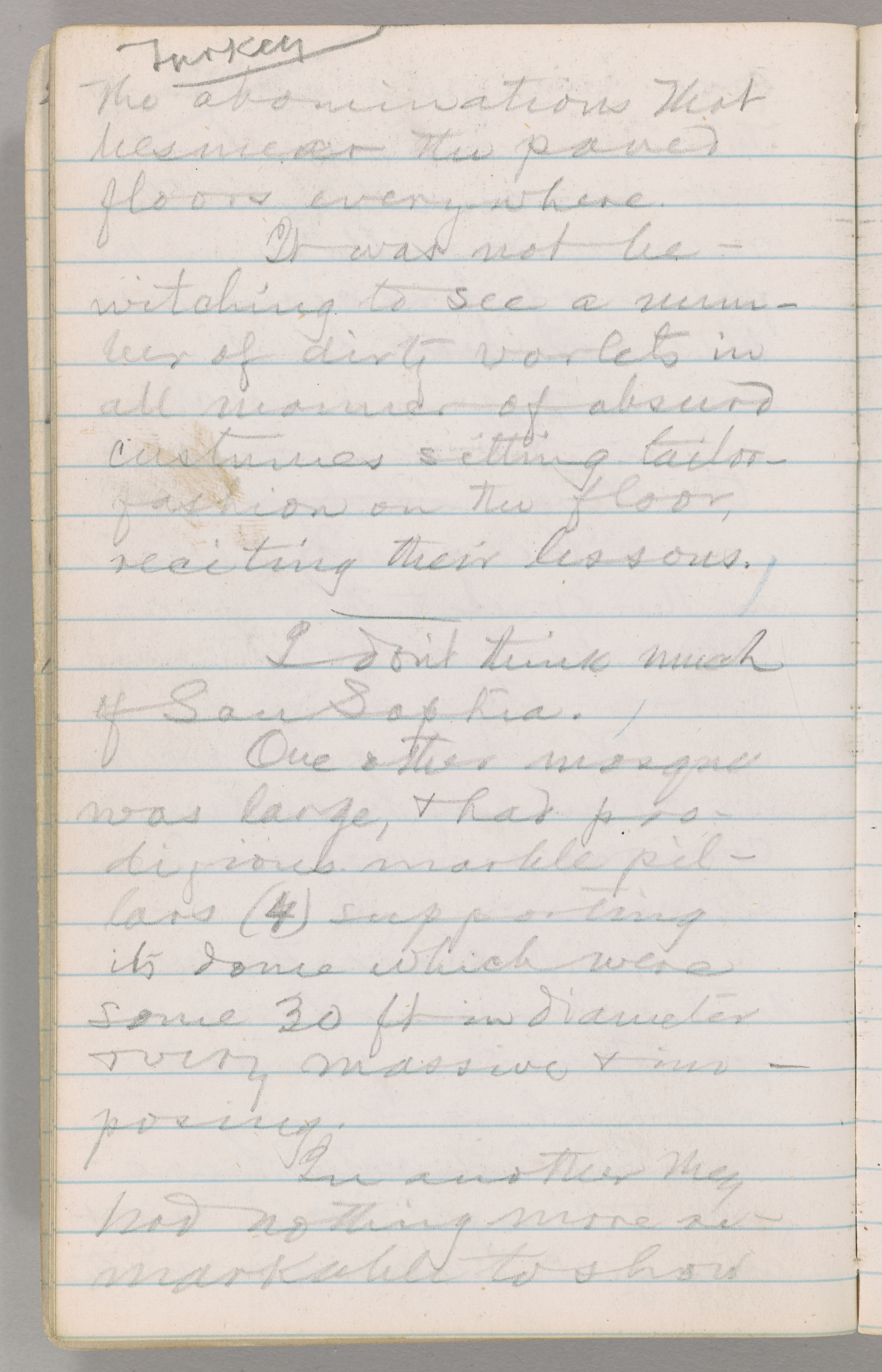
Turkey
besmear the paved
floors everywhere.
It was not
be-
witching
bewitching
to see a
num-
ber
number
of dirty varlets in
all manner of absurd
costumes sitting tailor-
fashion on the floor,
reciting their lessons.
I don’t think much
of San Sophia.
One other mosque
was large, & had
pro-
digious
prodigious
marble
pil-
lars
pillars
(4) supporting
its
dome which were
some 30 ft in diameter
& very massive &
im-
posing
imposing
.
In another they
had nothing more
re-
markable
remarkable
to show
[MS: N9_leaf_022r]
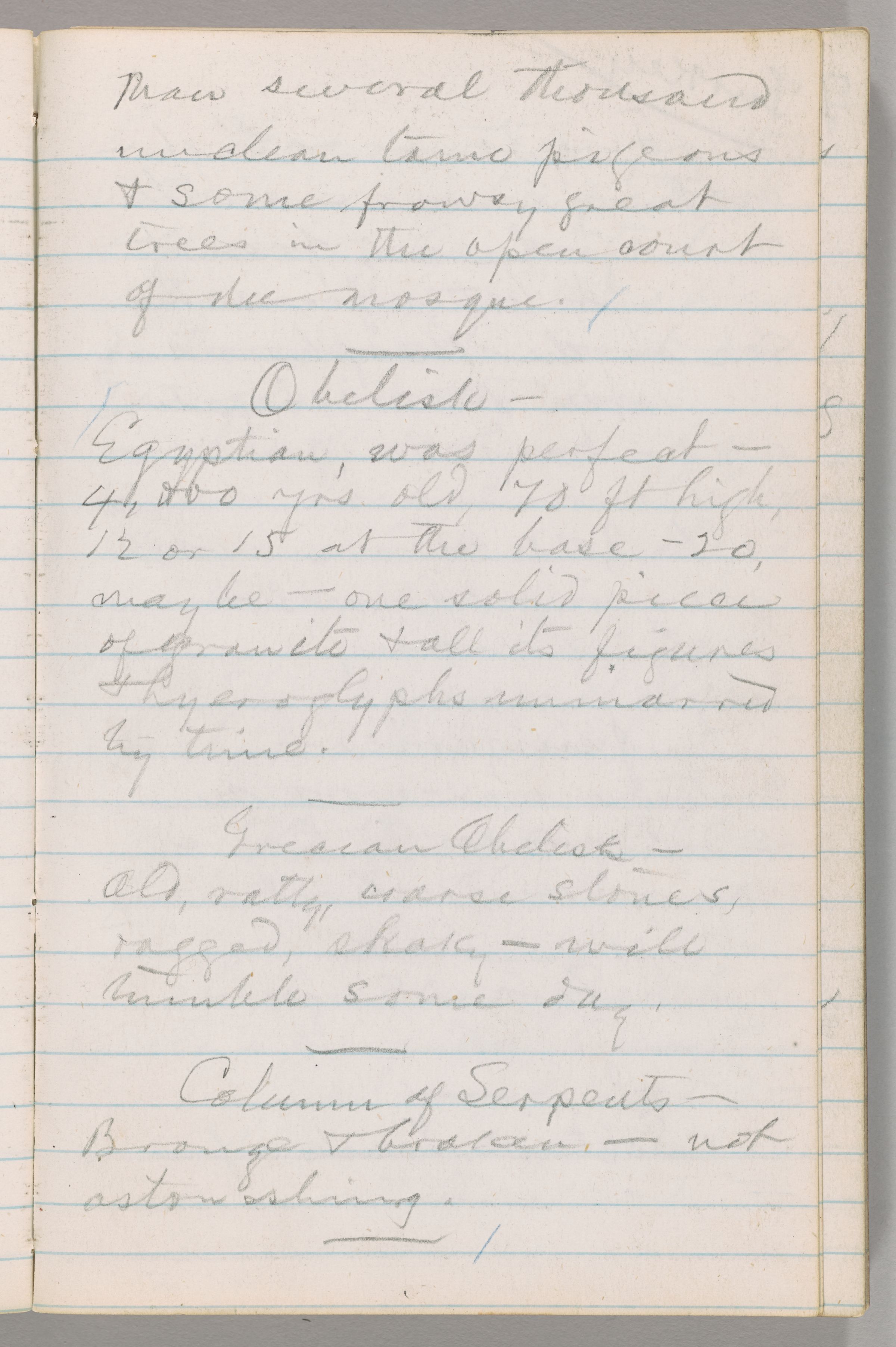
than
several thousand
unclean tame pigeons
& some frowsy great
trees in the open
court
of the mosque.
Obelisk—
Egyptian, was perfect—
4,000 yrs old, 70 ft high,
12 or 15 at the
base—20,
maybe—one solid piece
of granite & all its figures
& hyeroglyphs
unmarred
by time.
[MTP: N&J1_399]
Grecian Obelisk—
Old, ratty, coarse stones,
ragged, shaky—will
tumble some
day.
Column of Serpents—
Bronze & broken—not
astonishing.
[MS: N9_leaf_022v]
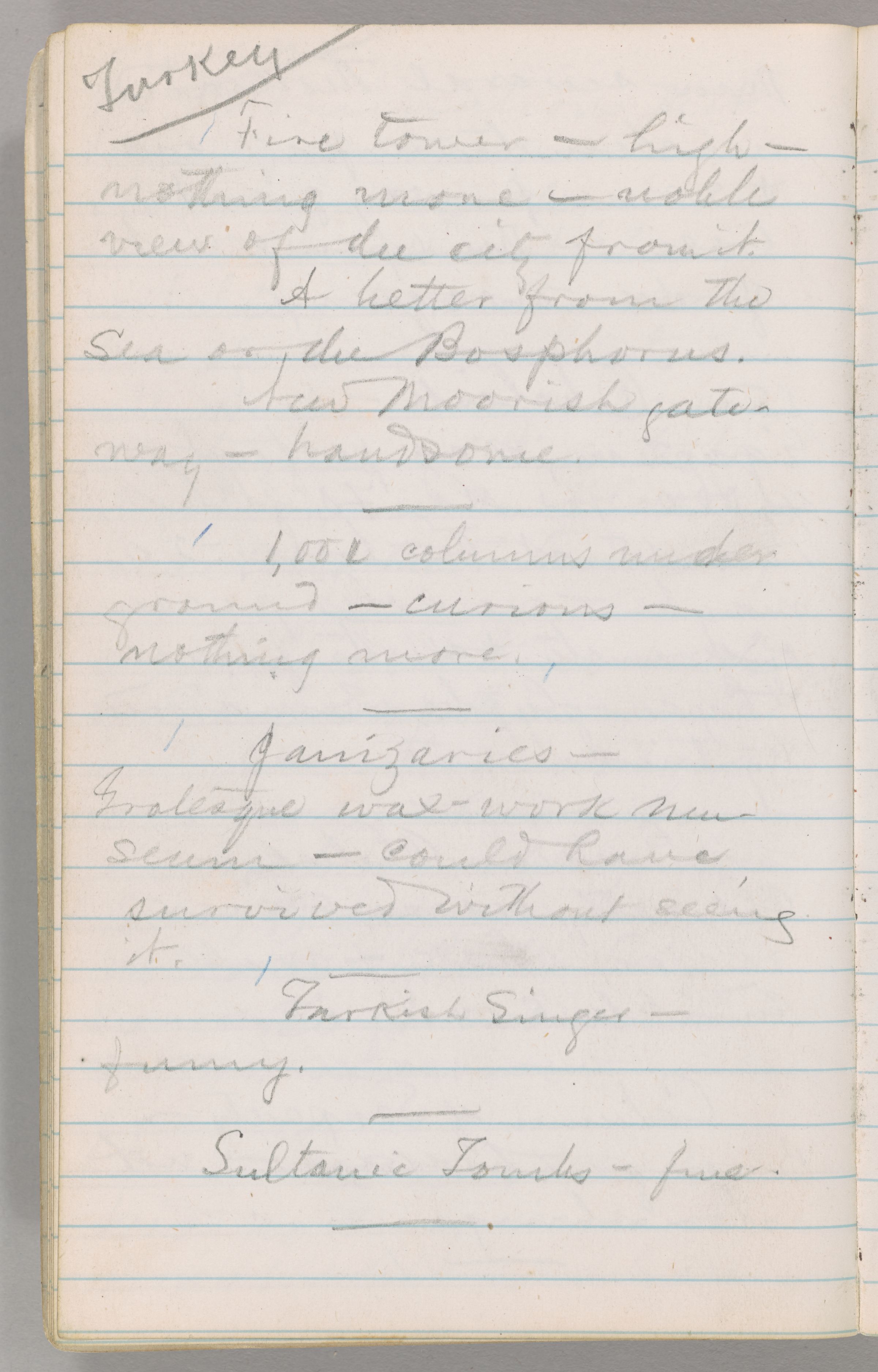
Turkey
Fire tower—high—
nothing more—noble
view of the city from it.
A better from the
Sea or the Bosphorus.
New Moorish
gate-
way
gateway
—handsome.
1,000 columns under
ground—curious—
nothing more.
Janizaries—
Grotesque wax-work
mu-
seum
museum
—could have
survived without seeing
it.
Turkish Singer—
funny.
Sultanic Tombs—fine.
[MS: N9_leaf_023r]
[MTP: N&J1_400]
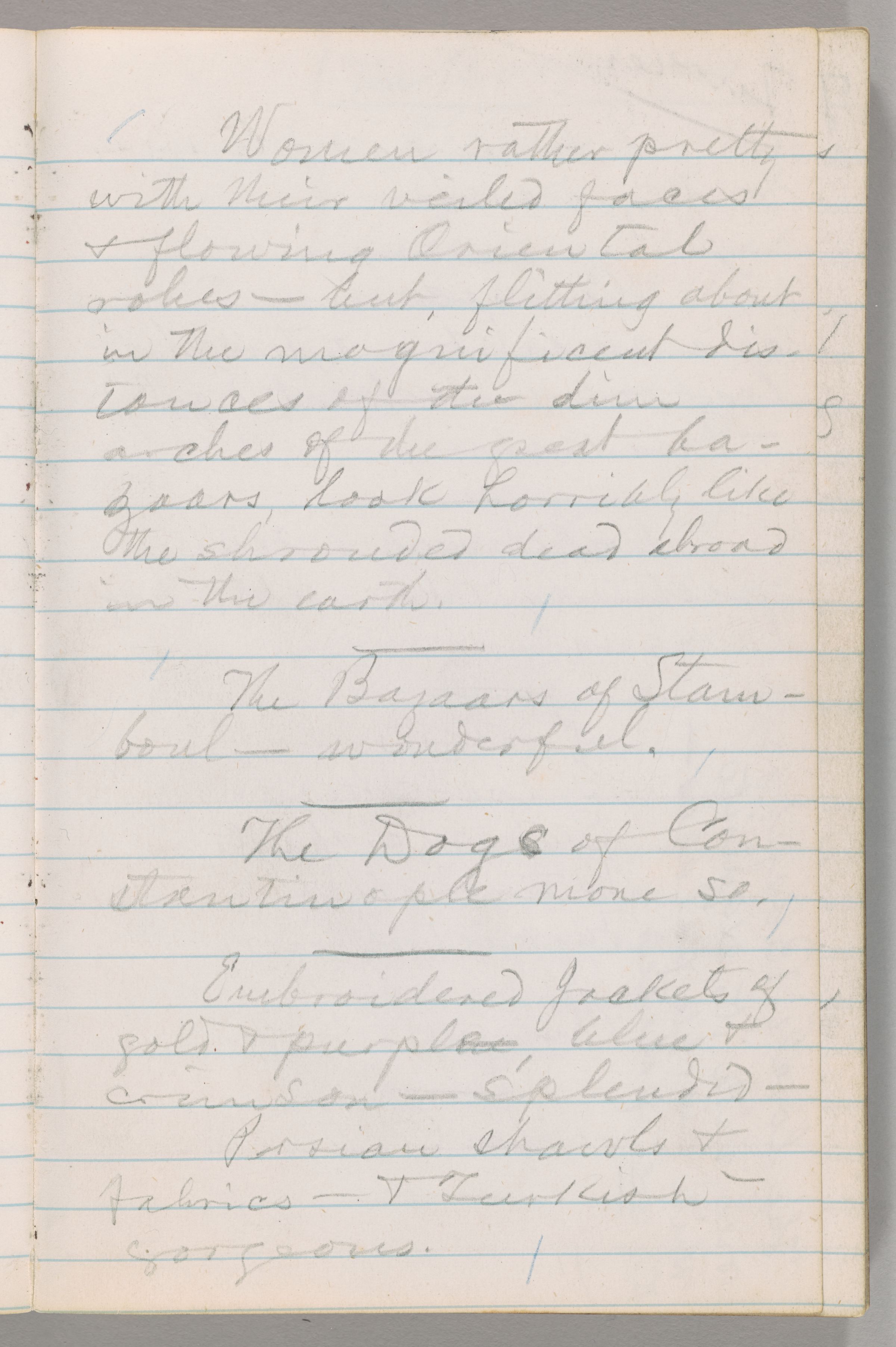
Women rather pretty
with their veiled faces
& flowing Oriental
robes—but,
flitting about
in the magnificent
dis-
tances
distances
of the dim
arches of the great
ba-
zaars
bazaars
, look horribly like
the shrouded dead abroad
in the earth.
The Bazaars of
Stam-
boul
Stamboul
—wonderful.
The Dogs of
Con-
stantinople
Constantinople
more so.
Embroidered Jackets of
gold & purple, blue &
crimson—splendid—
Persian shawls &
fabrics—& Turkish—
gorgeous.
[MS: N9_leaf_023v]
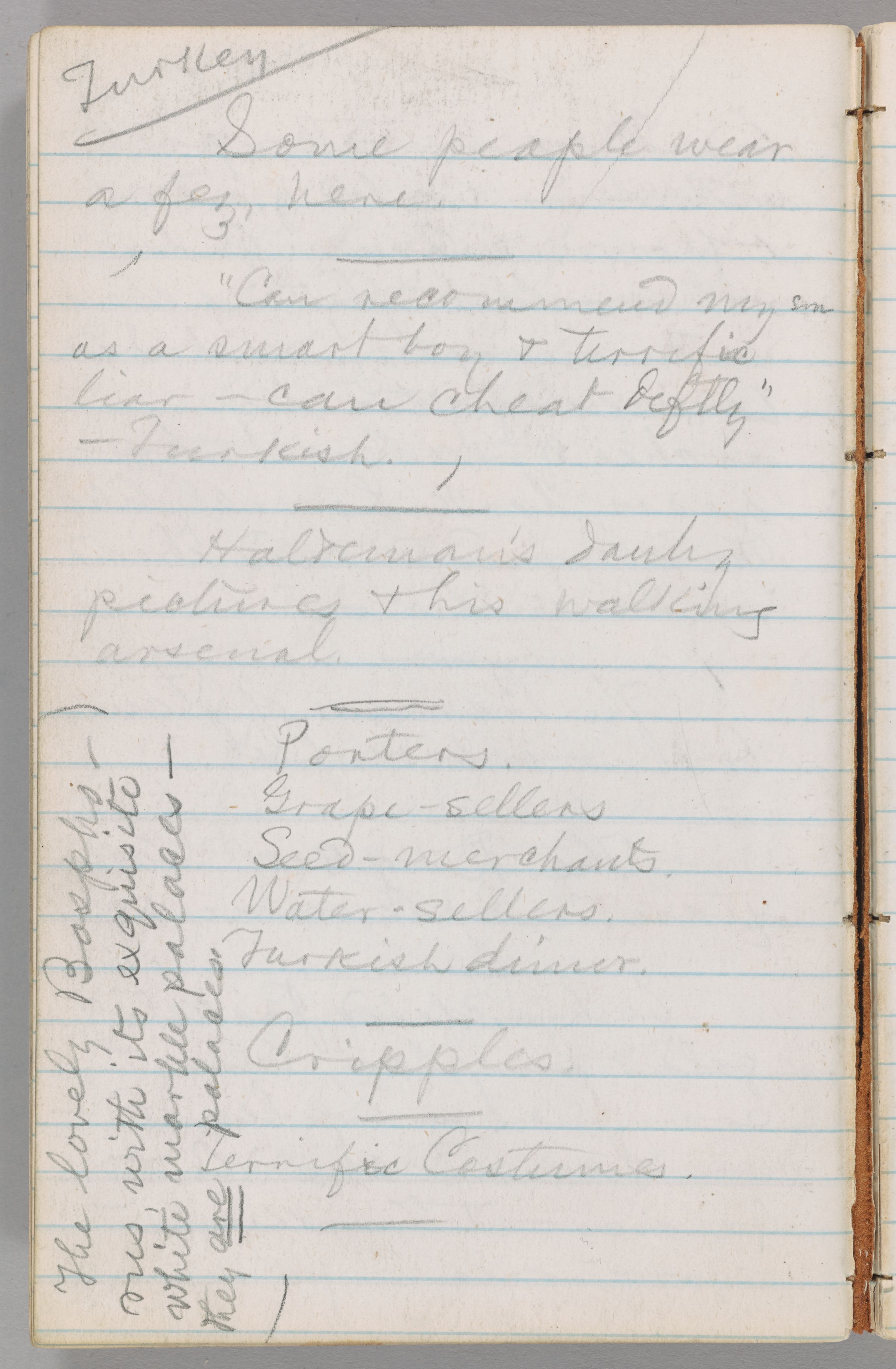
Turkey
Some people wear
a fez, here.
“Can recommend my son
as a smart boy & terrific
liar—can cheat deftly”
—Turkish.
Haldeman’s dauby
pictures & his walking
arsenal.
Porters.
Grape-sellers
Seed-merchants.
[MTP: N&J1_401]
Terrific Costumes.
The lovely
Bospho-
rous
Bosphorus
, with its exquisite
white
marble palaces—
they are palaces.
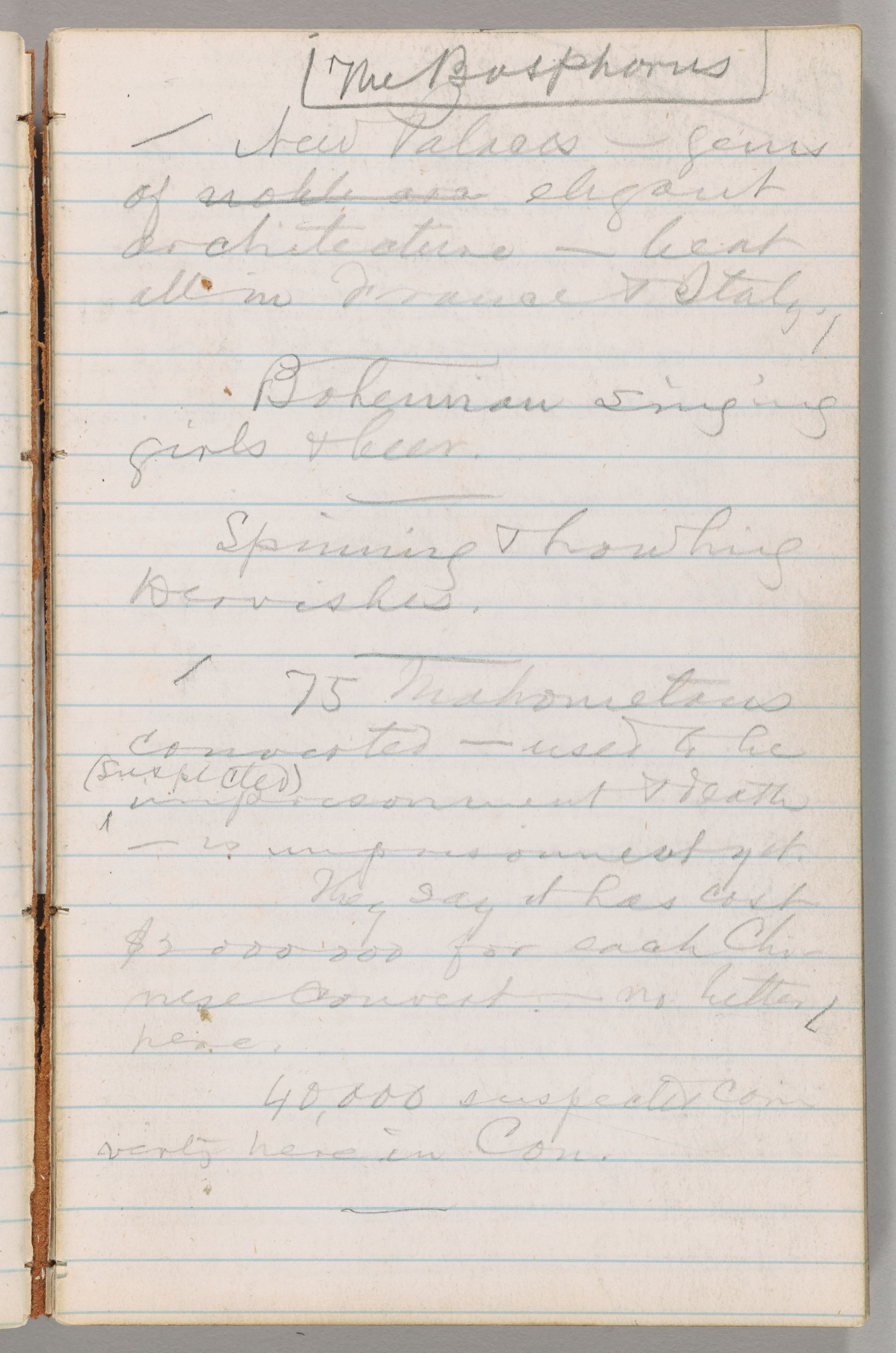
[MS: N9_leaf_024r]
New Palaces—gems
of noble arc elegant
architecture—beat
all in France
& Italy.
Bohemian singing
girls & beer.
Spinning & howling
Dervishes.
75 Mahometans
converted—used to be
(suspected)
imprisonment
& death
—is imprisonment yet.
They say it has cost
$2 000 000 for each
Chi-
nese
Chinese
convert—no better
here.
40,000 suspected
con-
verts
converts
here in Con.
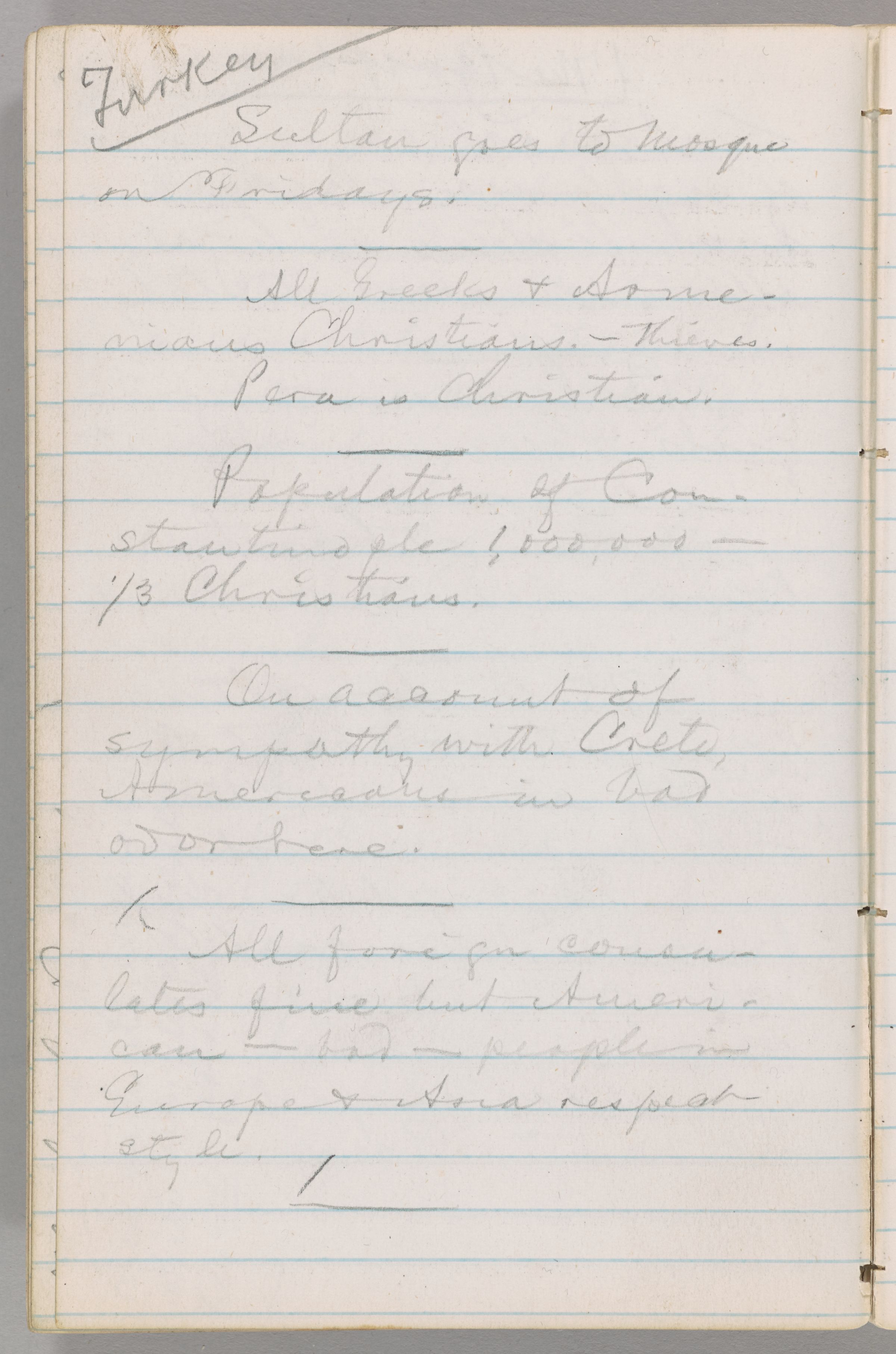
[MS: N9_leaf_024v]
[MTP: N&J1_402]
Turkey
Sultan goes to Mosque
on Fridays.
All Greeks &
Arme-
nians
Armenians
Christians.—thieves.
Pera is Christian.
Population of
Con-
stantinople
Constantinople
1,000,000—
⅓. Christians.
On account of
sympathy with Crete,
Americans in bad
odor here.
All foreign
consu-
lates
consulates
fine but
Ameri-
can
American
—bad—people in
Europe & Asia respect
style.
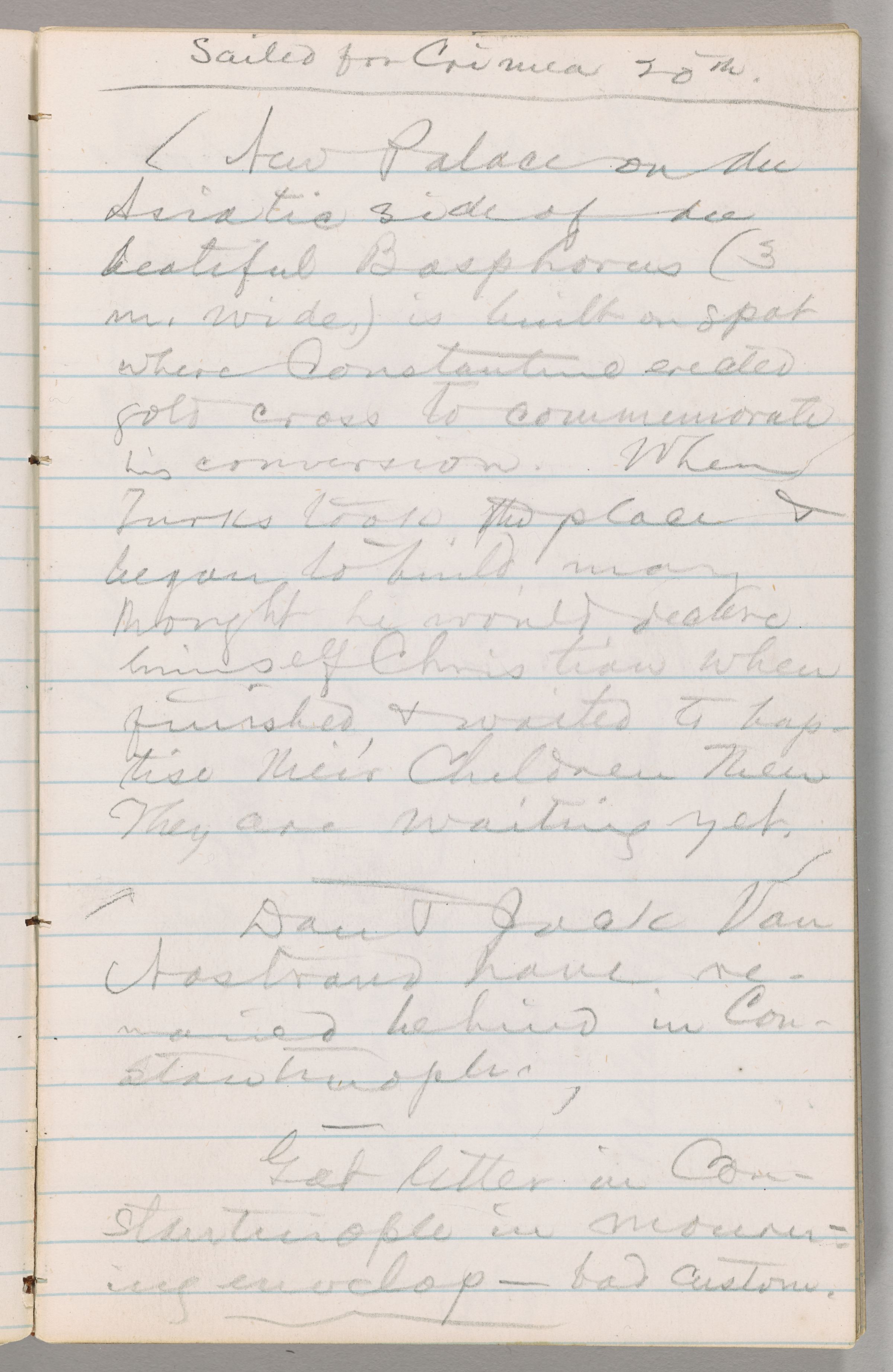
[MS: N9_leaf_024r]
Sailed for Crimea 20th.
New Palace on the
Asiatic side of the
beatiful
Bosphorus (3
m. wide,) is built on spot
where Constantine erected
gold cross to
commemorate
his conversion. When
Turks took the place &
began to build, many
thought he would declare
himself Christian when
finished, & waited to
bap-
tise
baptise
their Children then.
They are waiting yet.
Dan & Jack Van
Nostrand have
re-
mained
remained
behind in
Con-
stantinople
Constantinople
.
Got letter in
Con-
stantinople
Constantinople
in
mourn-
ing
mourning
envelop—bad custom.
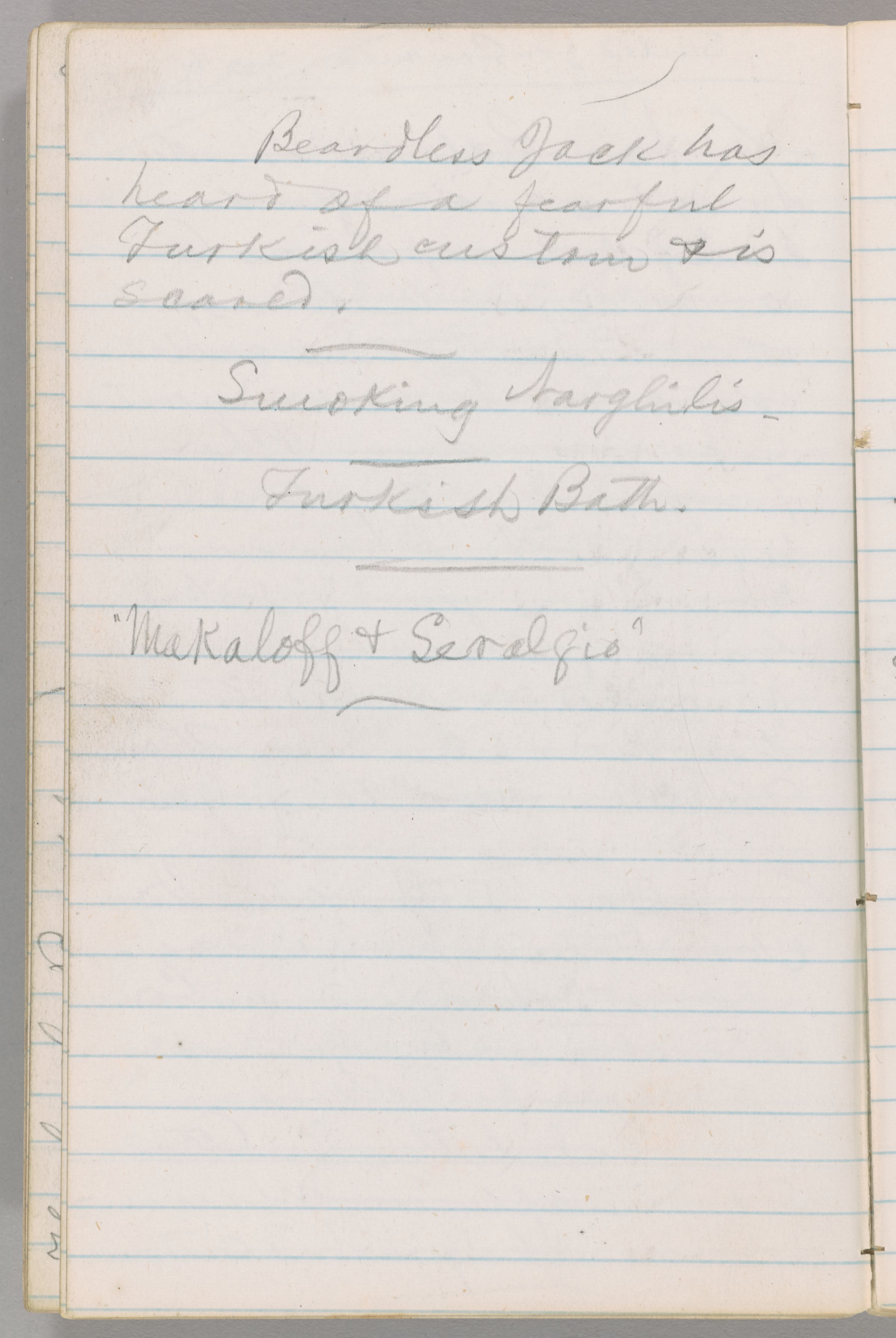
[MS: N9_leaf_024v]
Beardless Jack has
heard of a fearful
Turkish custom & is
scared.
[MTP: N&J1_403]
“Makaloff & Seralgio”
bottom half of page left blank
[MS: N9_leaf_025r]
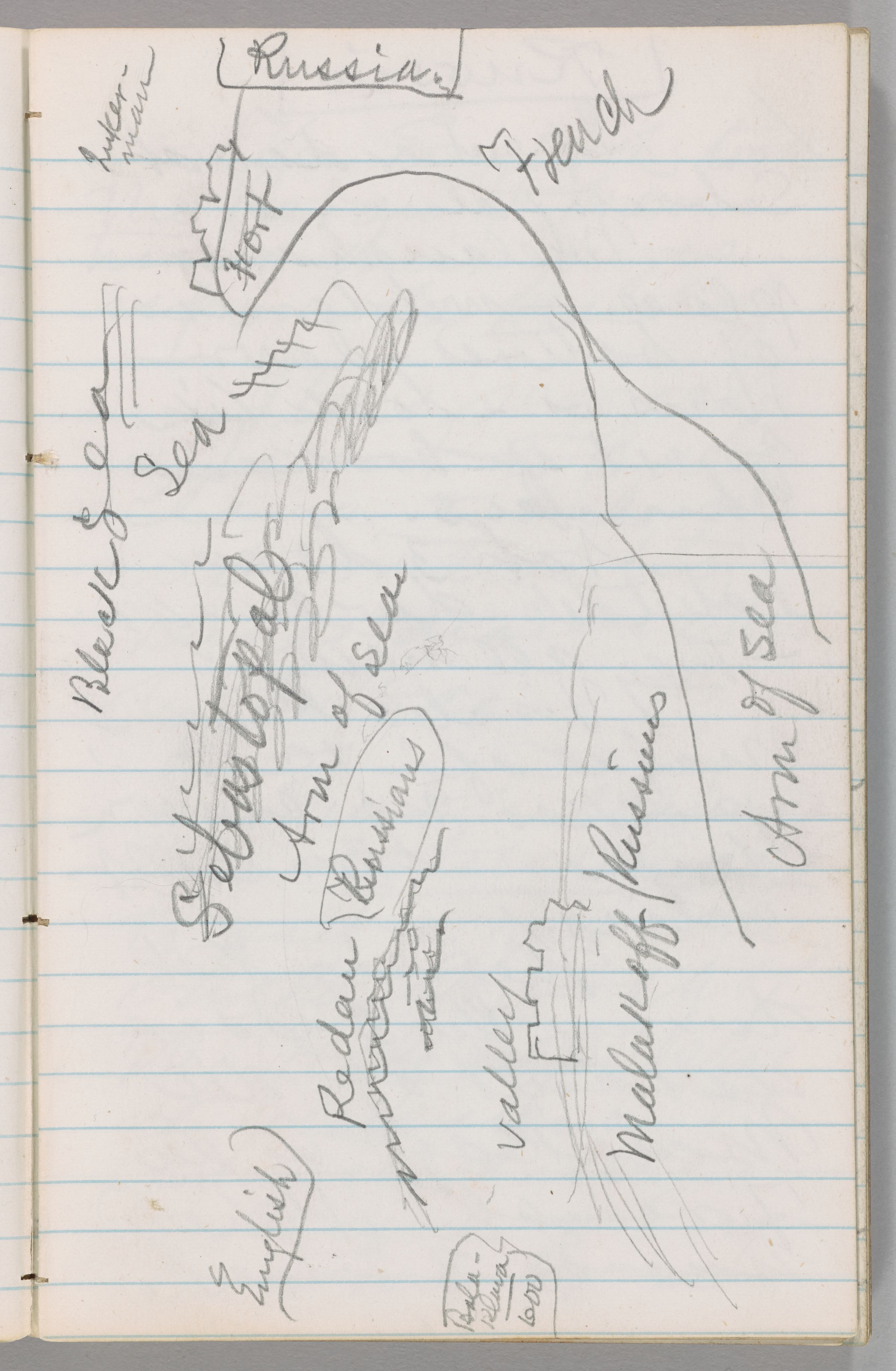
drawing, labeled:
Black Sea
Inkerman
Sebastopol
Fort
English
Arm of Sea
Redan
Tu Russians
Balaklava
600
Valley
Malakoff
Russians
Arm of Sea
French
[MS: N9_leaf_025v]
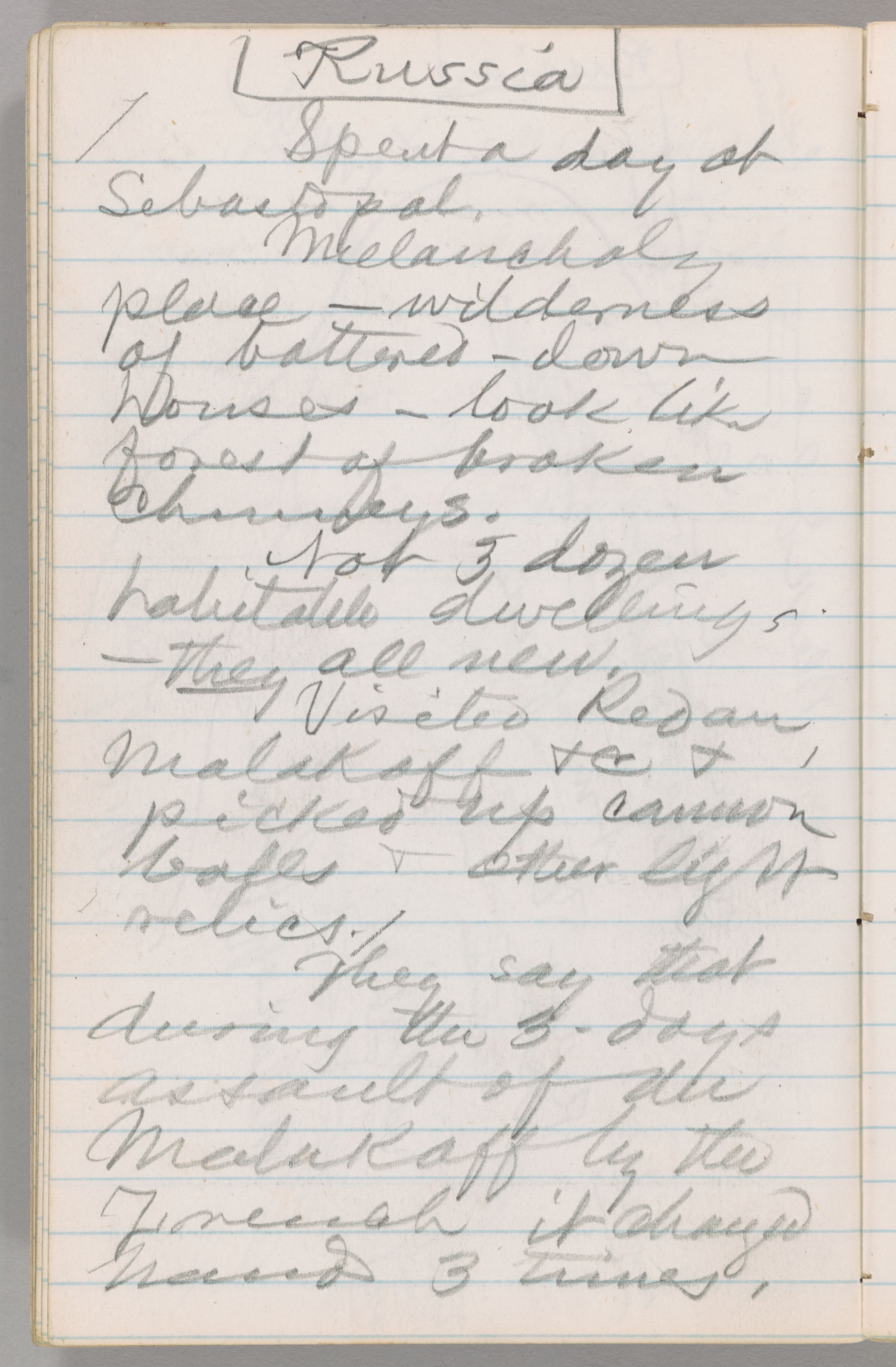
Melancholy
place—wilderness
of battered-down
houses—look like
forest of broken
chimneys.
Not 3 dozen
habitable dwellings
—they all new.
Visited Redan,
Malakoff &c. &
picked up cannon
balls & other light
relics.
They say that
during the 3-days
assault of the
Malakoff by the
French it changed
hands 3 times.
[MS: N9_leaf_026r]
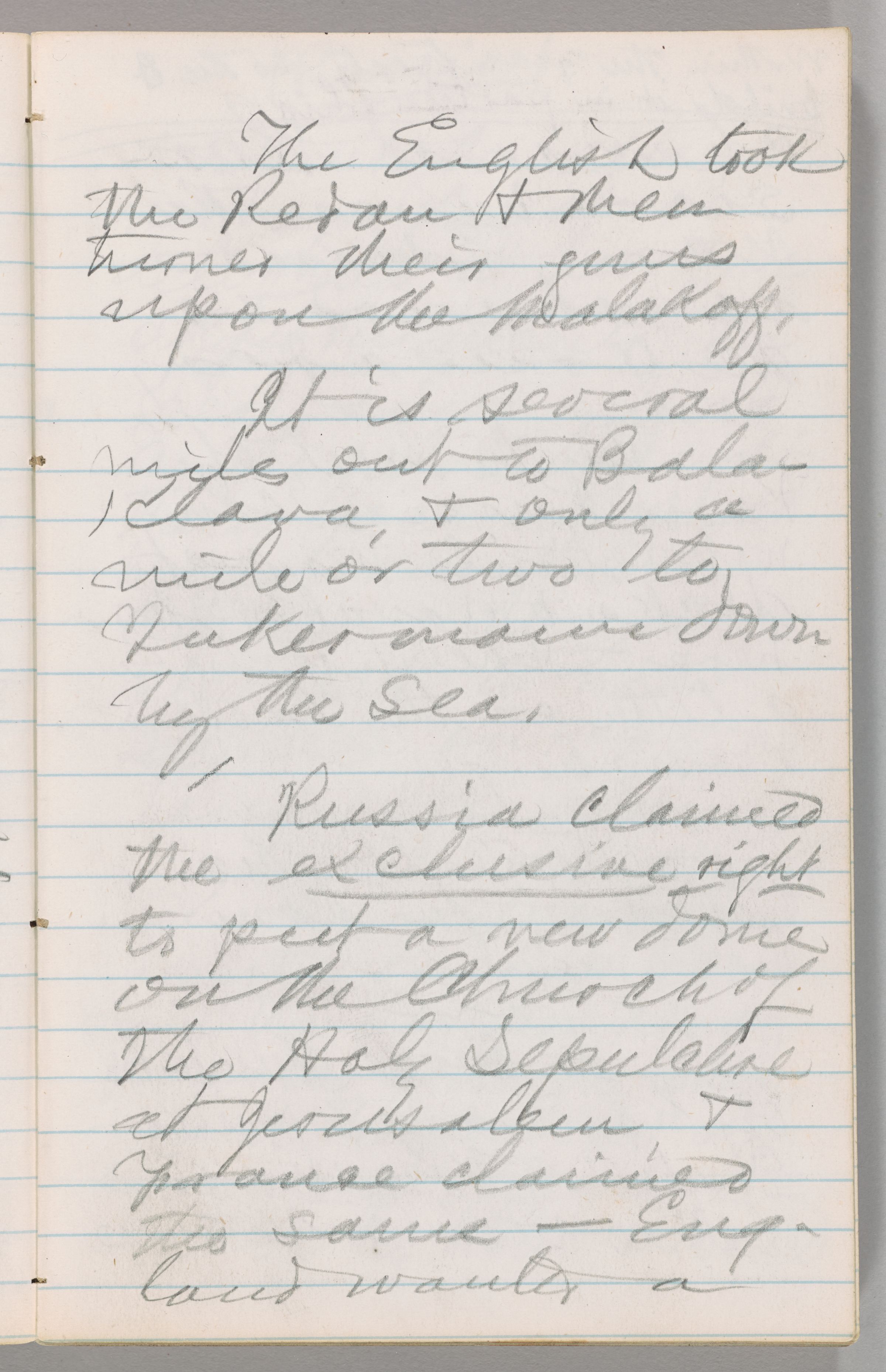
The English took
the Redan & then
turned their guns
upon the Malakoff.
It is several
miles out to
Bala-
klava
Balaklava
, & only a
mile or two to
Inkermann down
by the sea.
Russia claimed
the exclusive right
to put a new dome
on the
[MTP: N&J1_404] Church of
the Holy Sepulchre
at Jerusalem, &
France claimed
the same—
Eng-
land
England
wanted a
[MS: N9_leaf_026v]
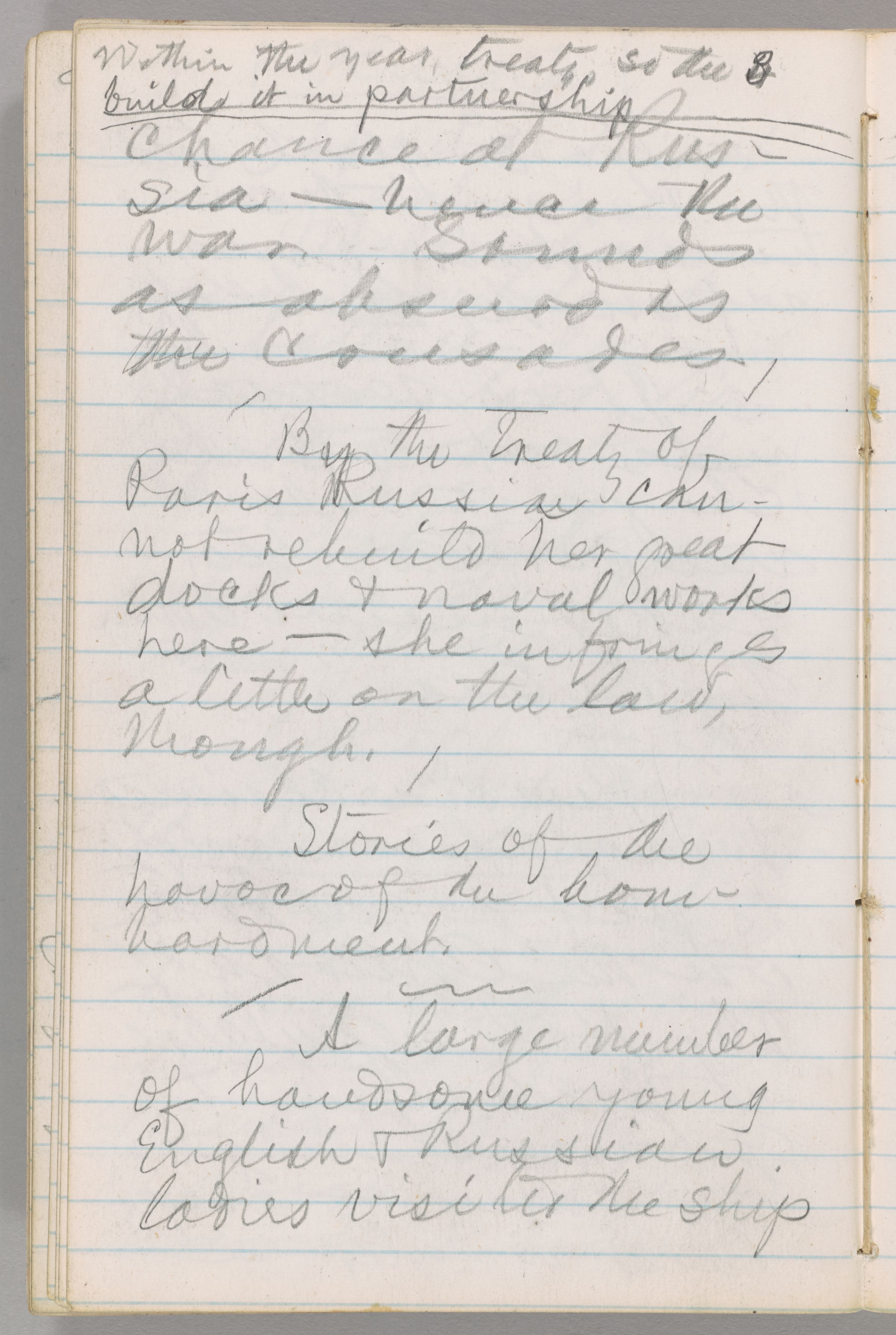
sia Russia —hence the
war. Sounds
as absurd as
the Crusades.
By the treaty of
Paris Russia
can-
not
cannot
rebuild her great
docks & naval works
here—she infringes
a little on the law,
though.
Stories of the
havoc of the
bom-
bardment
bombardment
.
A large number
of handsome young
English & Russian
ladies visited the ship
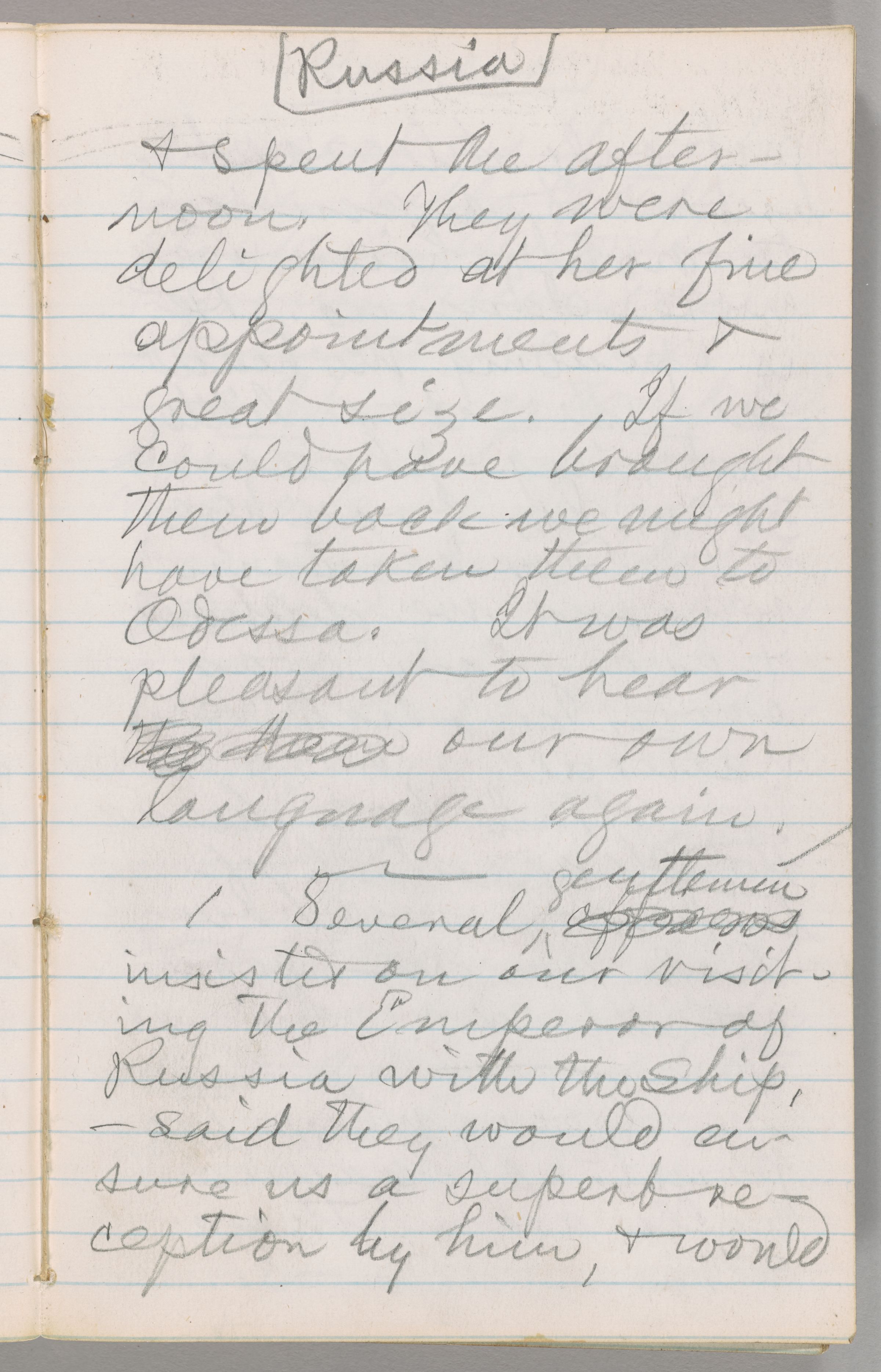
[MS: N9_leaf_027r]
noon afternoon . They were
delighted at her fine
appointments &
great size. If we
could have brought
them back we might
have taken them to
Odessa. It was
pleasant to hear
the them our own
language again.
[MTP: N&J1_405]
Several officers
gentlemen
insisted on our
visit-
ing
visiting
the
Emperor of
Russia with the ship,
—said they would
en-
sure
ensure
us a superb
re-
ception
reception
by
him, & would
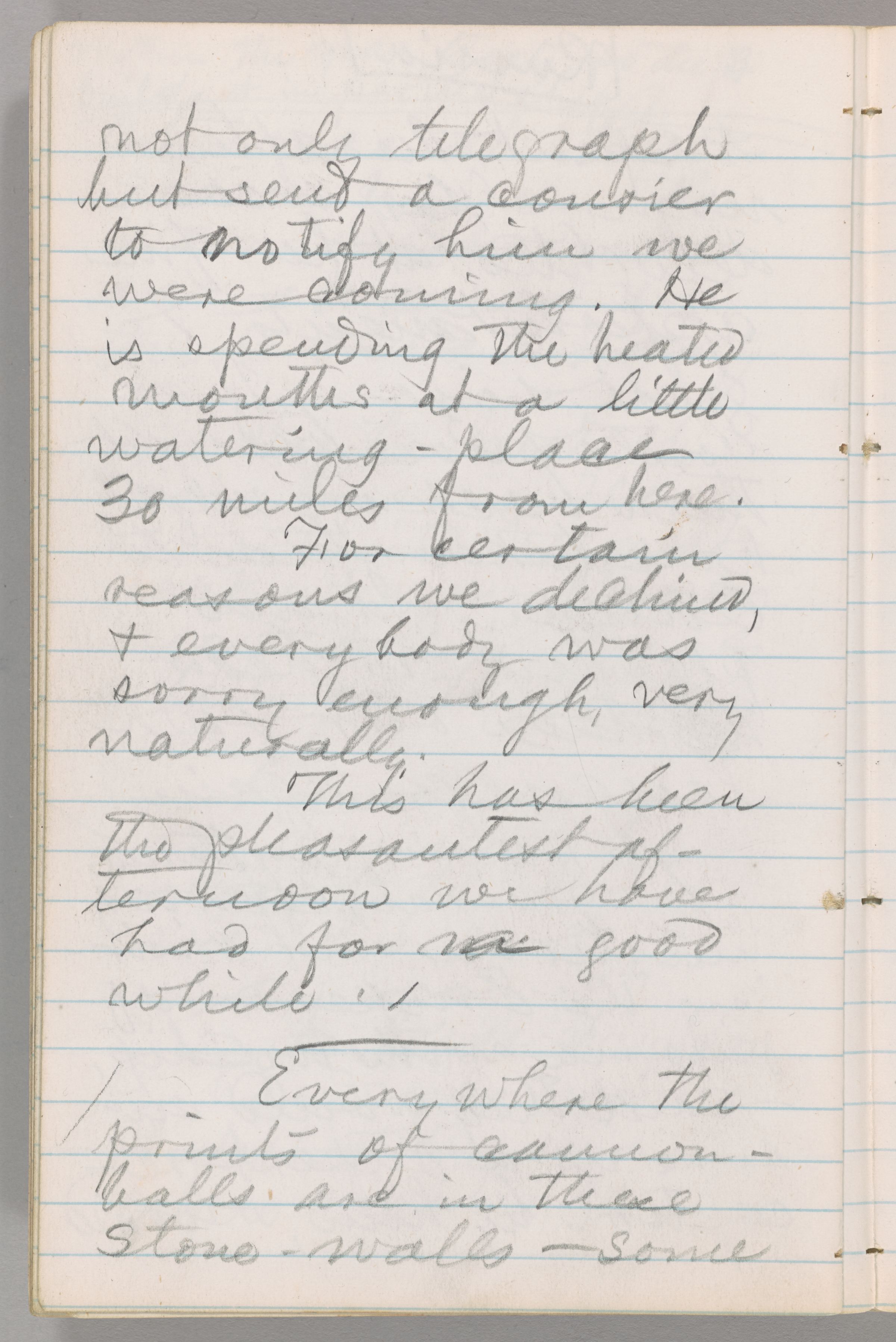
[MS: N9_leaf_027v]
not only telegraph
but send a courier
to notify him
we
were coming. He
is spending the heated
months at a little
watering-place
30
miles from here.
For certain
reasons we declined,
& everybody was
sorry enough, very
naturally.
This has been
the pleasantest
af-
ternoon
afternoon
we have
had for m a good
while.
Everywhere the
prints of cannon-
balls are in these
stone-walls—some
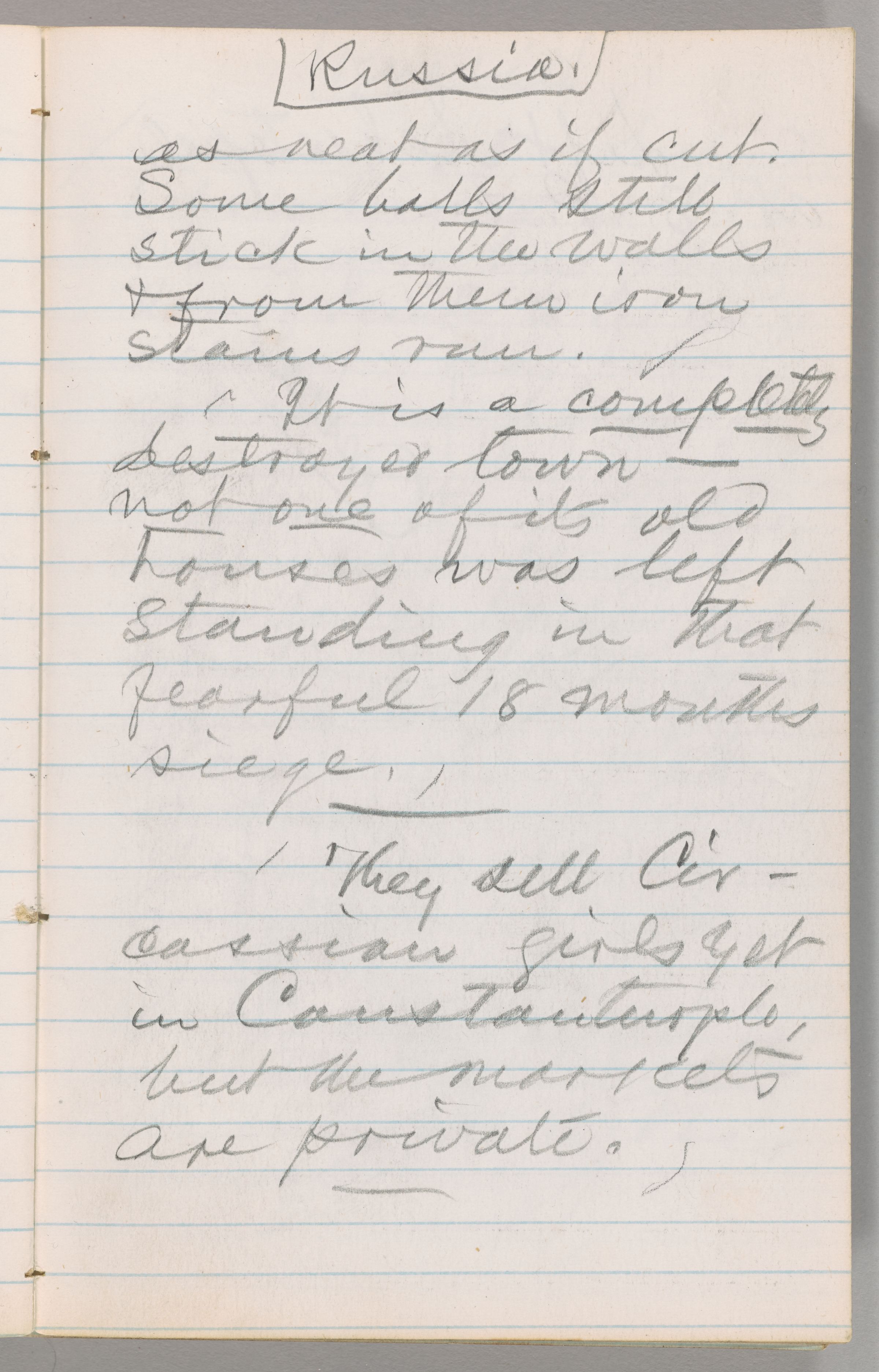
[MS: N9_leaf_028r]
Some balls still
stick in the walls
& from them iron
stains run.
It is a completely
destroyed town—
not
one of its old
houses was left
standing in that
fearful 18 months
siege.
They sell
Cir-
cassian
Circassian
girls yet
in Constantinople,
but the markets
are private.
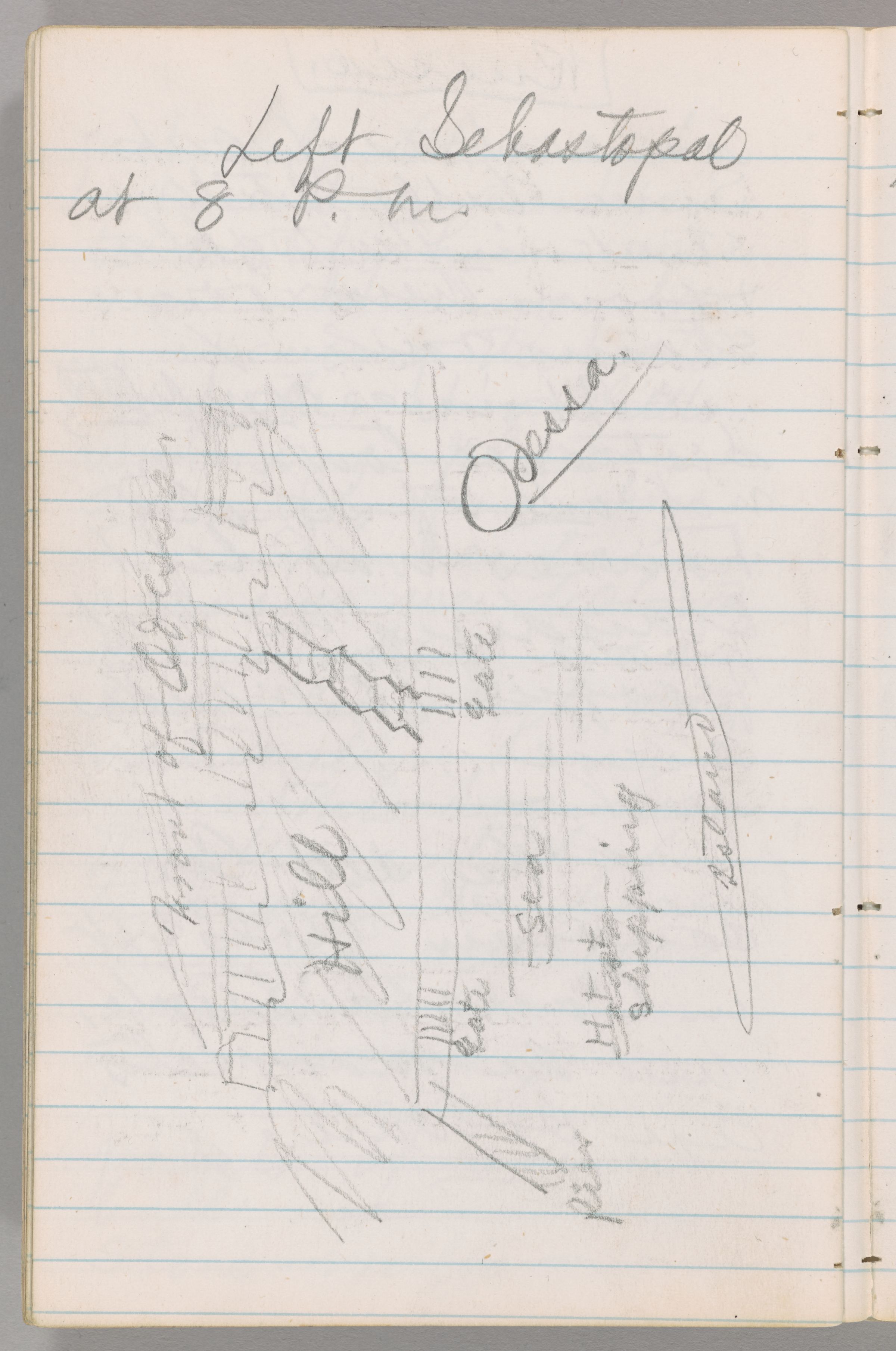
[MS: N9_leaf_028v]
Left Sebastopol
at 8 P.M.
drawing, labeled:
Front of Odessa
Hill
Gate Gate
sea
Odessa
pier shipping
island
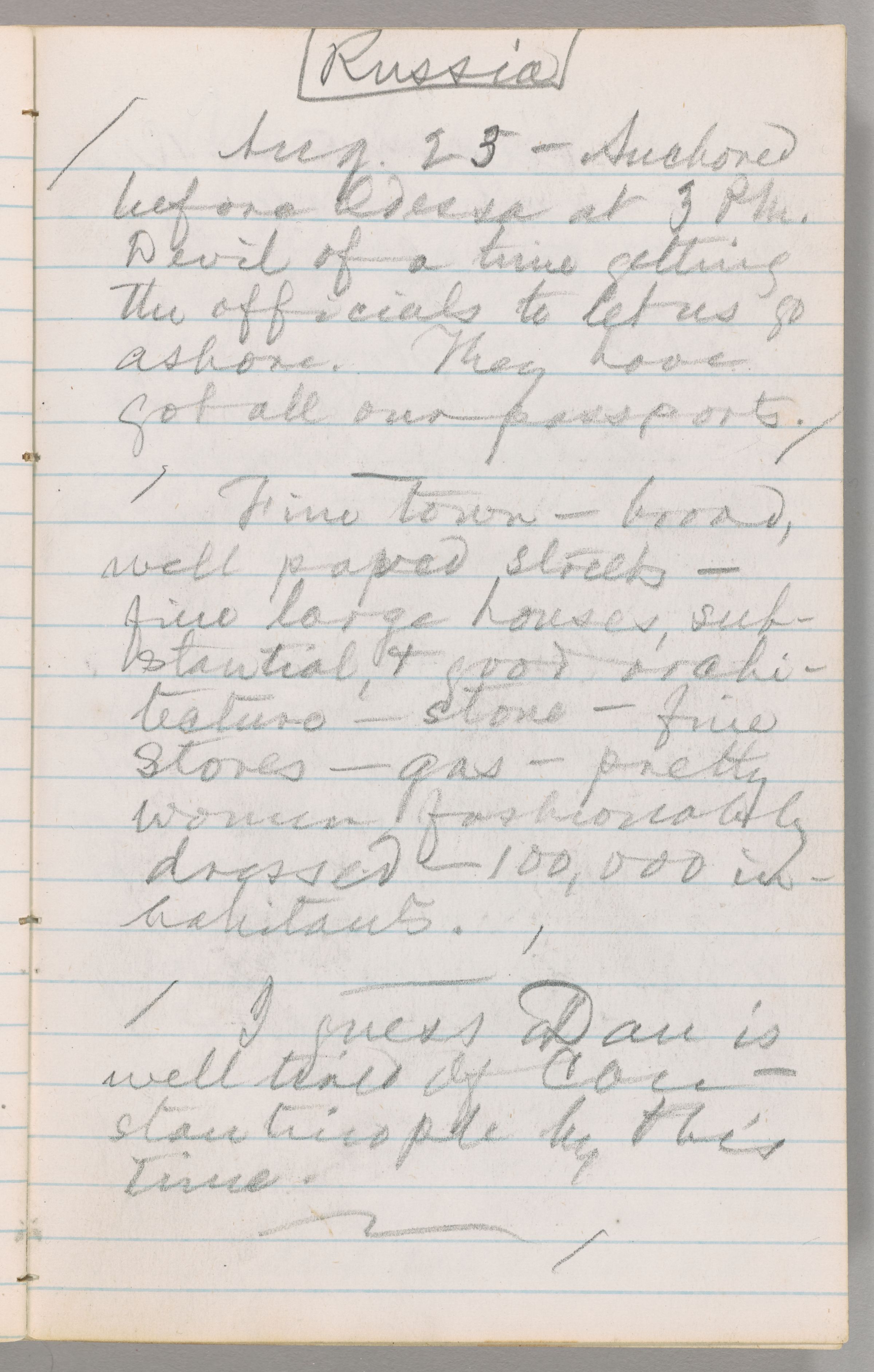
[MS: N9_leaf_029r]
Russia
Aug.
253—Anchored
before Odessa at
3 PM.
Devil of a time getting
the officials to let us go
ashore. They have
got all
our passports.
Fine town—broad,
well papved streets—
fine large houses,
sub-
stantial
substantial
, & good
archi-
tecture
architecture
—stone—fine
stores—gas—pretty
women,
fashionably
dressed—100,000
in-
habitants
inhabitants
.
I guess a Dan is
well tired of
Con-
stantinople
Constantinople
by this
time.
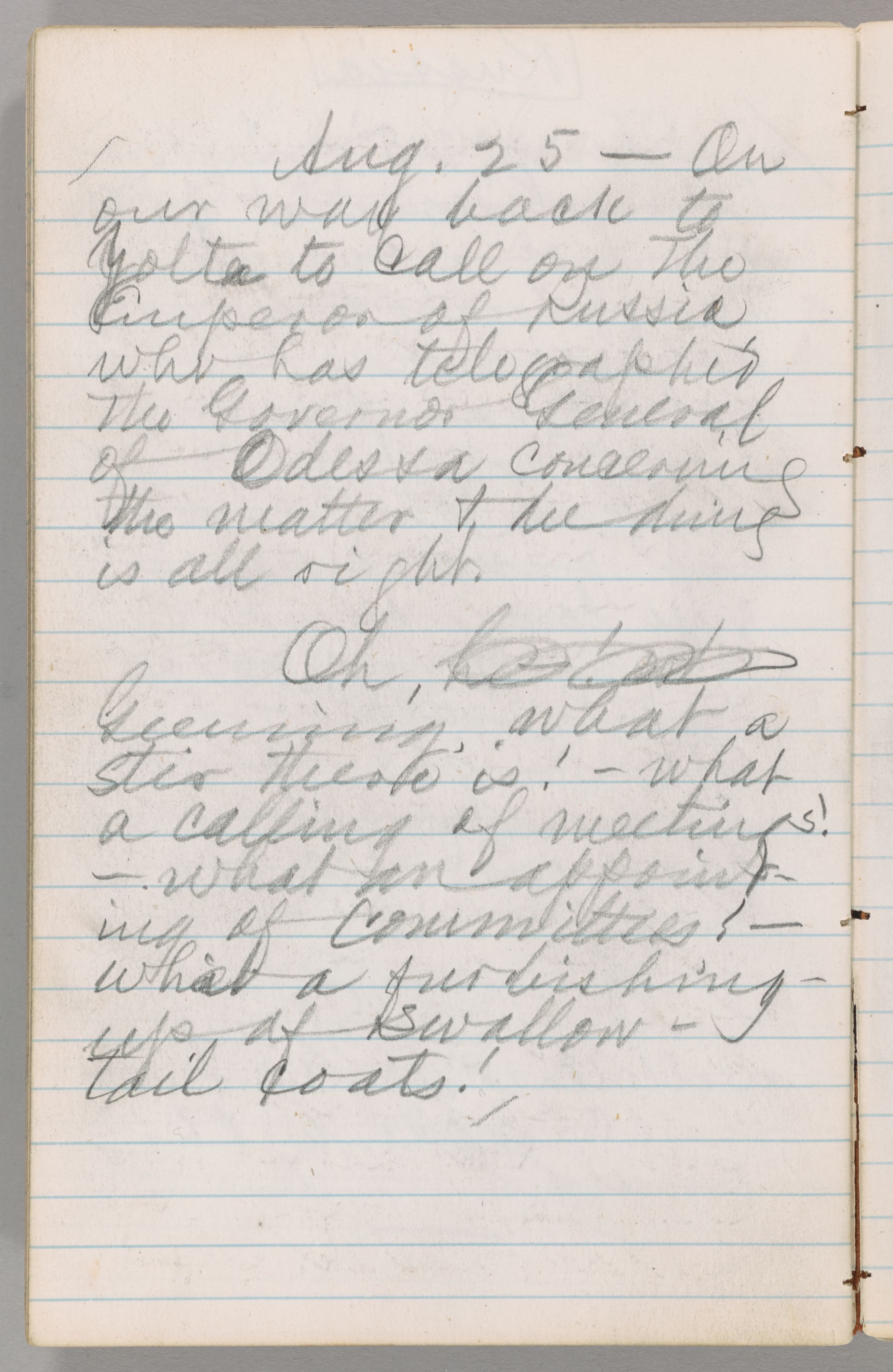
[MS: N9_leaf_029v]
Aug. 25—On
our way back to
JYoltea to call on the
Emperor
of Russia,
who has telegraphed
the Governor General
of Odessa concerning
the
matter & the thing
is all right.
[MTP: N&J1_406]
Oh, h—! wh
Geeminy, what a
stir there is!—what
a calling of
meetings!
—what an
appoint-
ing
appointing
of committees!—
whiat a
furbishing-
up of swallow-
tail coats!
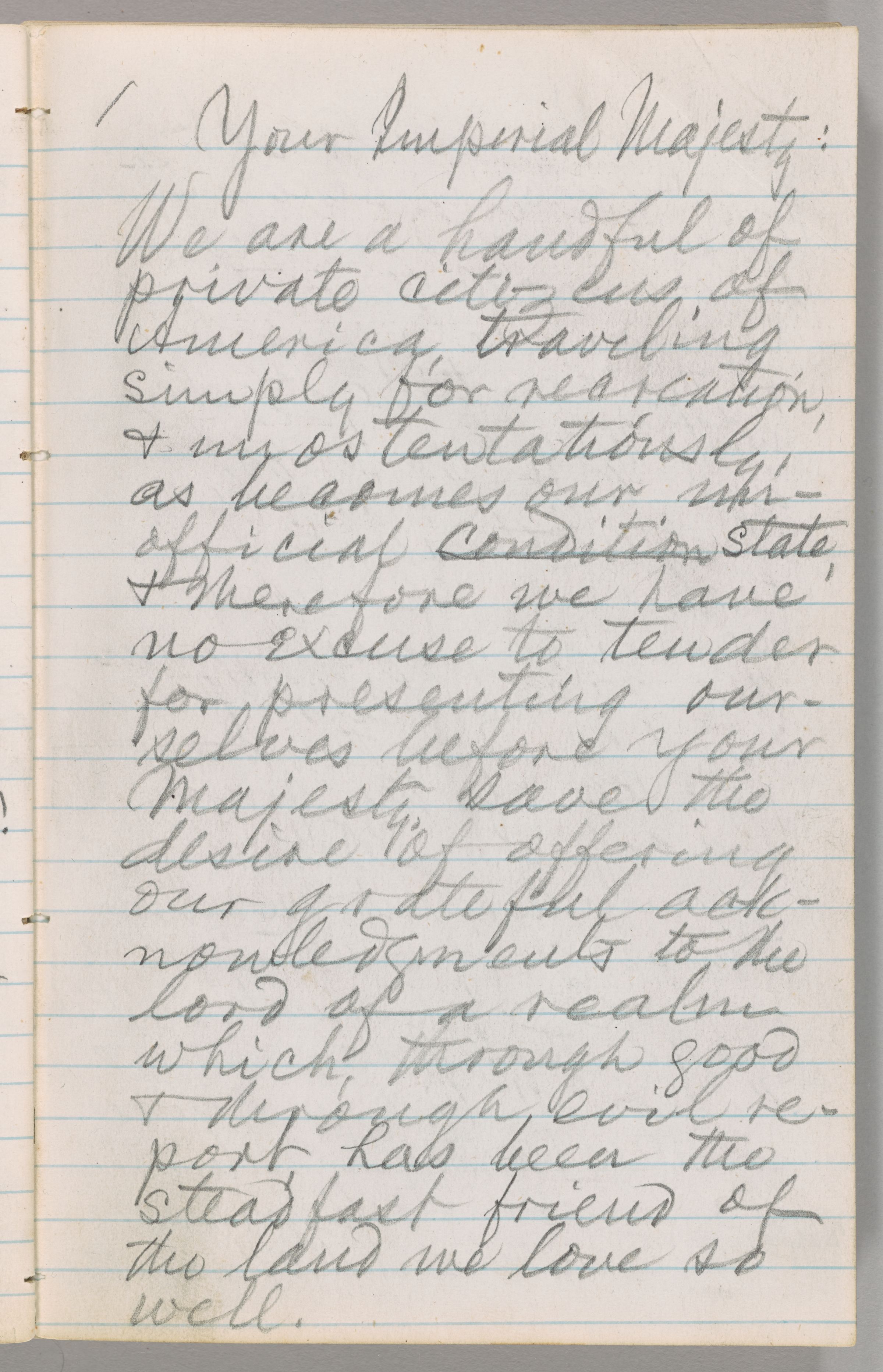
[MS: N9_leaf_030r]
Your Imperial Majesty:
We are a handful of
private citizens of
America, traveling
simply
for recreation,
& unostentatiously,
as becomes our
un-
official
unofficial
condition state,
& therefore we have
no excuse to tender
for
presenting
our-
selves
ourselves
before your
Majesty, save the
desire of offering
our grateful
ack-
nowledgments
acknowledgments
to the
lord of a realm
which, through good
& through evil
re-
port
report
, has been the
steadfast friend of
the land we love so
well.
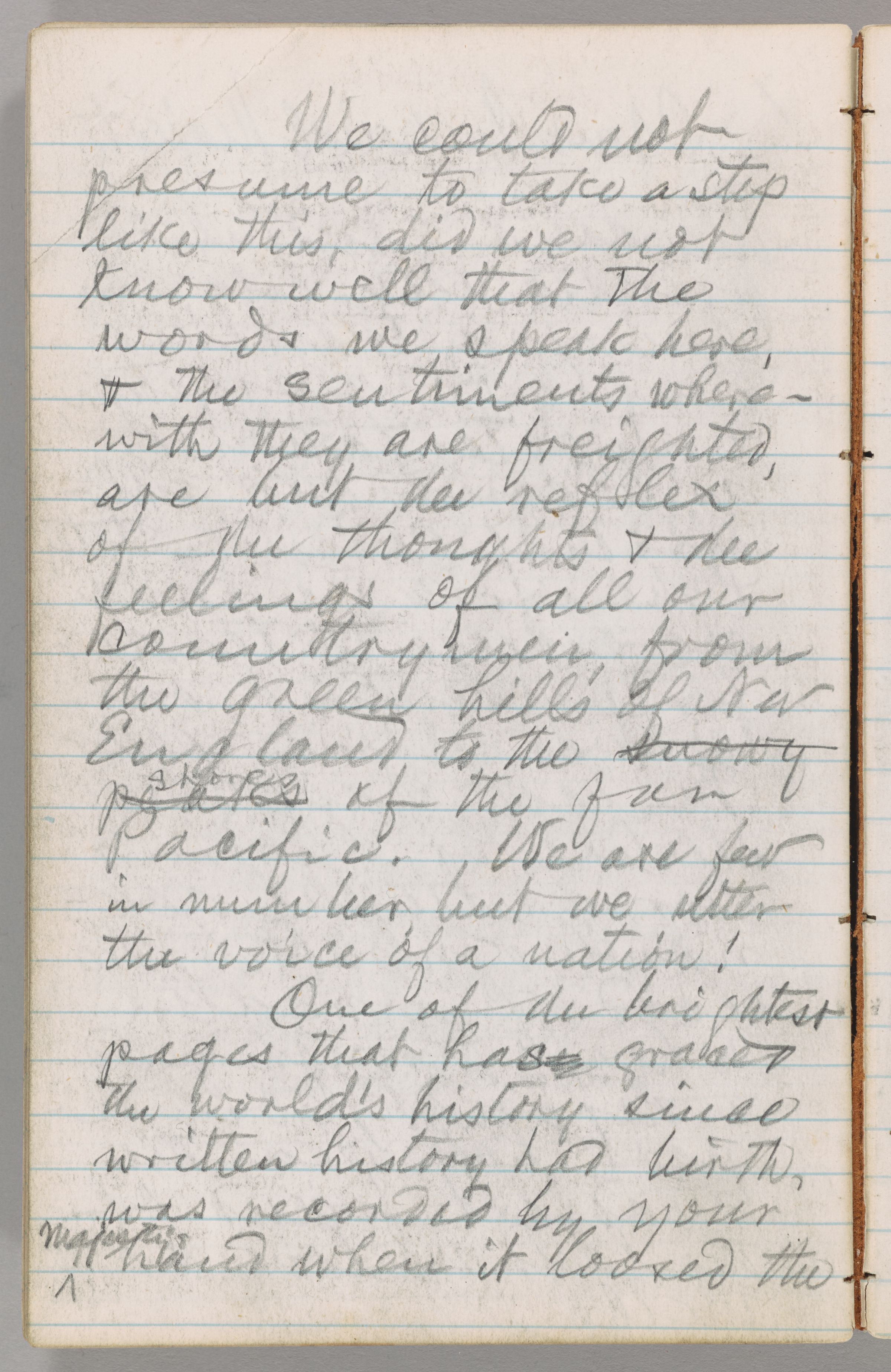
[MS: N9_leaf_030v]
[MTP: N&J1_407]
We could not
presume to take a step
like this, did we not
know well that the
words
we speak here,
& the sentiments
where-
with
wherewith
they are freighted,
are but the
reflex
of the thoughts & the
feelings of all our
countrymen, from
the green
hills of New
England to the snowy
peaks
shores
of the far
Pacific. We are few
in number, but we utter
the voice of a nation!
One of the brightest
pages that haves graced
the world’s history since
written history had birth,
was recorded by your
Majesty’s
hand when it loosed the
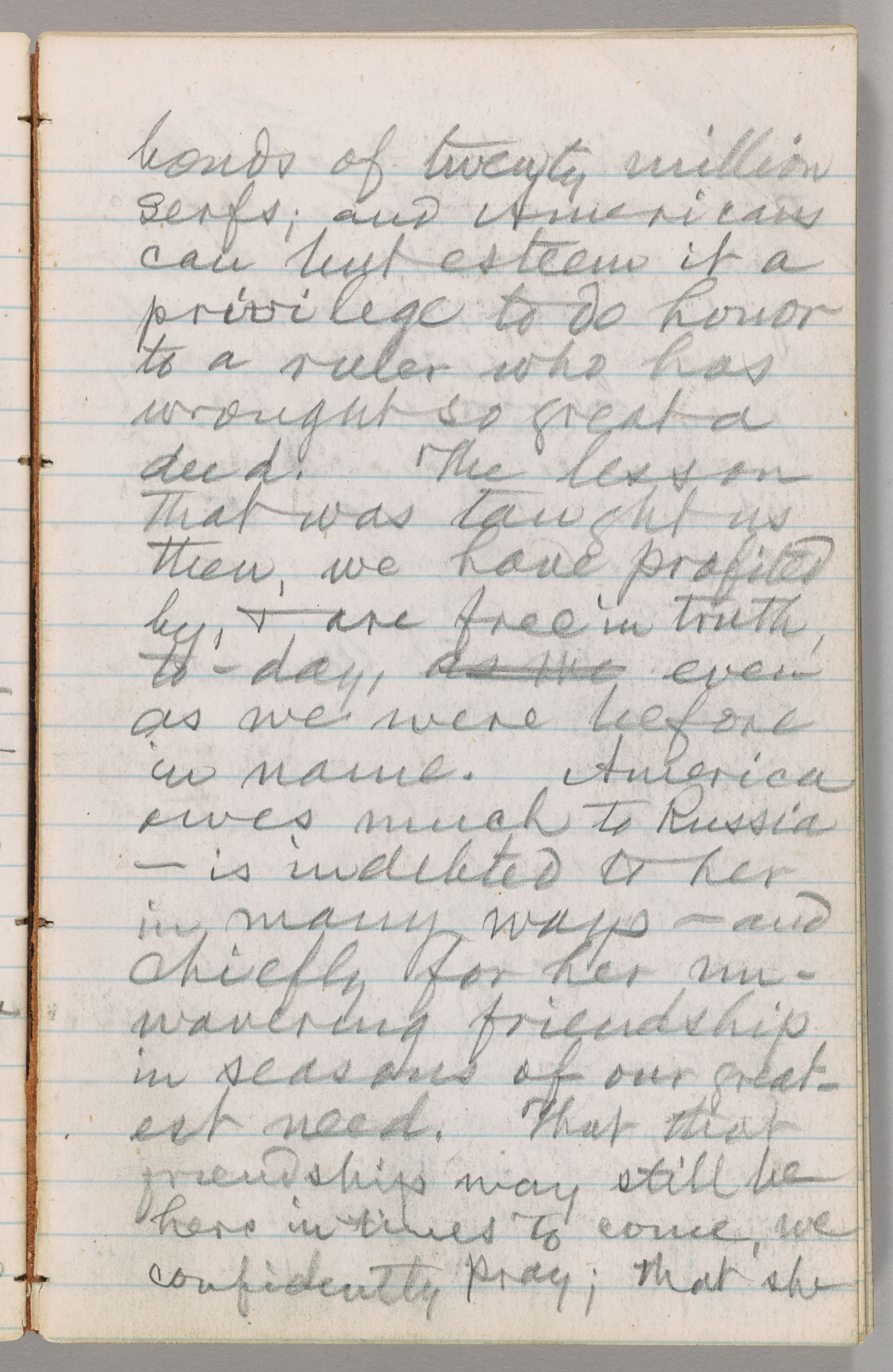
[MS: N9_leaf_031r]
bonds of twenty million
serfs;
and Americans
can but esteem it a
privilege to do honor
to a ruler who has
wrought
so great a
deed. The lesson
that was taught us
then, we have profited
by, &
are free in truth,
to-day, as we even
as we were before
in name.
America
owes much to Russia
—is indebted to her
in many ways—and
chiefly for her
un-
wavering
unwavering
friendship
in seasons of our
great-
est
greatest
need. That that
friendship may
still be
hers in times to come, we
confidently pray; that she
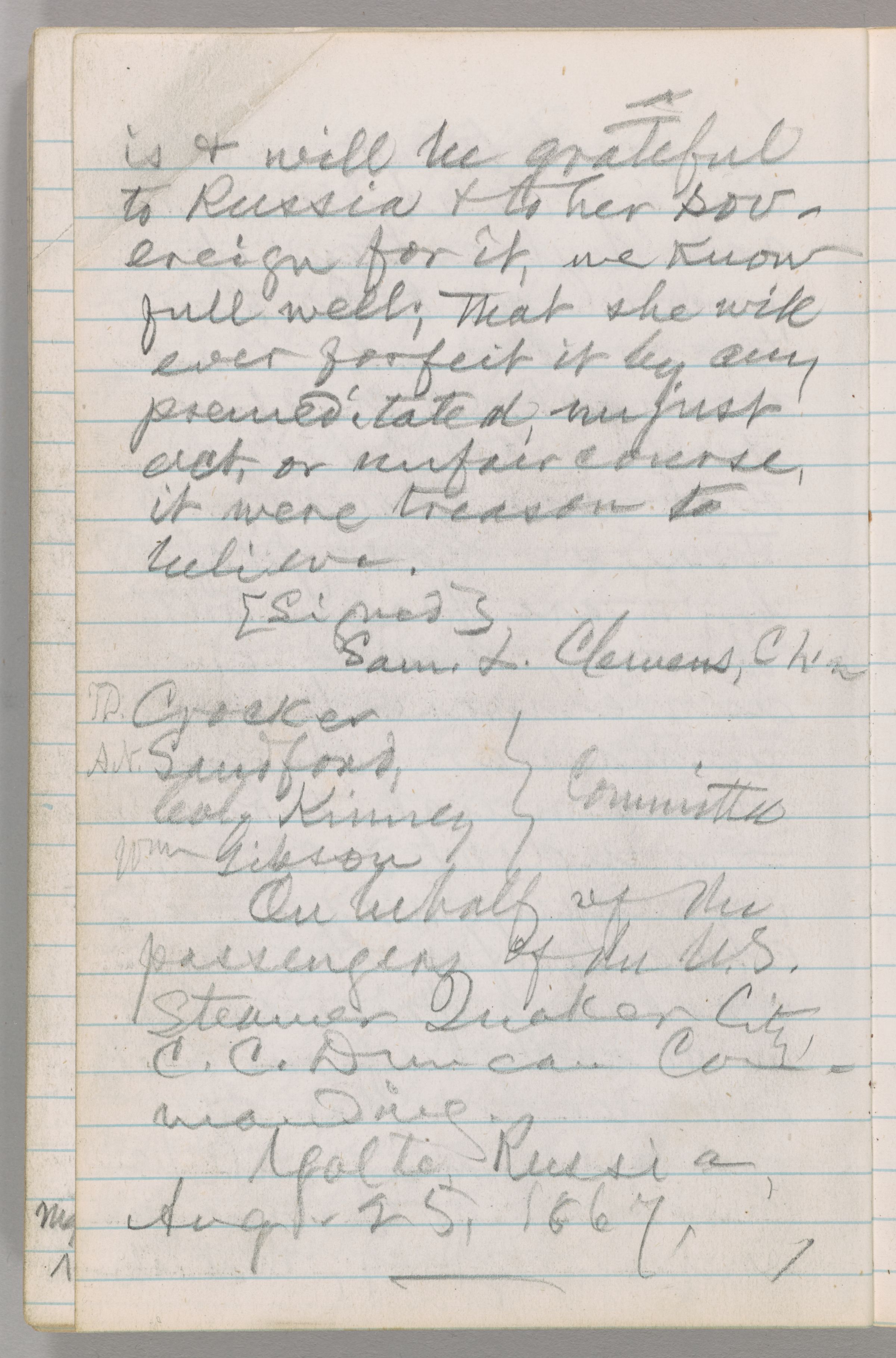
[MS: N9_leaf_031v]
is &
will be grateful
to Russia & to her
sov-
ereign
sovereign
for it, we know
full well; that
she will
ever forfeit it by any
premeditated, unjust
act, or unfair course,
it
were treason to
believe.
⟦Signed⟧
Sam. L. Clemens, Ch’n
Committee
TD. Crocker
AN. Sandford,
Col. Kinney
On behalf of the
passengers of the U.S.
Steamer Quaker City,
C. C. Duncan
Com-
manding
Commanding
.
Yalte, Russia,
Aug. 25, 1867.
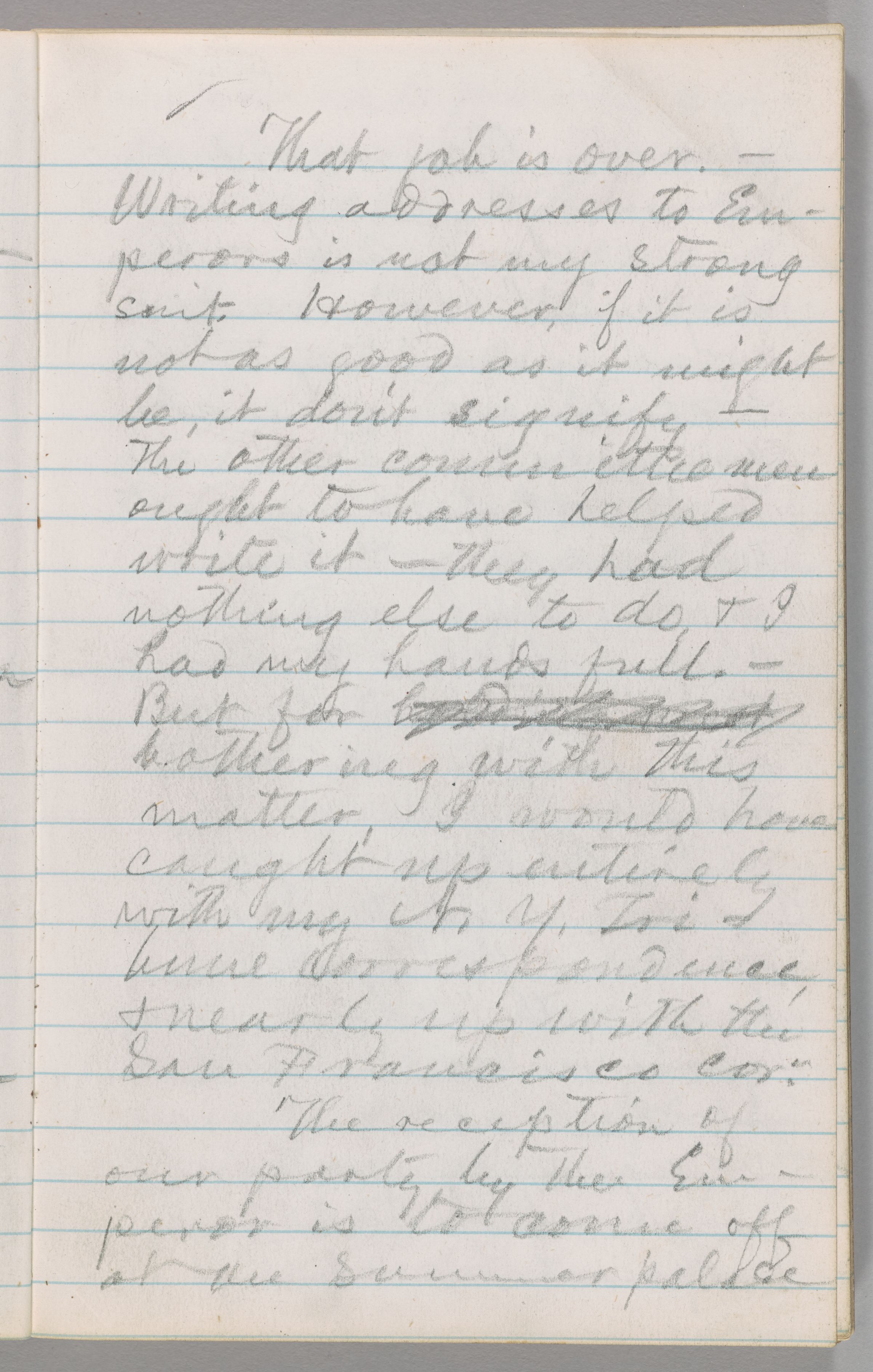
[MS: N9_leaf_032r]
That job is over.—
Writing addresses to
Em-
perors
Emperors
is not my strong
suit. However, if it is
not as good as it might
be, it
don’t signify—
the other committeemen
ought to have helped
write it—they had
[MTP: N&J1_408] nothing else to do, & I
had my hands full.—
But for holding
most
bothering with this
matter, I would have
caught up
entirely
with my N. Y.
Tri-
bune
Tribune
correspondence,
& nearly up with the
San
Francisco corr.
The reception of
our party by the
Em-
peror
Emperor
is to come off
at the summer palace
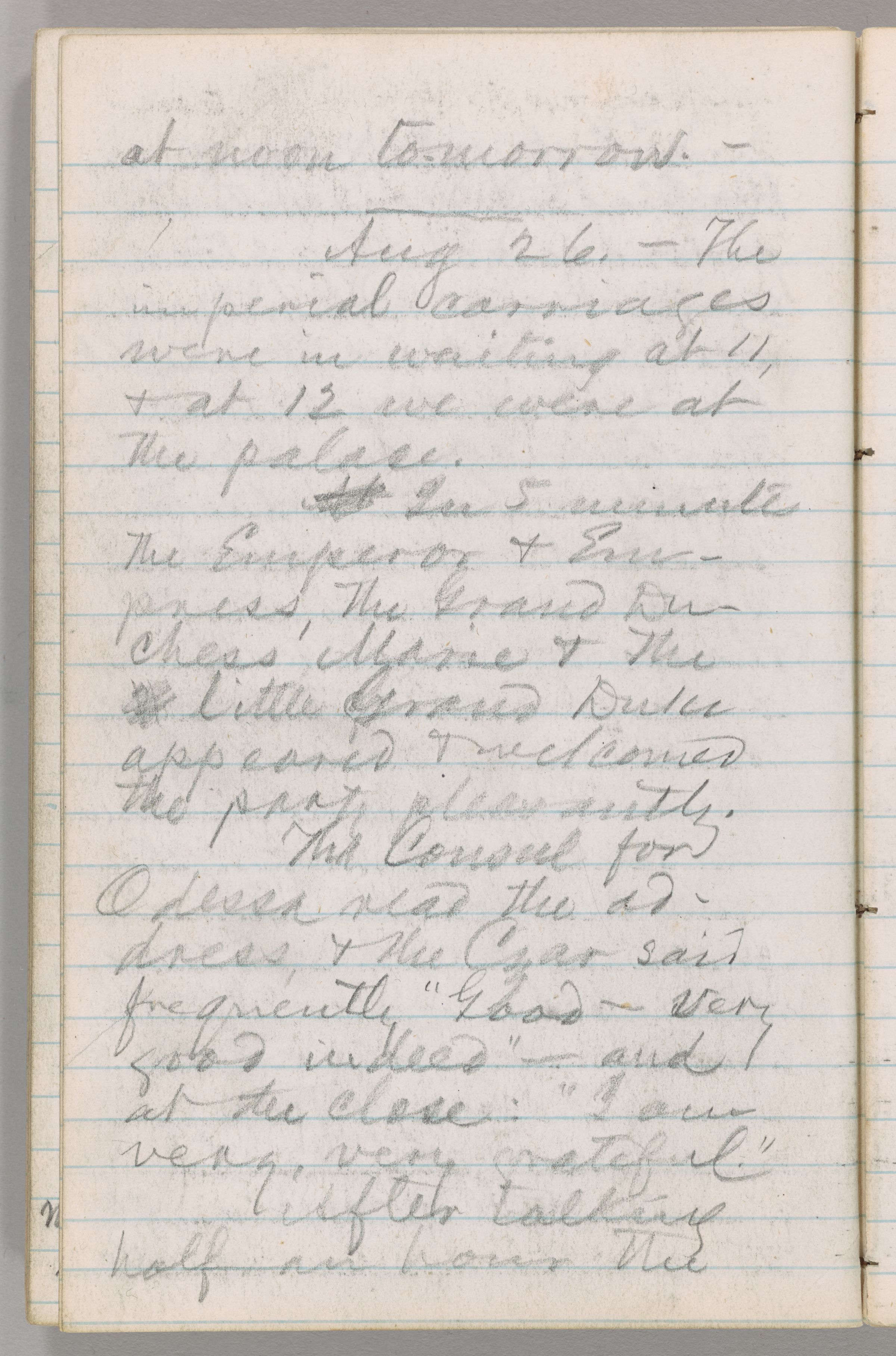
[MS: N9_leaf_032v]
at noon to-morrow.—
Aug 26.—The
imperial carriages
were in waiting at 11,
& at 12 we were at
the
palace.
At In 5 minutes
the Emperor &
Em-
press
Empress
, the Grand
Du-
chess
Duchess
Marie
& the
2 little gGrand Duke
appeared & welcomed
the
party pleasantly.
The Consul for
Odessa read the
ad-
dress
address
, & the Czar said
frequently “Good—very
good indeed”—and
at the close: “I am
very, very grateful.”
[MTP: N&J1_409]
After talking
half an hour the
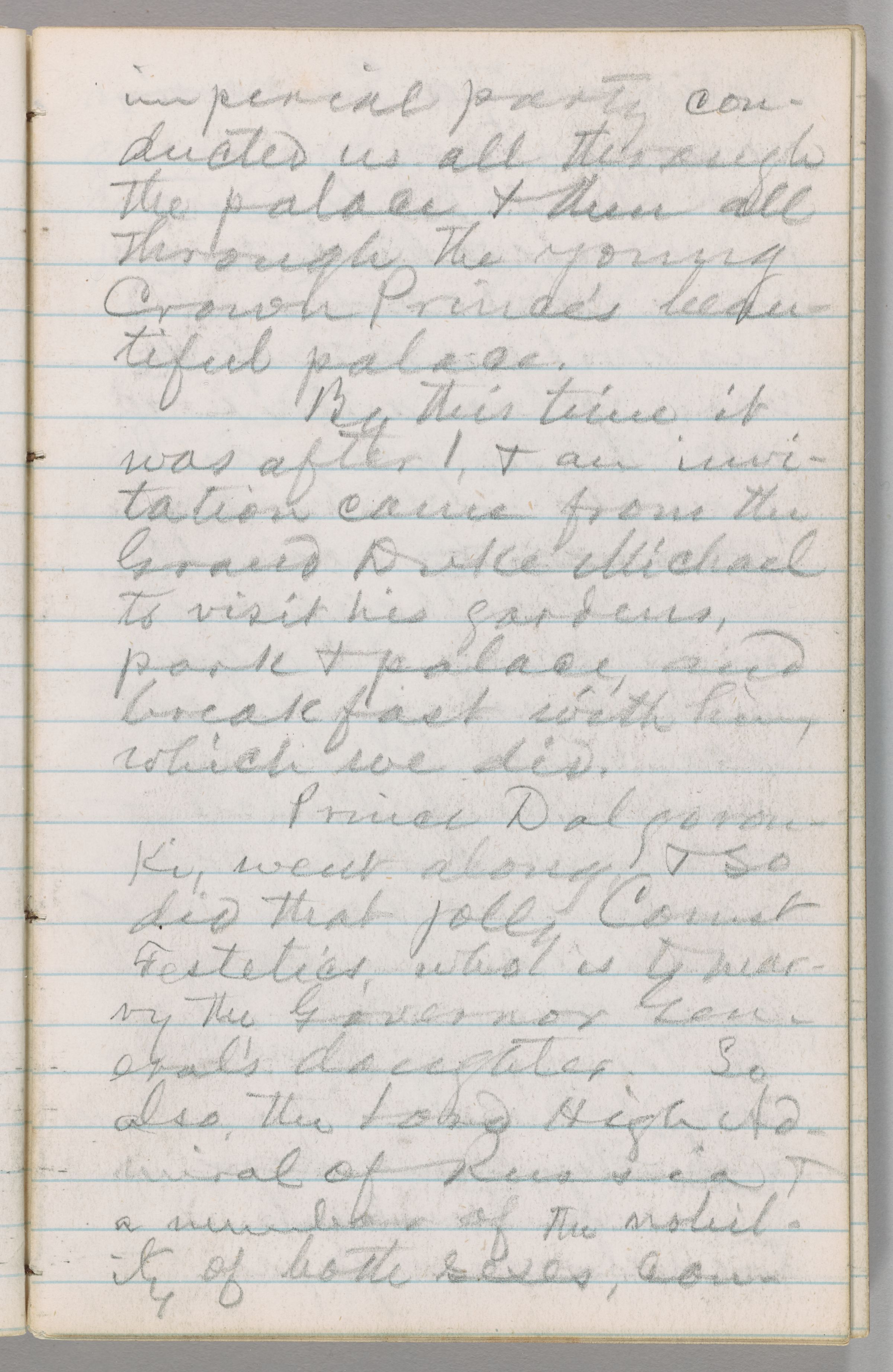
[MS: N9_leaf_033r]
imperial party
con-
ducted
conducted
us
all through
the palace & then all
through the young
Crown Prince’s
beau-
tiful
beautiful
palace.
By this time it
was after 1, & an
invi-
tation
invitation
came from the
Grand Duke
Michael
to visit his gardens,
park &
palace, and
breakfast with him,
which we did.
Prince
Dalgorou-
ki
Dalgorouki
, went along, & so
did that jolly Count
Festetics, who is to
mar-
ry
marry
the Governor
Gen-
eral’s
General’s
daughter. So
also, the Lord High
Ad-
miral
Admiral
of Russia
&
a number of the
nobil-
ity
nobility
of both sexes, con-
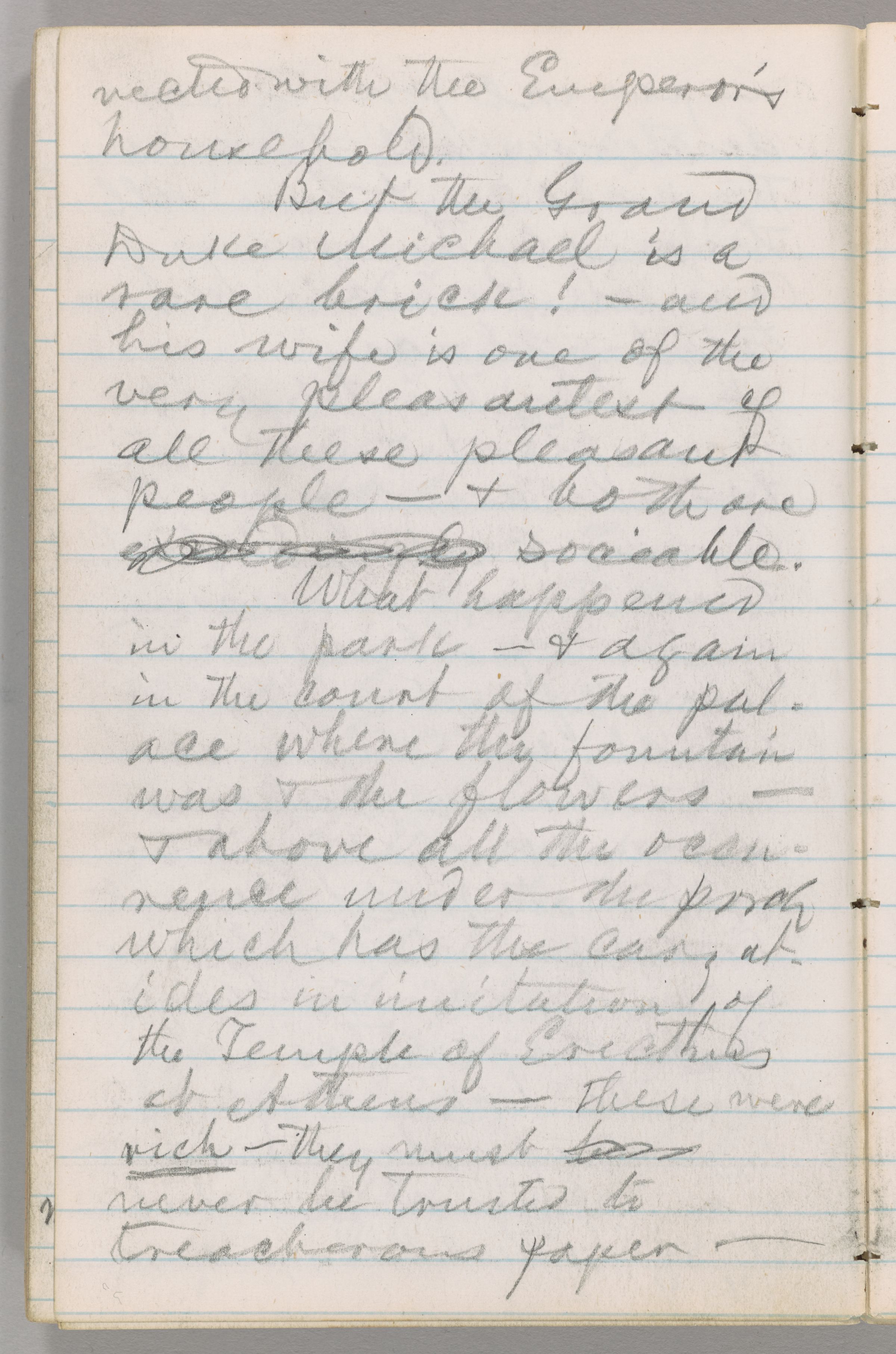
[MS: N9_leaf_033v]
nected
with the Emperor’s
household.
But the Grand
Duke Michael is a
rare brick!—and
his wife is one of the
very
pleasantest of
all these pleasant
people—& both are
exceedingly
sociable.
What happened
in the park—& again
in the court of the
pal-
ace
palace
where the
fountain
was & the flowers—
& above all the
occu-
rence
occurence
under the porch
which
has the
caryat-
ides
caryatides
in imitation of
the Temple of Erecthus
at Athens—these were
rich—they must be
never be trusted to
treacherous paper—
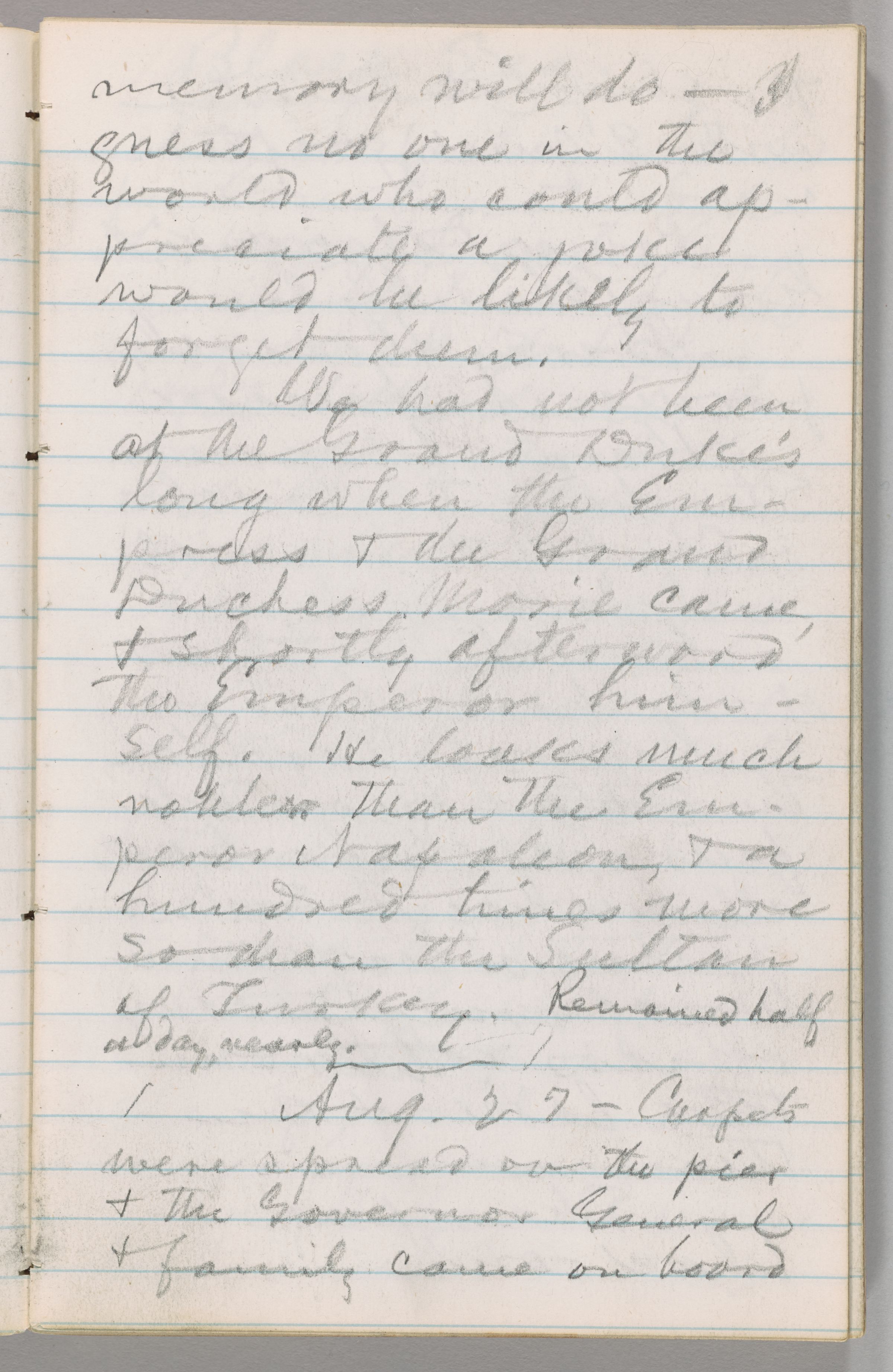
[MS: N9_leaf_034r]
memory will do—I
guess no one in the
world who could
ap-
preciate
appreciate
a joke
would be likely to
forget them.
[MTP: N&J1_410]
We had not been
at the Grand Duke’s
long when the
Em-
press
Empress
& the Grand
Duchess
Marie came,
& shortly afterward
the Emperor
him-
self
himself
. He looks much
nobler than
the
Em-
peror
Emperor
Napoleon, & a
hundred times more
so than the Sultan
of Turkey.
Remained half
a day, nearly.
Aug. 27—Carpets
were spread on the pier
& the Governor General
&
family came on board
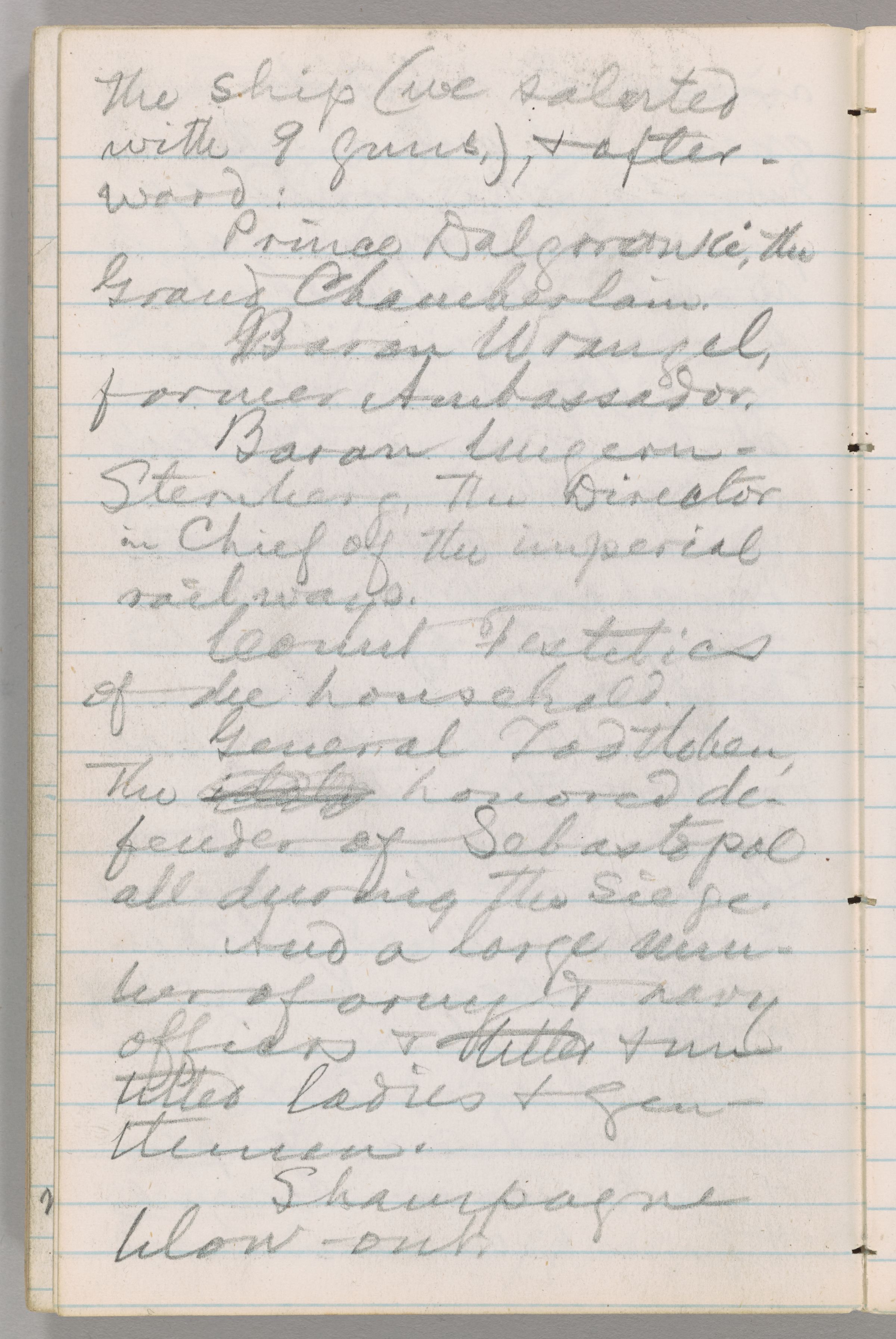
[MS: N9_leaf_034v]
the ship (we saluted
with 9 guns,) &
after-
ward
afterward
:
Prince Dalgorouki, the
Grand Chamberlain.
G Baron Wrangel,
former Ambassador.
Baron Ungern-
Sternberg, the Director
in Chief of the imperial
railways.
Count Festetics
of the household.
General Todtleben,
the idoli honored
de-
fender
defender
of
Sebastopol
all during the siege.
[MTP: N&J1_411]
And a large
num-
ber
number
of army & navy
officrs & titled &
un-
titled
untitled
ladies
&
gen-
tlemen
gentlemen
.
Shampagne
blow-out.
[MS: N9_leaf_035r]
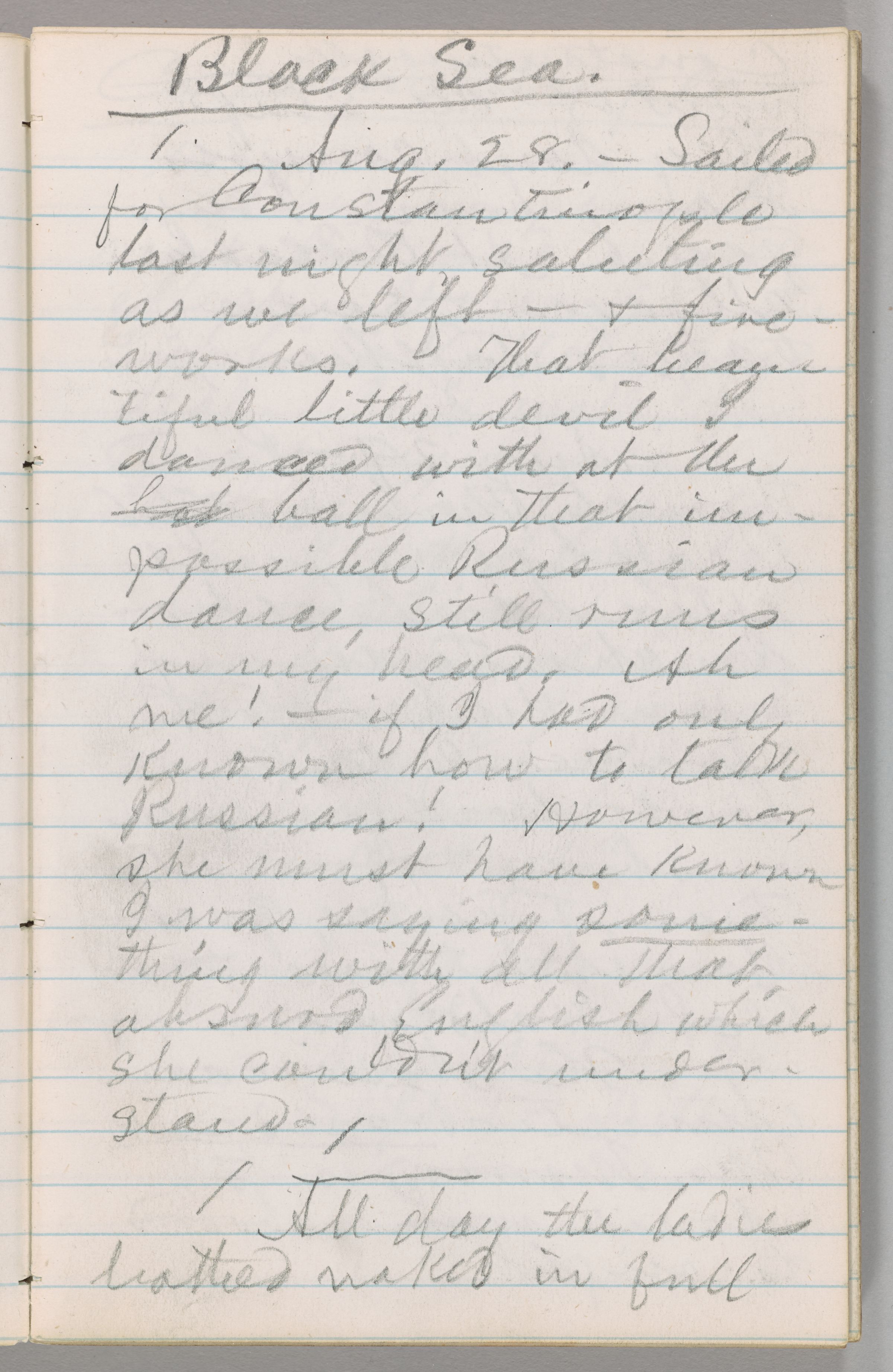
Black Sea.
Aug. 28.—Sailed
for Constantinople
last night, saluting
as we left—&
fire-
works
fireworks
. That
beau-
tiful
beautiful
little devil I
danced with at the
ball in that
im-
possible
impossible
Russian
dance, still runs
in my head. Ah
me!—if I had only
known how to talk
Russian! However,
she must have known
I was saying
some-
thing
something
with all that
absurd English which
she couldn’t
under-
stand
understand
.
All day the ladies
bathed naked in full
[MS: N9_leaf_035v]
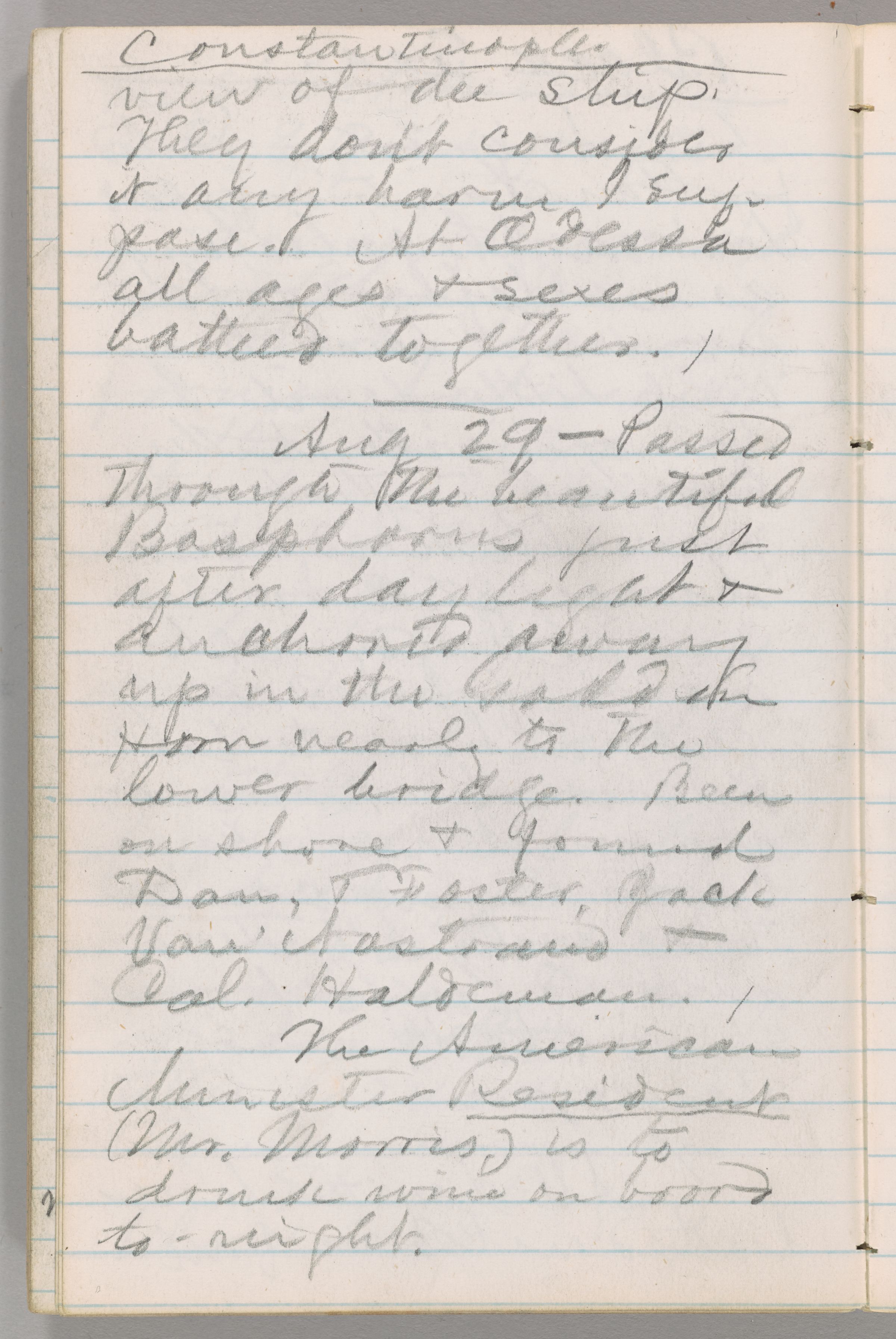
They don’t consider
it any harm, I sup-
pose suppose . At Odessa
all ages & sexes
bathed together.
Aug 29—Passed
through the beautiful
Bosphorus just
after
daylight &
anchored away
up in the Golden
Horn nearly to the
lower bridge.
Been
on shore & found
Dan, & Foster, Jack
Van Nostrand &
Col.
Haldeman.
The American
Minister Resident
(Mr. Morris,) is to
drink
wine on board
to-night.
[MS: N9_leaf_036r]
[MTP: N&J1_412]
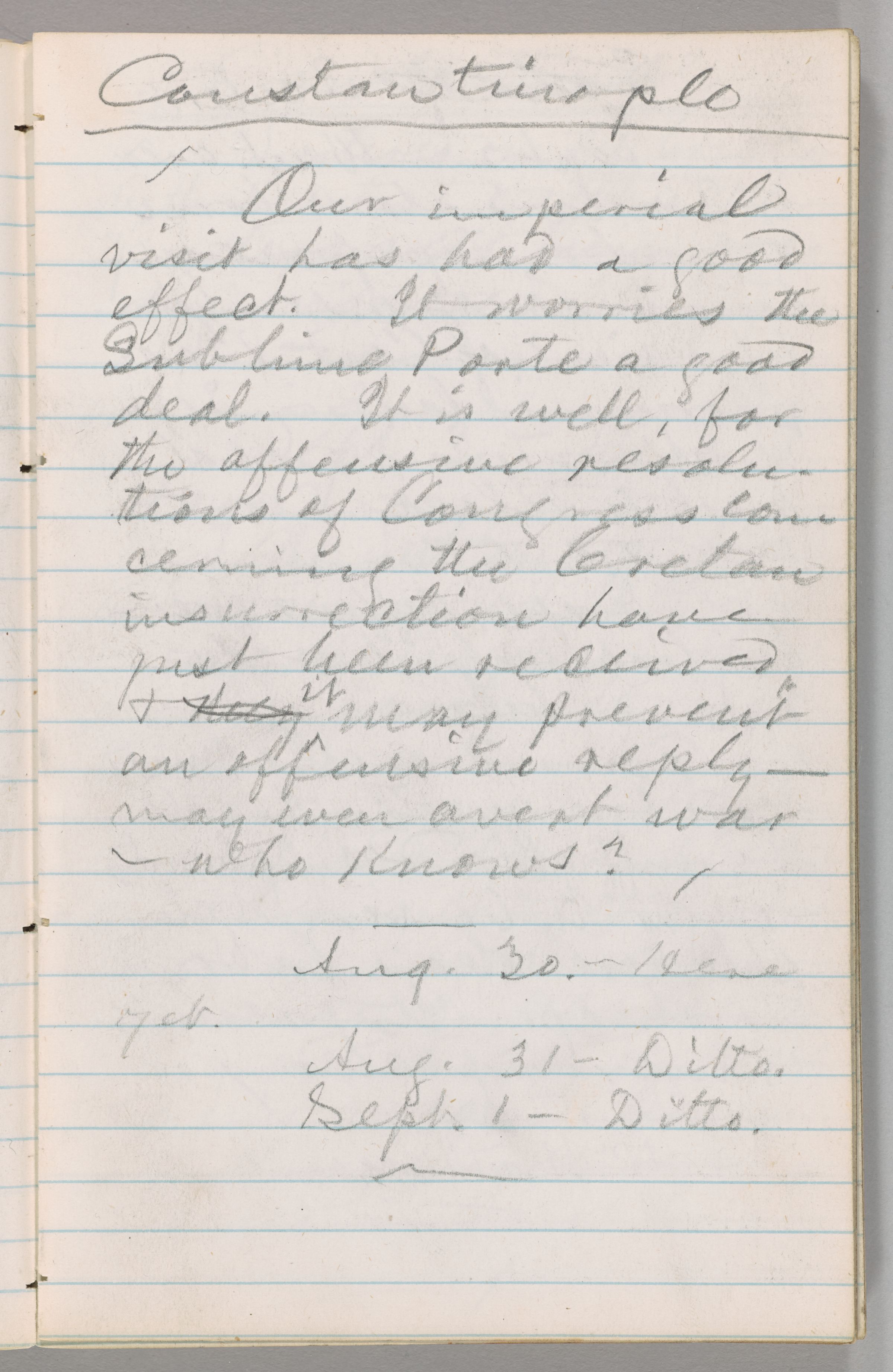
Constantinople
Our imperial
visit has had a good
effect. It worries the
Sublime Porte a good
deal. It
is well, for
the offensive
resolu-
tions
resolutions
of Congress
con-
cerning
concerning
the Cretan
insurrection have
just been received,
& they
it
may
prevent
an offensive reply—
may even avert war
—who knows?
Aug. 30.—Here
yet.
Aug. 31—Ditto.
[MS: N9_leaf_036v]
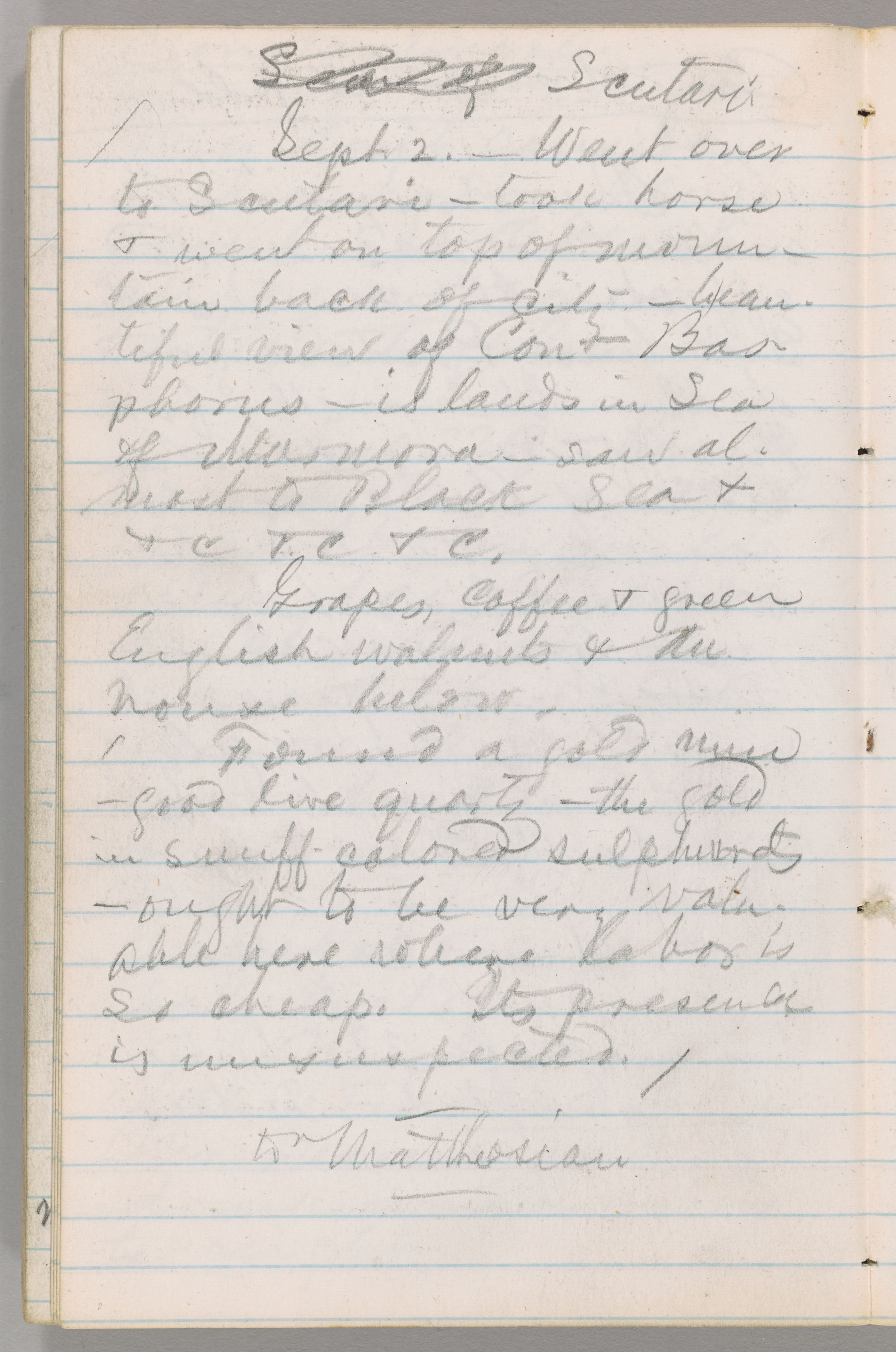
Sea of Scutari.
Sept. 2.—Went over
to Scutari—took horse
& went on top of
moun-
tain
mountain
back of
city—
beau-
tiful
beautiful
view of Con—
Bos-
phorous
Bosphorus
—islands in Sea
of Marmora—saw
al-
most
almost
to Black
Sea &
&c &c &c.
Grapes, coffee & green
English walnuts & the
house below.
Found a gold mine
—good live quartz—the gold
in snuff-colored sulphurrets
—ought to
be very
valu-
able
valuable
here where labor is
so cheap. Its presence
is unsuspected.
[MTP: N&J1_413]
[MS: N9_leaf_037r]
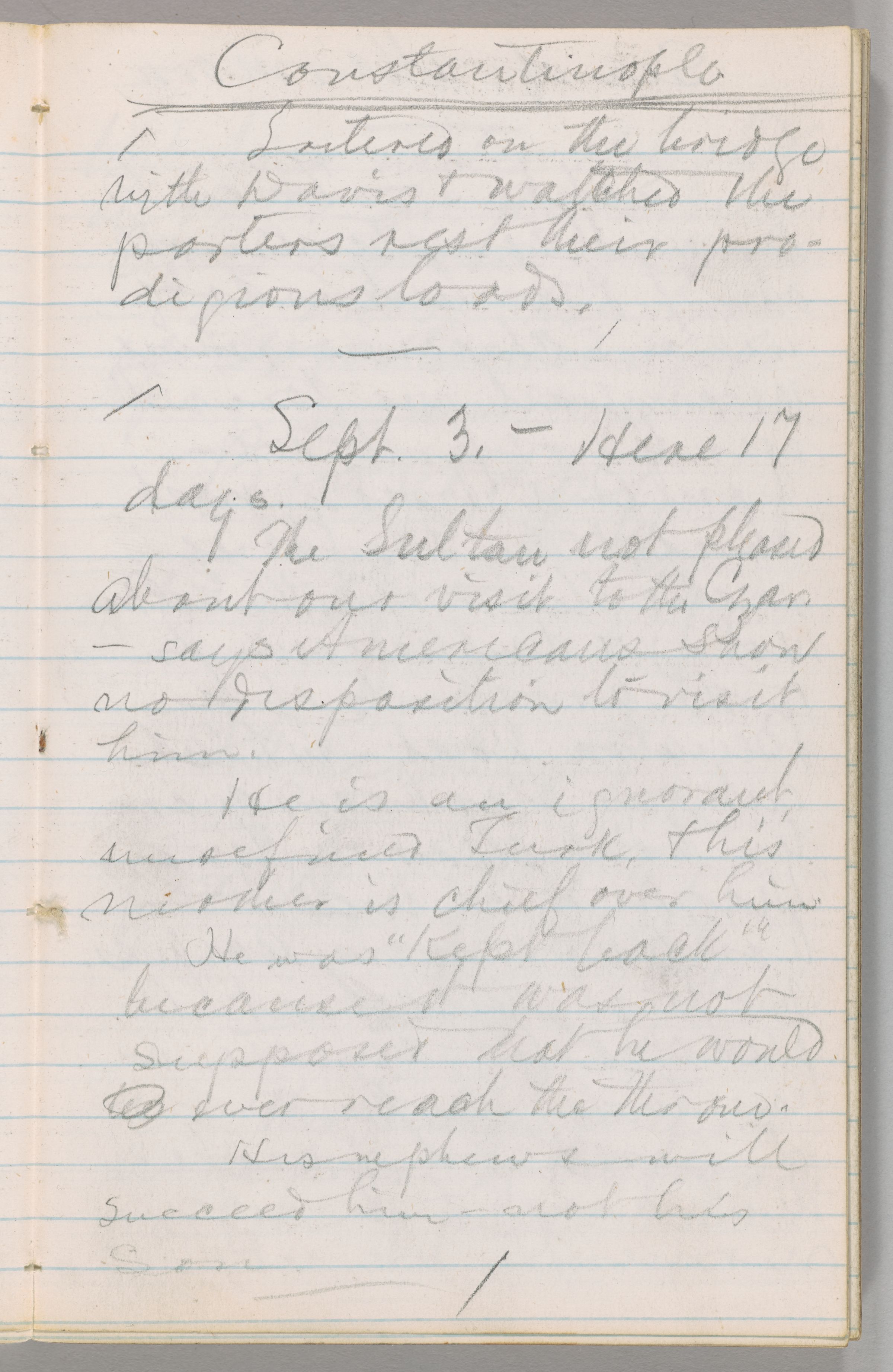
Constantinople
Loitered on the bridge
with Davis & watched the
porters rest their
pro-
digious
prodigious
loads.
Sept. 3.—Here 17
days.
The Sultan not pleased
about our visit to the Czar.
—says Americans show
no
disposition to visit
him.
He is an ignorant,
unrefined Turk, & his
mother is chief over him.
He was “kept back”
because it was not
supposed that he would
be ever
reach the throne.
His nephews will
succeed him—not his
son.
[MS: N9_leaf_037v]
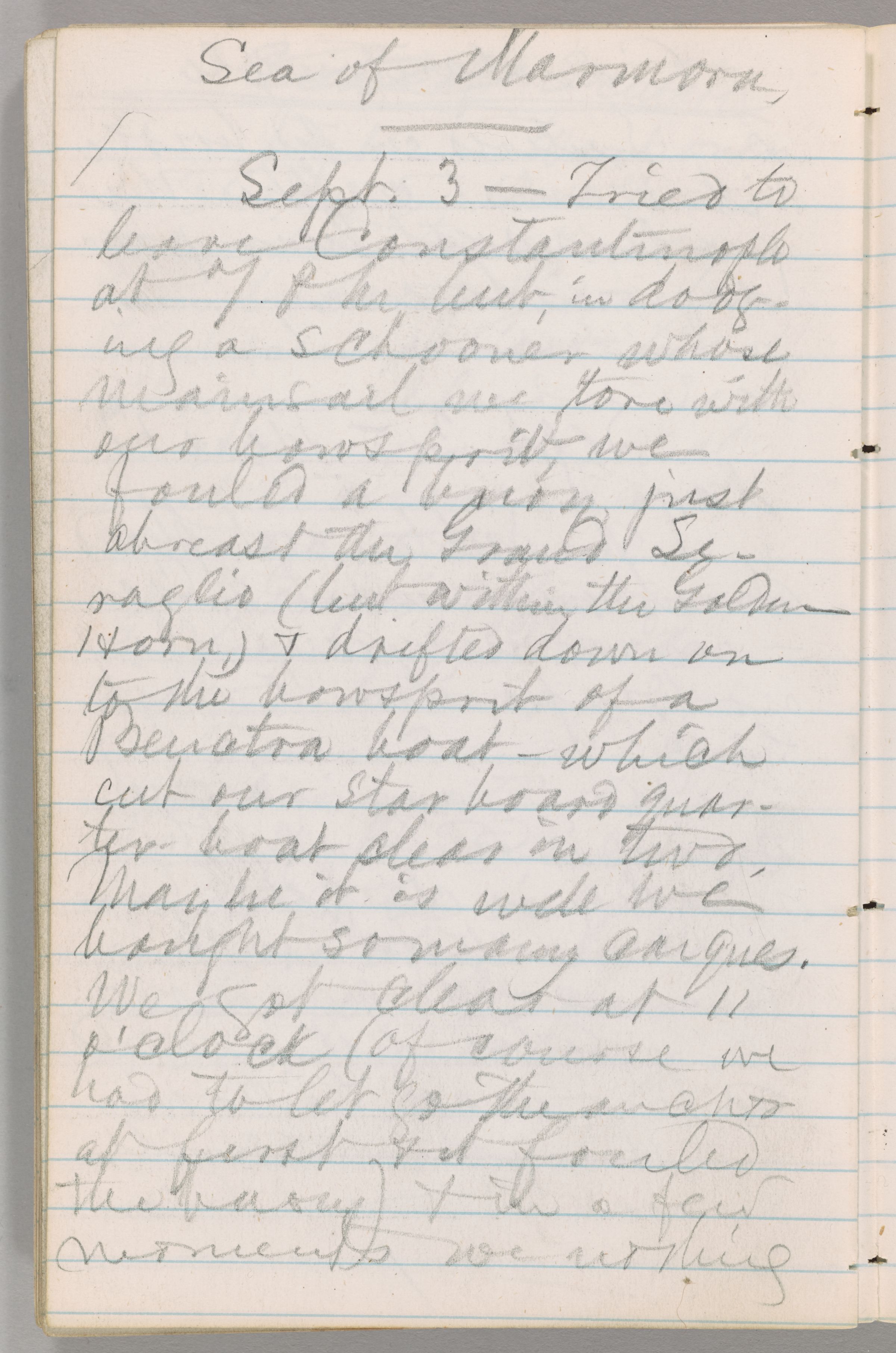
Sea of Marmora.
Sept. 3—Tried to
leave Constantinople
at 7 PM, but, in
dodg-
ing
dodging
a schooner, whose
mainsail we tore with
our bowsprit, we
fouled a buoy, just
abreast the Grand
Se-
raglio
Seraglio
(but within the Golden
Horn,) & drifted down on
to the bowsprit of a
Beuctra boat—which
cut our starboard
quar-
ter-boat
quarter-boat
clear in two.
Maybe it is well
we
bought so many caiques.
We got clear at 11
o’clock (of course we
had to let go
the anchor
at first & it fouled
the buoy) & in a few
moments we nothing
[MS: N9_leaf_038r]
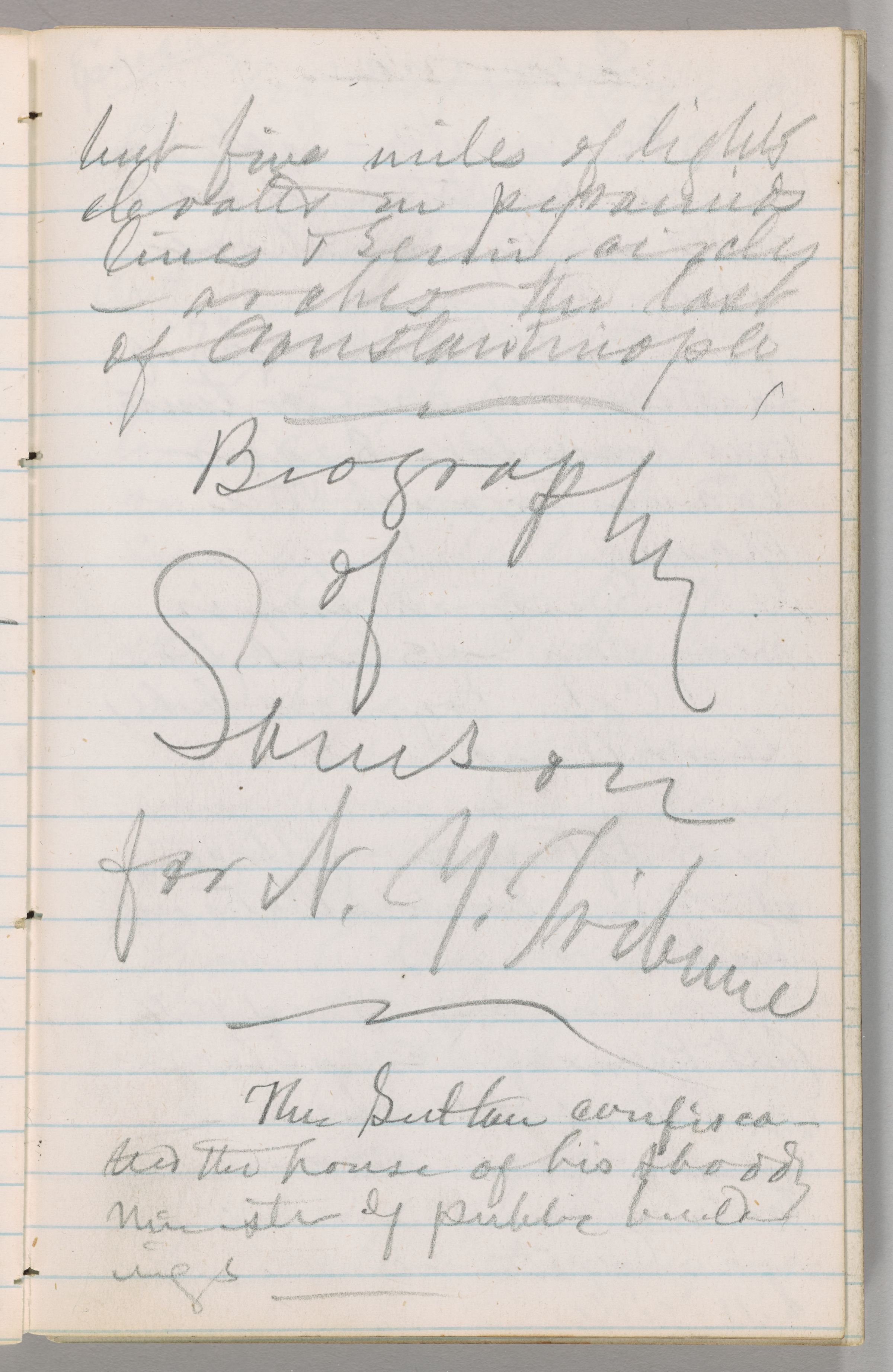
but five miles of lights
elevated in pyramids
lines &
semi-circles
—arches—the last
of Constantinople
[MTP: N&J1_414]
Biography
of
Samson
for N. Y. Tribune
This Sultan
confisca-
ted
confiscated
the house of his shoddy
minister of public
build-
ings
buildings
[MS: N9_leaf_038v]
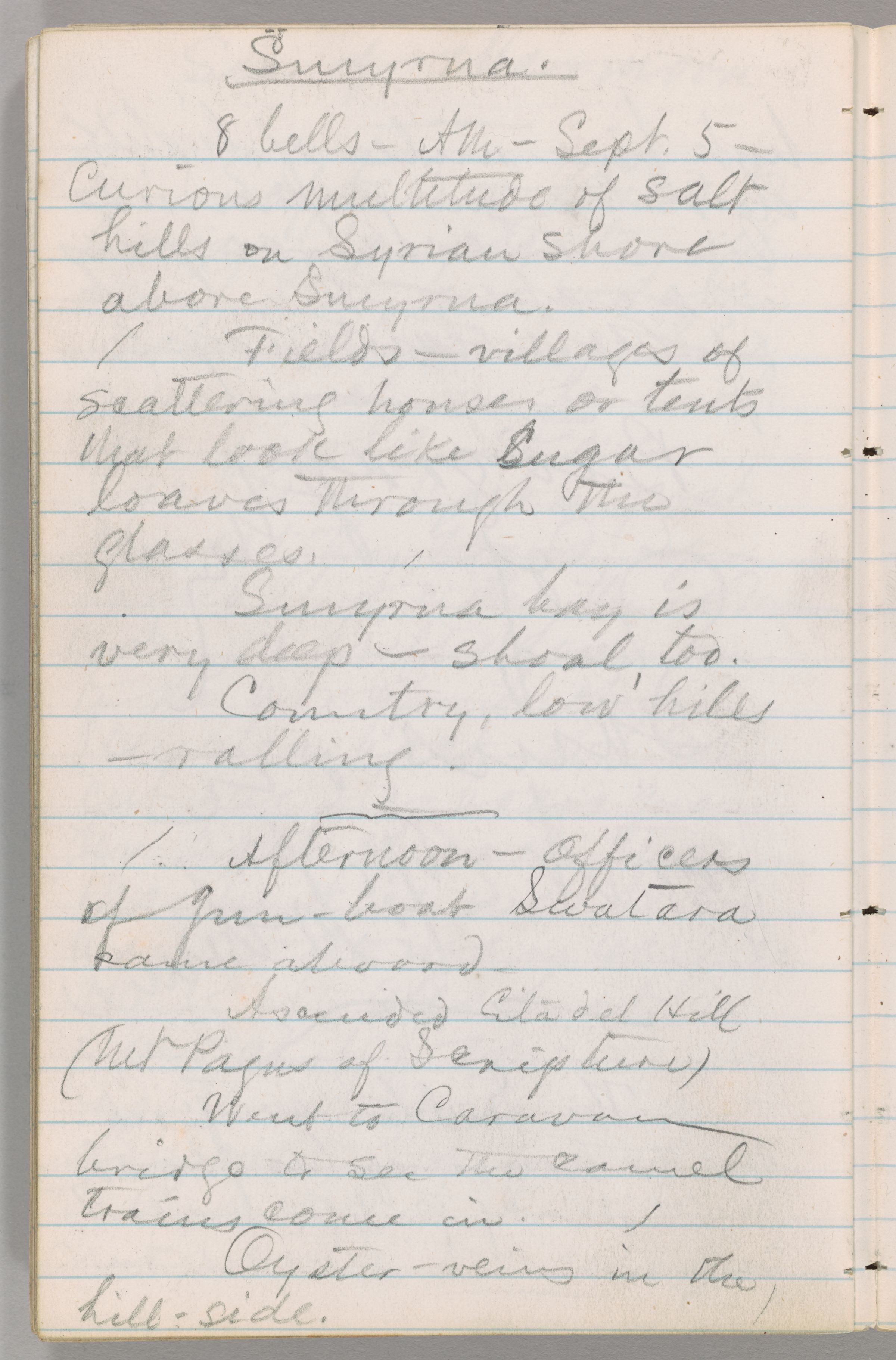
Smyrna.
8 bells—AM—Sept. 5—
Curious multitude of salt
hills on Syrian shore
above
Smyrna.
Fields—villages of
scattering houses or tents
that look like l sugar
loaves through the
glasses.
Smyrna bay is
very deep—shoal, too.
Country, low hills
—rolling.
Afternoon—officers
of gun-boat Swatara
came aboard.
Ascended Citadel Hill
(Mt Pagus of Scripture)
Went to Caravan
bridge to see the camel
trains come in.
Oyster-veins in the
hill-side.
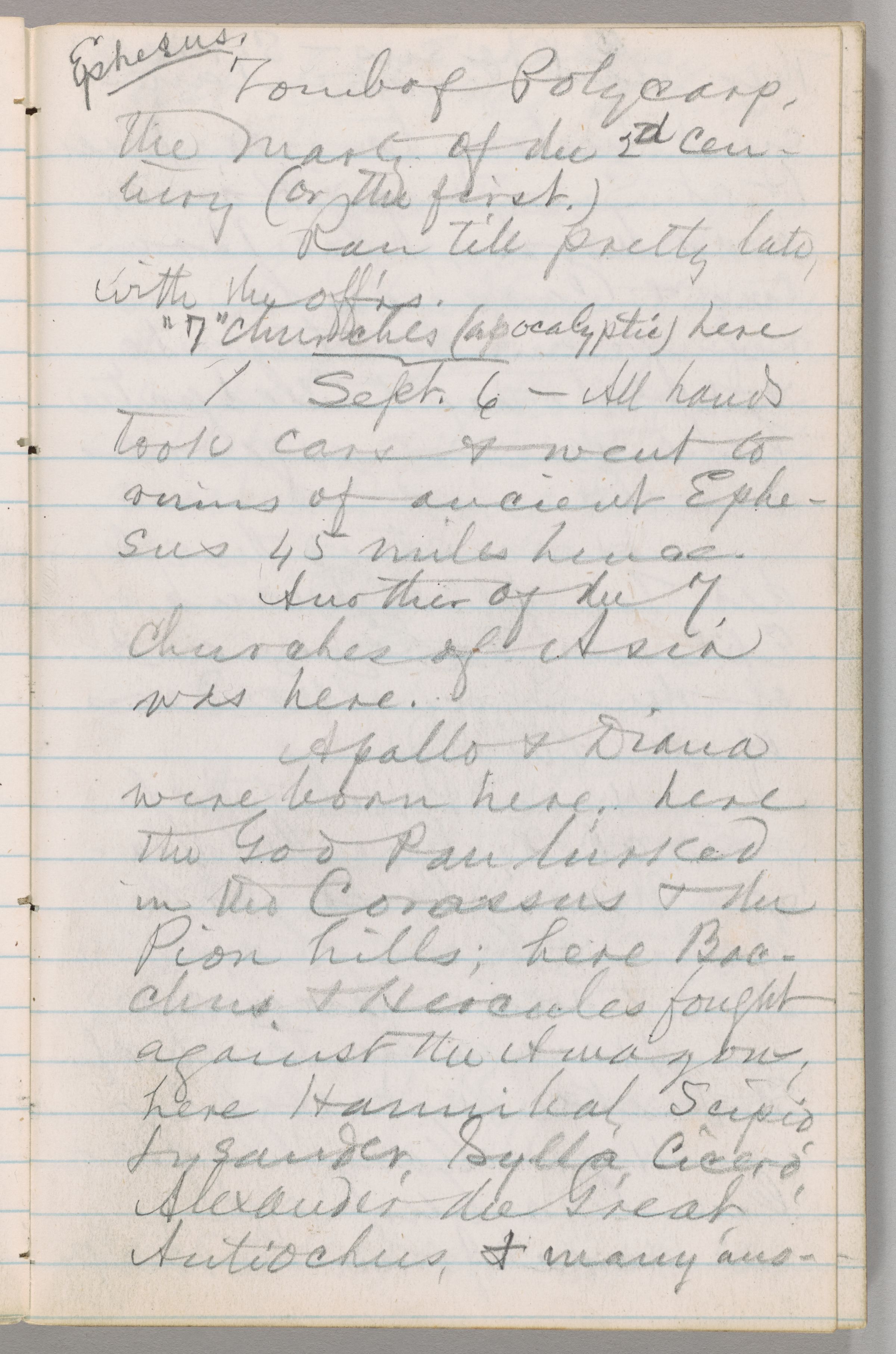
[MS: N9_leaf_039r]
[MTP: N&J1_415]
Tomb of Polycarp,
the marty of the 2d
cen-
tury
century
(or the
first.)
Ran till pretty late,
with the off’rs.
“7” churches (apocalyptic) here
Sept. 6—All hands
took cars & went to
ruins of ancient
Ephe-
sus
Ephesus
45 miles
hence.
Another of the 7
churches of Asia
was here.
Apollo & Diana
were born here; here
the God Pan lurked
in the Corassus &
the
Pion hills; here
Bac-
chus
Bacchus
& Hercules fought
against the Amazons;
here
Hannibal, Scipio,
Lysander, Sylla, Cicero,
Alexander the Great,
Antiochus, &
many ano-
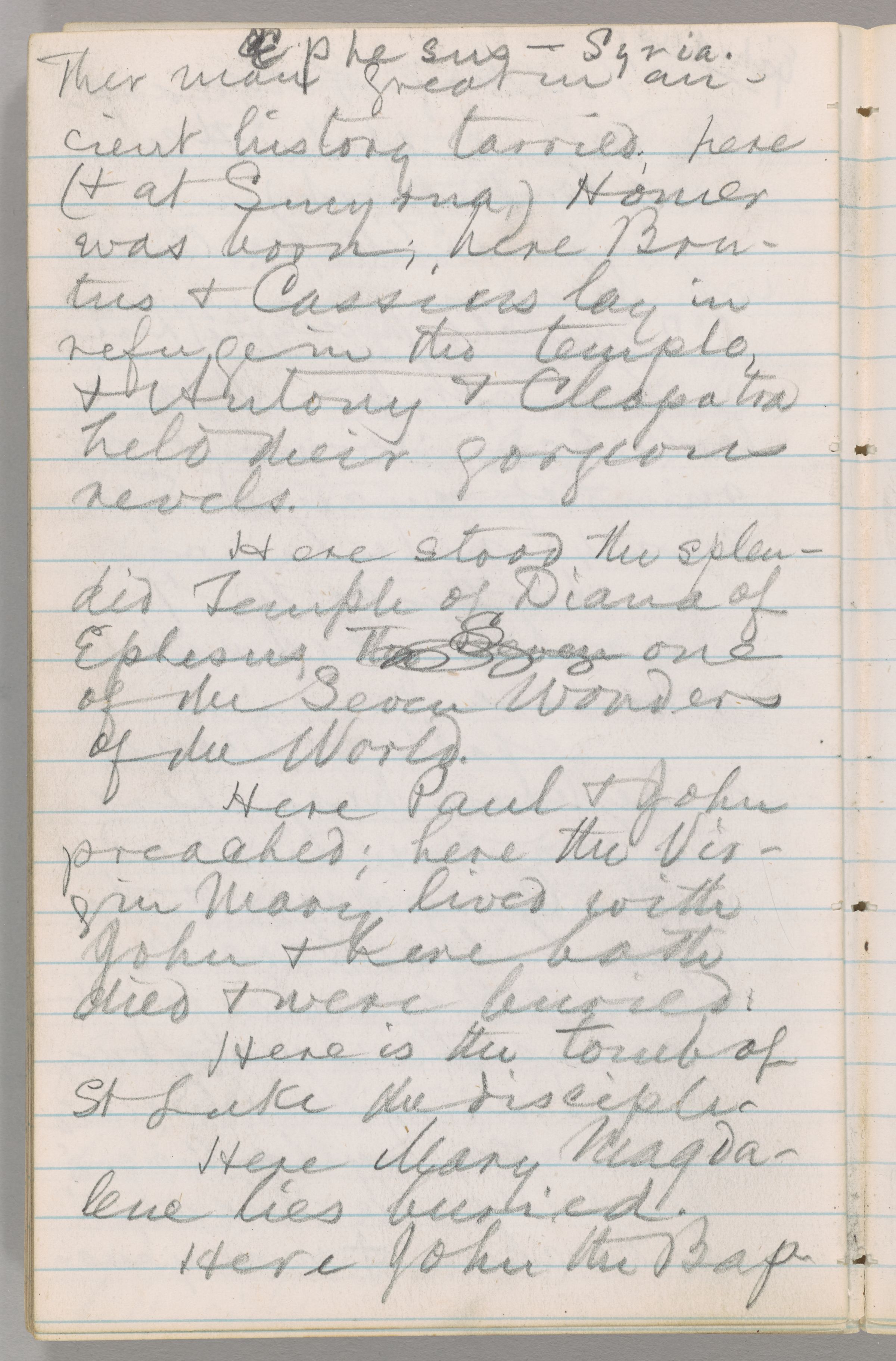
[MS: N9_leaf_039v]
Ephesus—Syria.
cient ancient history tarried; here
(& at Smyrna,) Homer
was born; here Bru-
tus Brutus & Cassius lay in
refuge in the temple,
& Antony & Cleopatra
held their gorgeous
revels.
Here stood the
splen-
did
splendid
Temple of Diana of
Ephesus, the Seven one
of
the Seven Wonders
of the World.
Here Paul & John
preached; here the
Vir-
gin
Virgin
Mary lived with
John & here
both
died & were buried.
Here is the tomb of
St Luke the disciple.
Here Mary
Magda-
lene
Magdalene
lies buried.
Here John the Bap-
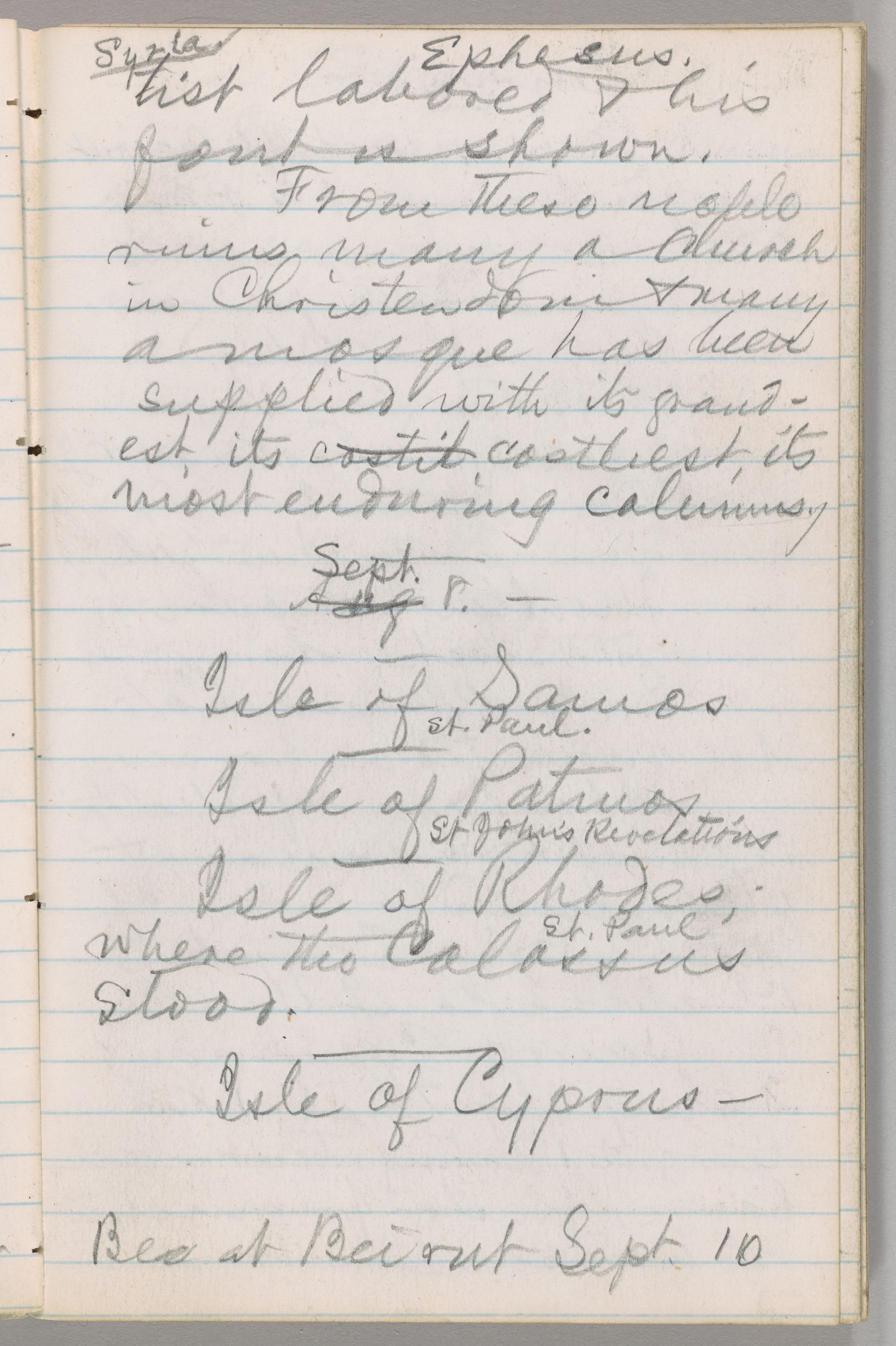
[MS: N9_leaf_040r]
Syria. Ephesus.
font is shown.
From these noble
ruins many a church
in Christendom & many
a mosque has been
supplied with its
grand-
est
grandest
, its costil costliest, its
most enduring columns.
[MTP: N&J1_416]
Aug Sept. 8.—
St. Paul.
Isle of Patmos
St John’s Revelations
Isle of Rhodes,
where the Colossus
stood.
Isle of Cyprus—
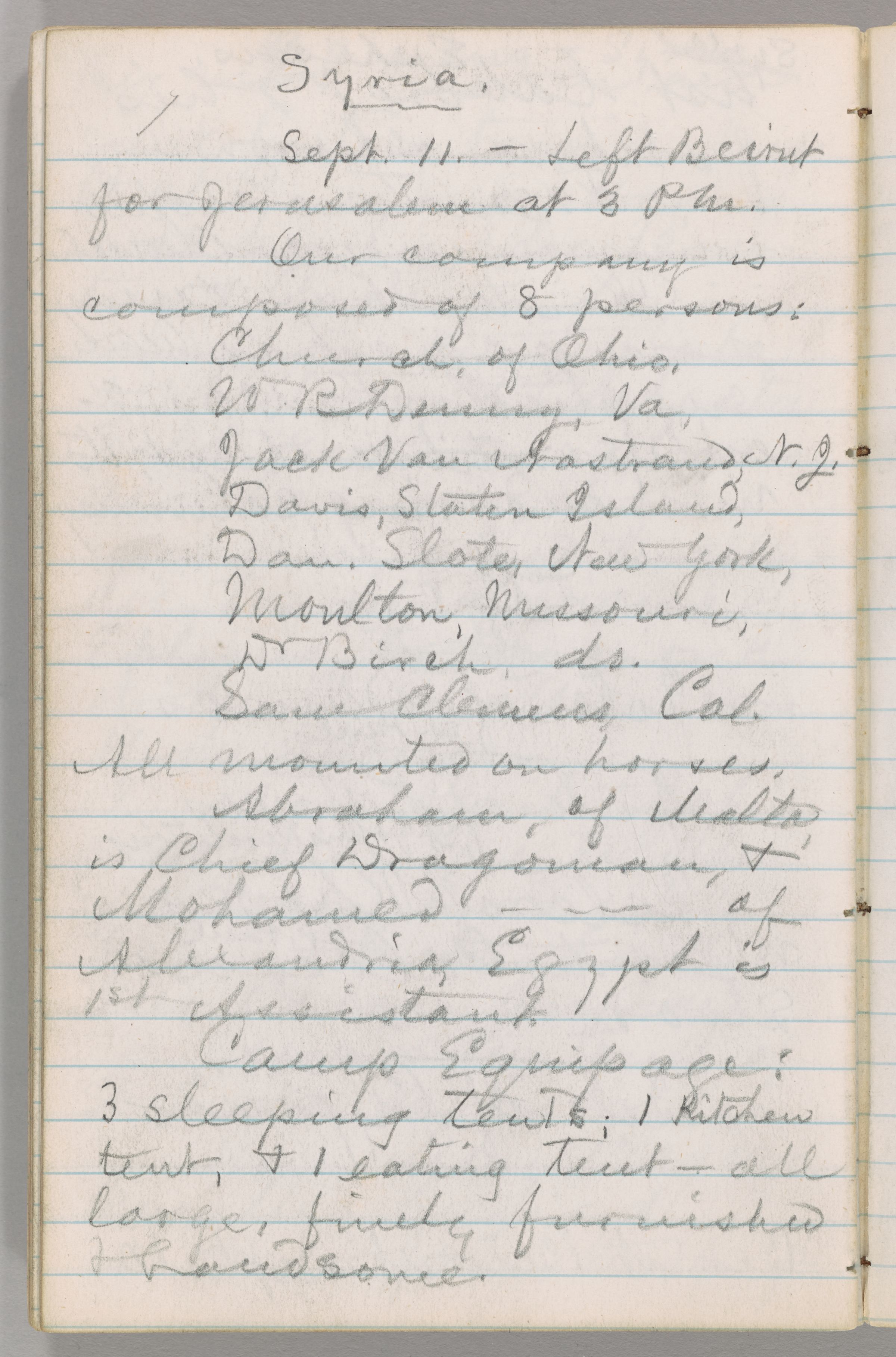
[MS: N9_leaf_040v]
Syria.
Sept. 11.—Left Beirut
for Jerusalem at 3 PM.
Our company is
composed of 8 persons:
Church, of Ohio,
WR Denny, Va,
Jack Van Nostrand, N.J.
Davis, Staten Island,
Dan. Slote, New York,
Moulton, Missouri,
Dr Birch, do.
Sam Clemens, Cal.
All mounted on horses.
[MTP: N&J1_417]
Abraham, of Malta,
is Chief Dragoman, &
Mohamed ——— of
Alexandria, Egypt is
1st Assistant.
Camp Equipage:
3 sleeping tents; 1 kitchen
tent, & 1 eating tent—all
large,
finely furnished
& handsome.
[MS: N9_leaf_041r]
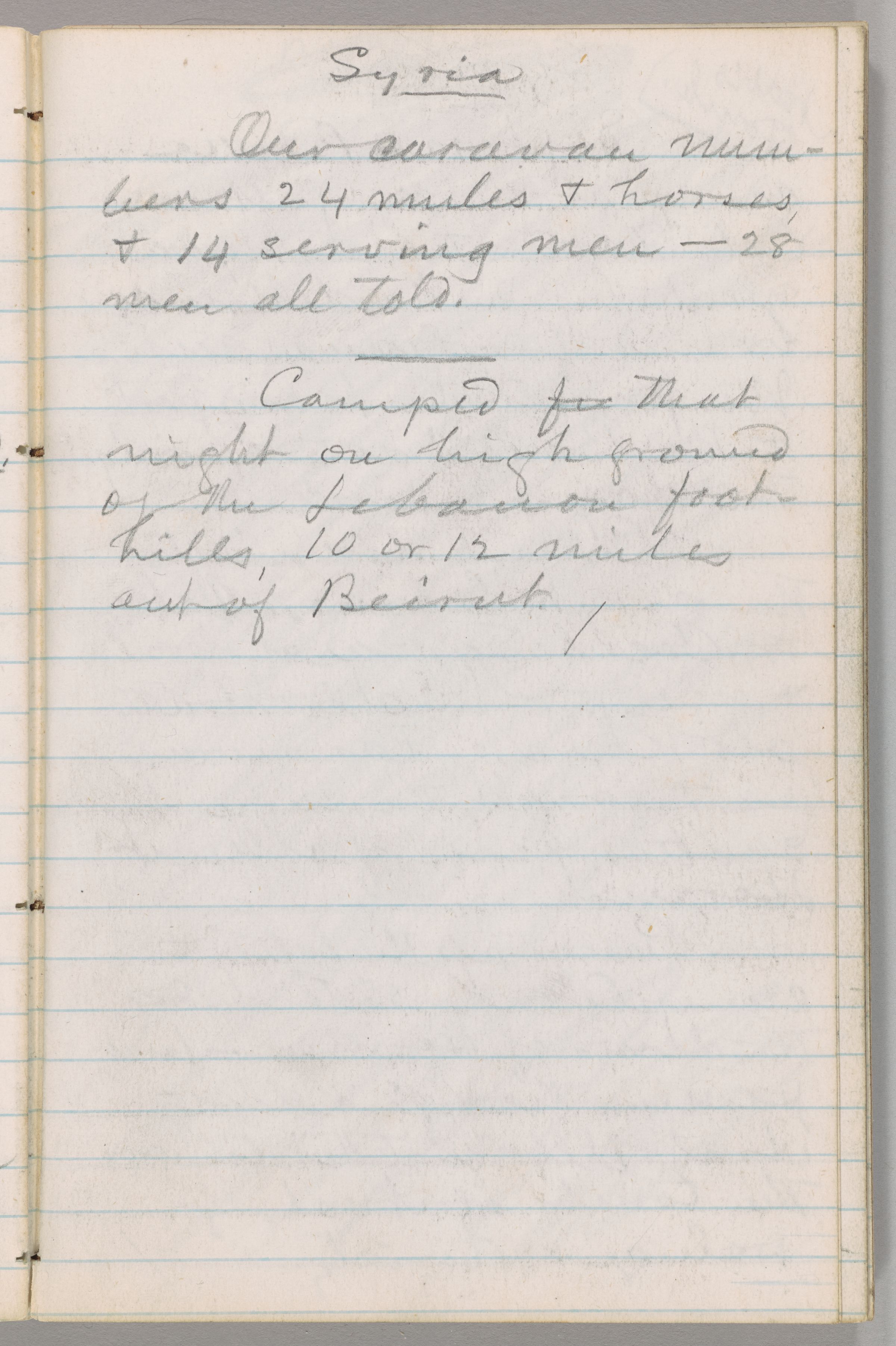
Syria
Our caravan
num-
bers
numbers
24 mules & horses,
& 14 serving men—28
men all told.
Camped fi that
night on high ground
of the Lebanon
foot-
hills
foothills
, 10 or 12 miles
out of Beirut.
[MS: N9_leaf_041v]
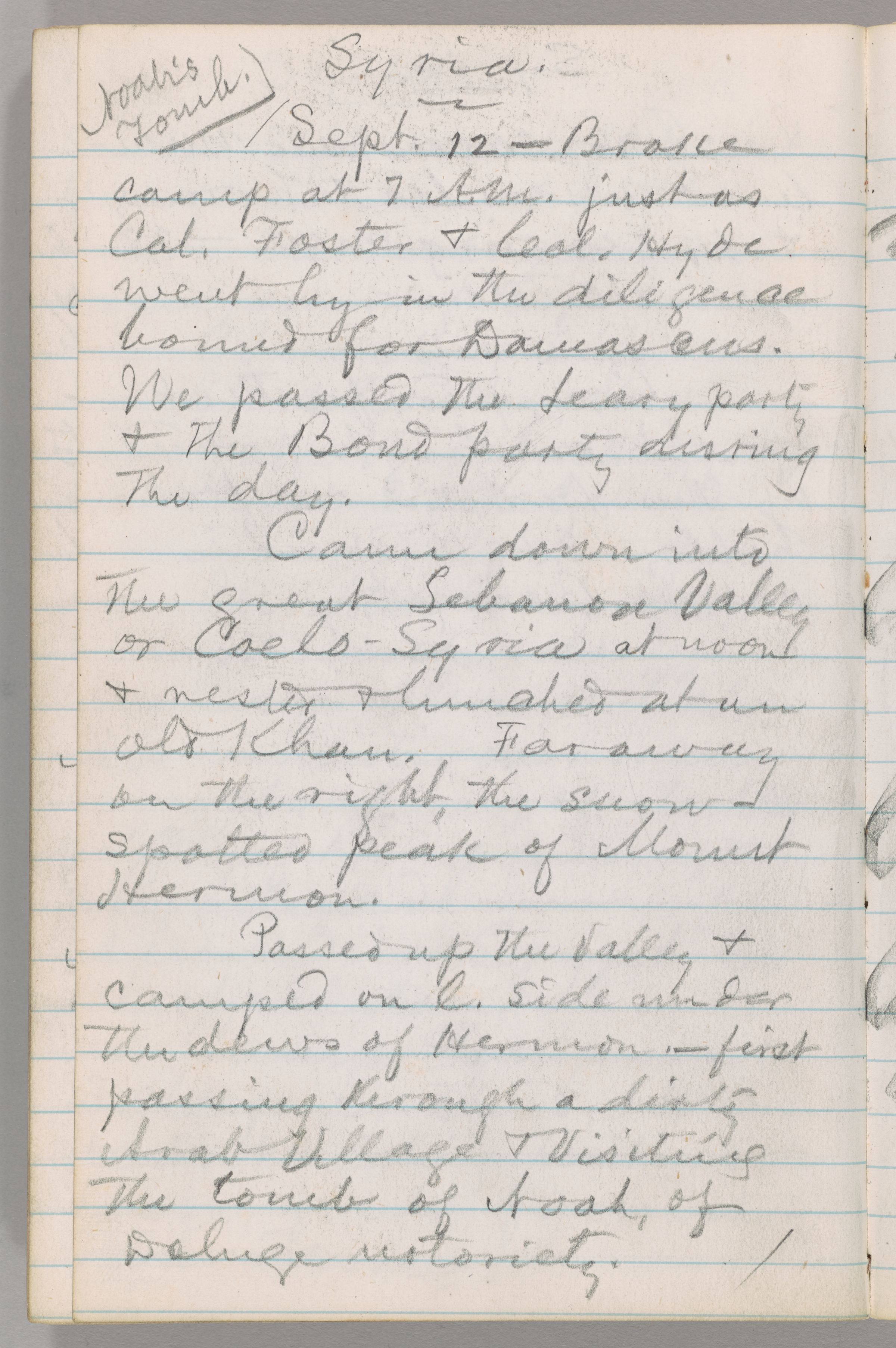
Sept. 12—Broke
camp at 7 A.M. just as
Col. Foster & Col. Hyde
went by in the
diligence
bound for Damascus.
We passed the Leary party
& the Bond party
during
the day.
Came down into
the great Lebanon Valley
or Coelo-Syria at noon
& rested &
lunched at an
old Khan. Far away
on the right, the snow-
spotted peak of Mount
Hermon.
Passed up the Valley &
camped on 1. side under
the dews of Hermon.—first
passing through a dirty
Arab village & visiting
the tomb of Noah, of
Deluge
notoriety.
[MS: N9_leaf_042r]
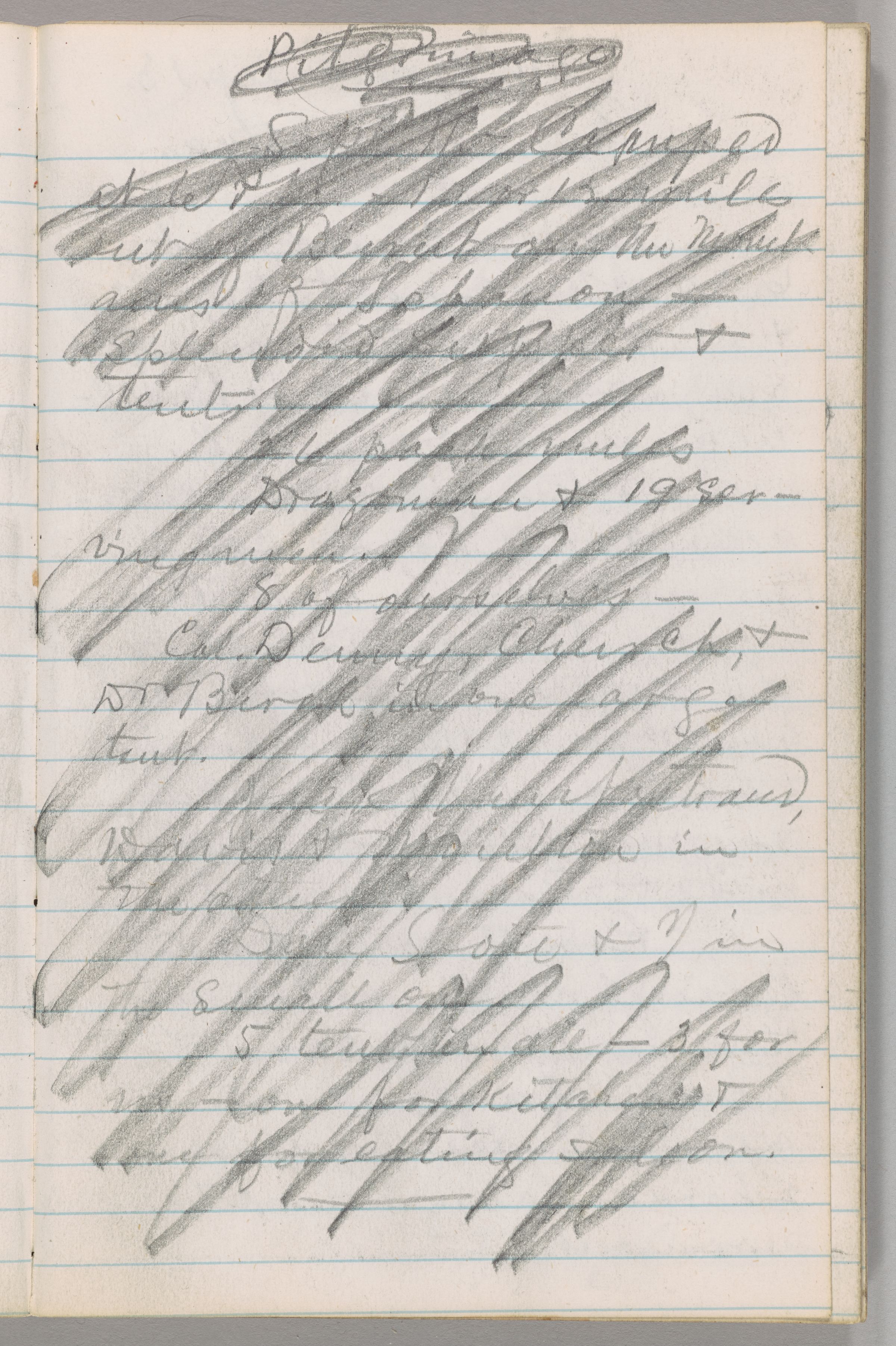
Sept 11—Camped
at 6 PM.—10 or 12 miles
out of Beirut on the
Mount-
ains
Mountains
of
Lebanon—
splendid supper &
tents.
26 pack mules
Dragoman & 19
ser-
vingmen
servingmen
.
8 of ourselves—
Col. Denny, Church, &
Dr Birch, in one large
tent.
Jack Van Nostrand,
Davis & Moulton in
the other.
Dan Slote & I in
the small one.
5 tents in all—3 for
us—one for kitchen &
one for eating
saloon.
[MS: N9_leaf_042v]
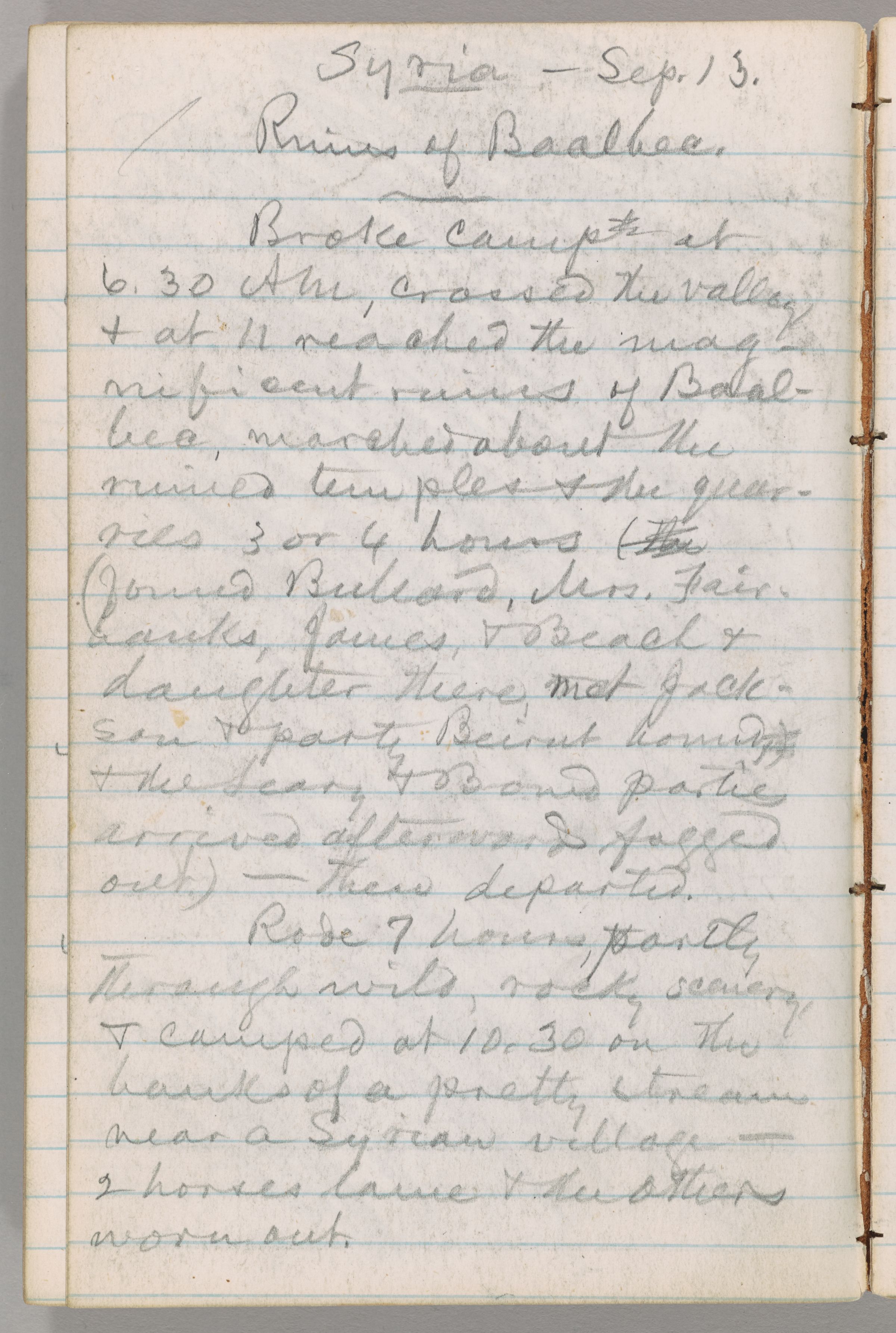
Syria —Sep. 13.
Ruins of Baalbec.
[MTP: N&J1_418]
Broke camp◊ at
6.30 AM, crossed the valley,
& at 11 reached the
mag-
nificent
magnificent
ruins of
Baal-
bec
Baalbec
, marched about the
ruined temples & the
quar-
ries
quarries
3 or 4 hours
(the (found Bullard, Mrs.
Fair-
banks
Fairbanks
, James, & Beach &
daughter there,
&c met
Jack-
son
Jackson
& party Beirut bound ),
& the
Leary & Bond parties
arrived afterwards fagged
out.)—then departed.
Rode 7 hours, & partly
through wild, rocky scenery,
& camped at
10.30 on the
banks of a pretty stream
near a Syrian village—
2 horses lame &
the others
worn out.
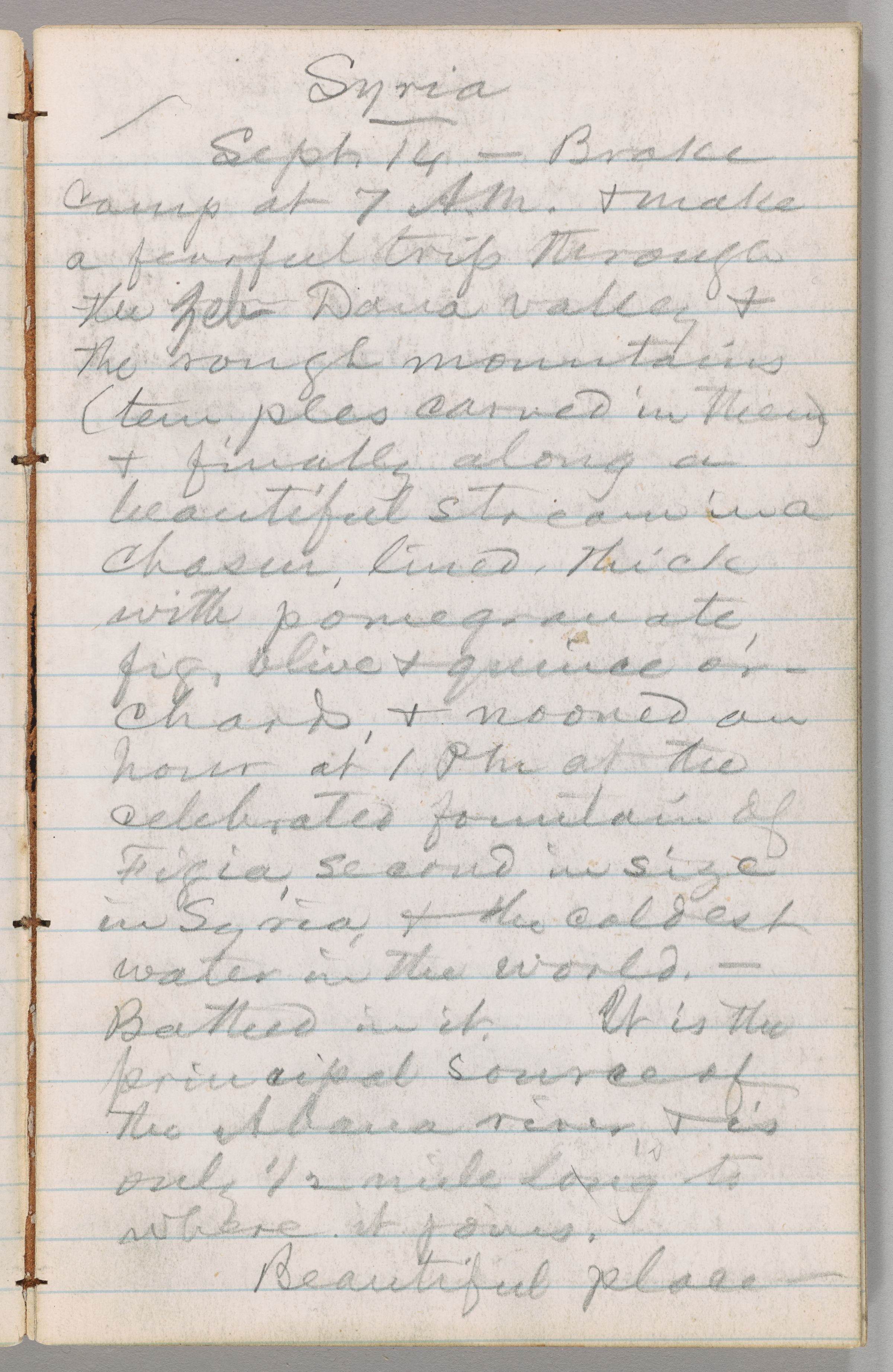
[MS: N9_leaf_043r]
Syria
Sept. 14—Broke
camp at 7 A.M. & make
a fearful trip through
the
—— Zeb Dana valley &
the rough mountains
(temples carved in
them)
& finally along a
beautiful stream in a
chasm, lined, thick
with
pomegranate,
fig, olive & quince
or-
chards
orchards
, & nooned an
hour at 1 PM at the
celebrated fountain of
Figia, second in size
in Syria, & the coldest
water in
the world.—
Bathed in it. It is the
principal source of
the Abana river, & is
only ½ mile long to
where it joins.
Beautiful place—
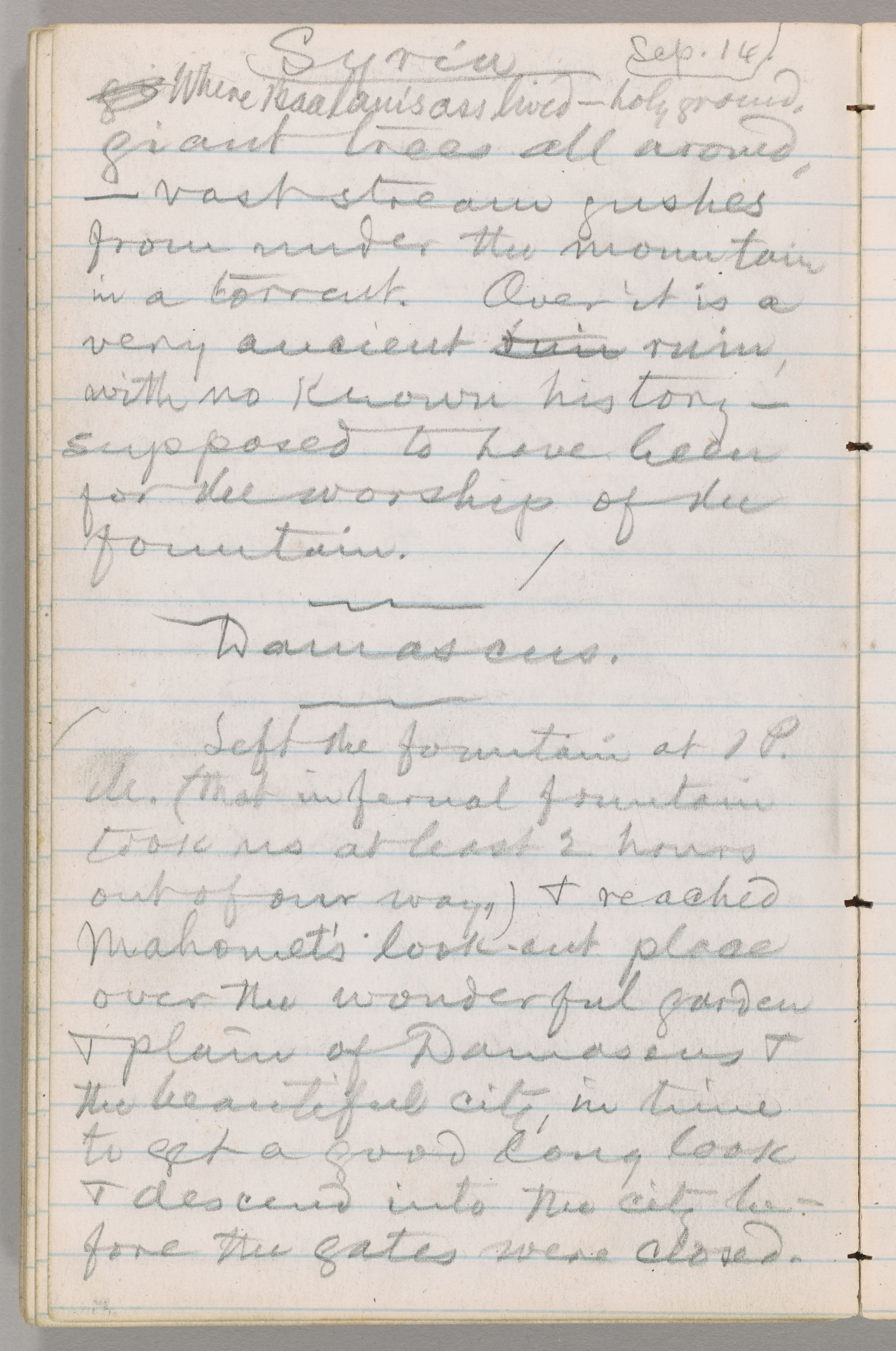
[MS: N9_leaf_043v]
—vast stream gushes
from under the mountain
in a torrent. Over it is a
very ancient ruin,
with no known history—
supposed to have been
for the worship of the
fountain.
[MTP: N&J1_419]
Damascus.
Left the fountain at 1 P.
M. (that infernal fountain
took us at least 2 hours
out
of our way .,) & reached
Mahomet’s look-out place
over the wonderful garden
& plain of Damascus &
the beautiful city, in
time
to get a good long look
& descend into the city
be-
fore
before
the gates were
closed.
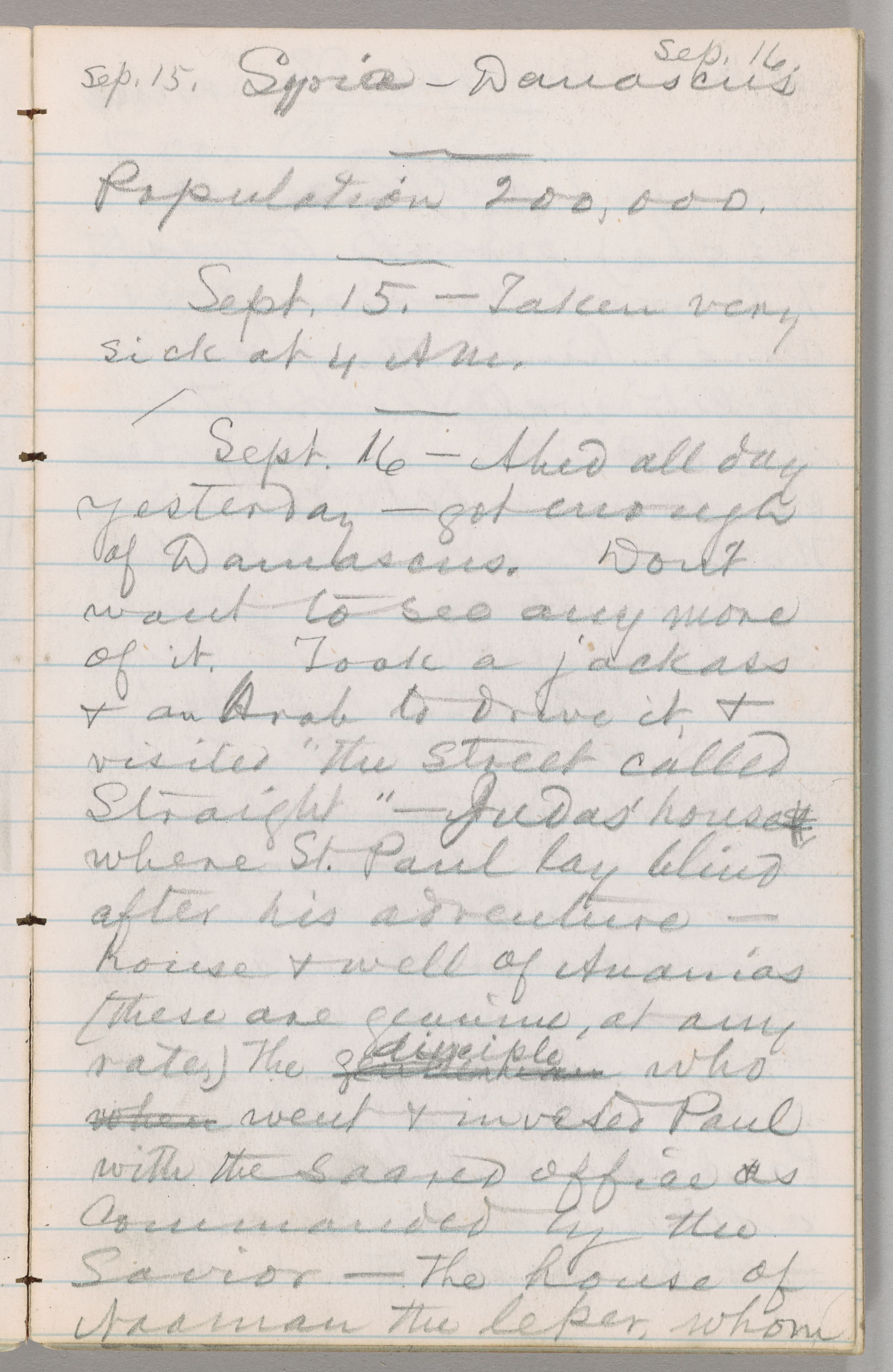
[MS: N9_leaf_044r]
Sep. 15. Syria—Damascus Sep. 16.
Population 200,000.
Sept. 15.—Taken very
sick at 4 AM.
Sept. 16—Abed all day
yesterday—got enough
of Damascus. Don’t
want to see any more
of it. Took a jackass
&
a b an
Arab to drive it, &
visited “the street called
Straight”—A Judas’ houses,
where St. Paul lay blind
after his adventure—
house
& well of Ananias
(these are genuine, at any
rate,) the gentleman
disciple
who
when went & invi
ested Paul
with the sacred office & as
commanded by
the
Savior—the house of
Naaman the leper, whom
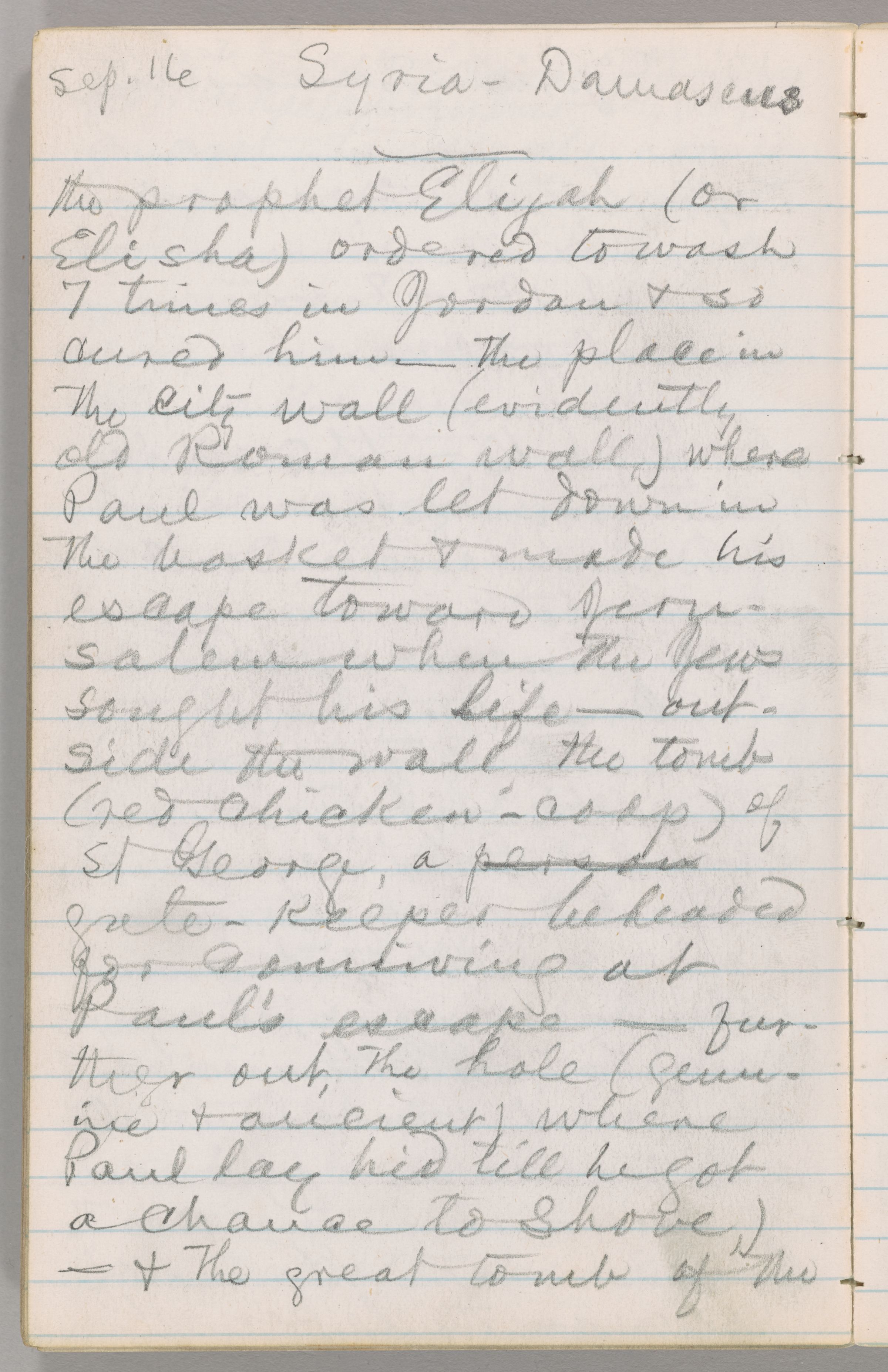
[MS: N9_leaf_044v]
Sep. 16 Syria—Damascus
Elisha) ordered to wash
7 times in Jordan & so
cured him .—the place in
the city wall (evidently
old Roman wall,) where
Paul was let down in
the basket & made his
escape toward Jeru-
salem Jerusalem when the Jews
[MTP: N&J1_420] sought his life— out-
side outside the wall, the tomb
(red chicken-coop) of
St George, a person
gate-keeper beheaded
for conniving at
Paul’s escape— fur-
ther further out, the hole ( genu-
ine genuine & ancient) where
Paul lay hid till he got
a chance to shove,)
—& the great tomb of the
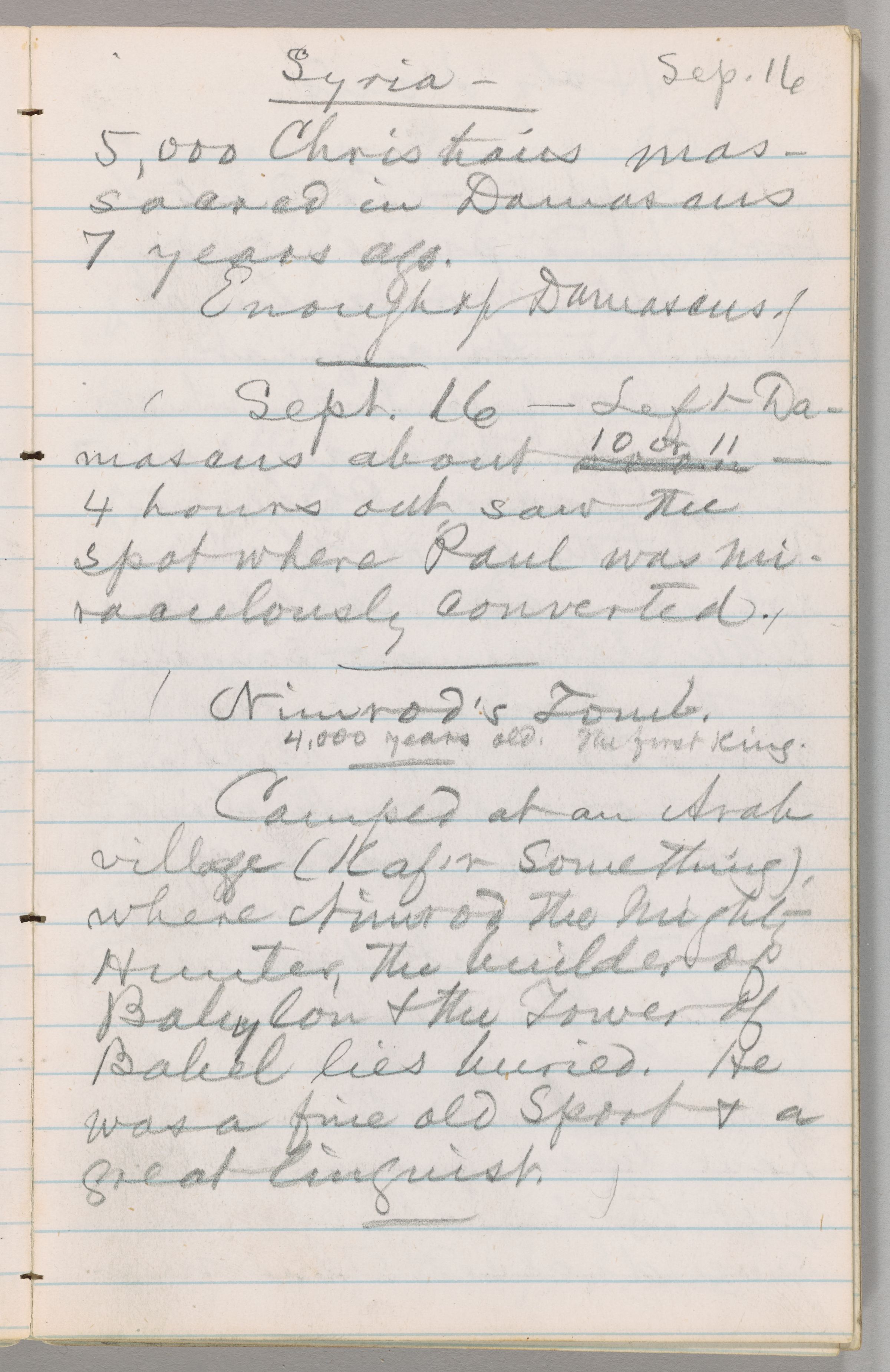
[MS: N9_leaf_045r]
Syria— Sep. 16
sacred massacred in Damascus
7 years ago.
Enough of Damascus.
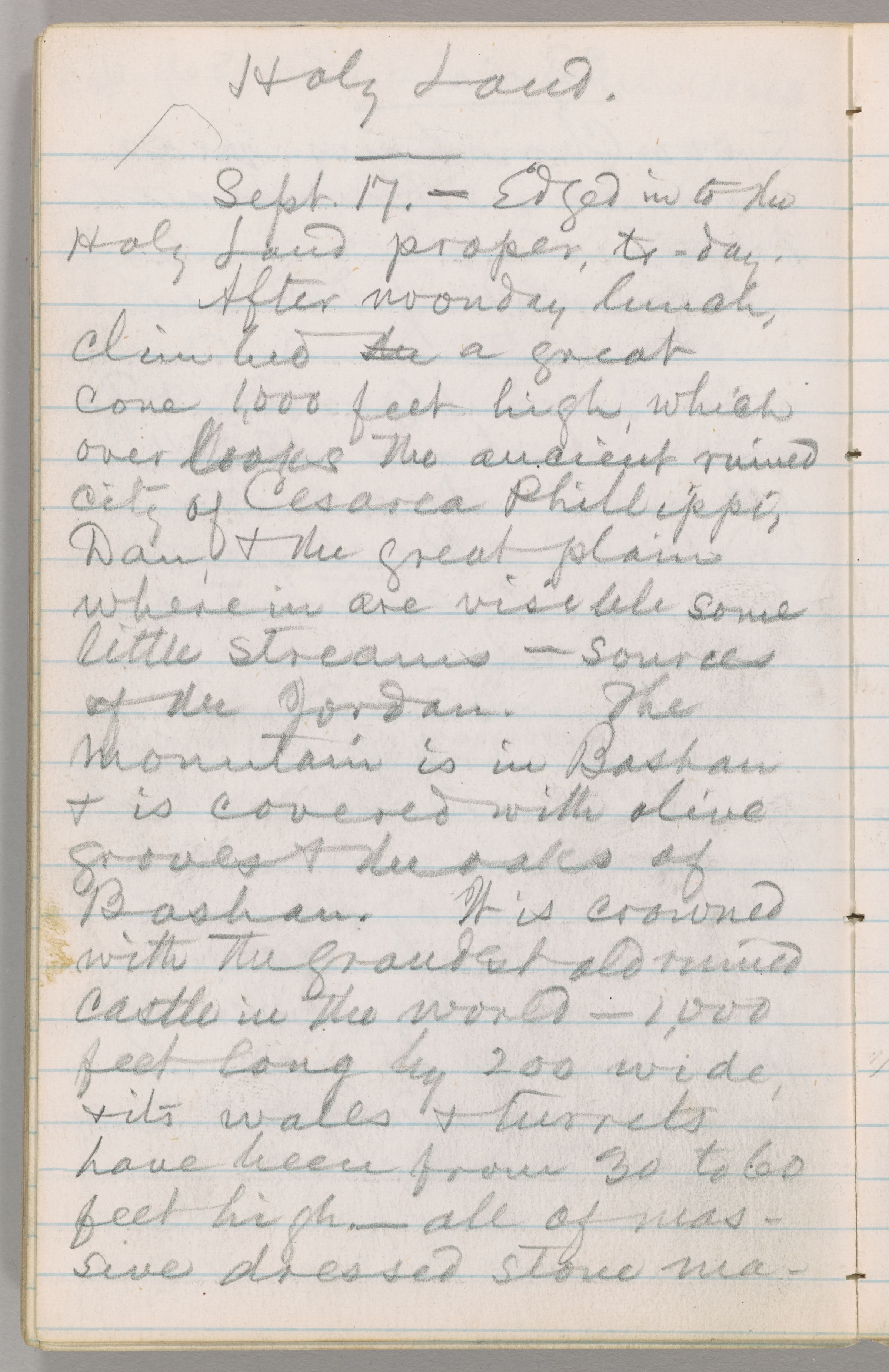
Sept. 16—Left
Da-
mascus
Damascus
about noon
10
or 11
—
4 hours out, saw the
spot
where Paul was
mi-
raculously
miraculously
converted.
Nimrod’s Tomb.
4,000 years old. The first King.
Camped at an Arab
village (Kafir Something),
where Nimrod
the Mighty
Hunter, the builder of
Babylon & the Tower of
Babel lies buried. He
was a fine old Sport & a
great linguist.
[MS: N9_leaf_045v]
Holy Land.
Sept. 17.—Edged in to the
Holy Land proper, to-day.
After noonday lunch,
climbed the a great
cone 1,000 feet high, which
overlooks the ancient ruined
city of Cesarea Phillippi,
Dan, & the great plain
wherein are visible some
little streams—sources
of the Jordan. The
mountain is in
Bashan
& is covered with olive
groves & the oaks of
Bashan. It is crowned
with the grandest old ruined
castle in the world—1,000
feet long by 200 wide,
& its walls
& turrets
have been from 30 to 60
feet high .—all of
mas-
sive
massive
dressed stone ma-
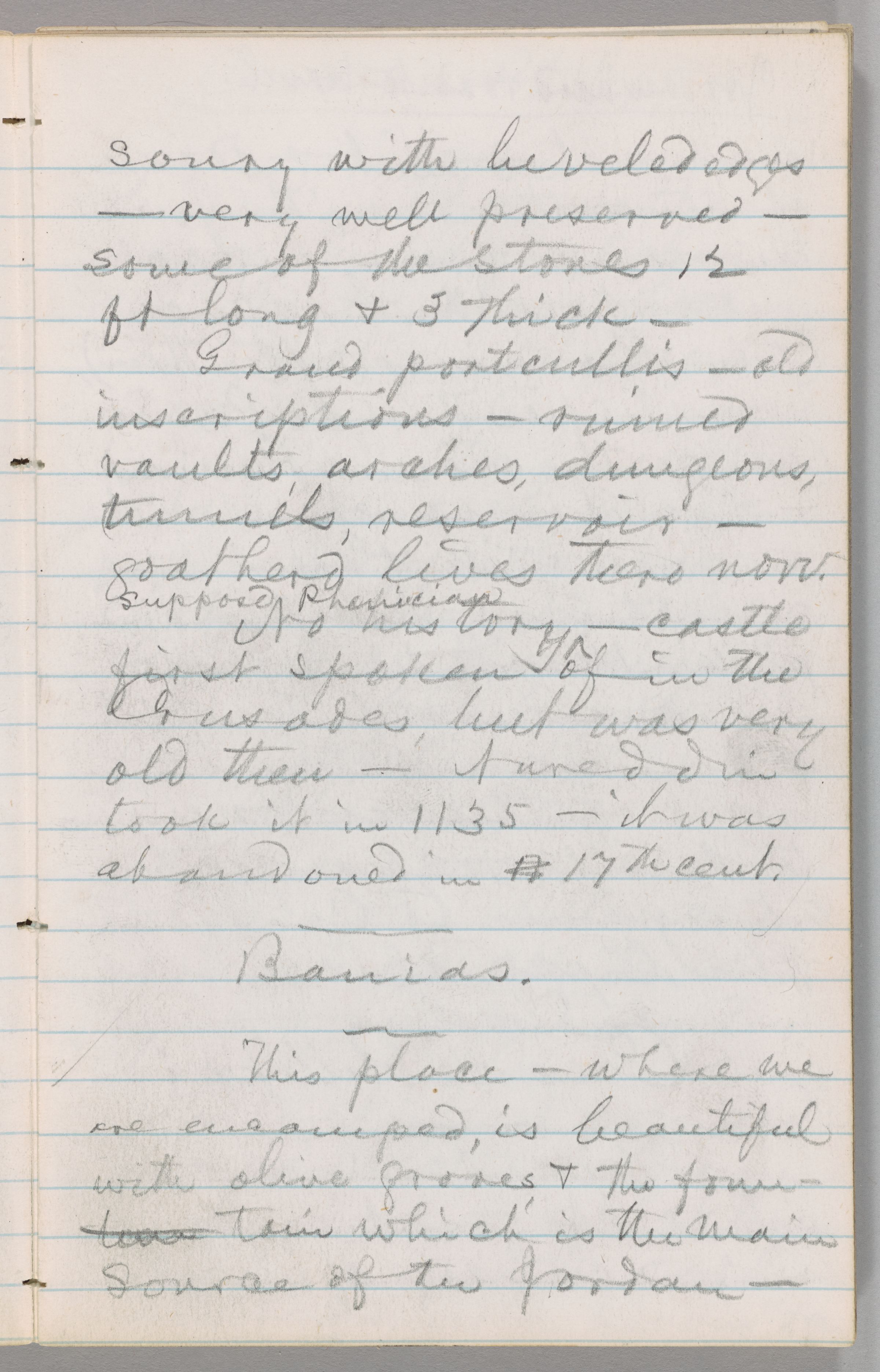
[MS: N9_leaf_046r]
sonry with beveled edges
—very well preserved—
some of
the stones 12
ft long & 3 thick—
[MTP: N&J1_421]
Grand portcullis—old
inscriptions—ruined
vaults, arches, dungeons,
tunnels,
reservoir—
goatherd lives there now.
No history supposd Phenician
—castle
first spoken of in the
Crusades, but
was very
old then—Nureddin
took it in 1135—it was
abandoned in 17 17th cent.
Banias.
This place—where we
are encamped, is beautiful
with olive groves, & the
foun-
tintain
fountintain
which is the main
source of the Jordan—
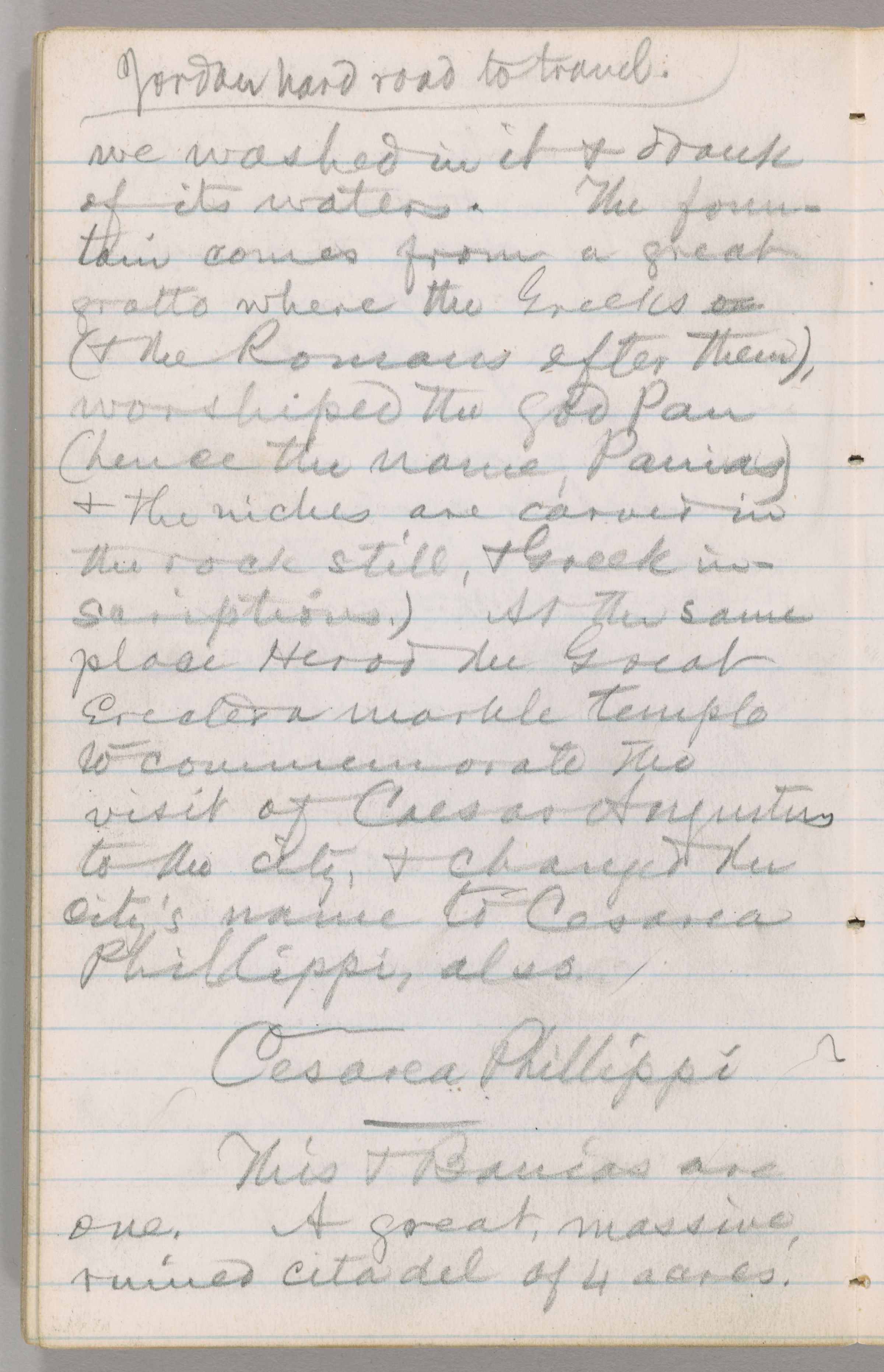
[MS: N9_leaf_046v]
of its waters. The foun-
tain fountain comes from a great
grotto where the Greeks or
(& the Romans after them),
worshiped the god Pan
(hence the name, Panias)
& the niches are carved in
the rock still, & Greek in-
scriptions inscriptions .) At the same
place Herod the Great
erected a marble temple
to commemorate the
visit of Caesar Augustus
to the city, & changed the
city’s name to Cesarea
Phillippi, also.
Cesarea Phillippi
This & Banias are
one. A great, massive,
ruined citadel of 4 acres.
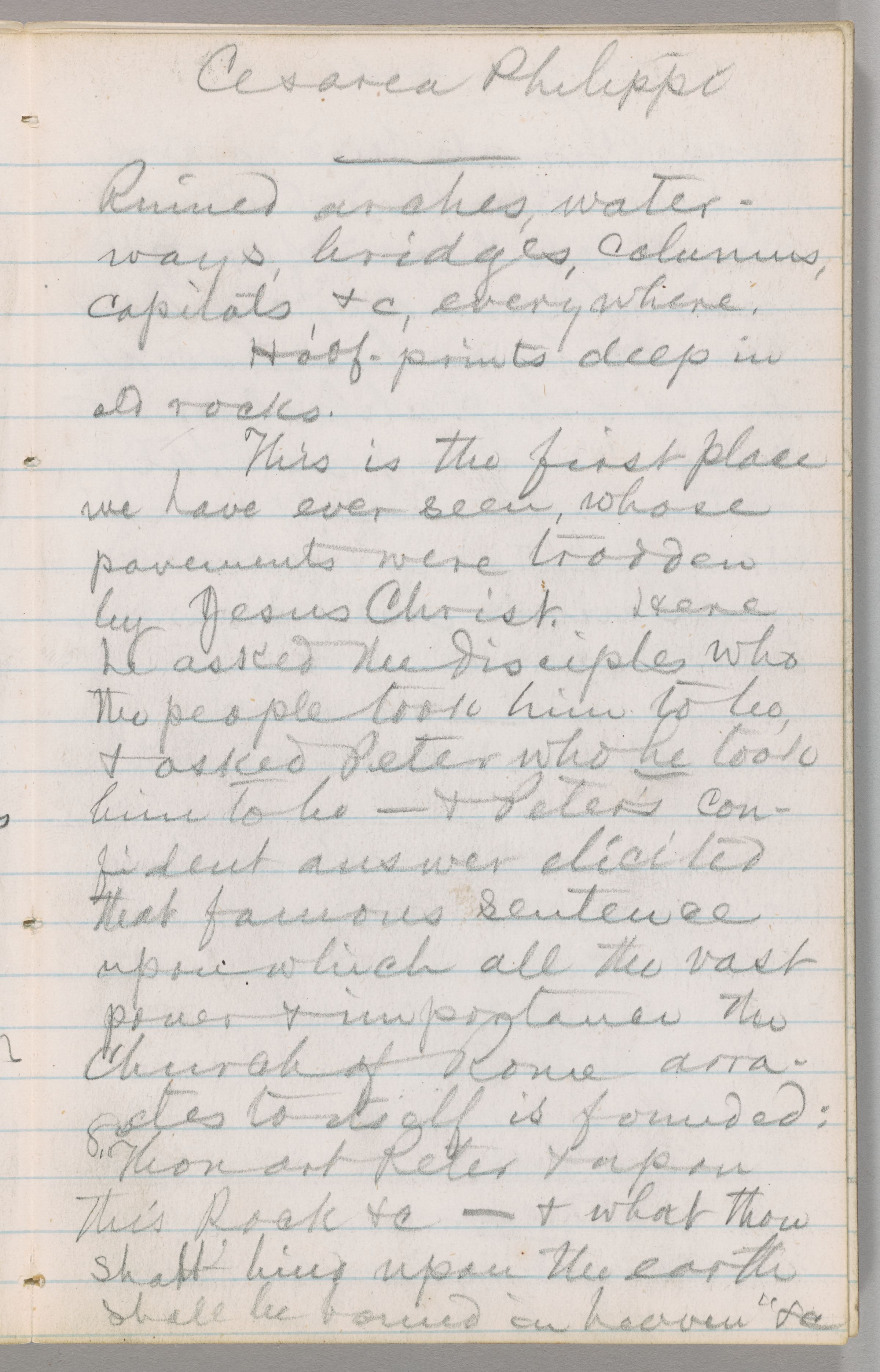
[MS: N9_leaf_047r]
Cesearea Philippi
Ruined arches,
water-
ways
waterways
, bridges, columns,
capitals, &c, everywhere.
Hoof-prints deep in
old rocks.
This is the first place
we have ever seen, whose
pavements were trodden
by Jesus
Christ. Here
he asked the disciples who
the people took him to be,
& asked
Peter who he took
him to be—& Peter’s
con-
fident
confident
answer
elicited
that famous sentence
upon which all the vast
power & importance the
Church of Rome
arra-
gates
arragates
to itself is founded:
“Thou art Peter & upon
this
Rock &c—& what thou
shalt bind upon the earth
shall be bound in heaven”
&c
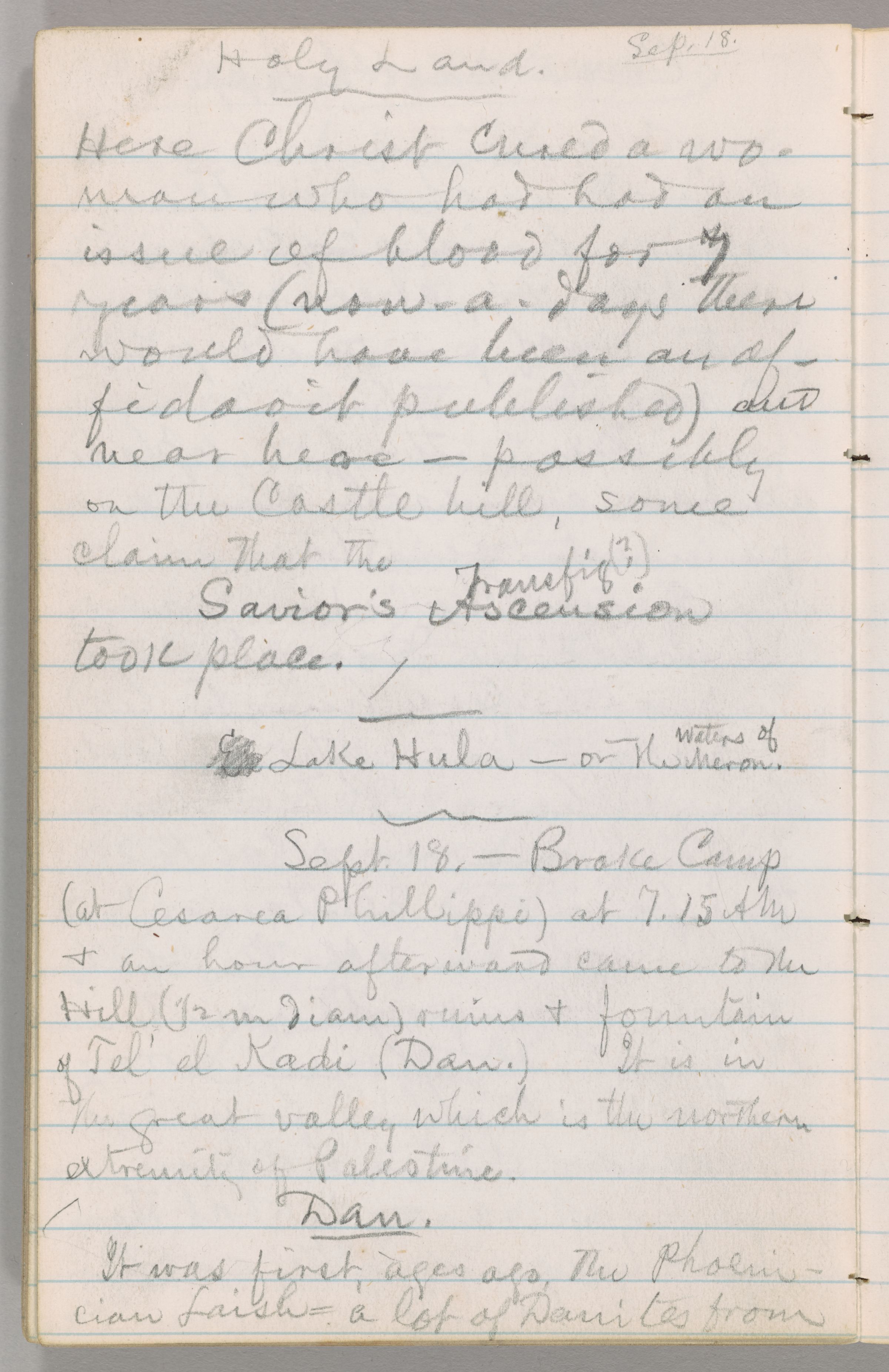
[MS: N9_leaf_047v]
Holy Land. Sep. 18
man woman who had had an
issue of blood for 3 7
years (now-a-days there
would have been an af-
fidavit affidavit published) and
near here—possibly
on the Castle hill, some
claim that the
Savior’s Ascension Transfig(?) took place.
[MTP: N&J1_422]
E Lake Hula—or The Waters of Meron.
Sept. 18.—Broke Camp
(at Cesarea Phillippi) at 7.15 AM
& an hour afterward
came to the
Hill (½ m diam) ruins & fountain
of Tel’ el Kadi (Dan.) It is in
the great valley which is the northern
extremity of Palestine.
Dan.
It was first, ages ago, the
Phoeni-
cian
Phoenician
Laish—a lot of Danites from
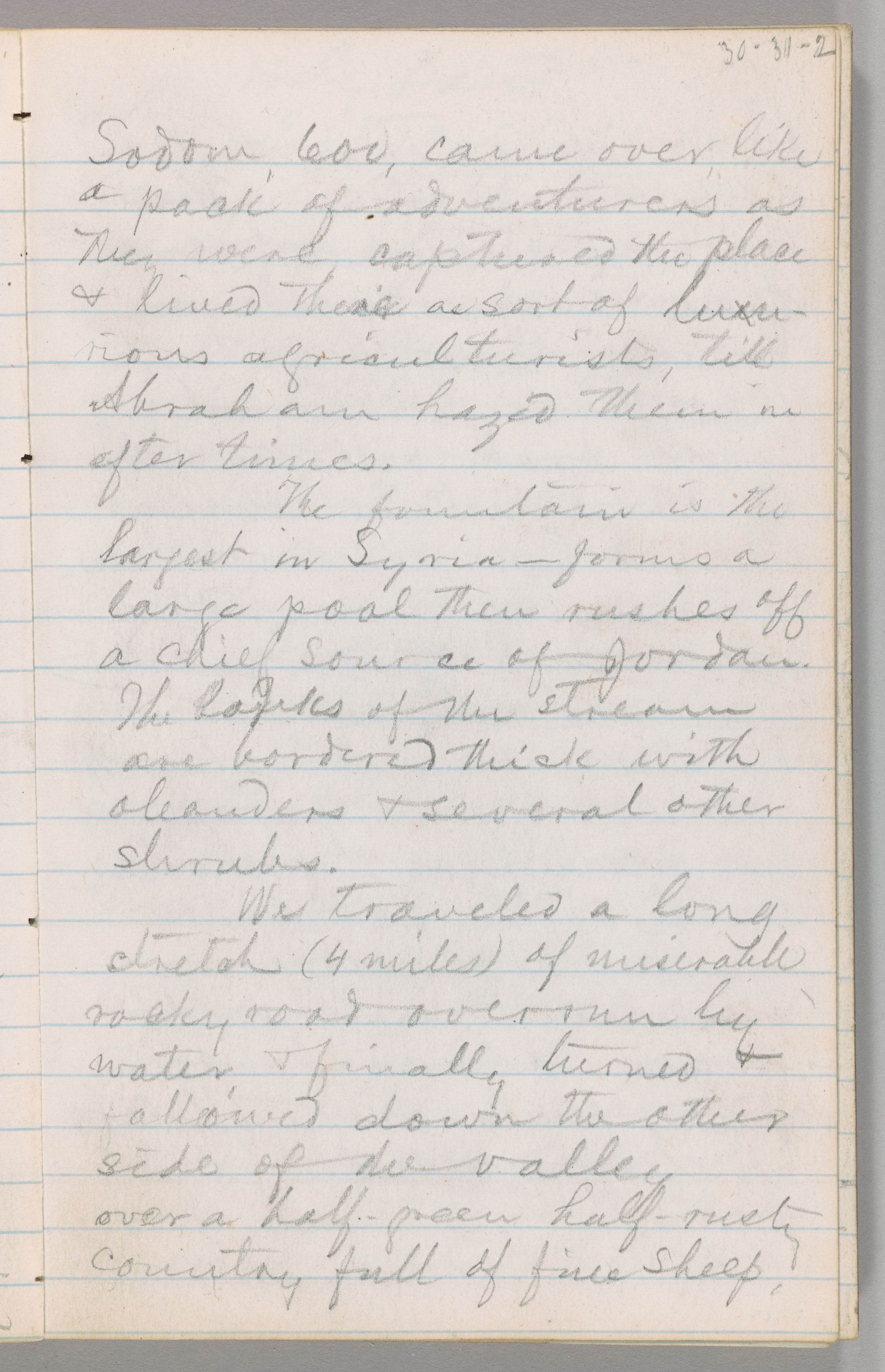
[MS: N9_leaf_048r]
a pack of adventurers as
they were, captured the place
& lived theirre as sort of luxu-
rious luxurious agriculturists, till
Abraham hazed them in
after times.
The fountain is the
largest in Syria .—forms a
large pool then rushes
off
a chief source of Jordan.
¶J The banks of the stream
are bordered thick with
oleanders &
several other
shrubs.
We traveled a long
stretch (4 miles) of miserable
rocky road overrun by
water,
& finally turned &
followed down the other
side of the valley
over a
half-green half-rusty
country full of fine sheep,
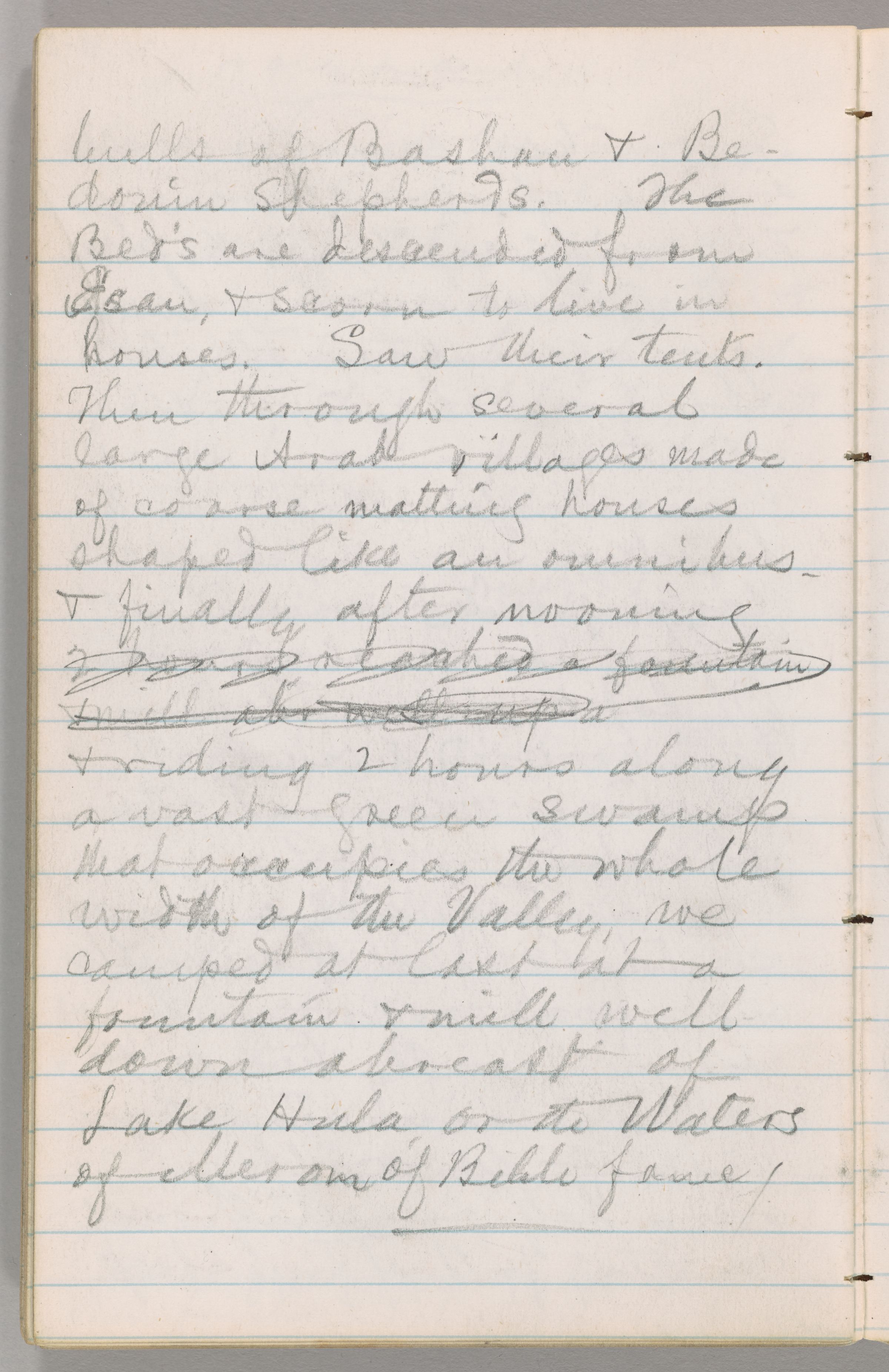
[MS: N9_leaf_048v]
bulls of
Bashan &
Be-
douin
Bedouin
Shepherds. The
Bed’s are descended from
A Esau,
& scorn to live in
houses. Saw their tents.
Then through several
large Arab
villages made
of coarse matting houses
shaped like an omnibus,
& finally after
nooning
2 hours, reached a fountain
& mill abr well up a
& riding 2 hours along
a vast green swamp
that occupies the whole
width of the
Valley, we
camped at last at a
fountain & mill well
down abreast of
Lake Hula,
or the Waters
of Meronm of Bible fame
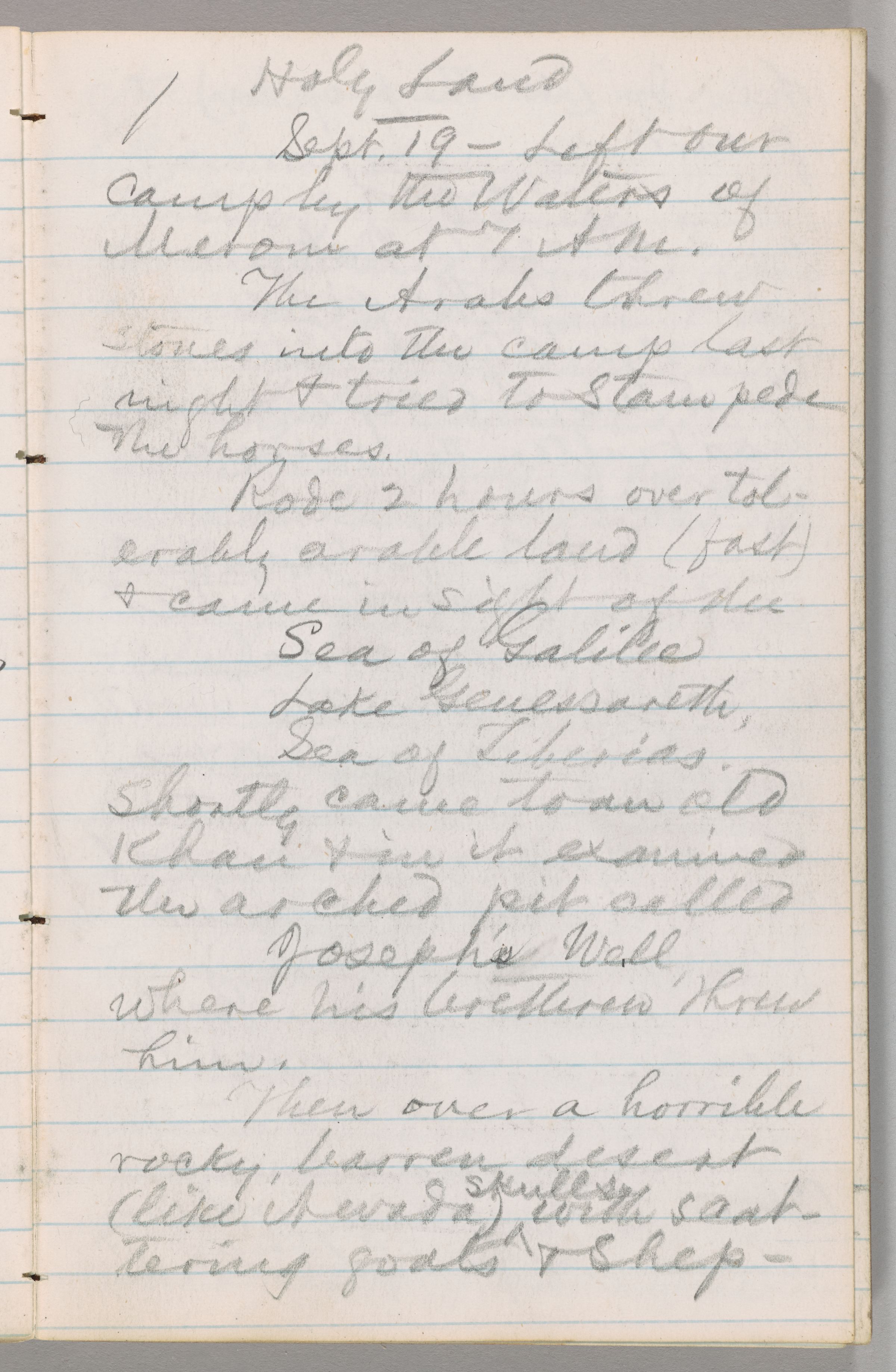
[MS: N9_leaf_049r]
Holy Land
Sept. 19—Left our
camp by the Waters of
Merom at 7 AM.
The Arabs threw
stones into the camp last
night & tried to stampede
the
horses.
[MTP: N&J1_423]
Rode 2 hours over
tol-
erably
tolerably
arable land (fast)
& came in sight of the
Sea of Galilee
Lake Genessareth,
Sea of Tiberias.
Shortly came to an old
Khan & in it examined
the arched pit
called
Joseph’s Well,
where his brethren threw him.
Then over a horrible
rocky, barren desert
(like Nevada,) skulls
with
scattering goats & shep-
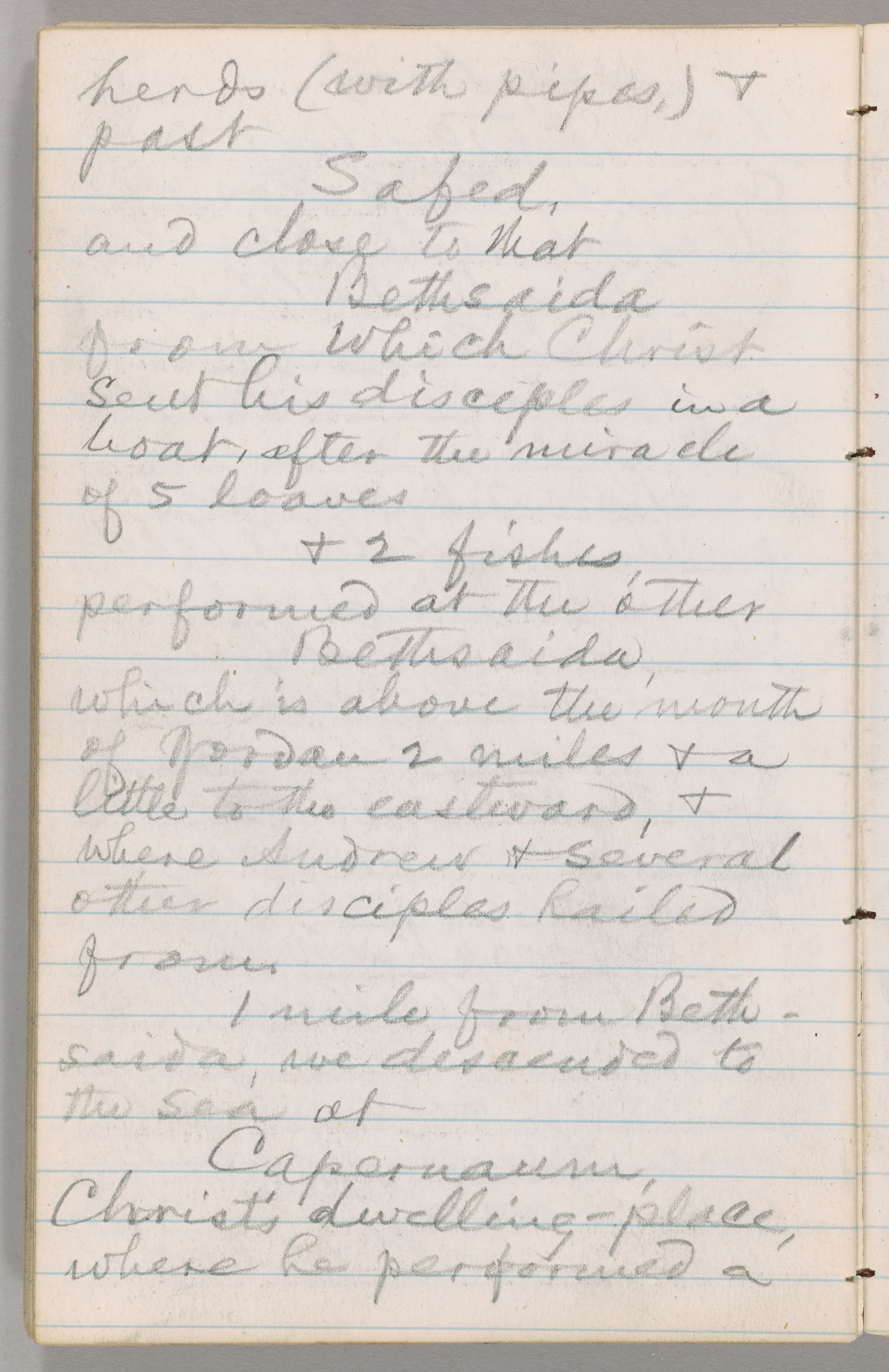
[MS: N9_leaf_049v]
herds (with pipes,) &
past
Safed,
and close to that
Bethsaida
from which Christ
sent his disciples in a
boat, after the miracle
of 5 loaves
& 2 fishes,
performed at the other
Bethsaida,
which is above the mouth
of Jordan 2 miles & a
little to the
eastward, &
where Andrew & several
other disciples hailed
from.
1 mile from
Beth-
saida
Bethsaida
, we descended to
the sea at
Capernaum,
Christ’s dwelling-place,
where he performed a
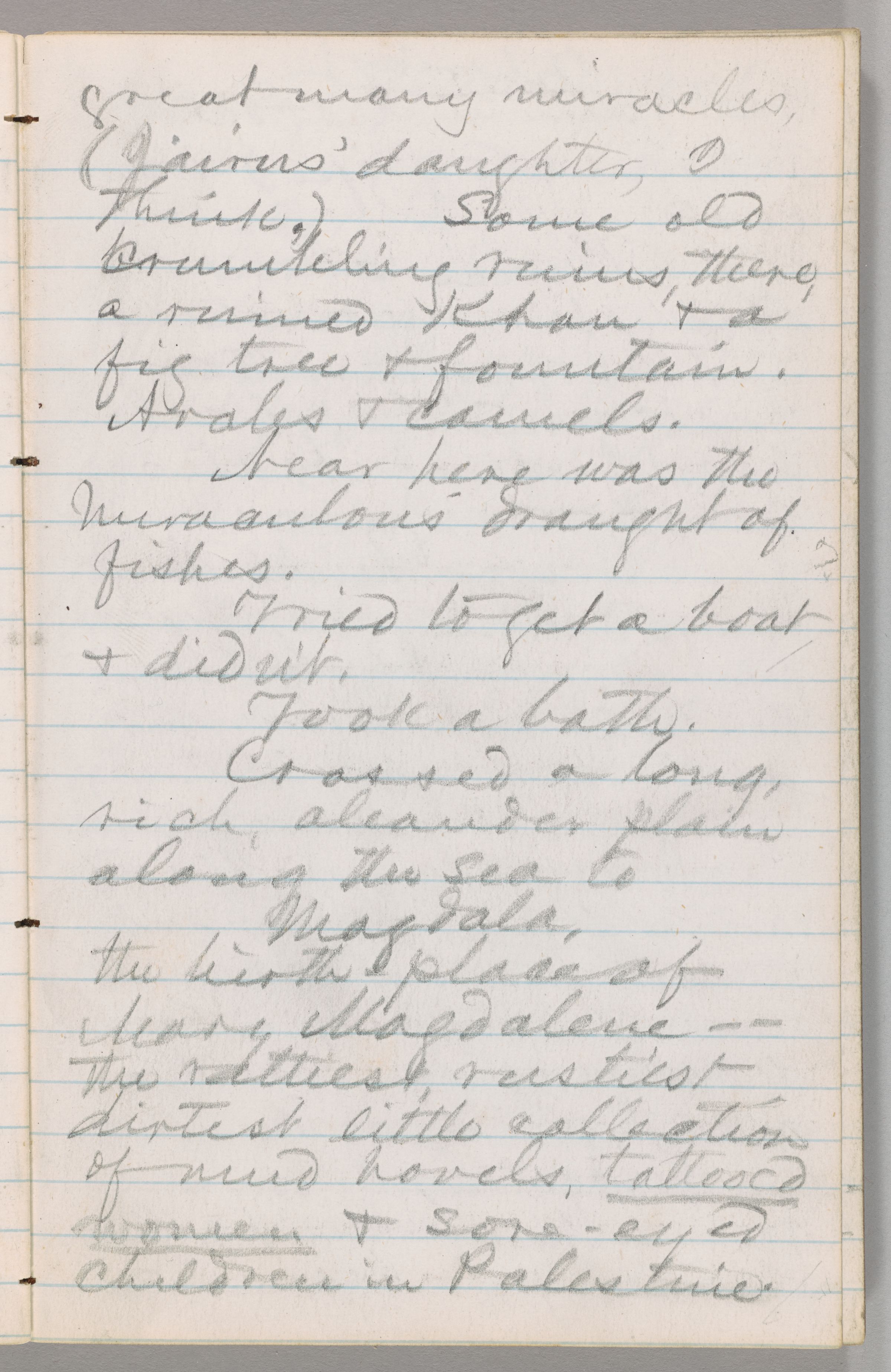
[MS: N9_leaf_050r]
great
many miracles,
(Jairus’ daughter, I
think ,.) Some old
b
crumbling ruins, there,
a ruined Khan & a
fig tree & fountain.
Arabs &
camels.
Near here was the
miraculous draught of
fishes.
Took a bath.
Crossed a long,
rich, oleander plain
along the sea to
[MTP: N&J1_424]
Magdala,
the birth-place of
Mary Magdalene—
the rattiest, rustiest
dirtest
little collection
of mud hovels, tattooed
women &
sore-eyed
children in Palestine.
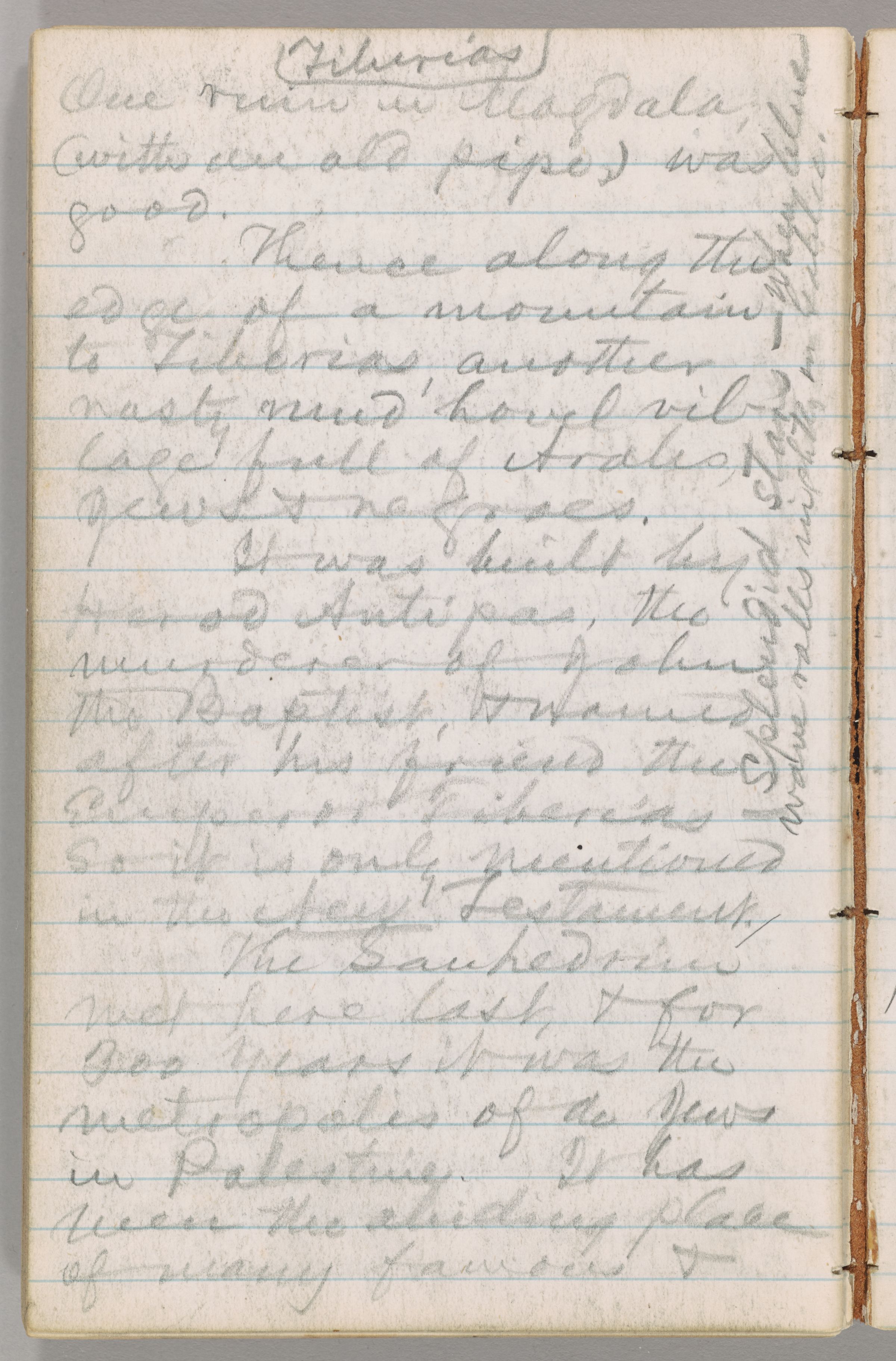
[MS: N9_leaf_050v]
(with an old pipe,) was
good.
Thence along the
edge of a mountain
to Tiberias, another
nasty mud hovel
vil-
lage
village
full of Arabs,
Jews & negroes.
It was built by
Herod Antipas, the
murderer of John
the Baptist, & named
after
his friend the
Emperor Tiberias—
so it is only mentioned
in the New Testament.
The Sanhedrim
met here last, & for
300 years it was the
metropolis of the Jews
in Palestine. It has
been the abiding place
of many famous &
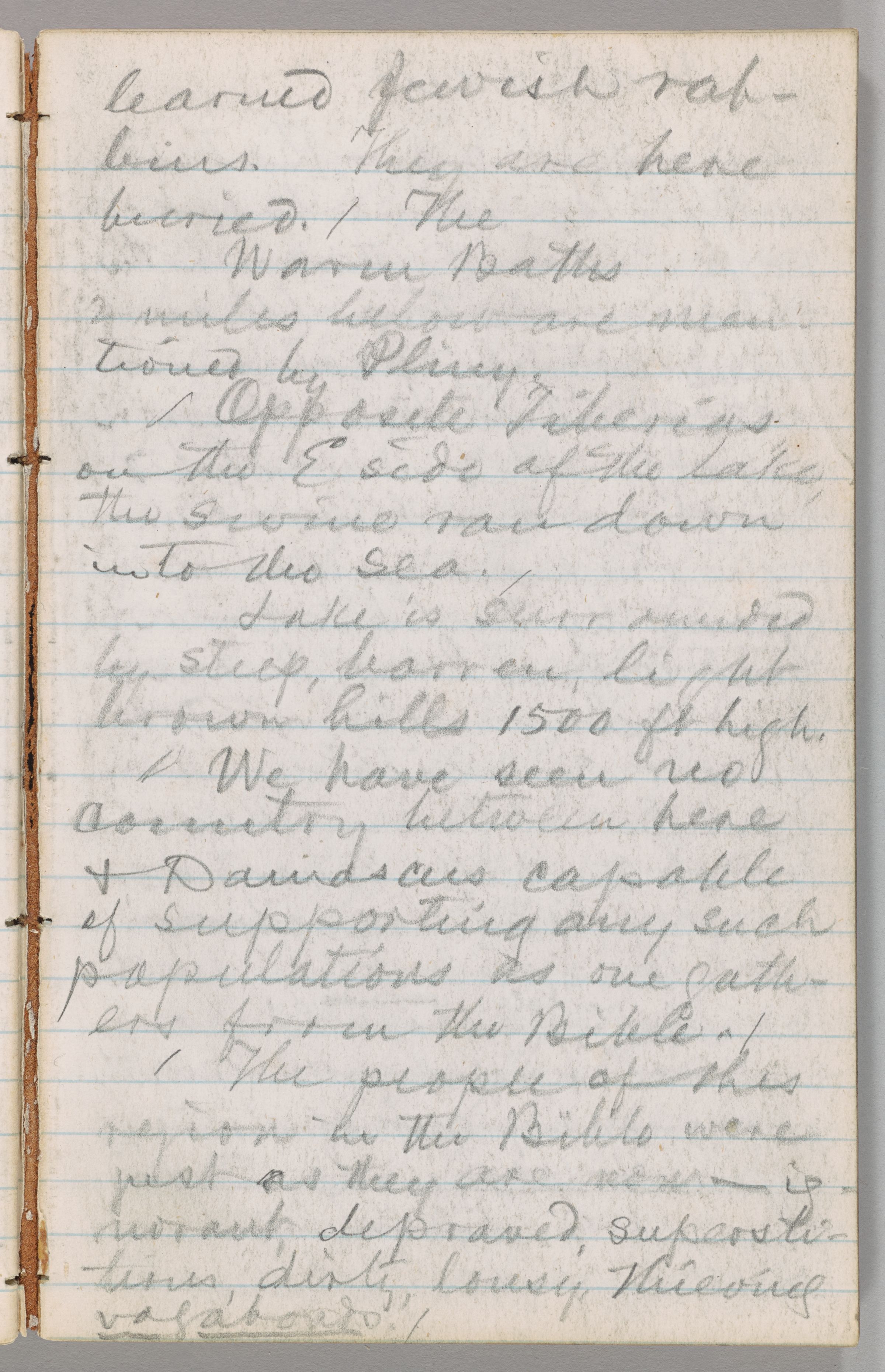
[MS: N9_leaf_051r]
learned
Jewish
rab-
bins
rabbins
. They are here
buried. The
Warm Baths
2 miles below are
men-
tioned
mentioned
by Pliny.
Opposite Tiberias
on the E side of the lake,
the swine ran down
into the sea.
Lake is surrounded
by steep, barren, light
brown hills 1500 ft high.
We have seen no
country between here
& Damascus capable
of supporting any such
populations as one
gath-
ers
gathers
from the Bible.
The people of this
region in the Bible were
just as they are now—
[MTP: N&J1_425]
ig-
norant
ignorant
,
depraved,
supersti-
tious
superstitious
, dirty, lousy, thieving
vagabonds.
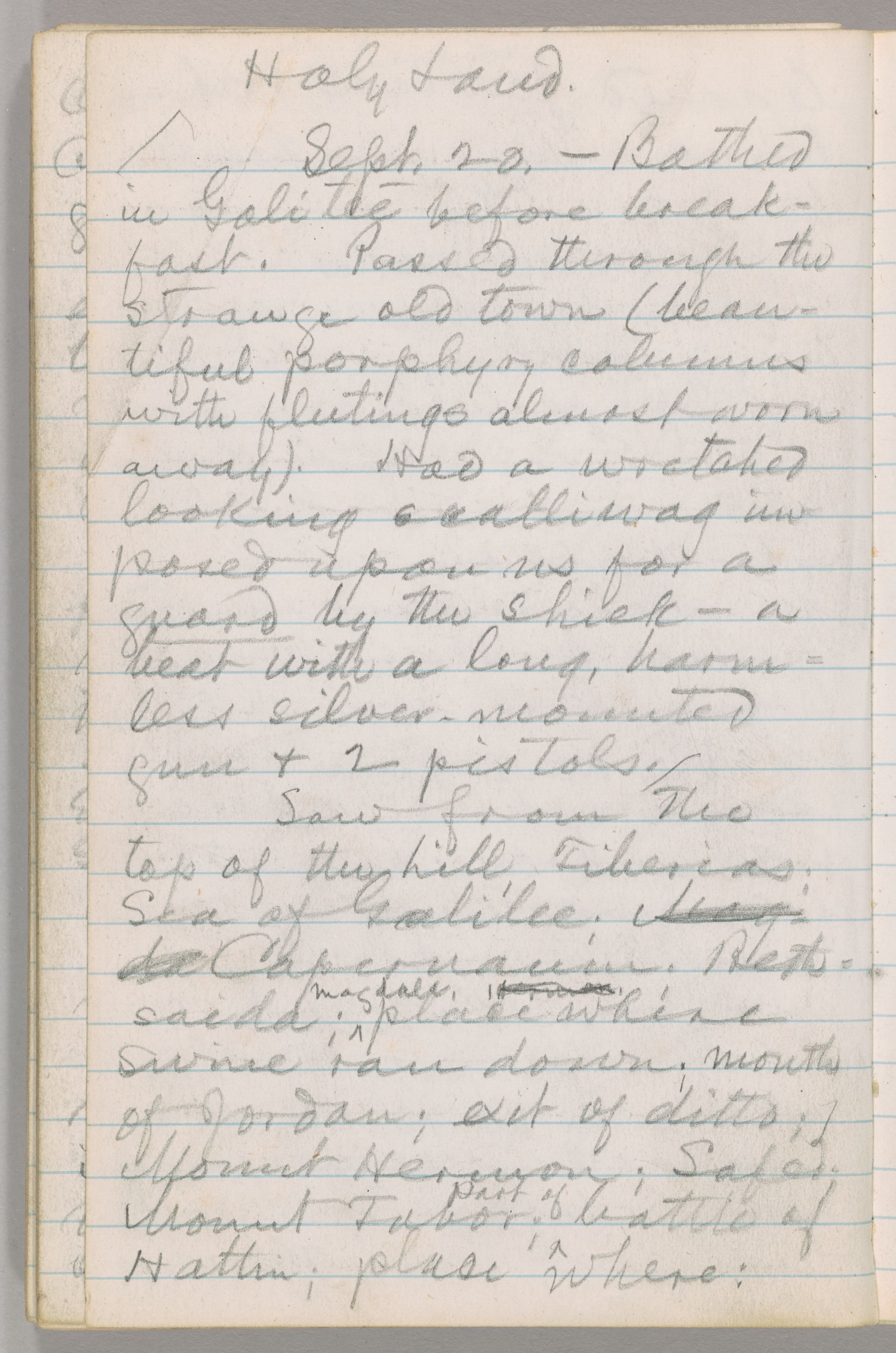
[MS: N9_leaf_051v]
Holy Land.
Sept. 20.—Bathed
in Galilee before
break-
fast
breakfast
. Passed through the
strange old town
(
beau-
tiful
beautiful
porphyry columns
with flutings almost worn
away). Had a wretched
looking scalliwag
im-
posed
imposed
upon us for a
guard by the
shiek—a
beat with a long,
harm-
less
harmless
silver-mounted
gun & 2 pistols.
Saw from the
top of the hill, Tiberias;
Sea of Galilee;
Mag-
da
Magda
Capernaum;
Beth-
saida
Bethsaida
; Magdala, Hermon,
place where
swine ran down; mouth
of Jordan; exit of ditto;
Mount Hermon; Safed;
Mount Tabor;
part of
battle of
Hattin; place where:
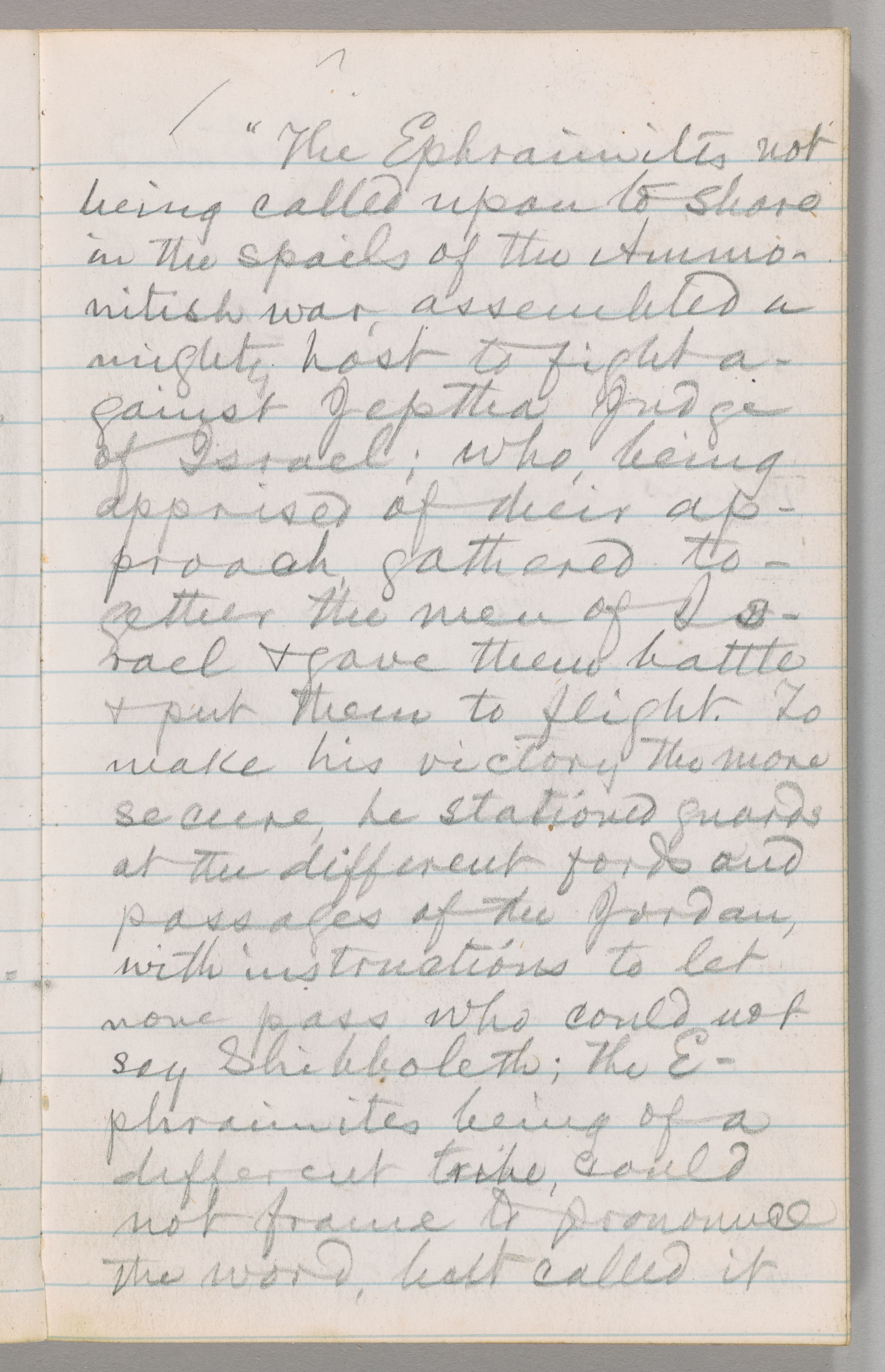
[MS: N9_leaf_052r]
“The Ephraimites not
being called upon to share
in the spoils of the
Ammo-
nitish
Ammonitish
war, assembled a
mighty host to fight
a-
gainst
against
Jeptha, Judge
of Israel; who, being
apprised of their
ap-
proach
approach
, gathered
to-
gether
together
the men
of
Ir
srael
Irsrael
& gave them battle
& put them to flight. To
make his victory the
more
secure, he stationed guards
at the different fords and
passages of the
Jordan,
with instructions to let
none pass who could not
say Shibboleth; the
E-
phraimites
Ephraimites
being of a
different tribe, could
not frame to pronounce
the word, but
called it
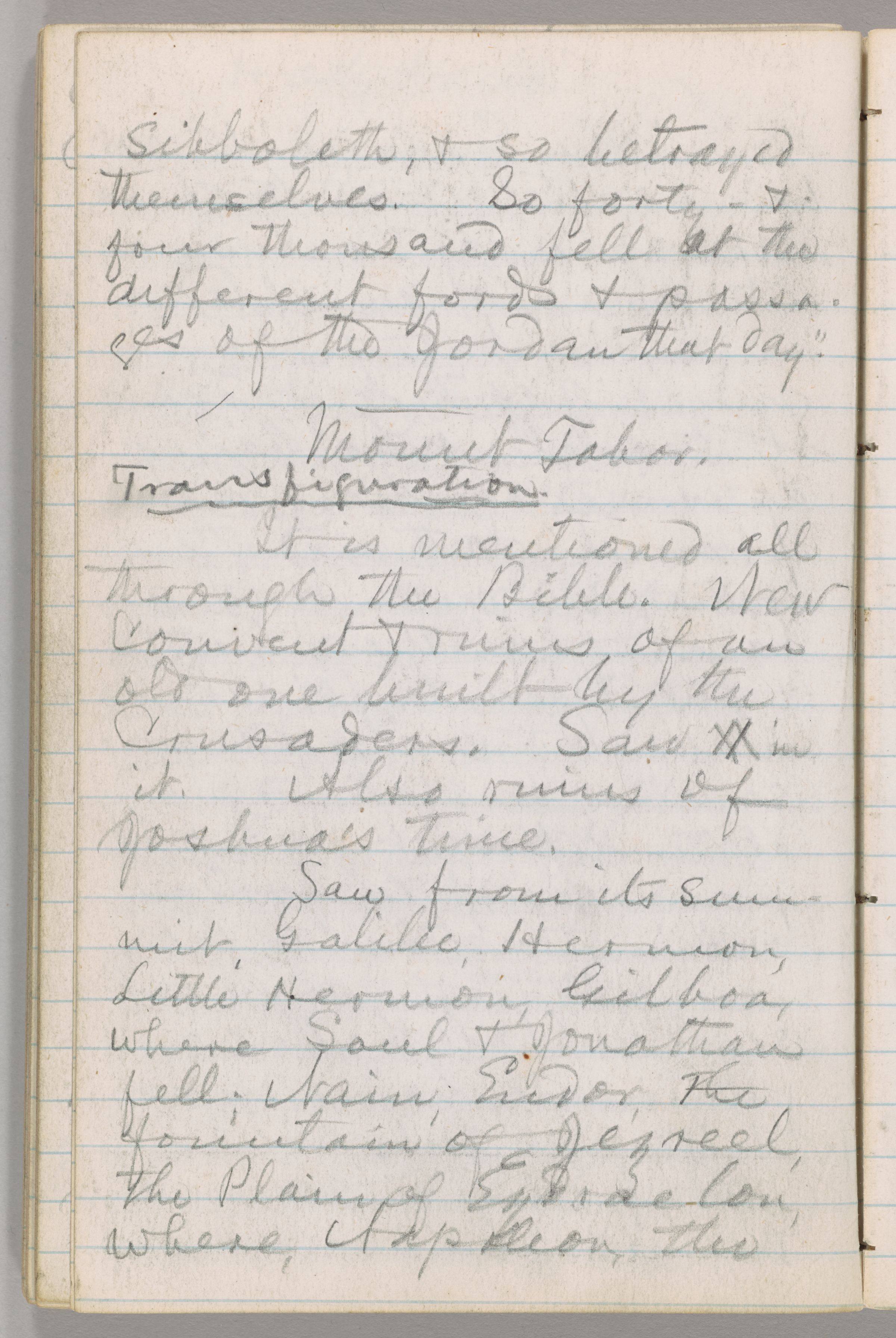
[MS: N9_leaf_052v]
Sibboleth, & so betrayed
themselves. So forty-&-
four
thousand fell at the
different fords &
passa-
ges
passages
of the Jordan that day.”
[MTP: N&J1_426]
Mount Tabor.
Transfiguration.
It is mentioned all
through the Bible. New
Convent & ruins of an
old one built
by the
Crusaders. Saw XX in
it.
Also ruins of
Joshua’s time.
Saw from its
sum-
mit
summit
, Galilee, Hermon,
Little Hermon, Gilboa,
where Saul &
Jonathan
fell; Nain, Endor, — the
fountain of Jezreel,
the Plain of
Ezdraelon,
where, Napoleon, the
[MS: N9_leaf_053r]
Crusaders, the ancient
Jews
& all the nations
of the earth have fought
at different times.
Then came to
Nazareth, where Christ
lived &
carpentered till
30 of age (not allowed
by Jewish law to teach
sooner.
Glass windows,
—some 2-story—many
shops—many cone-
shaped mud hovels;
—camels &
fantastic
Arabs & dirty children
—all around, the hills
that were familiar to
the eyes of Jesus—
Saw the grotto of the
Annunciation—the
pillar miraculously
sustained—old columns
[MS: N9_leaf_053v]
by Saint Helena, mother
of Constantine—
Grotto where lived
Joseph Mary & infant
Christ—
Workshop of
Jo-
seph
Joseph
& Jesus.
Great Stone on which
Jesus & disciples rested
after return from Sea
of
Galilee.
[MTP: N&J1_427]
Synagogue where
Jesus taught & from
which Jews took him
to throw him down
the
mountain, when
he “passed from their
presence”.
Fountain of the
Virgin.
[MS: N9_leaf_054r]
Holy Land.
Sept. 21—Left
Naz-
areth
Nazareth
& its chalk hills
at 7.30, came down a
high, steep
mountain & galloped
across the Plain of Esdraelon. to
Endor,
the rustiest of all, almost—
a few nasty mud cabins,—
many caves
& holes in the
hill from which the fierce,
ragged, dirty inhabitants
swarmed.
Pop. 250.
The Witch’s Cave
has a fig tree before it & a
spring within. Endor is a
fit
place for a witch.
Camel dung on the roofs
& caked against the houses
to dry.
Like to got yanked here
I
suspect.
Next, to
Nain,
an hour further—still
smaller town. Little Mosque
over spot once
occupied
[MS: N9_leaf_054v]
by widow’s house.
Grave-
yard
Graveyard
—very old & ratty—
ex-
itsists
exitsists
yet, & place shown
where corpse was passing
through city wall when
Christ resurrected it. Next around end of
Little Hermon
[MTP: N&J1_428]
(lemon orchards & dung),
where woman built shanty
on wall for Elisha & he
raised her dead son. Think
Samuel lived or was born
here—doubtful. Next
to
Ancient Ruined Castle
celebrated in the Crusades (this
should have come before
Shunem) & place where
Napoleon won a splendid
victory over the Syrians
(Turks). Next,
crossed the
Valley of Jezreel (which
[MS: N9_leaf_055r]
is an arm
of Esdraelon)
to
City of Jezreel,
on the hill, where Ahab
King of Judah lived in
splendor with his
awful
heifer Jezebel, who swore
away a fellow’s life who would
not sell his valley
vineyard
to her & then took possession
—on account of which a she
fell under a curse.
Jehu the mighty rider,
“rode furiously” (couldn’t
done it anywhere but in
this
plain), captured the
city, threw Jez over the
walls & she was eaten
by dogs.
Went next to the
Fountain of Jezreel,
Where Gideon slipped o up on
the Midianites & Amale-
[MS: N9_leaf_055v]
kites with his 300 who
lapped like dogs, & with
candles, pitchers &
trum-
pets
trumpets
, & made 15,000 (30,?)
slay themselves.
Here Saul camped,
while the Philistines lay
at Shunem (big
advan-
tage
advantage
of slope all
the
way.) In the night he
passed over left
shoul-
der
shoulder
of Little Hermon
& to
Endor, where witch
called up Samuel, who
proph. his defeat. Next
day he &
Jonathan & 2
other sons fled over Mt.
Gilboa (over our heads),
& the 3
were killed & Saul
fell on his sword, thus
making the throne to David.
Around corner of
this Gilboa
Esdraelon
is what stands
for
the Armageddon of
[MS: N9_leaf_056r]
Scripture. Megiddo
Here Neco-
Pharaoh of
Egypt gained
splendid victory over Josiah,
Israelitish King.
This Esdraelon is
called the battle-field
of the nations. 11
sepa-
rate
separate
&
distinct nations
have fought in it.
Here Deborah & Barak
beat Sisera (nail in
head by Jael) Jud 4–12, 24
Gideon Jud. 6–7. Saul (last
battle with Philistines)
1
Sam. 31. Benhadad,
Syrian King, defeated
here by Ahab 1 K, 22.
Josiah K of Juda,
routed
& put to death by Egyp.
King 2 K 23–29. 2
Chron. 35–22.
Bona-
parte
Bonaparte
.
Think of all
these marshaled at once
in this great level
plain
[MS: N9_leaf_056v]
25 m long & 8 broad!—
the Assyrians & Persians,
the Jews
& Gentiles,
Cru-
saders
Crusaders
& Saracens,
Egyp-
tians
Egyptians
, Turks, Arabs, and
Franks—in
divers
cos-
tumes
costumes
, a splendid array!
Call up the shadowy
war-
riors
warriors
& deploy them
again
on the great plain under
the moon! 5,000,000.
From uplands can
see without a glass,
El Fuleh, Tabor,
Naza-
reth
Nazareth
, Carmel,
Grait & Little
Hermon, depression of
Jordan, Jezreel, Shunem,
Next to
El Genin, where
wh we are camped. (Dr.
Jackson & Payne are here,
& the Pacha of Akka with
a great retinue &
many
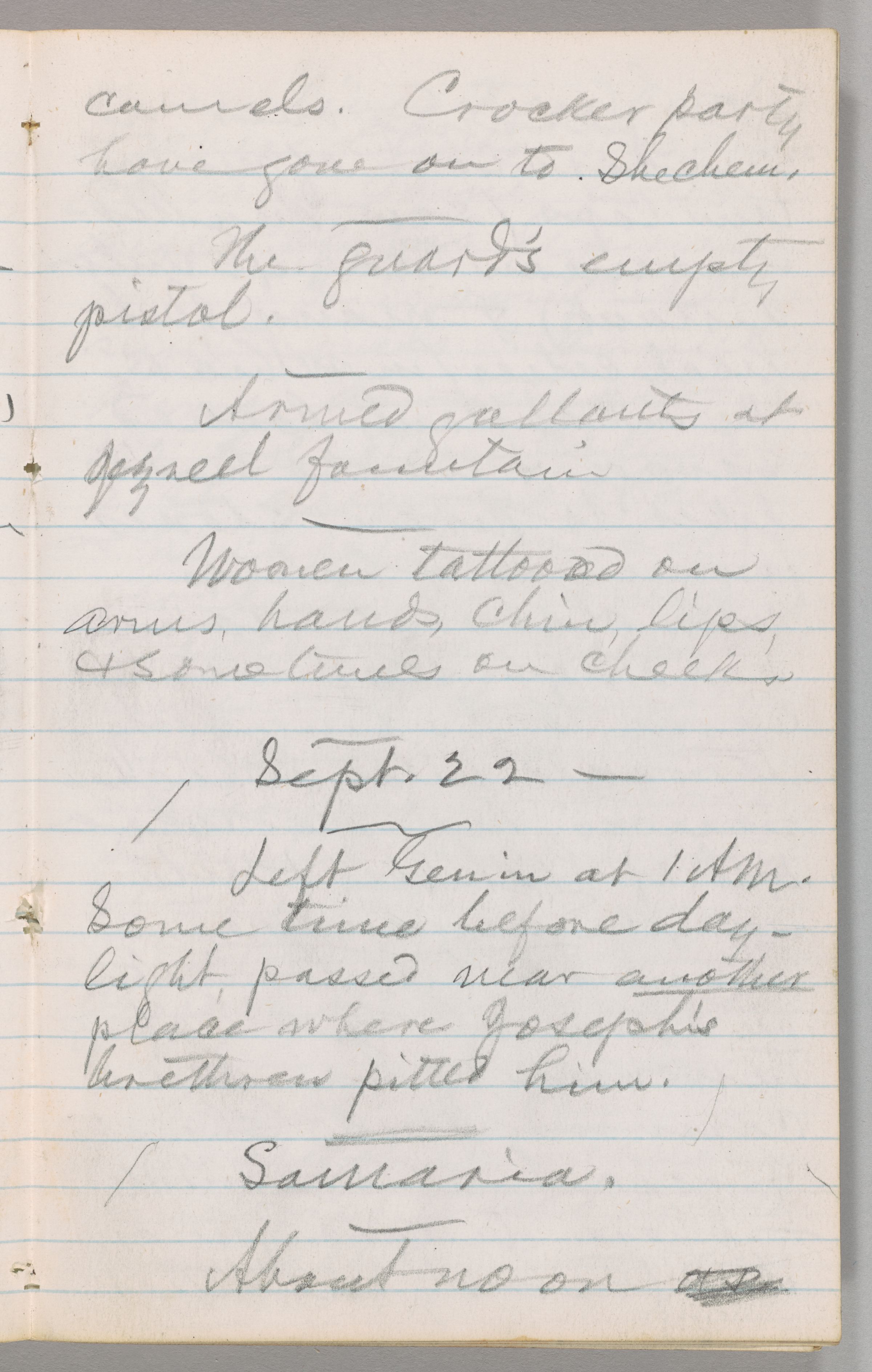
[MS: N9_leaf_057r]
camels. Crocker party
have gone on to Shechem.
The guard’s empty
pistol.
Armed gallants at
Jezreel fountain
Women tattooed on
arms, hands, chin, lips,
& sometimes on cheeks.
Sept. 22—
Left Genin at 1 AM.
Some time before
day-
light
daylight
, passed near another
place where Joseph’s
brethren
pitted him.
Samaria.
About noon as
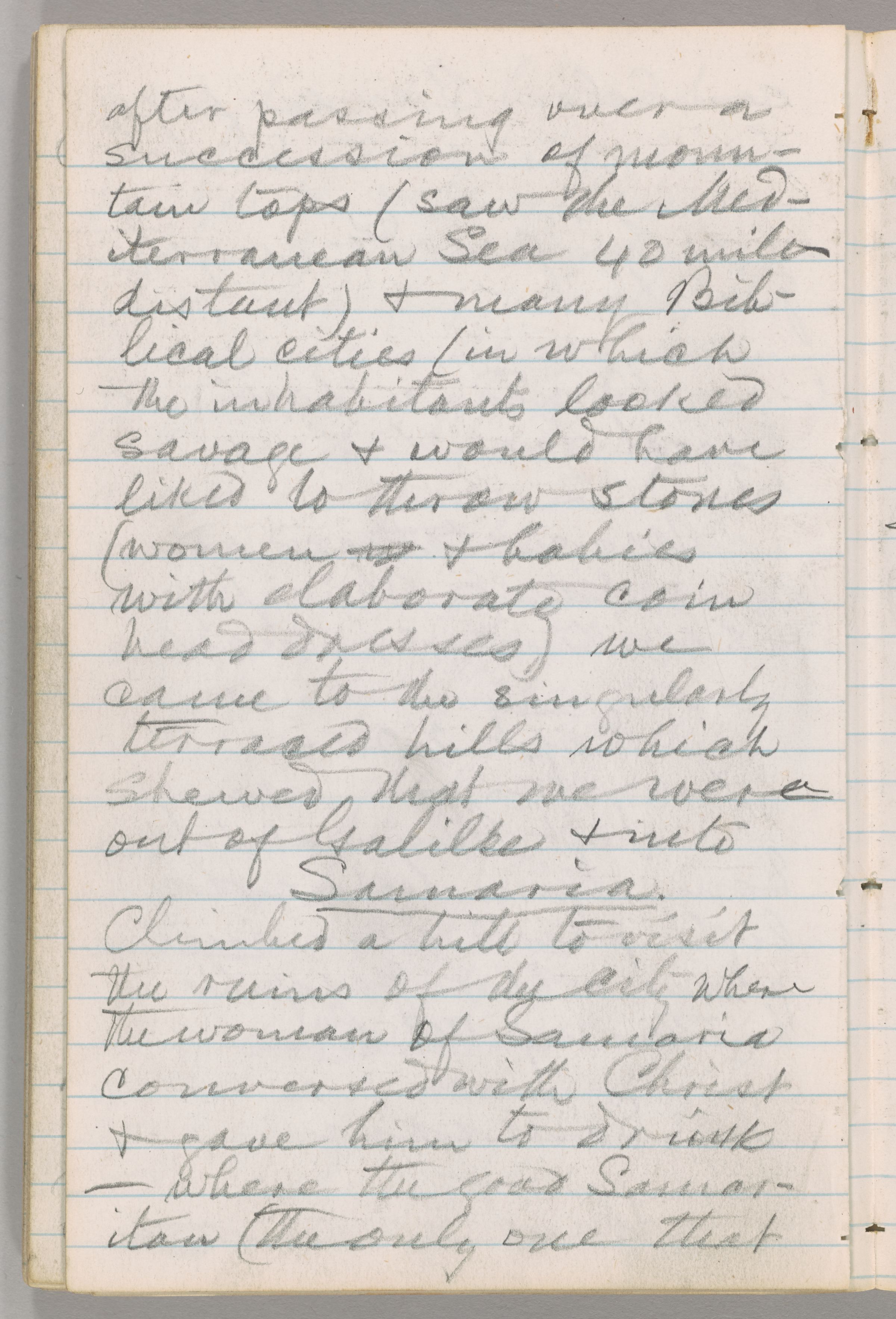
[MS: N9_leaf_057v]
after passing over a
succession of
moun-
tain
mountain
tops (saw the
Med-
iterranean
Mediterranean
Sea 40
miles
distant) & many
Bib-
lical
Biblical
cities (in which
the inhabitants looked
savage
& would have
liked to throw stones
(women w & babies
with
elaborate coin
headdresses,) we
came to the singularly
terraced hills which
shewed that we were
out of
Galilee & into
[MTP: N&J1_430]
Samaria.
Climbed a hill to visit
the ruins of the city where
the woman of
Samaria
conversed with Christ
& gave him to drink
—where the good
Samar-
itan
Samaritan
(the only one that
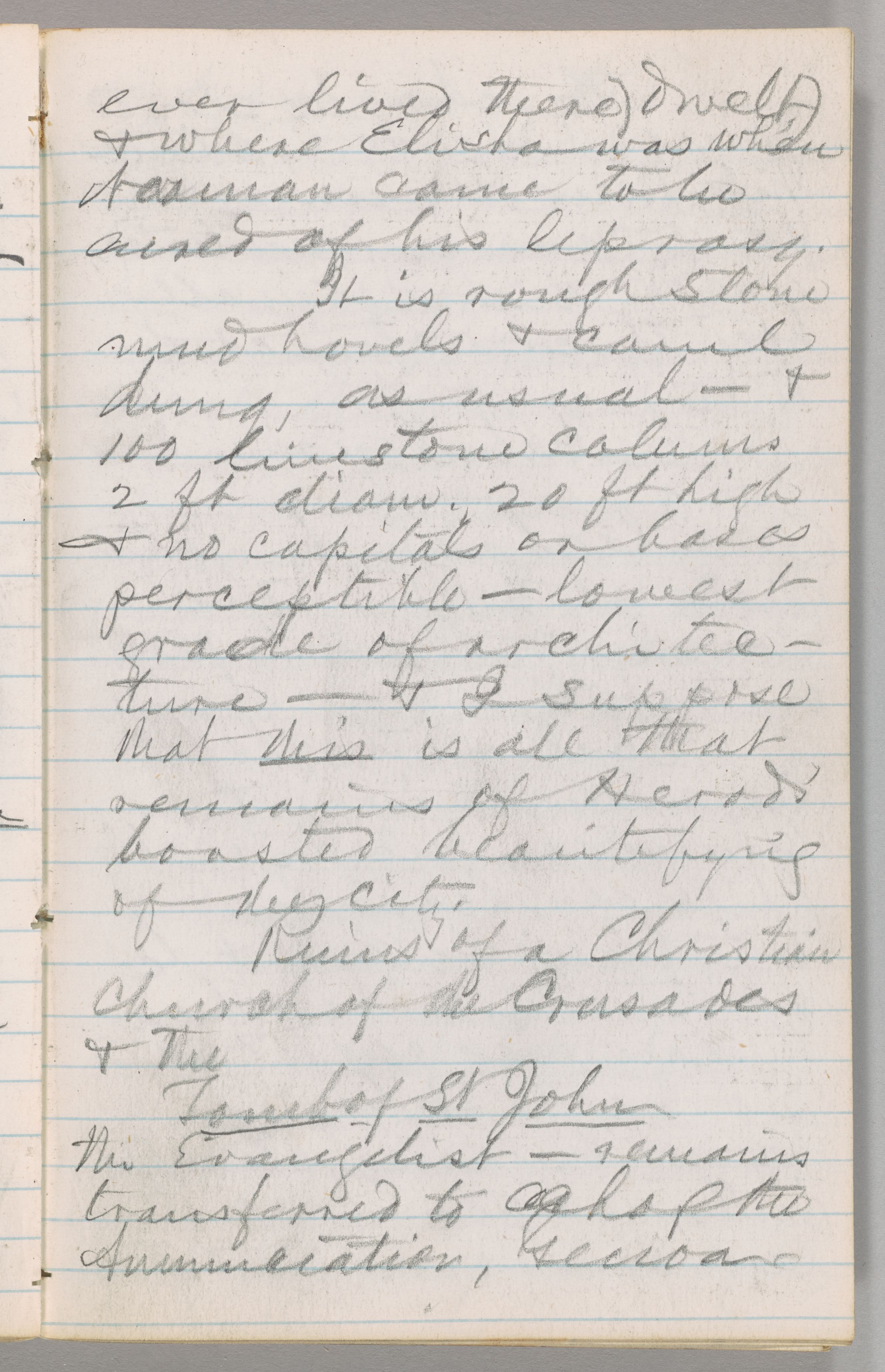
[MS: N9_leaf_058r]
ever lived there) dwelt,)
& where Elisha was
when
Naaman came to be
cured of his leprosy.
It is rough stone
mud hovels & caml
dung, as usual—&
100 limestone colums
2 ft diam., 20 ft high
& no capitals or bases
perceptible—lowest
grade of
architec-
ture
architecture
—
& I suppose
that this is all that
remains
of Herod’s
boasted beautifying
of the city.
Ruins of a Christian
church of the Crusades
& the
Tomb of St John
the Evangelist—remains
transferred to cch of the
Annunciation,
Genoa.
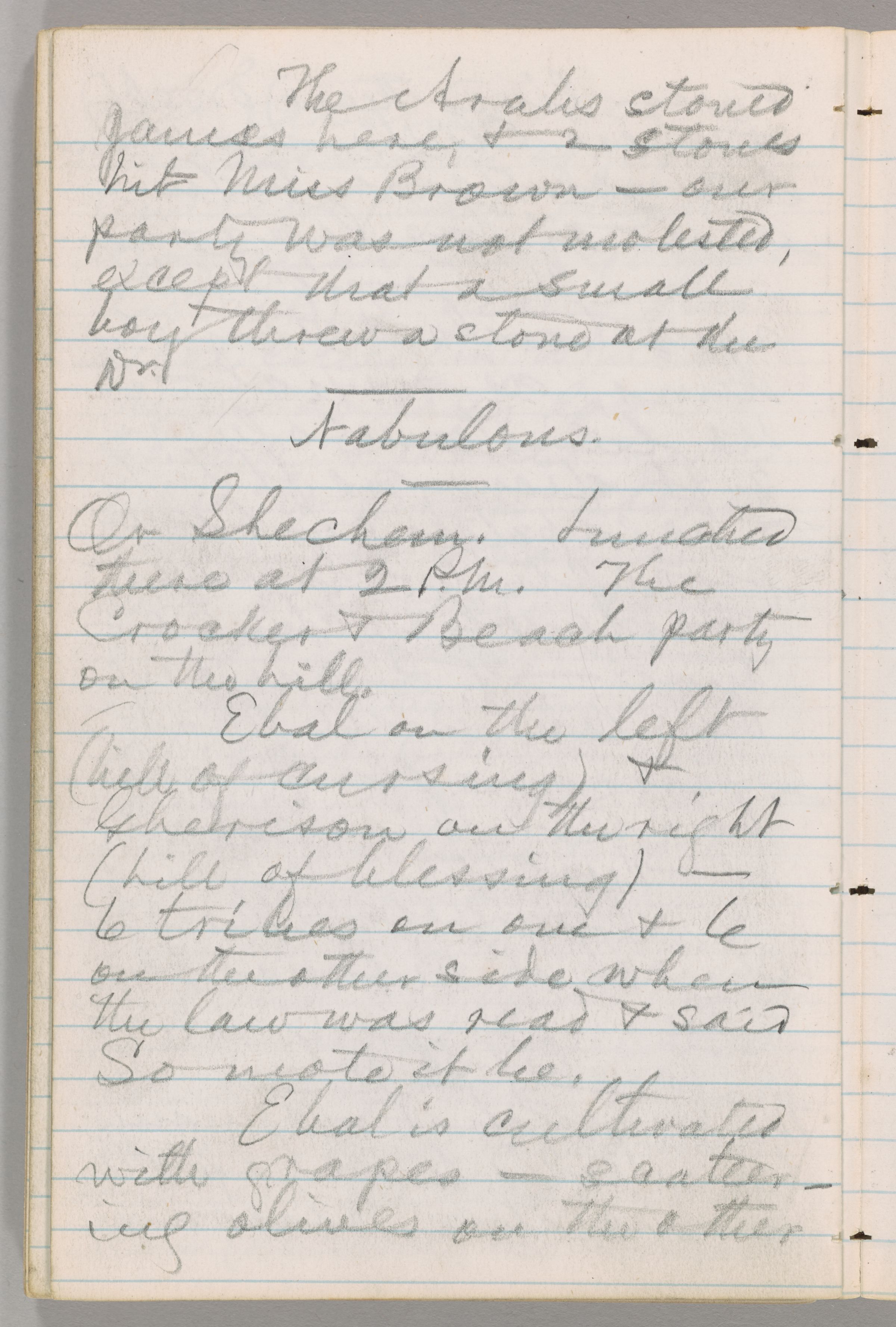
[MS: N9_leaf_058v]
The Arabs stoned
James here, & 2 stones
hit Miss Brown—our
party was not
molested,
except that a small
boy threw a stone at
the
Dr.
Nabulous.
Or Shechem. Lunched
there at 2 P.M. The
Crocker & Beach party
on the hill.
Ebal on the left
(hill of cursing) &
Gherison on the right
(hill of
blessing)—
6 tribes on one & 6
on the other side when
the law was read &
said
So mote it be.
Ebal is cultivated
with grapes—
scatter-
ing
scattering
olives on the other
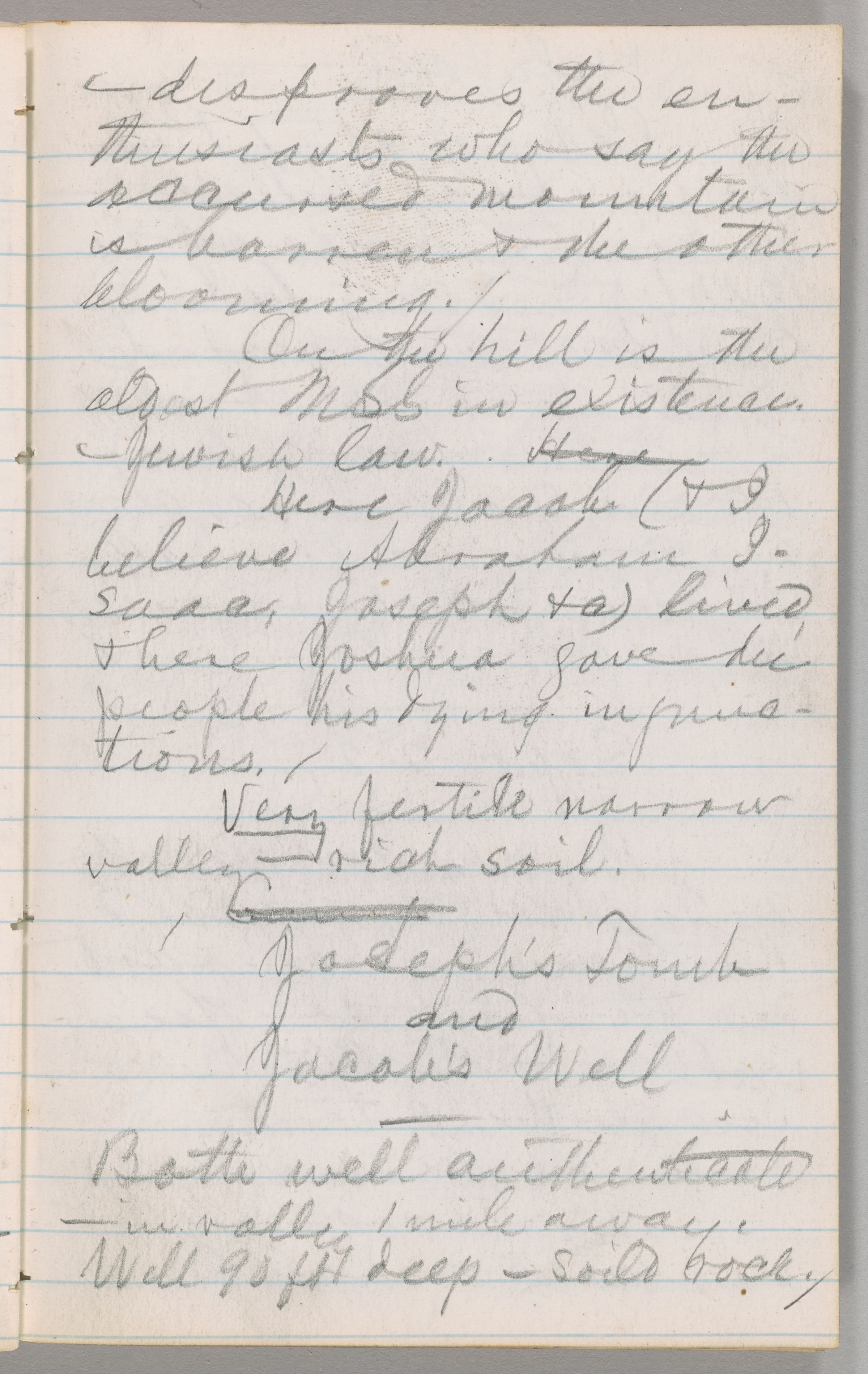
[MS: N9_leaf_059r]
—disproves the
en-
thusiasts
enthusiasts
who say the
accursed mountain
is barren & the other
blooming.
On the hill is the
oldest MSS in existence.
—Jewish law. Here
Here Jacob (& I
believe Abraham
I-
saac
Isaac
, Joseph &c) lived,
& here Joshua
gave the
people his dying
injunc-
tions
injunctions
.
Very fertile narrow
valley—rich soil.
Camp
[MTP: N&J1_431]
Joseph’s Tomb
and
Jacob’s Well
Both well authenticate
—in valley 1 mile away.
Well 90 ft
deep—solid rock.
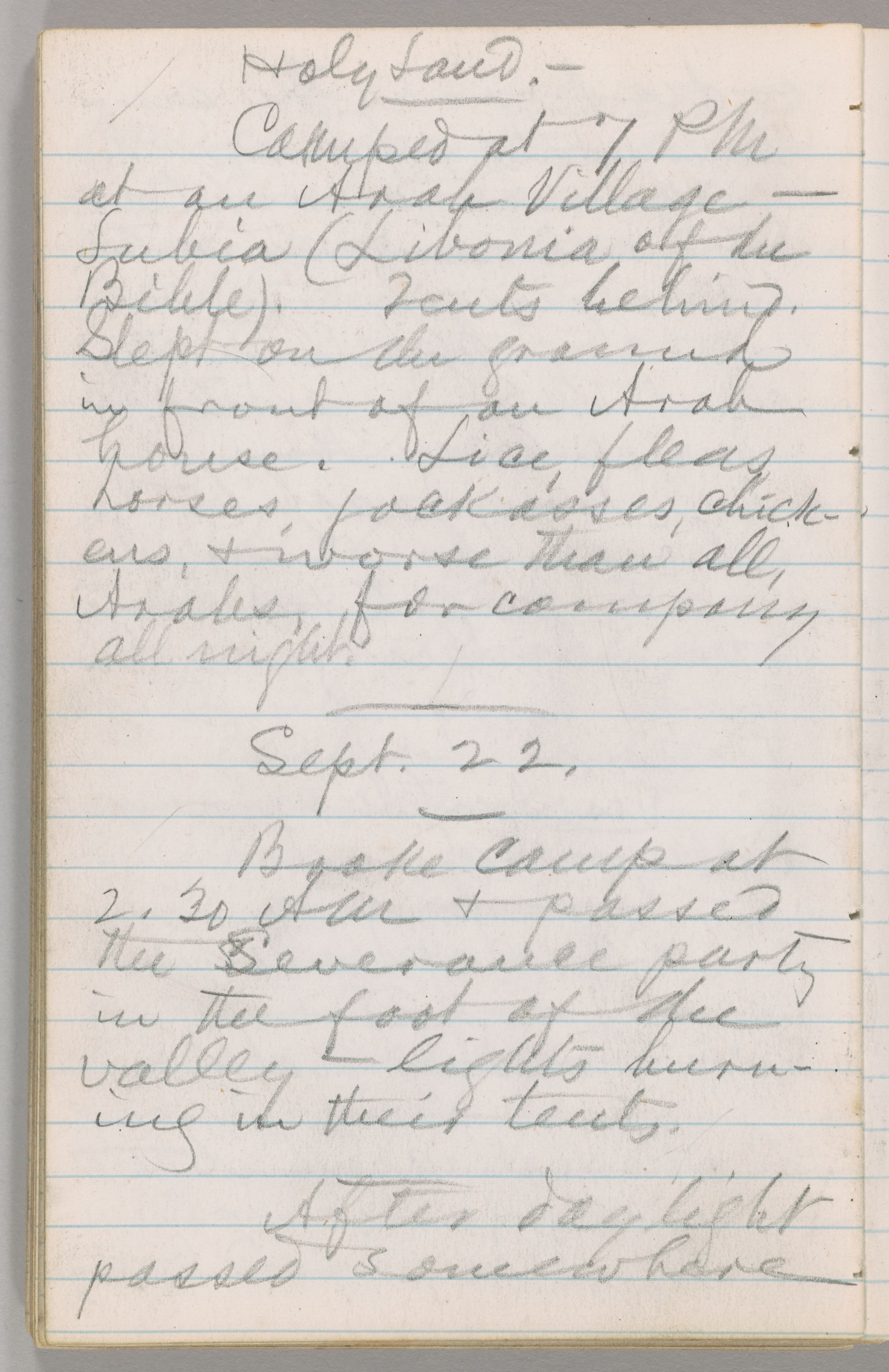
[MS: N9_leaf_059v]
Holy Land.—
Camped at 7 PM
at an Arab Village—
Lubia (Libonia of the
Bible). Tents behind.
Slept on the ground
in front of an Arab
house. Lice, fleas,
horses, jackasses,
chick-
ens
chickens
, & worse than all,
Arabs, for company
all night.
Sept. 22.
Broke camp at
2.30 AM & passed
the Severance party
in the foot of the
valley—lights
burn-
ing
burning
in their tents.
After daylight
passed somewhere
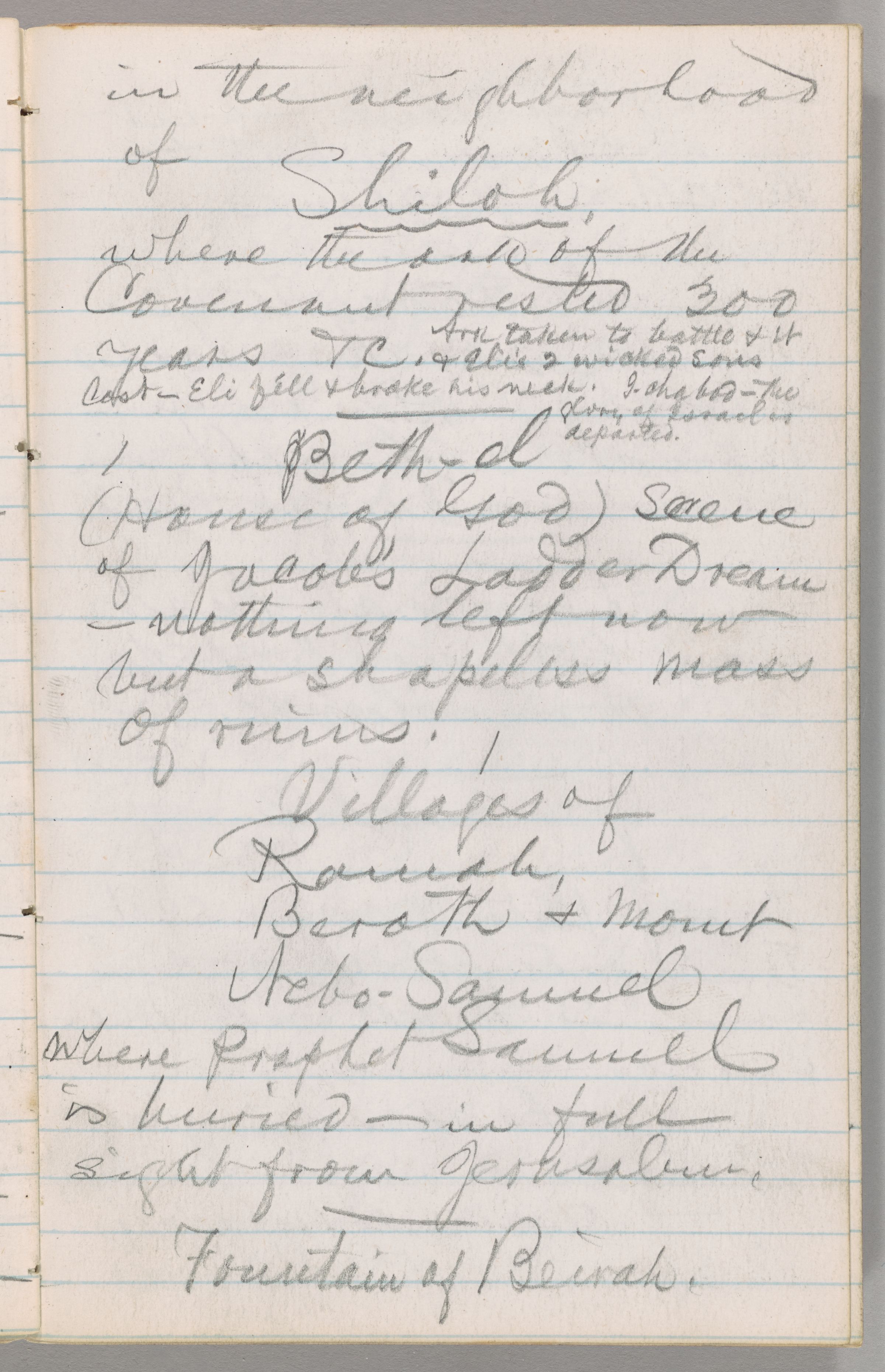
[MS: N9_leaf_060r]
in the neighborhood of
Shiloh,
where the ark of the
Covenant
rested 300
years, &c. Ark taken to battle & it
& Eli’s 2 wicked sons
lost—Eli fell & broke his neck. I-chabod—the
glory of Israel is
departed.
J Beth-el
(House of God) Scene
of Jacob’s Ladder Dream
—nothing left now
but
a shapeless mass
of ruins.
Villages of
Ramah,
Beroth & Mount
Nebo-Samuel
where Prophet Samuel
is buried—in full
sight from Jerusalem.
[MTP: N&J1_432]
Fountain of Beirah.
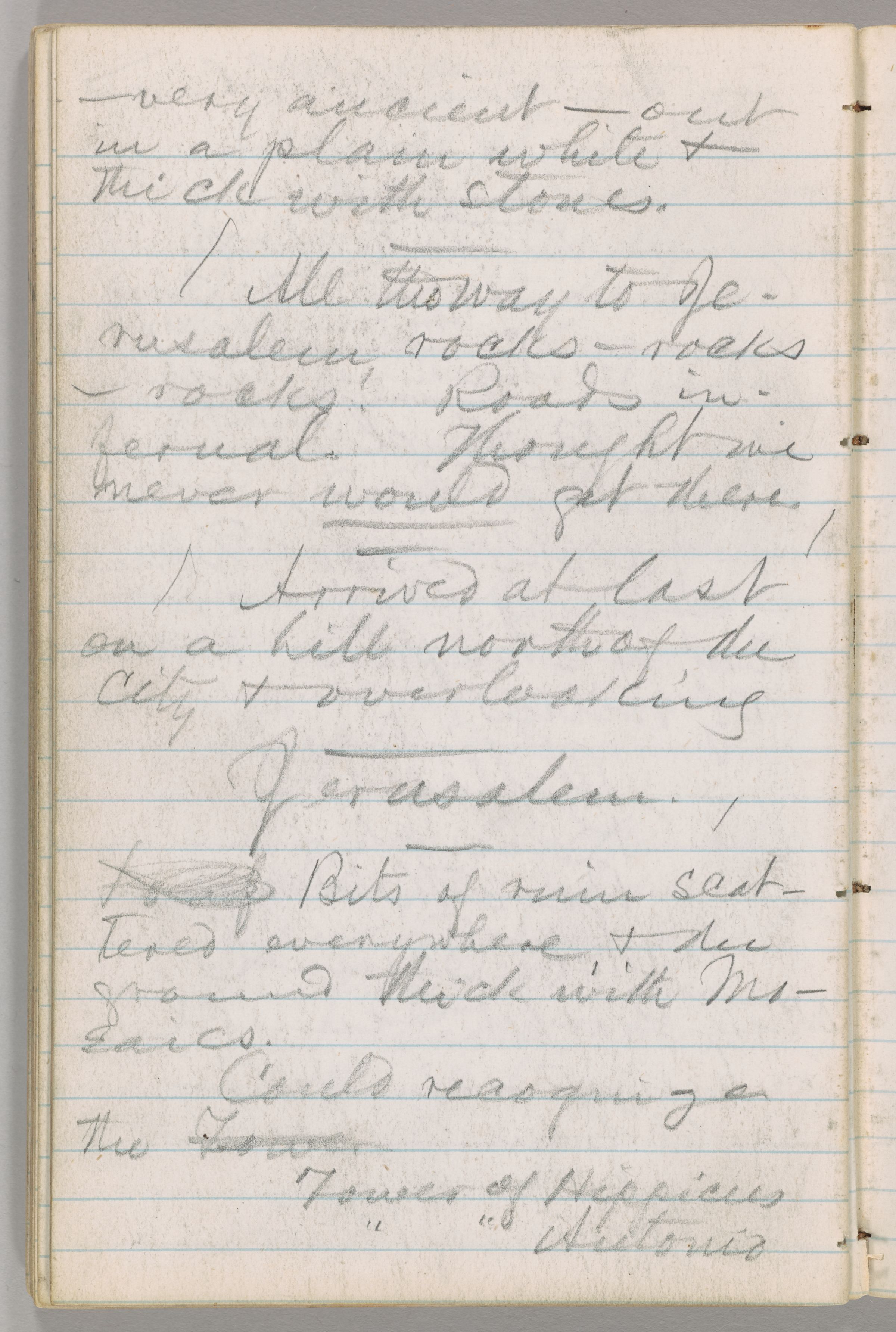
[MS: N9_leaf_060v]
—very ancient—out
in a plain white &
thick with stones.
All the way to
Je-
rusalem
Jerusalem
, rocks—rocks
—rocks. Roads
in-
fernal
infernal
. Thought we
never would get there.
Arrived at last
on a hill north of the
city & overlooking
Jerusalem.
Loaf Bits of ruin
scat-
tered
scattered
everywhere, & the
ground thick with
Mo-
saics
Mosaics
.
Could recognize
the Tower
Tower of Hippicus
“ “ Antonio
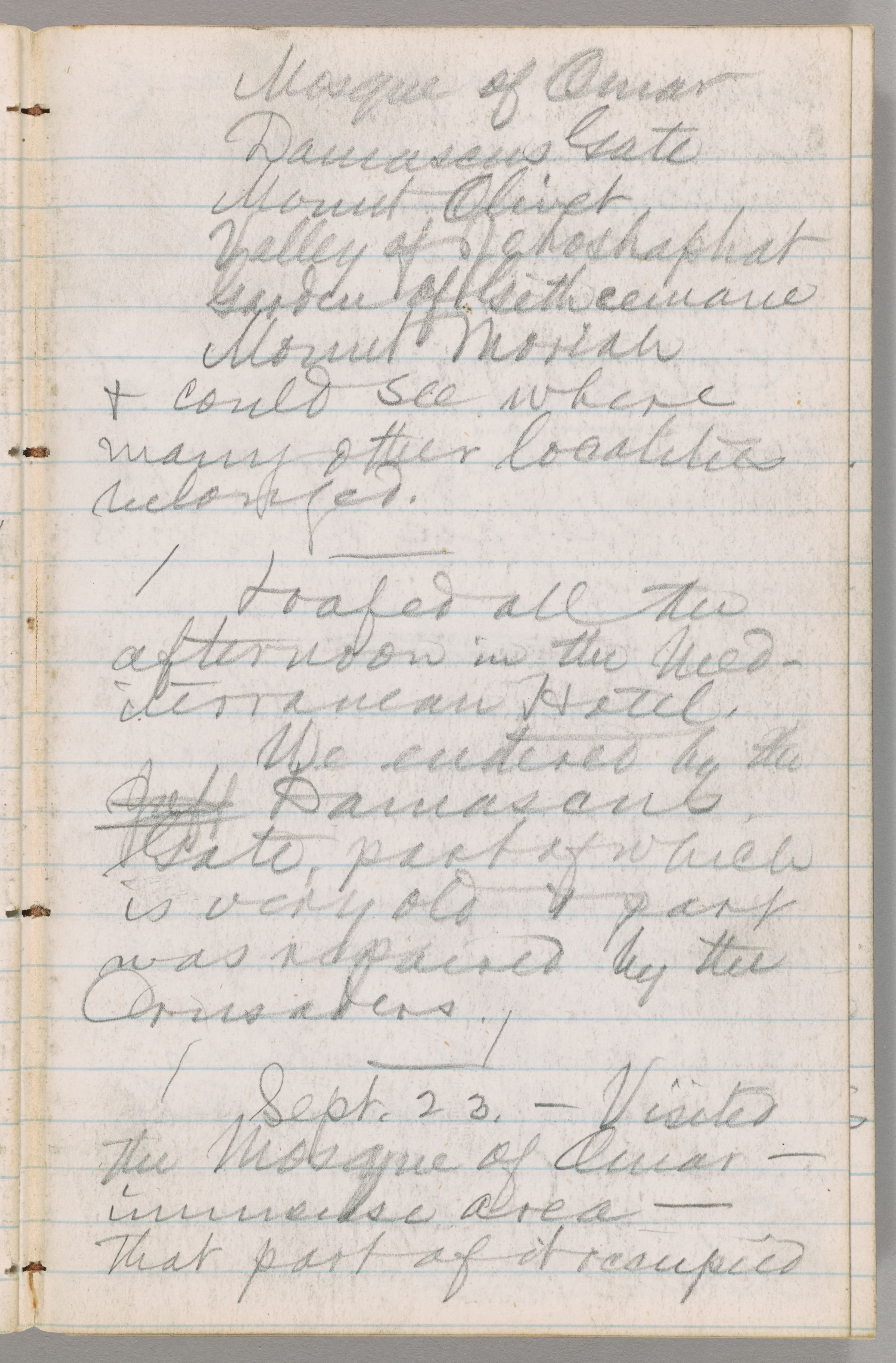
[MS: N9_leaf_061r]
Mosque of Omar
Damascus Gate
Mount Olivet
Valley of Jehoshaphat
Garden of Gethsemane
Mount Moriah
& could see where
many other localities
belonged.
Loafed all the
afternoon in the
Med-
iterranean
Mediterranean
Hotel.
We entered by the
Jaff Damascus
Gate, part of which
is very old &
part
was repaired by the
Crusaders.
Sept. 23.—Visited
the Mosque of Omar—
immense area—
that part of it occupied
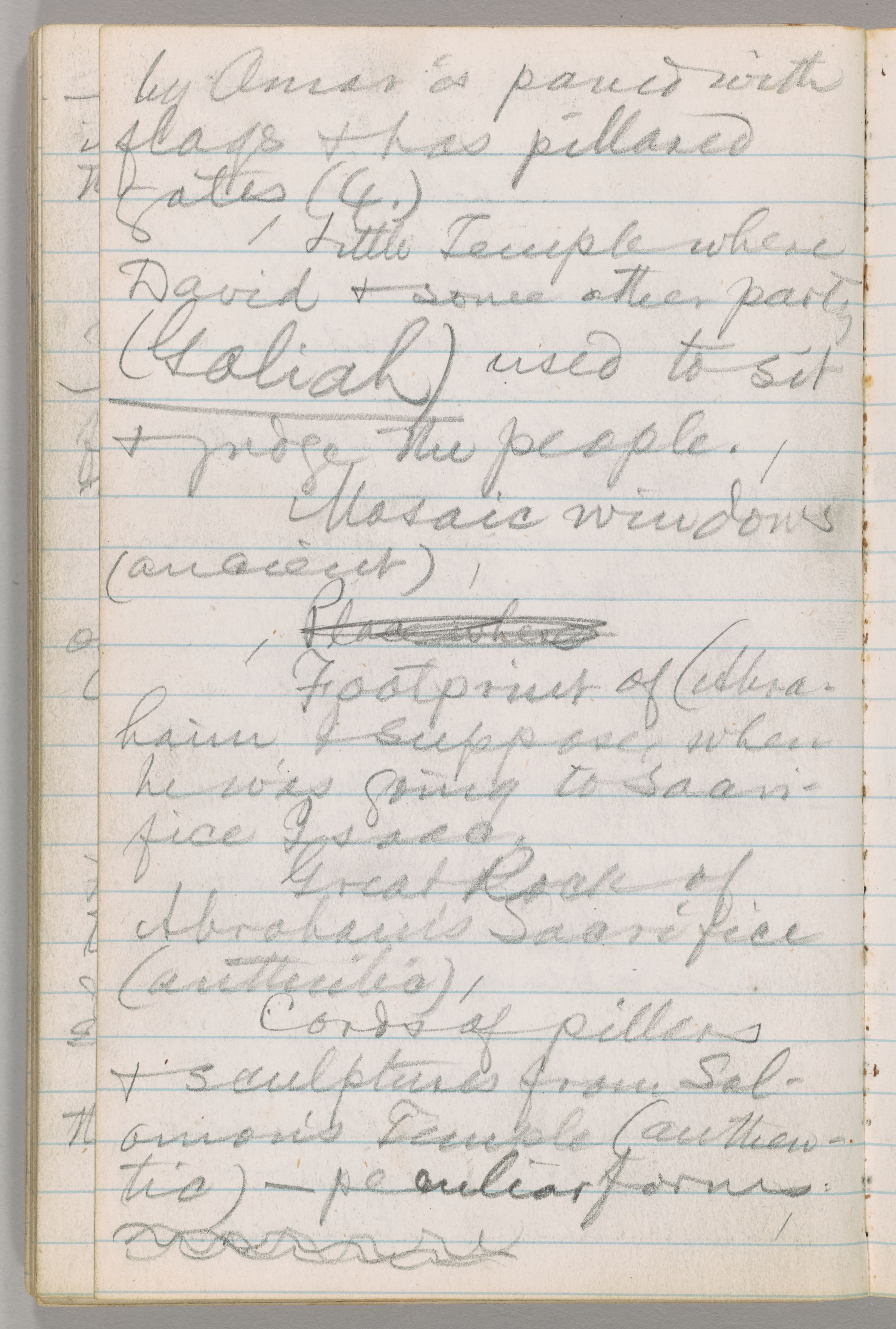
[MS: N9_leaf_061v]
by Omar is paved with
flags & has pillared
gates (4.)
Little Temple where
David & some other party
(Goliah)
used to sit
& judge the people.
Mosaic windows
(ancient)
Place where
Footprint of (
Abra-
haim
Abrahaim
, I suppose, when
he was going to
sacri-
fice
sacrifice
Isaac.
Great Rock of
Abraham’s Sacrifice
(authentic)
Cords of pillars
& sculptures from
Sol-
omon
Solomon
’s Temple (
authen-
tic
authentic
)
[MTP: N&J1_433] —peculiar
forms.
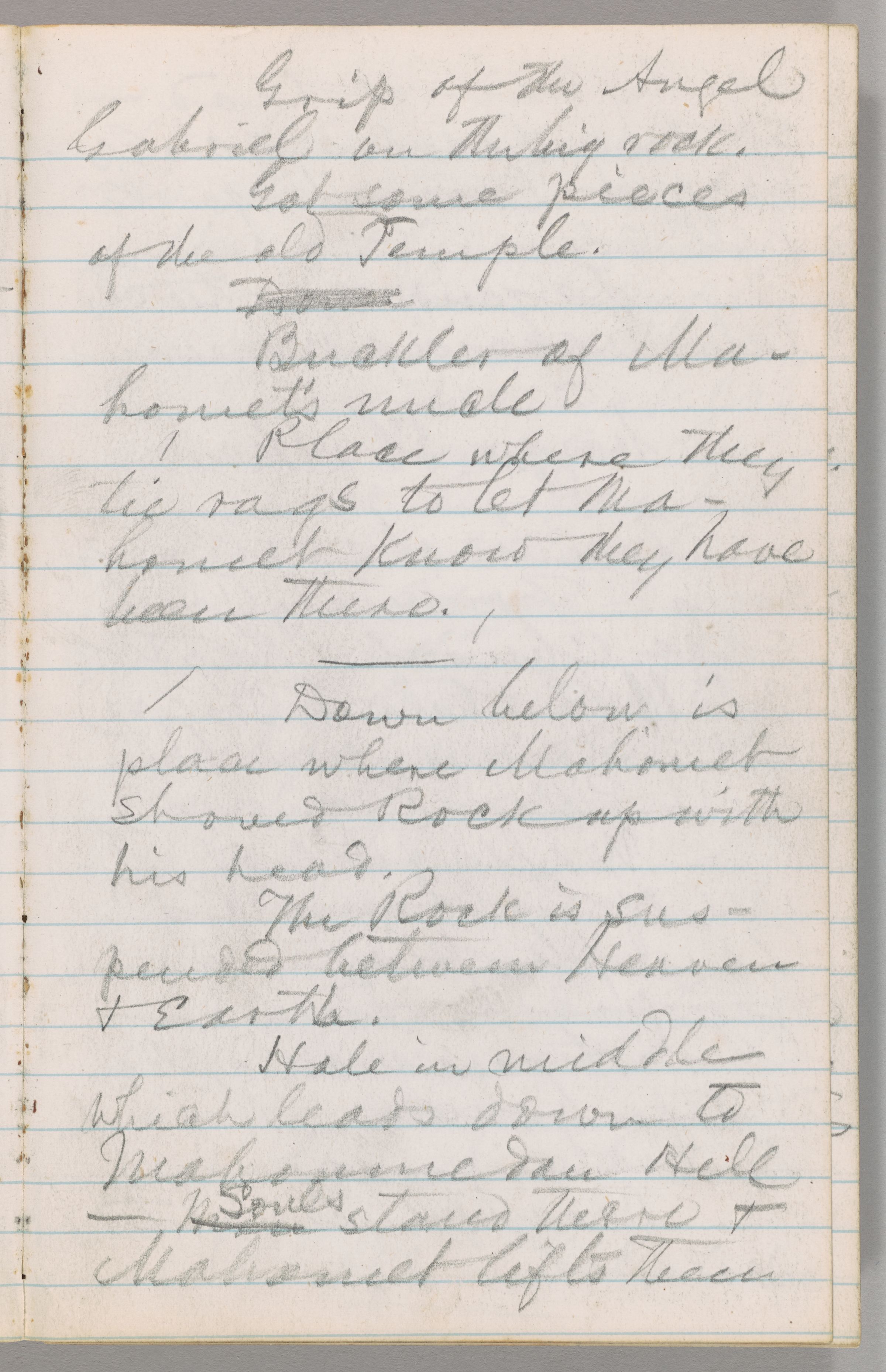
[MS: N9_leaf_062r]
Grip of the Angel
Gabriel on the big rock.
Got some pieces
of the old Temple.
Down
Buckler of
Ma-
homet
Mahomet
’s uncle
Place where they
tie rags to let
Ma-
homet
Mahomet
know they have
been there.
Down below is
place where Mahomet
shoved Rock up with
his head.
The Rock is
sus-
pended
suspended
between Heaven
& Earth.
Hole in middle
which leads down to
Mahommedan Hell
—Men
Souls
stand there &
Mahomet lifts them
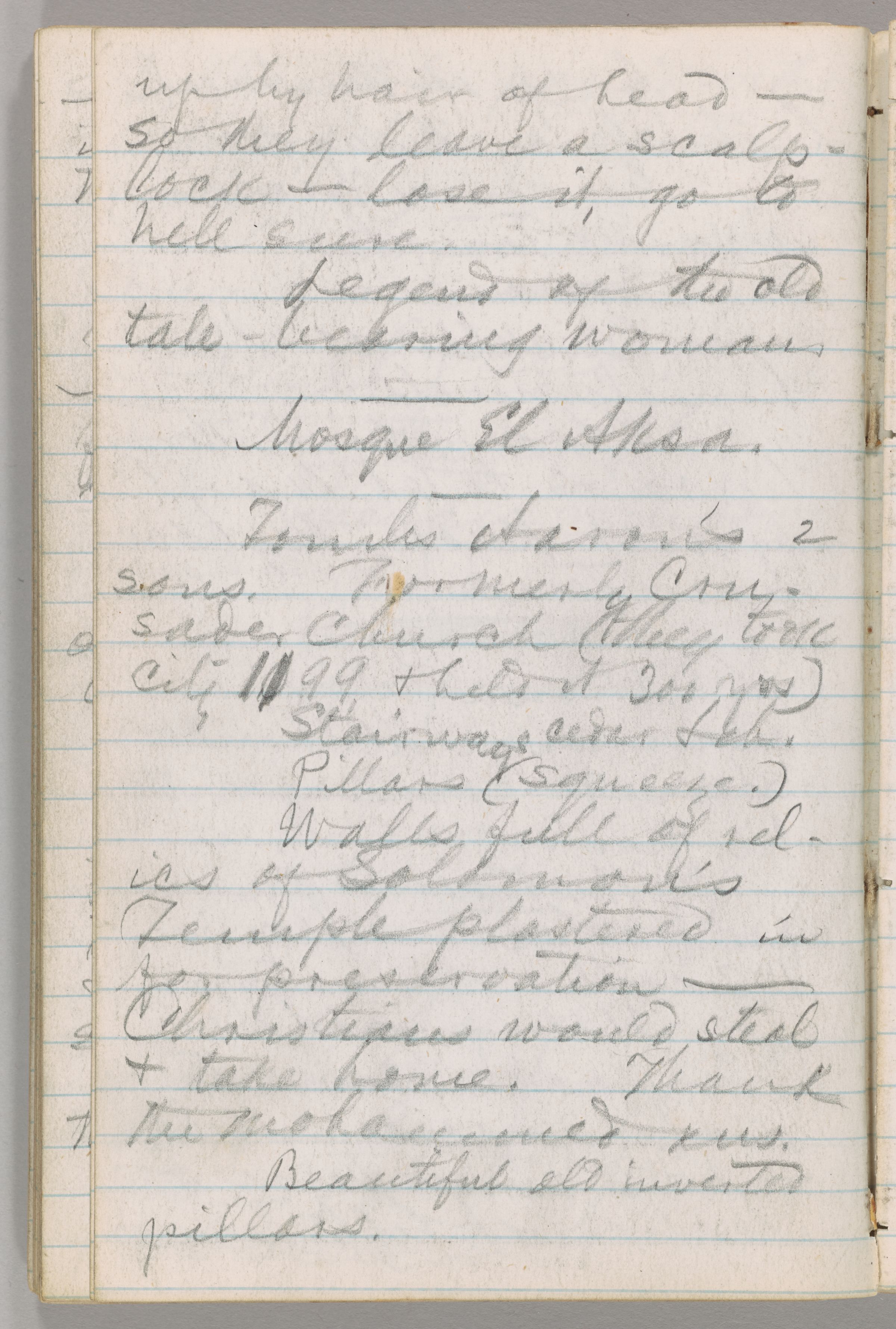
[MS: N9_leaf_062v]
up by
hair of head—
so they leave a scalp-
lock—lose it, go to
hell sure.
Legend of the old
tale-bearing woman.
Mosque El Aksa.
Tombs Aaron’s 2
sons. Formerly
Cru-
sader
Crusader
Church (they took
city 10199, & held it 300 yrs)
Stairways cedar Leb.
Pillars (squeeze.)
Walls full of
rel-
ics
relics
of Solomon’s
Temple plastered in
for preservation—
Christians
would steal
& take home. Thank
the Mohammedans.
Beautiful old inverted
pillars.
[MS: N9_leaf_063r]
[MTP: N&J1_434]
Underneath are the
old monstrous arched
pillars & foundations
of Solomon’s
Temple,
preserved excellently
by the ruins that lay
upon them so long.
Also the double
gate where the first
fruits came in for
the priests.
And the
subter-
ranean
subterranean
way to the
Pool of Siloam
discovered by Dr
Robinson.
Crypts under temple
40 ft high arches—
olive trees & pavements
of great age
above
No hogs in Palestine
[MS: N9_leaf_063v]
Pool of Bethesda.
The Gate Beautiful
and
Seat of Judgment
(pillar sticking out)
where Mahomet will judge
the world. Both
over-
look
overlook
valley of
Jehosha-
phat
Jehoshaphat
, Tomb of St James,
(apostle,) tomb of
Absa-
lom
Absalom
&
that of a High
Priest.
Place where Christ
sat when people said
His blood be upon us
& upon our
children.
Place near Tower
Antonio where he took
up his cross.
Via Sacra. Dolorosa.
3d place where he
[MS: N9_leaf_064r]
fell with X cr &
broke
a great pillar.
4th place—where
he left mark of
el-
bow
elbow
in wall.
Dives house
Lazarus House
[MTP: N&J1_435]
Tombs of the Kings.
Quarries under the City.
Calvary.
Organ & chanting of the
Monks.
Repairing of the Dome.
Dim cathedral light
of many smoking tapers.
[MS: N9_leaf_064v]
Maximilians gift.
Place where Helena
found the Cross—& her
chapel & where she sat.
Pillar of Flagellation.
Stocks.
Place where soldier
was beheaded who said
Truly this was the Son
of God.
Place where John
& Mary stood looking
at Christ on the X when
he said Woman,
behold
thy Son—Behold thy
Mother.
Place where Jesus
appeared to Mary in the
Garden.
Place where the
women came at early
dawn & saw the
an-
gels
angels
at the
Sepulchre.
The rent rock & the
[MS: N9_leaf_065r]
holes where the 3 crosses
stood.
Navel of the world
in the Greek Chapel, where
Adam’s dust came from.
Russian gift to the
Cross.
Sword & spurs of
Godfrey of Bulloigne,
first King of Jerusalem
(genuine) worn
by
Patri-
arch
Patriarch
of Greek Church
at Installation.
Crown of thorns.
[MTP: N&J1_436]
Sept. 24—Left
Jeru-
salem
Jerusalem
at 8 AM. Passed
out at St Stephen’s Gate
along base of Olivet
in
Jehoshaphat by
Jew Graveyard &
tomb of Absalom—
Jews throw stones at
it to this
day.
[MS: N9_leaf_065v]
Hill of Offense over
beyond village o & Pool
of Siloam.
Job’s well.
Brook & Valley
of Kedron.
Village of Bethany.
It is fearfully ratty—some
houses—mud—6 feet
square & others holes
in the
ground—all
windowless.
House & tomb of
Lazarus & his 2
sisters.
Lunched.
Over mountain
& saw Jordan Valley,
Mountains of Moa
Moab & Dead Sea
[MS: N9_leaf_066r]
Modern 2d Jericho.
8 Arched aqueduct—old
walls, & river bed full
of verdure.
Fountain of Elisha
where ravens fed him
Elijah & where he
as-
cended
ascended
in fiery chariot
& his robe fell upon
Elisha, who healed these
waters. Where
Gilgal
stood—where the 12
stones taken from
Jordan were placed—
where Christ was
baptised (?) where
Des-
ert
Desert
wandres first touched
Caanan—where they
set up the ark
& ate of
the old corn & ceased from
manna & quails—
where they long
remained.
[MS: N9_leaf_066v]
Ancient Jericho.
Where Joshua marched
around 7 times & blew
down the walls.
[MTP: N&J1_437] Many ruins still there (arches,
of course),
& mosaics in
the brook. Precipice
perforated with holes.
Cam This is the
Plain of Jericho, noted
as the most fertile spot
in
Palestine—they
used to I irrigate it.
Apples of Sodom.
Campd near the
old Square Tower (
Mid-
dle
Middle
Ages no doubt)—
garris &
Modern (mud)
Jericho.—garrisoned
by 15 men—Bedouin
war.
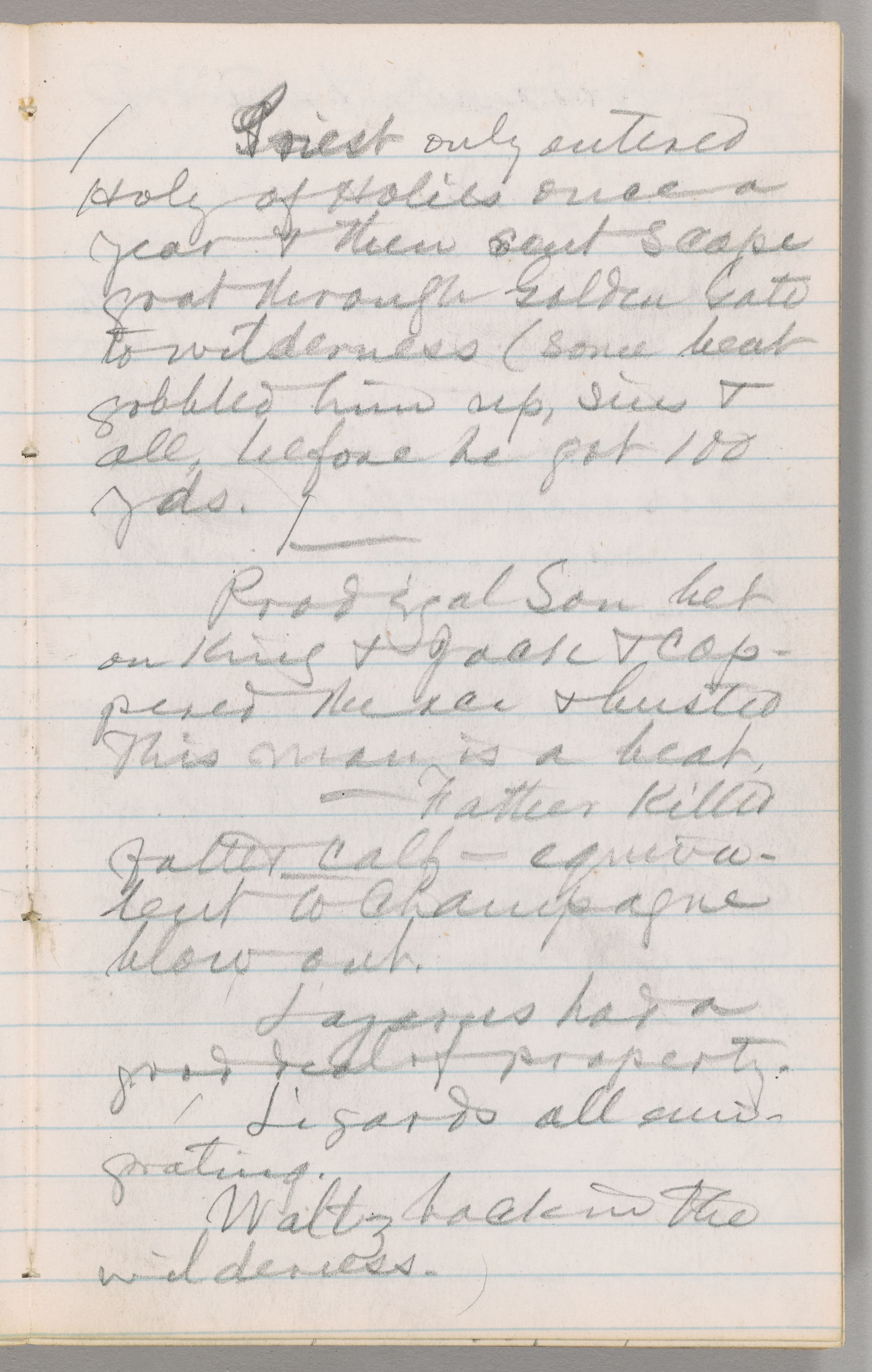
[MS: N9_leaf_067r]
Sc Priest only entered
Holy of Holies once a
year & then sent scape
goat through Golden Gate
to wilderness (some beat
gobbled him up, sins &
all,
before he got 100
yds.
Prodigal Son bet
on King & Jack &
cop-
pered
coppered
the ace & busted
This man
is a beat.
—Father killed
fatted calf—
equiva-
lent
equivalent
to champagne
blow out.
Lazarus had a
good deal of property.
Lizards all
emi-
grating
emigrating
.
Waltz back in the
wilderness.
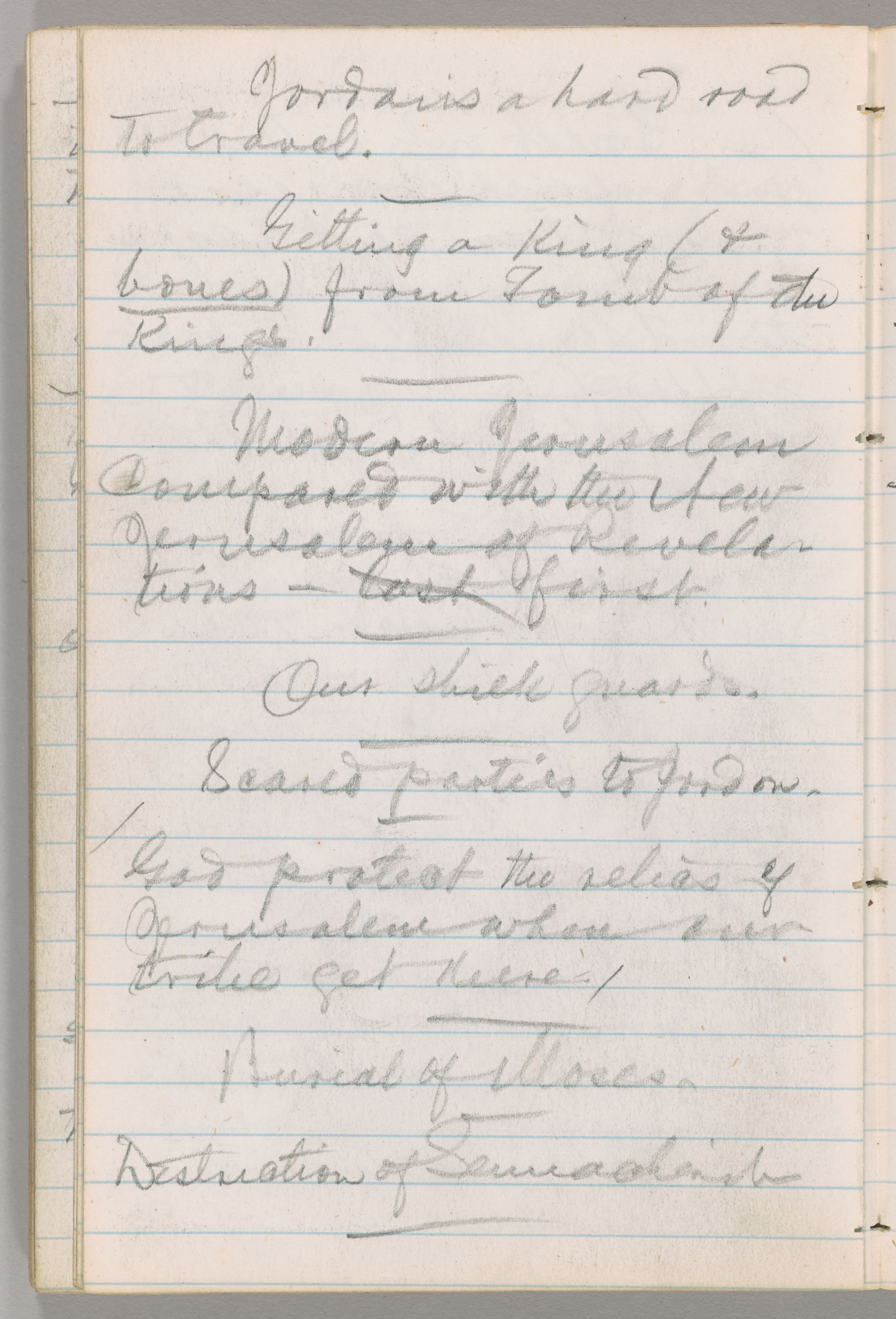
[MS: N9_leaf_067v]
Jordan’s a hard road
to travel.
Gitting a King (&
bones) from Tomb of the
Kings.
Modern Jerusalem
compared with the New
Jerusalem of
Revela-
tions
Revelations
—last
first.
Our shiek guards.
[MTP: N&J1_438]
God protect the relics of
Jerusalem when our
tribe get there.
Burial of Moses.
Destruction of Sennacherib
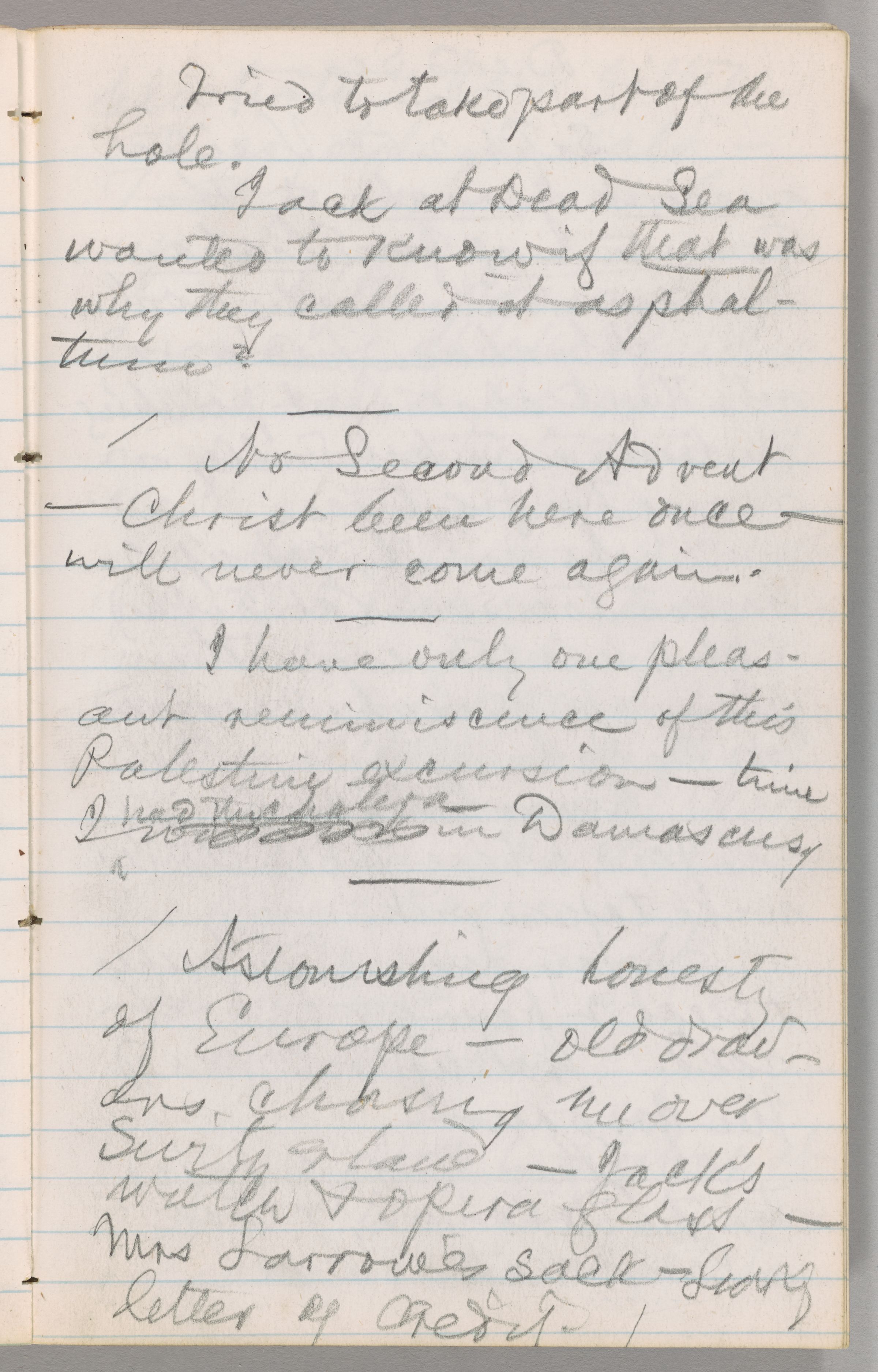
[MS: N9_leaf_068r]
Tried to take part of the
hole.
Jack at Dead Sea
wanted to know if that was
why they called
it
asphal-
tum
asphaltum
?
No Second Advent
—Christ been here once—
will never come again.
I have only one
pleas-
ant
pleasant
reminiscence of this
Palestine excursion—time
I was sick
had the cholera
in Damascus.
Astonishing honesty
of Europe—old
drov-
ers
drovers
chasing me over
Switzerland—Jack’s
watch
& opera glass—
Mrs Larrowe’s sack—Leary
letter of credit.
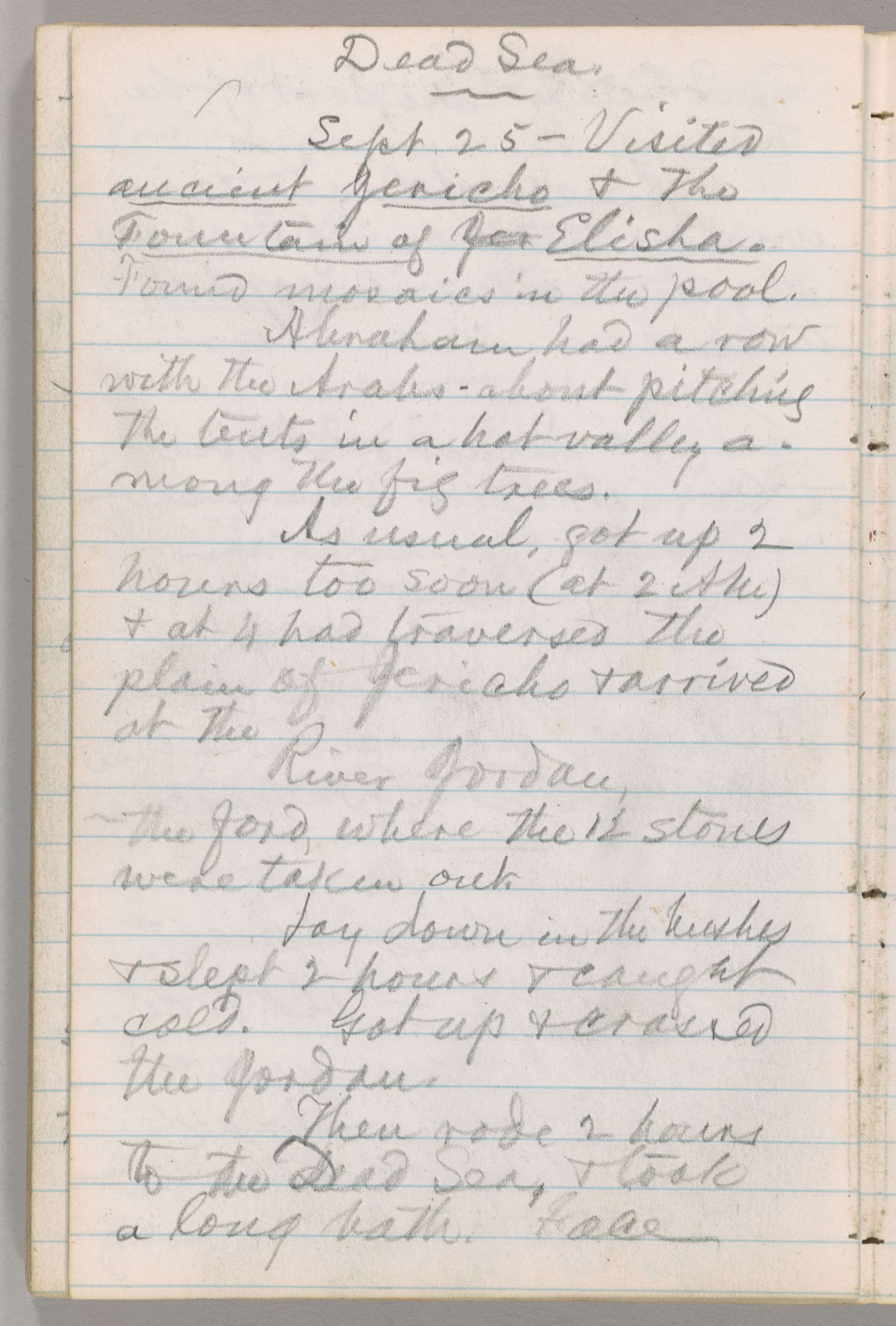
[MS: N9_leaf_068v]
Dead Sea.
Sept. 25—Visited
ancient Jericho & the
Fountain of
Jer
Elisha.
Found mosaics in the pool.
Abraham had a row
with the Arabs about pitching
the tents in a hot valley
a-
mong
among
the fig trees.
As usual, got up 2
hours too soon (at 2 AM)
& at 4 had traversed the
plain of
Jericho & arrived
at the
River Jordan,
—the ford, where the 12 stones
were taken out.
Lay down in the bushes
& slept 2 hours & caught
cold. Got up & crossed
the Jordan.
Then rode 2 hours
to the d Dead Sea, & took
a long bath. Face
[MS: N9_leaf_069r]
blistered & hair filled
with crystalized salt.—
Took a horse in & he
upset.
[MTP: N&J1_439]
After providing
so many shieks & guides,
never saw a Bedouin—
one guard wanted
to smouch
me.
Rode 5½ hours through
frightful heat, over the roughest
mountain scenery, and
arrived at last, brimming
with gratitude, at the
pro-
digious
prodigious
Convent of Mar
Saber,
in a wild glen on
the brook Kedron.
Staid all night.
That bombardment.
Bethlehem.
Sept. 26—Got up at
3 AM & traveled 2½ hours
over mountains at got to
[MS: N9_leaf_069v]
Annunciation
trees trees in a plain where the angels an-
nounced announced the birth of the
Saviour to the Shepherds.
Then ¼ hour to
Beth-
lehem
Bethlehem
& to the
Milk Grotto.
Then to the convent
of the Nativity—built by
St Helena in 326.
The birth-place.
The Manger.
Prophet Zechariah.
St Jerome.
Joseph’s retiring-
grotto during the
confine-
ment
confinement
.
Place where 20,000
children beheaded by
Herod were buried.
St Eusebius.
Lunched there &
left.—2 hours to Je-
[MS: N9_leaf_070r]
rusalem. On the way,
visited
Rachel’s Tomb
(authentic.)
In Jerusalem
break-
fasted
breakfasted
at noon at the
Med-
iterranean
Mediterranean
Hotel, & then
went to
the Hill of Offense,
where Solomon built
a temple for his Egyptian
wife. Tree
there that
Judas Iscariot hanged
himself on.
Went to the Jews’
wailing place
along-
side
alongside
the old wall of
Solomon’s Temple
—cyclopian masonry.
Many Pharisees, with
a
curl forward of
ear.
Another part of
Temple wall, where
Dr Robinson
discovered
[MS: N9_leaf_070v]
the spring of the arch
which Solomon built
to connect Zion Hill
with the Temple. The
prophecy that 2 stones
should not remain upon
each other not
strictly
fulfilled. 3 or 4 of these
stones are 20 feet
[MTP: N&J1_440] long
& 5 or 6 thick.
How
did they haul them with
camels & jacks.
Retired to our
tents outside the
Da-
mascus
Damascus
Gate.
Rough on the
RAVENS—
could hardly make their
own living, let alone
board Elijah.
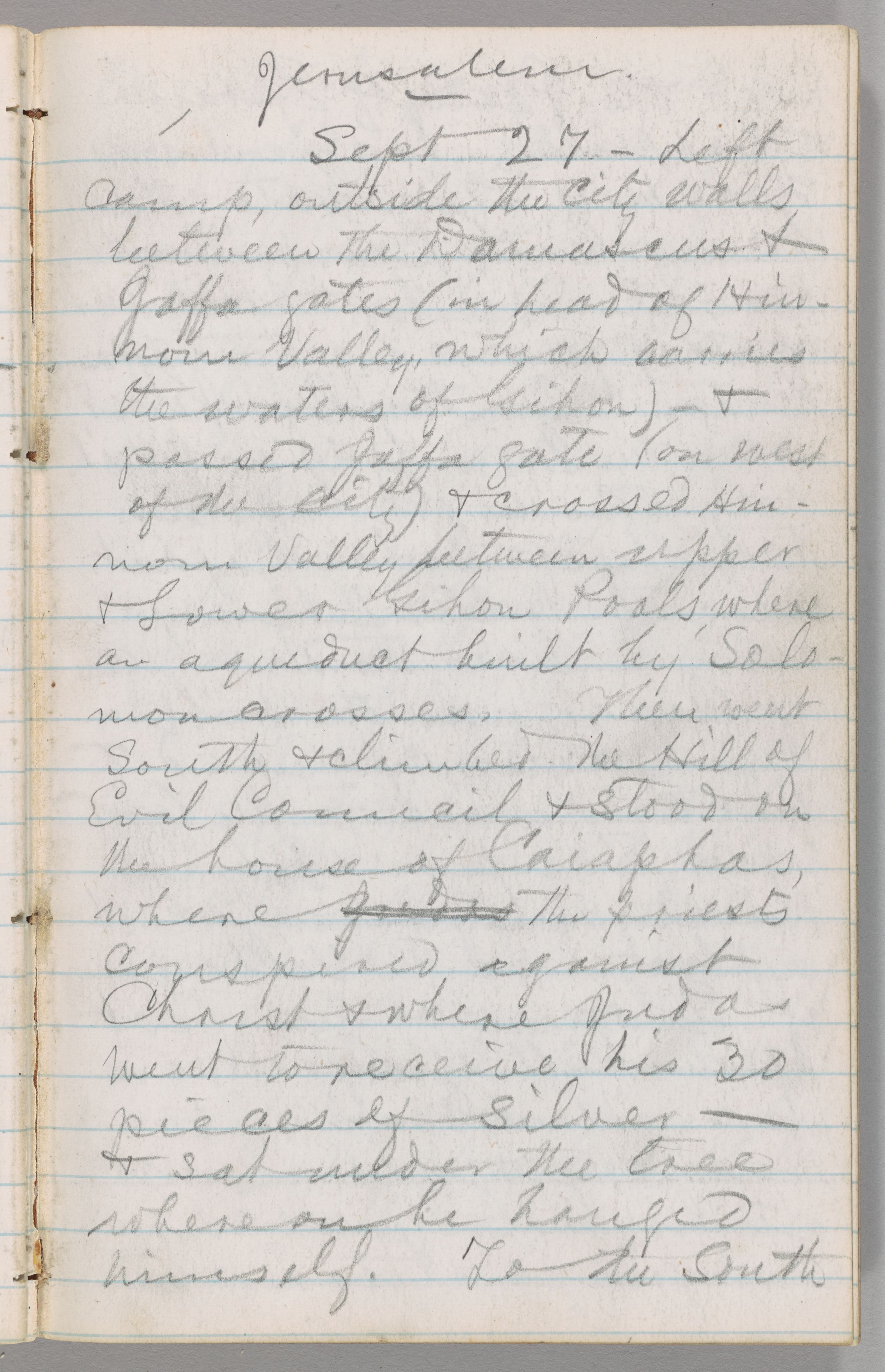
[MS: N9_leaf_071r]
Jerusalem.
Sept 27.—Left
camp, outside the city walls,
between the Damascus &
Jaffa gates
(in head of
Hin-
nom
Hinnom
Valley, which carries
the waters of Gihon)—&
passed Jaffa
gate (on west
of the city) & crossed
Hin-
nom
Hinnom
Valley between upper
& Lower
Gihon Pools, where
an aqueduct built by
Solo-
mon
Solomon
crosses. Then went
South &
climbed the Hill of
Evil Council & stood on
the house of Caiaphas,
where
Judas the priests
conspired against
Christ & where Judas
went to
receive his 30
pieces of silver—
& sat under the tree
whereon he hanged
himself. To the South
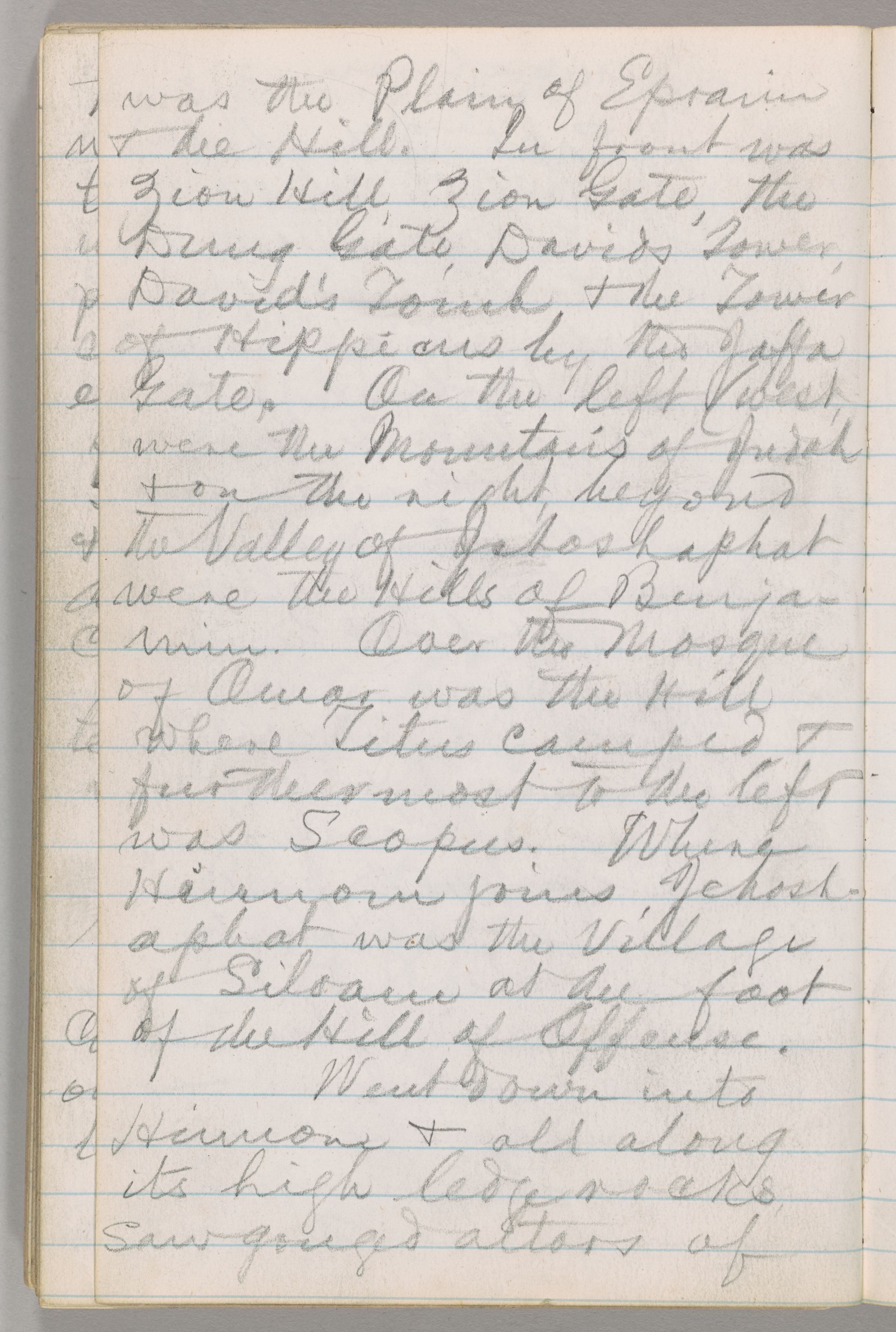
[MS: N9_leaf_071v]
was the Plain of Epraim
& the Hill. In front was
Zion Hill, Zion Gate, the
Dung Gate, Davids Tower,
David’s Tomb, & the Tower
of Hippicus by the Jaffa
Gate,. On the left (west,
were the Mountains
of Judah
& on the right, beyond
the Valley of Jehoshaphat
were the Hills of
Benja-
min
Benjamin
. Over the Mosque
of Omar was the Hill
where Titus camped, &
furthermost to the left
was Scopus. Where
Hinnom joins
Jehosh-
aphat
Jehoshaphat
was the Village
of Siloam at the foot
of the Hill of Offense.
Went down into
Hinnom & all along
its high ledge rocks,
saw gouged altars of
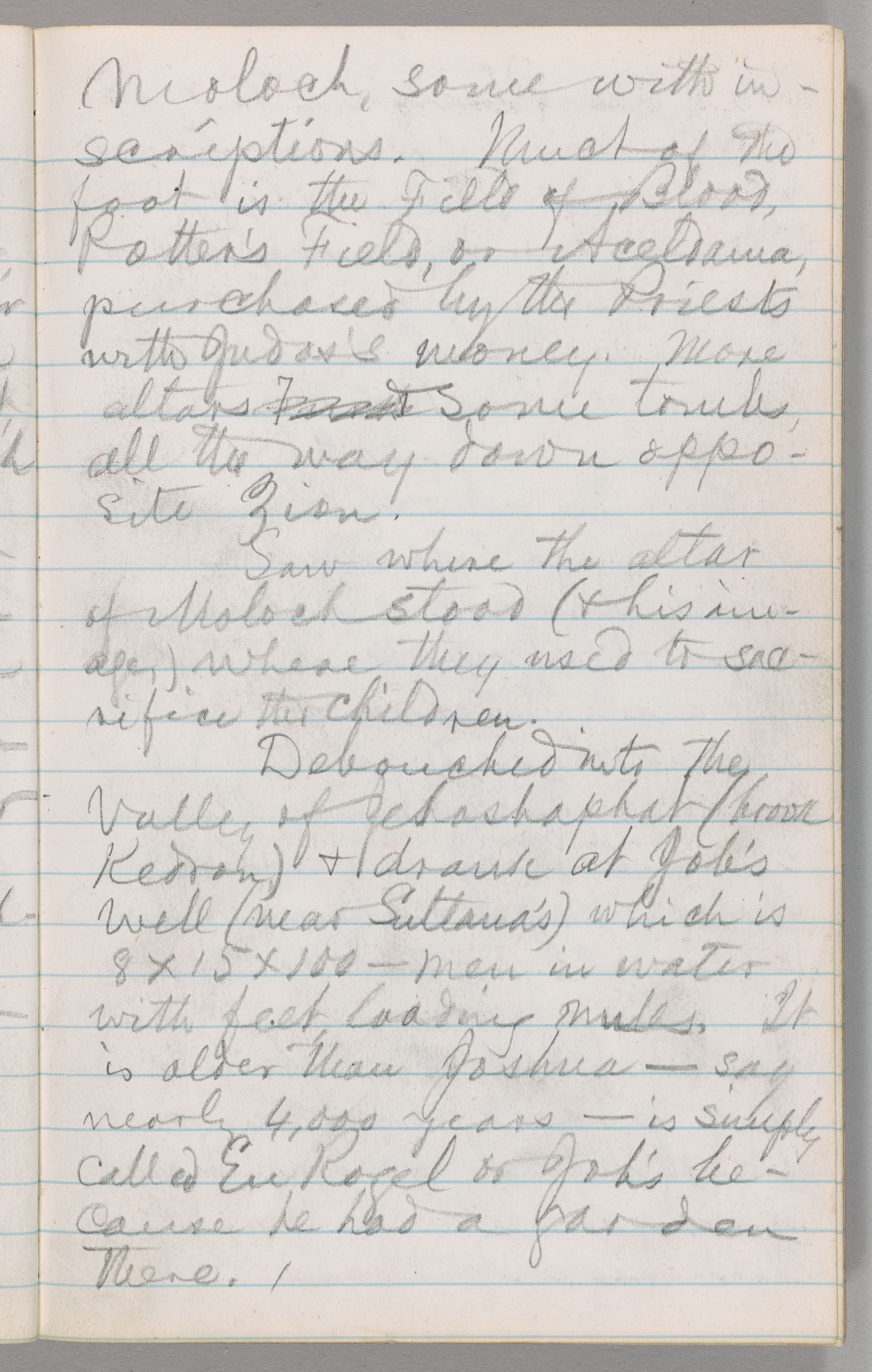
[MS: N9_leaf_072r]
Moloch, some with
in-
scriptions
inscriptions
. Much of the
foot is the Field
of Blood,
Potter’s Field, or Aceldama,
purchased by the Priests
with Judas’s
money. More
altars & more & some tombs,
all the way down
oppo-
site
opposite
Zion.
Saw where the altar
of Moloch stood (& his
im-
age
image
,) where they used to
sac-
rifice
sacrifice
the children.
Debouched into the
Valley of Jehoshaphat (brook
Kedron,) & drank at Job’s
well
(near Sultana’s) which is
8 × 15 × 100—men in water
with feet, loading mules. It
is older than Joshua—say
nearly
[MTP: N&J1_441] 4,000 years—is simply
called En Rogel or Job’s
be-
cause
because
he had a garden
there.
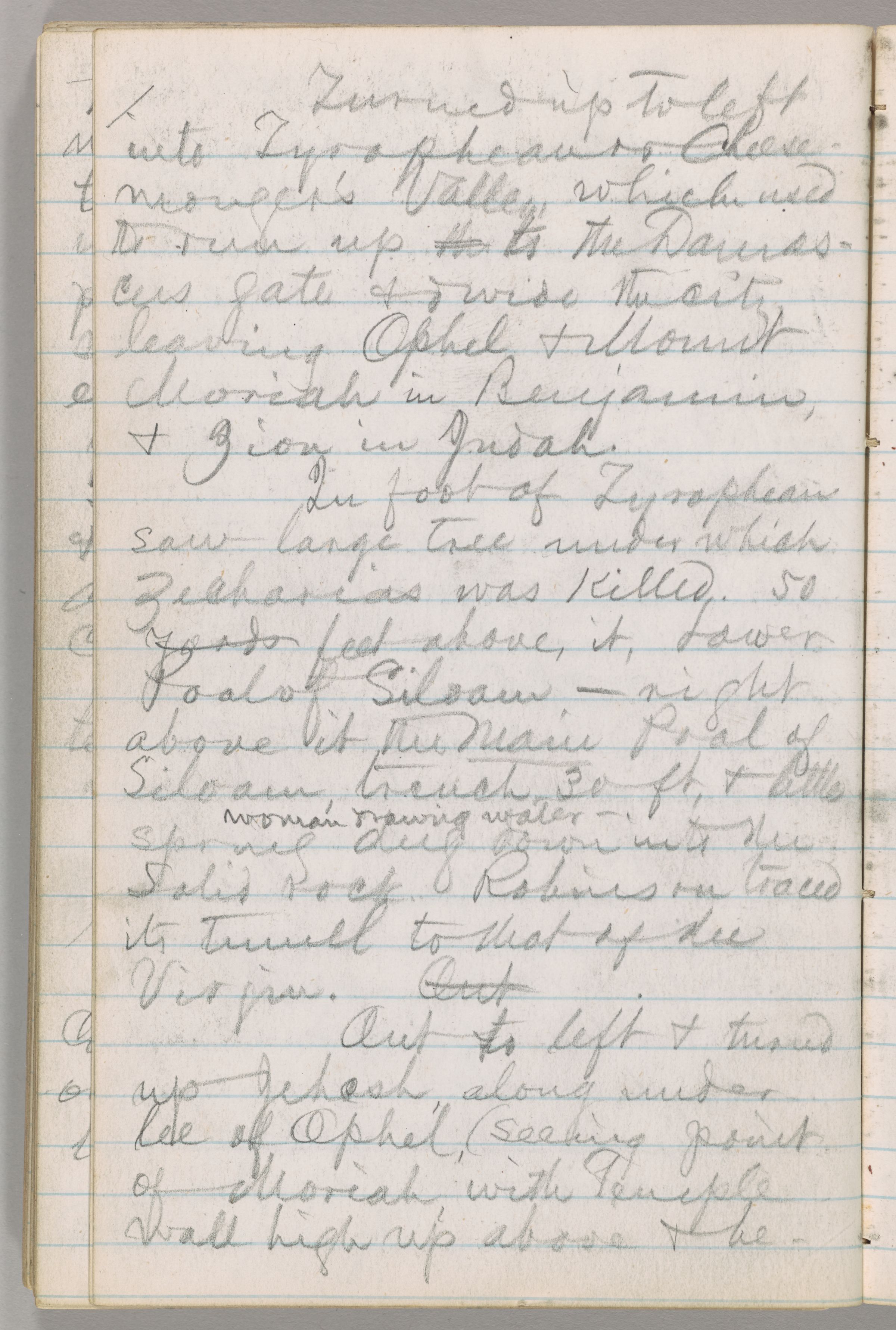
[MS: N9_leaf_072v]
Turned up to left
into Tyrophean or Cheese-
monger’s Valley, which used
to run up th to the
Damas-
cus
Damascus
gate &
divide the city,
leaving Ophel & Mount
Moriah in Benjamin,
& Zion in
Judah.
In foot of Tyrophean
saw large tree under which
Zecharias was killed. 50
yards feet above, it, Lower
Pool of Siloam—right
above it the Main Pool of
Siloam, trench 30 ft, & little
spring
woman drawing water—
dug down into the
solid rock. Robinson traced
its tunnel to that of the
Virgin. Out
Out & to left & turned
up Jehosh, along under
lee of Ophel,
(seeing point
of Moriah, with Temple
wall high up above & be-
[MS: N9_leaf_073r]
fore us,
St Stephen’s gate,
the Golden Gate outside &
the Gate Beautiful as a
vestibule
within, & the pillar
projecting which
Ma-
homet
Mahomet
is to straddle &
judge the
world.
The King’s Gardens
all along—& the King’s
well. Passed by the
cu-
rious
curious
old
Village of
Si-
loam
Siloam
, with some of its
dens carved out of the
rock, & came first
to
the Tomb of Zecharias,
(carr then to St James &
then to Absalom
&
Jehosh-
aphats
Jehoshaphats
Tombs—all in a
row & all cut out of the
solid rock—Jews
through
throw stones at Ab’s yet
because he drove out his
father—pile there. Passed
Jew cemetery.—
[MS: N9_leaf_073v]
Turn Tur Virgin Mary’s Fountain.
Proceeded to the
Gar-
den
Garden
of Gethsemane, with
its Garden & of Flowers
& 8
hoary Olive trees.
Outside saw little lane
where Judas betrayed, & just
above, the rock on which
disciples slept.
Turned up to left,
past St Agnes & Virgin
Mary’s Tombs, & ascended
to top
of Mount of Olives.
By Convent road which
Jose David ascended
when
Absalom drove him out
& member of hous of Saul
threw stones after him.
By
Convent where
Catho-
lics
Catholics
say Jesus ascended
to Heaven.
[MTP: N&J1_442]
To the southeast saw
another hill between Olivet
& Bethany where Bible
says he
ascended—
[MS: N9_leaf_074r]
To the east & southeast
saw plainly the Jordan, its
valley,
the Dead Sea & the
Mountains of Moab. To
the south saw the Frank
Mountain
& near it the
desert where Christ was
tempted of the devil—&
the rather toward the S.W.
the Plain of Ephraim, the
Hill of Offense
& toward
Beth-
lehem
Bethlehem
. On the west,
Je-
rusalem
Jerusalem
& beyond, the
Mountains of
Judah.
On the north the hill where
Titus pitched his camp, &
beyond, Scopus.
In the
distance, Nebo-Samuel.
Crossed the Valley of
Jehoshaphat, & whn abreast
of the Damascus gate (north),
came to the noblest
stateliest
tree in
Palestine—Godfrey de
Bulloigne’s
tree where he camped.
[MS: N9_leaf_074v]
Mahomedan’s believe
that when the Golden
gate is unwalled &
opened, they pass
out
of power forever—
both themselves, the
Jews & Christians
are expecting it
now.
Went through
the Via Dolorosa.
Sept. 28—Went all through
the Holy Sepulchre again.
Saw the rock faces in a
wall on Via Dolorosa that
cried Hosanna! when Jesus
passed.
Visited the Fountain of
Hezekiah, where SDavid
saw the mother of
Solomon
bathing.
Went to the Pool of
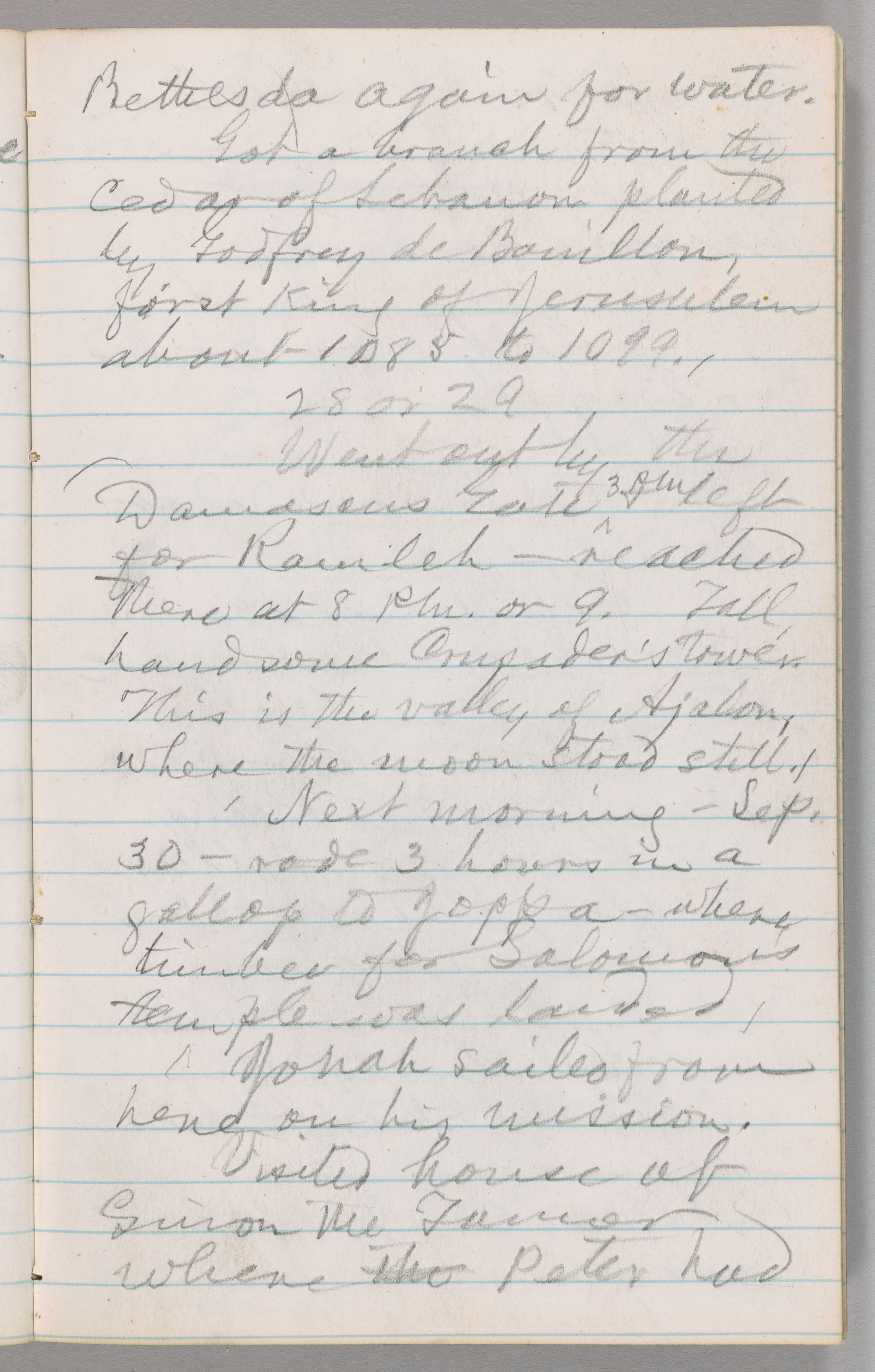
[MS: N9_leaf_075r]
Bethesda again for water.
Got a branch from the
Cedar of Lebanon planted
by Godfrey de Bouillon,
first King
of Jerusalem
about 1085 to 1099.
[MTP: N&J1_443]
28 or 29
Went out by the
Damascus Gate 3 PM
& left
for Ramleh—reached
there at 8 PM. or 9. Tall,
handsome Crusader’s tower.
This is the valley of
Ajalon,
where the moon stood still.
Next morning—Sep.
30—rode 3 hours in a
gallop to Joppa—where
timber for Solomon’s
temple was landed
Jonah sailed from
here on his mission.
Visited house of
Simon the Tanner
where the Peter had
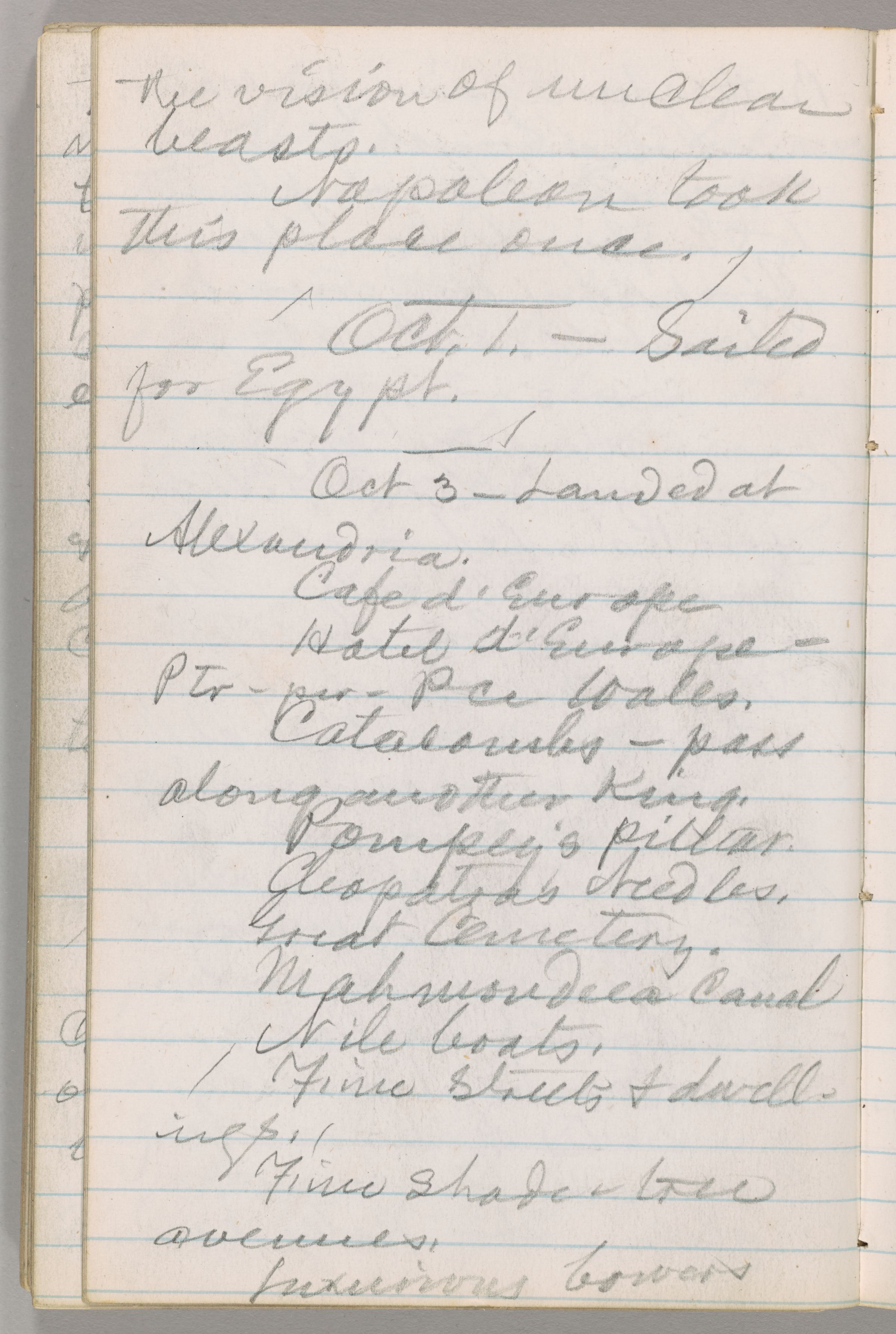
[MS: N9_leaf_075v]
the
vision of unclean
beasts.
Napoleon took
this place once.
Oct. 1.—Sailed
for Egypt.
Cafe d’Europe
Hotel d’Europe—
Ptr-per-Pce Wales.
Catacombs—pass
along another King.
Pompey’s pillar.
Cleopatra’s Needles.
Great Cemetery.
Nile boats.
Fine streets & dwellings.
Fine shade-tree avenues.
Luxurious bowers
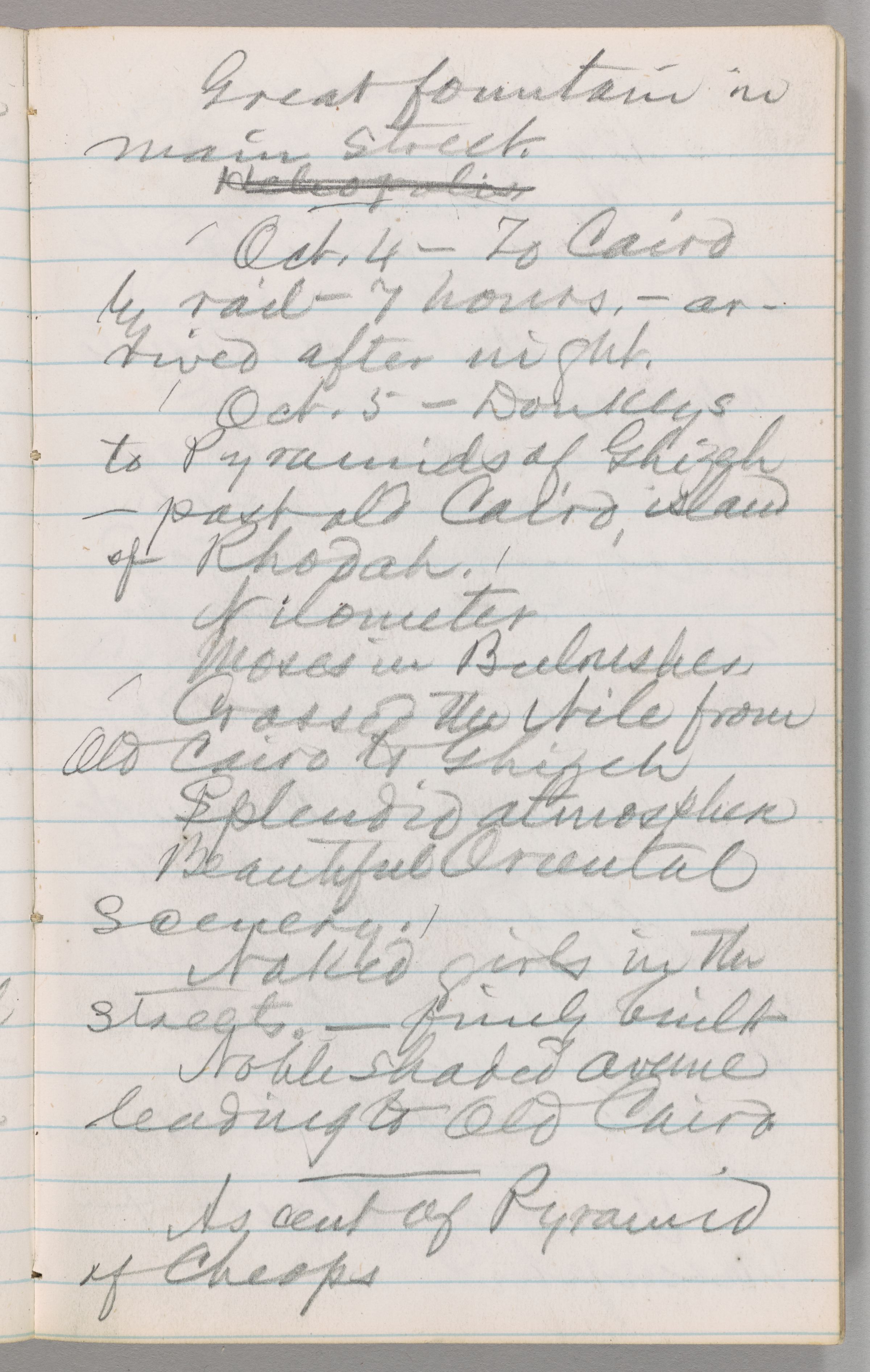
[MS: N9_leaf_076r]
[MTP: N&J1_444]
Great fountain in
main street.
Heliopolis.
Oct. 4—To Cairo
by rail—7 hours,—
ar-
rived
arrived
after night.
Oct. 5—Donkeys
to Pyramids of Ghizeh
—past old Cairo, island
of Rhodah.
Nilometer
Moses in Bulrushes.
Crossed the Nile from
Old Cairo to Ghizeh
Splendid atmosphere
Beautiful Oriental
scenery.
Naked girls in the
streets.—finely built.
Noble shaded avenue
leading to Old Cairo.
Ascent of Pyramid
of Cheops
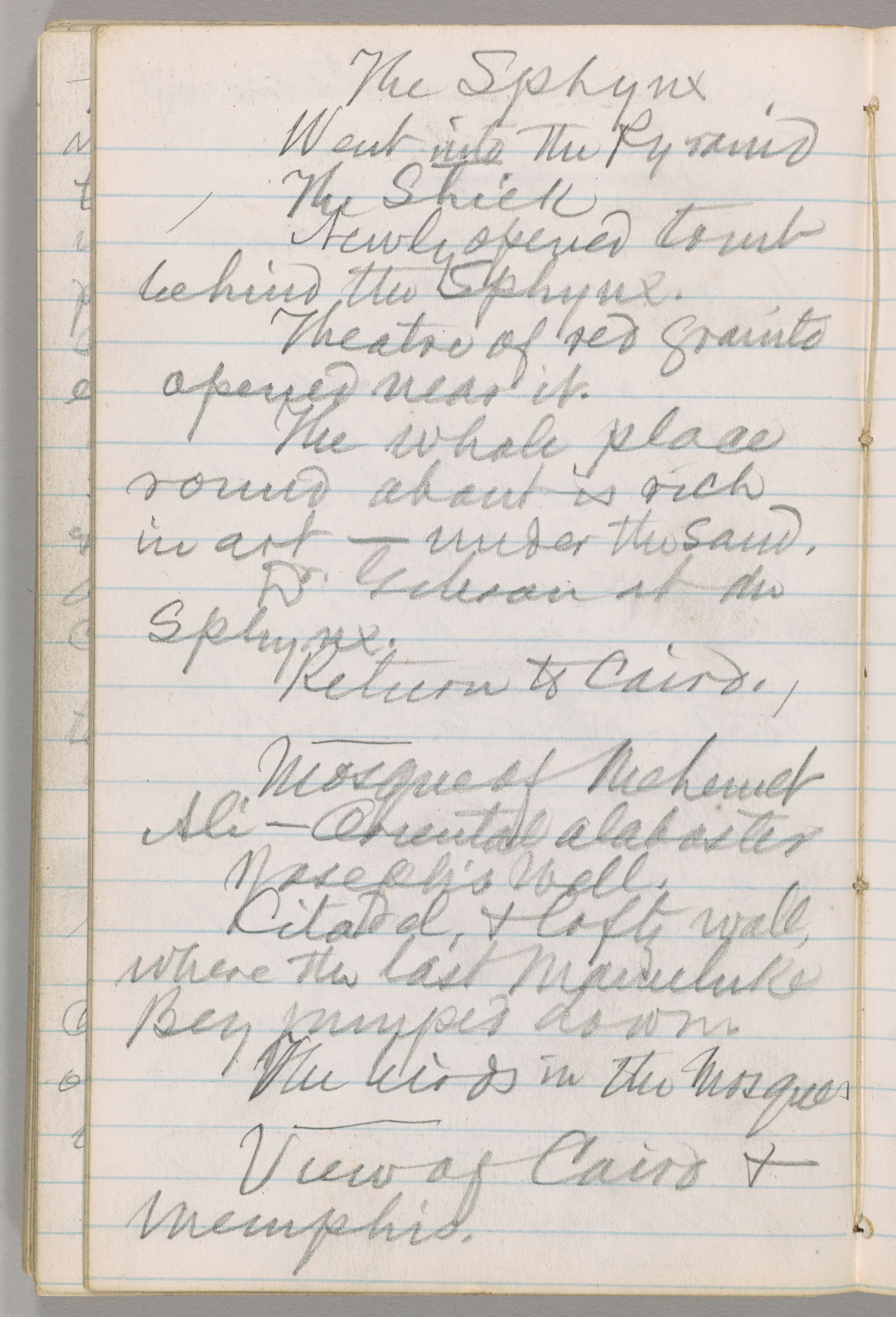
[MS: N9_leaf_076v]
The Sphynx
Went into the Pyramid
The Shiek
Newly opened tomb
behind the Sphynx.
Theatre of red granite
opened near it.
The whole place
round about is rich
in art—under the sand.
Return to Cairo.
Mosque of Mehemet
Ali—Oriental alabaster
Joseph’s Well.
Citadel, & lofty wall,
where the last Mameluke
Bey jumped down.
[MTP: N&J1_445]
The birds in the Mosque.
View of Cairo &
Memphis.
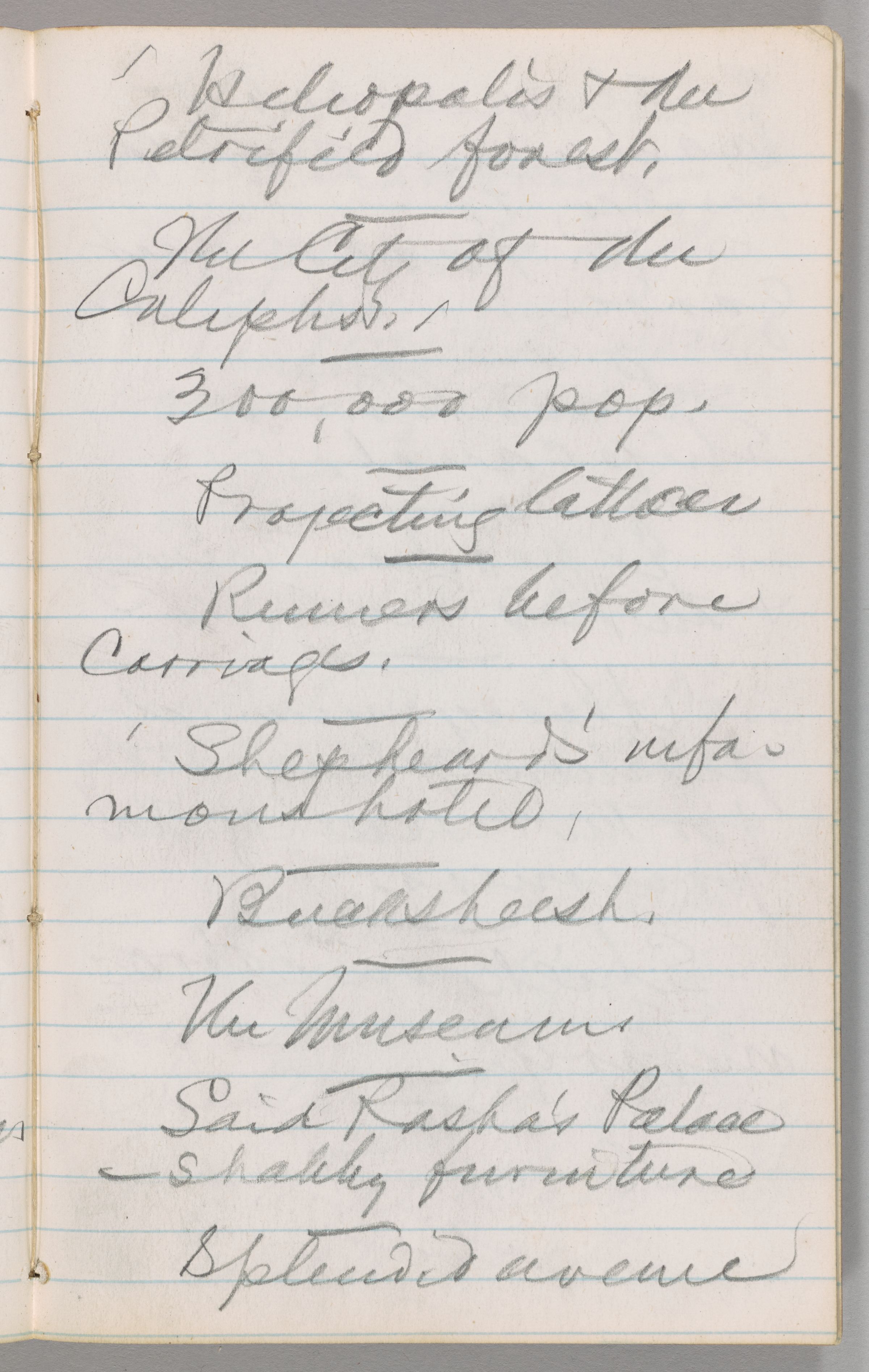
[MS: N9_leaf_077r]
Heliopolis & the
Petrified forest.
The City of the
Caliphs.
300,000 pop.
Projecting lattices
Shepheard’s
infa-
mous
infamous
hotel
Bucksheesh.
Said Pasha’s Palace
—shabby furniture
Splendid avenue
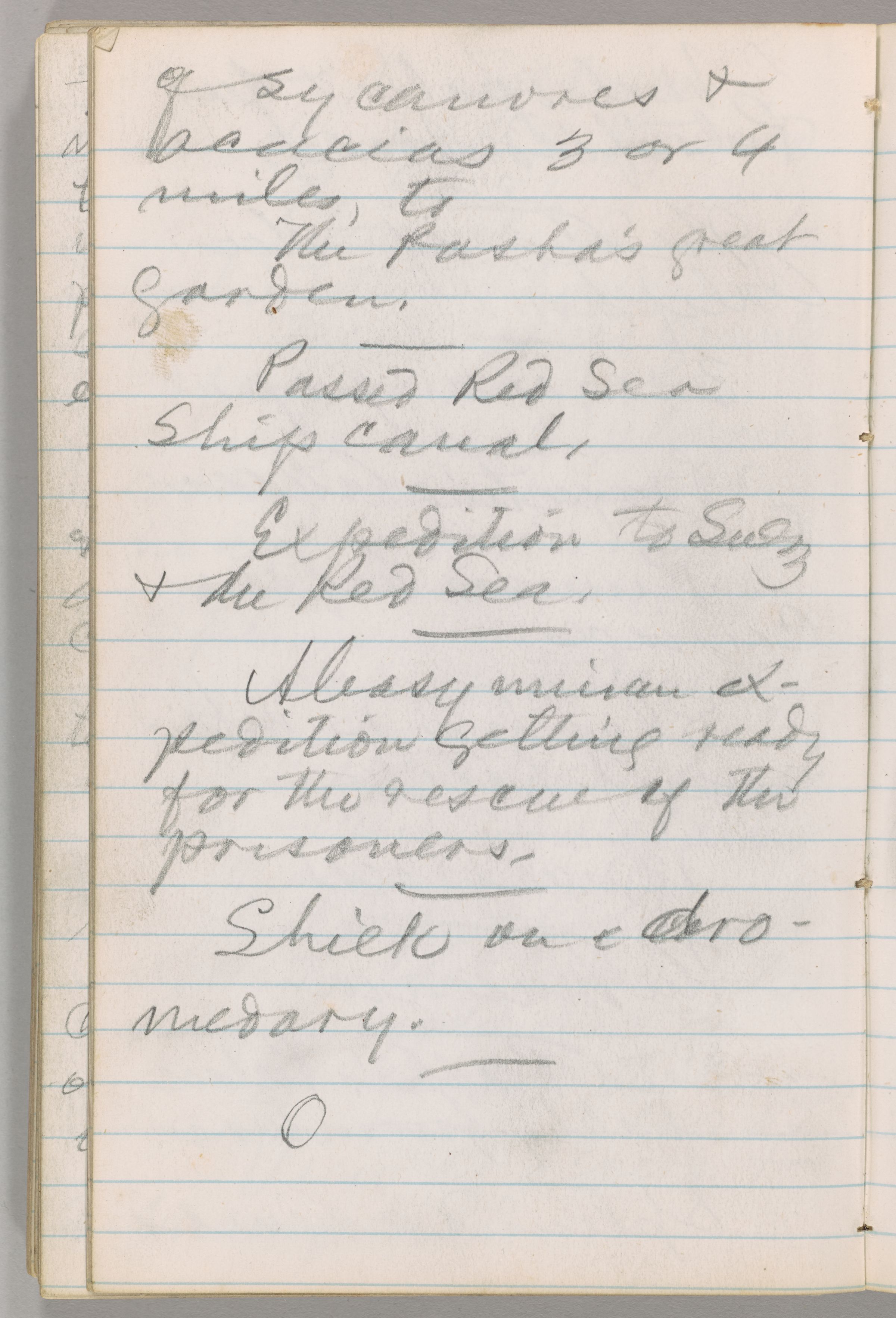
[MS: N9_leaf_077v]
of sycamores &
acacias 3 or 4
miles, to
Passed Red Sea
Ship canal.
Expedition to Suez
& the Red Sea.
[MTP: N&J1_446]
Abasynnian
ex-
pedition
expedition
getting ready
for the rescue of the
prisoners.
Shiek on a ca
dro-
medary
dromedary
.
O
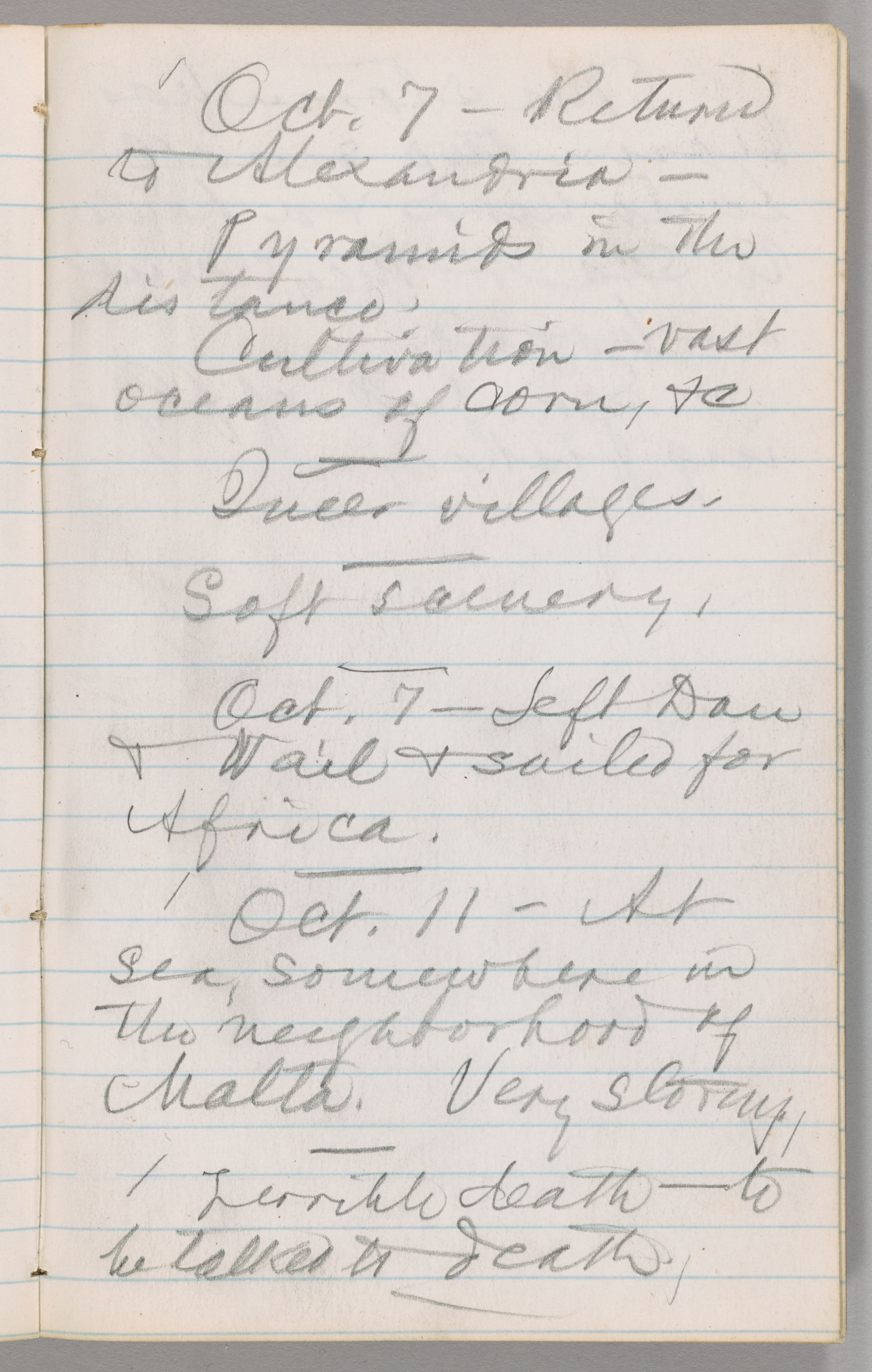
[MS: N9_leaf_078r]
Oct. 7—Returnd
to Alexandria—
Pyramids in the
distance.
Cultivation—vast
oceans of corn, &c
Queer villages.
Soft scenery.
Oct. 7—Left Dan
& Vail & sailed for
Africa.
Oct. 11—At
sea, somewhere in
the neighborhood of
Malta. Very stormy.
Terrible death—to
be talked to death.
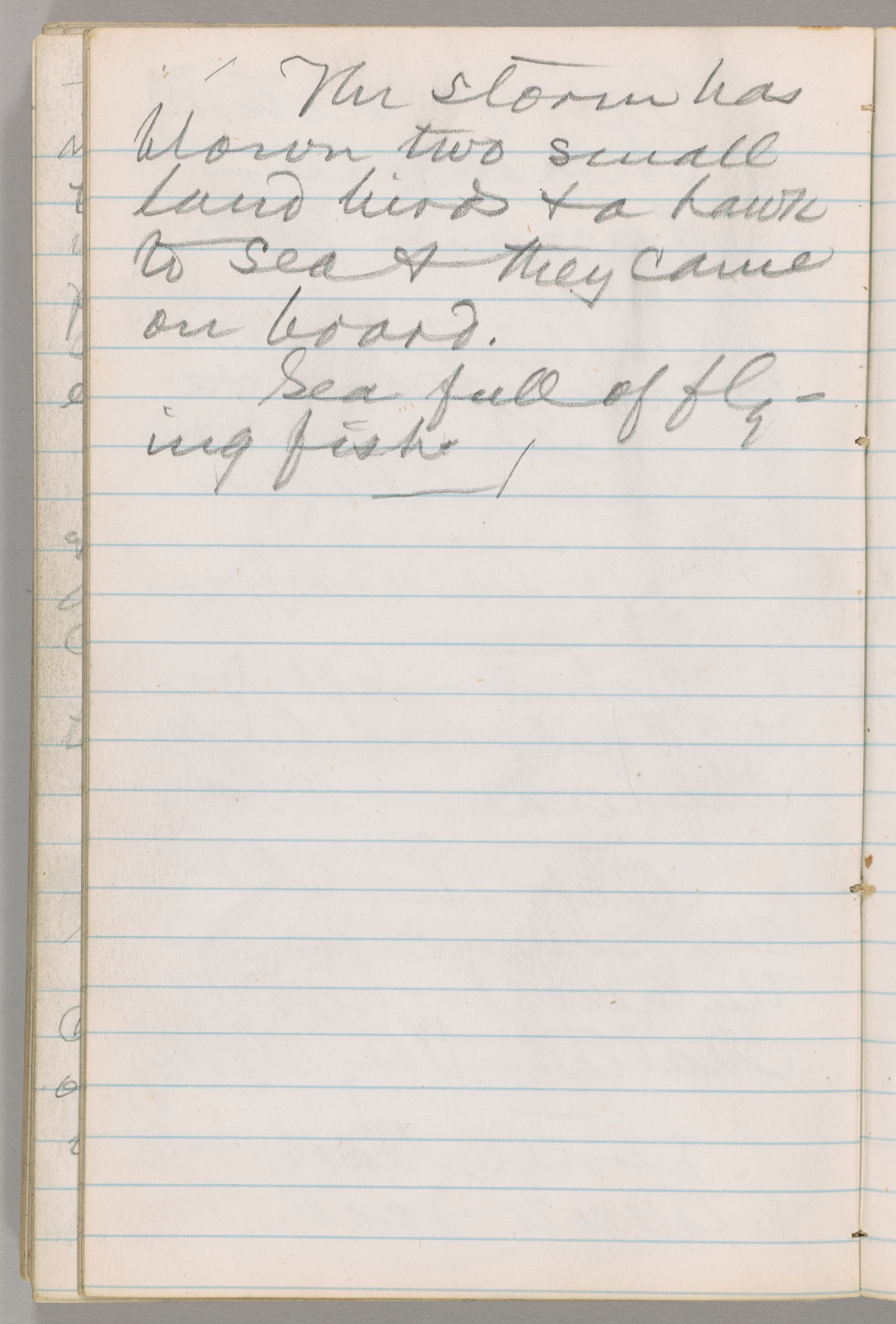
[MS: N9_leaf_078v]
[MTP: N&J1_447]
The storm has
blown two small
land birds & a hawk
to sea & they came
on
board.
Sea full of
fly-
ing
flying
fish.
sequence 2
Clemens inscribed the remaining pages of the notebook from the back cover; the text that follows begins with a new sequence of pages beginning with the outside back cover
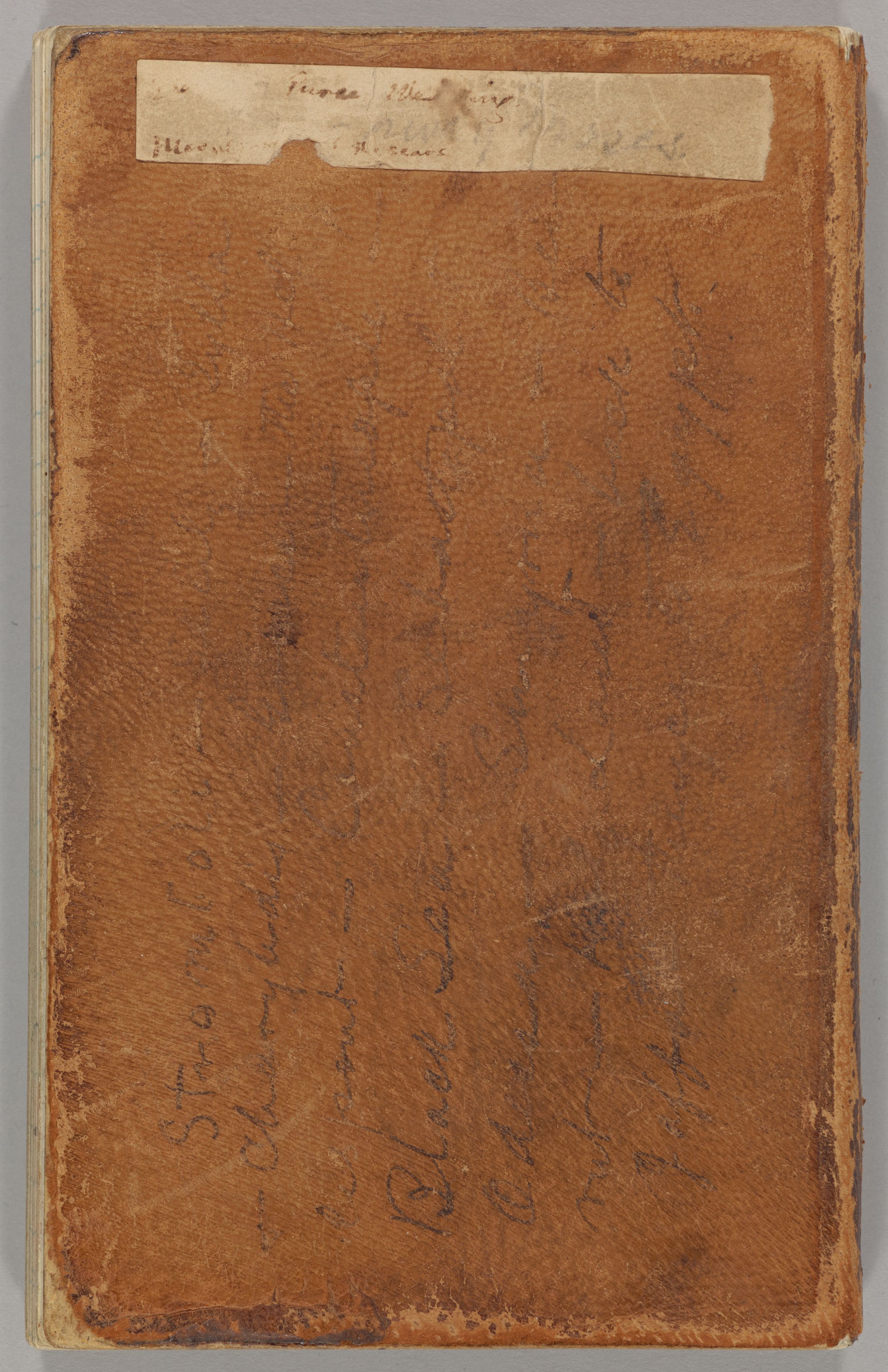
[MS: N9_outside back cover]
Stromboli—Sicily—Sylla
—Charybdis—Greece—the
Hellespont—Constantinople—
Black Sea—Sebastopol &
Odessa,—Smyrna—
Bei-
rut
Beirut
—Holy
Land—back to
Jaffa—thence to Egypt.
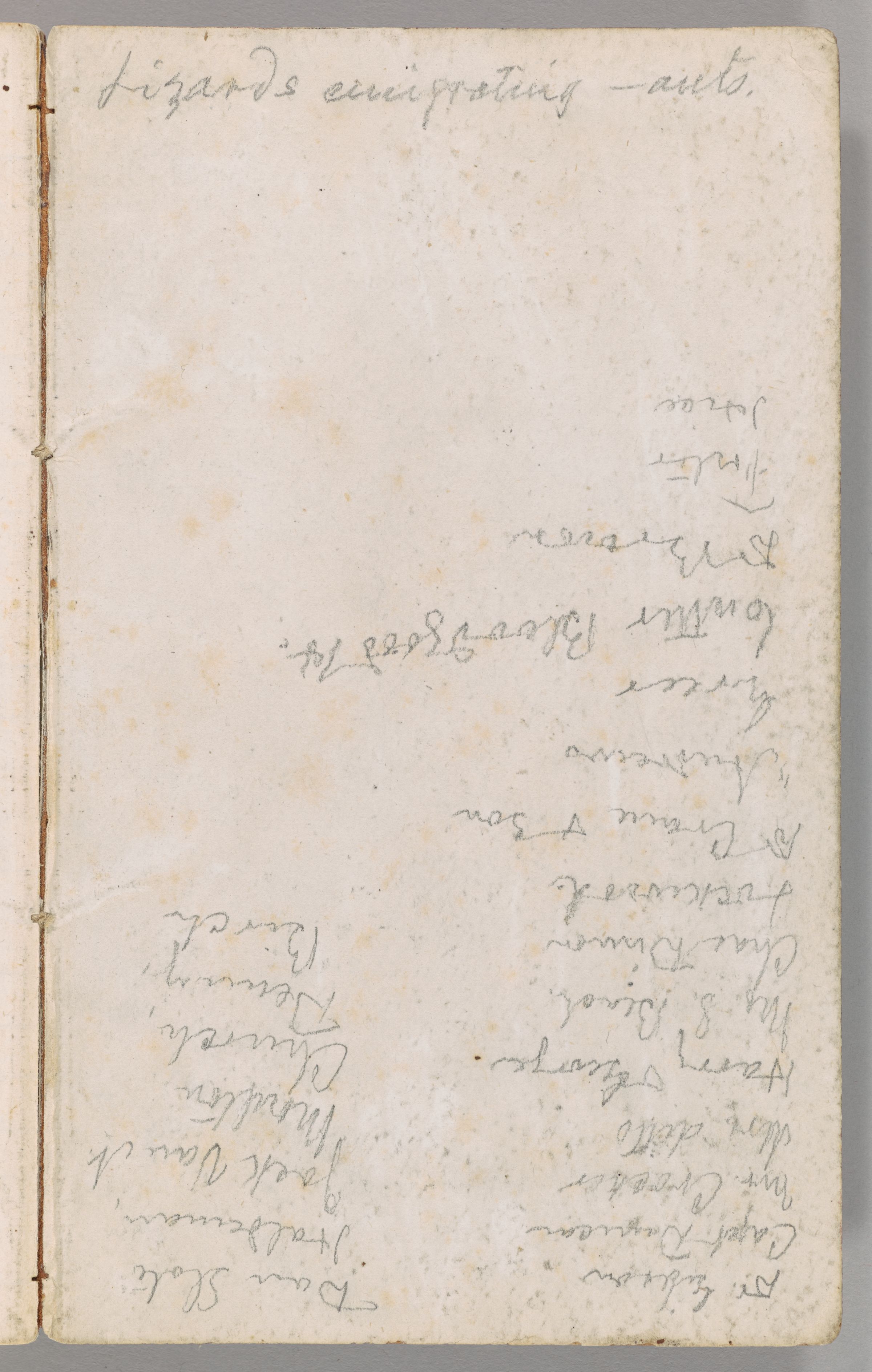
[MS: N9_inside back cover]
written upside down at the bottom of the page
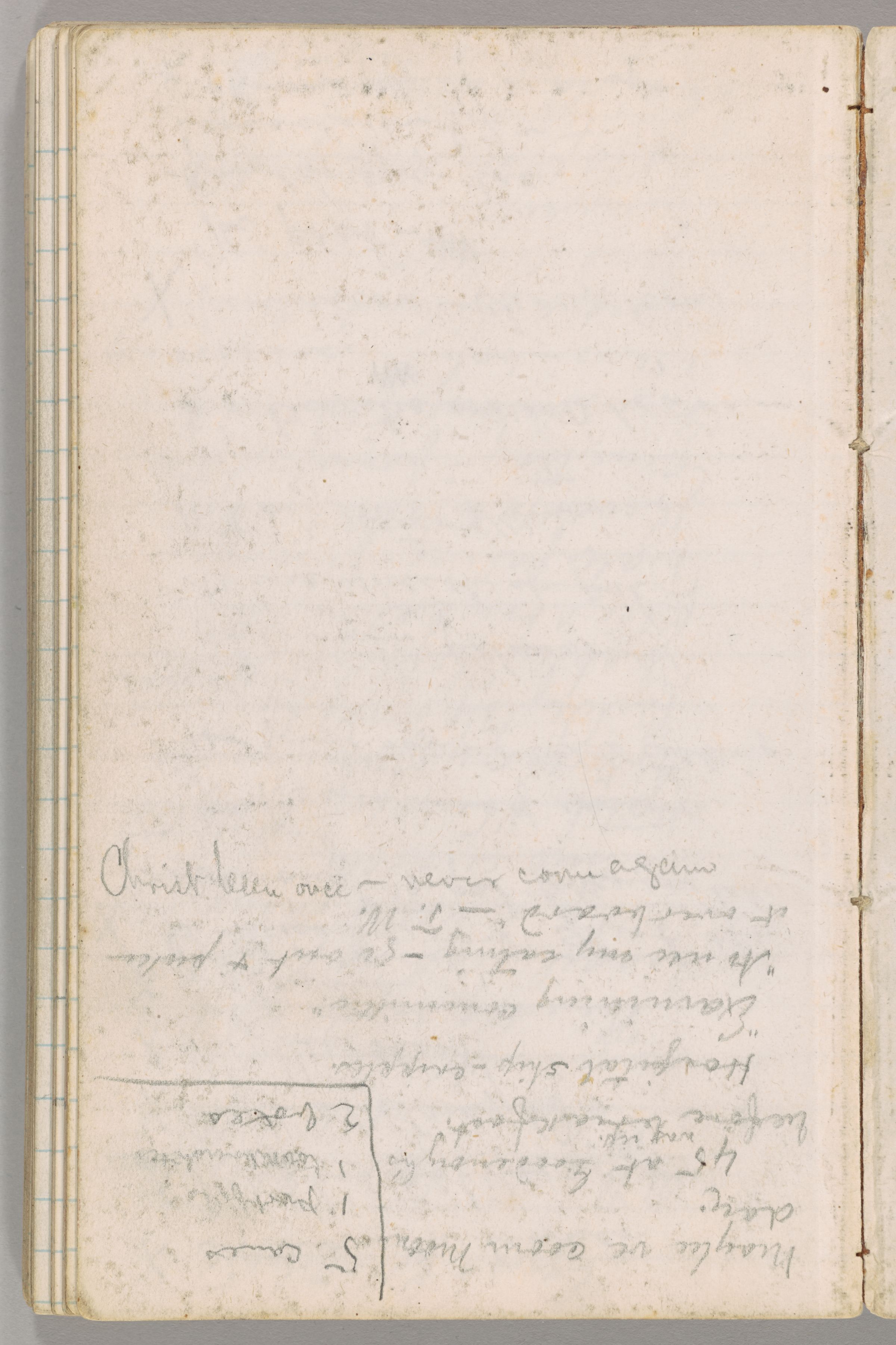
[MS: N9_back flyleaf recto]
5 canes
1 portfolio
1 toothbrush &c.
2 boxes.
Maybe ve coom
Moon-
day
Moonday
.
[MTP: N&J1_449]
45 at Goodenough’s
before was
up. breakfast.
Hospital ship—cripples.
“No use my eating—go out & puke
it overboard.”—J. W.
written upside down directly below the previous paragraph
Christ been once—never come again.
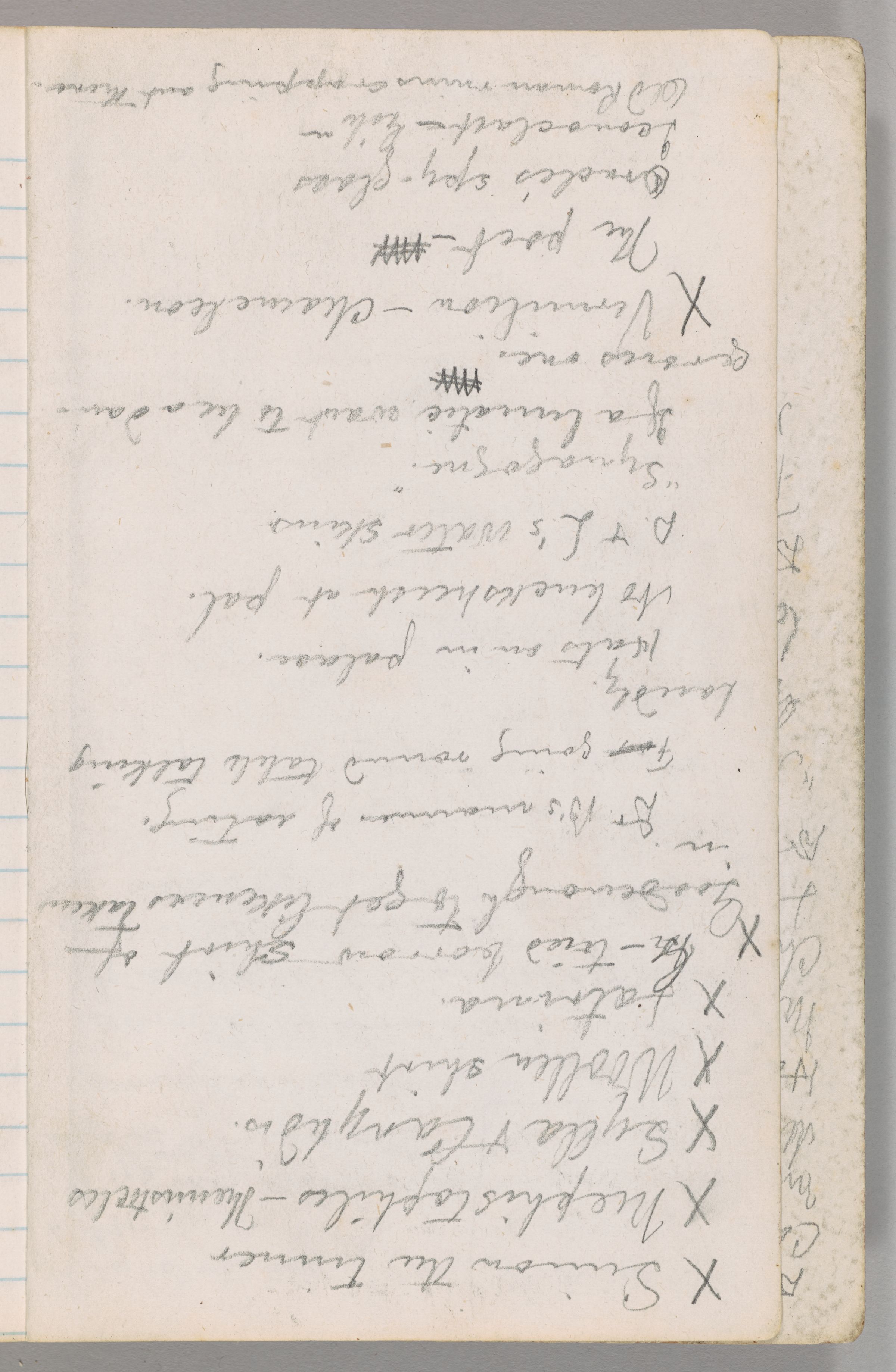
[MS: N9_back flyleaf verso]
✗ Mephistophiles—Themistocles
✗ Sylla & Carybdis.
✗ Woollen shirt
✗ Latrina.
✗
MG—tried borrow shirt of
Goodenough to get likeness
taken
in.
Dr. B’s manner of eating.
Fos going round table talking
loudly.
[MTP: N&J1_450]
D. & L.’s water skins.
If a lunatic want to be a
dan-
gerous
dangerous
one.
✗ Vermilion—chameleon.
[MTP: N&J1_451]
Old Roman ruins cropping out there.
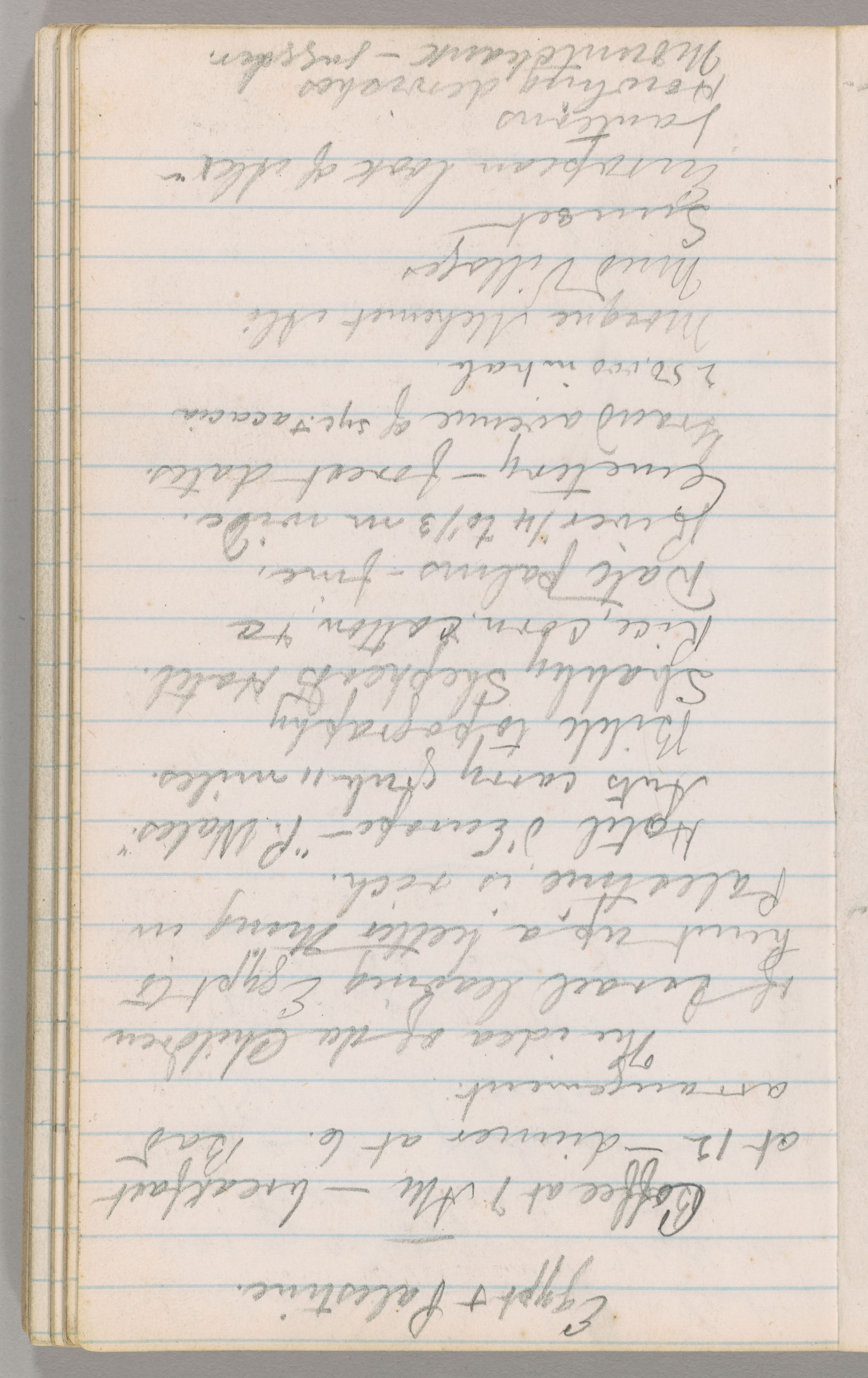
[MS: N9_leaf_01r]
Egypt & Palestine.
Bre Coffee at 7 AM—breakfast
at 12—dinner at 6. Bad
arrangement.
The idea of the Children
of Israel leaving Egypt to
hunt up a better thing in
Palestine is rich.
Hotel d’Europe—“P. Wales.”
Ants carry grub 11 miles.
Bible topography
Shabby Shepherd’s Hotel.
Rice, corn, &cotton, &c
Date palms—fine.
River ¼ to ⅓ m wide.
Cemetery—forest dates.
Grand avenue of syc. & acacia
250,000 inhab.
Mosque Mehemet Ali
Mud Villages
Sunset
European look of Alexn
Lanterns
Howling dervishes
Mountebank—juggler.
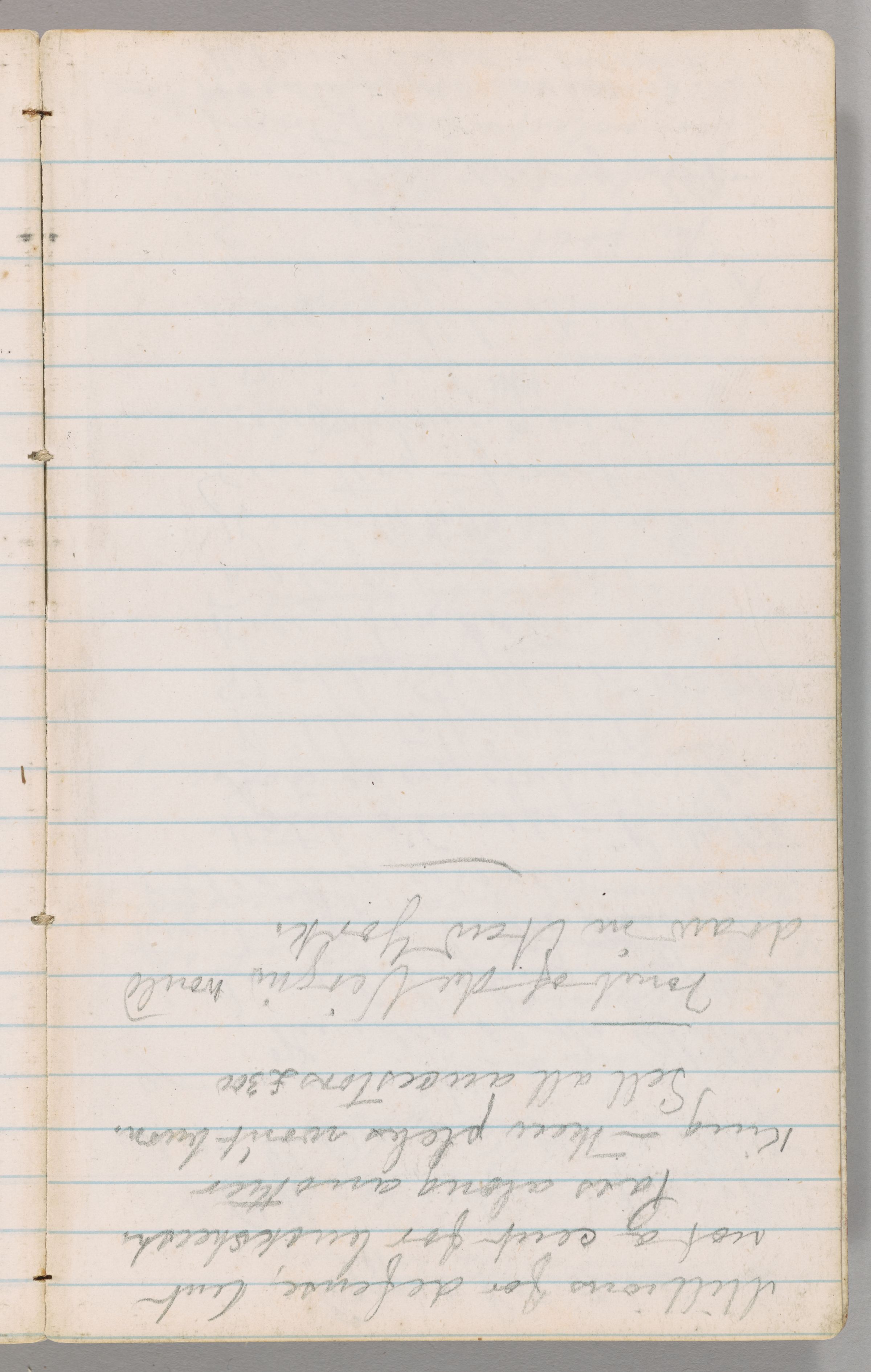
[MS: N9_leaf_01v]
Millions for defense, but
not a cent for bucksheesh.
[MTP: N&J1_452]
Pass along another
King—these plebs won’t burn.
Tomb of the Virgin would
draw in New York.
eight blank pages follow
sequence 3
a new sequence of two pages begins below, dated August 14 (see leaf 006r in sequence 1 at the beginning of this notebook); they are followed by a third page with a drawing
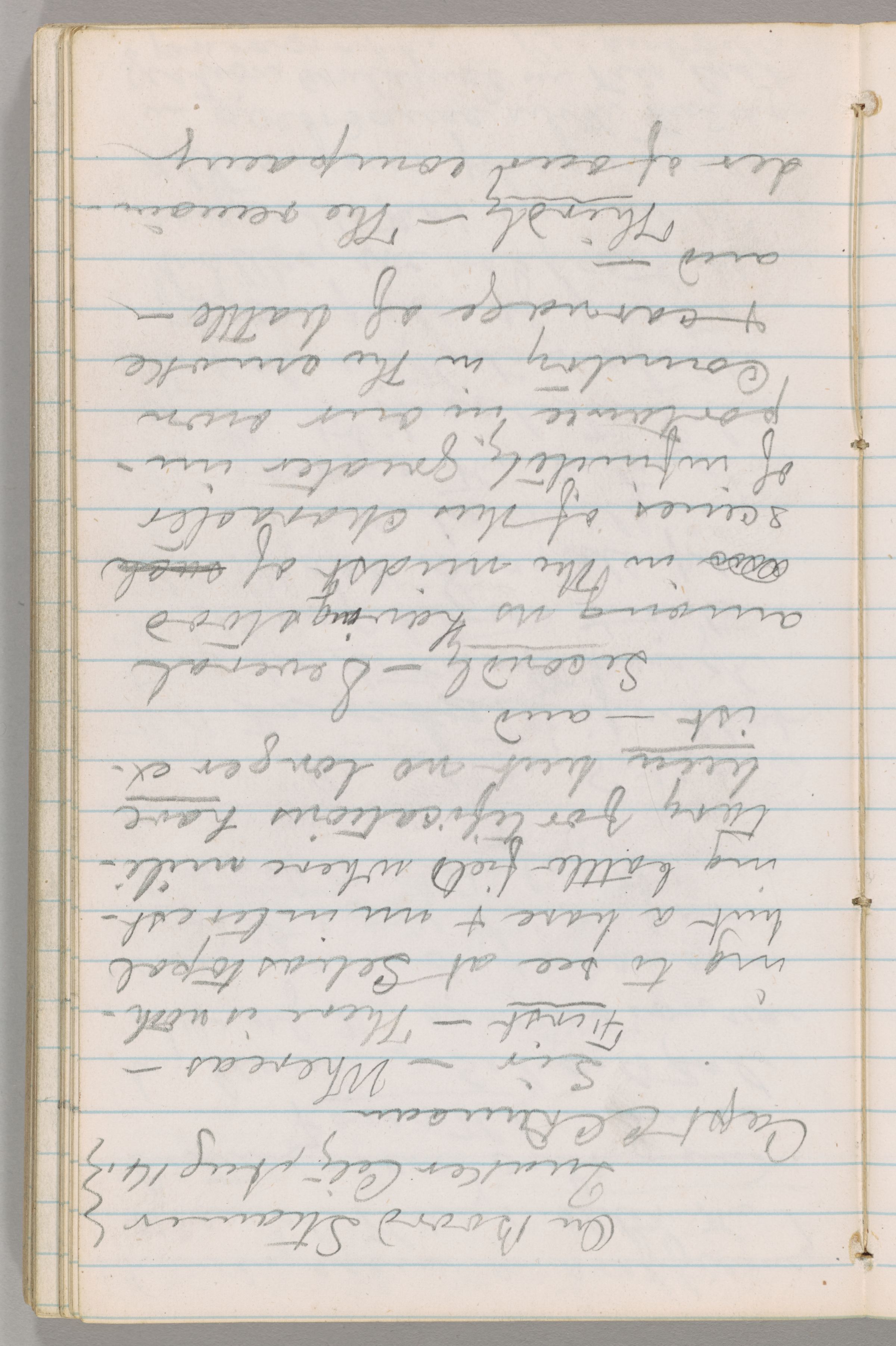
[MS: N9_leaf_06r]
[MTP: N&J1_386]
a brace appears to the right of the two lines below
Quaker City, Aug 14.
Capt C C Duncan
Sir—Whereas—
First—There is
noth-
ing
nothing
to see at Sebastopol
but a bare
&
[MTP: N&J1_387]
uninterest-
ing
uninteresting
battle-field where
mili-
tary
military
fortifications have
been but no longer
ex-
ist
exist
—and
Secondly—Several
among us haveing stood
am in the midst of such
scenes of this character
of
infinitely greater
im-
portance
importance
in our own
Country in the smoke
& carnage of
battle—
and—
Thirdly—The
remain-
der
remainder
of our company
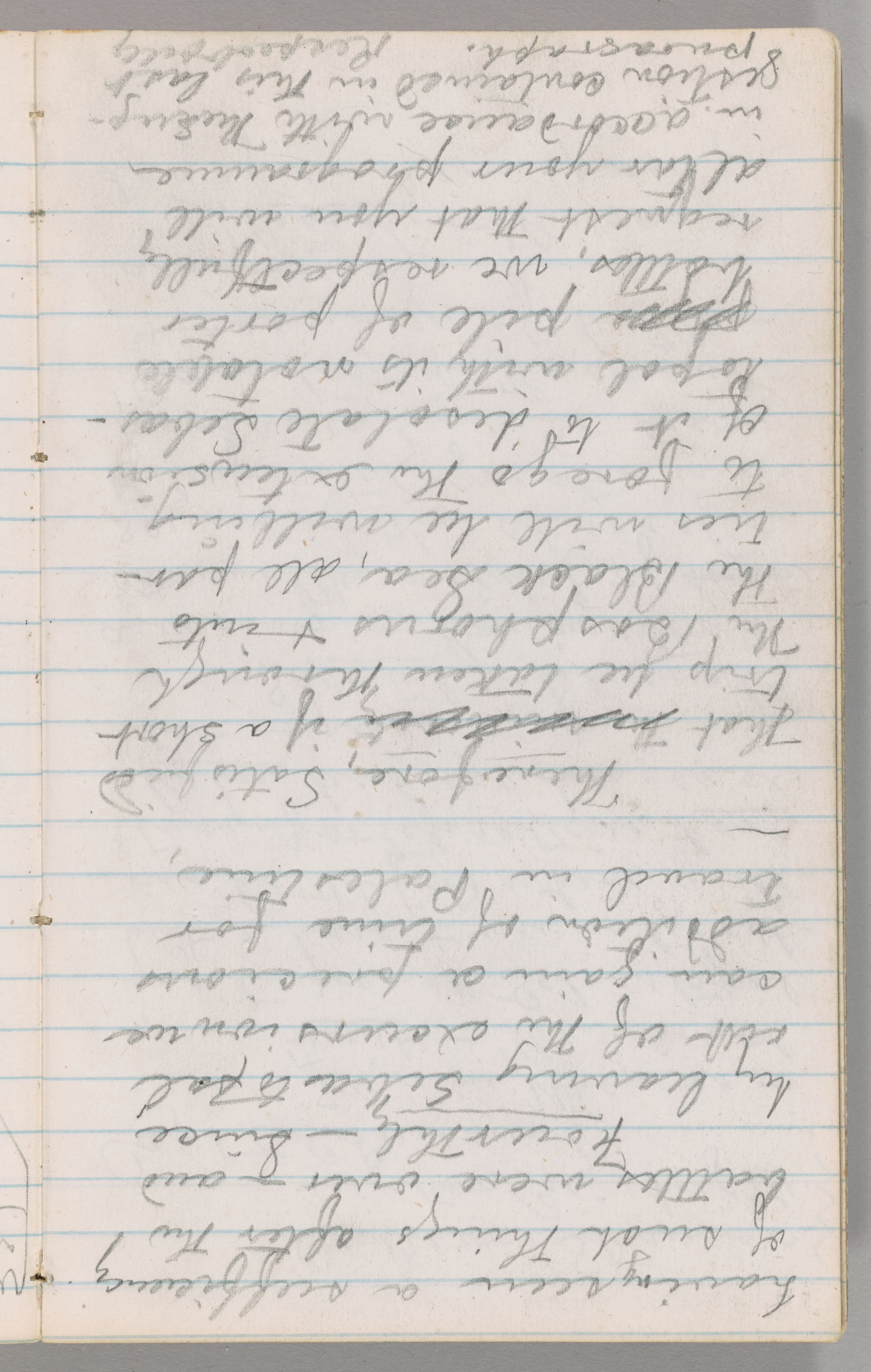
[MS: N9_leaf_06v]
having
seen a sufficiency
of such things after the
battles were over—and
Fourthly—Since
by leaving Sebastopol
out of the excursion
we
can gain a precious
addition of time for
travel in Palestine,
—
Therefore, Satisfied
that the minority if a
short
trip be taken through
the Bosphorus & into
the Black Sea, all
par-
ties
parties
will be willing
to forego the extension
of it to desolate
Sebas-
topol
Sebastopol
with its
notable
pyr pile of porter
bottles, we respectfully
request that you
will
alter your programme
in accordance with the
sug-
gestion
suggestion
contained in this last
paragraph.
Respectfully
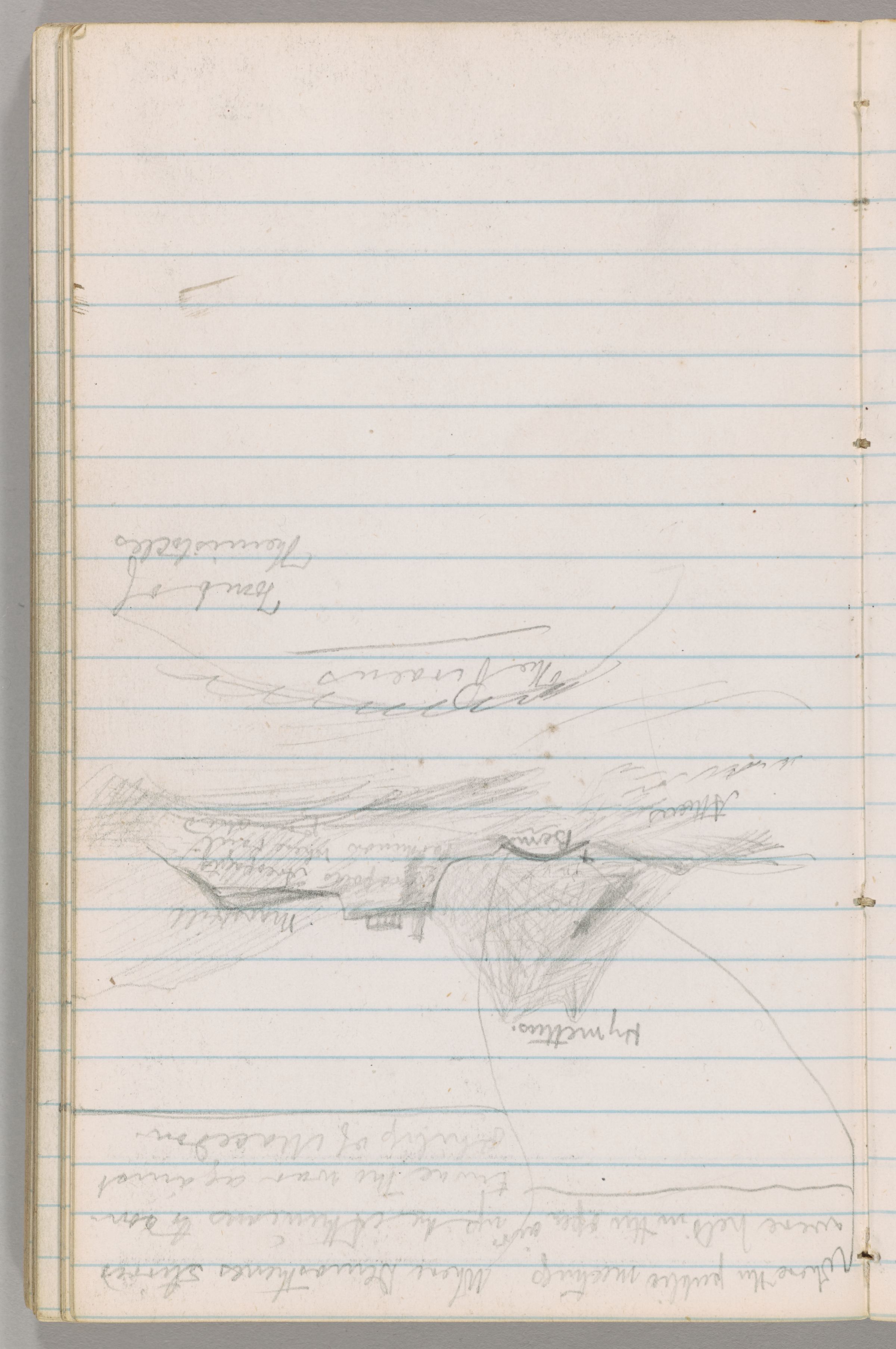
[MS: N9_leaf_07r]
pointing to the left side of ‘Bema’ in drawing below:
Where the public meetings
were held in the open air.
pointing to the right side of ‘Bema’ in drawing below:
Where Demosthenes stirred
up the Athenians to
con-
tinue
continue
the war against
Philip of
Macedon.
drawing, labeled:
Hymettus
Mars Hill
Acropolis
Parthenon
Areopagus
where Paul
preached
Athens
Bema
The Piraeus
Tomb of Themistocles
thirteen blank pages follow before the last page of sequence 1
Clemens was evidently not innocent of the “vandalism” for which he attacked his companions in chapter 45 of The Innocents Abroad:
The incorrigible pilgrims have come in with their pockets full of specimens broken from the ruins. I wish this vandalism could be stopped. They broke off fragments from Noah’s tomb; from the exquisite sculptures of the temples of Baalbec; from the houses of Judas and Ananias, in Damascus; from the tomb of Nimrod the Mighty Hunter in Jonesborough; from the worn Greek and Roman inscriptions set in the hoary walls of the Castle of Banias; and now they have been hacking and chipping these old arches here that Jesus looked upon in the flesh. Heaven protect the Sepulchre when this tribe invades Jerusalem!
The first entry in the following fragment in the private collection of Roger Barrett of Chicago is clearly related to the wedding of Robert Vail, the ship’s purser. Although it was probably not torn from this notebook, it is given here as supplementary information:
Vail’s courtship.
Down in tar-schoonersloop & back in kivered wagon.
Wm Mason—What matter wh yr leg?—Me—WHear you are writing book?
Salting bird’s tail.
Nautical Yarn full of technicalities
Some N.Y. Clerks.
The items marked by a marginal X here and below seem to be reminders for some of the “Oracle’s” malapropisms or for jibes at other passengers. Clemens used “Sylla and Carybdis” in chapter 32 of The Innocents Abroad where he described an encounter between the “Oracle” and “one of the boys”:
“It ain’t mentioned in the Bible!—this place ain’t—well now, what place is this, since you know so much about it?”
“Why it’s Scylla and Charybdis.”
“Scylla and Cha—confound it, I thought it was Sodom and Gomorrah!”