(July 1868)
Clemens recorded most of the entries in Notebook 11 while traveling from San Francisco to New York, by way of the Isthmus of Panama, in the summer of 1868. This notebook is largely made up of the two literary sketches, one completed and the second abandoned, that Clemens probably worked on during the Pacific and Atlantic stretches of the journey. In addition, the notebook includes observations, anecdotes, names, and topics intended for development in Clemens' newspaper correspondence.
Unfortunately no notebook survives from Clemens' immensely productive stay in California during the spring of 1868. He had left Washington in March and sailed for California in haste, explaining in a letter to Mrs. Fairbanks on the eve of his sailing: “If the Alta's book were to come out with those wretched, slangy letters unrevised, I should be utterly ruined” (MTMF, p. 24). When he arrived in San Francisco on 2 April, Clemens applied himself to the task of dissuading the owners of the Alta California from publishing a collection of his Quaker City letters, but it was over a month before he could send word of success to the publisher, Elisha Bliss, who was planning to issue Mark Twain's own revision of the Alta letters.
While waiting for the Alta to relent, Clemens kept busy by lecturing on the Quaker City pilgrimage. He filled a hall in San Francisco—“a little over sixteen hundred dollars in the house—gold & silver,” he reported to Mrs. Fairbanks (MTMF, p. 26)—and then set off on a triumphant two-week lecture tour that retraced the circuit through the California Mother Lode country into Nevada which he made in 1866 with his Sandwich Islands lecture. Upon his return to San Francisco, Clemens learned that the Alta had finally accepted his terms. “I am steadily at work,” he wrote to Bliss on 5 May, “and shall start East with the completed Manuscript, about the middle of June” (MTL, p. 153).
During the next two months, in all-night sessions, Clemens completed the Innocents Abroad manuscript. On 23 June he could write to Bliss, “The book is finished, & I think it will do” (University of Pittsburgh). With this prodigious labor accomplished, he could not resist postponing his departure, as he told Bliss on 5 July, “in order to lecture & so persecute the public for their lasting benefit & my profit” (TS in MTP). This was Clemens' 2 July farewell lecture to San Francisco on Venice. On 6 July he boarded the steamship Montana and sailed through the Golden Gate for the last time.
The midsummer voyage down to Panama was pleasant—“we had smooth water and cool breezes all the time”—according to his account published in the Alta California on 6 September. Clemens evidently took the opportunity to recuperate from his two months' burst of labor, for Notebook 11 is unusually spare in observation. The voyage passed largely without incident, and the most noteworthy event turned out to be an evening of amateur theatricals presented on July 10 by the shipboard stag party which Clemens helped organize.
After a stop at Acapulco on 13 July, the Montana continued on to Panama. It was probably during this leg of the voyage that Clemens turned his attention to the drafting of “The Story of Mamie Grant, the Child-Missionary.” A burlesque of unctuous Sunday school literature (see S&B, pp. 31–32, for a fuller discussion), this heavily ironic sketch is a continuation in spirit of Clemens' attacks on the self-conscious piety of the Quaker City pilgrims.
The Montana docked at Panama on 20 July. While pausing at the bar of the Grand Hotel, Clemens unexpectedly met Captain Edgar Wakeman but the encounter is not recorded in this notebook. He did, however, make notes on the Panama Railroad Company, which carried him across the isthmus in three hours, in contrast to his two-day journey by river steamer across Nicaragua in 1866. At the end of the line in Aspinwall, Clemens was greeted by sights he had seen in March while hurrying to California—“the same combination of negroes, natives, sows, monkeys, parroquets, dirt, jiggers, and groceries in the small shops far up town; the same clusters of steamships in the harbor; the same business stir about the steamship office” (Alta, 6 September 1868). Here Clemens boarded the Henry Chauncey and on 21 July sailed for New York.
The idea for the story about a Frenchman's balloon voyage to a prairie in Illinois, which appears as the first entry following “Mamie Grant,” had occurred to Clemens while en route to Panama, and he may well have taken the opportunity during the Atlantic voyage to begin work on the narrative. The date of composition, however, cannot be determined precisely. Clemens' note on the sketch, attributing its unfinished state to the publication of Jules Verne's Five Weeks in a Balloon, could not have been made before the spring of 1869, when the novel was first published in the United States. Yet the sketch itself appears to have been written on shipboard.
Although the similarity to Verne's novel was close enough to persuade Clemens to abandon his narrative, he would return to the idea at least twice. In April 1876 he incorporated a journey from France to the Midwest in a balloon into a manuscript titled “A Murder, a Mystery, and a Marriage,” but it wasn't until 1894, in Tom Sawyer Abroad, that Mark Twain was able to exploit fully the idea of structuring a narrative around a balloon voyage.
The Henry Chauncey arrived in New York on 29 July. Five days later Clemens was still in New York, where he wrote to Mrs. Fairbanks: “I have met many friends, & have been very, very busy” (MTMF, pp. 34–35). On 4 August he took the train to Hartford and delivered the manuscript to Bliss. “Of all the beautiful towns it has been my fortune to see this is the chief,” wrote Mark Twain in his 6 September letter to the Alta, “I never saw any place before where morality and huckleberries flourished as they do here.” Clemens remained in Hartford for two weeks, working on the manuscript with Bliss and catching up on his newspaper correspondence, and in the last week of August, following several days in New York, he was at last ready to go to Elmira for the visit with the Langdons which was to begin his courtship of Olivia.
Notebook 11 now contains 108 pages, 57 of them blank. The pages measure 7⅜ by 4 9/16 inches (18.7 by 11.6 centimeters), and their edges are marbled in red, black, and gold. The pages are ruled with twenty-three blue horizontal lines and are divided by red vertical lines into four unequal columns in account book fashion. The endpapers and flyleaves are white. The cover is stiff natural calf; the binding has recently been repaired. There is an inscription in ink on the front cover, probably written by Paine:
July 1868
SF. to N.Y
2 Stories in here.
All entries are in pencil. Most, including all of the Mamie Grant and balloon voyage narratives, are on right-hand pages only. The notebook's first twenty-five right-hand pages, which contain the Mamie Grant sketch, are numbered consecutively. Paine entered occasional use marks in black pencil, though there are none in the two extended sketches.
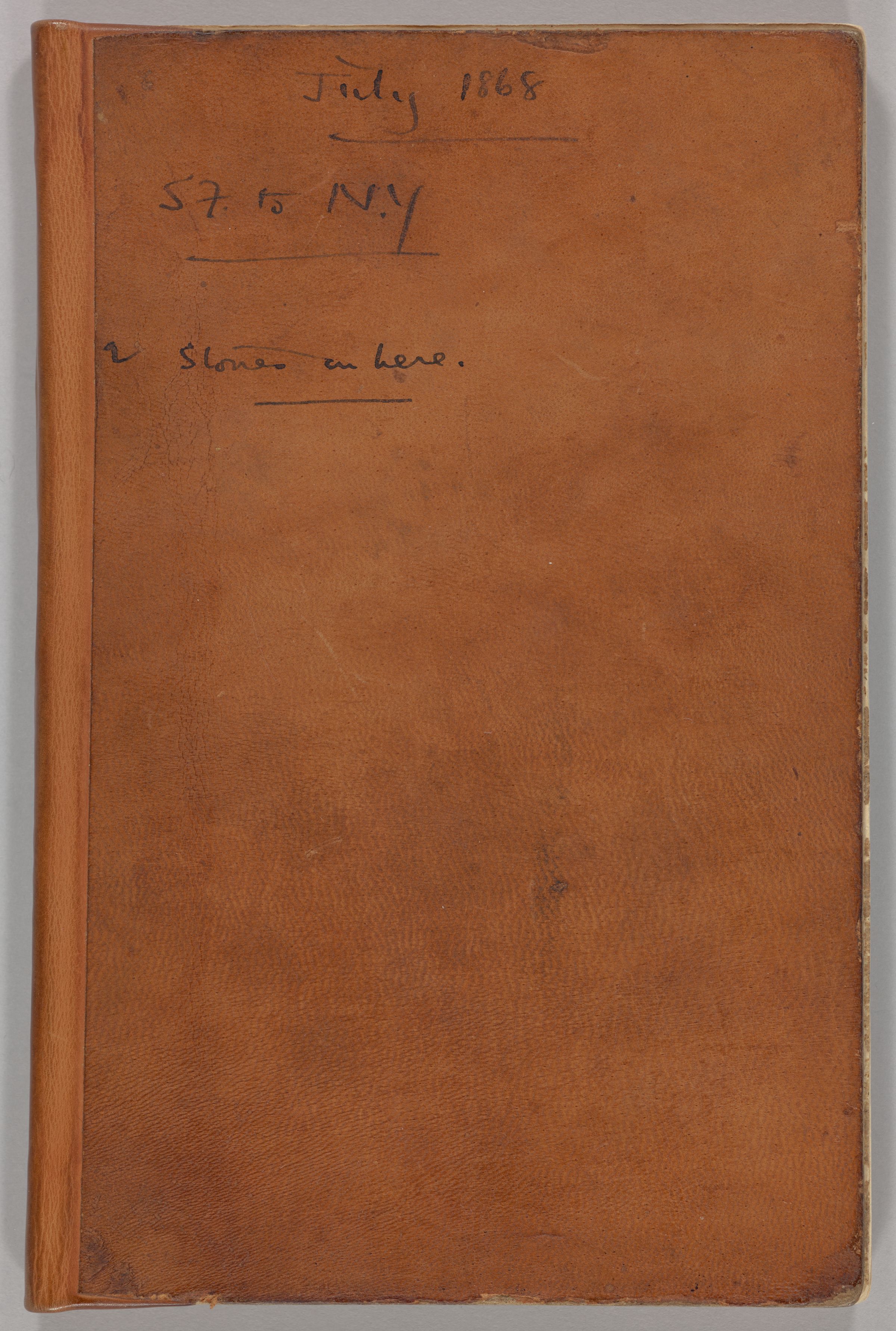
[MS: N11_outside front cover]
in unknown hand, possibly AB Paine:
July 1868
SF to N.Y
2 stories in here.

[MS: N11_front endpaper]
blank

[MS: N11_front flyleaf recto]
blank
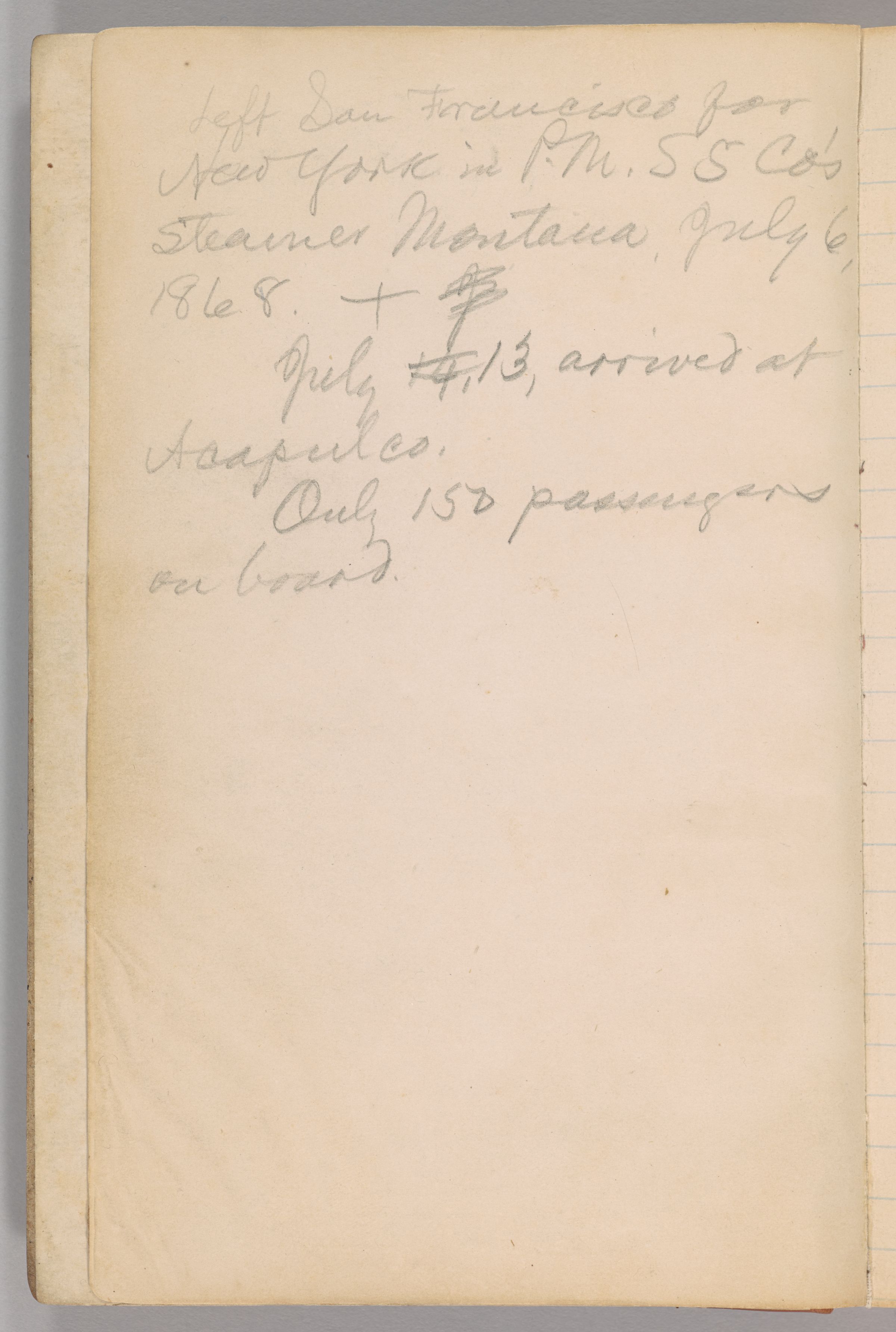
[MS: N11_front flyleaf verso]
L
Left San Francisco for New York in P.M. SS Co's Steamer Montana, July 6, 1868. —J
July 14, 13, arrived at Acapulco.
Only 150 passengers on board.Ⓣtextual note1
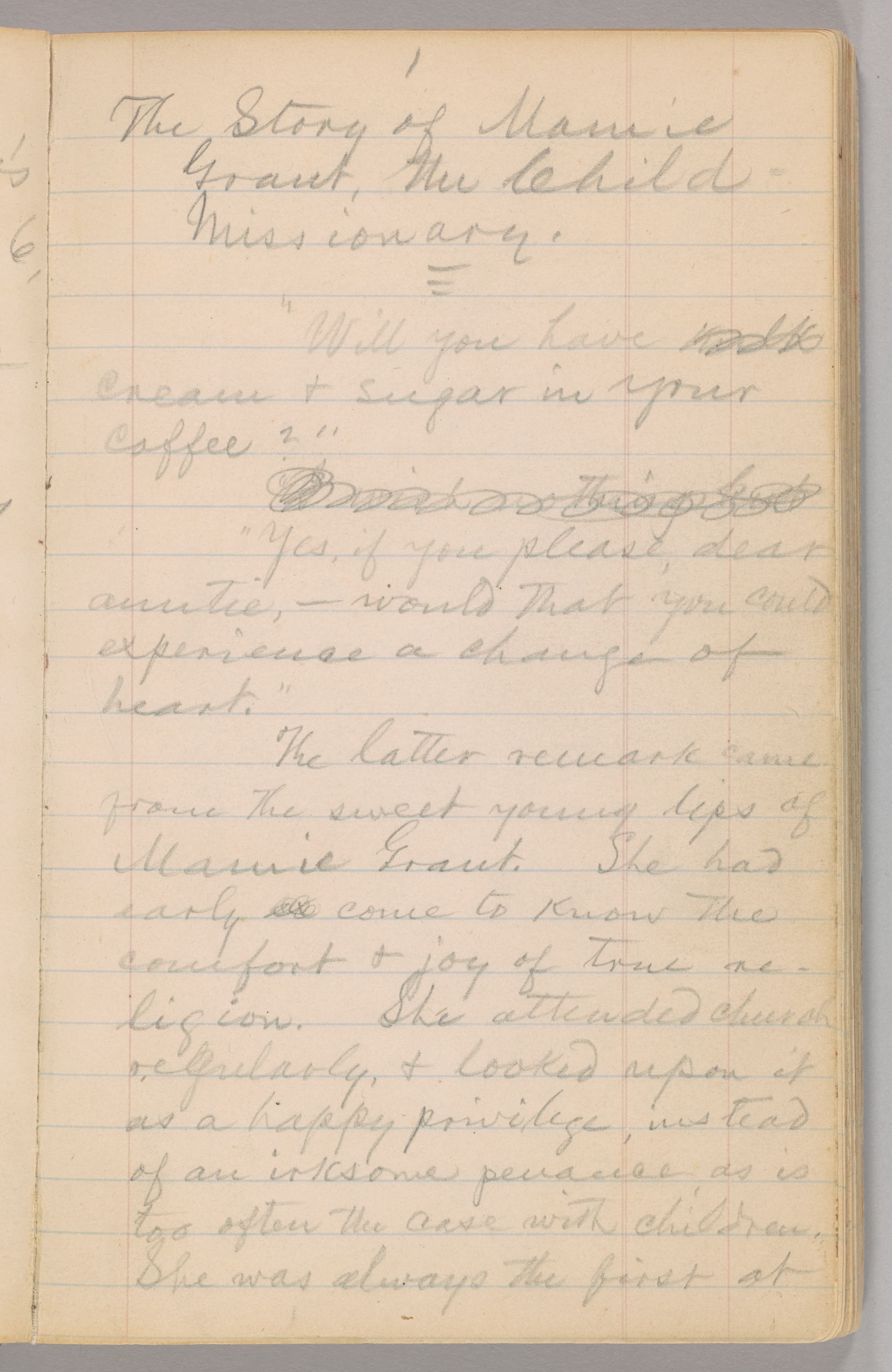
[MS: N11_leaf_001r]
The Story of Mamie Grant, the Child-Missionary.
“Will you have milk cream & sugar in your coffee?”
“I wish nothing but
“Yes, if you please, dear auntie,—would that you could experience a change of heart.”
The latter remark came from the sweet young lips of Mamie Grant. She had early ex come to know the comfort & joy of true religion. She attended church rel regularlyⓉtextual note, & looked upon it as a happy privilege, instead of an irksome penance, as is too
often the case with children. She was always the first at
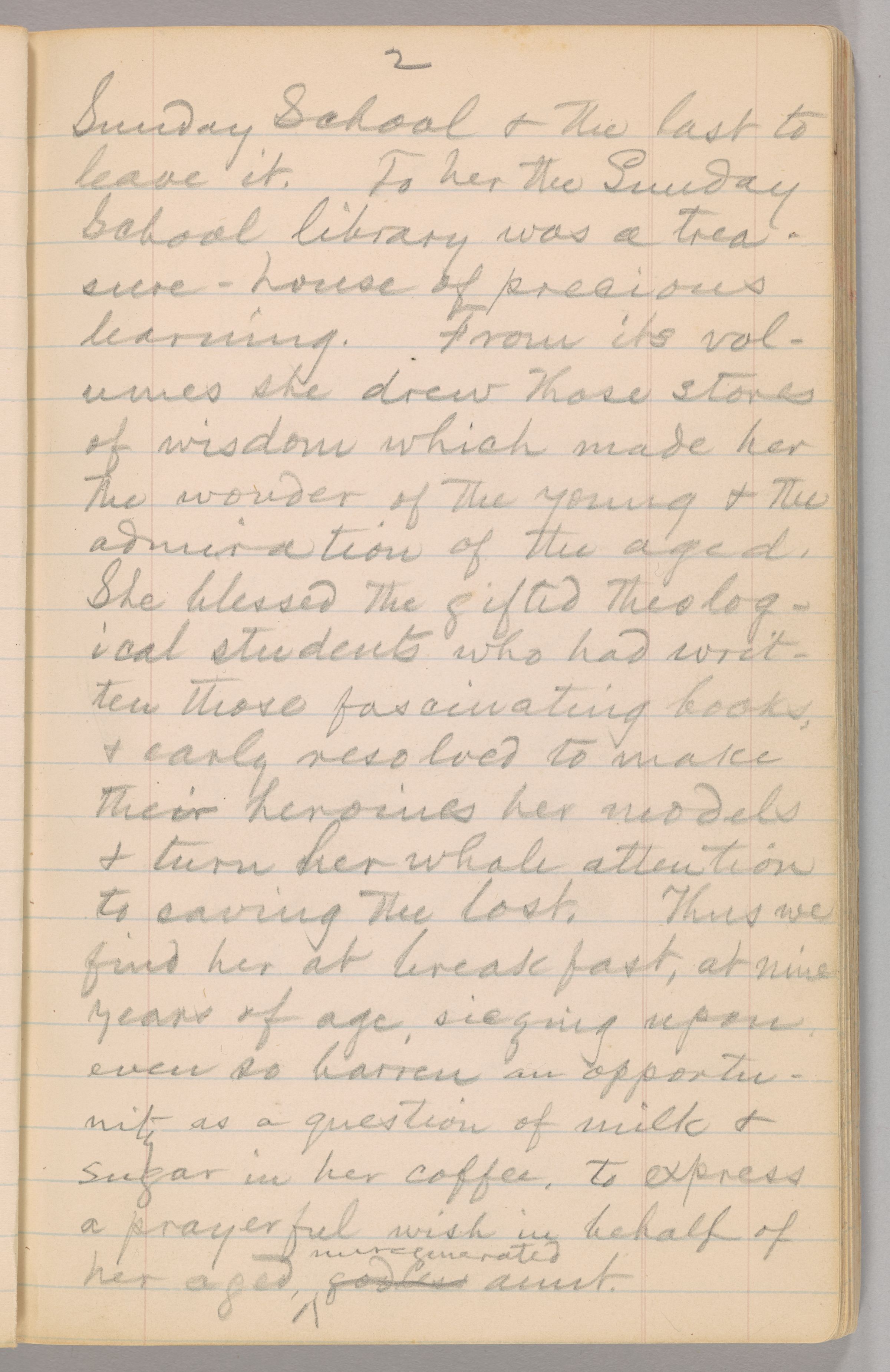
[MS: N11_leaf_002r]
Sunday School & the last to leave it. To her the Sunday School library was a treasure-house
of precious learning. From its volumes she drew those stores of wisdom which made
her the wonder of the young & the admiration of the aged. She blessed the gifted theological
students who had written those fascinating books, & early resolved to make their heroines
her models & turn her whole attention to saving the lost. Thus we find her at breakfast,
at nine years of age, siezing upon even so barren an opportunity as a question of
milk & sugar in her coffee, to express a prayerful wish in behalf of her aged, godless unregeneratedⓉtextual note aunt.
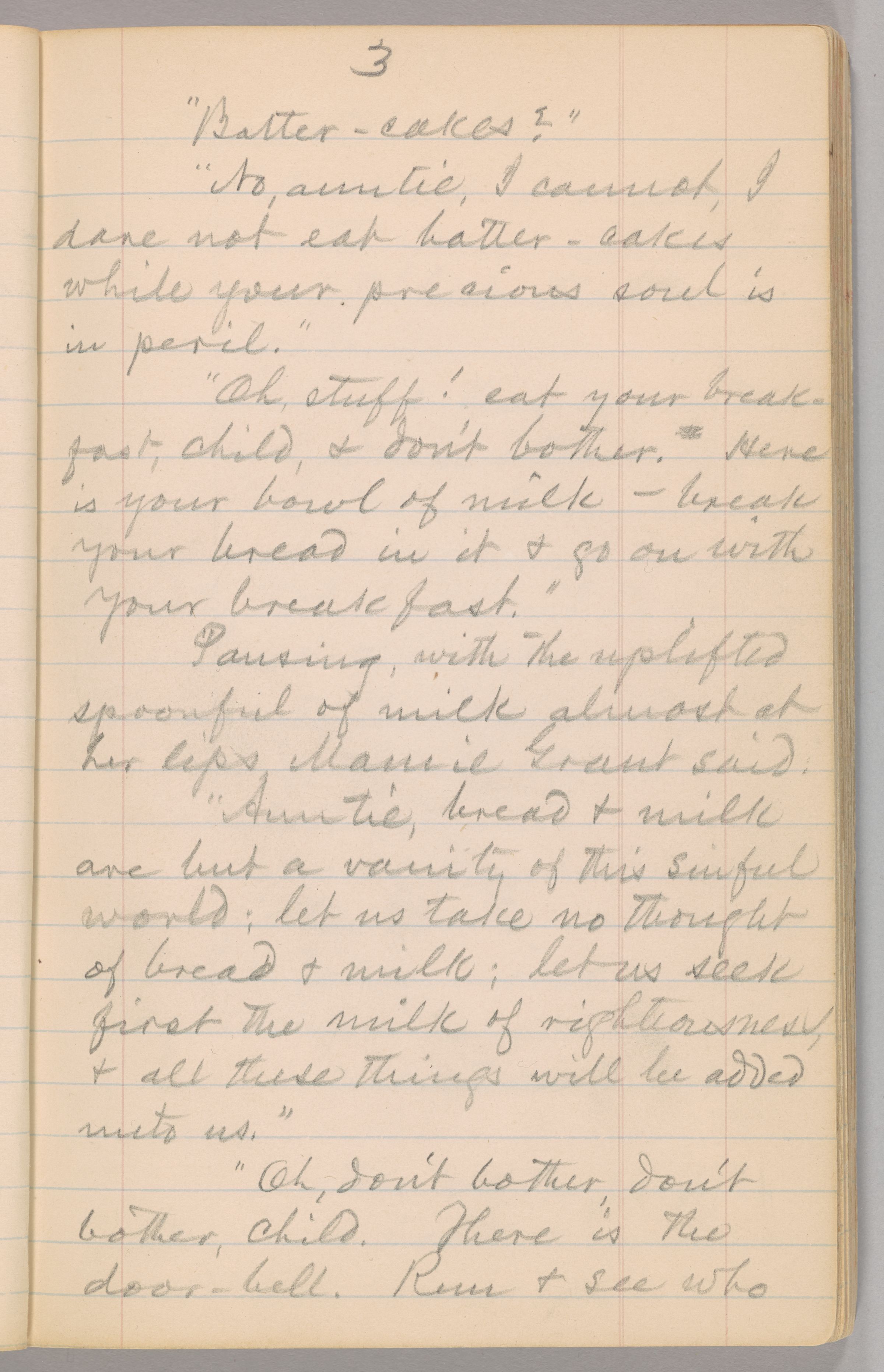
[MS: N11_leaf_003r]
“Batter-cakes?”
“No, auntie, I cannot, I dare not eat batter-cakes while your precious soul is in peril.”
“Oh, stuff! eat your breakfast, child, & don't bother.” Here is your bowl of milk—break your bread in it & go on with your breakfast.”
Pausing, with the uplifted spoonful of milk almost at her lips, Mamie Grant said:
“Auntie, bread & milk are but a vanity of this sinful world; let us take no thought of bread & milk; let us seek first the milk of righteousness, & all these things will be added unto us.”
“Oh, don't bother, don't bother, child. There is the door-bell. Run & see who
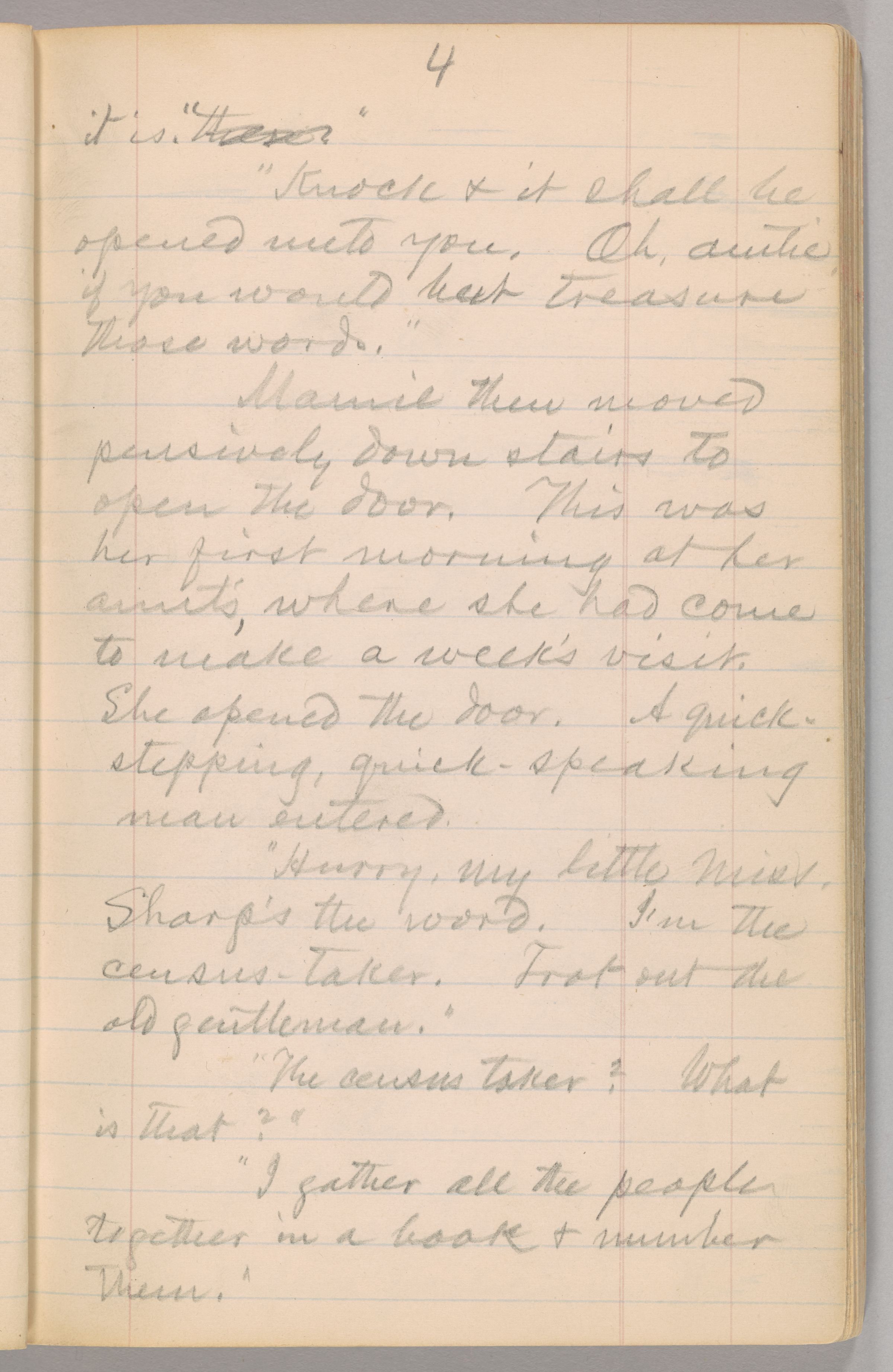
[MS: N11_leaf_004r]
is there.” it is.”Ⓣtextual note
“Knock & it shall be opened unto you. Oh, auntie, if you would bebutⓉtextual note treasure those words.”
Mamie then moved pensively down stairs to open the door. This was her first morning at her aunt's, where she had come to make a week's visit. She opened the door. A quick-stepping, quick-speaking man entered.
“Hurry, my little Miss. Sharp's the word. I'm the census-taker. Trot out the old gentleman.”
“The census taker? What is that?”
“I gather all the people together in a book & number them.”
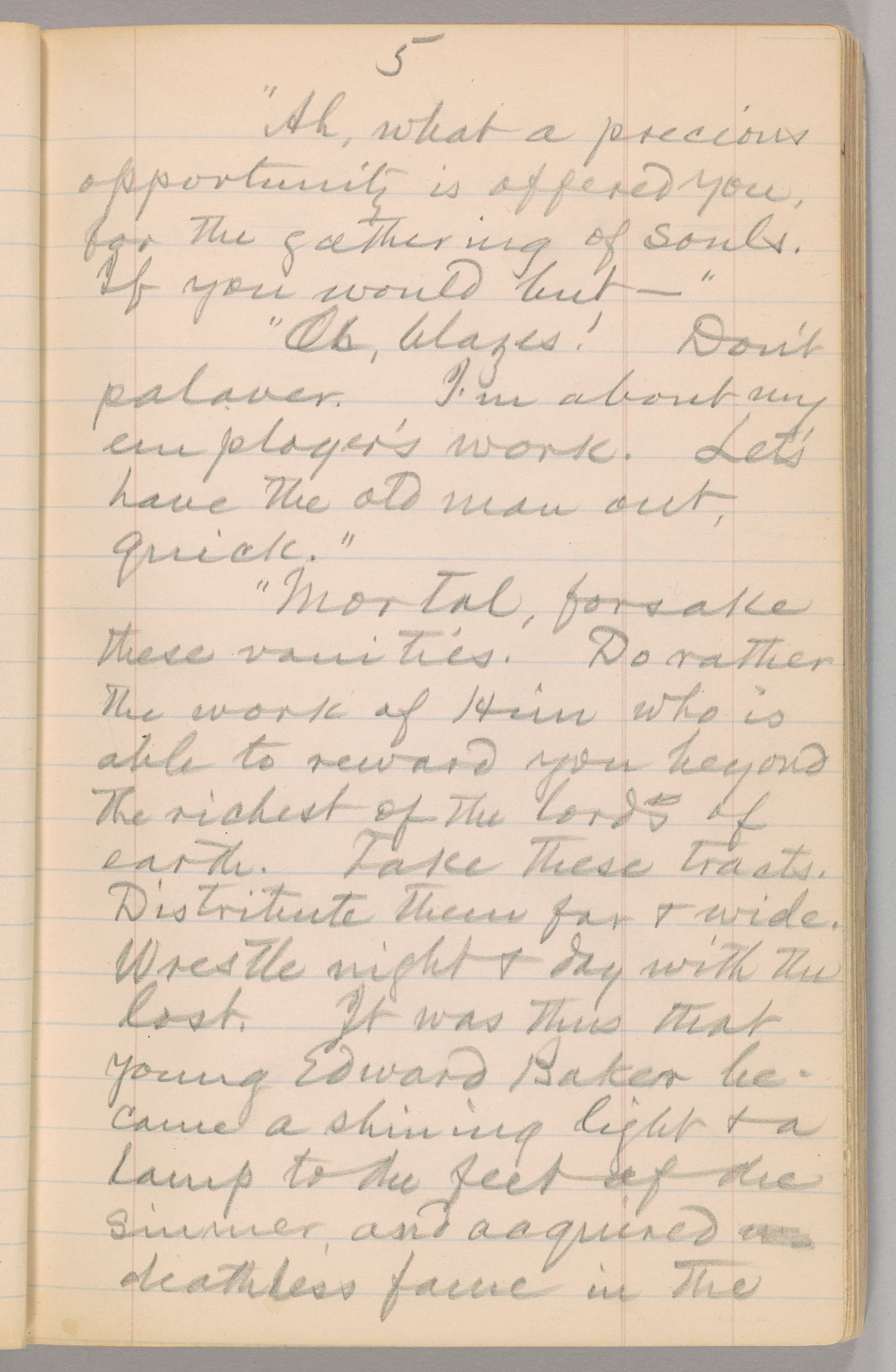
[MS: N11_leaf_005r]
“Ah, what a precious opportunity is offered you, for the gathering of souls. If you would but—”
“Oh, blazes! Don't palaver. I'm about my employer's work.
Let's have the old man out, quick.”
“Mortal, forsake these vanities. Do rather the work of Him who is able to reward you
beyond the richest of the lord'slordsⓉtextual note of earth. Take these tracts. Distribute them far & wide. Wrestle night & day with
the lost. It was thus that young Edward Baker became a shining light & a lamp to the
feet of the sinner, and acquired -- deathless fame in the
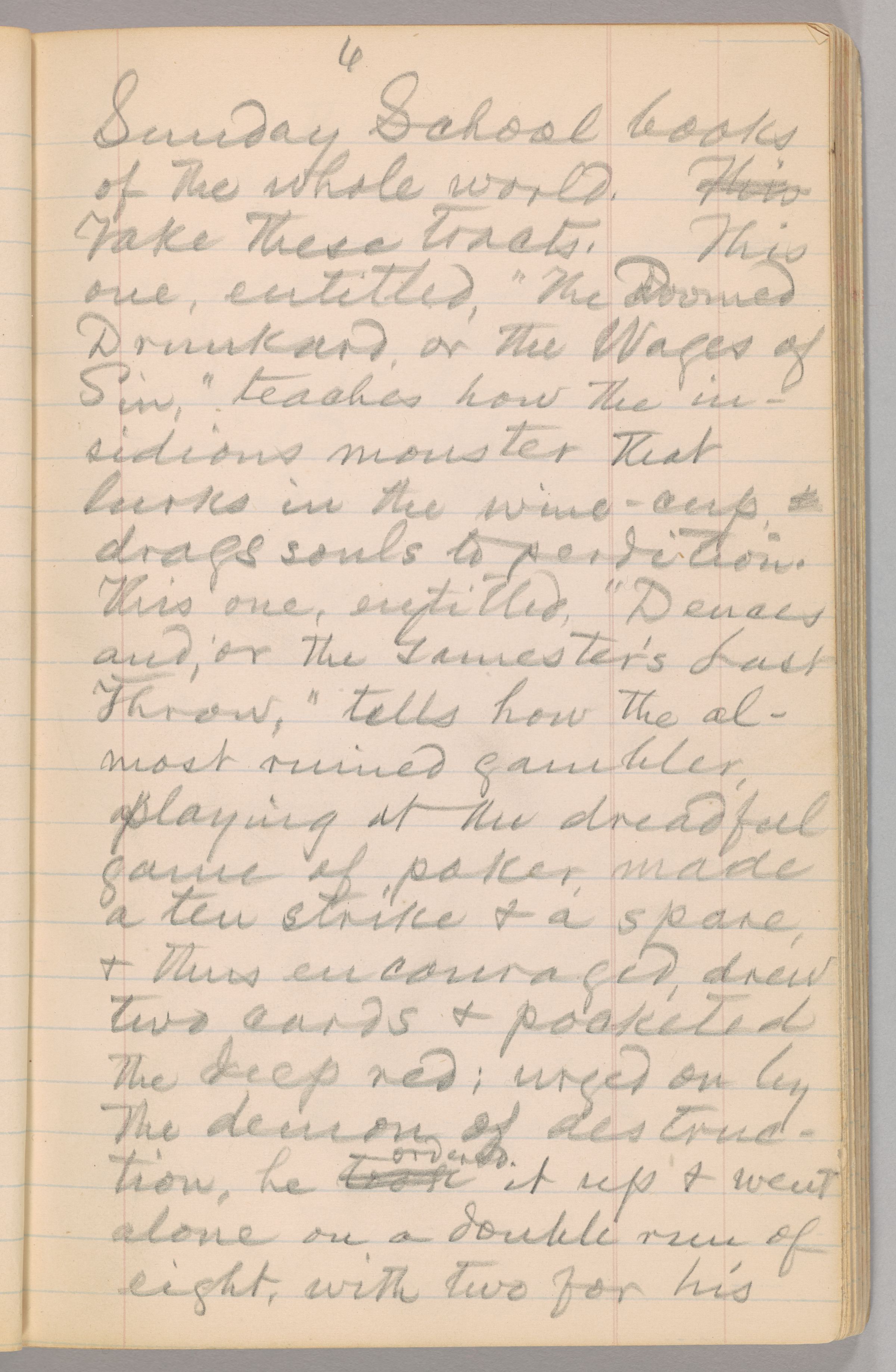
[MS: N11_leaf_006r]
Sunday School books of the whole world. This Take these tracts. This one, entitled, “The dDoomed Drunkard, or the Wages of Sin,” teaches how the insidious monster that lurks
in the wine-cup, - drags souls to perdition. This one, entitled, “Deuces and, or the Gamester's Last Throw,” tells how the almost ruined gambler, aplaying at the dreadful game of poker, made a ten strike & a spare, & thus encouraged,
drew two cards & pocketed the deep red; urged on by the demon of destruction, he took orderedⓉtextual note it up & went alone on a double run of eight, with two for his
[MS: N11_leaf_007r]
heels, & then, just as fortune seemed at last to have turned in his favor his opponent
coppered the ace & won. The fated gamester blew his brains out & perished. Ah, poker
is a dreadful, dreadful game. You will see in this book how well our theological students
are qualified to teach understandingly all classes that come within their reach. Gamblers'
souls are worthy to be saved, & so they holy studentsⓉtextual note even acquaint themselves with the science &Ⓣtextual note technicalities of their horrid games, in order to be able to talk to them infor the saving of their souls in language which they are accustomed to. This tract,
entitled—”
[MS: N11_leaf_008r]
—¶” WhyⓉtextual note, he is gone! I wonder if my words have sunk into his heart. I wonder if the seeds
thus sown will bear fruit. I cannot but believe that he will quit his sinful census-gathering
& go to gathering souls. Oh, I know he will. It was just in this way that young James Wilson converted the Jew peddlar,
& sent him away from his father's house with his boxes full of Bibles and hymn-books—a
peddlar no longer, — but a blessed colporteur.” It is so related in the beautiful Sunday School book entitiled “James Wilson, the
Boy Missionary.”
At this moment the door-
[MS: N11_leaf_009r]
bellⓂemendation rang again. She opened it.
“Morning Gazette, mMiss—eighty forty cents due, oronⓉtextual note two weeks.”
“Do you carry these papers all about town?”
“To mighty near every house in it—largest daily circulation of any daily paper published in the city—best advertising medium—”
“Oh, to think of your opportunities! This is not a Baptist paper, is it?”
“Well I should think not. She's a Democrat.—”
“Could not you get the editor of it to drop the follies of this world & make the Gazette
a messenger of light & hope, a Baptist ben-
[MS: N11_leaf_010r]
ediction at every fireside?”
“Oh, I haven't got time to bother about such things. Saving your presence, Miss, Democrats don't care a damn about light & hope—they wouldn't take the paper if she was a Baptist. But hurry, won't you, please—forty cents for two weeks back.”
“Ah, well, if they would stop the paper, that would not do. But Oh, you can still
labor in the vineyard. When you leave a paper at a house, call all the people of that
house together & urge them to turn from the evil of their ways & be saved. Tell them
that the meanest & the laziest & the vilest of His creatures is still within the
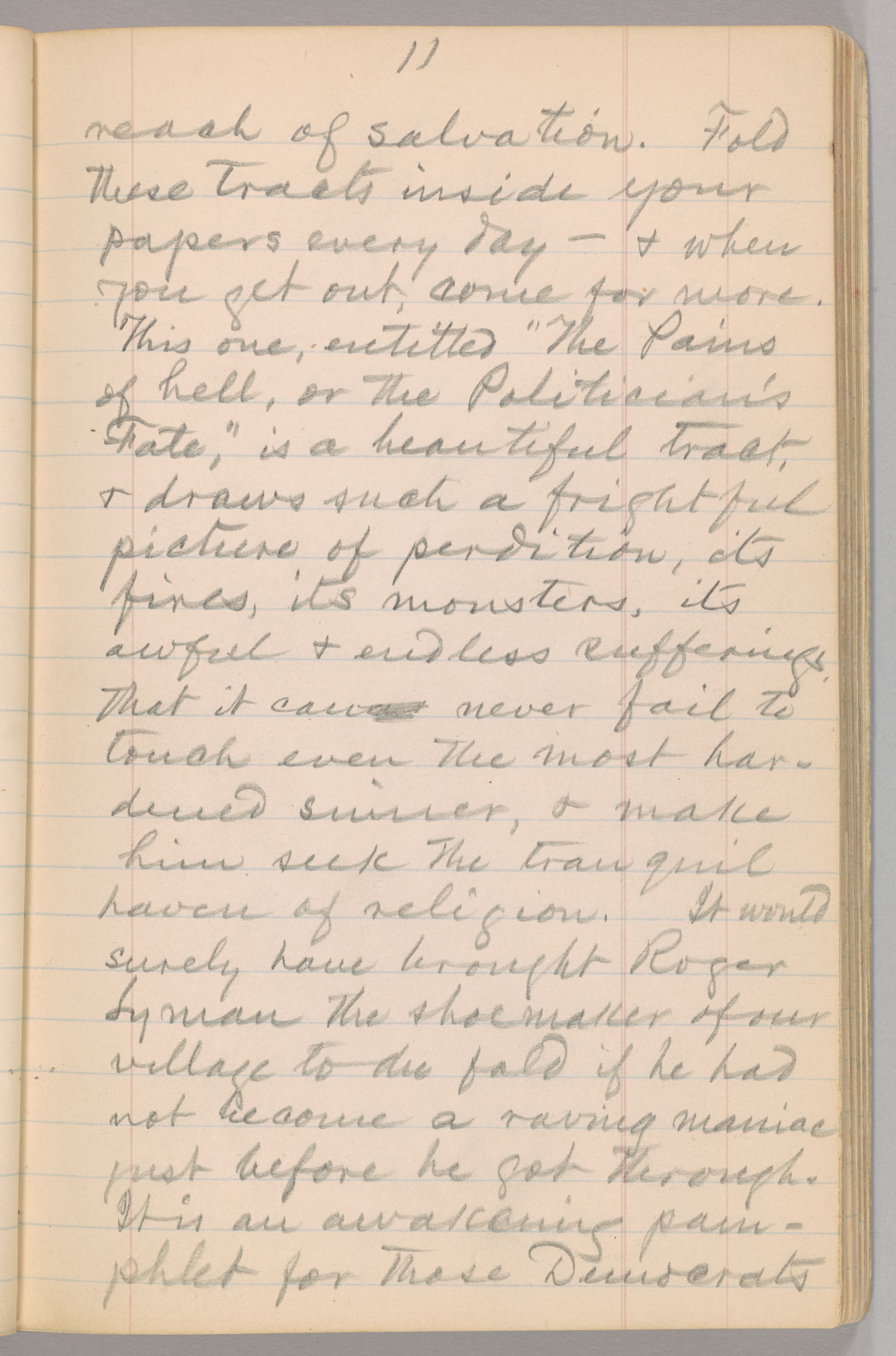
[MS: N11_leaf_011r]
reach of salvation. Fold these tracts inside your papers every day—& when you get
out, come for more. This one, entitled “The Pains of hell, or the Politician's Fate,”
is a beautiful tract, & draws such a frightful picture of perdition, its fires, its
monsters, its awful & endless sufferings, that it cann never fail to touch even the most hardened sinner, & make him seek the tranquil haven
of religion. It would surely have brought Roger Lyman the shoemaker of our village
to the fold if he had not become a raving maniac just before he got through. It is
an awakening pamphlet for those Democrats
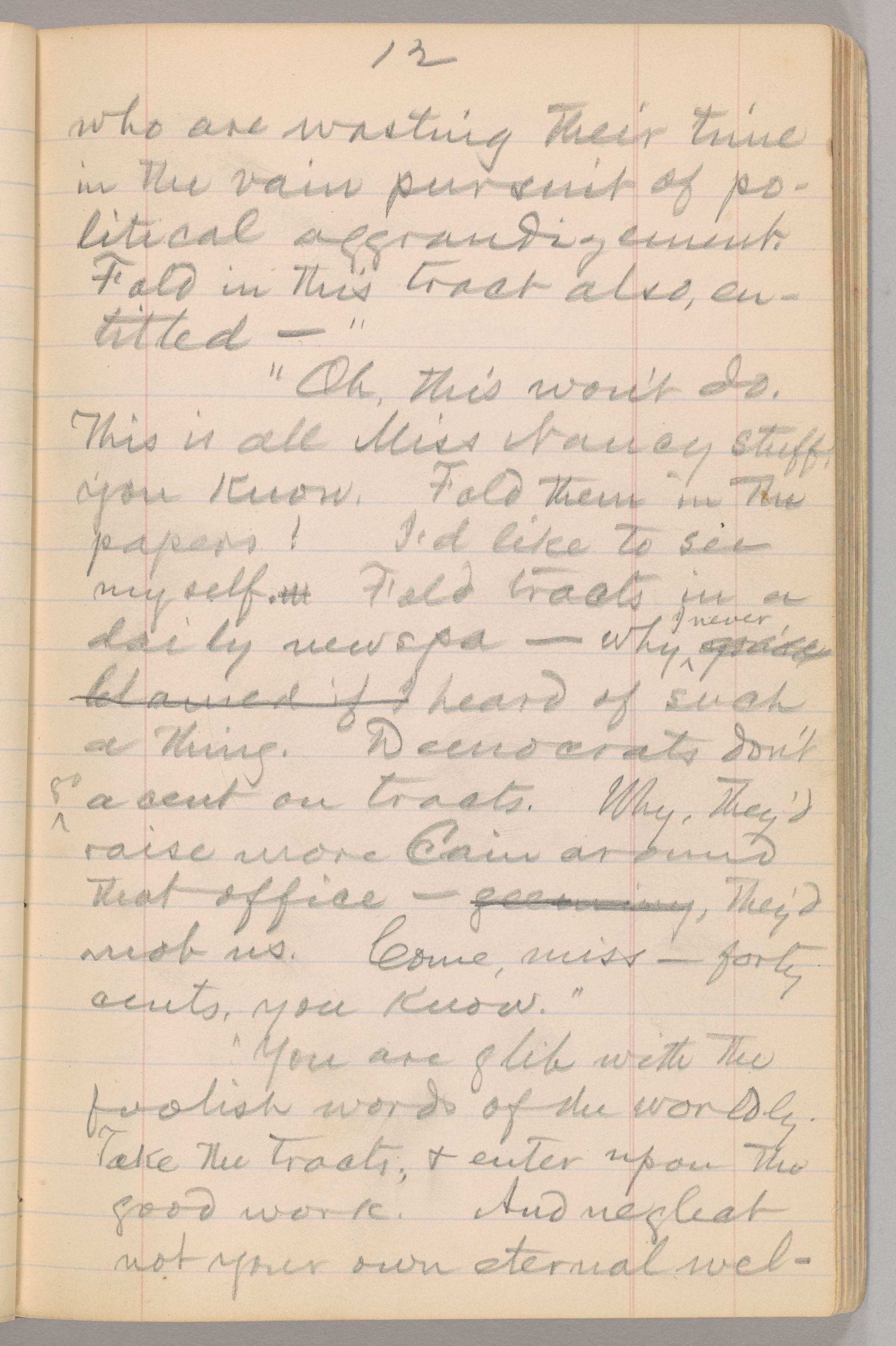
[MS: N11_leaf_012r]
who are wasting their time in the vain pursuit of political aggrandizement. Fold in
this tract also, entitled—”
“Oh, this won't do. This is all Miss Nancy stuff, you know. Fold them in the papers! I'd like to see myself. —Ⓣtextual note Fold tracts in a daily newspa— why you're blamed if I I neverⓉtextual note heard of such a thing. Democrats don't goⓉtextual note a cent on tracts. Why, they'd raise more cCain around that office—geeminy, they'd mob us. Come, miss—forty cents, you know.”
“You are glib with the foolish words of the worldly. Take the tracts., & enter upon the good work. And neglect not your own eternal wel-
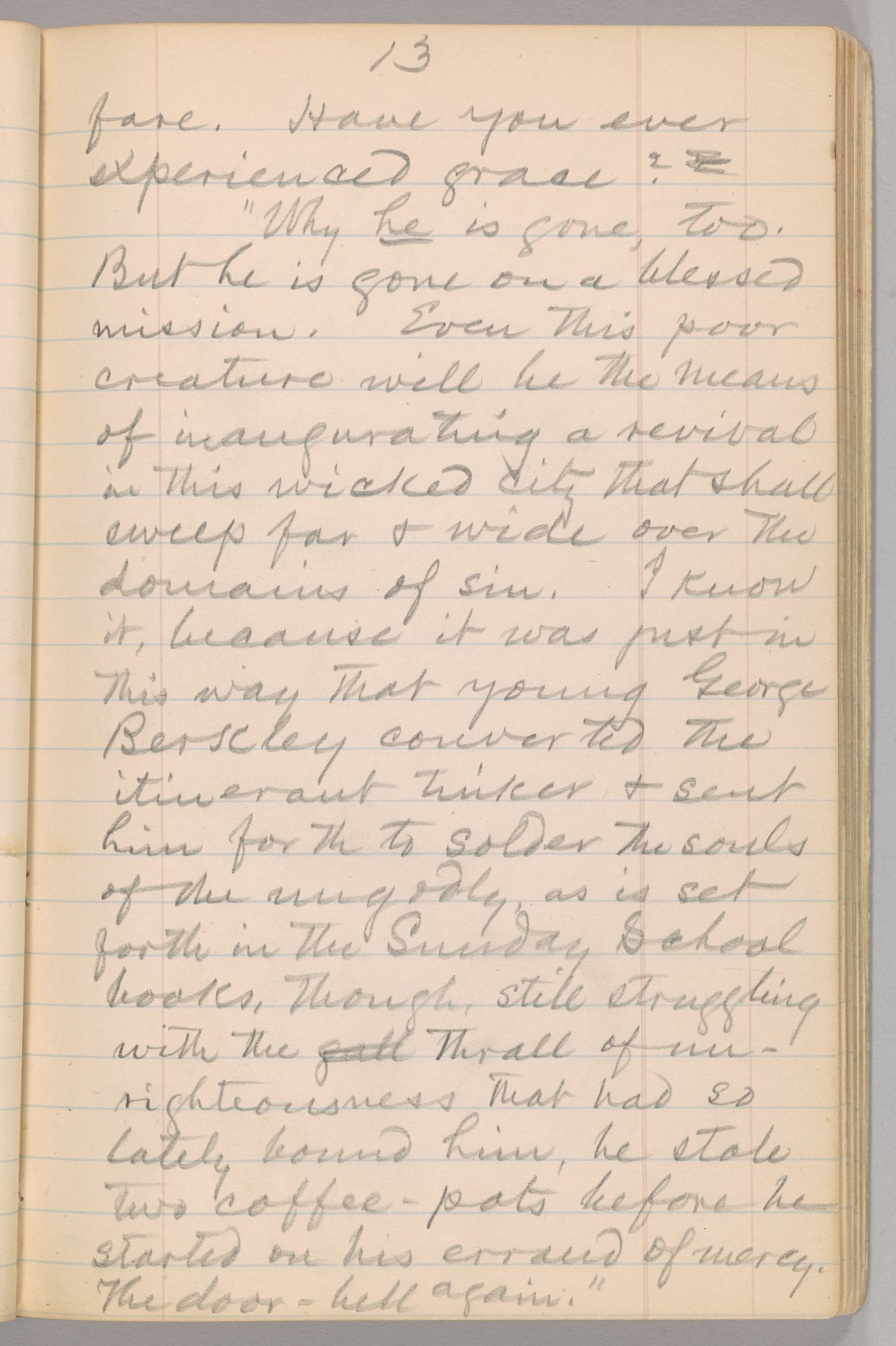
[MS: N11_leaf_013r]
fare. Have you ever experienced grace?”
“Why he is gone, too. But he is gone on a blessed mission. Even this poor creature will be the means of inaugurating a revival in this wicked city that shall sweep far & wide over the domains of sin. I know it, because it was just in this way that young George Berkley converted the itinerant tinker & sent him forth to solder the souls of the ungodly, as is set forth in the Sunday School books, though, still struggling with the gall thrall of unrighteousness that had so lately bound him, he stole two coffee-pots before he started on his errand of mercy. The door-bell again.”
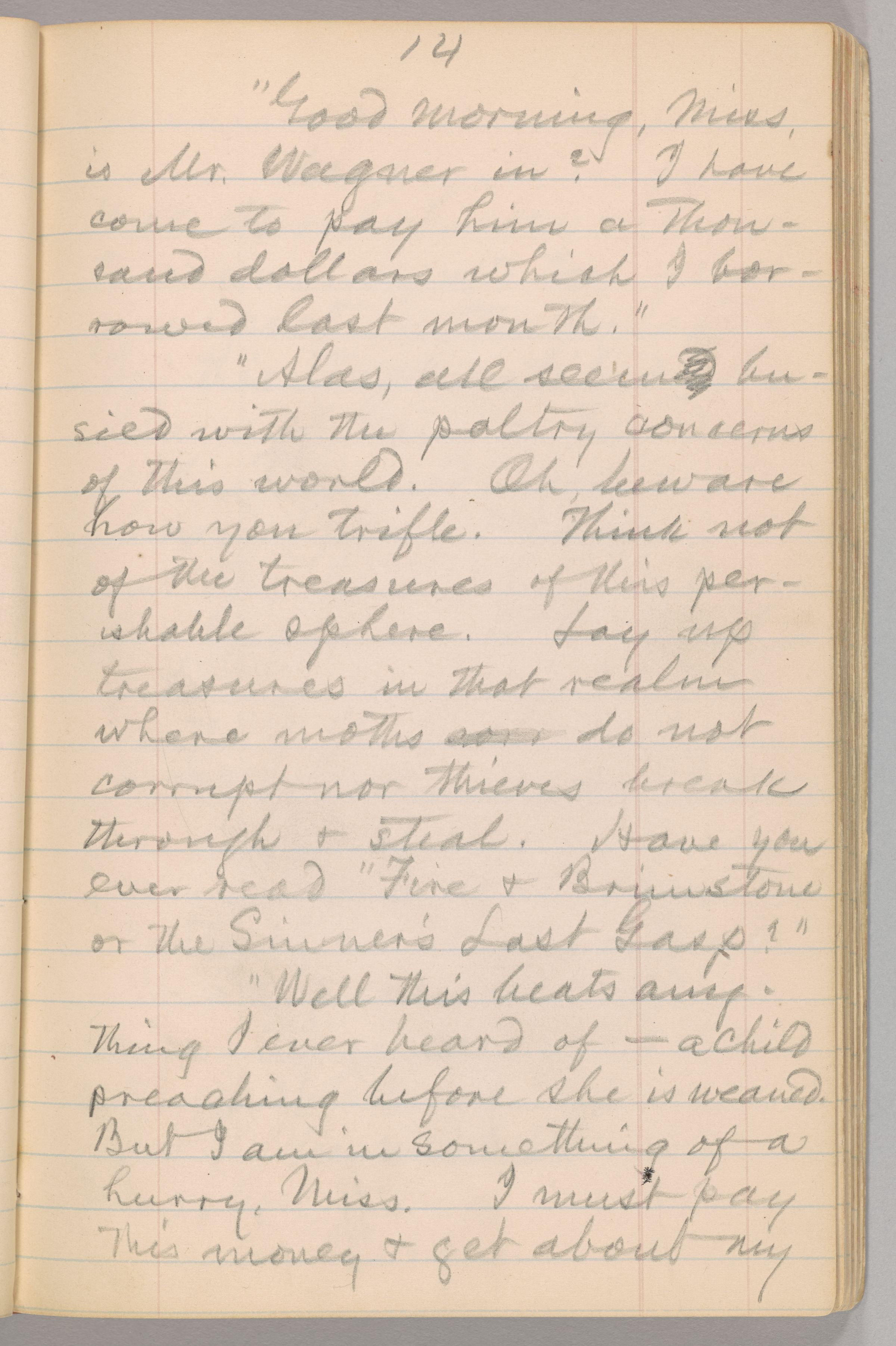
[MS: N11_leaf_014r]
“Good morning, Miss, is Mr. Wagner in? I have come to pay him a thousand dollars which I borrowed last month.”
“Alas, all seemed busied with the paltry concerns of this world. Oh, beware how you trifle. Think not of the treasures of this perishable sphere. Lay up treasures in that realm where moths corr do not corrupt nor thieves break through & steal. Have you ever read “Fire & Brimstone or the Sinner's Last Gasp?”
“Well this beats anything I ever heard of—a child preaching before she is weaned.
But I am in something of a hurry, Miss. I must pay this money & get about my
[MS: N11_leaf_015r]
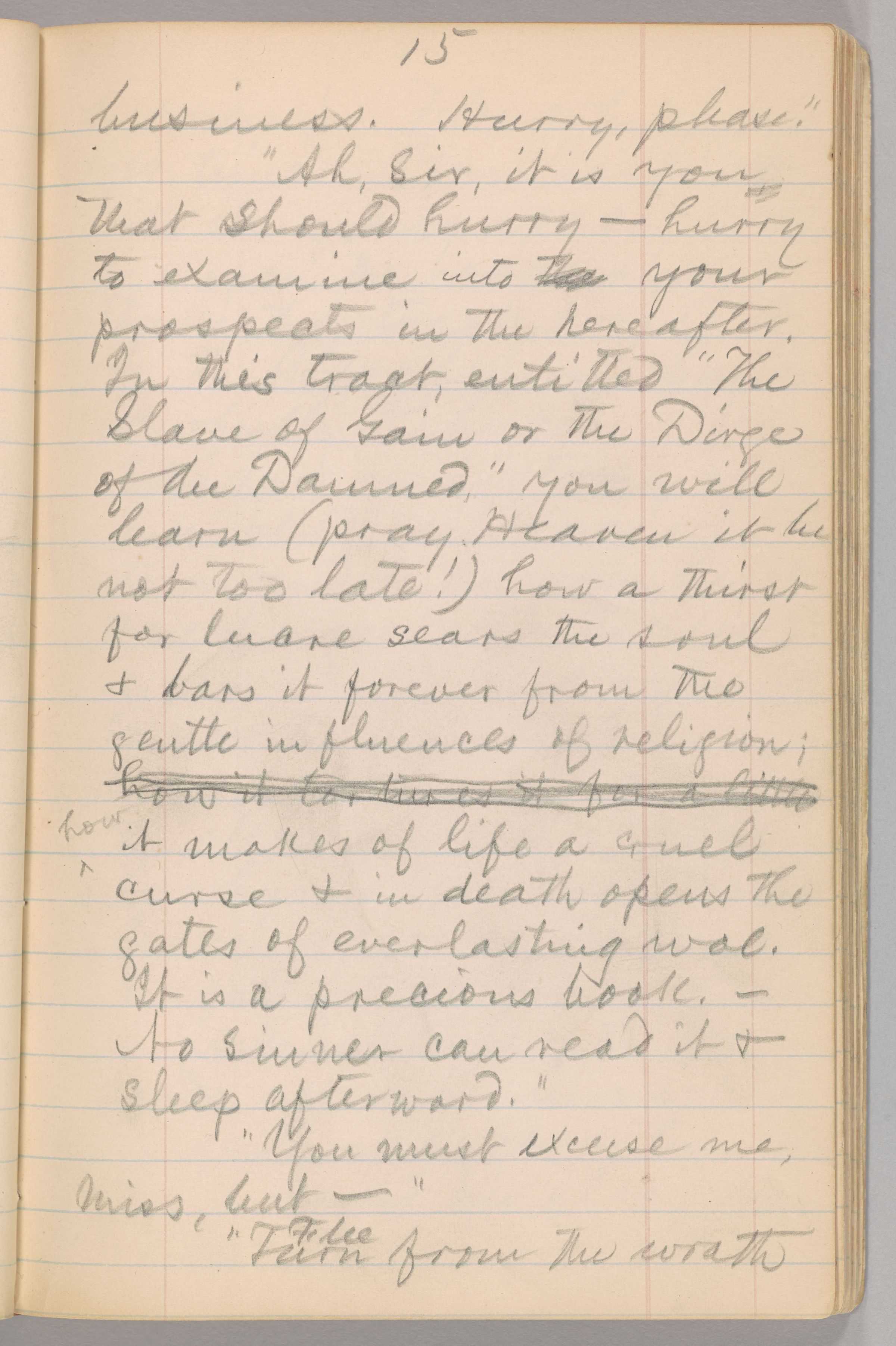
business. Hurry, please.”
“Ah, Sir, it is you, that should hurry—hurry to examine into the your prospects in the hereafter. In this tract, entitled “The Slave of Gain or the Dirge of the Damned,” you will learn (pray Heaven it be not too late!) how a thirst for lucre sears the soul & bars it forever from the gentle influences of religion; how it tortures it for a little how it makesⓉtextual note of life a cruel curse & in death opens the gates of everlasting woe. It is a precious book.—No sinner can read it & sleep afterward.”
“You must excuse me, Miss, but—”
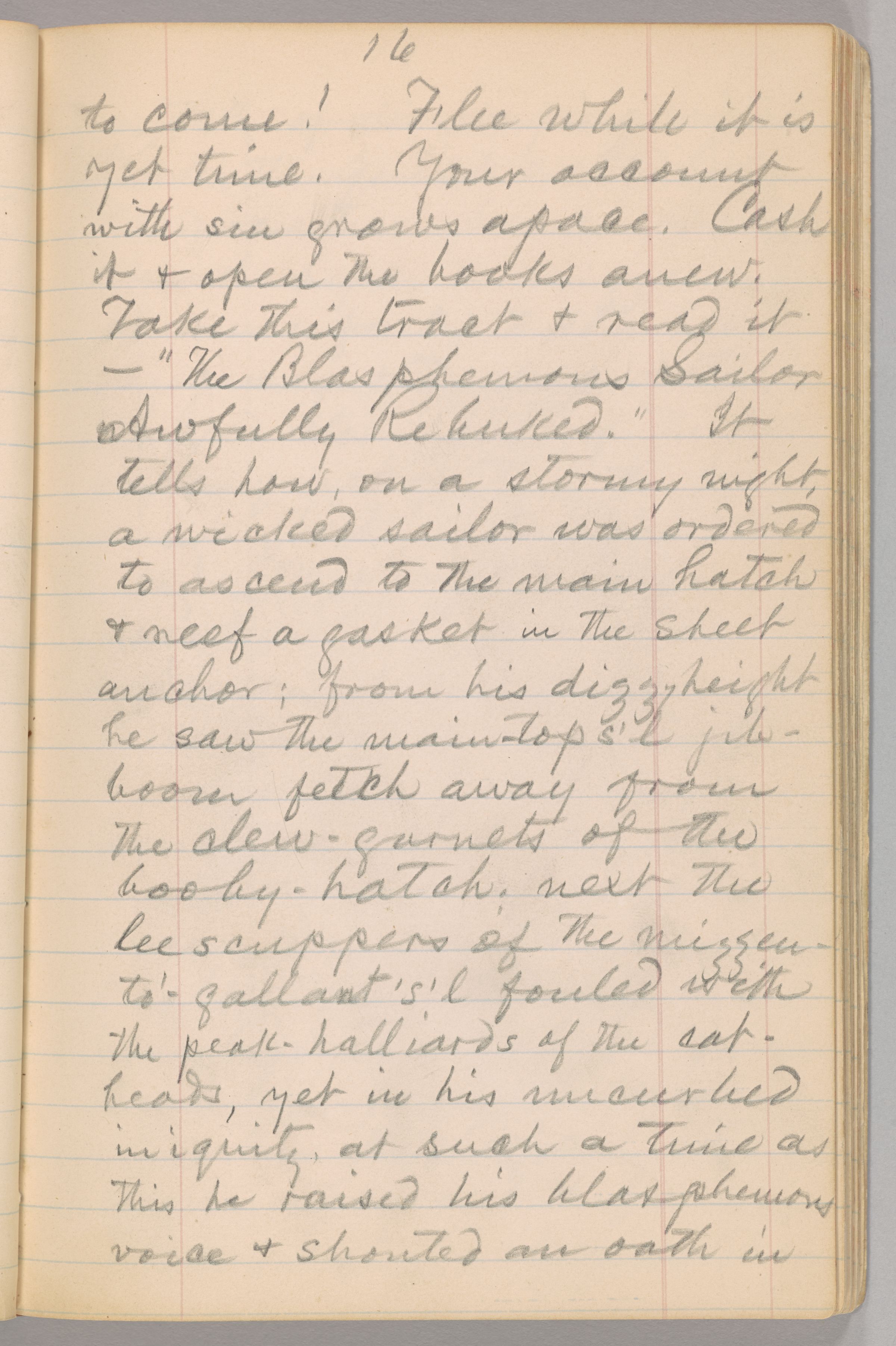
“Turn/FleeⓉtextual note from the wrath
[MS: N11_leaf_016r]
to come! Flee while it is yet time. Your account with sin grows apace. Cash it & open
the books anew. Take this tract & read it—“The Blasphemous Sailor - Awfully Rebuked.” It tells how, on a stormy night, a wicked sailor was ordered to
ascend to the main hatch & reef a gasket in the sheet anchor; from his dizzy height
he saw the main-tops'l jib-boom fetch away from the clew-garnets of the booby-hatch;
next the lee scuppers of the mizzen-to'-gallant's'l fouled with the peak-halliards
of the cat-headsⓂemendation, yet in his uncurbed iniquity, at such a time as this he raised his blasphemous voice
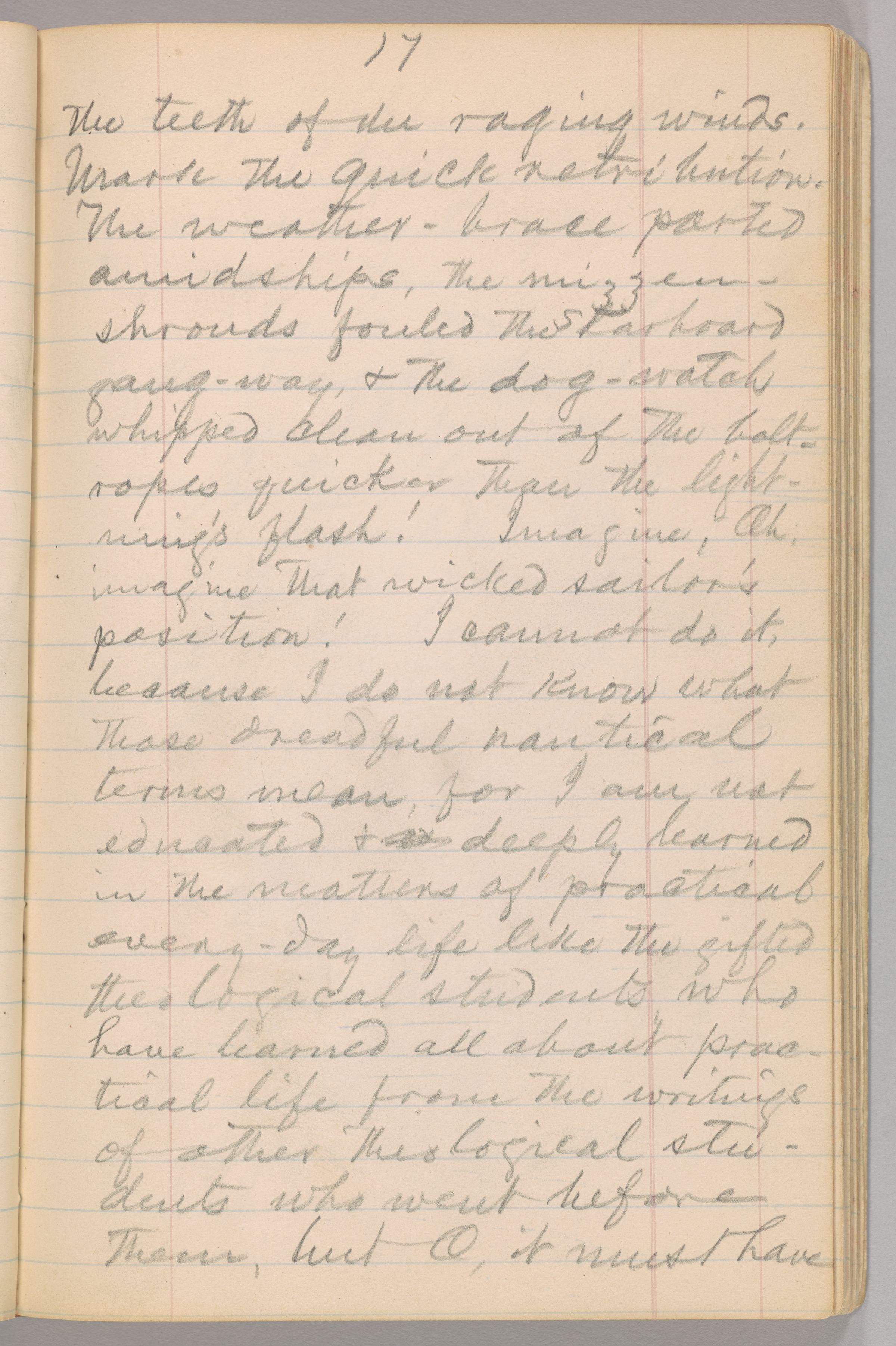
& shouted an oath in
[MS: N11_leaf_017r]
the teeth of the raging winds. Mark the quick retribution. The weather-brace parted
amidships, the mizzen-shrouds fouled the starboard gang-way, & the dog-watch whipped
clean out of the bolt-ropes quicker than the lightning's flash! Imagine, Oh, imagine
that wicked sailor's position! I cannot do it, because I do not know what those dreadful
nautical terms mean, for I am not educated & ex deeply learned in the matters of practical every-day life like the gifted theological
students, who have learned all about practical life from the writings of other theological
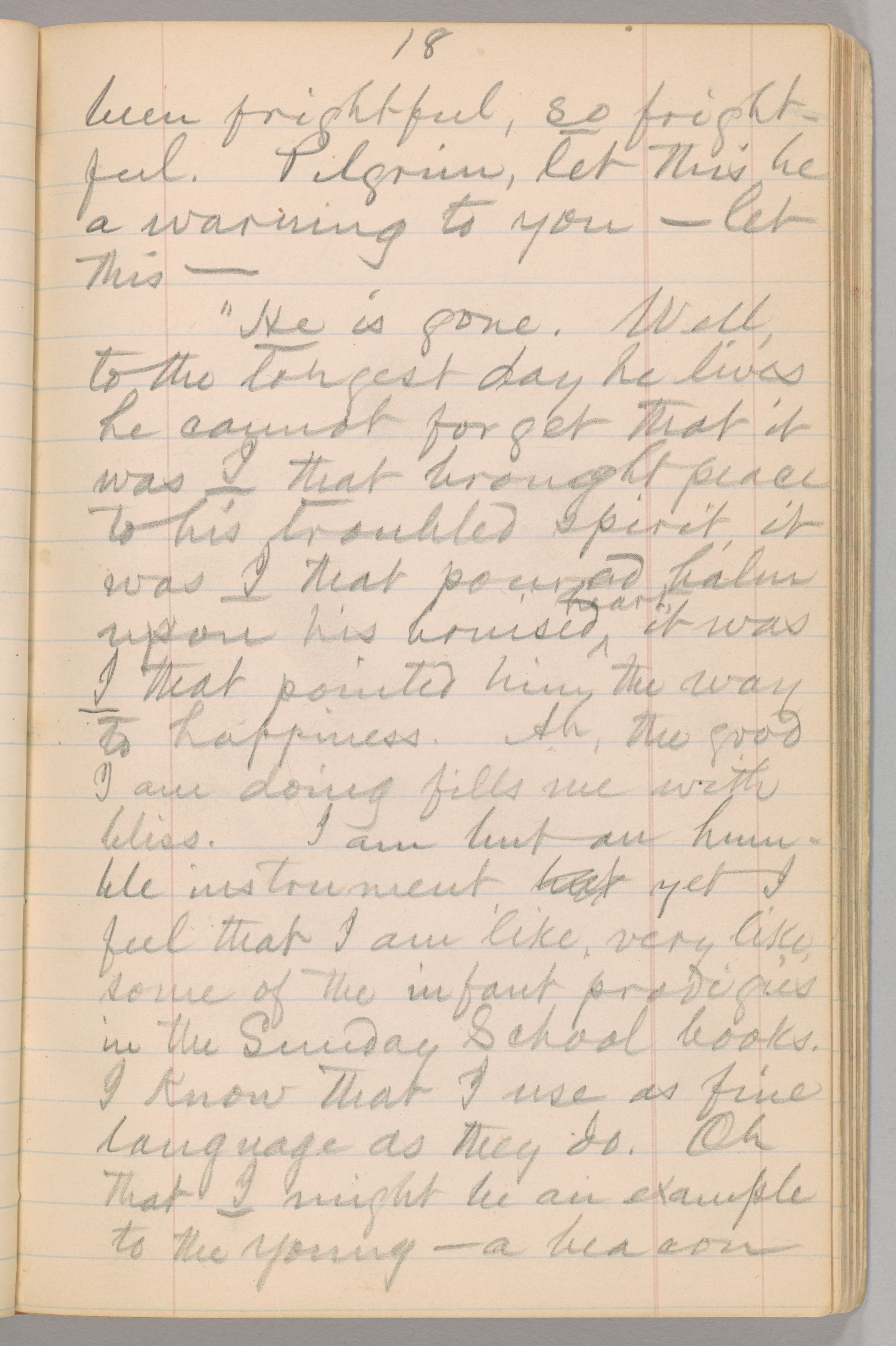
students who went before them, but O, it must have
[MS: N11_leaf_018r]
been frightful, so frightful. Pilgrim, let this be a warning to you—let this—
“He is gone. Well, to the longest day he lives he cannot forget that it was I that brought peace to his troubled spirit, it was I that poured balm upon his bruised heart,Ⓣtextual note it was I that pointed him the way to happiness. Ah, the good I am doing fills me with bliss.
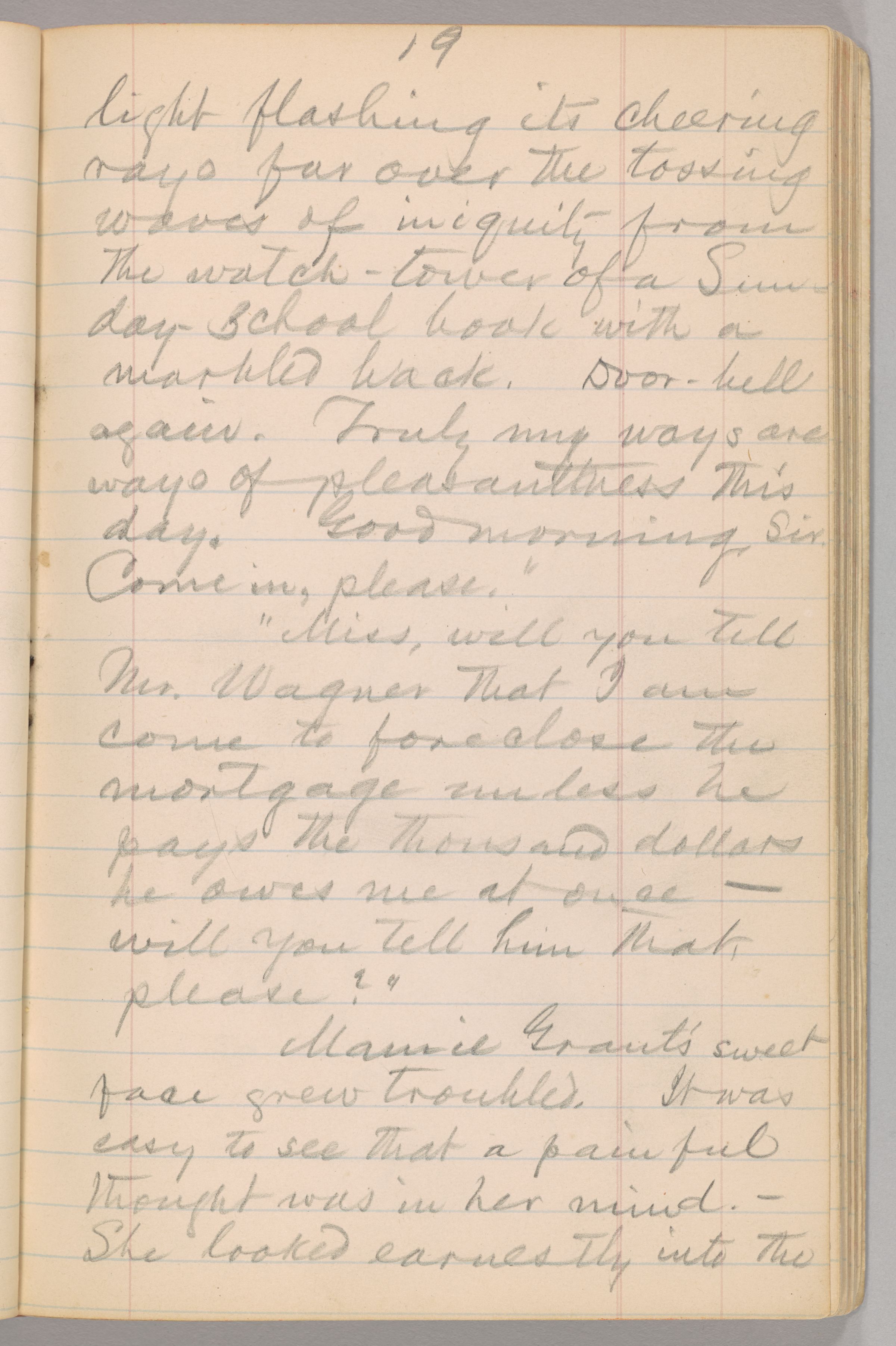
I am but an humble instrument, but yet I feel that I am like, very like, some of the infant prodigies in the Sunday
School books. I know that I use as fine language as they do. Oh that I might be an example to the young—a beacon
[MS: N11_leaf_019r]
light flashing its cheering rays far over the tossing waves of iniquity from the watch-tower
of a Sunday-school book with a marbled back. Door-bell again. Truly my ways are ways
of pleasantness this day. Good morning, Sir. Come in, please.”
“Miss, will you tell Mr. Wagner that I am come to foreclose the mortgage unless he pays the thousand dollars he owes me at once—will you tell him that, please?”
Mamie Grant's sweet face grew troubled. It was easy to see that a painful thought
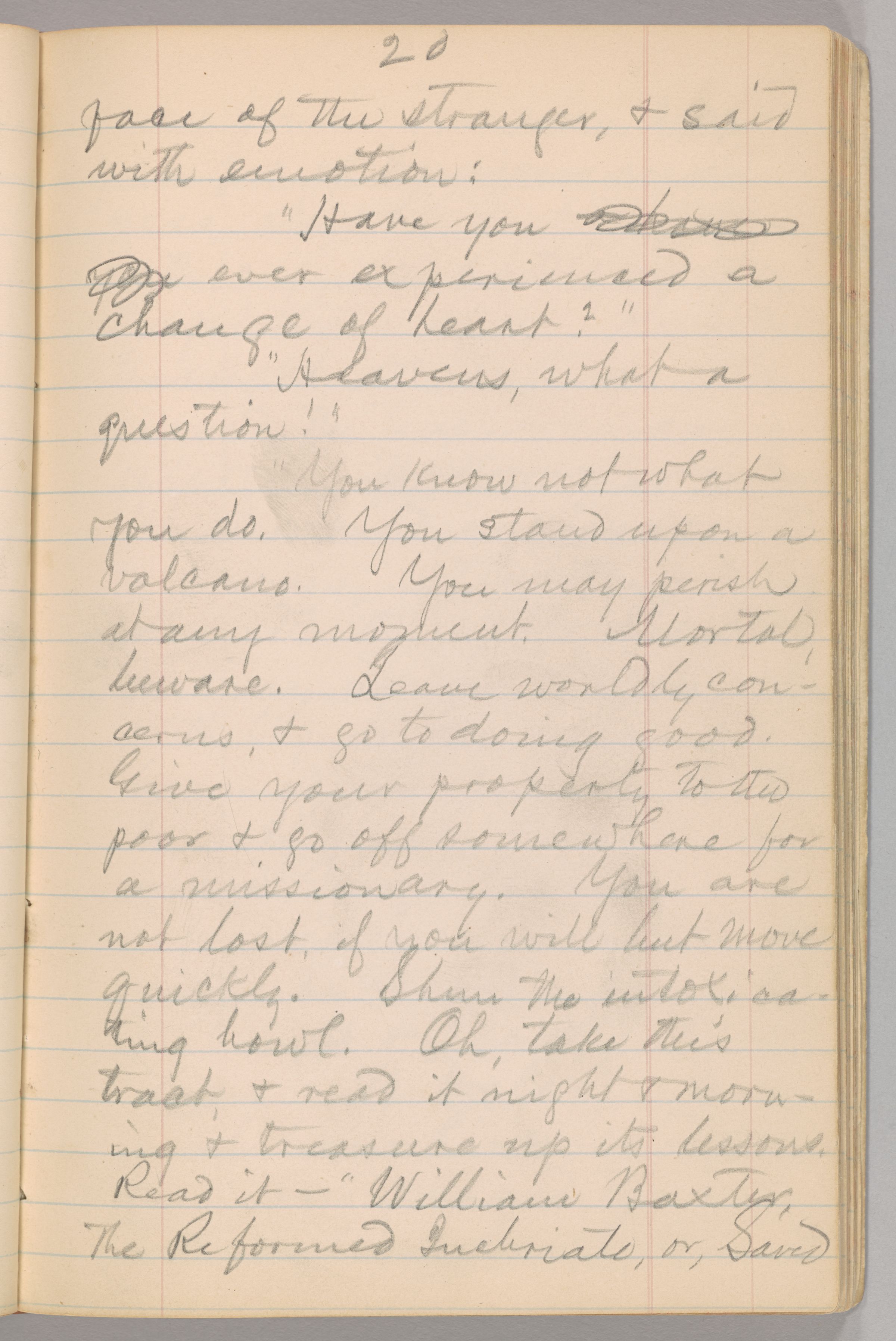
was in her mind.—She looked earnestly into the
[MS: N11_leaf_020r]
face of the stranger, & said with emotion:
“Have you—have you ever experienced a change of heart?”
“Heavens, what a question!”
“You know not what you do. You stand upon a volcano. You may perish at any moment.
Mortal, beware. Leave worldly concerns, & go to doing good. Give your property to
the poor & go off somewhere for a missionary. You are not lost, if you will but move
quickly. Shun the intoxicating bowl. Oh, take this tract, & read it night & morning
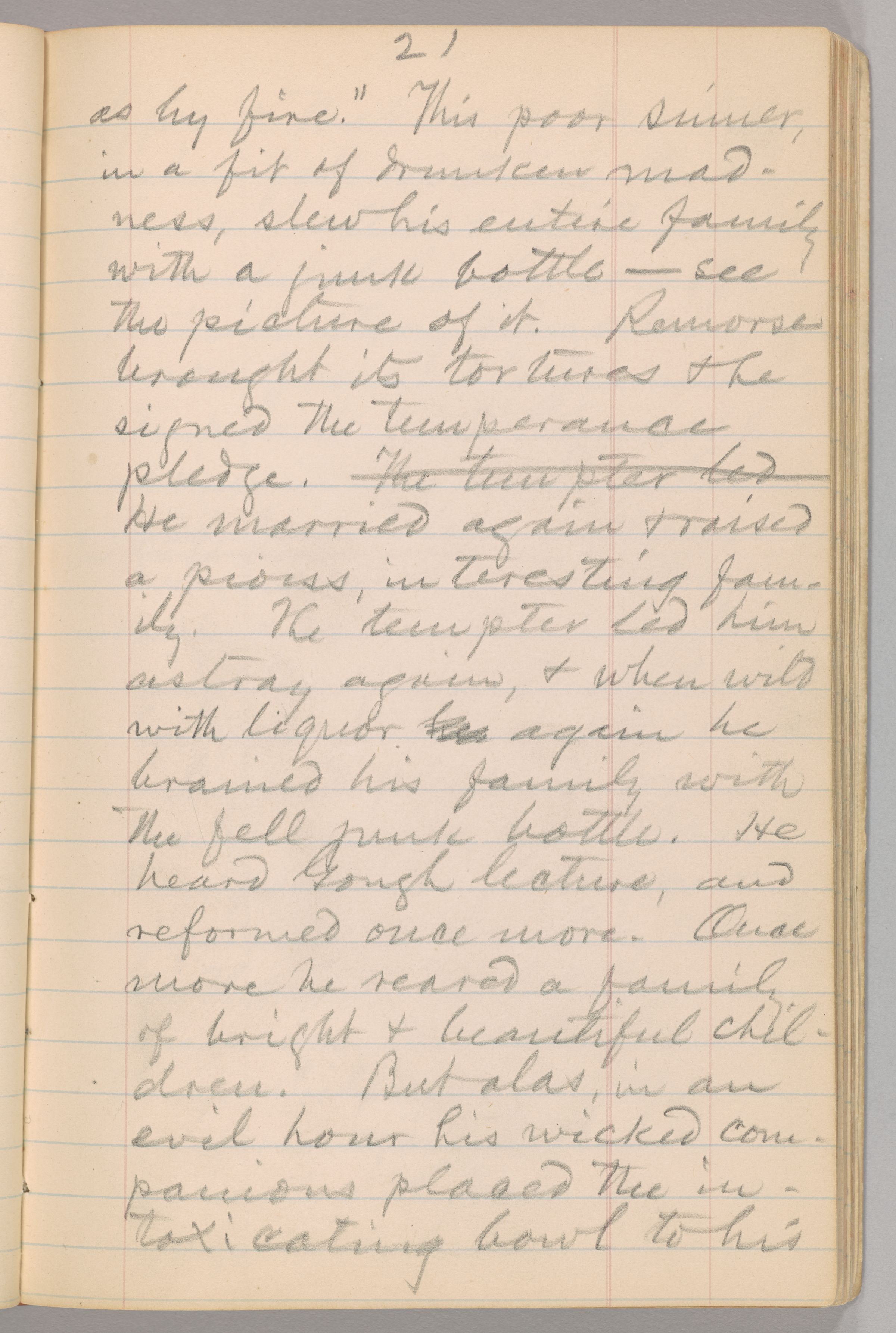
& treasure up its lessons. Read it—“William Baxter, the Reformed Inebriate, or, Saved
[MS: N11_leaf_021r]
as by fire.” This poor sinner, in a fit of drunken madness, slew his entire family
with a junk bottle—see the picture of it. Remorse brought its tortures & he signed
the temperance pledge. The tempter led He married again & raised a pious, interesting family. The tempter led him astray
again, & when wild with liquor he again he brained his family with the fell junk bottle. He heard Gough2 lecture, and reformed once more. Once more he reared a family of bright & beautiful
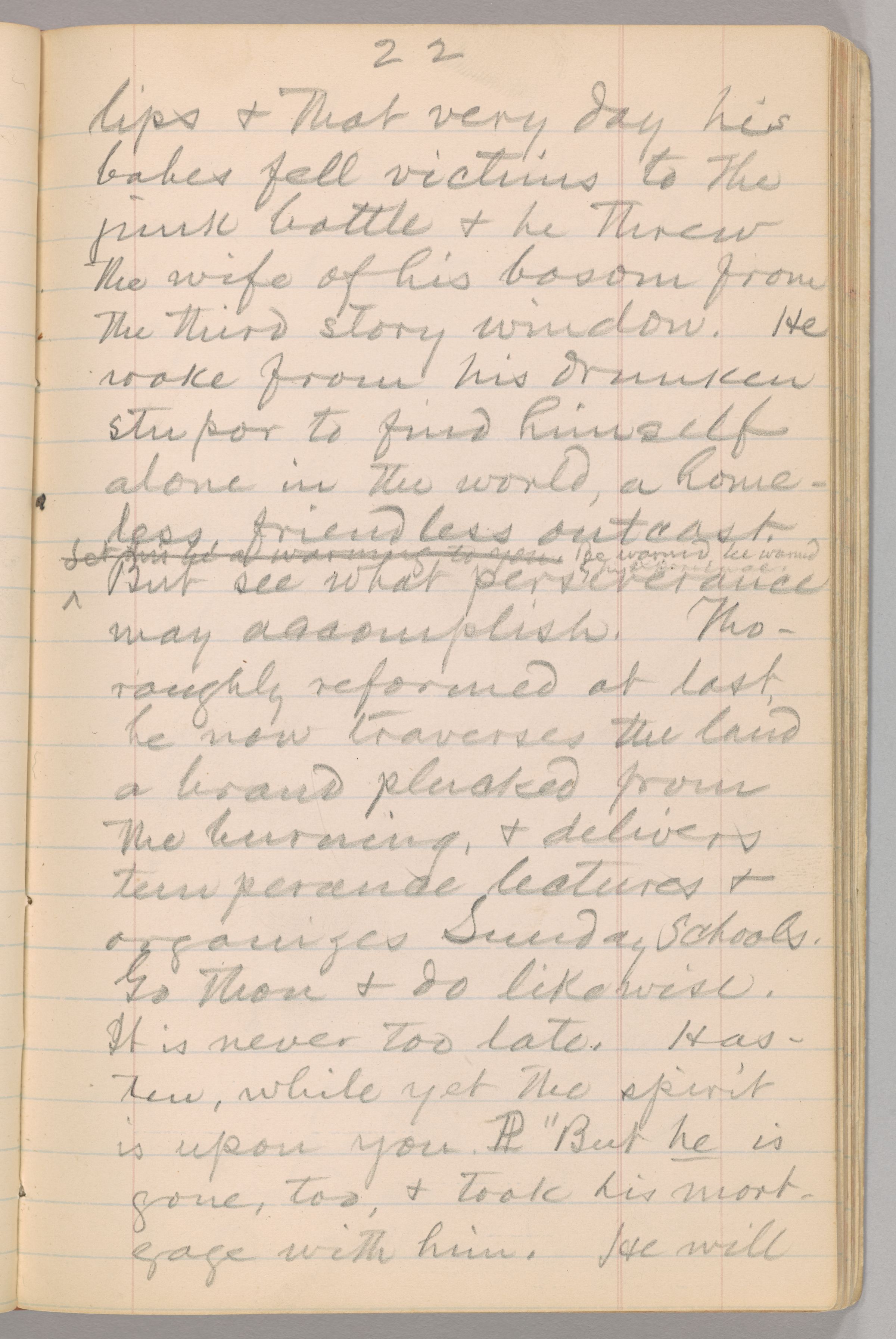
children. But alas, in an an evil hour his wicked companions placed the intoxicating
bowl to his
[MS: N11_leaf_022r]
lips & that very day his babes fell victims to the junk bottle & he threw the wife
of his bosom from the third story window. He woke from his drunken stupor to find
himself alone in the world, a homeless, friendless outcast. Let him be a warning to you. Be warned, be warned by his experience.Ⓣtextual note But see what perseverance may accomplish. Thoroughly reformed at last, he now traverses
the land a brand plucked from the burning, & delivers temperance lectures & organizes
Sunday Schools. Go thou & do likewise. It is never too late. Hasten, while yet the
spirit is upon you.—Ⓣtextual note
“But he is gone, too, & took his mortgage with him. He will
[MS: N11_leaf_023r]
reform, I know he will. And then the good he will do can never be estimated. Truly
this has been to me a blessed day.”
So saying, Mamie Grant put on her little bonnet & went forth into the city to carry tracts to the naked & hungry poor, to the rbanker in his busy office, to the rumseller dealing out his soul-destroying abominations.
That night when she returned, her uncle Wagner was in deep distress. He said:
“Alas, we are ruined. My newspaper is stopped, & I am posted on its bulletin board
as a delinquent. The tax-collecting census-
[MS: N11_leaf_024r]
taker has set his black mark opposite my name. Martin, who should have returned the
thousand dollars he borrowed has not come, & Phillips, in consequence, has foreclosed
the mortgage, & we are homeless!”
“Be not cast down, dear uncle,” Mamie said, “for I have sent all these men into the vineyard. They shall sow the fields far & wide & reap a rich harvest. Cease to repine at worldly ills, & attend only to the behests of the great hereafter.”
Mr. Wagner only groaned, for he was an unregenerated man.
Mamie placed a
[MS: N11_leaf_025r]
happy head upon her pillow that night,. for sheSheⓉtextual note said:
“I have saved a paper carrier, a census bureau, a creditor & a debtor, & they will bless me forever. I have done a noble work to-day. I may yet see my poor little name in a beautiful Sunday School book, & maybe T. S. Arthur3 may write it. Oh, joy!”
Such is the history of “Mamie Grant, the Child Missionary.”Ⓣtextual note

[MS: N11_leaf_026r]
Trip of a man in a balloon from Paris over India, China, Pacific Ocean, the Plains, to a prairie in Illinois, in a balloon.
Write of Herald office & Tribune Weeekly to Alta.
Something of Detective Baker.4
Lc on California
Boy on way to Texas—wagon broke down.
Ct the colts.
Eat personal property &—real estate.
[MS: N11_leaf_026v]
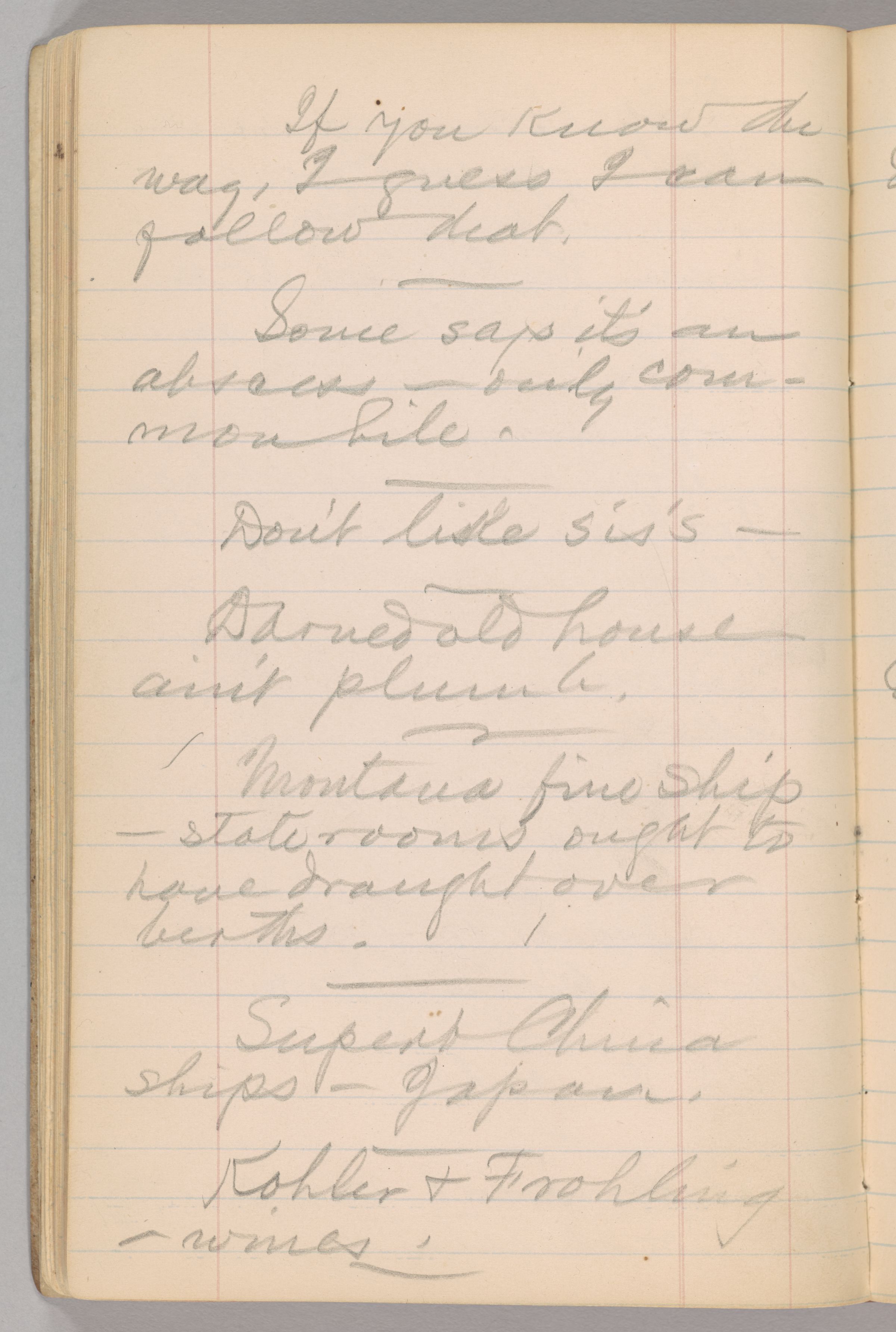
If you know the way, I guess I can follow that.
Some says it's an abscess—only common bile.
Don't like sis's—
Darned old house ain't plumb.
Montana fine ship—state rooms ought to have draught over berths.
Superb China ships—Japan.5
Kohler & Frohling—wines.
[MS: N11_leaf_027r]
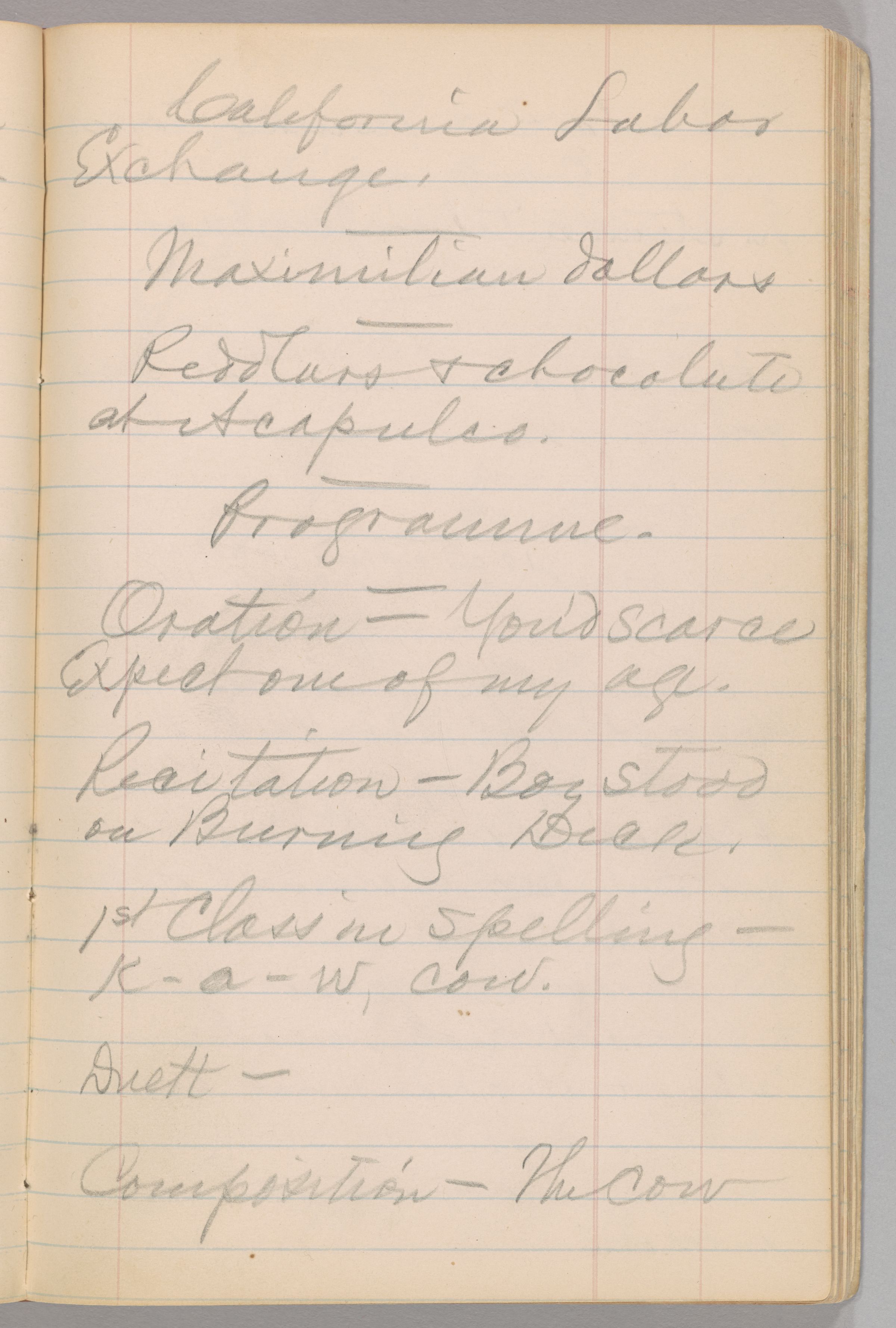
California Labor Exchange.6
Maximilian dollars.7
Peddlars & chocolate at Acapulco.
Programme.8
Oration—You'd scarce Expect one of my age.
Recitation—Boy stood on Burning Deck.
1st Class in spelling—k-a-w, cow.
Duett—
Composition—The cow
[MS: N11_leaf_027v]
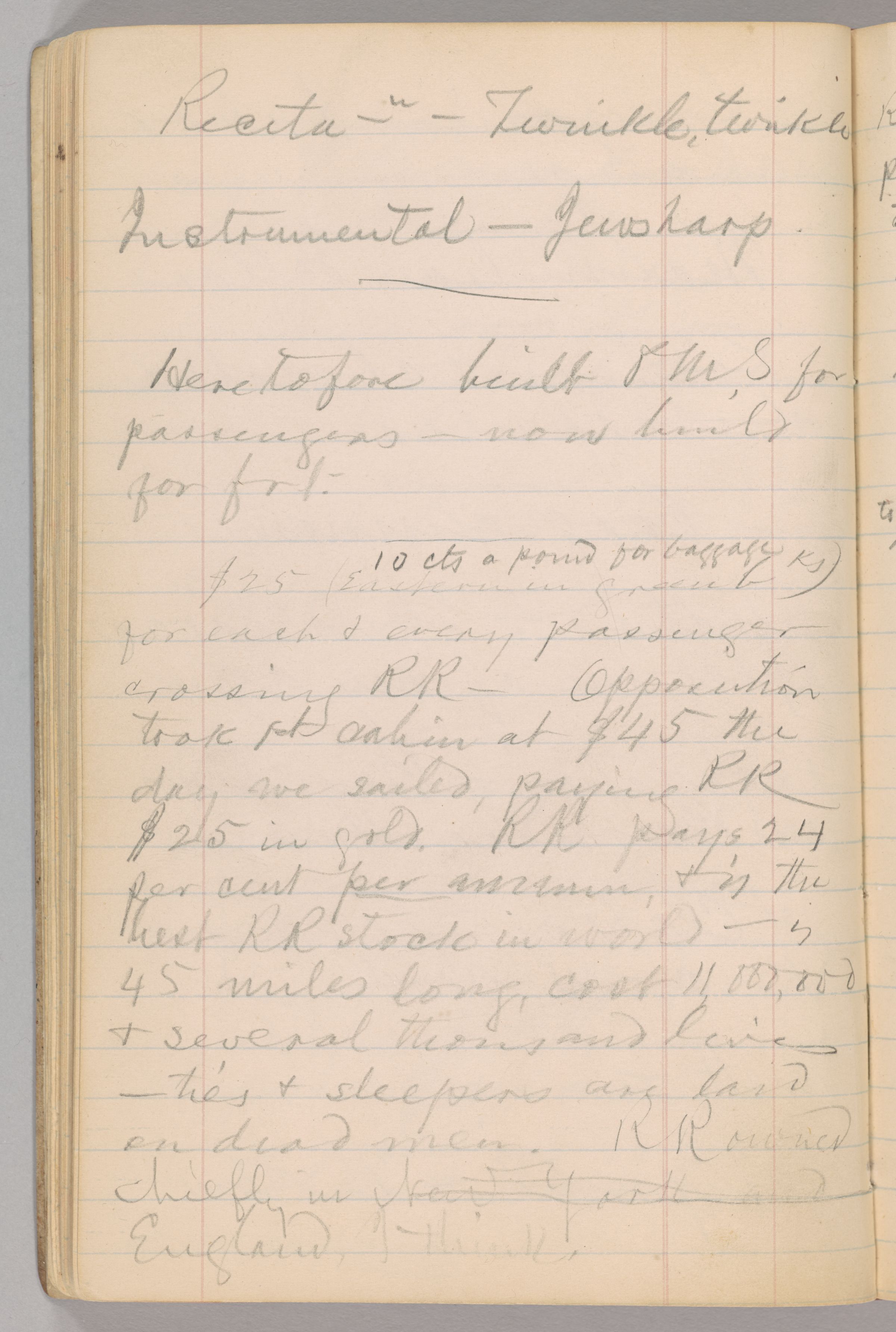
Recitan—Twinkle, twinkle
Instrumental—Jewsharp.
Heretofore built PMS for passengers—now build for frt.
$25 (Eastern in greenbks) 10 cts a pound for baggageⓉtextual note for each & every passenger crossing RR—Opposition took 1st cabin at $45 the day we sailed, paying RR $25 in gold. RR pays 24 per cent per annum, & is the best RR stock in world—is 45 miles long, cost 11,000,000 & several thousand lives—ties & sleepers are laid on dead men. RR owned chiefly in New York and England, I think.9
[MS: N11_leaf_028r]
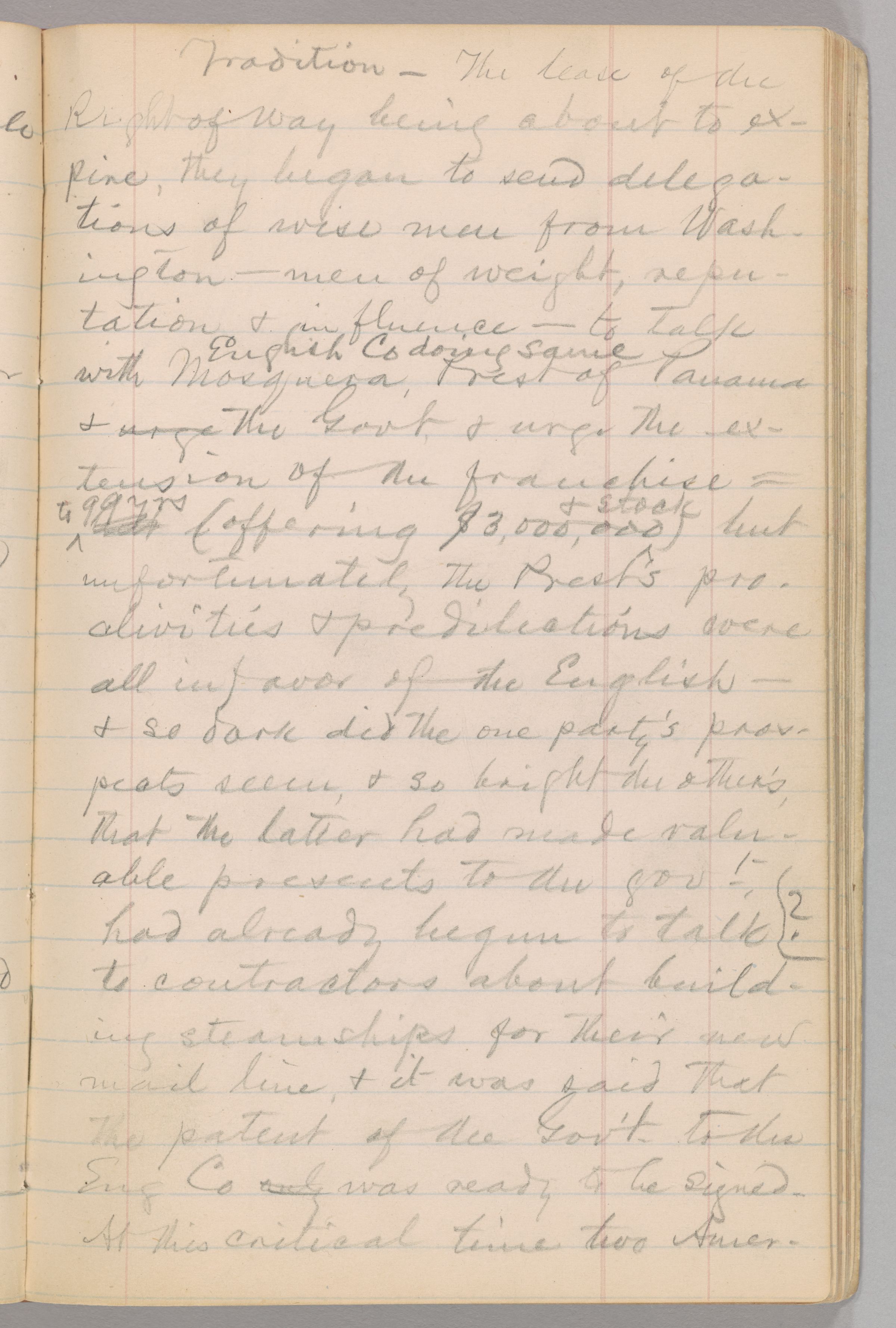
Tradition10—The lease of theⓉtextual note Right-of-way being about to expire, they began to send delegations of wise men from
Washington—men of weight, reputation & influence—to talk with Mosquera, Prest of Panama
English Co doing sameⓉtextual note & urge the Govt, & urge the extension of the franchise—but u to 99 yrsⓉtextual note (offering $3,000,000 & stockⓉtextual note) but unfortunately the Prest's proclivities & predilections were all in favor of
the English—& so dark did the one party's prospects seem, & so bright the other's,
that the latter had made valuable presents to the govt, had already begun to talk ?Ⓣtextual note to contractors about building steamships for their new mail line, & it was said that
the patent of the Gov't. to the Eng Co only was ready to be signed. At this critical time two Amer-
[MS: N11_leaf_029r]
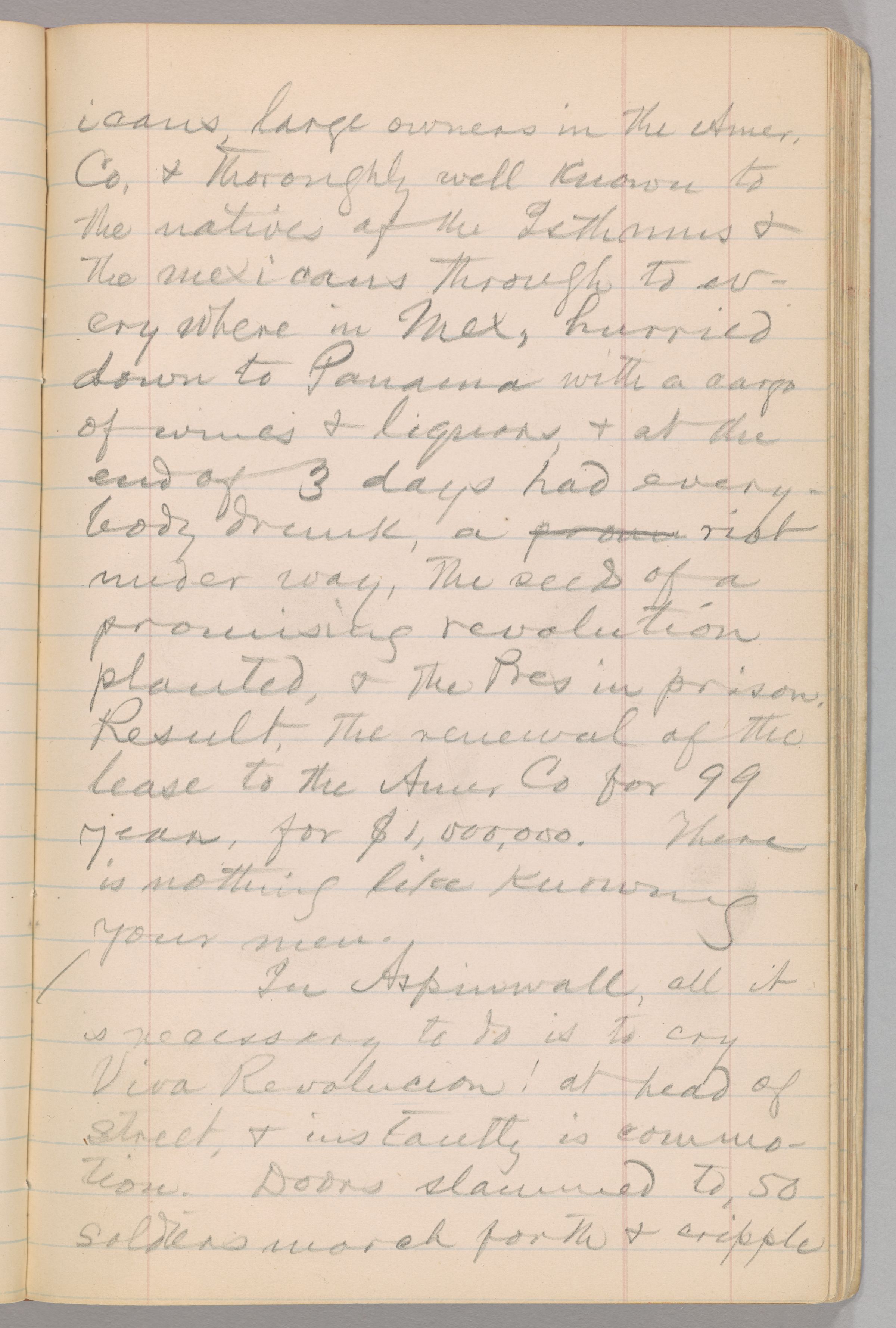
icans, large owners in the Amer. Co, & thoroughly well known to the natives of the
Isthmus & the mexicans through to everywhere in Mex.,Ⓜemendation hurried down to Panama with a cargo of wines & liquors, & at the end of 3 days had
everybody drunk, a promi riot under way, the seeds of a promising revolution planted, & the Pres in prison.
Result, the renewal of the lease to the Amer Co for 99 years, for $1,000,000. There
is nothing like knowing your men.
In Aspinwall,11 all it is necessary to do is to cry Viva Revolucion! at head of street, & instantly
is commotion. Doors slammed to, 50 soldiers march forth & cripple
[MS: N11_leaf_030r]
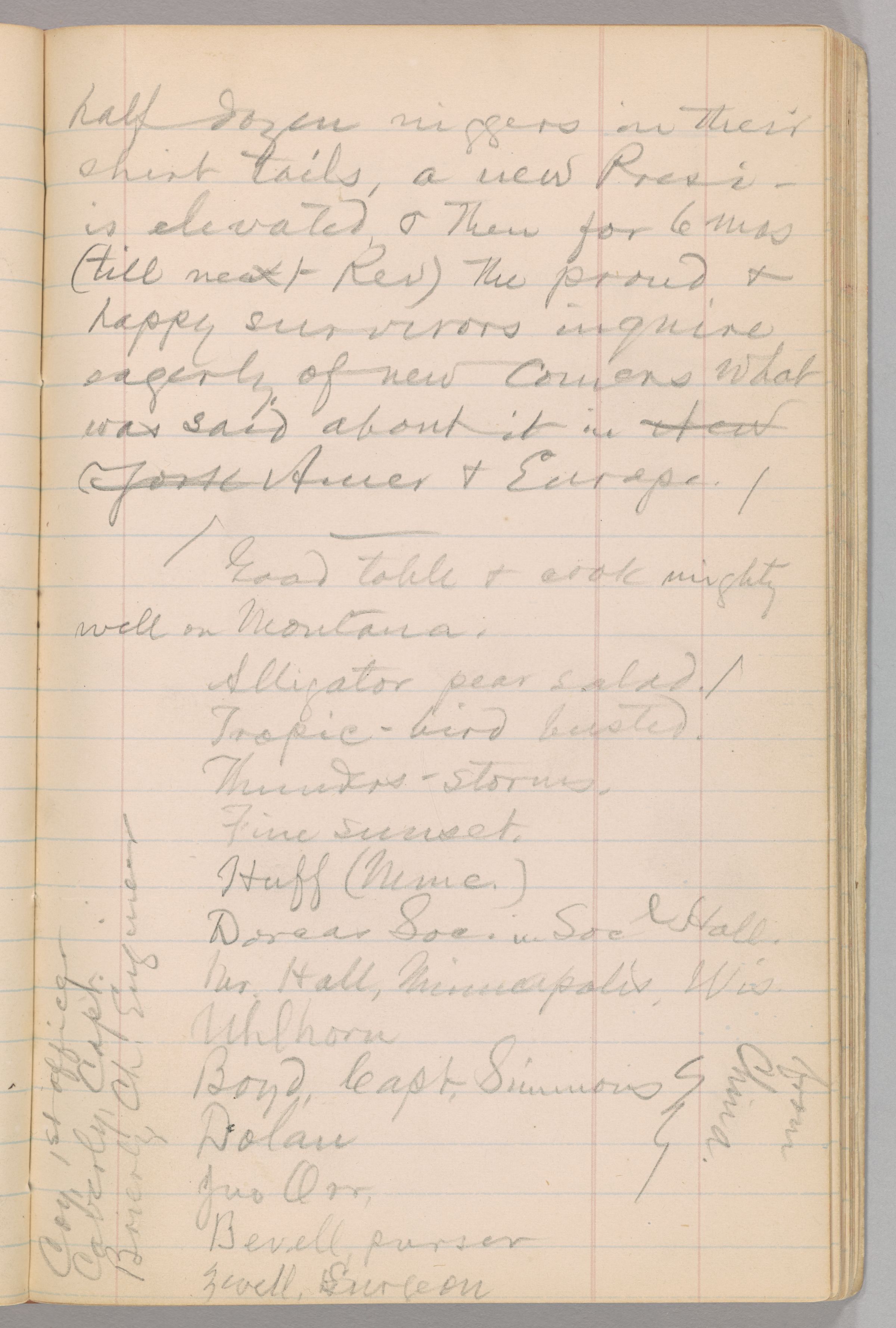
half dozen niggers in their shirt tails, a new Presi. is elevated, & then for 6 mos
(till next Rev) the proud & happy survivors inquire eagerly of new comersⓂemendation what was said about it in New York Amer & Europe.
Good table & cook mighty well on Montana.
Alligator pear salad.
Tropic-bird busted.
Thunders-storms.
Fine sunset.
Huff (Mme.)
Dorcas Soc. in Soc1 Hall.12
Mr. Hall, Minneapolis, Wis.
Uhlhorn
Boyd, Capt. Simmons
Dolan
from China.Ⓣtextual note13
Jno Orr,
Bevell, purser14
ZwellⓂemendation, DSurgeon
next three lines written vertically in the left margin:
Coy, 1st officer
Caverly, Capt.
Brierly, Ch. EngineerⓉtextual note
[MS: N11_leaf_031r]
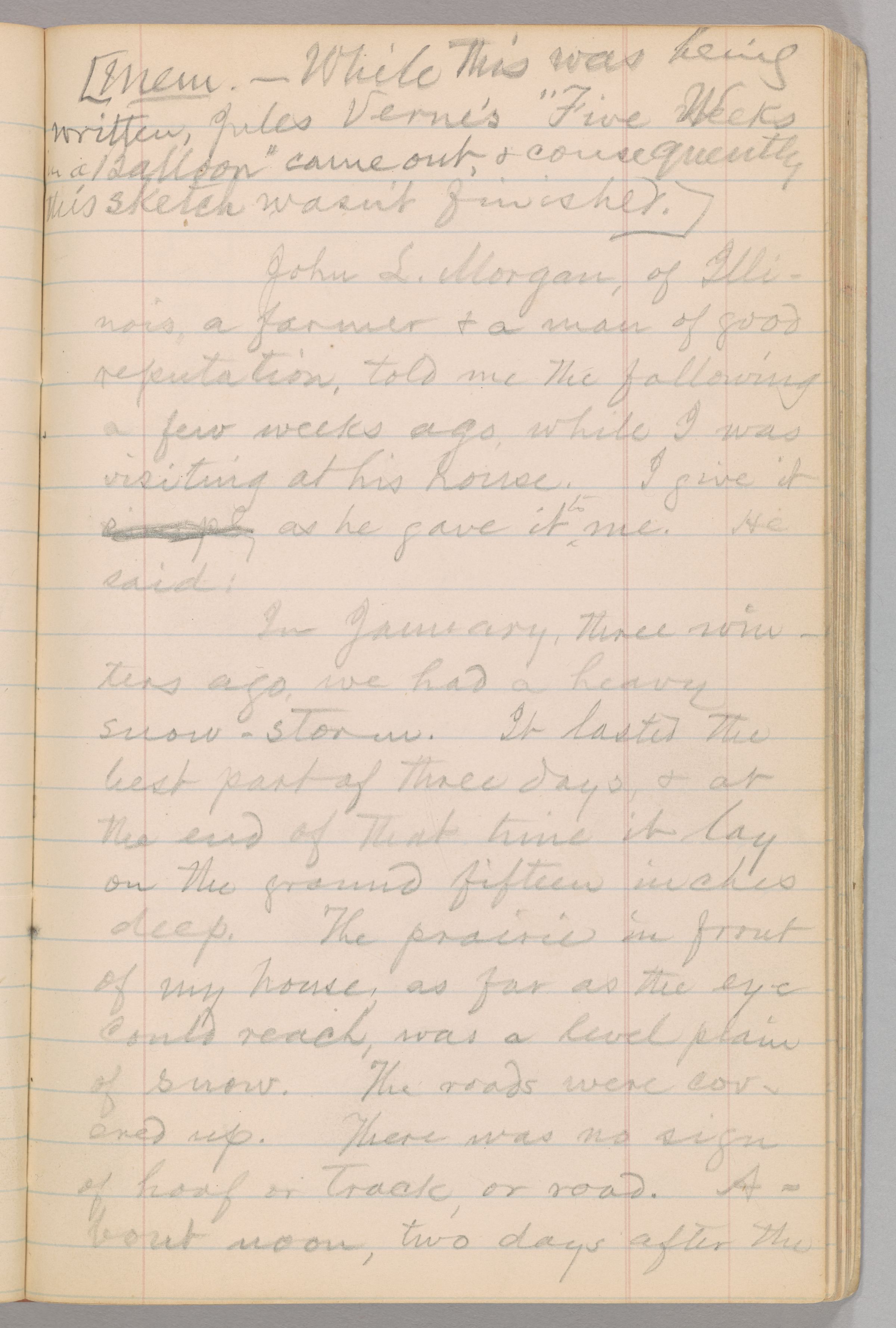
(Mem.—While this was being written, Jules Verne's “Five weeksWeeksⓉtextual note in a Balloon” came out,15 & consequently this sketch wasn't finished.Ⓣtextual note
John L. Morgan,16 of Illinois, a farmer & a man of good reputation, told me the following a few weeks ago, while I was visiting at his house. I give it simply as he gave it toⓉtextual note me. He said:
In January, three winters ago, we had a heavy snow-storm. It lasted the best part
of three days, & at the end of that time it lay on the ground fifteen inches deep.
The prairie in front of my house, as far as the eye could reach, was a level plain
of snow. The roads were covered up. There was no sign of hoof or track, or road. About
noon, two days after the
[MS: N11_leaf_032r]
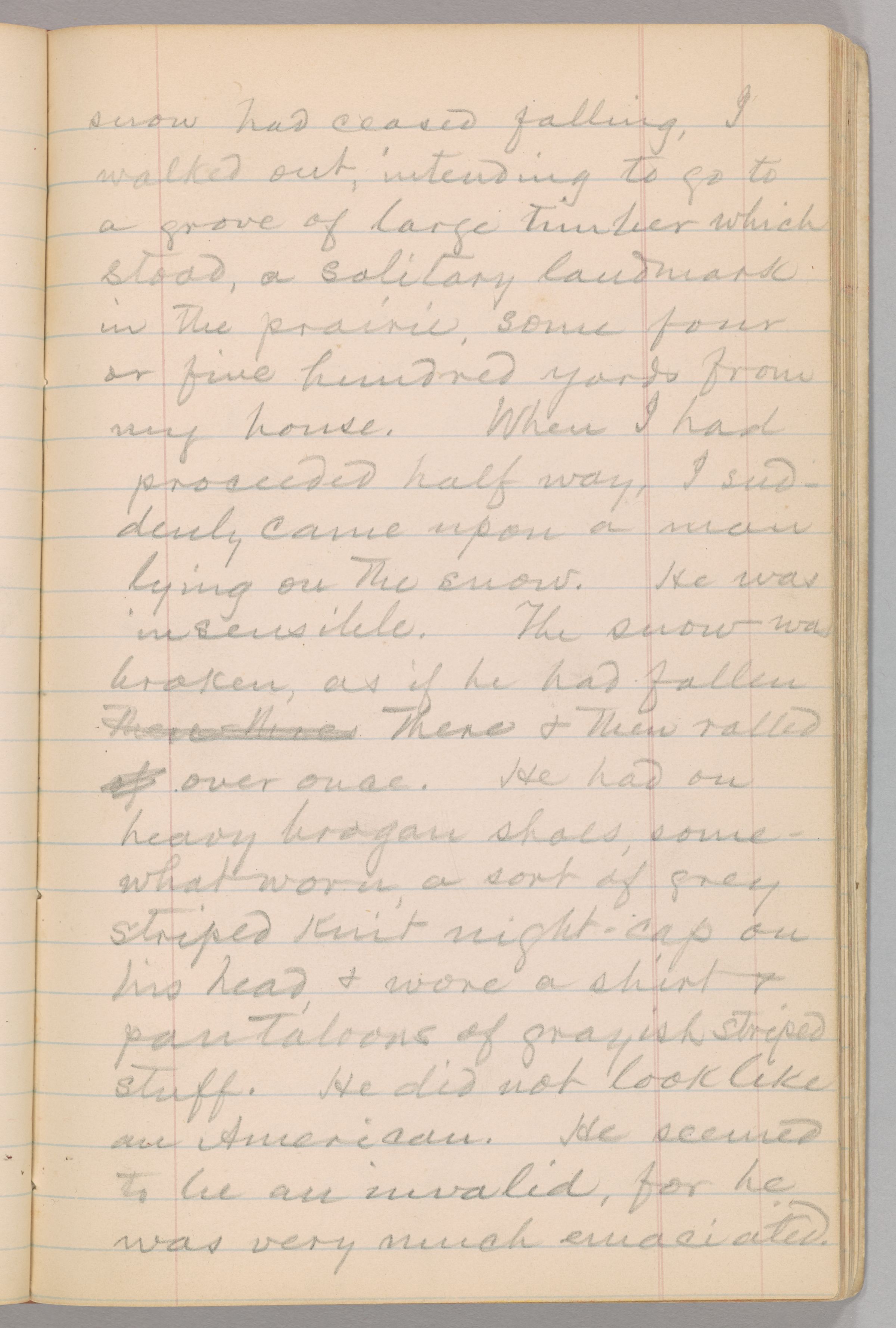
snow had ceased falling, I walked out, intending to go to a grove of large timber
which stood, a solitary landmark in the prairie, some four or five hundred yards from
my house. When I had proceeded half way, I suddenly came upon a man lying on the snow.
He was insensible. The snow was broken, as if he had fallen there thre there & then rolled of over once. He had on heavy brogan shoes, somewhat worn, a sort of grey striped knit
night-cap on his head, & wore a shirt & pantaloons of grayish striped stuff. He did
not look like an American. He seemed to be an invalid, for he was very much emaciated.
[MS: N11_leaf_033r]
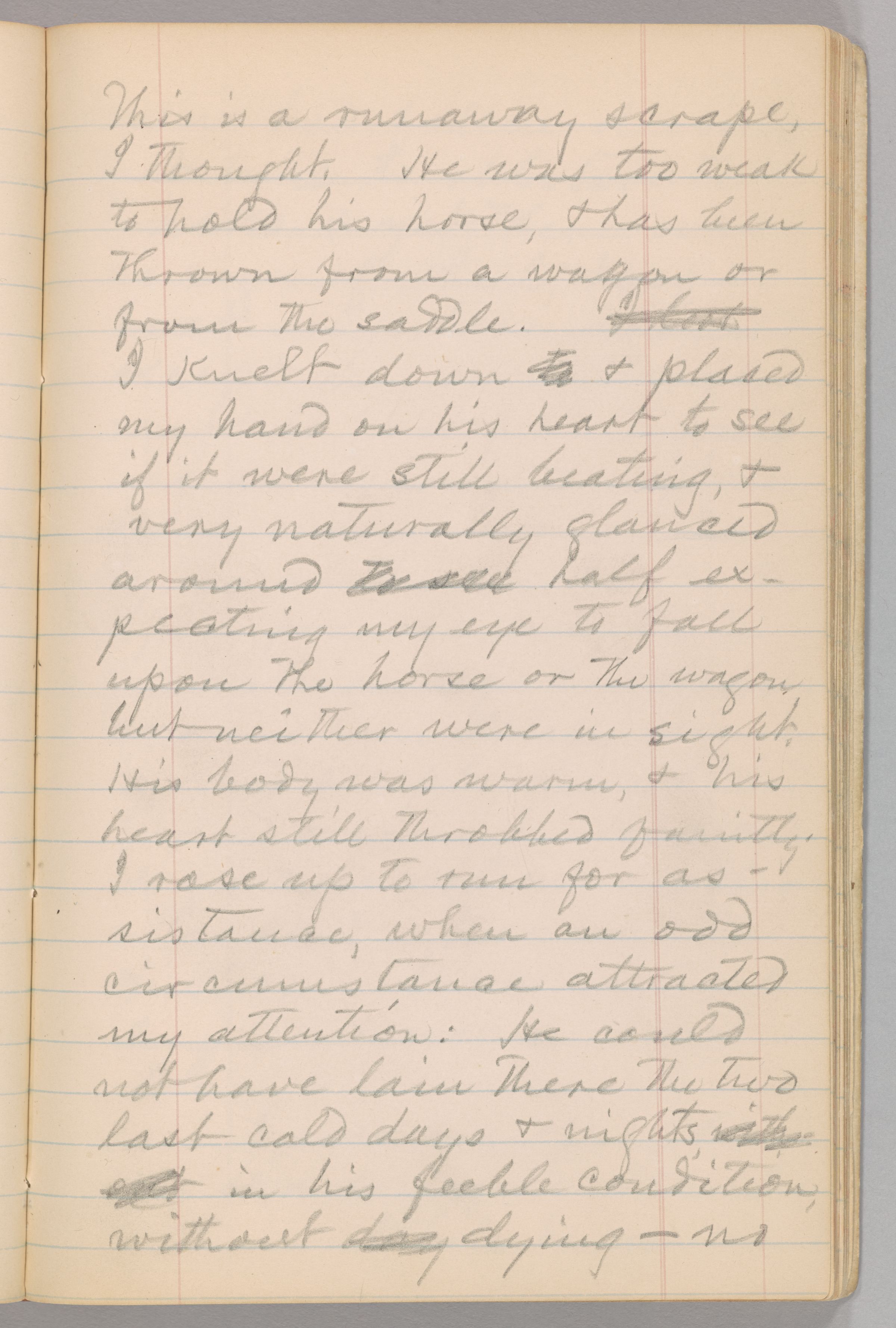
This is a runaway scrape, I thought. He was too weak to hold his horse, & has been
thrown from a wagon or from the saddle. I look I knelt down to & placed my hand on his heart to see if it were still beating, & very naturally glanced
around to see half expecting my eye to fall upon the horse or the wagon but neither were in sight.
His body was warm, & his heart still throbbed faintly. I rose up to run for assistance,
when an odd circumstance attracted my attention: He could not have lain there the
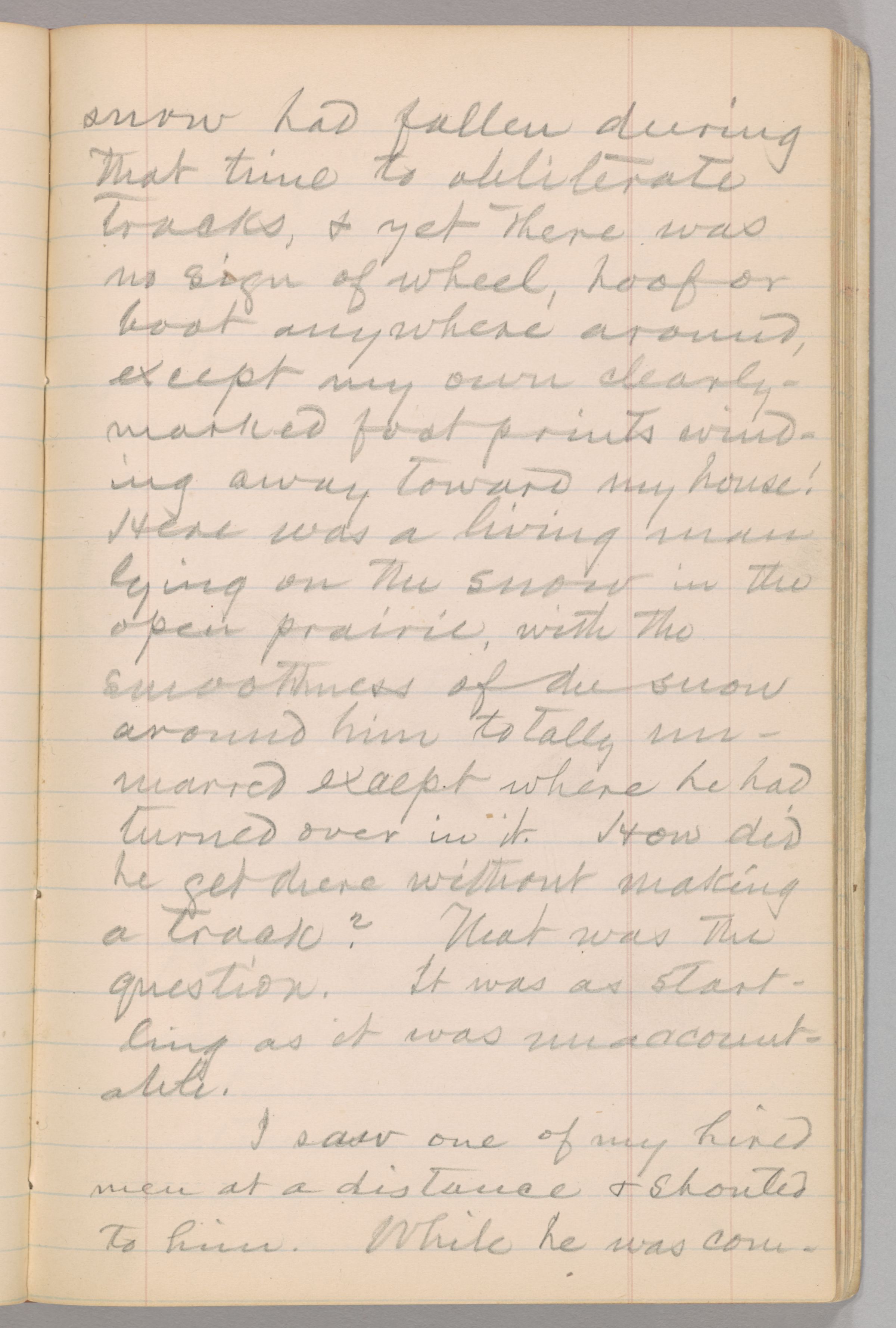
two last cold days & nights, without in his feeble condition, without day dying—no
[MS: N11_leaf_034r]
snow had fallen during that time to obliterate tracks, & yet there was no sign of
wheel, hoof or boot anywhere around, except my own clearly-marked footprintsⓂemendation winding away toward my house! Here was a living man lying on the snow in the open
prairie, with the smoothness of the snow around him totally unmarred except where
he had turned over in it. How did he get there without making a track? That was the
question. It was as startling as it was unaccountable.
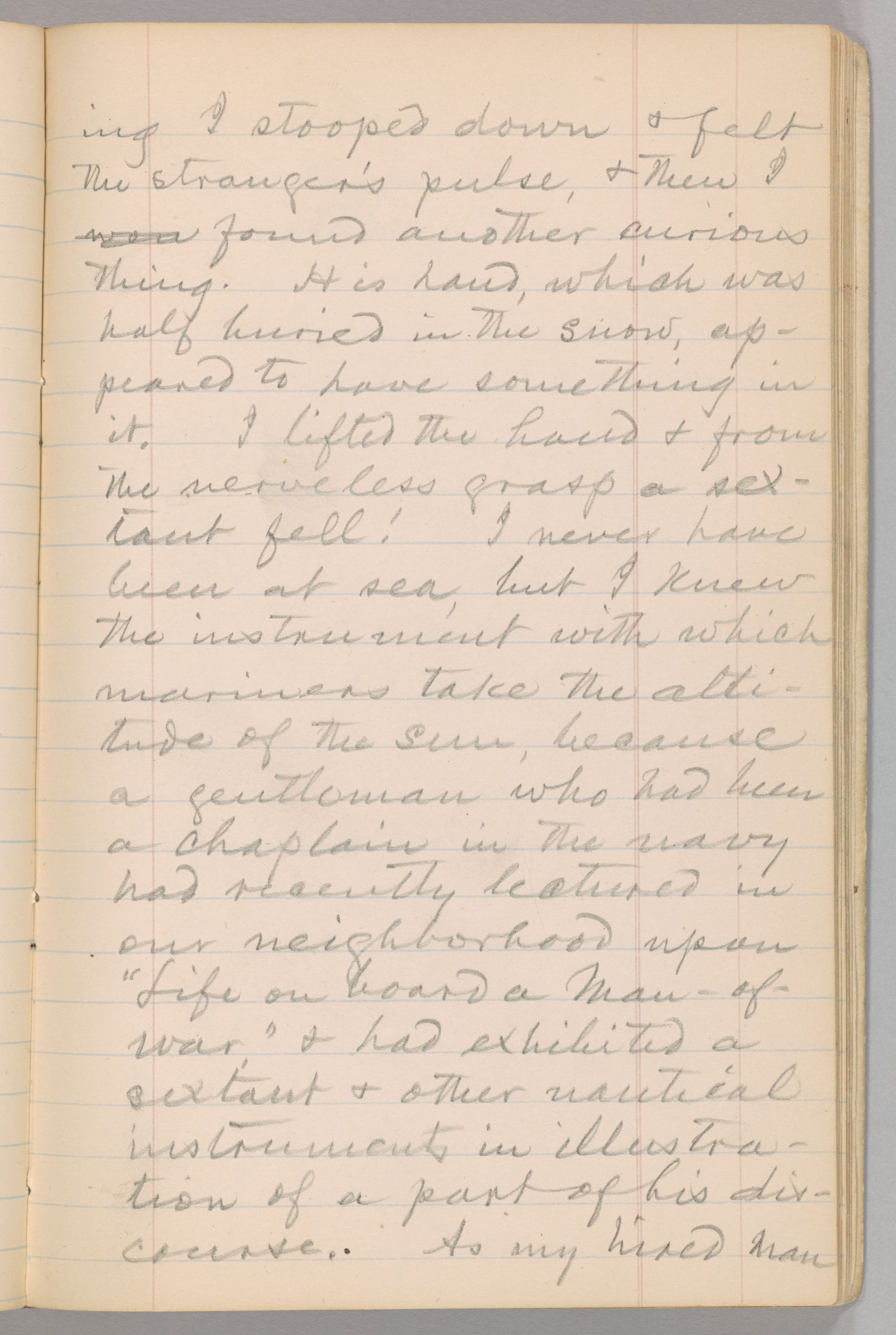
I saw one of my hired men at a distance & shouted to him. While he was com-
[MS: N11_leaf_035r]
ing I stooped down & felt the stranger's pulse, & then I won found another curious thing. His hand, which was half buried in the snow, appeared
to have something in it. I lifted the hand & from the nerveless grasp a sextant fell!
I never have been at sea, but I knew the instrument with which mariners take the altitude
of the sun, because a gentleman who had been a chaplain in the navy had recently lectured
in our neighborhood upon “Life on board a Man-of-war,” & had exhibited a sextant &
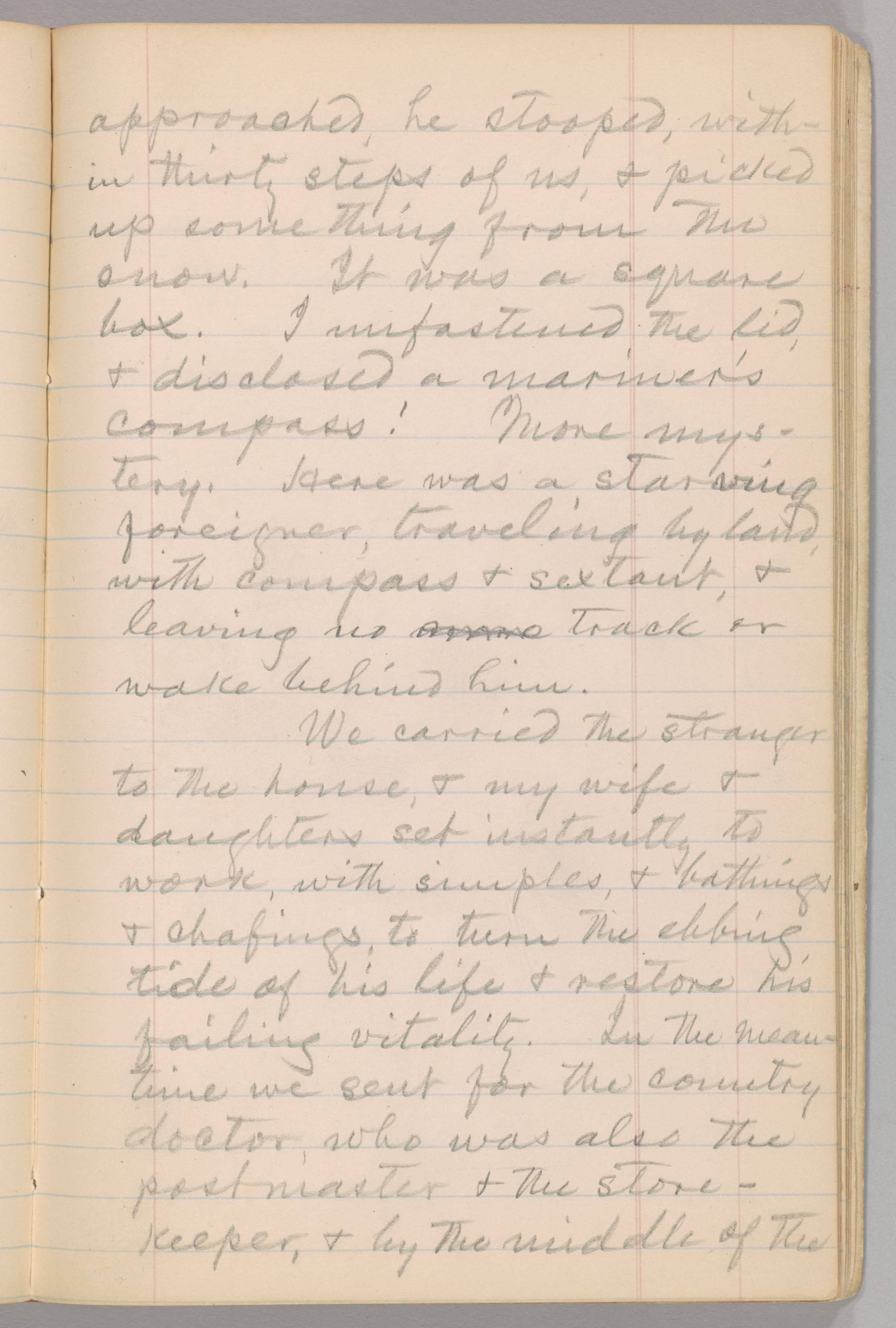
other nautical instruments in illustration of a part of his discourse. As my hired
man
[MS: N11_leaf_036r]
approached, he stooped, within thirty steps of us, & picked up something from the
snow. It was a square box. I unfastened the lid, & disclosed a mariner's compass!
More mystery. Here was a starving foreigner, traveling by land, with compass & sextant,
& leaving no one word track or wake behind him.
We carried the stranger to the house, & my wife & daughters set instantly to work,
with simples, & bathings & chafings, to turn the ebbing tide of his life & restore
his failing vitality. In the meantime we sent for the country doctor, who was also
the postmasterⓂemendation & the store-keeperⓂemendation, & by the middle of the
[MS: N11_leaf_037r]
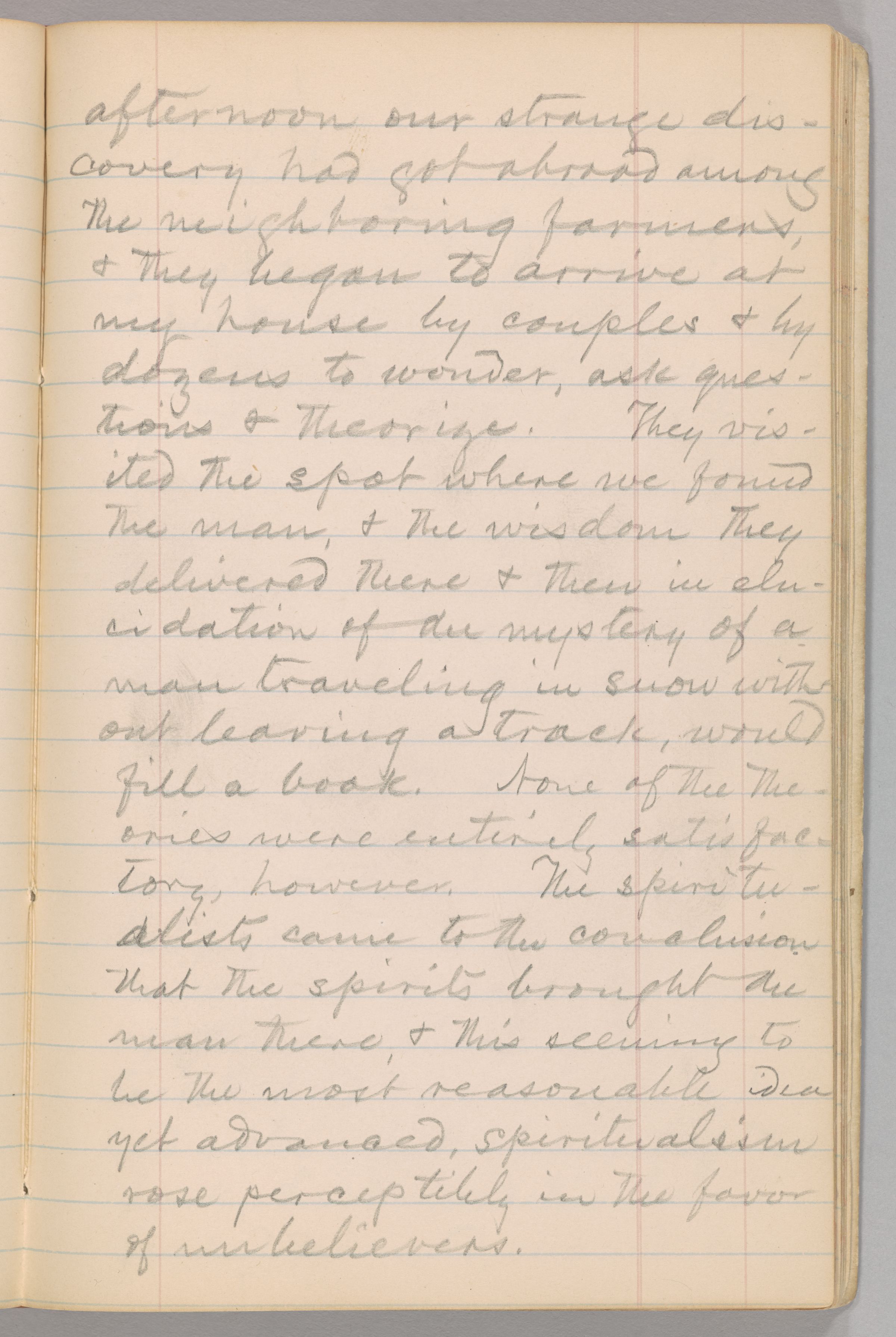
afternoon our strange discovery had got abroad among the neighboring farmers, & they
began to arrive at my house by couples & by dozens to wonder, ask questions & theorize.
They visited the spot where we found the man, & the wisdom they delivered there &
then in elucidation of the mystery of a man traveling in snow without leaving a track,
would fill a book. None of the theories were entirely satisfactory, however. The spiritualists
came to the conclusion that the spirits brought the man there, & this seeming to be
the most reasonable idea yet advanced, spiritualism rose perceptibly in the favor
of unbelievers.
[MS: N11_leaf_038r]
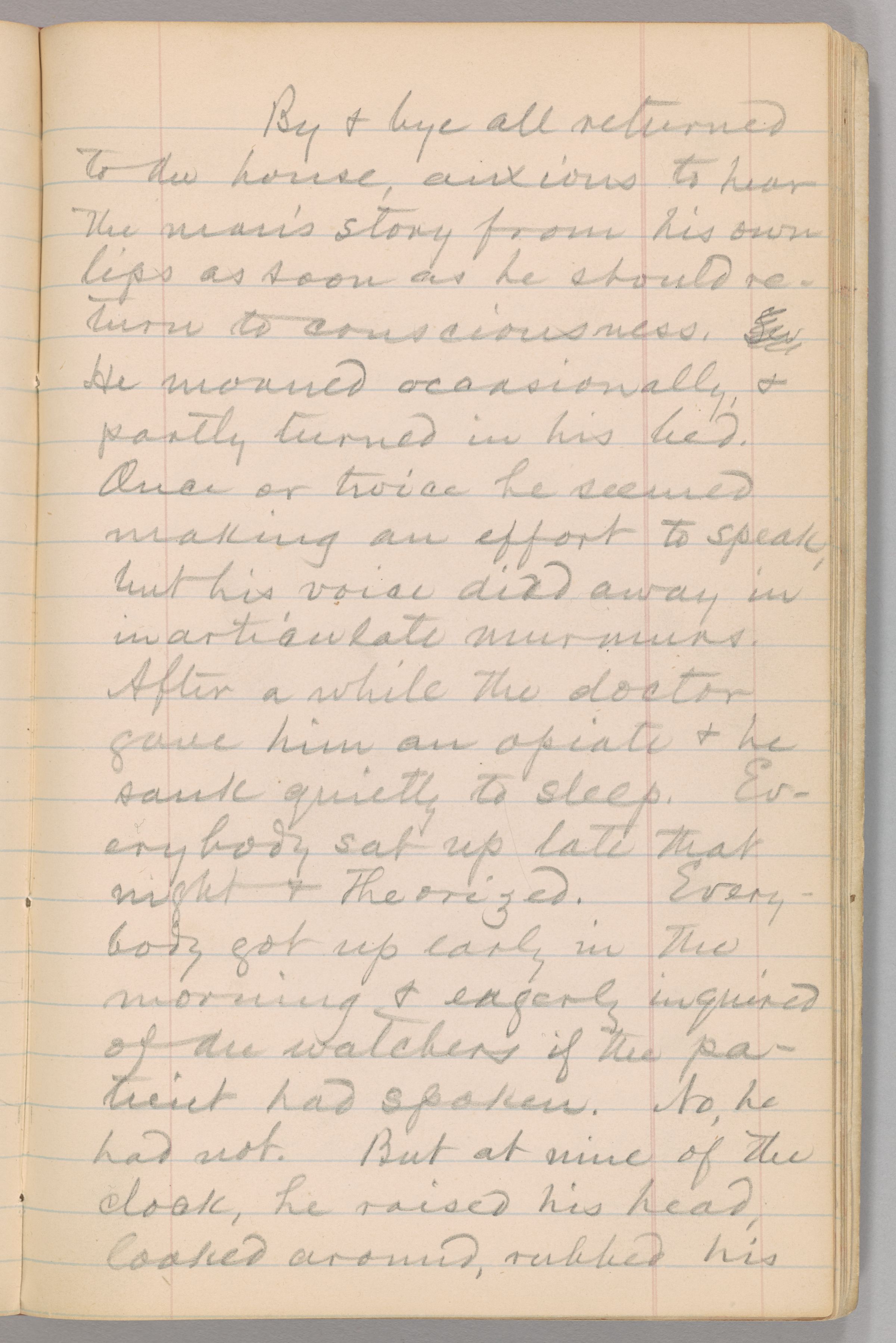
By & bye all returned to the house, anxious to hear the man's story from his own lips
as soon as he should return to consciousness. Sev He moaned occasionally, & partly turned in his bed. Once or twice he seemed making
an effort to speak, but his voice died away in inarticulate murmurs. After a while
the doctor gave him an opiate & he sank quietly to sleep. Everybody sat up late that
night & theorized. Everybody got up early in the morning & eagerly inquired of the
watchers if the patient had spoken. No, he had not. But at nine of the clock, he raised
his head, looked around, rubbed his
[MS: N11_leaf_039r]
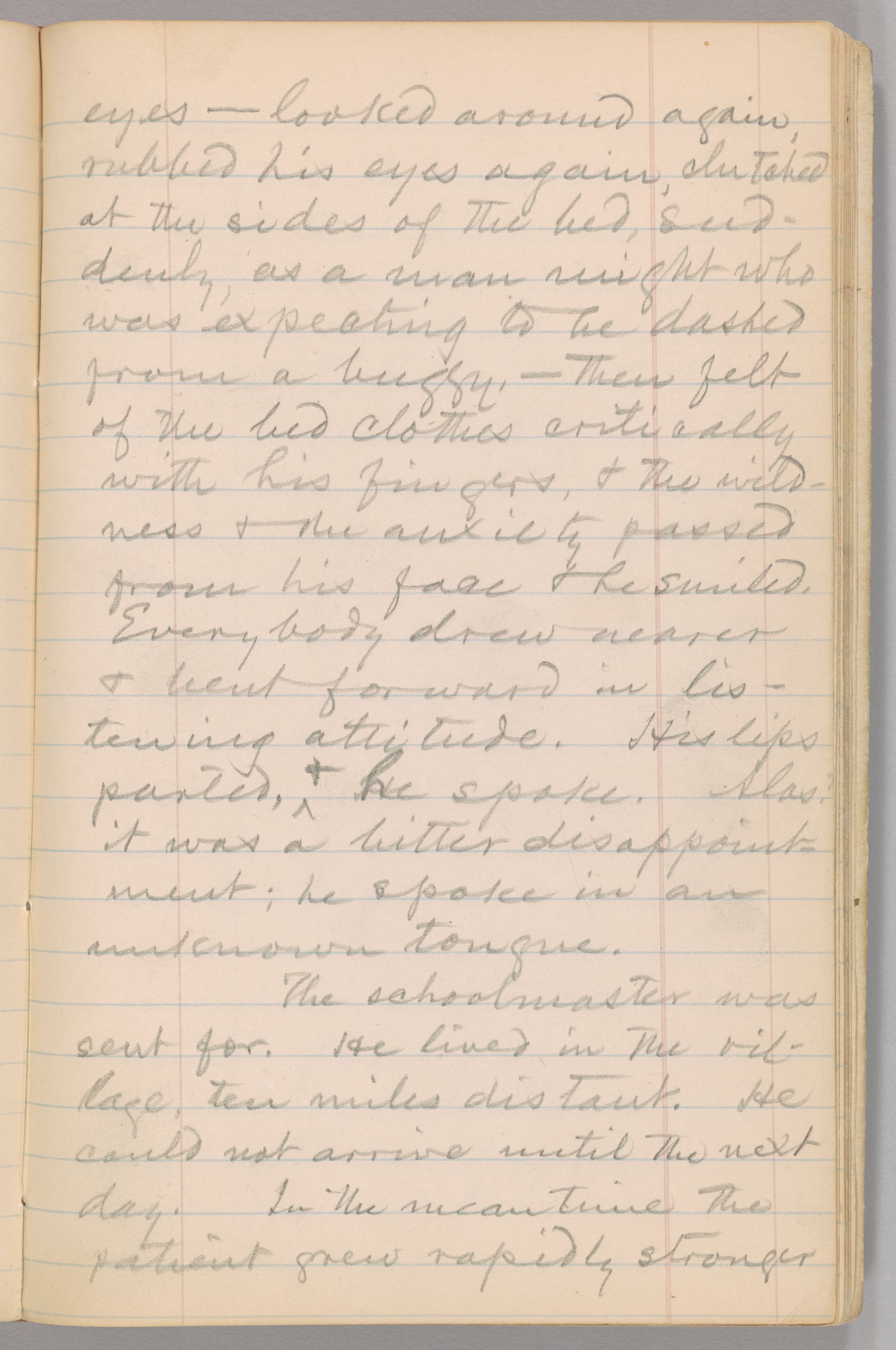
eyes—looked around again, rubbed his eyes again, clutched at the sides of the bed,
suddenly, as a man might who was expecting to be dashed from a buggy,—then felt of
the bed clothes critically with his fingers, & the wildness & the anxiety passed from
his face & he smiled. Everybody drew nearer & bent forward in listening attitude.
His lips parted., & HeheⓉtextual note spoke. Alas! it was a bitter disappointment; he spoke in an unknown tongue.
The schoolmaster was sent for. He lived in the village, ten miles distant. He could
not arrive until the next day. In the meantime the patient grew rapidly stronger
[MS: N11_leaf_040r]
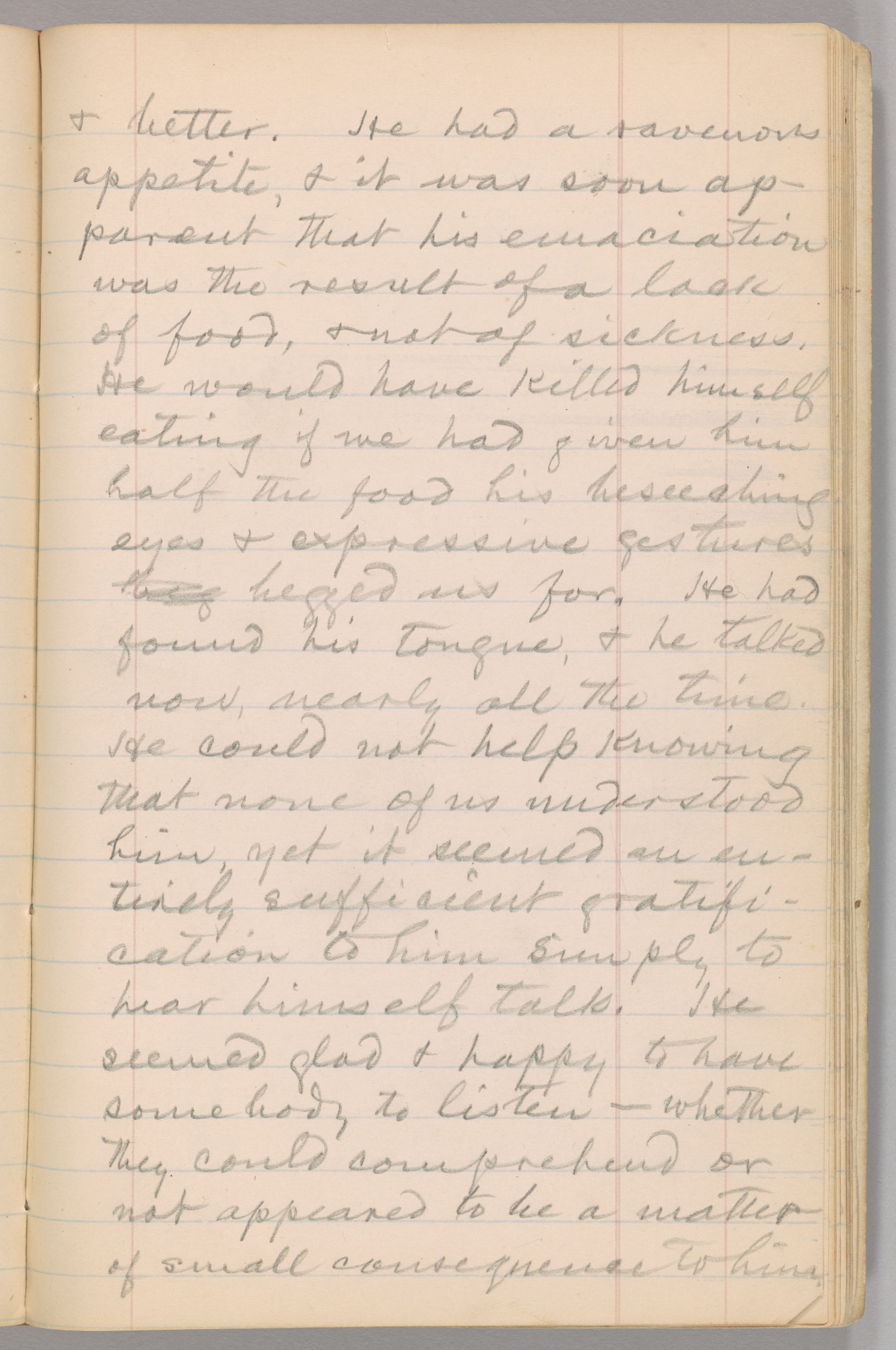
& better. He had a ravenous appetite, & it was soon apparent that his emaciation was
the result of a lack of food, & not of sickness. He would have killed himself eating
if we had given him half the food his beseeching eyes & expressive gestures beg begged us for. He had found his tongue, & he talked now, nearly all the time. He
could not help knowing that none of us understood him, yet it seemed an entirely sufficient
gratification to him simply to hear himself talk. He seemed glad & happy to have somebody
to listen—whether they could comprehend or not appeared to be a matter of small consequence
to him.
[MS: N11_leaf_041r]
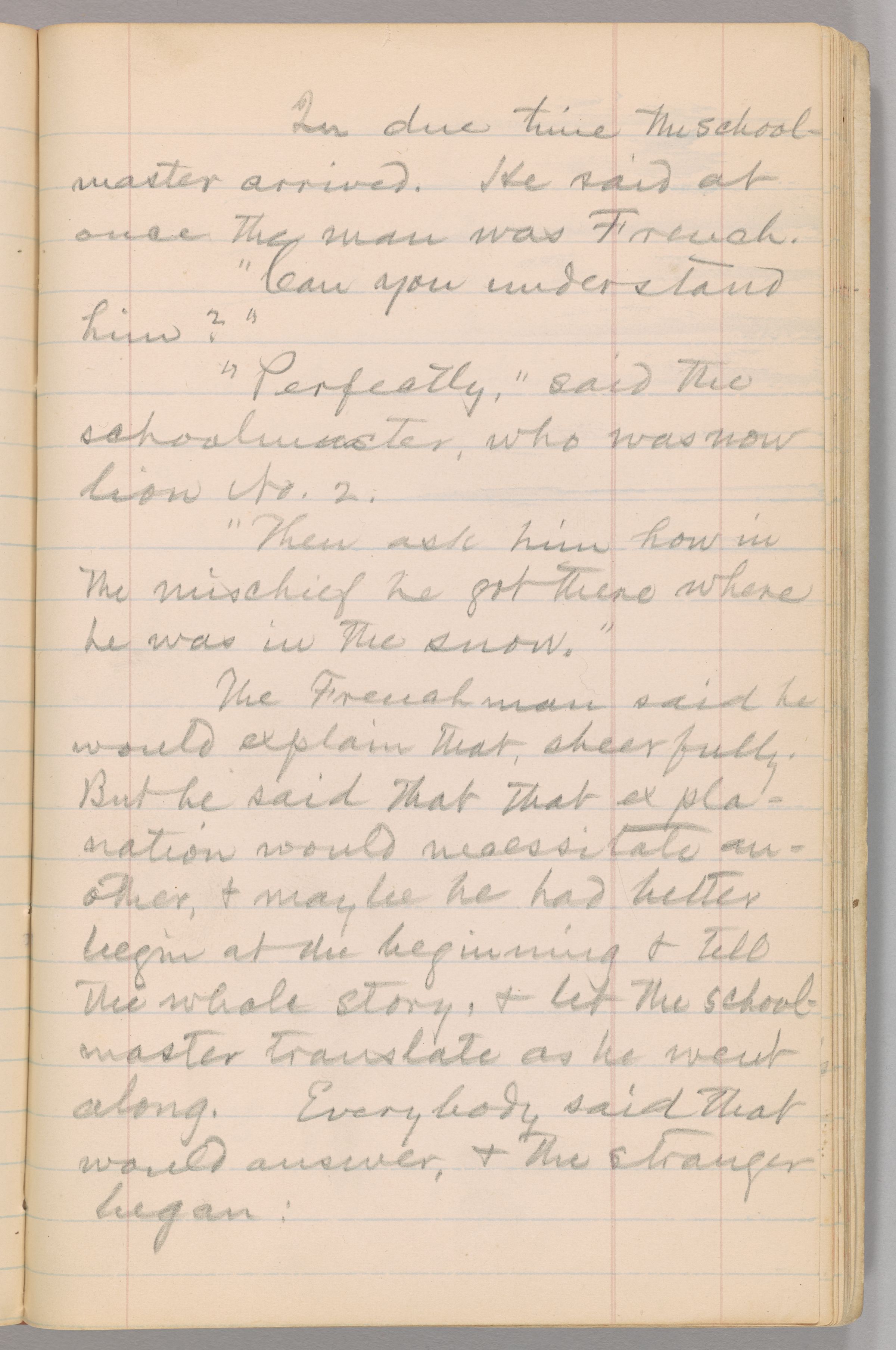
In due time the schoolmasterⓂemendation arrived. He said at once the man was French.
“Can you understand him?”
“Perfectly,” said the schoolmaster, who was now lion No. 2.
“Then ask him how in the mischief he got there where he was in the snow.”
The Frenchman said he would explain that, cheerfully. But he said that that explanation would necessitate another, & maybe he had better begin at the beginning & tell the whole story, & let the schoolmasterⓂemendation translate as he went along. Everybody said that would answer, & the stranger began:
[MS: N11_leaf_042r]
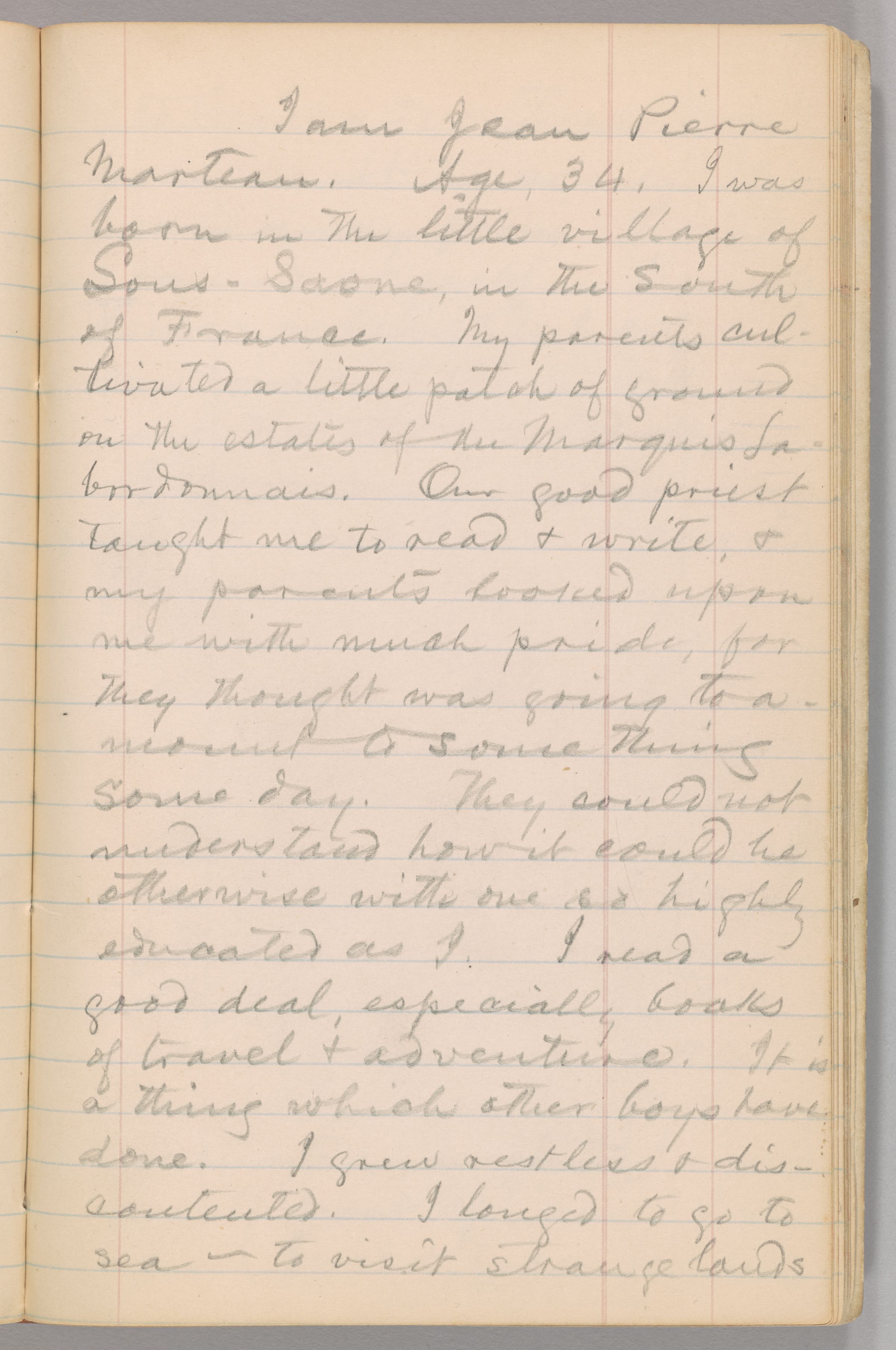
I am Jean Pierre Marteau. Age, 34. I was born in the little village of Sous-Saone,
in the South of France. My parents cultivated a little patch of ground on the estates
of the Marquis Labordonnais. Our good priest taught me to read & write, & my parents
looked upon me with much pride, for they thought was going to amount to something
some day. They could not understand how it could be otherwise with one so highly educated
as I. I read a good deal, especially books of travel & adventure. It is a thing which
other boys have done. I grew restless & discontented. I longed to go to sea—to visit
strange lands
[MS: N11_leaf_043r]
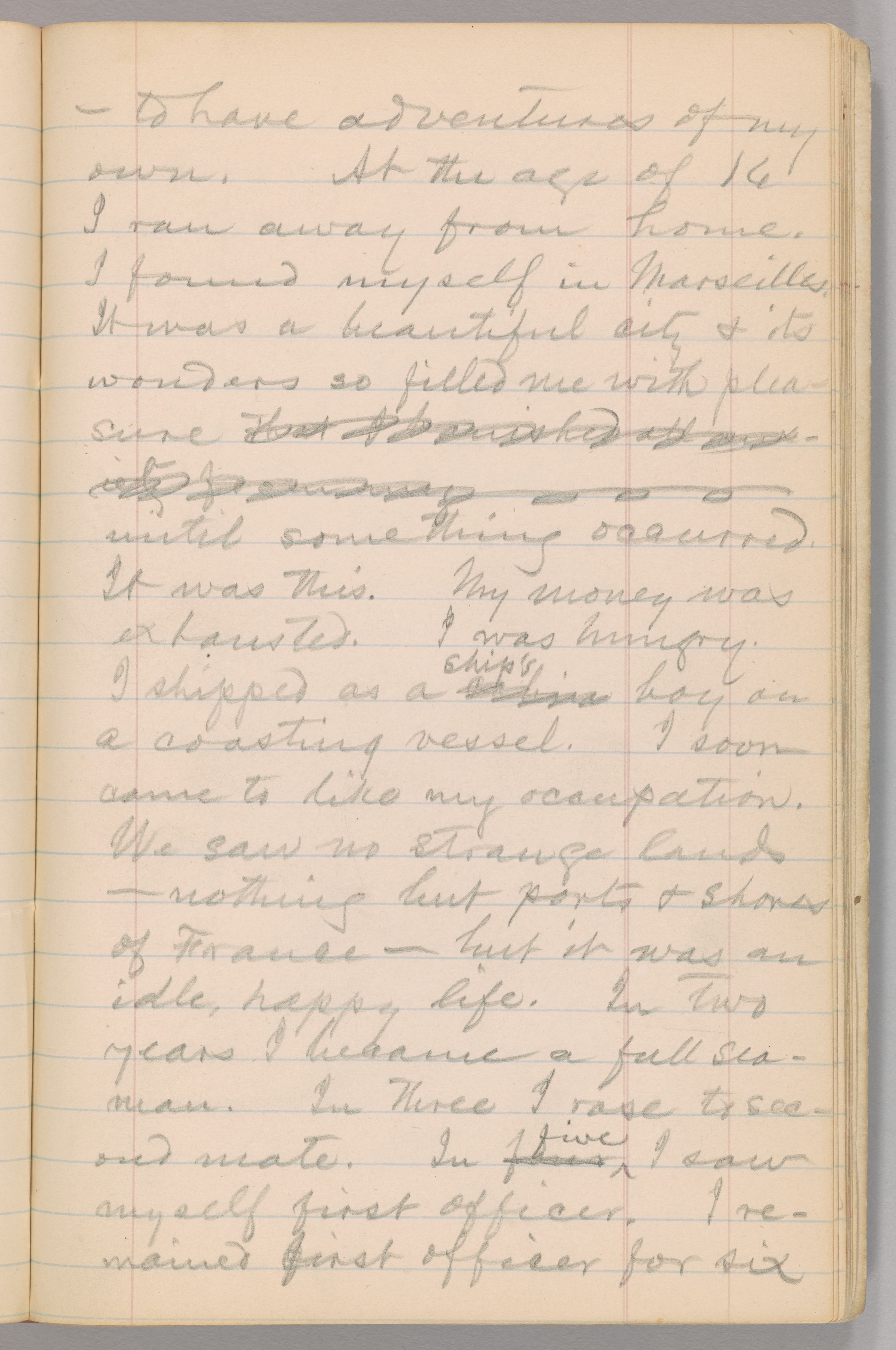
—to have adventures of my own. At the age of 16 I ran away from home. I found myself
in Marseilles. It was a beautiful city & its wonders so filled me with pleasure that I banished all anxiety from my until something occurred. It was this. My money was exhausted. I was hungry. I shipped
as a cabin ship'sⓉtextual note boy on a coasting vessel. I soon came to like my occupation. We saw no strange lands—nothing
but ports & shores of France—but it was an idle, happy life. In two years I became
a full seaman. In three I rose to second mate. In four fiveⓉtextual note I saw myself first officer. I remained sfirst officer for six
[MS: N11_leaf_044r]
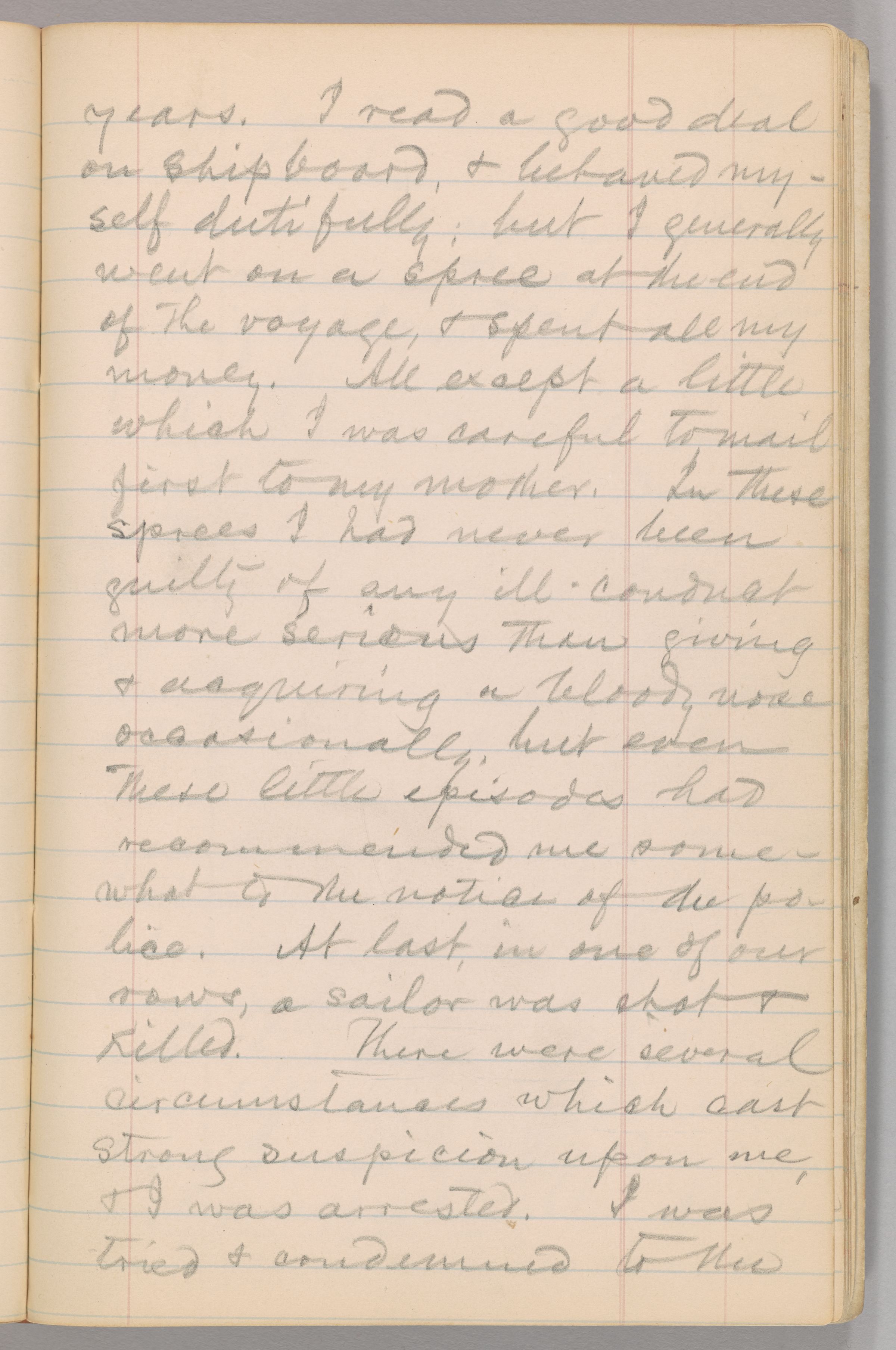
years. I read a good deal on shipboard, & behaved myself dutifully; but I generally
went on a spree at the end of the voyage, & spent all my money. All except a little
which I was careful to mail first to my mother. In these sprees I had never been guilty
of any ill-conduct more serious than giving & acquiring a bloody nose occasionally,
but even these little episodes had recommended me somewhat to the notice of the police.
At last, in one of our rows, a sailor was shot & killed. There were several circumstances
which cast strong suspicion upon me, & I was arrested. I was tried & condemned to
the
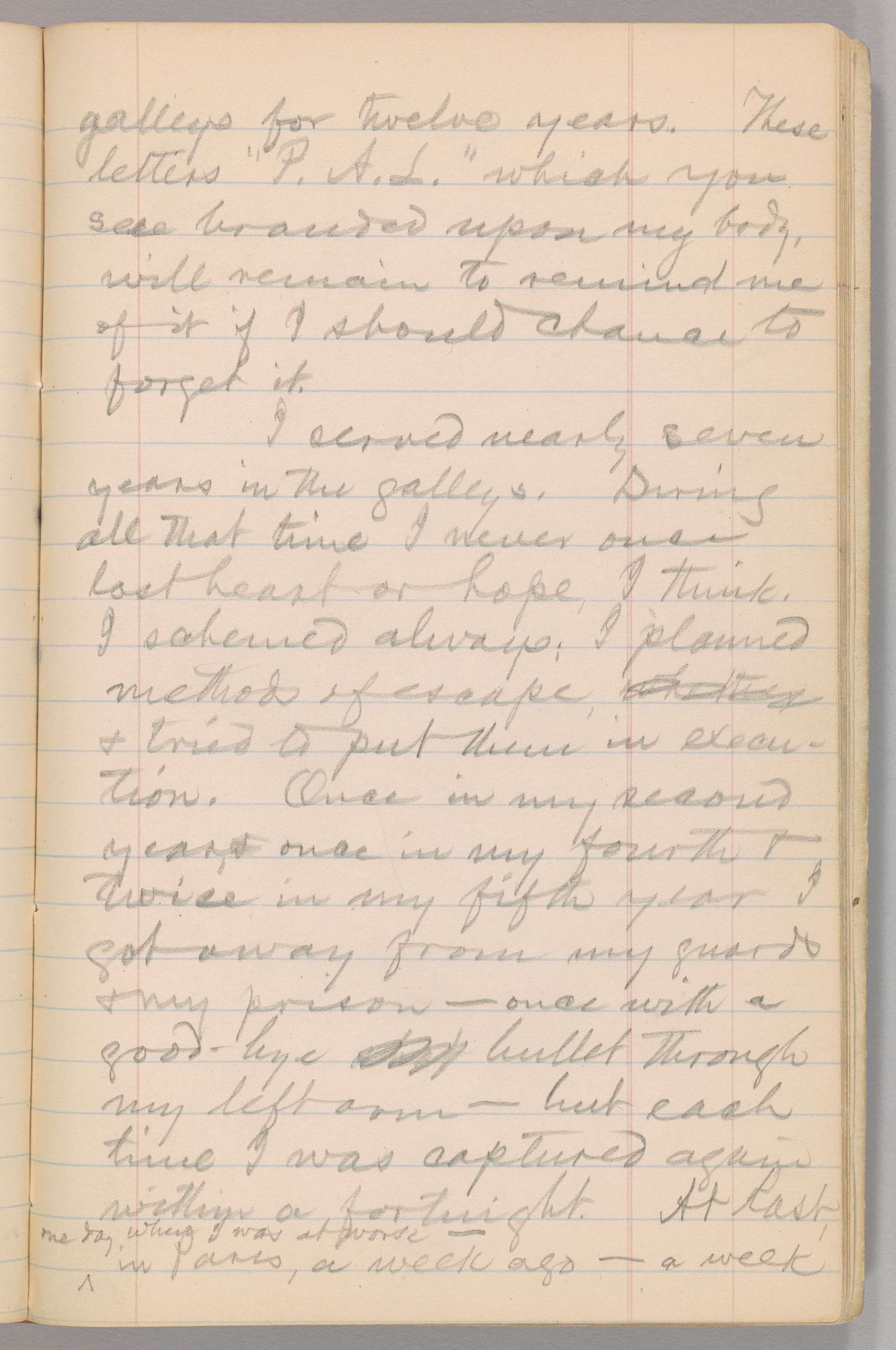
[MS: N11_leaf_045r]
galleys for twelve years. These letters “P.A.L.” which you see branded upon my body,
will remain to remind me of it if I should chance to forget it.
I served nearly seven years in the galleys. During all that time I never once lost
heart or hope, I think. I schemed always; I planned methods of escape, whether & tried to put them in execution. Once in my second years,Ⓣtextual note once in my fourth & twice in my fifth year I got away from my guards & my prison—once
with a good-bye shot bullet through my left arm—but each time I was captured again within a fortnight.
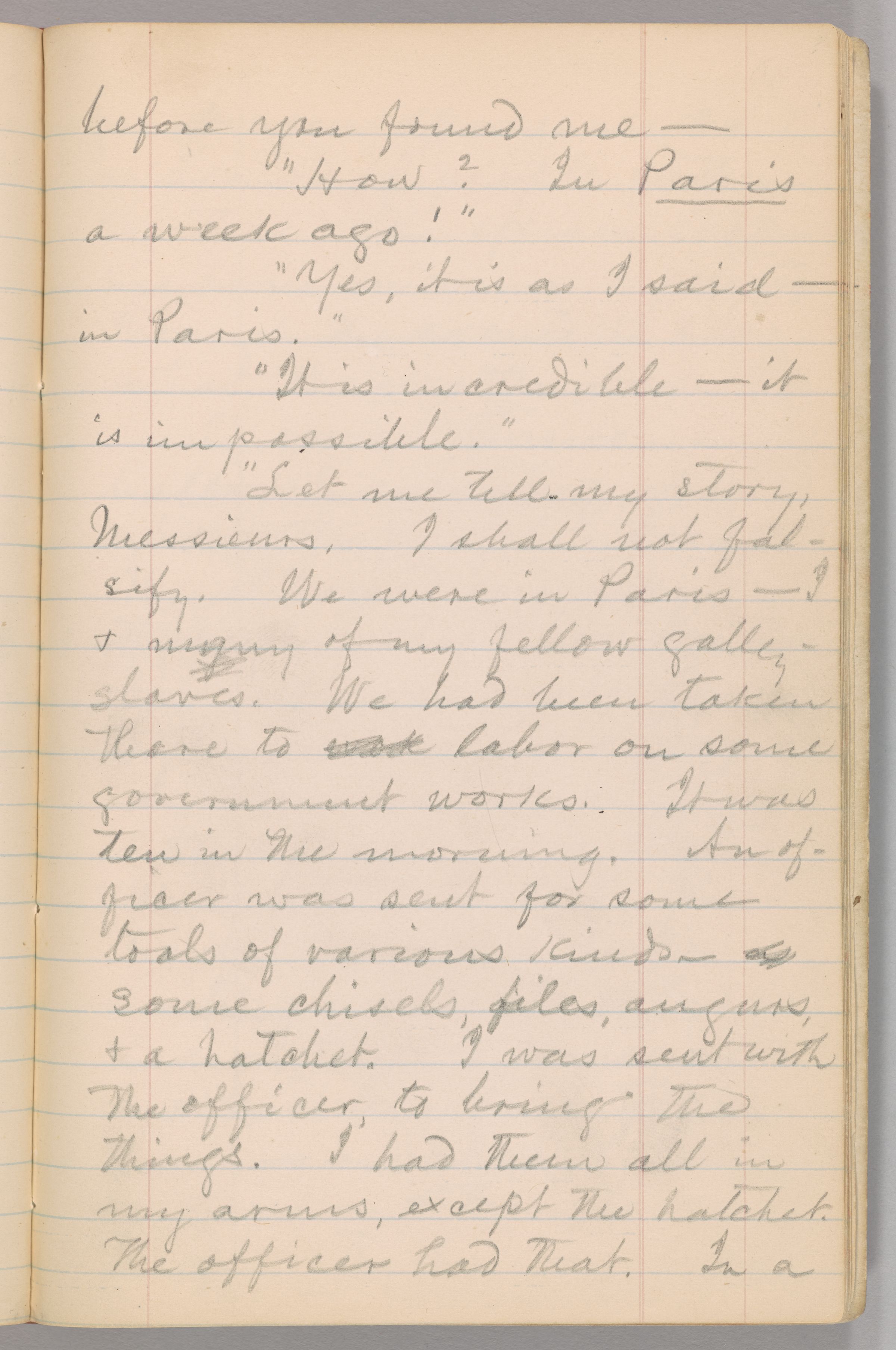
At last, one day when I was at work—Ⓣtextual notein Paris, a week ago—a week
[MS: N11_leaf_046r]
before you found me—
“How? In Paris a week ago!”
“Yes, it is as I said—in Paris.”
“It is incredible—it is impossible.”
“Let me tell my story, Messieurs. I shall not falsify. We were in Paris—I & my manyⓉtextual note of my fellow galley-slaves. We had been taken there to work labor on some government works. It was ten in the morning. An officer was sent for
some tools of various kinds—a some chisels, afiles, augurs, & a hatchet. I was sent with the officer, to bring the things. I had
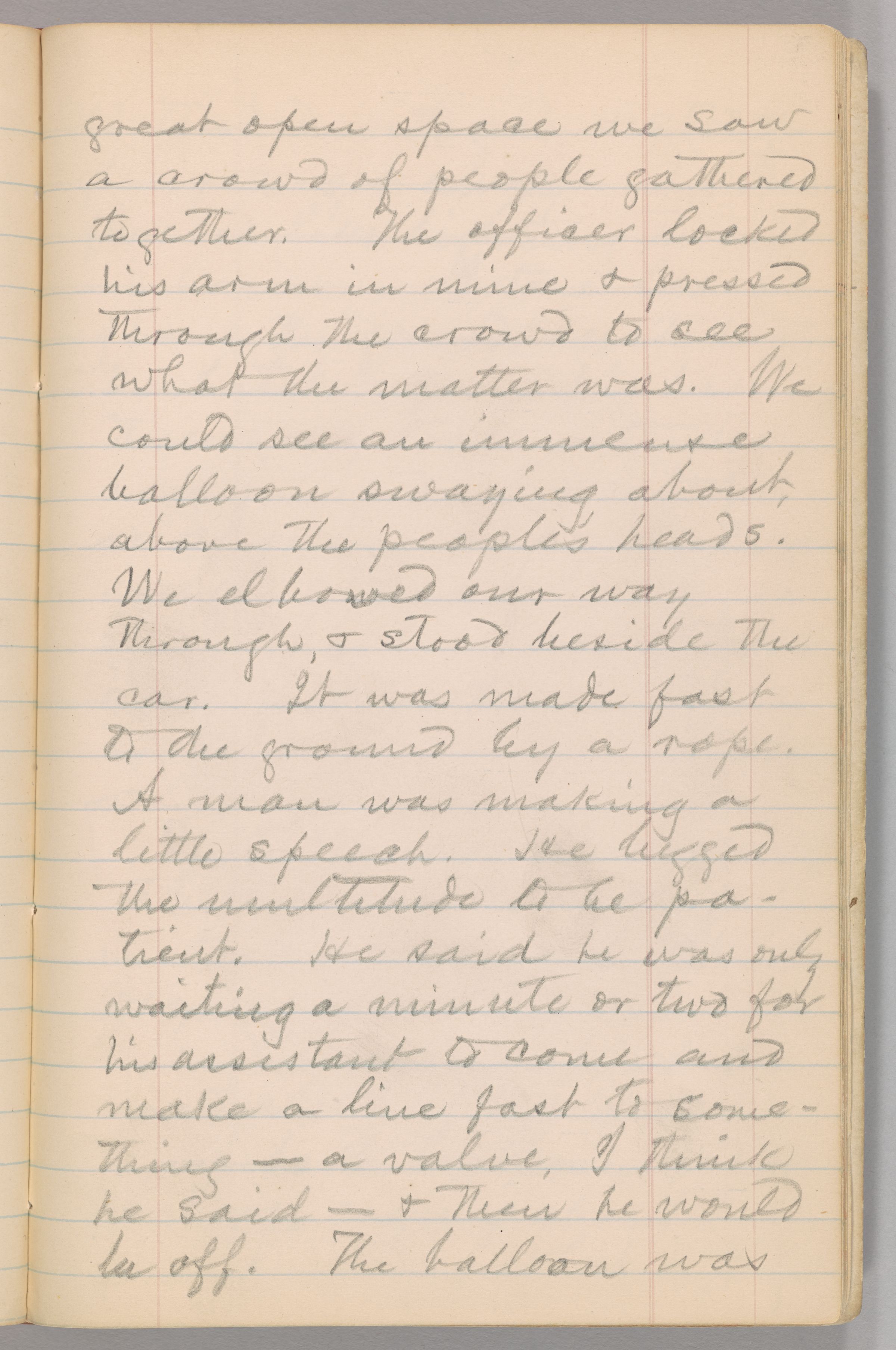
them all in my arms, except the hatchet. The officer had that. In a
[MS: N11_leaf_047r]
great open space we saw a crowd of people gathered together. The officer locked his
arm in mine & pressed through the crowd to see what the matter was. We could see an
immense balloon swaying about, above the people's heads. We elbowed our way through,
& stood beside the car. It was made fast to the ground by a rope. A man was making
a little speech. He begged the multitude to be patient. He said he was only waiting
a minute or two for his assistant to come and make a line fast to something—a valve,
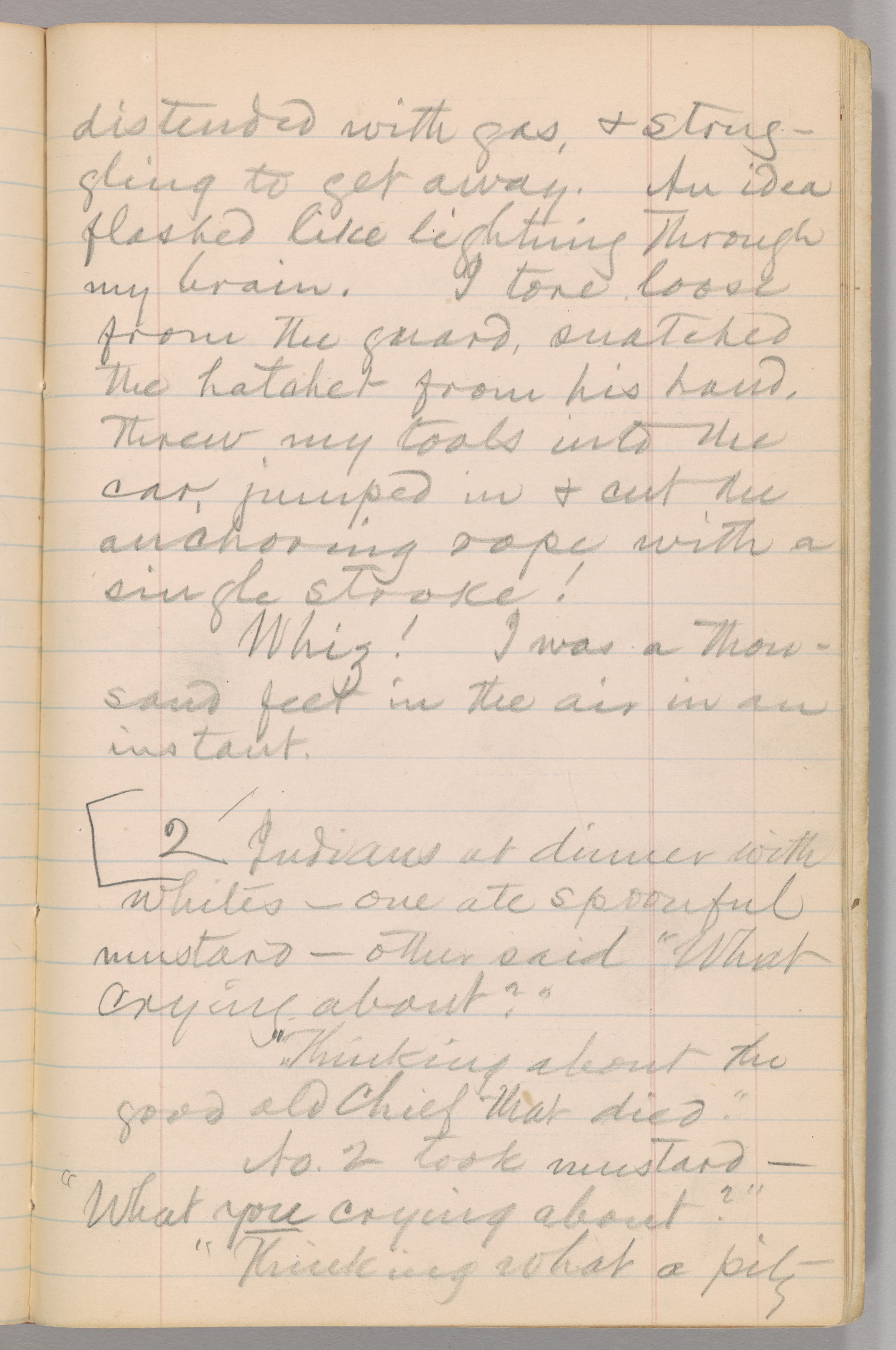
I think he said—& then he would be off. The balloon was
[MS: N11_leaf_048r]
distended with gas, & struggling to get away. An idea flashed like lightning through
my brain. I tore loose from the guard, snatched the hatchet from his hand, threw my
tools into the car, jumped in & cut the anchoring rope with a single stroke!
Whiz! I was a thousand feet in the air in an instant.
2Ⓣtextual note Indians at dinner with whites—one ate spoonful mustard—other said “What crying about?”
“Thinking about the good old Chief that died.”
No. 2 took mustard—“What you crying about?”
“Thinking what a pityⓉtextual note
[MS: N11_leaf_048v]
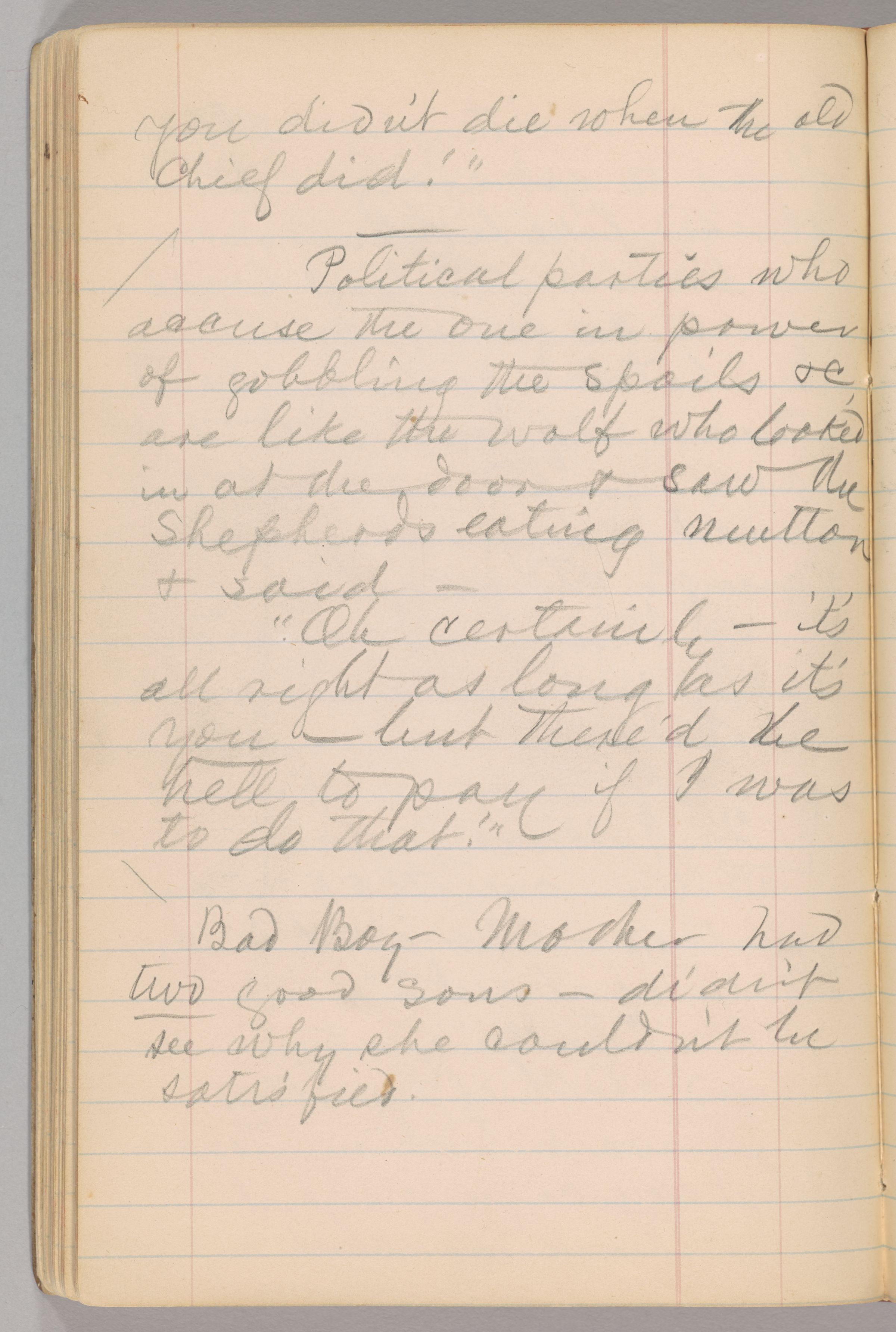
you didn't die when the old Chief did!”
Political parties who accuse the one in power of gobbling the spoils &c, are like the wolf who looked in at the door & saw the shepherds eating mutton & said—
“Oh certainly—it's all right as long as it's you—but there'd be hell to pay if I was to do that!”
Bad Boy—Mother had two good sons—didn't see why she couldn't be satisfied.Ⓣtextual note
bell
heads
keeper
master
master